

Key Takeaways
- MQLs measure engagement, not buying intent — fix the definition first.
- Nurture often ends before buyers are ready. Timing, not quality, is the issue.
- Volume-based KPIs erode sales’ trust in the MQL queue over time.
- You’re qualifying a person. Pipeline requires the account to be ready.
- More MQLs won’t fix it — track pipeline per MQL, not raw volume.
Your dashboard says MQL volume is healthy. Sales says the leads are worthless. Pipeline still misses the number.
Most SaaS MQL-to-pipeline failures are definition failures before they are conversion failures. The system is often counting engagement as qualification, then asking sales to turn that activity into opportunities.
That does not mean the MQL is dead.
The “MQL is dead” argument correctly challenges weak qualification. But removing the label does not solve the underlying problem. If you still measure the wrong behaviour, you simply move the same failure somewhere else in the funnel.
You may have already tightened form fields, adjusted lead scores, or added another nurture sequence. Those changes can help, but only when they address the actual constraint.
The RLA MQL-to-Pipeline Diagnostic isolates five common failure points, starting with the most likely and least expensive to correct.
If your issue begins earlier in the funnel, review your broader SaaS growth marketing system and SaaS lead generation strategies.
Your MQLs Aren’t Dead. They’re Measuring the Wrong Behaviour.
The MQL is useful when it represents meaningful marketing progression. It becomes misleading when it is expected to prove sales readiness by itself.
The “MQL is dead” position gets one thing right: an email click or content download should not be treated as proof that an account is ready to buy. But eliminating MQLs does not help a marketing leader who still needs to explain pipeline contribution next quarter.
The more useful framework is:
Engagement → Fit → Intent → Readiness → Sales Acceptance
Engagement means the prospect did something measurable. Fit means the account matches your ICP (ideal customer profile). Intent shows evidence of an active problem or evaluation. Readiness means a legitimate sales conversation makes sense now. Sales acceptance confirms that sales agrees the lead deserves attention.
That hierarchy also clarifies the roles of MQL, SAL, and SQL.
An MQL marks marketing progression. An SAL (sales accepted lead) shows that sales accepted the handoff. An SQL (sales qualified lead) reflects deeper sales qualification. Opportunity and pipeline metrics then show whether the qualification system is producing commercial outcomes.
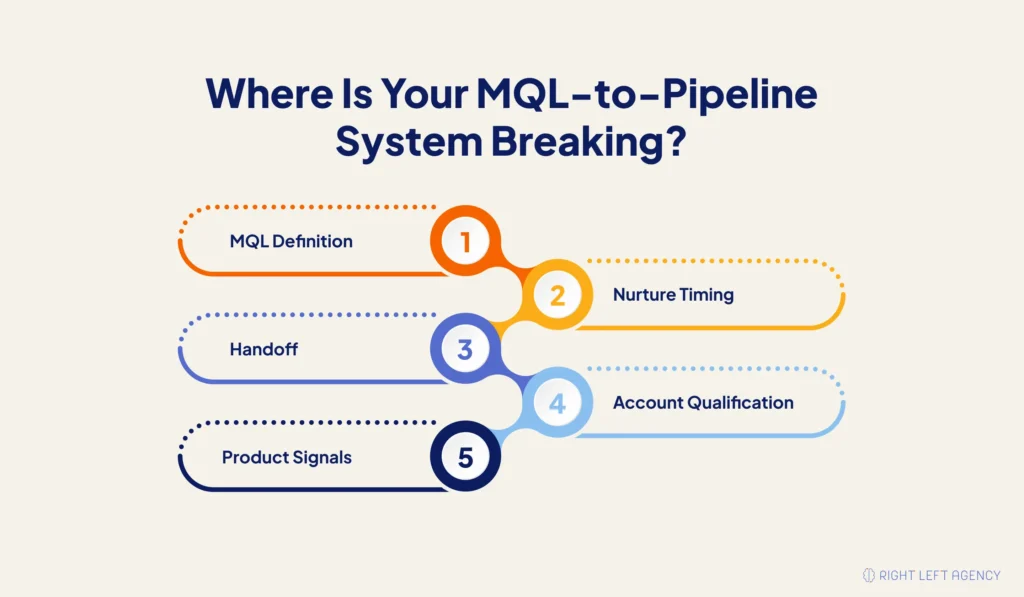
The RLA MQL-to-Pipeline Diagnostic examines five layers:
- MQL definition
- Nurture timing
- Handoff and sales acceptance
- Account-level qualification
- Product-behaviour signals
The order is intentional. Start with definition because it is common and relatively inexpensive to investigate. Product-event scoring comes last because it may require data infrastructure or engineering support.
Failure Point 1: Your MQL Definition Counts Engagement, Not Buying Intent
If a prospect can become an MQL through content consumption alone, your model is probably measuring interest rather than buying intent.
Symptom: MQL volume appears healthy, but sales repeatedly rejects leads that downloaded content, attended webinars, or engaged with campaigns without showing evidence of an active buying process.
A gated asset can inflate the problem quickly. A prospect downloads a whitepaper, attends a webinar, opens several emails, and passes a scoring threshold. The system records progression even though you may still know little about the account’s fit, buying authority, urgency, or current project.
Behavioural scoring is not inherently wrong. The failure happens when engagement receives enough weight to override weak fit and weak intent.
Paid acquisition can amplify the problem. Campaigns optimised for form fills send more engagement into a model that already rewards form activity. The system becomes efficient at producing MQLs without necessarily improving the number of accounts worth sales attention.
Misattribution: Teams often blame the channel. Paid search, content, or webinars appear to be producing “bad leads” when the deeper problem is the qualification rule applied after those leads enter the CRM.
That is why a SaaS Google Ads audit should evaluate downstream lead quality as well as acquisition performance.
Why Your Lead Score Can Be Technically Correct and Commercially Wrong
A scoring model can calculate activity perfectly and still make the wrong commercial decision.
Consider this structural illustration:
- Webinar attendance: +10
- Whitepaper download: +15
- Pricing-page visit: +20
- Multiple email opens: +10
The prospect crosses the MQL threshold.
The arithmetic is correct. Yet the model still may not know whether the company fits your ICP, has an active problem, involves the right stakeholder, or expects to buy within a meaningful timeframe.
A numerical score creates precision. It does not automatically create qualifications.
| Signal | What It Tells You | What It Doesn’t Tell You |
|---|---|---|
| Multiple page visits | Interest | Purchase intent |
| Pricing-page visit | Commercial curiosity | Buying authority |
| Webinar attendance | Engagement | Sales readiness |
| High lead score | Activity and model fit | An actual opportunity |
| Multiple contacts engaging | Account interest | An active buying process |
The Evidence to Pull
Use CRM evidence before changing the threshold:
- Export MQLs from the last two quarters and identify how many qualified through content activity without a pricing, demo, trial, or product signal.
- Review disqualification reasons. If “not a fit” appears repeatedly, engagement may be overriding ICP qualification.
- Compare MQL-to-SQL performance by source. Large differences between paid content leads and high-intent demo requests can expose the weakest lead definitions.
What changes if you fix it: MQL volume may fall, but sales should receive fewer contacts whose activity is being mistaken for readiness. That creates a cleaner base for evaluating every downstream stage.
Failure Point 2: Your Nurture Timing Doesn’t Match the Buying Cycle
If your nurture sequence ends before successful buyers typically reach an active evaluation, the problem is timing rather than qualification alone.
Symptom: Leads engage early, disappear, and then return months later when they are finally ready to evaluate. By that point, the original campaign or sequence has already ended.
A nurture programme built around a campaign calendar can stop long before the buying process matures.
If meaningful opportunities frequently emerge 60 to 90 days after first qualification, a much shorter sequence may simply time out. The contact does not necessarily become irrelevant. The buying committee may still be forming, budget may still be unresolved, or the project may not yet have executive attention.
Sequence timing should also reflect the sales motion.
A self-serve buyer with a lower ACV (annual contract value) and a larger enterprise account should not automatically move through the same cadence. Their evaluation periods, stakeholder involvement, and need for sales interaction differ.
Misattribution: These contacts are often labelled “cold” when the actual issue is that marketing expected readiness too early.
The correct response is not automatically to make every nurture sequence longer. First compare nurture duration with your actual opportunity-creation timeline.
For execution guidance beyond this diagnosis, see SaaS lead nurturing and the B2B SaaS customer journey.
The Evidence to Pull
Check:
- Median days from MQL creation to opportunity creation for opportunities that ultimately became customers.
- Your current nurture-sequence length compared with that timeline.
- The percentage of opportunities created from contacts who had already completed or exited nurture.
- Whether previously nurtured accounts have a defined path back into active marketing or sales workflows.
What changes if you fix it: Good-fit prospects remain connected to the buying journey without being forced into an early sales conversation or disappearing after an arbitrary nurture deadline.
Failure Point 3: Your Handoff Threshold Is Optimised for Volume, Not Sales Acceptance
If you measure success by how many MQLs marketing sends rather than how many sales accepts, the handoff is optimised for volume instead of outcome.
Symptom: Marketing meets its MQL target while sales rejects, deprioritizes, or slowly follows up on a large share of the handoff.
This does not require incompetence from either team.
A marketing team measured on MQL volume has a rational incentive to generate and pass more MQLs. A sales team measured on meetings and opportunities has a rational incentive to focus on contacts that appear closest to a commercial conversation.
The KPI systems can therefore push both teams toward different definitions of success.
Premature handoff is one result. A prospect may deserve continued nurturing but still reach sales because marketing has already achieved its threshold.
Routing can compound the problem.
A qualified lead that sits in a queue, reaches the wrong territory, or receives slow follow-up can underperform regardless of its initial quality. Time-to-first-touch therefore belongs in the handoff diagnosis, not only in sales performance reporting.
Disqualification data matters just as much. If nobody owns the rejection-reason field, marketing loses the evidence required to fix its qualification model.
Misattribution: Marketing interprets weak conversion as a follow-up problem. Sales interprets it as a lead-quality problem. Both conclusions can look correct from their own dashboards.
That is why sales and marketing alignment needs a measurable acceptance stage, not just shared goals and meetings.
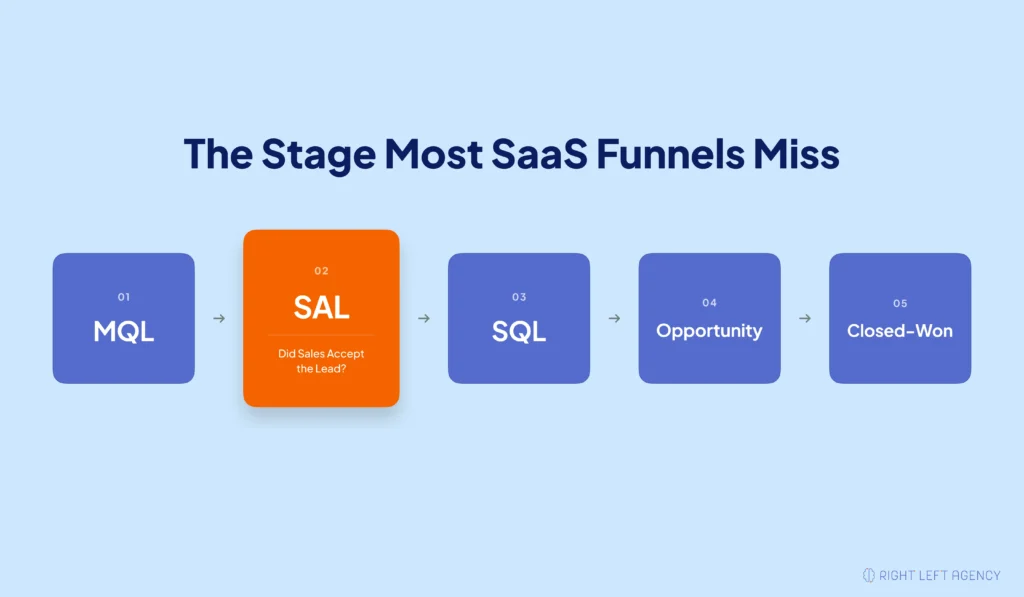
The Missing SAL Stage
The sales-accepted lead, or SAL, makes rejection visible.
A useful progression is:
MQL → SAL → SQL → Opportunity → Closed-won
An MQL tells you marketing believes a lead deserves progression. SAL tells you sales agrees the lead is worth its time.
Without SAL, funnels often jump directly from MQL to SQL. That hides an important distinction between leads sales rejected immediately and leads sales accepted but later failed to advance.
If MQL-to-SAL acceptance is weak, investigate qualification and handoff.
If sales accepts most MQLs but SQL-to-opportunity progression is weak, the constraint may sit later.
When Bad MQLs Train Sales to Ignore Good MQLs
Weak MQLs can damage the performance of stronger ones through a self-reinforcing loop:
- Marketing sends too many weak MQLs.
- Sales spends time reviewing leads that rarely progress.
- Sales’ trust in the MQL label falls.
- Follow-up on future MQLs becomes slower or less consistent.
- Strong MQLs now receive weaker treatment and convert worse.
- Marketing sees the decline as a sales follow-up problem, while sales sees it as further evidence of poor lead quality.
Neither team has to be irrational for the loop to continue.
The solution is to make acceptance, rejection, and response time measurable.
The Evidence to Pull
Review:
- MQL-to-SAL acceptance rate by source, segment, and lead type.
- Rejection reasons and whether sales records them consistently.
- Median time from MQL creation to the first meaningful sales action.
- No-response rates among leads sales accepted.
There is no universal percentage of MQLs sales should accept. The useful range depends on your MQL criteria, ICP, acquisition mix, and sales motion.
What changes if you fix it: Sales receives a more credible queue, marketing gets usable rejection data, and the MQL label can regain operational trust.
Failure Point 4: You’re Qualifying a Person, Not an Account
The MQL represents a person. Pipeline represents an account.
If your qualification process stops at the contact record, you may be evaluating activity without enough context about whether the company is actually moving toward a purchase.
Symptom: One highly engaged contact crosses the MQL threshold, but sales sees no clear account-level problem, buying process, decision authority, timeline, or additional stakeholder involvement.
Suppose one employee downloads three resources and repeatedly visits the site.
Marketing sees strong activity. Sales still needs to know whether the company matches your ICP and whether the organisation — not just one individual — shows credible buying intent. That requires separating fit scoring from intent scoring.
Fit asks whether the account is commercially relevant. Intent asks whether the account appears to be moving toward a decision.
Combining both into one score makes the model harder to diagnose. A highly active poor-fit company can look similar to a strong-fit account with emerging commercial intent.
Firmographic filtering should therefore happen before behavioural activity is allowed to dominate qualification.
Misattribution: Teams often treat this as a lead-scoring problem and simply adjust point values. The deeper issue is that they are scoring the wrong unit of analysis.
For stronger account criteria, review your ideal customer profile and B2B customer segmentation.
Trial Signups and Content Leads Are Not the Same Lead
A trial signup and a content download provide different evidence. A trial signup demonstrates product interest.
A content download demonstrates topic interest. Scoring both through the same threshold can hide important differences in intent.
A prospect who starts a trial and completes a core workflow may deserve a different qualification path from someone who has downloaded several educational resources. But product interest alone is also insufficient if the account does not fit your target market.
The useful model keeps lead type, ICP fit, and intent signal distinct enough to diagnose separately.
The Buying Committee Problem
One engaged contact does not automatically mean the account is buying.
B2B SaaS decisions can involve users, technical evaluators, finance, procurement, and executives. You do not need every stakeholder identified before progressing an account, but additional relevant engagement provides stronger evidence than one contact acting alone.
Tools such as Clearbit, 6sense, and HubSpot can improve account visibility and firmographic context.
They do not make the qualification judgment for you.
Better data tells you more about the account. Your qualification framework still decides whether those signals indicate fit, intent, and readiness.
The Evidence to Pull
Review:
- The percentage of successful opportunities where multiple contacts engaged before opportunity creation.
- ICP-fit distribution across your current MQL population.
- How frequently high behavioural scores come from weak-fit accounts.
- Whether trial signups, content leads, and demo requests follow distinct qualification paths.
What changes if you fix it: Sales receives account context rather than isolated contact activity, making it easier to distinguish genuine commercial movement from one person’s interest.
Failure Point 5: You’re Scoring Email Engagement Instead of Product Behaviour
For SaaS companies with trials or freemium products, in-product behaviour can be a stronger buying signal than another marketing email interaction. The challenge is that many CRM scoring models cannot see it.
Symptom: Marketing heavily scores opens, clicks, downloads, and page visits while meaningful product actions remain trapped inside product analytics tools.
Email engagement tells you someone is paying attention to marketing. An activation event tells you what that person or account is actually doing with the product.
A product qualified lead, or PQL, uses meaningful product behaviour as part of qualification. The relevant activation event is product-specific.
For one SaaS platform, activation might mean inviting teammates. For another, it could mean completing a core workflow, connecting an integration, importing data, or using a critical feature repeatedly.
You should not borrow another company’s PQL definition. Look for the behaviours that consistently appear before meaningful commercial progression in your own customer journey.
Misattribution: Teams often assume they have a scoring-strategy problem. In reality, they may not have the infrastructure required to score the strongest signal.
The Event Pipeline Most Teams Don’t Have
This is frequently a plumbing failure, not a strategy failure.
A mid-market SaaS company may already use Segment to collect product events, Amplitude or Mixpanel to analyze them, HubSpot for marketing automation, and Salesforce for sales.
But those systems are useful for qualification only when the relevant events reach the CRM record where marketing and sales make decisions.
If an Account Executive cannot see that a trial user completed a meaningful activation event, the CRM may treat that user as less qualified than someone who opened several emails. That is not fixed by changing the lead-score threshold.
You first need a reliable route from product analytics into HubSpot or Salesforce. Depending on the stack, that can become a RevOps (revenue operations), data, or engineering dependency.
Tools are inputs. They cannot improve qualification when the signal never reaches the decision system.
The Evidence to Pull
Ask:
- Can sales see meaningful product events on a contact or account record in the CRM?
- For closed-won customers that entered through a trial, what activation behaviour occurred before opportunity creation?
- Are product events available for scoring, routing, or lifecycle-stage changes?
- Can you distinguish trial signups that merely registered from accounts that actually adopted a core workflow?
If you cannot answer the first question, this layer is not fully diagnosable inside your current CRM.
What changes if you fix it: Marketing and sales can qualify trial-led accounts using evidence of product adoption rather than relying primarily on attention to marketing.
The Sales-Readiness Test: What Makes a Lead Worth Sales Time
After diagnosing the five failure points, use one standard to judge the handoff: is there a legitimate sales conversation to have now? A lead should not move to sales simply because an arbitrary score was crossed.
The Sales-Readiness Test evaluates seven criteria:
| Criterion | The Question It Answers |
|---|---|
| Fit | Is this the right type of company? |
| Problem | Does the company have the problem the product solves? |
| Intent | Is there evidence of active evaluation? |
| Timing | Is there a credible reason to act now? |
| Authority | Is this person connected to the buying process? |
| Account context | Are other relevant stakeholders engaging? |
| Next step | Is there a legitimate conversation to initiate? |
The test is not another points model.
Its purpose is to prevent one category from hiding weakness in another. A prospect can show strong engagement and weak fit. An excellent-fit account can show no current intent. A trial user can activate the product without having a commercial use case.
The handoff should reflect the combined judgment.
Why BANT Is One Option, Not the Answer
BANT is useful because it makes qualification explicit around budget, authority, need, and timing. It is not a universal answer.
Requiring confirmed budget before sales involvement could eliminate legitimate opportunities in product-led or lower-ACV motions. Enterprise SaaS may require deeper qualification than transactional SaaS.
The transferable principle is:
Your qualification model must match your ACV, ICP, sales motion, and buying process.
Use BANT where it reflects how customers actually buy. Adapt it where it does not.
Why Generating More MQLs Won’t Fix Any of This
Volume and conversion are different optimization problems. If qualification is weak, increasing MQL volume sends more leads through the same broken system.
The cycle is predictable:
Pipeline stalls. Leadership asks for more MQLs. Marketing increases activity and reaches the MQL target. Sales rejects or deprioritizes many of those leads.
Pipeline still misses. Leadership asks for more MQLs again. Nothing in that cycle fixes definition, timing, handoff, account qualification, or missing product signals. Improving lead quality may therefore reduce MQL volume.
That can look like failure on a volume-based dashboard while downstream performance improves. To interpret the change properly, connect qualification metrics with SaaS marketing attribution and SaaS marketing ROI.
Pipeline per MQL
Pipeline per MQL = pipeline generated ÷ MQLs generated.
This does not replace full-funnel reporting. It shows whether the MQL population is becoming commercially more productive.
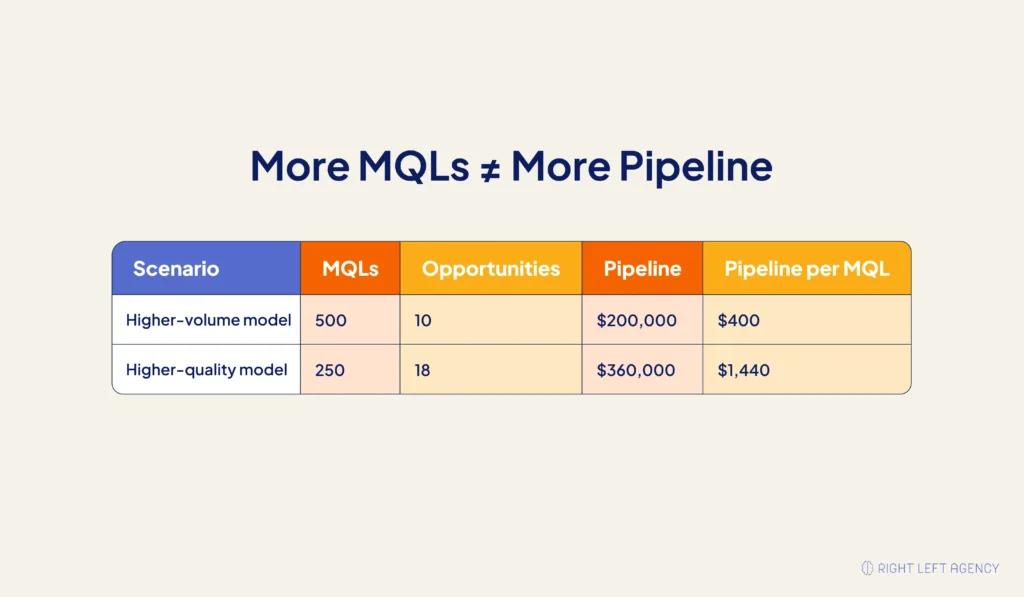
The second model generates fewer MQLs but more opportunities and pipeline. That is why the raw MQL count cannot tell leadership whether qualification is improving.
When Your KPI System Is the Root Cause
Sales acceptance appeared earlier as a handoff diagnostic. Here, it matters as a management KPI.
If marketing is rewarded primarily for MQL volume and CPL while sales is rewarded for meetings, opportunities, and bookings, the organisation has created conflicting incentives.
The sophisticated version of the problem is not “marketing does not understand lead quality.”
It is that marketing’s KPI system may reward behaviour that creates weak handoffs.
Report downstream quality alongside MQL volume:
- MQL → SAL acceptance
- MQL rejection rate
- MQL → SQL
- MQL → opportunity
- SQL → opportunity
- Opportunity → pipeline
- Meetings booked per 100 MQLs
- Opportunities per 100 MQLs
- Pipeline per MQL
- Win rate
- Sales cycle length
- CAC (customer acquisition cost) and CAC payback
These measures show whether lower MQL volume represents declining demand or stronger qualification.
What Changes When You Fix the Right Layer
The solution depends on which failure point your evidence confirms.
Use these five questions to identify the constraint:
| Layer | Diagnostic Question |
|---|---|
| Definition | Can someone become an MQL through engagement without showing meaningful fit or intent? |
| Timing | Does nurture end before successful buyers typically reach opportunity stage? |
| Handoff | Can you measure whether sales accepts MQLs and why it rejects them? |
| Account | Are you qualifying one person without enough evidence about the wider account? |
| Product Signal | Can your CRM see the product behaviours associated with meaningful activation? |
Different layers require different types of intervention.
RevOps and process problems usually sit in MQL definition, lifecycle stages, SAL measurement, routing, rejection data, and KPI design.
Tooling or engineering problems become more likely when product events, account data, or critical qualification signals cannot reach HubSpot, Salesforce, or the system used for routing.
Outside help may make sense when the problem spans acquisition, qualification, measurement, sales handoff, and multiple systems, making it difficult for one internal team to isolate the constraint objectively.
Not every pipeline problem is an MQL problem.
If the breakdown begins before qualification, use a SaaS website conversion audit to investigate the path from traffic to lead capture.
If the broader issue is inconsistent lead generation, review common B2B SaaS lead generation challenges.
The goal is not to protect the MQL metric. The goal is to make every qualification stage tell you something commercially useful.
Conclusion
A healthy MQL count and a stalled pipeline aren’t contradictory signals — they’re the same signal, read two different ways. The dashboard confirms marketing is generating activity. Sales’s rejection rate confirms that activity isn’t the same as buying readiness.
The fix is rarely to abandon the MQL, and it’s rarely one missing ingredient. It’s usually a single layer — definition, timing, handoff, account context, or product signal — quietly overriding the other four. Diagnose in that order because it’s the cheapest path to the answer: check what a lead needs to become an MQL before you rebuild your nurture cadence, and check your nurture cadence before you commission a product-event pipeline.
Whichever layer your evidence points to, the underlying discipline stays the same: qualify the account, not the click, and hold every stage from MQL to SAL to SQL to opportunity accountable to pipeline, not to volume.
Find the layer limiting your MQL-to-pipeline performance.
Book a Growth Fit Call before investing in more lead volume.
Frequently Asked Questions
Why don’t SaaS MQLs convert to pipeline?
SaaS MQLs often fail to create pipeline because the qualification threshold measures engagement instead of genuine buying readiness. Nurture timing, premature handoff, weak account context, and missing product signals can also reduce progression.
What is the difference between an MQL, an SAL, and an SQL?
An MQL has met marketing’s qualification criteria. An SAL is an MQL that sales has accepted as worth pursuing. An SQL has progressed further and meets the sales team’s standard for an active sales conversation.
What percentage of MQLs should sales accept?
There is no universal MQL-to-SAL acceptance percentage. The appropriate rate depends on your MQL definition, ICP, acquisition channels, ACV, and sales motion.
Should we replace MQLs with SQLs?
Not necessarily. Removing the MQL stage does not fix weak qualification. Define what an MQL should represent, then measure progression through SAL, SQL, opportunity, pipeline, and revenue.
What is a product qualified lead?
A product qualified lead is a prospect whose in-product behaviour indicates meaningful adoption or commercial potential. The qualifying activation event should reflect your own product and customer journey.
Why doesn’t generating more MQLs increase pipeline?
More MQLs increase pipeline only when enough leads progress through later stages. If qualification or handoff is weak, additional MQL volume increases waste rather than fixing the underlying problem.
Should SaaS companies deliberately reduce MQL volume?
Reducing MQL volume can be positive when tighter qualification produces stronger sales acceptance, opportunity creation, and pipeline. The effect should be judged through downstream metrics rather than MQL count alone.
Should MQL qualification use BANT?
BANT can help when budget, authority, need, and timing reflect your actual sales process. It should not be applied universally because product-led, SMB, mid-market, and enterprise SaaS motions require different qualification standards.