

Key Takeaways
- Define your ICP with specific firmographics, pain points, and buying triggers to focus on high-value prospects.
- Analyze your best existing customers to identify patterns in revenue, retention, and satisfaction.
- Align sales and marketing teams around a shared ICP to improve lead quality and conversion rates.
- Use your ICP to guide product roadmap decisions and optimize customer acquisition spending.
- Review and update your ICP every 6-12 months as your product evolves and markets change.
Introduction
You have a product that fits the market. Your sales team is sharp. Marketing has a budget to spend. But deals keep slipping away, customers don’t stick around, and nobody can figure out why growth feels stuck.
The real problem isn’t your product or your team. You are just going after every lead without knowing who your ideal customer actually is.
But if you create your ideal customer profile, you can focus on the customers who are likely to buy, stay longer, and get the most value from your product. It enhances your marketing efforts, shortens your sales cycle, and increases revenue.
In this article, you’ll learn what an ideal customer profile is, why it matters for your B2B or SaaS business, and how to create one that actually drives growth.
Let’s start with the basics.
What Is an Ideal Customer Profile?
An ideal customer profile (ICP) is a detailed description of the type of company or customer that gets the most value from your product or service. It’s not about individual buyers. It’s about the characteristics that make a company or organization the perfect fit for what you sell.
For example, if you sell project management software for growing SaaS companies, your ideal customer profile might look like this:
- SaaS companies with 50 to 200 employees
- Annual revenue between $5M and $20M
- Uses tools like Slack, HubSpot, and Google Workspace
- Growing fast and needs better team collaboration
Your ICP keeps your team focused on high-value prospects instead of chasing every lead that comes through the door.
Why an Ideal Customer Profile Is Important
Building an ideal customer profile has a significant business impact. Here’s why it matters.
Sales and Marketing Alignment
One of the biggest challenges in B2B companies is the disconnect between sales and marketing teams. Marketing generates leads, and sales complains they’re low quality. Sales wants better leads, and marketing feels their efforts are undervalued.
An ideal customer profile solves this problem. When both teams agree on who the right customer is, marketing can focus on attracting qualified leads, and sales can spend time on prospects who are actually ready to buy.
The result? Better MQL (Marketing Qualified Leads) and SQL (Sales Qualified Leads) quality. Your pipeline becomes healthier, and teams work together instead of pointing fingers.
Higher Conversion and Revenue Impact
When you focus on the right customers, everything gets easier. Your sales cycle becomes shorter because you’re talking to people who already have the problem you solve. Your deal sizes increase because you’re targeting companies that have the budget and need for your solution.
Companies with a clearly defined ICP see conversion rates increase by up to 68%. Your sales team spends less time on dead-end conversations and more time closing deals.
Lifetime value also goes up. When you attract the right customers, they stick around longer. They’re more likely to renew, upgrade, and refer you to others.
Product and Business Strategy Benefits
Your ideal customer profile doesn’t just help sales and marketing. It also guides your product roadmap and business strategy.
When you know exactly who you’re building for, you can make better product decisions. You prioritize features that matter to your ICP instead of adding random functionality that nobody uses.
Your customer acquisition spending becomes smarter. You stop wasting money on broad campaigns that attract the wrong people. Instead, you invest in channels and messages that resonate with your ideal customers.
Key Components of an Ideal Customer Profile
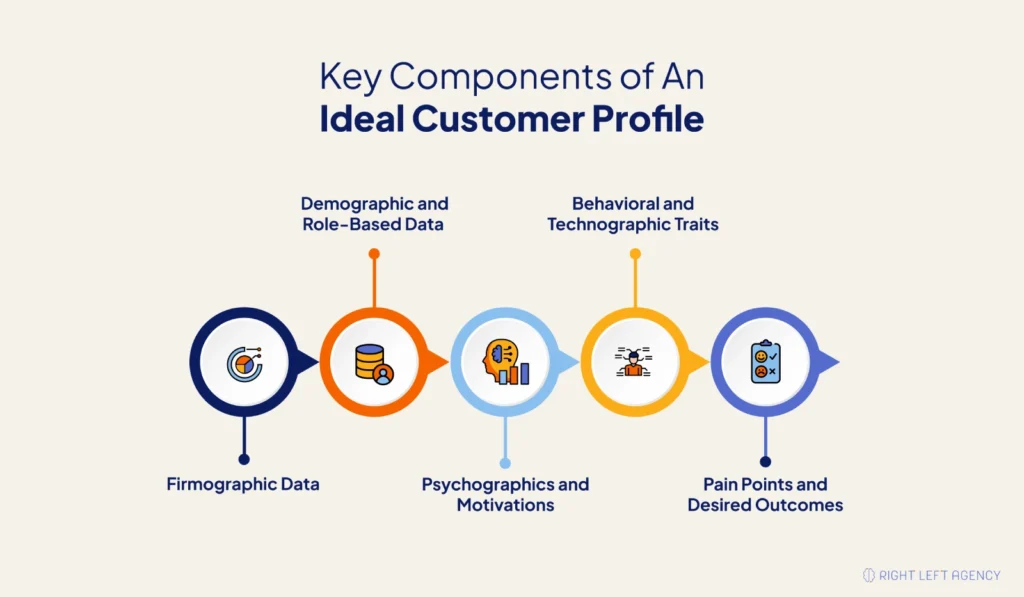
A strong ideal customer profile goes beyond basic company details. It digs into the characteristics that truly matter. Here are the key components you should include.
Firmographic Data (B2B ICP)
Firmographics are the company-level details that help you identify the right organizations. These include:
Industry and niche: What sector does the company operate in? For example, are they in SaaS, manufacturing, construction, healthcare, or ecommerce?
Company size and revenue: How many employees do they have? What’s their annual revenue range? A startup with 10 people has very different needs than an enterprise with 5,000 employees.
Location and operating region: Where is the company based? Do they operate globally or in specific regions? This matters for compliance, language, time zones, and sales support.
Growth stage: Is the company a bootstrapped startup, venture-backed scaleup, or established enterprise? Growth stage impacts budget, decision speed, and product needs.
Demographic and Role-Based Data
While firmographics describe the company, demographics describe the people inside it. This includes:
Job titles and seniority: Who are the decision-makers? Are you selling to VPs, directors, or C-level executives?
Decision-makers vs influencers: In B2B sales, multiple people influence the buying decision. Your ICP should identify who holds the budget and who influences the choice.
When demographics matter: Demographics are more important in B2C, but they still play a role in B2B. Understanding the seniority and department of your buyers helps you tailor your messaging.
Psychographics and Motivations
Psychographics go deeper than job titles. They reveal what drives your ideal customers. This includes:
Goals, values, and priorities: What does your ideal customer care about? Are they focused on growth, efficiency, cost reduction, or innovation?
Buying mindset and urgency triggers: What pushes them to look for a solution? Is it a regulatory change, rapid growth, a competitor threat, or internal pain points?
Understanding motivations helps you craft messages that connect emotionally and rationally.
Behavioral and Technographic Traits
Behavior tells you how your ideal customers operate. Technographics tell you what tools they use. Both are critical for targeting and personalization.
Buying behavior patterns: Do they prefer free trials or demos? Do they research heavily before buying, or do they make quick decisions?
Tools, platforms, and tech stack fit: What software do they already use? If your product integrates with Salesforce, HubSpot, or Shopify, knowing your ICP uses these tools makes targeting easier.
Pain Points and Desired Outcomes
At the core of every ideal customer profile are the problems your product solves and the results your customers want.
Core problems your product solves: What specific pain points does your ICP face? Maybe they struggle with manual processes, poor visibility, or scaling challenges.
Success metrics your ICP cares about: What does success look like for them? It could be faster time to market, higher customer retention, reduced costs, or increased revenue.
Ideal Customer Profile Template
Creating an ideal customer profile doesn’t have to be complicated. You just need a simple structure that captures the right details.
What to Include in an ICP Template
Your ICP template should include the following sections:
Company overview: Industry, company size, revenue range, location, and growth stage.
Challenges and pain points: What problems does your ideal customer face? What keeps them up at night?
Buying triggers: What events or situations push them to look for a solution? Examples include rapid growth, new regulations, or leadership changes.
Decision-making process: How do they buy? Who is involved? How long does the sales cycle take?
Success indicators: What does a successful customer look like? High product usage, low churn, strong referrals, or fast expansion?
Simple ICP Template Example
Here’s a sample structure you can customize for your business:
Ideal Customer Profile: Project Management SaaS
Company Overview:
- Industry: SaaS, technology, or digital agencies
- Company size: 50 to 200 employees
- Revenue: $5M to $20M annually
- Location: North America, Europe
- Growth stage: Series A to Series B funding
Challenges and Pain Points:
- Teams work in silos with poor visibility
- Projects frequently miss deadlines
- Using multiple disconnected tools for collaboration
- Struggling to scale processes as the company grows
Buying Triggers:
- Hiring rapidly and onboarding new teams
- Expanding into new markets or products
- Leadership pushing for better accountability
- Recent project failures or missed launches
Decision-Making Process:
- VP of Operations or Head of Product leads the decision
- Involves team leads and finance for budget approval
- Prefers a free trial before committing
- Sales cycle: 30 to 60 days
Success Indicators:
- Active daily usage across teams
- High feature adoption (reports, integrations, automations)
- Low churn rate
- Positive word-of-mouth and referrals
You can modify this template based on your product and market.
How to Create an Ideal Customer Profile
Building an ideal customer profile takes more than guesswork. Follow these steps to create an ICP that actually works.
Analyze Your Best Existing Customers
Start by looking at your current customers. Not all customers are created equal. Some bring in more revenue, stay longer, and refer others. These are your best customers.
Revenue contribution: Which customers generate the most revenue? Are there patterns in company size, industry, or use case?
Retention and lifetime value: Which customers stick around the longest? High retention signals a strong product-market fit.
Pull data from your CRM, billing system, and customer success tools. Look for trends in customer behavior, usage, and satisfaction.
Identify Common Patterns and Traits
Once you have a list of your best customers, dig into the commonalities.
Industry, size, and behavior patterns: Do most of your best customers come from specific industries? Are they in a certain revenue range or employee count?
Shared pain points and goals: What problems do they all face? What outcomes are they trying to achieve?
These patterns reveal the characteristics of your ideal customer profile. Document them clearly.
Validate with Sales and Customer Data
Don’t create your ICP in a vacuum. Get input from the people who talk to customers every day.
CRM insights: Look at deal close rates, sales cycle length, and win/loss data. Which customer types close faster and with higher success rates?
Sales feedback: Ask your sales team which leads are easiest to close and which customers are most satisfied. They know firsthand who fits and who doesn’t.
Customer interviews: Talk to your best customers directly. Ask them why they chose your product, what problems it solved, and what their buying process looked like.
Finalize and Document Your ICP
Once you’ve gathered all the data, turn it into a clear, documented profile.
Turning data into a usable profile: Summarize the key characteristics, pain points, and triggers. Make it specific enough to be useful but flexible enough to evolve.
Internal alignment and documentation: Share your ICP with sales, marketing, product, and customer success teams. Make sure everyone understands who you’re targeting and why.
Store your ICP somewhere accessible. Use it in hiring, onboarding, campaign planning, and product decisions.
Ideal Customer Profile Examples
An ideal customer profile follows the same core structure across businesses, but its emphasis changes based on how customers buy and use the product. The following examples apply the same ICP framework to different business models, focusing on the components that drive real buying decisions.
Below are real-world ICP examples across common business models.
B2B SaaS Ideal Customer Profile Example
Company type: SaaS companies in the HR tech or sales enablement space
Company size: 100 to 500 employees
Revenue: $10M to $50M annually
Pain points:
- Manual onboarding processes slow down new hires
- Lack of visibility into team performance
- Tools don’t integrate with existing CRM
Buying process:
- VP of Sales or Head of HR leads the purchase
- Involves IT and finance for approval
- Prefers a demo and pilot before full rollout
- Sales cycle: 45 to 90 days
Agency or Service-Based Business ICP Example
Client maturity: Established agencies with 3+ years in business
Revenue: $1M to $10M annually
Budget range: $5,000 to $20,000 per month for services
Pain points:
- Struggling to scale client acquisition
- Inconsistent lead quality from paid ads
- Need help building repeatable marketing systems
Decision timeline:
- Decision-makers: Founders or CMOs
- Sales cycle: 2 to 4 weeks
- Prefer case studies and referrals before engaging
E-Commerce or Product Business ICP Example
Customer behavior: Online shoppers aged 25 to 45 with household income above $75K
Purchase triggers:
- Seasonal promotions and product launches
- Recommendations from influencers or friends
- Free shipping and easy returns
Retention drivers:
- High-quality products with fast delivery
- Excellent customer service
- Loyalty programs and exclusive offers
Ideal Customer Profile vs Buyer Persona
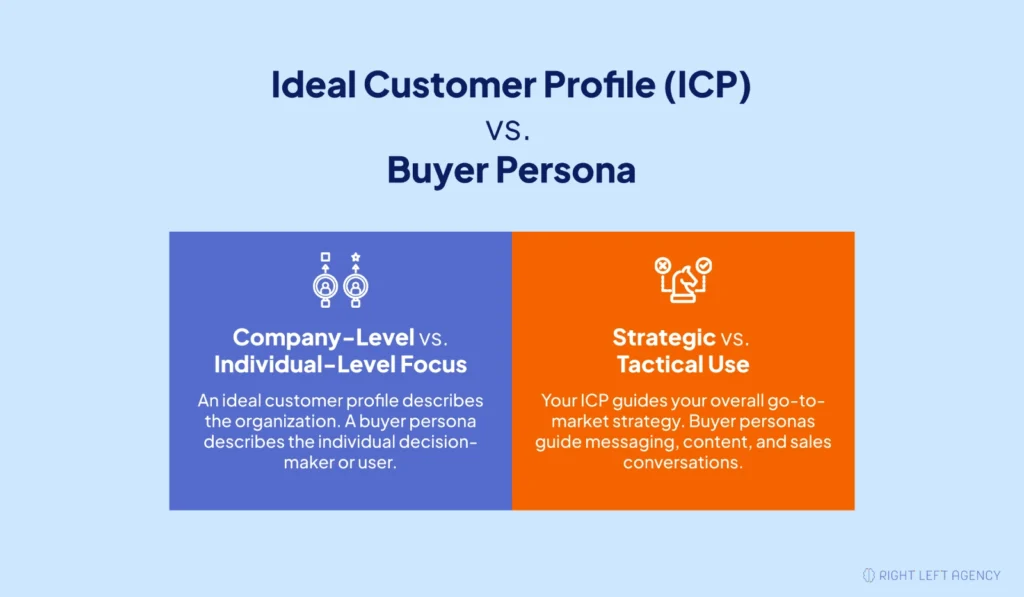
Many people confuse ideal customer profiles with buyer personas. They’re related but serve different purposes.
Key Differences Between ICP and Buyer Persona
Company-level vs individual-level focus: An ideal customer profile describes the organization. A buyer persona describes the individual decision-maker or user.
Strategic vs tactical use: Your ICP guides your overall go-to-market strategy. Buyer personas guide messaging, content, and sales conversations.
For example, your ICP might be SaaS companies with 100 to 500 employees. Your buyer persona might be Sarah, a VP of Marketing who cares about ROI and team efficiency.
When to Use ICP, Buyer Personas, or Both
Go-to-market strategy: Use your ICP to decide which markets to enter, which accounts to target, and where to focus resources.
Content and campaign planning: Use buyer personas to craft messages that resonate with specific roles and pain points.
In B2B, you need both. Your ICP filters the right companies. Your buyer personas help you connect with the right people inside those companies.
B2B Ideal Customer Profile Best Practices
Building a B2B ideal customer profile requires a slightly different approach than B2C.
How B2B ICPs Differ from B2C
Longer sales cycles: B2B purchases involve multiple stakeholders, budget approvals, and longer evaluation periods. Your ICP should account for this complexity.
Multiple decision-makers: In B2B, you’re rarely selling to just one person. Your ICP should identify all the key players in the buying process.
ICP for Account-Based Marketing (ABM)
If you’re running account-based marketing campaigns, your ICP becomes even more critical.
Target account selection: Use your ICP to create a list of high-value accounts. Focus your ABM efforts on companies that match your profile.
Personalization at scale: Tailor your messaging, content, and outreach based on your ICP’s pain points and goals. Personalization drives higher engagement and conversion.
Common Ideal Customer Profile Mistakes
Even with the best intentions, teams make mistakes when creating their ICP. Here’s what to avoid.
Creating an ICP That Is Too Broad
A common mistake is making your ideal customer profile so broad that it doesn’t filter anyone out.
Why broad ICPs attract low-quality leads: If your ICP includes every company with 10 to 10,000 employees, you’re back to square one. Your sales team wastes time on unqualified prospects.
Keep your ICP specific enough to guide decisions. You can always expand later.
Relying on Assumptions Instead of Data
Don’t guess who your ideal customer is. Use real data.
Risks of gut-based profiling: Assumptions lead to targeting the wrong companies. You end up spending money on campaigns that don’t convert.
Talk to customers. Analyze your CRM. Let data drive your ICP, not opinions.
Not Updating Your ICP Over Time
Markets change. Products evolve. Your ICP should too.
Market changes: New competitors, regulations, or technologies can shift your target audience.
Product evolution: As you add features or enter new markets, your ideal customer might change.
Review your ICP every six to twelve months. Make updates based on what you’re learning.
Tools to Build and Validate Your ICP
You don’t have to build your ideal customer profile from scratch. There are tools that make the process easier.
CRM and Analytics Tools
Your CRM holds valuable data about your customers.
Using CRM filters and reports: Filter your customers by revenue, industry, deal size, and close rate. Look for patterns in your best accounts.
Behavioral tracking: Tools like HubSpot, Salesforce, and Pipedrive track customer interactions. Use this data to understand buying behavior.
Research and Data Enrichment Tools
Data enrichment tools help you fill in the gaps.
Firmographic and technographic data sources: Tools like Clearbit, ZoomInfo, and LinkedIn Sales Navigator provide detailed company and technology data.
Use these tools to validate your ICP and find similar companies.
How to Measure the Success of Your ICP
Creating an ideal customer profile is just the start. You need to measure its impact.
Key Metrics to Track
Conversion rate: Are you closing a higher percentage of deals from ICP-fit accounts?
Customer lifetime value: Are ICP-fit customers staying longer and spending more?
Sales cycle length: Are deals closing faster when you target your ICP?
Track these metrics over time. Compare ICP-fit accounts to non-ICP accounts.
Signs Your ICP Needs Refinement
Your ICP isn’t working if you see:
Low engagement: Your outreach gets ignored. Your content doesn’t resonate.
Poor lead quality: Sales complains that marketing is sending the wrong leads.
High churn: Customers leave shortly after signing up.
These are signals to revisit and refine your ICP.
Conclusion
A well-defined ideal customer profile is one of the most powerful tools in your growth toolkit. It aligns your sales and marketing teams, shortens your sales cycle, and helps you attract customers who get real value from your product.
When you stop trying to sell to everyone and focus on the right customers, everything changes. Your conversion rates go up, your retention improves, and your team works more efficiently.
Start by analyzing your best customers, identify the patterns, and document your findings. Share your ICP across your organization. Use it to guide every decision, from product features to marketing campaigns.
FAQs About Ideal Customer Profiles
Is an ICP Only for B2B Businesses?
No, but it’s most common in B2B. B2C businesses can also use an ideal customer profile to define their target audience. However, B2C profiles often focus more on demographics and psychographics than firmographics.
How Often Should You Update Your ICP?
Review your ideal customer profile every six to twelve months. Update it when your product changes, you enter new markets, or you notice shifts in customer behavior.
Can You Have Multiple ICPs?
Yes. Many companies have multiple ideal customer profiles, especially if they serve different markets or use cases. Just make sure each ICP is distinct and well-documented. Avoid creating too many, or you’ll lose focus.