Key Takeaways
- Validate measurement before scaling.
- Audit search intent before adding budget.
- Evaluate landing pages only after traffic quality is clear.
- Judge performance by qualified pipeline, not lead volume alone.
- End every audit with a clear decision: Scale, Fix First, or Stop/Rebuild.
What Should a B2B SaaS Google Ads Audit Verify Before You Increase Spend?
A B2B SaaS Google Ads account should not receive more budget until four things are clear: the measurement is reliable, the campaigns capture the right intent, the landing experience can convert that traffic, and the resulting leads become qualified pipeline.
More budget does not fix a weak account. It amplifies weak tracking, irrelevant traffic, and poor conversion paths.
A B2B SaaS Google Ads audit is a structured review of whether paid search measurement, traffic intent, conversion experience, and downstream lead quality are reliable enough to support additional spend.
The audit should end with one decision: Scale, Fix First, or Stop and Rebuild.
A B2B SaaS Google Ads audit should evaluate four dependent layers.
| Layer | What It Determines |
|---|---|
| Measurement integrity | Can you trust the performance data? |
| Intent and account structure | Are you paying for the right demand? |
| Offer and landing experience | Can that demand convert effectively? |
| Lead quality feedback loop | Does paid search create a qualified pipeline? |
The order matters. If measurement is unreliable, CPA or ROAS can mislead you. If lead outcomes never return from your CRM, Google Ads may optimize toward leads that sales does not want.
So, what should a SaaS PPC audit examine first? Measurement. Then intent and account structure. Then the post-click experience. Only after those layers are sound should qualified-pipeline economics drive the scaling decision.
Teams already investing in paid search can also evaluate their broader approach to B2B SaaS paid search management against the same framework.
Why More Google Ads Budget Can Amplify Problems Instead of Solving Them
Increasing spend gives Google Ads more room to do what the account is already set up to do.
An account may show an acceptable cost per lead while branded traffic carries the average, or most leads never become SQLs or opportunities.
A ready but underfunded account has trustworthy measurement, relevant demand, a workable conversion path, and acceptable downstream economics. More budget may help capture additional high-intent demand.
A not-ready account has structural problems that should be fixed first.
Your wider PPC strategy for SaaS companies should make that distinction before budget becomes the default answer.
Layer 1: Measurement Integrity — Can You Trust the Data?
No meaningful scaling decision should be made until Google Ads accurately measures the right outcomes.
Verify What Google Ads Is Actually Optimizing Toward
Primary conversion actions tell Smart Bidding which outcomes matter. Review primary versus secondary conversions, macro versus micro conversions, duplicate actions, double-firing tags, and low-value events that may influence bidding.
A form submission is not automatically a qualified lead. If Google Ads treats every form fill as equally valuable, Maximize Conversions, Target CPA, or Target ROAS can optimize toward people likely to complete forms rather than people likely to become customers.
Verify the CRM and Offline Conversion Handoff
For B2B SaaS, measurement should continue after the initial conversion:
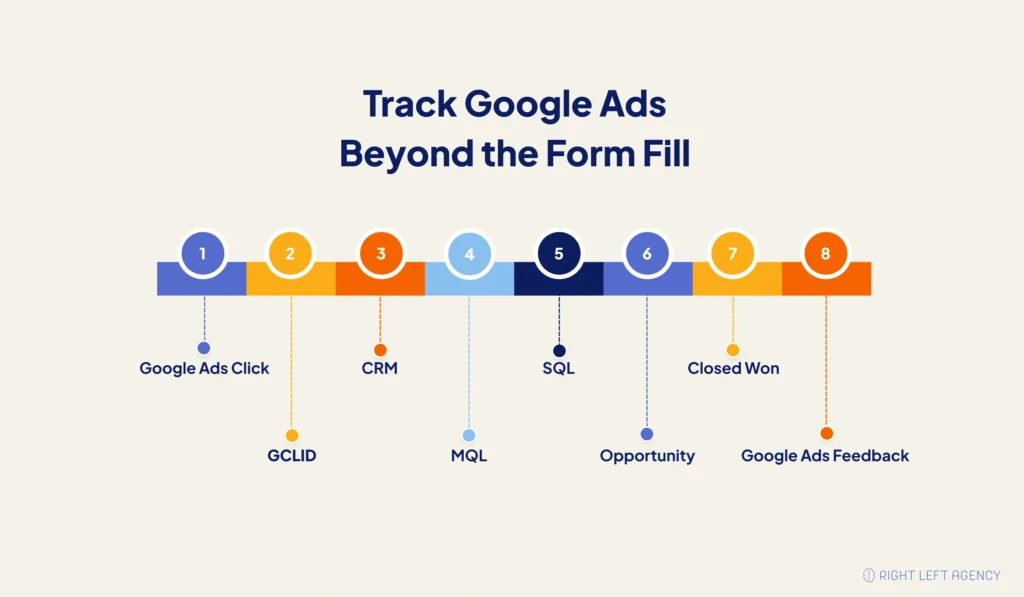
Check whether GCLID data is preserved, HubSpot or Salesforce receives the right click information, Offline Conversion Imports work correctly, and Enhanced Conversions for Leads are configured where appropriate.
UTM parameters can preserve campaign context across analytics and CRM systems, but they should not replace reliable click and conversion data.
A deeper SaaS marketing attribution review can help identify gaps between ad clicks, CRM activity, pipeline, and revenue.
Check Attribution Against the Actual SaaS Sales Cycle
Review whether attribution windows reflect the real sales cycle. Check conversion lag, data-driven attribution, Consent Mode, modeled conversions, and differences between Google Ads and GA4 reporting.
Conversion lag can make recent campaigns look weaker, while poor configuration or modeled conversions can overstate performance.
Check Whether Smart Bidding Has Enough Reliable Conversion Data
Automation needs useful signals. Over-fragmented accounts often leave individual campaigns with too few monthly conversions for Smart Bidding to learn from, which shows up as repeated learning periods and unstable performance.
Review conversion volume by campaign, bidding strategy, fragmentation, and repeated learning periods. Ask whether Smart Bidding has enough reliable conversion data to learn from.
For a deeper metric review, see Analyzing Paid Ad Performance.
Layer 2: Intent and Account Structure — Are You Paying for the Right Demand?
Once measurement is trustworthy, ask whether the account is attracting the commercial demand the business actually wants.
Separate Campaigns by Search Intent
Evaluate brand, non-brand or category, competitor, and pain-point searches separately.
Brand campaigns often look efficient because the user already knows the company. Blending them with non-brand results can hide weaker acquisition performance.
The better question is: Which types of search intent are producing qualified pipeline?
Audit Search Terms, Negative Keywords, and Match Types
Keywords show what you want to target. The search terms report shows what you actually paid for.
Look for job seekers, students, consumers, irrelevant industries, low-commercial-intent searches, and queries outside your Ideal Customer Profile.
Maintain negative keywords actively, especially when broad match is used. Phrase and exact match also need to be judged by the traffic they produce.
If AI Max for Search campaigns or similar automated expansion features are enabled, include that expanded reach in the review rather than assuming the original keyword list defines the campaign’s full reach.
If you are asking, “How do I generate more qualified B2B SaaS pipeline without simply increasing ad spend?”, this is one of the first places to look after measurement.
Review Performance Max, Networks, Geography, and Audience Exclusions
Review where Performance Max is spending, whether network leakage exposes ads to weaker inventory, which geographies consume budget, and whether poor-performing regions should be reduced or excluded.
Also check existing-customer exclusions, irrelevant audiences, and Customer Match where useful.
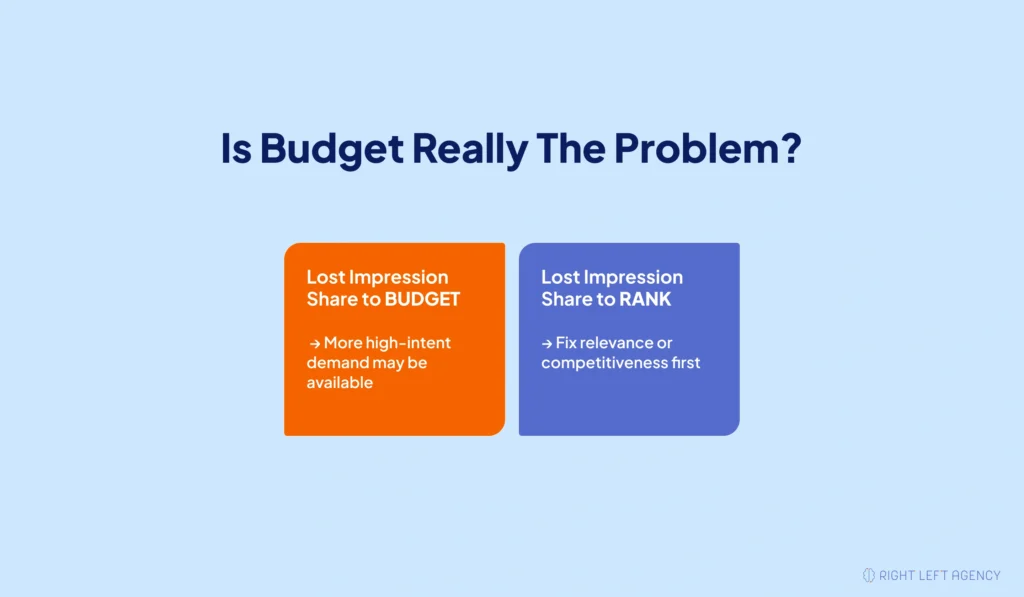
Determine Whether More Budget Is Actually the Right Lever
| Signal | Likely Interpretation | Scaling Implication |
|---|---|---|
| Lost impression share to budget | Potential budget constraint | Investigate more high-intent demand |
| Lost impression share to rank | Relevance or competitiveness issue | Fix before assuming budget is the problem |
Auction Insights can add context around competition and demand availability.
The real question is whether more budget will buy more valuable traffic or push the account toward weaker demand.
Layer 3: Offer and Landing Experience — Can the Traffic Convert Properly?
Only after traffic quality is understood should you judge the post-click experience.
Check Ad-to-Landing-Page Message Match
Check whether the headline reflects search intent, the page delivers the ad promise, and the value proposition matches the campaign.
High-intent traffic should not be dumped onto a generic homepage or product page when a dedicated landing page would better match the query.
Poor message match creates friction and can contribute to weaker Quality Score.
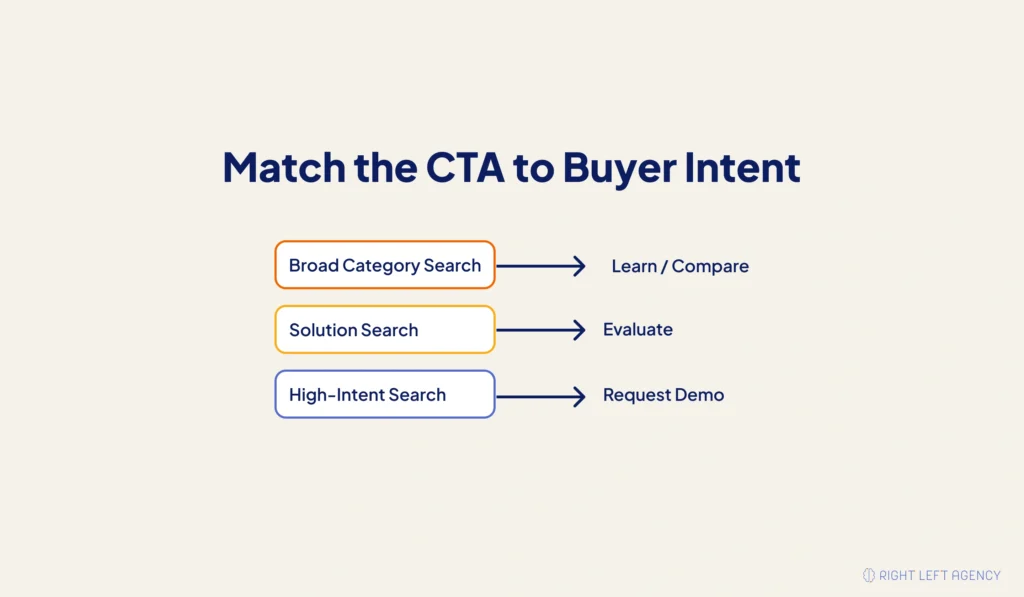
Match the Offer and CTA to Search Intent
The CTA should match buyer readiness.
Someone searching for a specific solution may be ready for a demo. Someone searching a broad category may still be comparing options.
A demo request attached to a category-level term can create an intent mismatch if the visitor is not ready for a sales conversation.
Audit Form Friction Against Lead Quality
A shorter form is not automatically better. B2B SaaS teams still need enough information to qualify leads.
Review unnecessary fields, required versus optional information, and whether each field supports qualification. Judge changes against MQL and SQL quality, not conversion rate alone.
Review Mobile Experience, Ad Assets, and Destination Quality
Check mobile usability, CTA visibility, form experience, content hierarchy, and destination relevance.
Also review sitelinks, callouts, and structured snippets. These assets should reinforce information that matters to a B2B buyer.
For a broader conversion framework, see SaaS landing page strategy.
Layer 4: Lead Quality Feedback Loop — Does Google Ads Produce Qualified Pipeline?
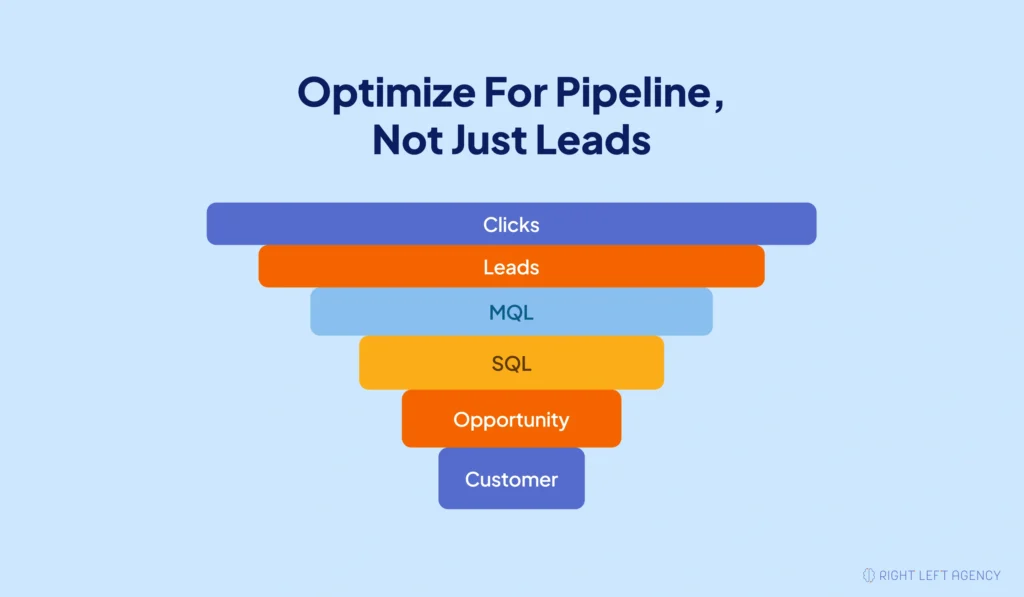
A campaign is valuable when its leads progress through the sales process, not simply when they complete a form.
Feed Sales Disposition Data Back Into Paid Search
Review whether sales consistently records qualified, disqualified, poor-fit, opportunity-created, and closed-won outcomes.
If Google Ads produces 100 leads but sales rejects 80, optimizing toward raw lead volume reinforces the wrong result.
Lead-quality data should inform paid-media decisions and, where possible, bidding feedback.
Measure MQL-to-SQL-to-Opportunity Performance by Campaign
Evaluate performance as:
Campaign → MQL → SQL → Opportunity → Closed Won
A low-CPL campaign can look excellent inside Google Ads while producing few opportunities. Another may generate more expensive leads but convert far better into SQLs and pipeline.
Compare downstream quality by campaign instead of relying on blended account totals.
Use CAC Payback and LTV: CAC as the Scaling Gate
CAC, CAC payback, LTV: CAC, ROAS, and pipeline contribution provide stronger scaling context than raw lead volume.
The question is not: “Can Google Ads generate more leads?”
It is: “Can Google Ads acquire more of the right customers at economics that support additional investment?”
Determine Whether “Bad Leads” Are a Targeting or Qualification Problem
Poor lead quality can come from weak search intent or incorrect targeting, but also from an unclear ICP, inconsistent qualification criteria, or sales and marketing using different definitions of a good lead.
If campaigns attract the wrong people, fix acquisition. If sales and marketing disagree about qualification, fix the definition and feedback process first.
See sales and marketing alignment for SaaS growth for more on that problem.
Paid-Search Growth Requires Qualified Outcomes
Lead volume alone doesn’t tell the full story. In one Right Left Agency engagement with a B2B fintech client, redistributing budget toward the channels producing the best qualified leads, then optimizing forms, landing pages, and ad copy, produced a 125% increase in qualified lead volume over six months, alongside a drop in cost per qualified lead.
The broader lesson is simple: lead volume matters only when the leads have business value.
Book a Growth Fit Call
Walk through the account against the four-layer framework and identify what should be fixed before increasing spend.
Book a Growth Fit Call to determine whether the account is ready to Scale, needs to Fix First, or should Stop and Rebuild.
What Can You Verify Yourself, and What Requires Deeper Account or CRM Access?
A SaaS team can run many initial checks internally. Other conclusions require deeper account history, technical access, and CRM data.
| Audit Area | Can Be Initially Checked Internally | Where Deeper Access Helps |
|---|---|---|
| Measurement | Basic conversion configuration | GTM, GA4, CRM, offline conversion validation |
| Search intent | Search terms and campaigns | Google Ads Editor and full account history |
| Landing experience | Page and offer review | Campaign-level attribution and analytics |
| Lead quality | Basic sales feedback | HubSpot, Salesforce, Looker Studio, pipeline data |
If you are wondering, “How do I know whether my account needs an agency audit?”, outside help becomes more useful when your team can see symptoms but cannot identify the first broken dependency, or when account, tracking, and CRM data need to be reviewed together.
What Should a Professional B2B SaaS Google Ads Audit Include?
A professional audit should review the four layers and tell you what needs to change first:
- Measurement
- Intent and account structure
- Offer and landing experience
- Lead-quality feedback
- Prioritized remediation
What should a proper paid-media audit tell you to change first? The first broken dependency.
If tracking is broken, landing-page testing should not lead the plan. If search terms reveal major intent problems, raising budgets should not be the first recommendation.
Companies that need support after the audit can also explore B2B SaaS paid search management.
Turn the Audit Into a Fix Sequence: Scale, Fix First, or Stop
| Verdict | When It Applies | Next Action |
|---|---|---|
| Scale | Measurement, intent, conversion experience, and economics are working | Increase spend carefully |
| Fix First | Correctable structural problems remain | Repair the first broken dependency |
| Stop / Rebuild | Foundational data or account structure is unreliable | Rebuild before scaling |
Fix Problems in Dependency Order
Prioritize issues in this order:
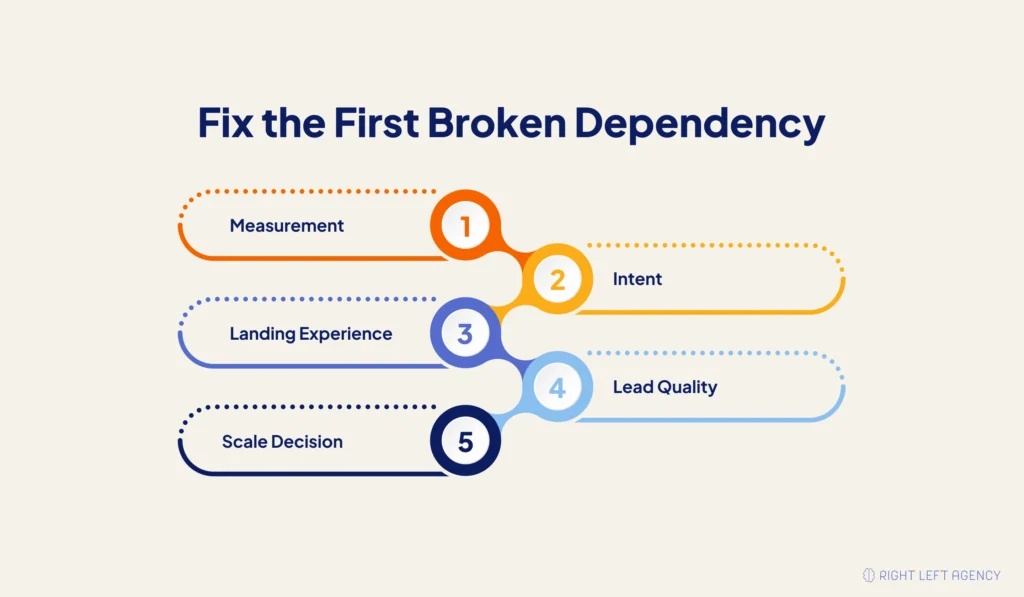
If Layer 1 is broken, fix Layer 1 and reassess. The first broken dependency should determine the next action.
Final Decision: Should You Increase Google Ads Spend?
Increase spend only when you can answer four questions confidently:
- Can we trust the conversion data?
- Are we buying the right demand?
- Can that demand convert effectively?
- Does it become qualified pipeline at sustainable economics?
If the answer breaks at any point, fix that layer first.
That is the purpose of a B2B SaaS Google Ads audit: not to find as many problems as possible, but to identify the problem that must be solved before the next dollar is spent.
Final verdict: Scale, Fix First, or Stop.
If you want to evaluate your account against this framework, Book a Growth Fit Call to identify what should change before you increase budget.
Not ready for a direct conversation? Download the B2B SaaS Google Ads Audit Checklist and work through the four layers internally.
Frequently Asked Questions About B2B SaaS Google Ads Audits
What Should a B2B SaaS Google Ads Audit Include?
It should review measurement, intent, and account structure, the landing experience, and downstream lead quality, then prioritize fixes in dependency order.
How Do You Know if a Google Ads Account Is Ready for More Budget?
Use the Scale, Fix First, or Stop logic. Scale when the four layers are reliable and economics support more spend. Fix First when correctable problems remain. Stop or Rebuild when foundational data or structure is too unreliable to guide scaling.
Should B2B SaaS Google Ads Optimize for Leads or Qualified Pipeline?
B2B SaaS teams should move toward optimizing for meaningful qualified outcomes rather than treating every form submission equally. CRM feedback helps distinguish stronger leads from weaker ones.
How Much Does a Google Ads Audit Cost?
There’s no universal price — it depends on scope and depth. SaaS Hero publishes an audit pricing range of $1,000–$2,000, which should be treated as one market reference point.
How Long Does a Google Ads Audit Take?
Audit duration depends on account complexity, tracking, CRM access, attribution requirements, and lead-quality analysis. There’s no fixed universal duration.
Can a SaaS Team Audit Google Ads Without an Agency?
Yes. Internal teams can review many account, intent, and landing-page issues themselves. Deeper tracking, offline conversion, attribution, and pipeline analysis may require broader technical and CRM access.