Key Takeaways
- Most pre-conversion SaaS growth stalls can be investigated through three buckets: channels, message, or funnel.
- Each bucket produces different symptoms that you can identify using GA4, CRM, sales, and conversion data.
- A 10-minute first-pass diagnosis can show you where to begin deeper investigation.
- More than one bucket can be broken at the same time.
- All three buckets ultimately affect the same outcome: qualified pipeline.
SaaS growth rarely stalls because your marketing team suddenly stopped working. More often, one part of the acquisition system has stopped doing its job: you’re reaching the wrong buyers, your message isn’t landing, or qualified prospects are getting stuck before conversion.
Traffic can even increase while qualified pipeline stays flat. That is why top-line marketing metrics alone rarely reveal the real constraint.
The challenge is identifying the constraint before putting more budget behind it.
Why More Marketing Spend Isn’t the First Move
Increasing spend into the wrong part of your growth system doesn’t fix the underlying problem. It makes that problem more expensive.
If your messaging doesn’t resonate, increasing paid media spend simply buys more traffic that still won’t convert. CAC rises while the real issue remains untouched.
If your funnel leaks visitors before they submit a form or book a demo, producing more content simply feeds more traffic into a broken conversion path.
Before making another budget decision, run a quick first-pass diagnosis.
In about 10 minutes, you can usually identify which area deserves deeper investigation: channels, message, or funnel. That simple step can prevent months of spending against the wrong constraint.
The Three-Bucket Framework for Diagnosing a SaaS Growth Stall
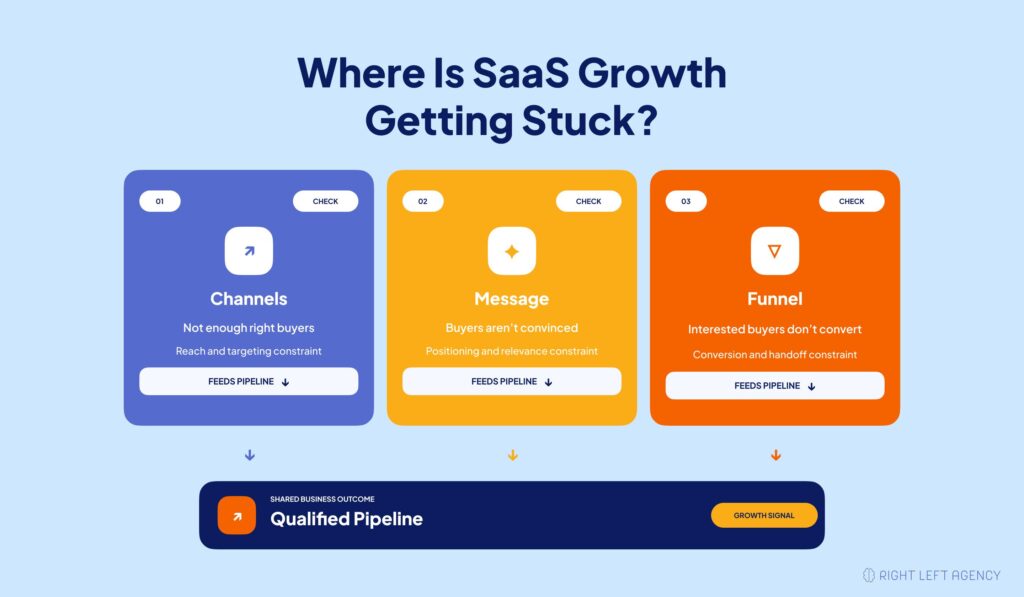
Most pre-conversion SaaS growth stalls can be investigated through three distinct areas:
- Channels: You’re not reaching enough of the right buyers.
- Message: The buyers you reach don’t clearly understand, trust, or value the offer.
- Funnel: Qualified and interested buyers encounter friction before completing the desired action.
These are distinct diagnostic categories, but they are not mutually exclusive. More than one can be broken at the same time.
The goal isn’t more traffic, a higher conversion rate, or a better-looking funnel in isolation. The goal is identifying which constraint is preventing qualified pipeline from growing.
Channels — Are You Reaching Enough of the Right Buyers?
A channel problem usually appears as declining qualified traffic, declining lead volume, or a growing share of leads and identified accounts that do not match your ICP.
If acquisition is the issue, you’ll typically see one of two patterns: qualified volume falls, or overall volume remains steady while lead quality gradually deteriorates.
Watch for signals such as:
- Cost per qualified lead rising on a specific channel
- Organic traffic from high-intent pages plateauing or declining despite consistent publishing
- Paid campaigns producing clicks without enough relevant opportunities
- Lead volume falling while conversion rates on existing traffic remain relatively stable
- More leads or identified accounts falling outside your target firmographic or technographic profile
A channel problem differs from a funnel problem in one important way.
With a channel problem, enough of the right people aren’t reaching the conversion experience.
With a funnel problem, qualified prospects are reaching it but still failing to complete the action.
Quick check: Pull your last 90 days of traffic by source in GA4 and compare it with qualified lead and opportunity data in your CRM. If qualified volume or ICP-match rate has declined while conversion rates on the traffic you still receive remain relatively stable, start with channels.
Message — Do Buyers Understand and Believe Your Offer?
A message problem often appears when traffic remains healthy but qualified conversion or lead quality weakens.
Buyers are arriving, but the message may not be giving them enough reason to take the next step.
They may not clearly understand the value, believe the claims, recognize themselves in the positioning, or see why your product is different from the alternatives.
This bucket is often confused with funnel problems because both can produce weak conversion rates.
The difference becomes clearer when you combine quantitative data with qualitative feedback.
Look for signals such as:
- High-intent pages converting below comparable pages with the same objective
- Prospects repeatedly asking what the product actually does
- Leads converting but turning out to be poor fits
- Sales teams spending excessive time correcting expectations
- Prospects failing to understand who the product is designed for
- Qualified traffic remaining healthy while pipeline weakens
Wrong-fit leads alone do not prove a messaging problem. If poor-fit leads are concentrated in one acquisition source, investigate that channel first. If the same pattern appears across multiple sources, positioning or messaging becomes more likely.
Quick check: Compare conversion rates across similar pages with the same search intent or conversion objective. Then review sales and CRM feedback from the leads those pages generate. If qualified traffic is healthy but conversion remains weak, or prospects show repeated confusion across channels, investigate messaging.
Funnel — Are Qualified Visitors Dropping Off Before They Convert?
A funnel problem happens when sufficiently qualified and interested visitors encounter friction between intent and conversion.
The prospect may understand your offer and want to take the next step, but something in the conversion experience makes that action difficult, unclear, risky, or unnecessarily demanding.
Common funnel problems include:
- Forms asking for too much information too early
- High form-start rates but low completion rates
- Slow or broken conversion experiences
- Weak or confusing CTA hierarchy
- Unclear expectations after submission
- Excessive commitment or missing trust near the decision point
The distinction from a message problem is intent.
With a message problem, the visitor may not be convinced enough to act.
With a funnel problem, signs of intent already exist, but friction prevents that intent from becoming a completed conversion.
Quick check: Compare form starts with form completions on your primary conversion pages. Look for concentrated drop-off at specific fields, steps, devices, or pages. A healthy start rate combined with weak completion is a strong signal that the funnel deserves deeper investigation.
Quick-Reference Table — Symptom, Check, and Where to Go Deeper
Use this table to identify where your investigation should begin.
| Bucket | Symptom | Fastest Way to Check | Where to Go Deeper |
|---|---|---|---|
| Channels | Qualified traffic or lead volume is declining, or more leads fall outside your ICP | Compare 90-day traffic with qualified lead and opportunity volume by channel | Paid channel audit or organic acquisition audit |
| Message | Qualified traffic remains healthy, but conversion or lead quality weakens | Compare similar page conversion rates and review sales feedback | Positioning and messaging review |
| Funnel | Interested visitors begin converting but fail to complete the action | Compare form starts, CTA clicks, and completed conversions | Conversion and funnel audit |
A 10-Minute Self-Test You Can Run Today
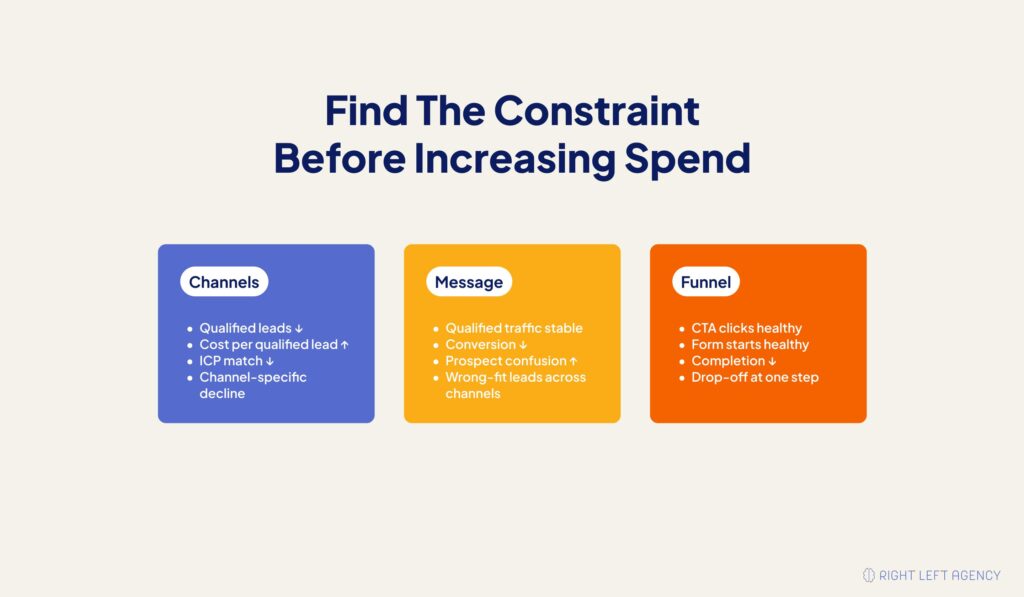
Use data you likely already have in GA4, your CRM, and your sales process.
You are not trying to complete a full marketing audit in 10 minutes. You’re trying to identify which area deserves deeper investigation first.
Channels
- Has qualified lead volume declined over the last one or two quarters?
- Has cost per qualified lead increased on a particular channel?
- Are fewer leads or identified accounts matching your ICP?
- Is the decline concentrated in one or two acquisition channels?
Message
- Is qualified traffic stable while conversion rates decline?
- Are prospects increasingly confused about what the product does or who it’s for?
- Are wrong-fit leads appearing across multiple acquisition sources?
- Are comparable high-intent pages underperforming on qualified conversion?
Funnel
- Are visitors starting forms or clicking CTAs but failing to complete the next step?
- Is drop-off concentrated at one field, page, or stage?
- Did a site, form, speed, or tracking change coincide with the decline?
- Are high-intent visitors abandoning the process after showing clear conversion intent?
If most of your yes answers cluster in one block, start your investigation there.
If your answers spread across two or more blocks, you may be dealing with multiple constraints.
What If More Than One Bucket Is Broken?
It’s common for more than one part of the system to break at the same time, especially when a growth stall lasts for more than a quarter.
For example, declining qualified traffic may push a team to loosen targeting just to maintain lead volume. Traffic recovers, but more visitors now fall outside the ICP. Conversion drops and sales starts reporting weaker leads.
What began as a channel problem now creates symptoms that resemble a messaging problem.
Fixing one constraint can also expose another. Repair a major funnel leak and conversion may improve, only to reveal that the traffic entering the newly fixed funnel was poorly targeted all along.
That is why channels, message, and funnel should be treated as one connected growth system rather than isolated marketing activities.
Which Problem Should You Fix First?
Prioritize the constraint with the clearest evidence and the greatest impact on qualified pipeline.
If you don’t have enough qualified traffic to generate reliable conversion data, investigate channels. If qualified traffic is healthy but conversion weakens, investigate messaging. If visitors show clear intent but abandon the conversion process, investigate the funnel.
When more than one problem exists, start with the constraint supported by the strongest evidence.
Turn Your Diagnosis Into a Plan
Once you know where the constraint sits, the next move becomes more specific.
A channel problem may require changes to targeting, acquisition mix, paid search, SEO, or content distribution.
A messaging problem may require stronger positioning, clearer value propositions, better audience alignment, or more convincing proof.
A funnel problem may require changes to forms, CTAs, conversion paths, page speed, trust signals, or tracking.
The important part is not treating every growth stall as a reason for a complete marketing overhaul.
Still not sure where growth is getting stuck? Right Left Agency can review your acquisition, messaging, and conversion data to identify the constraint before you put more budget behind it.
FAQ
How do I know if my SaaS growth problem is seasonal or structural?
Compare your current performance against the same period in previous years rather than only comparing it with the previous quarter.
If the decline consistently appears during the same period and prior years recovered without major intervention, seasonality may be contributing.
If the stall began outside a recurring seasonal pattern, lasts longer than previous slow periods, or is significantly more severe than historical dips, treat it as potentially structural and run the three-bucket diagnosis.
Should I fix messaging or channels first if I’m not sure which is broken?
Start with the constraint that has the clearest evidence and the biggest impact on qualified pipeline.
If qualified traffic volume is too low to generate reliable conversion data, investigate channels first.
If you already have sufficient qualified traffic but conversion rates are declining, investigate messaging before spending more money on acquisition.
When both signals are present, compare which change happened first and which one has the strongest relationship with the pipeline decline.
Can a funnel problem look like a channels problem?
Yes, especially if you’re only looking at top-line traffic and conversion numbers.
A funnel break can suppress overall conversion enough that it appears you’re attracting poor-quality traffic.
Look for evidence of intent.
If visitors are viewing high-intent pages, clicking CTAs, engaging with pricing, starting forms, or beginning a booking process before disappearing, the problem may sit inside the funnel rather than the acquisition channel.
What should I do if channels, message, and funnel all look fine but growth is still stalled?
If all three areas appear healthy, the constraint may sit downstream of marketing.
Possible areas include activation, retention, expansion, sales execution, or product-market fit within a particular customer segment.
Those issues require a different diagnostic framework.
This three-bucket model is designed specifically for the pre-conversion marketing system and for identifying what prevents qualified prospects from entering the pipeline.