Key Takeaways
- Agencies offer faster access to specialists.
- In-house teams provide deeper product knowledge.
- Compare total cost, not salary versus retainer.
- Build in-house when channels and workloads are proven.
- Hybrid teams often suit growth-stage SaaS companies best.
SaaS Marketing Agency vs In-House Team: The Quick Answer
A SaaS marketing agency is usually best when you need specialist skills quickly, want to avoid long hiring cycles, or lack enough work for multiple full-time roles.
An in-house team is better when channels are proven, workloads are steady, and close collaboration with product, sales, and leadership is essential.
A hybrid model often suits growth-stage SaaS companies. Internal leadership owns strategy, budget, and decisions, while the agency provides specialist expertise and execution capacity.
- Compare complete capabilities, not one employee with one agency.
- Agencies provide faster specialist access.
- Internal teams offer deeper product knowledge.
- Hybrid teams balance ownership and flexibility.
- Stage, budget, maturity, leadership, and urgency should guide the choice.
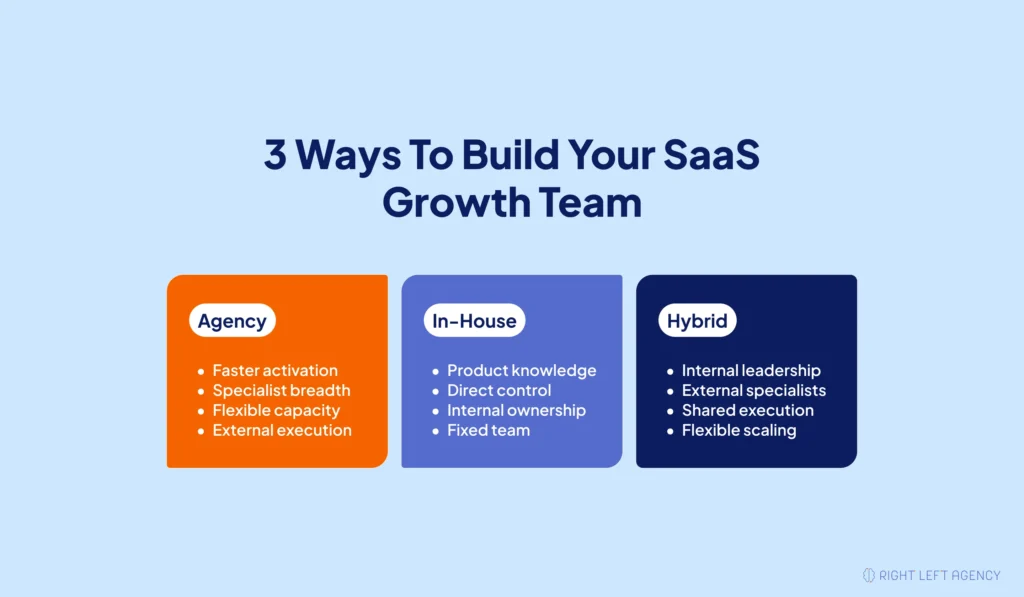
| Factor | Agency-Led | In-House-Led | Hybrid |
|---|---|---|---|
| Specialist access | Broad and fast | Depends on hires | Broad, with internal direction |
| Product knowledge | Built through onboarding | Usually deeper | Strong and shared |
| Speed | Usually faster | Slower if hiring is needed | Fast with clear ownership |
| Cost | Flexible external cost | Higher fixed cost | Mixed |
| Control | Shared | Direct | Led internally |
| Scalability | Easy to adjust | Requires hiring | Flexible |
| Management | Vendor management | People management | Shared |
| Best fit | Immediate capability gaps | Mature, repeatable functions | Growing SaaS companies |
This table is directional. Team quality, resources, and execution still determine performance.
What Do Agency, In-House, Fractional, and Hybrid Marketing Models Mean?
Before comparing cost and performance, it helps to understand how each model works and who owns what.
What Is an In-House SaaS Marketing Team?
An in-house SaaS marketing team consists of employees hired and managed directly by the company. Because they work closely with sales, product, customer success, and leadership, they build strong institutional knowledge of the company, customers, product, and internal processes.
A complete internal team may include a Head of Marketing or Growth, a product marketer, a demand generation manager, SEO and content specialists, a paid media specialist, a designer and developer, a lifecycle marketer, and a data or marketing operations specialist.
The main advantage is deep company knowledge. The main limitation is that a small team may not have enough time or specialist depth to manage every channel effectively.
What Is a SaaS Growth Marketing Agency?
A SaaS growth marketing agency is an external team that provides strategy, specialist execution, systems, and additional capacity — spanning growth strategy, SaaS SEO and content, paid media, demand generation, CRO, design and development, lifecycle marketing, attribution and reporting, and marketing or revenue operations.
The scope is usually defined in a statement of work that explains deliverables, responsibilities, exclusions, and working arrangements.
An agency differs from a freelancer because it brings several specialists together. It differs from a consultant because it may handle execution as well as strategy.
What Is Fractional Marketing Leadership?
Fractional marketing leadership gives a company part-time access to an experienced CMO or marketing leader, who may set priorities, build the roadmap, guide employees, manage agencies, improve reporting, and align marketing with leadership.
This model works well when senior direction is needed, but a full-time executive isn’t yet justified. The company will still need people to execute the plan.
What Is a Hybrid SaaS Marketing Team?
A hybrid team combines internal leadership with external specialists.
The internal leader owns business priorities, product and customer knowledge, budget, brand direction, internal alignment, and final decisions. The agency provides specialist expertise, campaign execution, technical implementation, design and development, testing capacity, and reporting support.
This model lets the company retain strategic control without hiring every specialist immediately. Proven channels can gradually move in-house as the workload grows.
SaaS Marketing Agency vs In-House Team: Quick Comparison
The biggest practical difference is simple: an agency gives you access to an existing team, while an in-house model requires you to build that team yourself.
| Comparison area | SaaS growth marketing agency | In-house marketing team | Fractional leadership | Hybrid model |
|---|---|---|---|---|
| Initial activation | Usually faster | Depends on recruitment | Relatively fast | Relatively fast |
| Cost structure | Variable external expense | Fixed employment expense | Part-time leadership cost | Mixed |
| Specialist breadth | Usually broad | Depends on team size | Mainly strategic | Broad |
| Product knowledge | Developed over time | Usually strong | Moderate to strong | Shared |
| Strategic control | Shared | Direct | Guided externally | Led internally |
| Management burden | Vendor management | People management | Leadership coordination | Shared |
| Scalability | Flexible | Requires hiring | Limited by available hours | Flexible |
| Technology access | Some tools may be included | Purchased and managed internally | Usually limited | Shared |
| Knowledge retention | Requires documentation | Retained internally | Requires documentation | Strong when processes are shared |
| Main risk | Dependency or weak alignment | Hiring and turnover | Limited execution capacity | Unclear ownership |
| Best fit | Urgent capability gaps | Mature, stable functions | Missing strategic leadership | Internal ownership plus external capacity |
A company should not make this decision based on size alone. Workload, channel maturity, management capacity, and urgency often matter more.
What Is the Real Cost of an In-House SaaS Marketing Team?
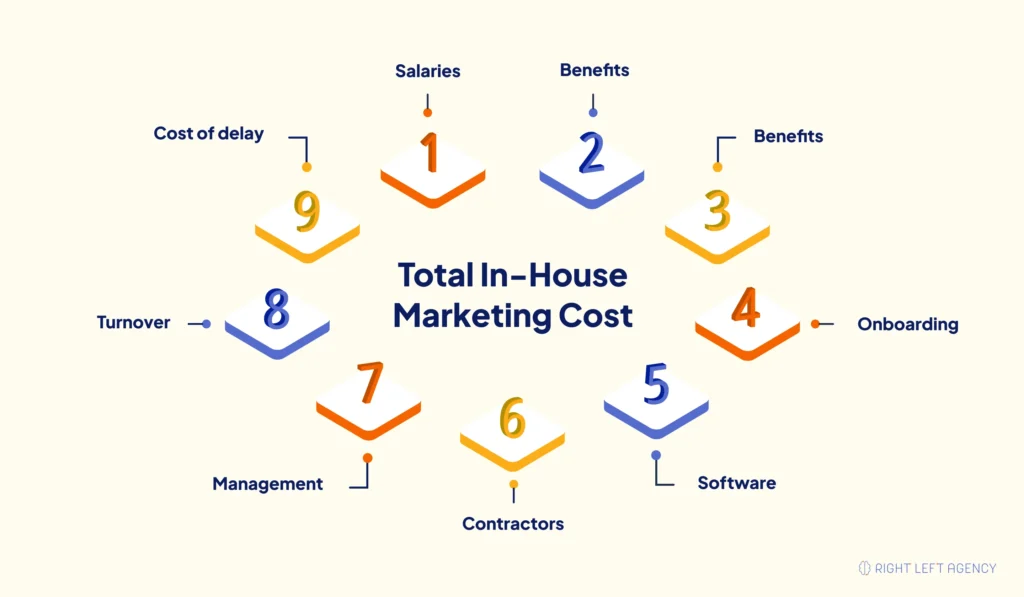
The cost of an in-house team goes far beyond salary. A realistic total cost of ownership includes compensation, recruitment, onboarding, software, management, contractors, turnover, and delayed execution.
Salaries and Total Compensation
A complete SaaS growth function needs several connected capabilities. One marketer may coordinate multiple channels, but one person is unlikely to manage strategy, SEO, content, paid media, CRO, design, development, lifecycle, and analytics at a specialist level.
Total compensation may include:
- Salary and incentives
- Benefits and payroll taxes
- Equipment
- Training
- Professional development
- Management time
Salary estimates should reflect location, seniority, employment structure, and the local hiring market.
Minimum Viable Internal Team
A lean team may include:
- An internal marketing leader
- SEO and content support
- Paid media or demand generation support
- Shared or outsourced design, development, and analytics
This may support a focused plan, but capability gaps often appear when several channels need to scale at once.
Complete Internal Growth Team
A broader team may need coverage across:
- Strategy and product marketing
- SEO and content
- Paid media and demand generation
- CRO, design, and development
- Lifecycle marketing
- Analytics, attribution, and RevOps
Not every capability needs a dedicated employee, but each function still needs a clear owner.
Recruitment, Onboarding, and Training Costs
Hiring also requires:
- Role planning
- Candidate sourcing
- Interviews
- Offer negotiation
- Onboarding
- Product and market training
- Ramp-up time
These costs increase when several specialists must be hired and coordinated.
Software, Technology, and Data Costs
An internal team may need:
- CRM and marketing automation
- Analytics and reporting tools
- SEO platforms
- Paid media platforms
- Attribution software
- Project management systems
Licenses, integrations, setup, maintenance, and training all add to the cost.
Management Overhead and Employee Turnover
Internal teams require leadership, performance management, development, and retention planning.
When one employee controls an entire channel, their departure may disrupt campaigns, reporting, documentation, and execution.
Common risks include:
- High fixed costs
- Specialist gaps
- Knowledge loss
Documentation, shared access, and cross-training can reduce these risks.
The Cost of Delayed Execution
Recruitment and onboarding delays can slow:
- Product launches
- Market expansion
- Pipeline growth
- Campaign testing
- Competitive learning
This opportunity cost should be included in the comparison.
Equivalent In-House Cost Framework
| Cost Category | What to Include |
|---|---|
| Compensation | Salaries, benefits, taxes, incentives, equipment |
| Recruitment | Sourcing, interviews, fees, leadership time |
| Onboarding | Training, ramp time, reduced productivity |
| Technology | CRM, analytics, SEO, automation, reporting |
| Supporting specialists | Contractors and freelancers |
| Management | Leadership, reviews, development, coordination |
| Turnover | Replacement costs and lost knowledge |
| Cost of delay | Missed pipeline, slower launches, delayed learning |
For broader planning, review the SaaS marketing budget allocation guide.
How Much Does a SaaS Growth Marketing Agency Cost?
A SaaS growth agency may charge a monthly retainer, project fee, performance-based fee, or a mix of these models. Pricing depends on the number of channels, strategy depth, team composition, production needs, implementation scope, and contract length.
Retainer, Project, and Performance-Based Pricing
A monthly retainer provides ongoing access to an agreed team and scope — confirm which specialists are included, how much execution capacity is available, which deliverables are recurring, what’s outside scope, and how additional work is priced.
Project pricing suits defined work such as growth audits, SEO or paid media audits, website redesigns, tracking implementation, market-entry strategy, positioning projects, and campaign launches.
Performance-based pricing ties part of the fee to agreed outcomes and works best when tracking is reliable and both sides agree on what the agency can actually control. No pricing model is always best — the right choice depends on the work.
Costs Outside the Retainer
Costs outside the retainer can include media spend, marketing software, data subscriptions, creative production, website or landing-page development, research incentives, events or sponsorships, out-of-scope work, and internal stakeholder time. The company also needs an internal owner to provide information, approve priorities, and coordinate stakeholders.
Compare Equivalent Capabilities
The most common mistake is comparing an agency with one employee.
A fair comparison should consider the full set of capabilities required.
| Capability or Cost | In-House Model | Agency Model |
|---|---|---|
| Strategic leadership | Internal leader or executive oversight | Included, shared, or separate |
| SEO and content | Employees or contractors | Included by scope |
| Paid media | Internal specialist | Included or separate |
| Design and development | Employees or contractors | Included, limited, or separate |
| Analytics | Internal analyst or operations support | Included by scope |
| Recruitment | Required | Not required |
| Ramp time | Multiple hiring stages | One onboarding period |
| Media spend | Separate | Separate |
| Technology | Purchased internally | Some tools may be included |
| Management | People management | Relationship management |
| Scalability | Requires hiring | Scope can expand or contract |
An agency may cost more than one employee but less than building an equivalent team. However, mature companies with stable channels and consistent workloads may gain more value by bringing key functions in-house.
For a deeper breakdown, read the SaaS marketing agency cost guide.
Which Model Provides the Capabilities a SaaS Growth Team Needs?
A SaaS growth team needs more than one channel — strategy, acquisition, conversion, lifecycle marketing, and reporting all have to work together. The real question is what you should own internally versus where you need outside expertise.
Growth Strategy, Positioning, and Product Marketing
Keep business priorities, product knowledge, and final decisions in-house.
An agency can help with positioning, messaging, research, and go-to-market planning, but only if it has access to your customers, sales team, product experts, and leadership.
SEO, AI Search Visibility, and Content Marketing
Organic growth usually needs a mix of SEO, content, technical support, and reporting.
An internal marketer can manage priorities and product context. An agency can add specialist SEO expertise, content capacity, and technical execution when the internal team cannot cover everything.
Paid Media and Demand Generation
Paid acquisition requires more than ad management. It also involves creative, landing pages, tracking, testing, and analysis.
An agency can provide these skills without adding several internal hires. Once the channel is proven and workload is steady, bringing it in-house may make more sense.
CRO, Web Design, and Development
CRO only works when improvements can actually be implemented.
If your internal team has limited design or development capacity, an agency can help move faster by handling UX, landing pages, development, testing, and tracking.
Lifecycle Marketing, Analytics, and Revenue Operations
Lifecycle marketing connects lead generation with nurturing, conversion, retention, and revenue reporting.
Internal ownership matters for CRM data, customer context, and team alignment. External specialists can support automation, attribution, dashboards, and technical setup.
Capability Ownership Matrix
Keep In-House
Keep the areas that depend on company knowledge and final judgment:
- Business goals
- Product knowledge
- Customer access
- Budget
- Brand direction
- Final decisions
Outsource
Outsource work that needs specialist skills or extra capacity:
- Technical audits
- Paid media
- Content production
- CRO implementation
- Development
- Reporting setup
Share
Share the areas that benefit from both internal context and outside expertise:
- Strategy
- Customer research
- Positioning
- Campaign planning
- Measurement
- Optimization
How Do Agency and In-House Teams Compare Operationally?
Cost matters, but operating structure can affect results just as much.
| Operational Factor | Agency | In-House Team |
|---|---|---|
| Speed | Usually activates faster | Requires recruitment and onboarding |
| Specialist depth | Broad immediate access | Depends on team size |
| Experimentation | Supports parallel workstreams | Limited by internal capacity |
| Product knowledge | Requires structured learning | Usually deeper |
| Scalability | Flexible scope | Requires hiring or contractors |
| Management | Vendor management | People management |
| Communication | Structured cadence | Daily internal access |
| Accountability | Contract and reporting based | Role and management based |
Speed to Hire, Onboard, and Launch
An agency can usually start faster because the team already exists. It still needs access to systems, product information, customer insights, and internal stakeholders.
An internal team takes longer to build but may move faster once fully established.
Specialist Depth and Experimentation Capacity
Agencies usually provide broader specialist access and can run several workstreams at once.
A small internal team may understand the business better but lack the capacity to manage strategy, content, paid media, analytics, design, and development together.
Product Knowledge and Brand Control
Internal teams usually have deeper product and brand knowledge.
Agencies must build that understanding through product demonstrations, stakeholder interviews, customer research, sales-call reviews, and regular communication.
Scalability and Flexible Capacity
An agency can expand or reduce support without changing permanent headcount.
This flexibility is useful during product launches, website projects, market expansion, seasonal campaigns, and temporary workload increases.
Communication and Cross-Functional Alignment
Neither model guarantees alignment.
Both require clear ownership, regular meetings, shared project systems, approval timelines, access to decision-makers, and defined escalation paths.
Accountability and Performance Measurement
Agencies and internal teams should be measured using the same business outcomes:
- Qualified pipeline
- Lead quality
- Lead-to-customer conversion
- Pipeline velocity
- Customer acquisition cost
- CAC payback
- Marketing-sourced revenue
- Revenue attribution
Traffic and lead volume provide context, but they do not prove business impact on their own.
When Should a SaaS Company Hire a Growth Marketing Agency?
A SaaS company should hire an agency when it has a clear growth goal but lacks the expertise or capacity to execute it.
Signs the Company Is Ready
A clear growth objective, a defined ICP, a market-ready product, sales capacity, an internal decision-maker, CRM and analytics access, a realistic budget and timeline, and a clear capability gap.
When an Agency Is Not the Right Choice
Product-market fit is unclear, the offer or ICP keeps changing, no internal owner is available, sales can’t convert more demand, there’s no implementation budget, retention is the main problem, leadership expects guaranteed results, or the agency can’t access data or decision-makers.
An agency can improve marketing execution, but it can’t fix an unproven product or a broken sales process.
When Should a SaaS Company Build an In-House Marketing Team?
An internal team becomes more practical when the work is consistent, the channels are proven, and long-term ownership creates a clear advantage.
Signs a Function Should Move In-House
When results are predictable, workload consistently supports a full-time role, the function is strategically important, daily product or sales access improves performance, responsibilities are clearly defined, a documented process already exists, internal leadership can manage the role, and the company can support retention and professional growth.
Common In-House Hiring Mistakes
Hiring one generalist for several specialist functions, hiring before a channel is validated, underestimating the management required, ignoring software and contractor costs, creating dependence on one employee, hiring execution roles without strategic leadership, and defining a role around tasks rather than outcomes.
The first marketing hire should solve the most important ownership gap — product marketing for one company, demand generation, marketing leadership, or ownership of a mature acquisition channel for another.
When Is a Hybrid SaaS Marketing Model the Best Choice?
A hybrid model works best when the company needs internal ownership without hiring every specialist in-house.
What the internal marketing leader should own:
Business priorities, product and customer context, budget, internal alignment, brand governance, final decisions, executive reporting, and agency management.
What the agency should own:
Specialist channel strategy, technical audits, SEO and paid media execution, campaign production, CRO programs, reporting infrastructure, and scalable production capacity.
What should be shared:
Customer research, positioning, campaign planning, experiment prioritization, measurement, performance reviews, growth roadmaps, and knowledge transfer.
Early-stage structure:
Founder or internal owner, fractional or agency strategy, outsourced specialists. The founder should stay involved in customer research, positioning, and offer development.
Growth-stage structure:
Internal Head of Marketing or Growth, agency specialists across priority channels, shared analytics and reporting, internal sales and product stakeholders. The internal leader owns priorities and alignment; the agency expands execution capacity.
Established SaaS structure:
Internal marketing leadership, core internal channel owners, internal marketing operations, and agencies for specialist work, overflow, expansion, or transformation. Established SaaS companies often use different ownership models for different functions.
Which Marketing Model Fits Each SaaS Growth Stage?
As the company matures, the best marketing structure usually changes.
| SaaS stage | Recommended model | Main priority |
|---|---|---|
| Pre-product-market fit | Founder-led with limited specialist help | Product and customer validation |
| Early stage | Lean internal, fractional, contractor, or agency support | Channel validation and measurement |
| Growth stage | Hybrid | Pipeline efficiency and scalable execution |
| Established or enterprise | Internal core team with specialist agencies | Governance, expansion, and optimization |
At pre-product-market fit, keep marketing lean and focus on customer validation, product improvement, positioning, retention, and market learning — an agency cannot solve product-market fit.
At early stage, prioritize flexibility over a large permanent team; use a lean internal team with agency, fractional, contractor, or freelance support to test channels, improve conversion, and build reporting without hiring too early.
At the growth stage, a hybrid model often works best: internal leadership owns priorities and business context while external specialists add speed and fill capability gaps. Focus on qualified pipeline, conversion, attribution, CAC efficiency, and repeatable growth, and move proven channels in-house gradually.
At established or enterprise scale, keep leadership and core strategic capabilities in-house, and use agencies for specialist channels, launches, expansion, overflow, or complex projects.
How Does the SaaS Go-to-Market Model Change the Decision?
Two SaaS companies at the same revenue stage may still need very different teams.
| SaaS model | Important capabilities | Likely ownership requirement |
|---|---|---|
| Product-led | Activation, lifecycle, product analytics, and CRO | Strong product and marketing collaboration |
| Sales-led | Demand generation, CRM, enablement, and attribution | Strong sales and marketing alignment |
| Enterprise | ABM, buying-committee content, and enablement | Greater internal coordination |
| Vertical SaaS | Industry expertise and narrow ICP knowledge | Strong internal subject-matter access |
| Multi-product or international | Localization, governance, and creative capacity | Hybrid or specialist support |
Product-led SaaS relies on product analytics, trial activation, lifecycle communication, product-qualified leads, CRO, and product marketing — internal product access is essential, and an agency can support acquisition, lifecycle systems, content, analytics, and conversion optimization.
Sales-led SaaS needs demand generation, sales enablement, CRM alignment, lead quality, and pipeline attribution for longer sales cycles. A hybrid model often works best here, with internal leadership managing sales alignment and the agency supporting campaign execution.
Enterprise SaaS involves complex buying committees, longer sales cycles, ABM, specialist content, and close stakeholder coordination. Internal knowledge should stay strong while agencies support content, paid media, analytics, and digital execution.
Vertical SaaS requires strong industry knowledge, specialist language, and access to internal subject-matter experts — agencies can support execution, but limited internal access may slow progress and reduce credibility.
Multi-product and international SaaS companies need support across multiple audiences, markets, campaigns, localization, creative production, and reporting. External specialists can expand capacity while internal leadership maintains brand and strategic consistency.
What Are the Risks of Hiring a SaaS Marketing Agency?
Common risks include weak product understanding, generic strategy, poor communication, agency dependency, misaligned incentives, bait-and-switch staffing, limited reporting transparency, weak attribution, long-term lock-in, loss of control, and data or account ownership disputes.
| Agency Risk | Safeguard |
|---|---|
| Weak SaaS experience | Review relevant case studies and references |
| Unknown delivery team | Confirm the people assigned to the account |
| Generic strategy | Require customer, product, and market research |
| Poor communication | Agree on meeting and reporting cadence |
| Misaligned metrics | Define pipeline and revenue measures |
| Data ownership issues | Retain ownership of accounts, data, and assets |
| Dependency | Require documentation and knowledge transfer |
| Difficult exit | Include termination and transition terms |
| Internal delays | Assign a clear internal relationship owner |
A service-level agreement can define communication expectations, response times, and other service standards where needed. The company should retain administrative access to advertising accounts, analytics, CRM, website systems, content, and creative files wherever possible.
What Are the Risks of Building an In-House Marketing Team?
Internal hiring removes some agency risks but introduces others: slow recruitment, the wrong first hire, generalist overload, missing specialists, high fixed costs, employee turnover, burnout, underused specialist roles, slow experimentation, tool fragmentation, weak attribution, and knowledge concentrated in one person.
How to Reduce In-House Risk
| In-house risk | Safeguard |
|---|---|
| Premature hiring | Validate the channel before adding permanent headcount |
| Wrong role | Define outcomes, workload, and ownership |
| Missing leadership | Assign strategic leadership before expanding execution |
| Generalist overload | Use specialists for missing capabilities |
| Knowledge loss | Document systems, decisions, and processes |
| Single-person dependency | Cross-train employees and share platform access |
| Turnover | Build retention and succession plans |
| Tool fragmentation | Standardize systems and data definitions |
| Underutilization | Confirm consistent workload before hiring |
What Should the First 90 Days With a SaaS Marketing Agency Look Like?
The first 90 days should create clarity, fix measurement gaps, launch priority work, and generate early evidence.
It should not be treated as a guaranteed deadline for final revenue results.
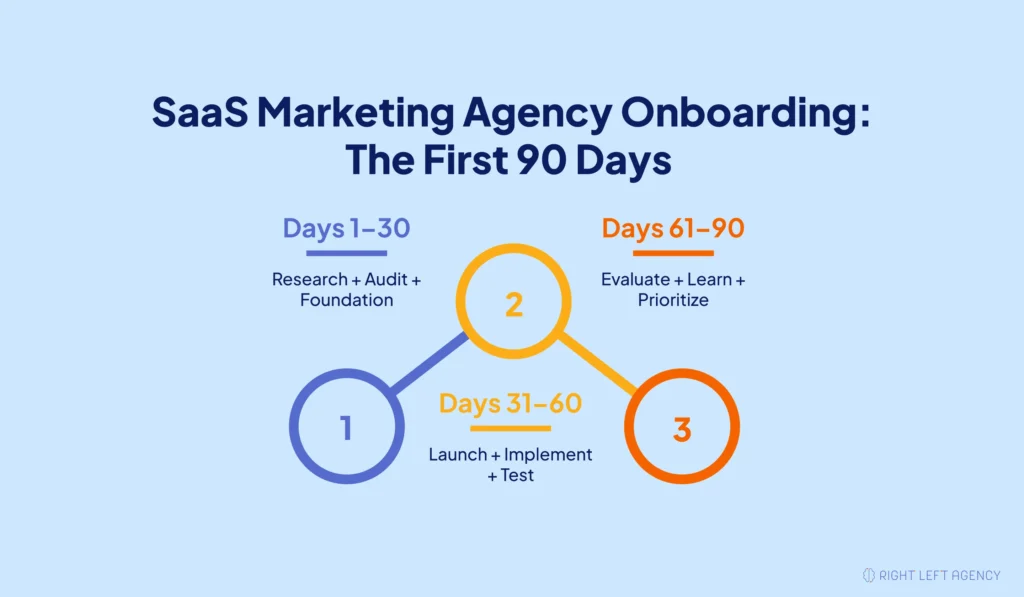
Days 1–30 — Research and audit: stakeholder and customer research, positioning and channel audits, analytics/CRM/tracking review, baseline measurement, priority roadmap. Goal: understand the business, audience, current performance, and biggest growth constraints.
Days 31–60 — Launch priority work: campaigns and content, tracking fixes, landing-page improvements, channel activation, initial testing, reporting setup. Goal: launch the highest-priority initiatives first.
Days 61–90 — Review and optimize: conversion signals, lead quality, pipeline indicators, experiment results, resource needs, next priorities. Goal: use early evidence to shape the next-quarter roadmap.
How Do You Transition From Agency-Led Execution to In-House Ownership?
An agency relationship does not need to create permanent dependency. A planned handover allows mature functions to move in-house without losing knowledge or performance.
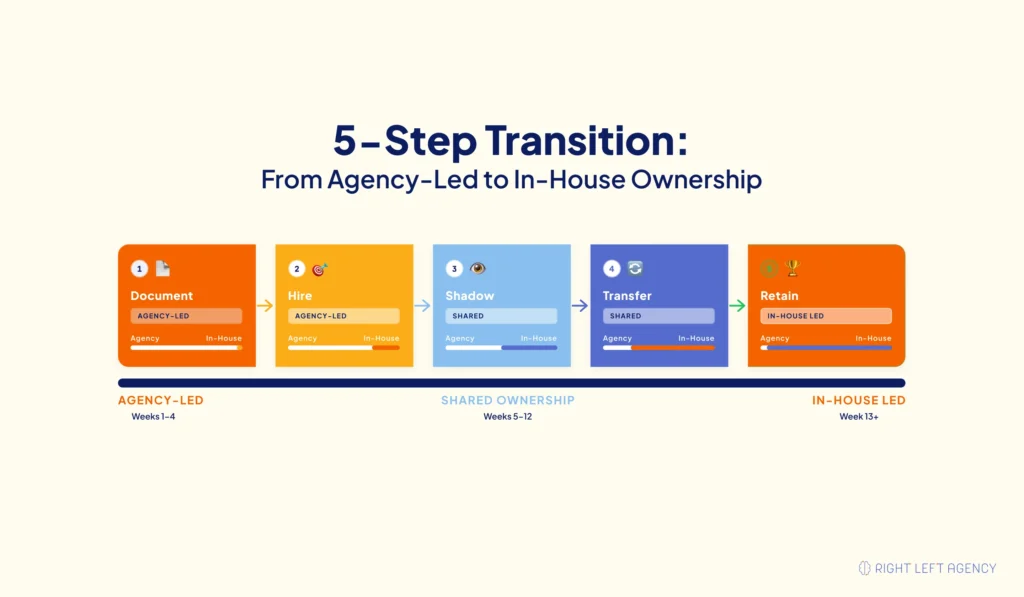
A function is ready to move in-house when it has predictable performance, consistent workload, strategic importance, sufficient budget, management capacity, documented processes, and a clearly defined internal role.
The agency should hand over playbooks and research, campaign and content history, creative files, tracking documentation, dashboards and account access, and benchmarks and process documents.
Phased Transition Process
| Phase | Primary Action |
|---|---|
| Document | Capture systems, decisions, assets, and performance history |
| Hire | Recruit for a validated role |
| Shadow | Let the new hire work alongside the agency |
| Transfer | Move access, execution, reporting, and decisions gradually |
| Retain | Keep specialist agency support where it still adds value |
SaaS Agency vs In-House Decision Scorecard
Use this scorecard to understand which model best fits your company today.
Score the Company Across Key Decision Factors
Score each factor from 1 to 5.
| Decision factor | Score of 1 | Score of 5 |
|---|---|---|
| Urgency | No immediate pressure | Execution is needed quickly |
| Budget flexibility | Highly constrained | Supports coordinated execution |
| Internal leadership | No clear owner | Strong marketing decision-maker |
| Product-market fit | Unclear | Well established |
| ICP stability | Changes frequently | Clearly defined |
| Channel maturity | Unvalidated | Predictable and repeatable |
| Specialist breadth needed | One narrow skill | Several connected capabilities |
| Need for daily product access | Low | Essential |
| Execution volume | Inconsistent | Sustained full-time workload |
| Management capacity | Limited | Strong |
| Risk tolerance | Low tolerance for external dependency | Comfortable managing partners |
| Need for flexibility | Low | High |
| Reporting maturity | Weak foundations | Reliable CRM and analytics |
| Long-term ownership | Low priority | Strategically important |
Interpret the Result
Focus less on the total score and more on which model matches your current situation.
Agency-led model
Best when you need speed, specialist expertise, and flexible support without adding several full-time hires.
In-house-led model
Best when your channels are proven, workload is steady, and close day-to-day collaboration matters.
Fractional leadership
Best when you need senior marketing direction but are not ready for a full-time executive.
Hybrid model
Best when you already have internal leadership but still need specialist skills, extra capacity, or support across developing channels.
Not ready to scale marketing
You may need to fix the foundations first if product-market fit is unclear, the ICP keeps changing, sales cannot convert demand, measurement is weak, or retention is the bigger problem.
Choose the Marketing Model That Builds Pipeline Efficiently
Choose an agency for faster execution, specialist expertise, and flexible capacity. Build in-house when channels are proven, workloads are consistent, and close collaboration between product and sales matters.
For many growth-stage SaaS companies, a hybrid model offers the best balance: internal leadership owns strategy and priorities, while external specialists provide execution support.
Compare each model based on total cost, capabilities, speed, management needs, risk, and pipeline impact—not salary versus retainer alone.
Compare Your In-House and Agency Options
Right Left Agency helps SaaS companies identify capability gaps and choose the right agency, in-house, fractional, or hybrid structure.
Frequently Asked Questions
Is a SaaS Marketing Agency Cheaper Than an In-House Team?
Often, yes—when comparing equivalent capabilities. Include salaries, benefits, recruitment, software, contractors, management, and ramp time, not just one employee’s salary.
How Much Does an Internal SaaS Marketing Team Cost?
It depends on team size, seniority, location, benefits, software, recruitment, and support costs. Compare total compensation, not base salary alone.
How Much Does a SaaS Growth Marketing Agency Cost?
Pricing depends on scope, specialists, production needs, implementation, and contract structure. Media spend, software, development, and extra projects may cost more.
How Many People Are Needed for a Complete SaaS Marketing Team?
A lean team may use internal leaders plus contractors or agencies. Full coverage may require strategy, SEO, content, paid media, CRO, creative, development, lifecycle, analytics, and RevOps.
When Should a SaaS Startup Hire Its First Marketer?
Hire once product-market fit is clearer, workload is consistent, and the role has defined ownership. The first hire should address the most important marketing gap.
When Is It Too Early to Hire a Marketing Agency?
It is too early when the product, ICP, or offer is unstable, no internal owner exists, sales cannot convert demand, or marketing is expected to solve product problems.
Can an Agency Replace a CMO or Head of Marketing?
Not always. An agency can support strategy and execution, but internal ownership is still needed for priorities, budget, product context, alignment, and final decisions.
What Should Remain In-House?
Keep business objectives, product knowledge, customer access, budget ownership, brand governance, internal alignment, and final decisions in-house.
What Is the Best Hybrid SaaS Marketing Structure?
Use an internal marketing leader for strategy and alignment, with an agency providing specialist execution and flexible capacity.
When Should a Proven Marketing Channel Move In-House?
Move it in-house when performance is predictable, workload supports a full-time role, the channel is strategically important, and management capacity exists.
How Long Does a SaaS Marketing Agency Take to Show Results?
Priority work should begin within the first 90 days. Pipeline and revenue results depend on the channel, sales cycle, starting point, and implementation speed.
What Should a SaaS Marketing Agency Report?
Report qualified pipeline, lead quality, conversion rates, CAC, CAC payback, marketing-sourced revenue, attribution, and relevant channel metrics.
Who Should Own Marketing Accounts, Data, and Content?
The SaaS company should retain control of advertising accounts, analytics, CRM data, website assets, content, creative files, and intellectual property wherever possible.