Key Takeaways
- No single attribution model works for every SaaS company.
- Early-stage SaaS teams should start with first-touch and last-touch attribution.
- Sales-led B2B SaaS teams need multi-touch attribution for long buyer journeys.
- Product-led SaaS teams should connect product data with marketing attribution.
- Mature SaaS teams should tie attribution to pipeline, CAC, and revenue.
The leads are coming in, the ad platforms look busy, and the content team can point to growing engagement. But when leadership asks which campaigns are actually creating pipeline and revenue, the room gets quiet.
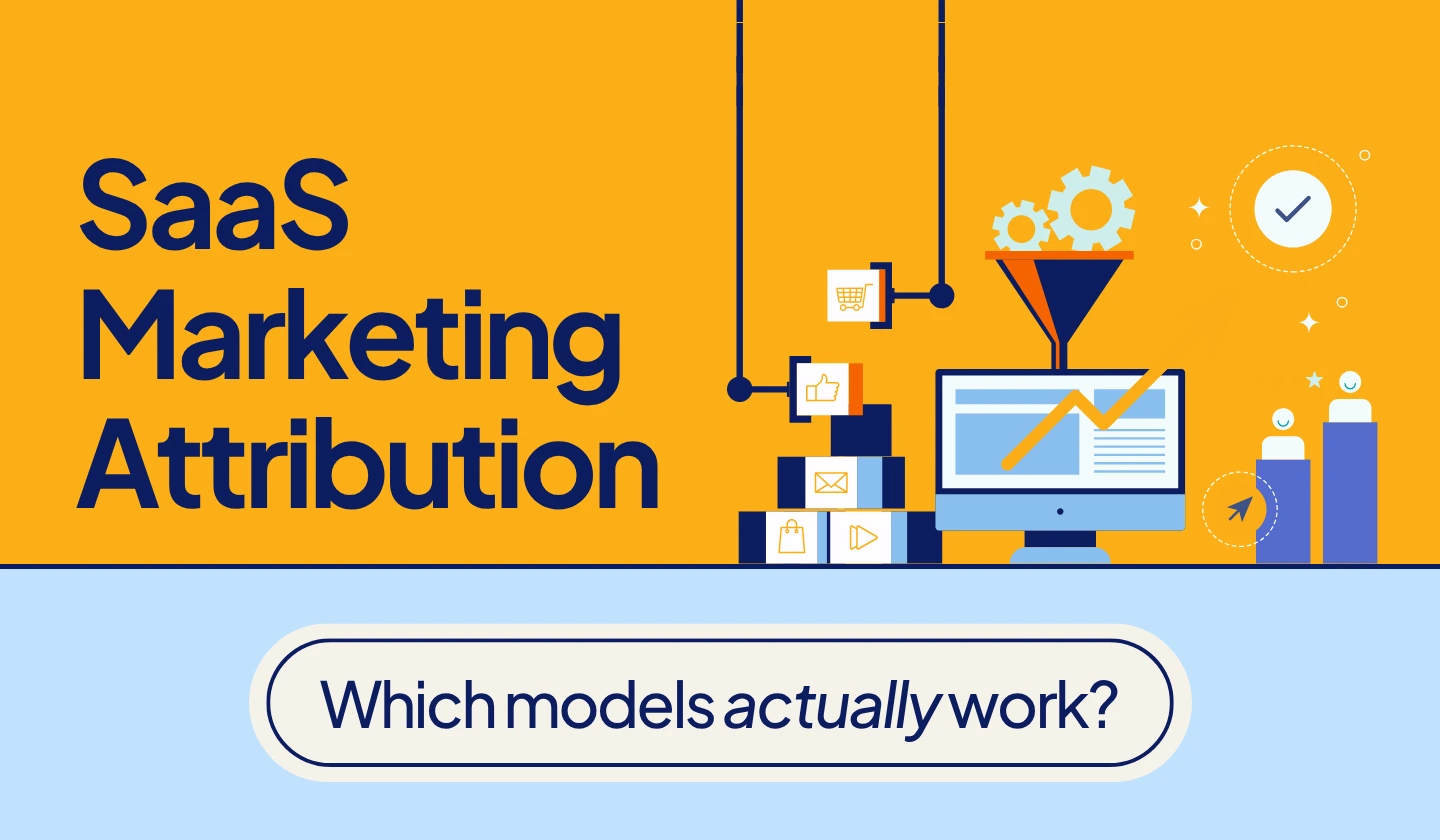
That is where SaaS marketing attribution becomes more than a reporting task. It becomes a growth decision system that helps teams understand which touchpoints influence qualified pipeline, CAC, and revenue. No single attribution model is perfect, but SaaS teams need a reporting system that shows which activities influence pipeline and revenue so marketing, sales, and leadership can make better budget decisions.
What Is SaaS Marketing Attribution?
Marketing attribution for SaaS is the process of connecting marketing channels, campaigns, and buyer touchpoints to leads, opportunities, pipeline, and revenue. In SaaS, this usually means tracking how a prospect moves from first interaction to MQL, SQL, opportunity, customer, and sometimes expansion revenue.
Attribution is useful, but it is not perfect. Some buyer influences, such as peer recommendations, private communities, sales conversations, and internal stakeholder research, may never appear cleanly in analytics. The goal is not perfect credit; the goal is better decision-making.
Attribution helps SaaS teams understand:
- Which channels create qualified leads
- Which campaigns influence the pipeline
- Which touchpoints help convert buyers
- Which sources create SQLs or opportunities
- Which activities support revenue
- Which budgets should be increased, reduced, or reallocated
For example, a buyer may first read a blog post, later click a LinkedIn ad, attend a webinar, compare case studies, and finally book a demo through branded search. Good pipeline attribution shows the full journey instead of giving all credit to the final click. The value comes from connecting lifecycle stages in the CRM, not just tracking the first form submission.
Why Marketing Attribution Is Difficult for SaaS Companies
Attribution is harder in SaaS because the buying journey is rarely simple. A B2B SaaS buyer may spend weeks or months researching vendors, comparing features, reading content, watching demos, speaking with sales, and getting internal approval before a deal moves into the pipeline.
The challenge becomes bigger when different tools report different numbers. Google Ads may credit a paid click, LinkedIn Ads may claim a view-through conversion, GA4 may show organic or direct traffic, and Salesforce may only show the original lead source. None of those views is necessarily wrong, but each one tells only part of the story.
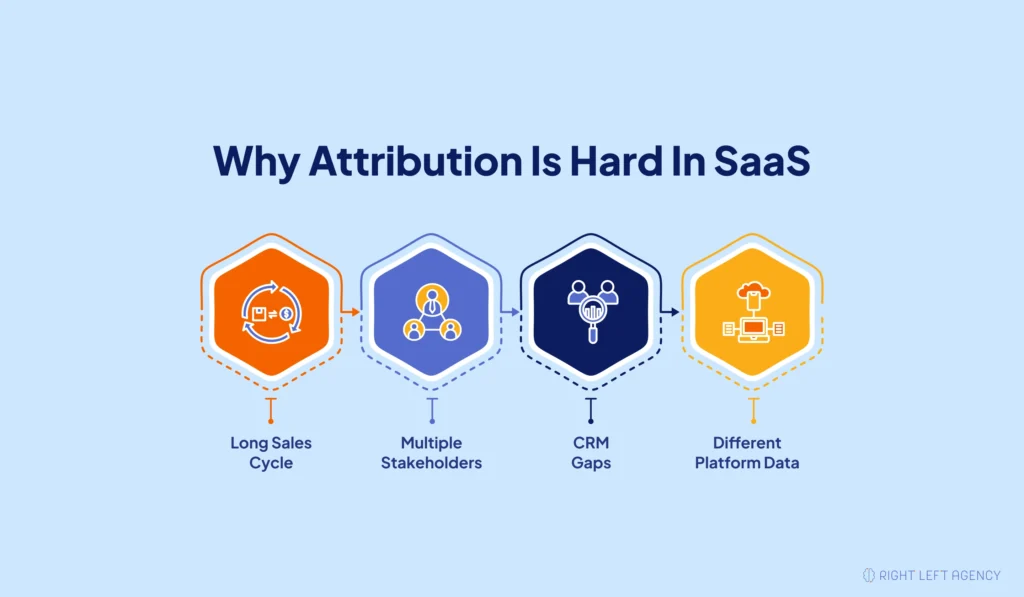
Common SaaS marketing analytics challenges include:
- Long sales cycles that delay revenue visibility
- Multiple stakeholders in the buying committee
- Multiple touchpoints before demo or trial conversion
- Free trials, demo requests, and product-qualified leads
- Sales-assisted conversions that are hard to credit
- Content influence that does not always generate direct conversions
- CRM and analytics gaps between lead source and opportunity data
- Different numbers across ad platforms, analytics, and CRM
This is why B2B SaaS attribution should be treated as a decision-making system, not a perfect truth. The goal is better pipeline quality, stronger CAC efficiency, and clearer revenue performance.
Common SaaS Marketing Attribution Models Compared
Different marketing attribution models assign credit to marketing touchpoints in different ways. No model is perfect, so the right choice depends on sales cycle length, funnel complexity, ACV, go-to-market motion, and data quality.
| Attribution Model | How It Works | Best For | Limitation |
|---|---|---|---|
| First-touch attribution | Gives credit to the first interaction | Understanding demand creation | Ignores later touchpoints |
| Last-touch attribution | Gives credit to the final interaction before conversion | Simple conversion tracking | Overvalues bottom-funnel channels |
| Linear attribution | Splits credit evenly across touchpoints | Multi-touch journeys | Treats all touchpoints equally |
| Time-decay attribution | Gives more credit to recent touchpoints | Sales-led funnels | Undervalues early awareness |
| U-shaped attribution | Gives more credit to the first touch and lead conversion | Lead generation analysis | May miss the sales-stage influence |
| W-shaped attribution | Credits first touch, lead creation, and opportunity creation | B2B SaaS pipeline tracking | More complex to manage |
| Data-driven attribution | Uses data to assign credit based on impact | Mature teams with enough data | Requires reliable data volume |
For measurement, SaaS teams can use Google Analytics attribution reporting, HubSpot attribution reports, and Salesforce Campaign Influence.
Example: If a buyer first discovers the company through a comparison article, later clicks a LinkedIn retargeting ad, and then books a demo through branded search, last-touch reporting may credit only branded search. A W-shaped or multi-touch report would show that content and paid social also helped move the account toward the pipeline.
Which Attribution Model Works Best for SaaS?
The best attribution model for SaaS depends on the company stage, sales cycle, ACV, data maturity, and whether the go-to-market motion is product-led, sales-led, or hybrid. However, SaaS teams should avoid relying on only one single-touch model once the funnel becomes more complex.
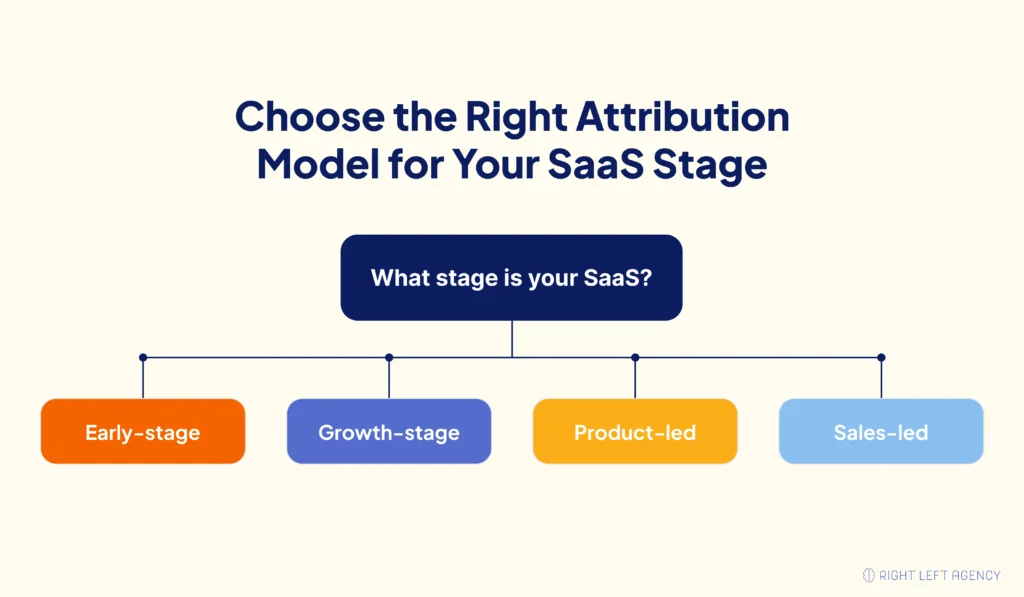
Practical recommendations:
- Early-stage SaaS:
A small SaaS company with low deal volume can use first-touch attribution to see which channels create awareness and last-touch attribution to see which pages or campaigns convert demo requests. - Growth-stage SaaS:
A growing SaaS company with more leads, campaigns, and sales activity can use U-shaped attribution or W-shaped attribution to understand which touchpoints create leads and which campaigns help turn those leads into opportunities. - Sales-led SaaS:
A B2B SaaS company with multiple stakeholders, long sales cycles, and sales-assisted deals should use W-shaped or multi-touch attribution to see how ads, content, sales conversations, case studies, webinars, and nurture campaigns influence pipeline creation. - Sales-led B2B SaaS:
A B2B SaaS company with multiple stakeholders and a complex buying committee should use W-shaped attribution or multi-touch attribution to see how ads, content, sales conversations, case studies, and nurture campaigns influence pipeline creation. - Product-led SaaS:
A product-led SaaS company should combine product analytics with marketing attribution so trial signups, activation events, product-qualified leads, paid conversions, and expansion activity are connected in one reporting view. - Mature SaaS teams:
A mature SaaS company with clean CRM data and enough conversion volume can use data-driven attribution alongside CRM revenue reporting, campaign influence, cohort analysis, and CAC payback tracking to understand which campaigns drive the strongest revenue outcomes.
Early-stage SaaS teams should avoid overcomplicating attribution before they have enough lead, opportunity, and revenue data. If the CRM is messy or deal volume is low, simple first-touch, last-touch, and lead-source reporting may be more useful than a complex model that creates false precision.
Pro Tip: For most B2B SaaS teams with sales-assisted funnels, W-shaped attribution is the most practical starting point. Multi-touch reporting can add more detail, but W-shaped attribution is often easier to explain to leadership and sales teams.
Why Multi-Touch Attribution Often Works Better for B2B SaaS
Multi-touch attribution often works better for B2B SaaS because buyers rarely convert after one interaction. A prospect may read a comparison article, click a Google Ads result, see a LinkedIn retargeting ad, download a guide, attend a webinar, and then book a demo.
Single-touch models may hide this journey. Last-touch attribution might credit branded search, while first-touch attribution might credit an old blog visit. Multi-touch reporting shows how different channels work together to create a qualified pipeline and revenue.
It can reveal:
- How content influences demo requests
- How paid search supports high-intent demand
- How LinkedIn Ads or paid social assist later-stage buyers
- How email nurture moves MQLs toward SQLs
- How webinars and case studies influence opportunities
- How remarketing supports sales-assisted conversions
- How campaigns contribute to opportunity creation
This matters because SaaS leaders need to know which campaigns support the pipeline, which touchpoints improve CAC payback, and which channels deserve more budget. If LinkedIn Ads generate fewer leads but a higher SQL-to-opportunity rate than Google Ads, the team should not judge LinkedIn only by CPL. The better question is whether LinkedIn creates larger opportunities or better-fit accounts.
SaaS Attribution Metrics to Track Beyond Leads
Attribution should not only track clicks, impressions, or leads. SaaS teams need to connect attribution to lead quality, pipeline, CAC, CAC payback, ARR, revenue influence, and marketing ROI.
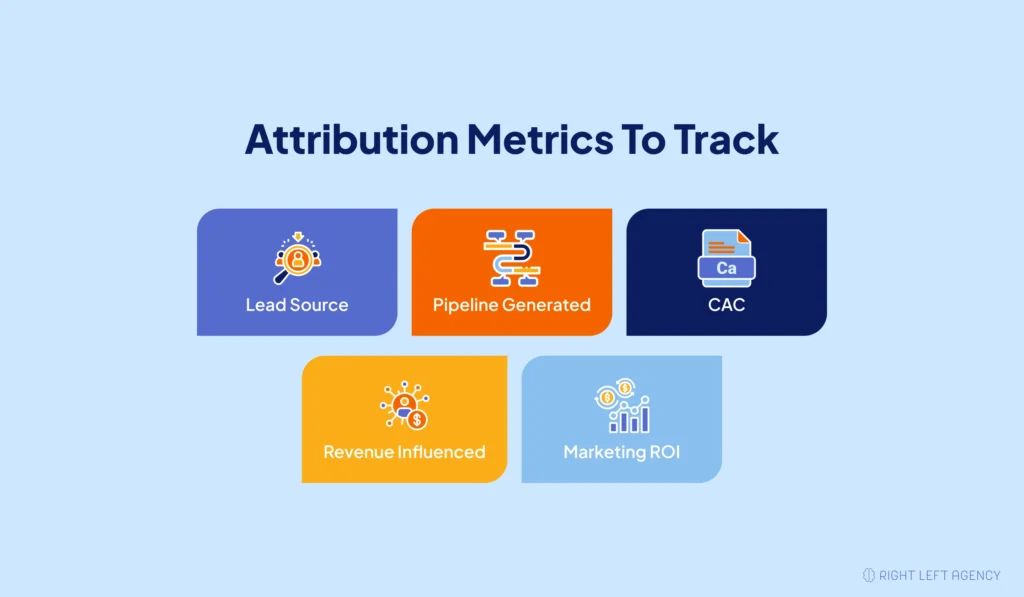
| Metric | Why It Matters |
|---|---|
| Lead source | Shows where leads originate |
| MQL-to-SQL rate | Shows whether leads are qualified |
| SQL-to-opportunity rate | Shows pipeline quality |
| Pipeline generated | Connects marketing to revenue potential |
| CAC | Shows acquisition efficiency |
| CAC payback | Shows growth sustainability |
| Revenue influenced | Shows marketing’s broader impact |
| Closed-won revenue | Shows which sources create actual customers |
| Marketing ROI | Shows whether campaigns support profitable growth |
The most useful attribution dashboard should show not only where leads came from, but which sources created SQLs, opportunities, pipeline value, and closed-won revenue. A campaign that generates cheap leads but no SQLs may look efficient in an ad platform and weak in the CRM. A campaign with a higher CPL may still be valuable if it creates a qualified pipeline, better-fit opportunities, higher ACV, and shorter CAC payback.
Common SaaS Attribution Mistakes That Waste Budget
Attribution becomes misleading when teams treat it as the exact truth or rely only on one reporting platform. SaaS teams need a balanced view across ad platforms, analytics tools, CRM data, and sales feedback.
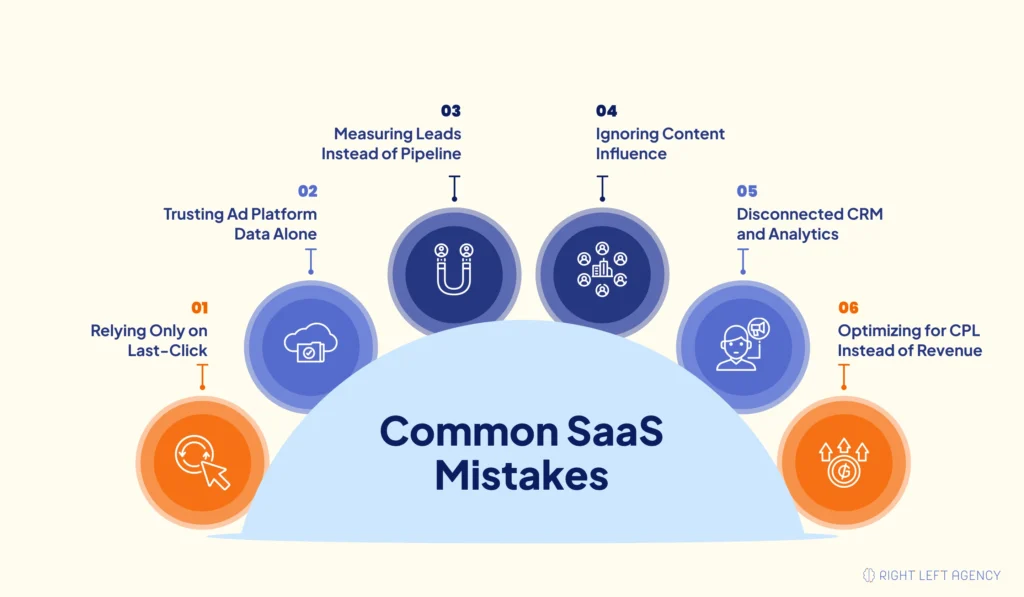
Avoid these mistakes:
- Relying only on last-click attribution
- Trusting ad platform data without CRM validation
- Measuring leads instead of the pipeline
- Ignoring content, nurture, and webinar influence
- Not connecting Google Analytics 4, HubSpot, Salesforce, and CRM data
- Treating attribution as exact truth
- Optimizing for CPL instead of revenue
- Ignoring sales feedback on lead quality
- Giving all credit to the bottom-funnel branded search
- Forgetting to review attribution by segment, ACV, or deal type
These mistakes often lead to poor budget decisions. For example, a team may cut a high-CPL LinkedIn campaign because it looks expensive, even though the CRM shows that it influenced high-value enterprise opportunities. A better approach is to compare reports, look for patterns, and use attribution to improve decisions.
How to Build a Better SaaS Attribution System
A better attribution system starts with clear funnel definitions, clean data, and shared reporting between marketing, sales, and revenue teams. Tools matter, but the process matters more.
- Define funnel stages clearly. Make sure everyone agrees on lead, MQL, SQL, opportunity, customer, and expansion stages. If sales and marketing define SQL differently, attribution reports will create confusion instead of clarity.
- Connect ad platforms, analytics, and CRM. Attribution is more useful when Google Ads, LinkedIn Ads, GA4, HubSpot, Salesforce, and CRM data are connected. This helps teams compare channel performance against actual pipeline and revenue outcomes.
- Track source, campaign, and touchpoint data. Use clean UTM tracking, consistent campaign naming, clear source definitions, and a shared tracking document for UTM rules, lifecycle stages, and reporting definitions. Without naming consistency, the same campaign may appear as multiple sources across tools.
- Measure pipeline, not just leads. Track which campaigns influence SQLs, opportunities, CAC, revenue, ARR, and closed-won deals. A campaign that produces fewer leads may still be the best performer if it creates stronger opportunities.
- Use multi-touch reporting where possible. Single-touch reports are useful, but they are often incomplete for long SaaS buying journeys. Multi-touch reporting helps teams see how paid media, content, email, webinars, and sales conversations work together.
- Review attribution with sales feedback. Sales can help identify which leads were truly qualified and which touchpoints mattered in the deal cycle. This prevents marketing from overvaluing campaigns that generate form fills but fail to create serious buying conversations.
- Use attribution to guide decisions, not to prove perfection. Attribution should support smarter budget, channel, and campaign decisions without creating false certainty. The best system helps teams ask better questions about pipeline quality, CAC efficiency, and revenue impact.
If attribution data shows that leads are not becoming a qualified pipeline, review your B2B SaaS lead generation challenges and sales and marketing alignment next.
How Attribution Supports a Pipeline-Focused Paid Media Strategy
Paid media should not only be judged by clicks, impressions, or CPL. For SaaS companies, a campaign is only valuable if it helps create qualified leads, SQLs, pipeline, CAC efficiency, and revenue.
Attribution helps SaaS teams separate high lead volume from a truly sales-qualified pipeline. This is especially important for Google Ads, LinkedIn Ads, Meta Ads, remarketing, and nurture campaigns, where the cheapest lead source is not always the best revenue source.
A pipeline-focused paid media review should compare each channel by CPL, MQL-to-SQL rate, SQL-to-opportunity rate, pipeline generated, CAC, and closed-won revenue. This prevents teams from cutting high-CPL campaigns that create real opportunities and scaling low-CPL campaigns that never move past the lead stage.
If a campaign has a low CPL but a weak SQL-to-opportunity rate, reduce spend or adjust targeting. If a campaign has a higher CPL but creates larger opportunities and better CAC payback, it may deserve more budget. Paid media attribution should guide budget movement toward qualified pipeline, not just cheaper form fills.
A stronger paid media strategy uses attribution to:
- Identify which channels create SQLs
- See which campaigns influence the pipeline
- Improve budget allocation
- Reduce wasted ad spend
- Optimize for CAC and revenue
- Support remarketing and nurture decisions
- Compare paid search, paid social, and content-assisted conversions
For deeper channel planning, see additional content about paid media for SaaS companies, B2B paid search agency, and SaaS lead generation strategies.
Conclusion
Attribution for SaaS teams is not about choosing one perfect model. It is about building a reporting system that helps SaaS teams understand how campaigns, channels, and touchpoints influence pipeline, CAC, revenue, and marketing ROI.
First-touch and last-touch models can help early teams, but growth-stage and B2B SaaS companies usually need multi-touch, W-shaped, or data-driven reporting connected to CRM revenue data.
If your paid media reporting stops at leads or CPL, the next step is to build a pipeline-focused measurement system that connects spend to qualified opportunities and revenue. Right Left Agency helps SaaS teams make that shift.
FAQ
What is SaaS marketing attribution?
Attribution for SaaS is the process of connecting marketing channels, campaigns, and touchpoints to leads, pipeline, customers, and revenue. It helps teams understand which sources create demand, which campaigns influence opportunities, and which activities support revenue. Strong reporting usually depends on clean CRM data, campaign tracking, analytics tools, and consistent lifecycle definitions across the full buyer journey.
Which attribution model is best for SaaS?
For many B2B SaaS companies, W-shaped or multi-touch attribution is the best starting point because it captures multiple stages of the buyer journey, including first touch, lead creation, and opportunity creation. Early-stage teams can start with first-touch and last-touch reporting, while mature teams may use data-driven attribution connected to CRM revenue data.
Why is attribution difficult in SaaS?
Attribution is difficult in SaaS because sales cycles are long, buying committees include multiple stakeholders, and buyers interact with many touchpoints before converting. Content, ads, email nurture, demo requests, free trials, and sales conversations may all influence one deal. Disconnected data between CRM, Google Analytics 4, HubSpot, Salesforce, and ad platforms makes reporting even harder.
Is multi-touch attribution better for B2B SaaS?
Multi-touch attribution is often better for B2B SaaS because buyers usually interact with multiple campaigns, content pieces, ads, and sales touchpoints before becoming an opportunity or customer. It helps teams see how paid search, content marketing, LinkedIn Ads, email nurture, webinars, and demo requests work together across the customer journey instead of overvaluing only one interaction.
What metrics should SaaS teams track with attribution?
SaaS teams should track lead source, MQL-to-SQL rate, SQL-to-opportunity rate, pipeline generated, CAC, CAC payback, revenue influenced, closed-won revenue, and marketing ROI. These metrics show whether campaigns are creating a qualified pipeline and sustainable revenue, not just cheap leads. The best attribution reporting connects marketing activity to opportunity quality, acquisition efficiency, and revenue impact.