Key Takeaways
- Lead nurturing turns existing interest into qualified pipeline through relevant, timely communication.
- Strong segmentation combines ICP fit, buyer stage, intent, behavior, and buying role.
- Behavioral and product signals are more useful than static email schedules alone.
- Clear scoring, sales handoffs, and recycling rules prevent valuable leads from being lost.
- Success should be measured through pipeline, opportunities, and revenue—not opens and clicks alone.
What Is SaaS Lead Nurturing?
SaaS lead nurturing is the process of helping interested prospects move toward a demo, trial, sales opportunity, or purchase.
It starts when someone takes an initial action, such as downloading a guide, joining a webinar, signing up for a trial, visiting the pricing page, or requesting a demo.
Nurturing continues until the lead converts, moves to sales, is disqualified, enters a recycling workflow, or opts out.
Email is a core channel, but effective SaaS lead nurturing can also include product messages, retargeting, website personalization, webinars, sales outreach, and account-based communication.
How Lead Nurturing Fits Into the SaaS Funnel
Lead nurturing sits between acquisition and sales qualification.
Acquisition creates awareness and captures interest. Nurturing helps prospects understand their problem, evaluate possible solutions, resolve concerns, and demonstrate readiness. Qualification determines whether sales involvement is appropriate. Sales then converts qualified interest into an active opportunity and customer.
The progression usually looks like this:
Acquisition → Lead capture → Nurturing → Qualification → Sales handoff → Opportunity → Customer onboarding
Customer onboarding begins after conversion. Trial onboarding can overlap with pre-sale nurturing because a trial user is still evaluating the product before purchasing.
A complete SaaS marketing strategy should define the conditions that move a lead between each stage, the team that owns the stage, and the data required before progression.
Lead Generation vs. Lead Nurturing
The primary difference between lead generation and lead nurturing is that lead generation attracts and captures prospects, while lead nurturing develops and qualifies that captured interest.
| Process | Main purpose | Typical activities | Primary outcome |
|---|---|---|---|
| Lead generation | Attract and capture potential buyers | SEO, paid campaigns, outbound, webinars, forms | New leads or accounts |
| Lead nurturing | Educate, engage, and qualify interest | Segmented content, email, triggers, scoring | Qualified pipeline |
| Sales | Validate and convert buying interest | Discovery, demos, proposals, negotiation | Opportunities and customers |
| Customer onboarding | Help new customers realize value | Setup, implementation, training, activation | Adoption and retention |
Generating more leads will not solve weak conversion if the company has poor targeting, generic follow-up, irrelevant content, or unclear qualification rules.
A poor-fit contact cannot become a high-value customer simply because the company sends more emails. Acquisition quality directly affects the performance of every nurture campaign.
Before increasing SaaS lead generation spending, review whether existing leads receive relevant follow-up and whether the qualification process separates genuine potential from low-value activity.
Lead Nurturing vs. Drip Campaigns
A drip campaign sends a fixed series of emails on a set schedule. Lead nurturing is more flexible. It adjusts the message or next step based on who the lead is and what they do.
For example, the workflow may change when someone visits the pricing page, attends a webinar, becomes inactive during a trial, invites a teammate, misses a demo, or reviews security content.
A complete nurture workflow should include clear entry rules, audience segments, behavioral triggers, branching paths, sales alerts, conversion goals, exit conditions, and suppression rules.
Lead Nurturing vs. Customer Onboarding
Lead nurturing moves prospects toward a purchase. Customer onboarding begins after the person or account becomes a paying customer.
Trial onboarding can function as both product education and pre-sale nurturing. Activation emails, setup checklists, and feature guidance help trial users experience value before making a purchase.
After conversion, the focus shifts toward adoption, retention, expansion, renewal, and churn prevention. These activities belong within SaaS lifecycle marketing, but they should not dominate a pre-sale nurturing strategy.
Why SaaS Lead Nurturing Matters for Qualified Pipeline
SaaS lead nurturing helps prospects build confidence before they are ready to buy. It educates buyers, addresses concerns, and shows when interest is turning into real intent.
A single content download may signal curiosity. Repeated pricing visits, product activity, and engagement from several stakeholders suggest stronger buying interest.
Effective nurturing helps SaaS companies qualify leads faster, improve demo and trial conversion, reduce wasted sales effort, and generate more value from existing acquisition channels.
Relationship Building, Trust, and Micro Wins
Lead nurturing builds trust when each interaction helps the prospect make progress.
A micro win is a small result delivered before purchase, such as completing a checklist, calculating ROI, using a template, solving a setup issue, or identifying a process gap.
These quick wins reduce risk and show that the SaaS company understands the buyer’s needs. Instead of repeatedly asking for a meeting, nurturing should guide the prospect toward the next useful step.
How Acquisition Quality Affects Nurturing
Lead nurturing cannot fix poor audience-product fit.
Broad targeting, generic outreach, weak positioning, and irrelevant lead magnets often attract people with little need, budget, authority, or buying potential.
Nurture performance usually depends on:
- ICP clarity
- Segmentation
- Positioning
- Message relevance
- Offer quality
- Timing
- Testing
Outbound also tends to work better when prospects already recognize the company through SEO content, webinars, social posts, podcasts, or founder-led content.
Use Outreach Benchmarks Carefully
Community-shared LinkedIn benchmarks sometimes include:
- 20–30% connection acceptance
- 5–10% response rate
- 20–25% response-to-call conversion
- One or two calls per 100 requests
Treat these as rough reference points, not universal standards.
Instead, identify the weakest stage in your own funnel. Low acceptance may suggest poor targeting. Strong acceptance with few replies may point to weak messaging. Replies without calls may indicate a poor offer or an overly aggressive CTA.
The Connection Between CAC, LTV, and Nurturing
CAC should be evaluated alongside LTV, retention, gross margin, payback period, and expansion potential.
Lead nurturing can improve acquisition efficiency by converting more value from leads the company has already paid to generate.
For example, a SaaS product charging $99 per month for an average of 12 months produces a revenue-based LTV of $1,188. Compared with a $500 CAC, that equals roughly 2.4:1 before gross margin and other costs.
A 3:1 LTV-to-CAC ratio is often used as a directional reference, not a fixed rule. The right ratio depends on the company’s margin, growth stage, retention, sales cycle, and payback period.
Better onboarding, pricing, customer success, and customer retention can improve LTV, but these post-sale areas sit outside the main scope of lead nurturing.
Why SaaS Leads Fail to Convert
SaaS leads often fail to convert because targeting, timing, content, data, qualification, and sales follow-up are not aligned with the buyer’s situation.
| Symptom | Likely cause | Corrective action |
|---|---|---|
| Leads engage but do not book demos | High-commitment CTA appears too early | Introduce stage-appropriate next steps |
| Sales rejects many MQLs | Engagement is measured without fit or intent | Add fit, intent, product, and account criteria |
| Trial users become inactive | Setup friction or unclear first value | Trigger activation and recovery guidance |
| Opportunities stall | Stakeholder objections remain unresolved | Nurture the buying committee |
| Email engagement declines | Generic content or excessive frequency | Improve segmentation and frequency controls |
| Follow-up is inconsistent | Marketing, product, sales, and CRM data are disconnected | Integrate lifecycle status and ownership |
| Leads remain in workflows indefinitely | Exit and recycling rules are missing | Establish clear workflow outcomes |
Poor Segmentation and Generic Messaging
Generic messaging makes prospects work too hard to see why your product matters.
A CFO and an operations manager care about different outcomes, risks, and proof. Segment leads by factors such as industry, company size, role, lifecycle stage, product activity, and purchase intent.
Personalization should feel relevant and helpful—not intrusive.
Weak Timing and Irrelevant Follow-Up
The correct content can fail when delivered at the wrong time.
Early-stage leads usually need education rather than an immediate sales request. High-intent activity may require rapid human follow-up.
Time-based nurturing should therefore work alongside behavioral triggers. Automated marketing and manual sales communication must also share frequency rules to prevent overlapping messages and conflicting CTAs.
Disconnected Data and Unclear Qualification
Marketing activity alone does not always show buying intent. One lead may open several emails but be a poor fit, while another may ignore emails yet actively use the trial, adopt key features, and invite teammates.
Better qualification combines CRM data, company fit, website behavior, email engagement, product usage, account activity, and sales feedback. These systems also need to stay in sync. Otherwise, duplicate or mismatched records can send the same buyer into multiple workflows and trigger inaccurate sales alerts.
Ignoring Buying Committees and Objections
Complex B2B SaaS purchases rarely depend on one person.
The original contact may need support from:
- An economic buyer
- Technical evaluators
- End users
- Security
- Legal
- Finance
- Procurement
- Executive sponsors
Each stakeholder needs different proof. Technical evaluators may require integration documentation. Finance may need ROI evidence. Security teams need risk and compliance information.
Champion enablement helps the original contact explain the value, answer internal questions, and build consensus.
Map the SaaS Buyer Journey Before Building Workflows
A SaaS buyer journey should define observable lifecycle stages, buyer needs, progression signals, ownership, entry conditions, exit conditions, and recycling rules.
A lead should move forward because of a meaningful action or validated change in status, not simply because time has passed.
Awareness, Consideration, and Decision Stages
| Stage | Primary buyer need | Appropriate content | Progression signal |
|---|---|---|---|
| Awareness | Understand the problem | Articles, reports, guides, checklists | Repeated topic engagement |
| Consideration | Evaluate possible approaches | Webinars, comparisons, implementation guides | Product or solution-page activity |
| Decision | Validate vendor and business value | Case studies, ROI tools, pricing, security content | Demo, trial, procurement, or security action |
Awareness content helps prospects define the problem. Consideration content helps them compare approaches. Decision content reduces financial, operational, technical, and commercial risk.
Trial and Product-Evaluation Stages
A trial signup does not always mean a user is ready to buy. Some are only exploring, while stronger intent shows through actions such as completing setup, using core features, inviting teammates, connecting integrations, returning regularly, or viewing upgrade options.
Inactivity may signal friction rather than lost interest, so recovery messages should help users complete the next step and reach value faster.
Sales-Qualified, Opportunity, and Recycling Stages
A sales-accepted lead, or SAL, is a lead sales has accepted for follow-up. A sales-qualified lead, or SQL, is a lead sales has validated as having credible fit, need, timing, or buying potential.
An opportunity exists when the account enters an active commercial evaluation.
Rejected, stalled, unresponsive, and closed-lost leads require distinct recycling rules.
Adapt the Journey to the SaaS Business Model
| SaaS model | Primary nurturing emphasis | Human involvement | Strongest signals |
|---|---|---|---|
| Low-ACV self-serve | Automation and conversion prompts | Low | Signup, activation, upgrade activity |
| Product-led growth | Product education and PQL identification | Moderate | Feature adoption, usage, team invitations |
| Sales-led growth | Demo follow-up and qualification | High | Demo activity, business need, account fit |
| Enterprise SaaS | Buying committees, ABM, risk reduction | Very high | Multi-stakeholder engagement, security, procurement |
| Hybrid SaaS | Product signals plus sales assistance | Variable | Activation combined with account fit |
Low-ACV SaaS requires scalable automation. Enterprise SaaS requires more human support, account-level communication, stakeholder coordination, and role-specific content.
Segment Leads by Fit, Intent, Behavior, and Buying Role
SaaS leads should be segmented by ICP fit, buyer stage, intent, behavior, role, product usage, account value, source, and urgency. Companies should create only the nurture tracks they can maintain, measure, and improve.
Define the Ideal Customer Profile
An ideal customer profile defines the type of account most likely to purchase, succeed with, and remain suitable for the product.
ICP criteria may include:
- Company size
- Industry
- Use case
- Technographic fit
- Account value
- Buying capacity
- Product need
- Geography
- Sales-motion compatibility
- Implementation requirements
Low-fit leads may enter low-cost educational nurturing, but they should not receive the same priority as strong-fit accounts.
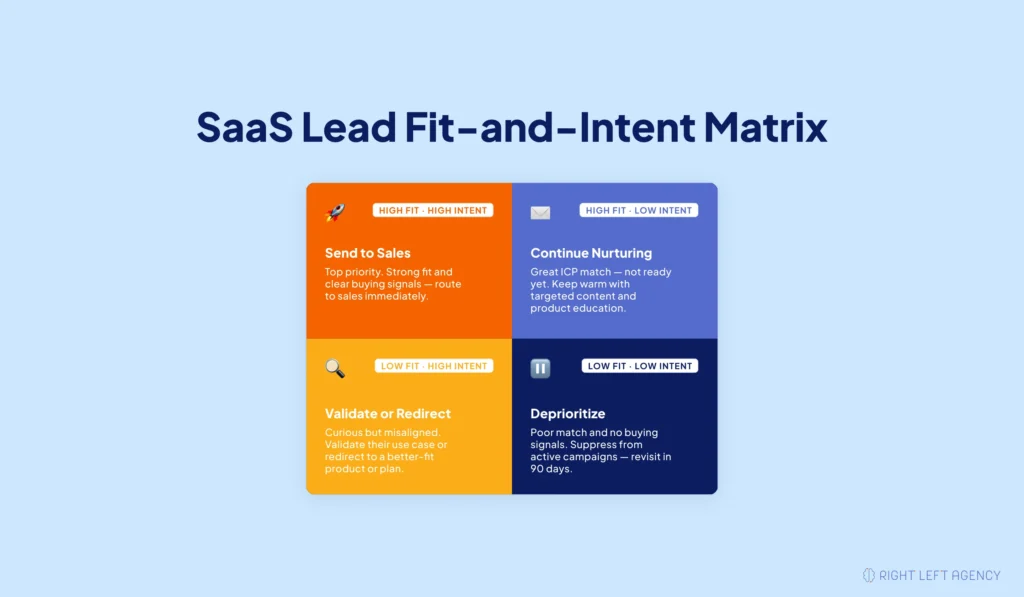
Use a Fit-and-Intent Matrix
| Lead category | Recommended treatment |
|---|---|
| High fit, high intent | Route to sales quickly with behavioral context |
| High fit, low intent | Use long-term educational and role-based nurturing |
| Low fit, high intent | Validate fit, redirect, or disqualify |
| Low fit, low intent | Suppress, deprioritize, or use low-cost nurturing |
High engagement should not override poor fit. Strong fit should not automatically trigger sales outreach when intent remains weak.
Segment by Lifecycle, Source, and Behavior
A webinar attendee, newsletter subscriber, trial user, and demo requester should not enter the same workflow.
Useful segmentation fields include:
- Lifecycle stage
- Lead source
- Content topic
- Website activity
- Webinar participation
- Email engagement
- Demo activity
- Product login
- Feature adoption
- Purchase urgency
Source should shape the initial context. Behavior should determine what happens next.
Segment the Buying Committee
Buying-committee segmentation identifies each stakeholder’s influence, priorities, objections, and evidence needs.
Track engagement at both contact and account levels. Several stakeholders from the same company reviewing pricing, implementation, technical, and security content may indicate coordinated evaluation.
Match Content to Buying-Committee Roles
| Role | Main concern | Appropriate content |
|---|---|---|
| Champion | Internal support and implementation success | Business case, internal presentation, implementation guide |
| Economic buyer | Financial value and risk | ROI calculator, pricing, executive case study |
| Technical evaluator | Integration and feasibility | Technical documentation, product demonstration |
| Security or legal | Risk and compliance | Security, privacy, and compliance documentation |
| Procurement | Commercial terms and vendor reliability | Pricing, procurement support, implementation plan |
| End user | Usability and practical value | Product walkthrough, trial guidance, use-case content |
Map Content to Buyer Stage, Role, Pain Point, and Objection
Lead nurturing content should answer the next question a buyer must resolve before progressing. Each asset should align with buyer stage, role, pain point, objection, and desired action.
Audit existing content before creating new assets. SaaS companies often already have useful articles, case studies, webinars, demonstrations, and documentation that have not been mapped to the buyer journey.
Educational Content for Early-Stage Leads
Early-stage content should help prospects understand the problem and possible approaches.
Useful formats include:
- Blog articles
- White papers
- Industry reports
- Webinars
- Checklists
- Templates
- Thought leadership
- Founder-led content
- Podcast appearances
Educational content should create familiarity and micro wins without forcing an early sales conversation.
Evaluation Content for Mid-Funnel Leads
Mid-funnel content helps prospects compare approaches and validate product fit.
Useful assets include:
- Product comparisons
- Competitor comparisons
- Product demonstrations
- Implementation guides
- Use-case pages
- Customer testimonials
- Case studies
- Feature documentation
The strongest proof reflects the prospect’s industry, use case, company size, and expected outcome.
Decision Content for High-Intent Leads
Decision-stage content supports business-case development and risk reduction.
Useful assets include:
- ROI calculators
- Pricing information
- Business-case templates
- Executive case studies
- Security documentation
- Compliance information
- Procurement resources
- Implementation plans
A champion may need an internal presentation. Finance may need ROI evidence. Technical teams may require integration documentation.
Address Objections Before They Stall the Deal
Identify objections by segment, stage, and buying role. Then map each objection to relevant evidence.
Common objections include:
- Pricing
- ROI
- Implementation effort
- Integrations
- User adoption
- Security
- Compliance
- Procurement
- Vendor reliability
Do not overwhelm early-stage leads with late-stage detail. Deliver objection-handling content when behavior suggests the concern has become relevant.
SaaS Lead Nurturing Strategies That Build Qualified Pipeline
1. Segment Leads Before Starting a Nurture Workflow
Determine ICP fit, lifecycle stage, source, buying role, intent, behavior, and product usage before assigning a nurture track.
A webinar attendee should not receive the same communication as an inactive trial user or demo requester.
2. Personalize by Fit, Intent, and Buyer Role
Meaningful personalization changes the message, content, CTA, and proof according to the buyer’s situation.
Use dynamic content, role-based messaging, account context, pain points, and objections rather than relying only on first-name personalization.
3. Use Behavioral Triggers Instead of Static Timing Alone
Behavioral nurturing responds to actual actions.
Useful triggers include:
- Pricing-page visits
- Product-page activity
- Webinar attendance
- Trial inactivity
- Feature adoption
- Demo no-shows
- Form abandonment
- Account-level engagement
Each trigger should create a relevant response, not automatically notify sales.
4. Deliver Quick Wins Before Asking for a Sales Commitment
Help prospects achieve a practical result before requesting a demo or purchase.
Templates, checklists, calculators, setup support, instructional videos, and product guidance can reduce friction and demonstrate expertise.
5. Use Social Proof to Reduce Perceived Risk
Use case studies, testimonials, implementation stories, and product examples that match the buyer’s industry, role, use case, and stage.
Relevant proof is more persuasive than a generic logo wall.
6. Address Buyer Objections Proactively
Map pricing, ROI, integration, implementation, security, compliance, adoption, and procurement concerns to relevant resources.
Trigger that content when the buyer’s behavior shows the objection is becoming important.
7. Create Role-Based Buying-Committee Tracks
Progress the account rather than nurturing only the original contact.
Build role-specific paths for champions, economic buyers, technical evaluators, end users, security, legal, finance, and procurement where required.
8. Coordinate Email With Product, Sales, Website, and Paid Channels
Email can deliver personalized progression. Retargeting can reinforce relevant proof. In-app messages can support trial activity. Sales can manage complex evaluations.
Every channel should support the same buyer objective without repeating the same message.
9. Introduce Sales When Readiness Signals Are Strong
A lead should be routed to sales when strong account fit combines with meaningful readiness signals.
These may include:
- Demo requests
- Repeated pricing activity
- Activation milestones
- Several active stakeholders
- Security or procurement activity
- Implementation questions
- High-value product usage
Sales should receive behavioral and account context, not only a score.
10. Re-Engage and Recycle Leads That Are Not Ready
Lead recycling moves rejected, inactive, stalled, or closed-lost leads into an appropriate future nurture path.
Segment recycling by loss reason, continued fit, purchase timing, and unresolved objection.
11. Test One Variable at a Time
Test segments, messages, content, subject lines, CTAs, cadence, channels, score thresholds, and handoff logic.
Changing several variables at once makes the result difficult to interpret.
Build Email and Behavioral Nurture Workflows
A SaaS lead nurturing workflow should define who enters, what progression it should create, which content and channels it uses, how behavior changes the path, when sales is notified, and what causes the lead to exit.
Every workflow should include:
- Entry condition
- Target segment
- Primary conversion event
- Content and channel
- Behavioral branches
- Sales notification rules
- Exit condition
- Suppression and frequency rules
SaaS email marketing should operate as part of the wider buyer journey rather than as an isolated campaign.
Core SaaS Email Nurture Sequences
Content-Download and Newsletter Nurture
Confirm access to the requested resource. Then provide related education, clarify the use case, introduce relevant proof, and invite a low-friction next step.
Branch the workflow when engagement or intent increases.
Webinar Nurture
Separate registrants, attendees, and no-shows.
Send reminders before the event. Afterward, provide the recording, related resources, proof, and an appropriate CTA.
Attendance, questions, and follow-up activity can contribute to intent scoring.
Demo-Request and Demo No-Show Nurture
Confirm the booking immediately and provide preparation material.
Trigger rapid sales follow-up. Remove the lead from unrelated promotional campaigns during active sales communication.
Move no-shows into a recovery sequence that makes rescheduling easy.
Free-Trial and Product-Evaluation Nurture
Focus on activation milestones and first value.
Respond to setup abandonment and inactivity with targeted guidance. Deliver feature education according to actual product behavior.
Introduce sales assistance or upgrade communication when product signals become strong.
Pricing-Page and High-Intent Nurture
Repeated pricing activity can indicate commercial evaluation, but it is not definitive proof of purchase intent.
Combine pricing activity with fit, product usage, other website behavior, and account engagement before routing the lead to sales.
Re-Engagement and Closed-Lost Nurture
Identify why the lead became inactive or why the opportunity was lost.
Reconnect when there is a meaningful reason, such as:
- New functionality
- Changed pricing
- New customer evidence
- An approaching renewal date
- A resolved objection
Build a Trigger-Action Framework
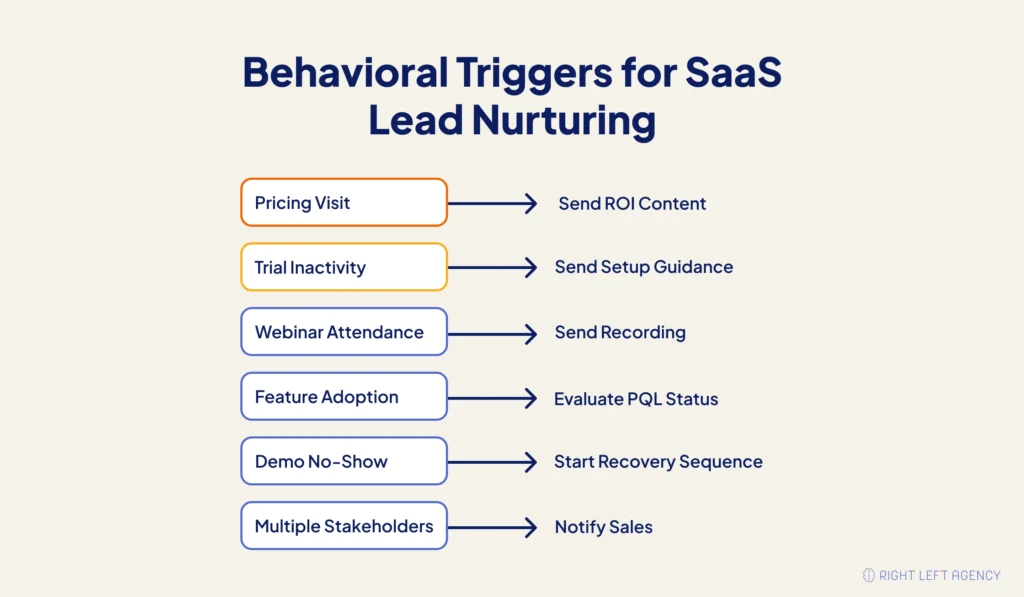
| Trigger | Possible interpretation | Recommended action |
|---|---|---|
| Pricing-page visit | Commercial evaluation | Send ROI or pricing support and update intent score |
| Repeated product-page visits | Active evaluation | Deliver a use case or comparison |
| Webinar attendance | Topic interest | Send recording, related content, and next step |
| Trial inactivity | Activation friction | Send quick-win guidance or an in-app checklist |
| Feature adoption | Value realization | Deliver advanced education and evaluate PQL status |
| Demo no-show | Scheduling friction | Start a recovery sequence |
| Form abandonment | Uncertainty or friction | Send a compliant reminder or supporting content |
| Account-level engagement | Multiple stakeholders are active | Notify sales and evaluate an ABM track |
Set Email Cadence, Frequency, and Exit Rules
Sequence length and frequency should match the buyer’s stage, intent, sales cycle, ACV, workflow goal, and communication preferences.
High-intent leads may need faster follow-up, while long-term nurture should be less frequent.
End the sequence when the lead converts, enters sales, becomes inactive, is disqualified, changes stage, or withdraws consent.
Marketing and sales should also share frequency rules to avoid sending overlapping messages or conflicting CTAs.
Protect Deliverability and User Preferences
Sustainable nurture performance requires:
- Sender reputation management
- Accurate consent records
- Preference centers
- Unsubscribe handling
- Suppression rules
- Clean contact data
- Frequency limits
- Responsible personalization
A lifecycle campaign audit can help identify overlapping sequences, deliverability risks, missing exit rules, and inconsistent consent handling.
Use Multi-Channel Nurturing Without Creating Message Overload
Multi-channel nurturing coordinates email, product, website, paid, social, webinars, and sales communication around the buyer’s next action.
Each channel should have a defined role. Coordination should reduce repetition, conflicting CTAs, and excessive contact.
Email, Retargeting, and Organic Content
Email supports personalized progression. Retargeting reinforces relevant proof. SEO content supports problem and solution research. Organic LinkedIn content builds familiarity. Podcasts and earned media can strengthen credibility.
Educational retargeting should promote content that matches the buyer’s stage rather than repeating the same demo advertisement.
In-App Messaging and Website Personalization
In-app communication works well when prospects are actively using the product.
Useful experiences include:
- Onboarding checklists
- Contextual tooltips
- Usage-based prompts
- Trial-recovery messages
- Feature guidance
- Personalized website content
- Chat support
Product behavior can determine whether an in-app message is more useful than another email.
Sales Calls, Sales Emails, and Human Follow-Up
Human follow-up is most valuable for:
- High-intent leads
- High-value accounts
- Complex evaluations
- Buying committees
- Security or procurement involvement
- Strong product-usage signals
Sales should receive the account’s fit, recent behavior, product usage, stakeholder activity, previous communication, and known objections.
Product-Led vs. Sales-Led Channel Mix
| Model | Primary channels | Typical automation level | Human involvement |
|---|---|---|---|
| Product-led SaaS | In-app messages, activation email, product notifications | High | Triggered by PQL activity |
| Sales-led SaaS | Email, demos, sales calls, role-based content | Moderate | Central to qualification |
| Enterprise SaaS | ABM, executive content, technical support, procurement guidance | Lower | High-touch and account-based |
| Hybrid SaaS | Product communication plus sales support | Variable | Based on fit and usage |
Build a Lead Scoring and Qualification Model
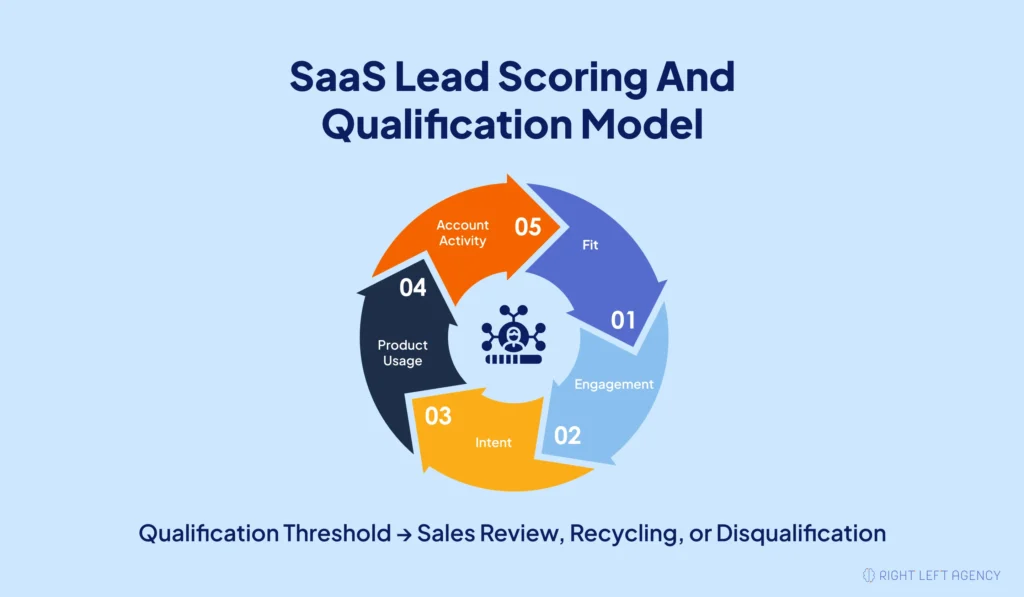
SaaS lead scoring combines fit, engagement, intent, product usage, and account activity to estimate sales readiness. A complete model also includes negative scoring, score decay, qualification thresholds, required conditions, and routing rules.
The five main scoring categories are:
- Fit
- Engagement
- Intent
- Product usage
- Account activity
Fit Scoring
Fit scoring measures how closely an account matches the ICP.
Signals may include:
- Industry
- Company size
- Use case
- Technology
- Geography
- Account value
- Business-model fit
- Implementation suitability
Fit scoring answers: Is this account commercially and operationally suitable?
Engagement and Intent Scoring
Engagement scoring tracks general interest, such as email clicks, content downloads, webinar attendance, and repeat website visits.
Intent scoring focuses on actions that suggest active evaluation, including pricing-page visits, demo activity, product comparisons, security content, implementation questions, and high-value form submissions.
A lead can engage with educational content without being ready to buy.
Product Usage and Account-Level Scoring
Product usage scoring considers:
- Trial signup
- Product login
- Setup completion
- Activation milestones
- Feature adoption
- Team invitations
- Integration activity
- Usage limits
- Product inactivity
Account scoring combines activity from several stakeholders within the same company.
Positive Signals, Negative Scoring, and Score Decay
Negative scoring prevents weak-fit or outdated activity from inflating readiness.
Negative signals may include:
- Poor-fit firmographic characteristics
- Student or job-seeker activity
- Competitor research
- Invalid data
- Unsupported geography
- Irrelevant use cases
- Prolonged inactivity
Score decay reduces the influence of old activity. A pricing visit from six months ago should not carry the same weight as repeated pricing activity this week.
Define MQL, PQL, SAL, SQL, and Opportunity
| Stage | Definition focus | Typical owner |
|---|---|---|
| MQL | Marketing fit and engagement meet an agreed threshold | Marketing |
| PQL | Product activity shows meaningful value or buying potential | Product, marketing, or revenue |
| SAL | Sales accepts the lead for follow-up | Sales |
| SQL | Sales validates need, fit, timing, or buying potential | Sales |
| Opportunity | An active commercial evaluation exists | Sales |
An MQL qualifies through marketing activity and fit. A PQL qualifies through meaningful product behavior.
An MQL or PQL becomes an SAL when sales accepts ownership. It becomes an SQL when sales validates commercial potential.
Set Qualification Thresholds and Routing Rules
Set qualification thresholds using real opportunity and revenue data, not arbitrary scores. A lead should only qualify when the score and required fit conditions are both met.
Route qualified leads by territory, segment, product, account owner, company size, or existing opportunity status. Also define what happens when sales accepts, rejects, or does not respond to a lead.
Use Example Scores Only as Illustrations
For example, a pricing-page visit might add 10 points, webinar attendance 20 points, and a score of 70 might trigger a sales review.
These numbers are examples, not benchmarks. Validate every score and threshold against lead quality, sales feedback, opportunity conversion, and revenue.
Align Marketing, Sales, Product, and Revenue Operations
Marketing, sales, product, and RevOps must share lifecycle definitions, qualification standards, ownership, routing rules, response expectations, and recycling processes.
Without shared governance, a well-built automation platform can still produce inconsistent follow-up and unreliable reporting.
Establish Shared Lifecycle and Qualification Definitions
Define each CRM status clearly:
- MQL
- PQL
- SAL
- SQL
- Opportunity
- Disqualified
- Stalled
- Closed-lost
- Recycled
Document the entry criteria, owner, required data, exit criteria, and next action for each stage.
Define Sales Handoff and Response-Time Expectations
A sales handoff should include:
- Qualification data
- Account fit
- Recent behavior
- Product usage
- Buying role
- Known objections
- Previous communication
- Recommended next action
High-intent requests should receive faster follow-up than general engagement.
A sales notification should also explain why the lead became qualified. A generic alert stating that a contact crossed a score threshold gives the salesperson little context and often leads to generic outreach.
Create a Marketing and Sales SLA
A sales SLA should define:
- Marketing qualification standards
- Required handoff data
- Sales response expectations
- Acceptance and rejection processes
- Required rejection reasons
- Follow-up attempts
- Recycling rules
- Review cadence
The SLA should be reviewed using actual conversion and rejection data rather than remaining a static document.
Prevent Duplicate and Conflicting Outreach
Maintain one lifecycle owner and synchronize CRM status across marketing, product, and sales systems.
Suppress broad promotional workflows during active sales conversations. Where supportive messages must continue, align them with the salesperson’s current objective.
Build a Closed-Loop Feedback Process
Sales should return information about:
- Rejection reasons
- Opportunity outcomes
- Common objections
- Missing content
- Score accuracy
- Segment quality
- Lost-deal reasons
This feedback helps marketing improve content, qualification thresholds, segmentation, and workflow timing.
Choose the Right Marketing Automation and Data Stack
The best lead nurturing software for B2B SaaS is the stack that supports the company’s workflow, data, integration, reporting, and governance requirements.
Technology should follow the operating process rather than define it.
Core Technology Categories
| Category | Primary function | Example platforms |
|---|---|---|
| CRM and marketing automation | Contact records, lifecycle stages, workflows, routing | HubSpot, Salesforce, Marketo, Pardot, ActiveCampaign |
| Email automation | Segmented and triggered email | Customer.io, Klaviyo, Mailchimp |
| Product analytics and customer data | Usage, activation, event, and identity data | Mixpanel, Amplitude, Pendo, Segment, Intercom |
| Intent and account intelligence | Account research and intent signals | 6sense, Bombora, Demandbase |
| Lead enrichment | Firmographic and contact data | Clearbit, ZoomInfo, Apollo.io, Hunter.io |
| Lead capture and conversion | Forms and landing-page capture | Typeform, Unbounce, OrbitForms, LinkedIn Lead Gen Forms |
| Analytics and attribution | Funnel and campaign performance | GA4 and attribution tools |
Not every SaaS company needs every category. A smaller team may perform well with a reliable CRM, clean lifecycle fields, accurate product events, and a focused automation platform.
CRM, Product, and Marketing Data Integration
Your CRM, product analytics, and marketing tools should share the same contact, account, lifecycle, and revenue data.
The stack should connect:
- Contact and account identity
- Lead source
- Website and email activity
- Product usage
- Score and lifecycle updates
- Sales notifications
- Opportunity and revenue data
The CRM should usually remain the main source for lifecycle status and ownership.
The biggest risk is often incomplete data flow. Product activity may reach the CRM, for example, while opportunity results never return to marketing. That makes it difficult to identify which behaviors actually predict pipeline and revenue.
Data Quality, Enrichment, and Deduplication
Poor data leads to poor automation.
Maintain clear processes for:
- Validation and enrichment
- Duplicate detection
- Account matching
- Identity resolution
- Standardized lifecycle fields
- Data ownership
- Regular audits
Document the fields and events each workflow depends on. A small change to a form, product event, CRM property, or sales status can break routing and reporting.
Review key workflows after website updates, CRM migrations, form changes, product releases, and analytics changes.
Privacy, Consent, and Responsible Personalization
Nurture workflows should respect privacy laws, consent, and user preferences.
Include controls for:
- Opt-in and opt-out management
- Preference centers
- Data retention
- Suppression rules
- Contact-frequency limits
- Secure data access
- Channel permissions
Personalization should feel helpful, not invasive. Referencing a resource someone requested is relevant. Mentioning every page they visited may feel excessive.
Measure SaaS Lead Nurturing Performance
The most important SaaS lead nurturing metrics measure progression into qualified pipeline, opportunities, customers, and revenue. Opens, clicks, and engagement remain useful diagnostic indicators, but they are not the final business outcome.
Define Campaign Goals, Entry Criteria, and Exit Criteria
Every workflow needs:
- A target segment
- A clear entry event
- An intended next stage
- A primary conversion event
- Supporting signals
- An exit condition
- A sales-escalation rule
- A reporting period
A workflow without a defined progression goal becomes difficult to evaluate. “Increase engagement” is usually too broad. “Move high-fit webinar attendees into qualified demos” provides a clearer objective.
Track Pipeline and Conversion Metrics
| Funnel transition | Primary metric |
|---|---|
| Lead capture to marketing qualification | Lead-to-MQL conversion |
| Marketing qualification to sales qualification | MQL-to-SQL conversion |
| Product qualification to sales opportunity | PQL-to-opportunity conversion |
| Lead engagement to demo | Lead-to-demo conversion |
| Demo to active evaluation | Demo-to-opportunity conversion |
| Trial to customer | Trial-to-paid conversion |
| Opportunity to customer | Opportunity conversion rate |
| Lead entry to qualification | Time to qualification |
| Opportunity creation to close | Sales-cycle length |
| Pipeline progression | Pipeline velocity |
| Nurture contribution | Nurture-sourced and nurture-influenced pipeline |
| Commercial impact | Revenue contribution and CAC impact |
Pipeline velocity reflects how efficiently qualified opportunities move through the sales process. A nurture program may improve velocity by helping prospects resolve objections earlier or by ensuring sales receives more complete context.
Use Engagement Metrics as Diagnostic Signals
Supporting metrics include:
- Email open rate
- Email click-through rate
- Content engagement
- Webinar attendance
- Product activation
- Feature adoption
- Re-engagement rate
- Lead recycling rate
These metrics help identify delivery, audience, message, timing, and content problems.
For example, strong email clicks with weak demo conversion may indicate that the CTA is too aggressive or that the content does not build enough commercial confidence.
Measure Nurture-Sourced and Nurture-Influenced Pipeline
| Metric | Definition | Example |
|---|---|---|
| Nurture-sourced pipeline | The nurture program produces the qualifying conversion that creates the opportunity | A lead enters a workflow and later books a qualifying demo |
| Nurture-influenced pipeline | The lead or account engages with nurture content during progression, but another touch creates the opportunity | A target account reads nurture content before replying to sales outreach |
Define attribution rules consistently. Do not assign full credit to every campaign that touched the account.
Use Cohorts, Control Groups, and Segment Reporting
Use:
- Cohort analysis
- Segment comparison
- Control groups where practical
- Workflow dashboards
- Revenue reporting
- Time-period comparison
These methods help determine whether performance improved because of the nurture campaign rather than unrelated changes.
Test and Optimize Nurture Campaigns Continuously
Nurture optimization follows a repeatable process:
- Gather enough data.
- Identify the weakest stage.
- Select one likely cause.
- Test one variable.
- Compare pipeline progression.
- Scale what works.
Do not abandon a channel after a small number of attempts. First determine whether the problem involves targeting, messaging, offer, timing, content, or handoff.
Test Segments, Messages, and Content
Test:
- Audience definition
- Value proposition
- Problem framing
- Content type
- Case study
- Personalization
Determine whether the wrong audience received the right message or the right audience received the wrong message.
Test Sequence Length, Timing, and Cadence
Test:
- Number of touches
- Delays
- Send times
- Behavioral timing
- Frequency
- Long-term nurture intervals
A sequence can fail because it ends too early, continues too long, moves too slowly, or contacts the buyer too frequently.
Test CTAs, Channels, and Handoffs
Test:
- Meeting requests
- Trial prompts
- Resource offers
- Channel combinations
- Sales thresholds
- Response times
The next action should match the lead’s stage and intent.
Review Score Accuracy and Sales Feedback
Review:
- False-positive MQLs
- Missed high-intent accounts
- Rejection reasons
- Opportunity conversion
- Routing accuracy
- Response delays
Update scoring when it fails to predict qualified pipeline.
Common SaaS Lead Nurturing Mistakes
| Mistake | Consequence | Corrective action |
|---|---|---|
| Treating all leads equally | Low relevance | Segment by fit, stage, intent, role, and behavior |
| Sending generic content | Weak engagement and progression | Map content to buyer context |
| Ignoring buying roles | Stakeholders remain unprepared | Build role-based tracks |
| Using only scheduled drips | Workflows ignore current behavior | Add triggers and branches |
| Contacting leads too frequently | Fatigue and unsubscribes | Apply frequency controls |
| Sending sales outreach too early | Prospects disengage | Use stage-appropriate CTAs |
| Ignoring product signals | PQLs remain hidden | Integrate usage data |
| Keeping leads in workflows indefinitely | Conflicting communication | Define exit rules |
| Measuring engagement without fit | Sales receives weak MQLs | Combine fit and intent |
| Ignoring score decay | Old activity inflates readiness | Reduce scores over time |
| Operating without a sales SLA | Slow or inconsistent follow-up | Define ownership and response expectations |
| Failing to recycle leads | Future pipeline disappears | Build recycling workflows |
| Using poor CRM data | Incorrect scoring and routing | Validate and deduplicate |
| Measuring only opens and clicks | Business impact remains unclear | Track pipeline and revenue |
| Ignoring consent | Compliance and trust risks | Maintain consent and preferences |
| Over-automating high-value accounts | Complex buyers receive limited support | Add human follow-up |
Segmentation and Messaging Mistakes
Common errors include undefined ICPs, broad audience groups, generic content, identical CTAs, and failure to address buying roles.
Workflow and Timing Mistakes
Common errors include fixed drips, excessive frequency, premature sales outreach, missing behavioral triggers, and undefined exit criteria.
Qualification and Handoff Mistakes
Qualification fails when lifecycle definitions are unclear, engagement is measured without fit, routing is weak, or no sales SLA exists.
Data, Measurement, and Compliance Mistakes
Poor data quality, weak attribution, deliverability problems, incomplete consent management, and excessive automation can undermine the entire system.
How to Build a SaaS Lead Nurturing Strategy Step by Step
Step 1: Assess the Current Funnel
Review lead sources, lifecycle stages, conversion rates, drop-off points, rejected leads, stalled opportunities, and existing workflows.
Output: Funnel baseline and prioritized conversion problem.
Step 2: Define the Campaign Goal
Choose one objective, such as:
- Lead-to-demo
- MQL-to-SQL
- PQL-to-opportunity
- Trial-to-paid
- Re-engagement
- Pipeline velocity
Output: One primary conversion event.
Step 3: Prioritize the Audience Segment
Select the first audience according to ICP, account value, lifecycle stage, role, source, behavior, and urgency.
Output: Clearly defined nurture audience.
Step 4: Identify Buyer Questions and Objections
Document the information buyers and stakeholders need at each stage.
Output: Buyer-question and objection map.
Step 5: Audit and Map Available Content
Review educational content, comparisons, proof, ROI resources, implementation guides, security information, pricing, and business-case assets.
Output: Content-to-stage and content-to-role map.
Step 6: Select Behavioral Triggers
Prioritize pricing visits, downloads, webinar activity, demo events, product usage, inactivity, and account engagement.
Output: Trigger-action list.
Step 7: Establish Qualification Rules
Define fit, engagement, intent, product, and account scoring. Add negative scoring, score decay, required conditions, and disqualification rules.
Output: Initial scoring model.
Step 8: Build the First Workflows
Begin with:
- Content-download nurture
- Demo no-show recovery
- Trial-inactivity recovery
- High-fit, low-intent nurture
- Closed-lost recycling
Output: Limited pilot workflows.
Step 9: Configure Sales Alerts and Handoffs
Set qualification thresholds, required data, routing, ownership, response time, and suppression rules.
Output: Documented handoff process.
Step 10: Define Exit and Recycling Conditions
Define outcomes for conversion, acceptance, disqualification, inactivity, closed-lost status, and consent changes.
Output: Clear outcome for every contact.
Step 11: Launch a Pilot Campaign
Use one segment, one objective, clean data, limited workflow scope, and an agreed reporting period.
Output: Controlled initial implementation.
Step 12: Measure, Improve, and Scale
Review progression, pipeline, revenue, feedback, test results, and workflow reliability.
Expand only after the pilot demonstrates value.
Output: Repeatable optimization process.
Assess Your SaaS Lead Nurturing Maturity
| Stage | Characteristics | Next priority |
|---|---|---|
| 1. Batch email | Same messages are sent broadly | Establish ICP and lifecycle stages |
| 2. Segmented campaigns | Basic segment and stage differences exist | Add automation and entry or exit rules |
| 3. Automated workflows | Sequences and routing are defined | Add behavioral and product triggers |
| 4. Behavior-driven nurturing | Messages respond to actual actions | Coordinate multiple channels |
| 5. Multi-channel orchestration | Email, product, website, paid, and sales are coordinated | Add account-level and buying-group logic |
| 6. Revenue-optimized nurturing | Scoring, attribution, and revenue outcomes guide decisions | Continue testing and forecasting |
A mature nurturing system is not simply a larger collection of automations. It uses cleaner data, stronger governance, coordinated channels, account-level insight, and reliable revenue reporting.
Build the next capability required by the current stage instead of adding advanced automation before the underlying lifecycle rules and data are dependable.
Turn Lead Nurturing Into a Repeatable Pipeline System
A qualified pipeline takes more than a few scheduled emails.
Strong SaaS lead nurturing starts with a clear ICP, defined lifecycle stages, relevant segmentation, useful content, and clear buying signals. Automation supports the process, but clean CRM data, accurate tracking, sales ownership, and agreed handoff rules keep it working.
Start with a few high-impact workflows. Define who enters, what should happen next, when sales steps in, and when the lead exits or returns to nurture.
Measure success through demos, trials, opportunities, and revenue—not opens and clicks alone. Treat lead nurturing as a connected pipeline system, not a collection of campaigns.
Keep the process simple, relevant, and easy to maintain. Use buyer behavior to guide communication, involve sales at the right time, and improve each workflow using real pipeline results.
Frequently Asked Questions
How long should a SaaS nurture sequence be?
Sequence length depends on buyer stage, intent, ACV, sales-cycle length, and workflow objective. A demo recovery sequence may last several days, while high-fit, low-intent leads may remain in lower-frequency nurturing for months.
How often should SaaS nurturing emails be sent?
Frequency should reflect urgency, behavior, buyer stage, user preferences, and channel overlap. High-intent workflows may use shorter intervals, while long-term educational nurturing should use a lower frequency.
Which channels work best for SaaS lead nurturing?
Email is central, but product messages, sales outreach, website personalization, retargeting, webinars, organic content, and social channels should support different buyer actions.
When should sales contact a nurtured lead?
Sales should contact a lead when strong account fit combines with meaningful intent, product usage, account-level engagement, a qualification threshold, or an explicit request.
How many nurture tracks should a SaaS company create?
Begin with the highest-value segments and conversion problems. A small number of measurable workflows is more effective than excessive complexity.
Can SaaS lead nurturing be fully automated?
Automation can manage segmentation, delivery, scoring, routing, and routine follow-up. High-value accounts, complex evaluations, and buying committees still require human interaction.
Which SaaS lead nurturing metrics matter most?
Prioritize lead-to-MQL, MQL-to-SQL, PQL-to-opportunity, lead-to-demo, demo-to-opportunity, trial-to-paid, pipeline velocity, opportunity conversion, revenue contribution, and nurture-sourced pipeline.
How should inactive leads be handled?
Use re-engagement, lower-frequency nurturing, recycling, suppression, or disqualification according to fit, inactivity reason, timing, and consent.
How is a PQL different from an MQL?
An MQL qualifies through marketing engagement and fit. A PQL qualifies through meaningful product behavior that indicates value realization or buying potential.
How should closed-lost opportunities be nurtured?
Segment closed-lost opportunities by loss reason, continued fit, purchase timing, competitor choice, and unresolved objections. Reconnect when new evidence or changed circumstances provide a credible reason.