Key Takeaways
- Align SEO goals with qualified trials, pipeline growth, and recurring SaaS revenue.
- Prioritize product-relevant keywords over broad topics that generate unqualified organic traffic.
- Match search intent with suitable pages, content formats, proof, and conversion paths.
- Strengthen technical foundations, commercial pages, internal linking, content quality, and authority.
- Measure SEO through conversions, pipeline, revenue, and customer acquisition not traffic alone.
What Is a SaaS SEO Strategy?
A SaaS SEO strategy is a structured plan that connects the problems ideal customers search for with the pages, content, technical foundations, authority signals, and conversion paths needed to generate qualified organic growth.
A SaaS SEO strategy is a decision-making framework that connects organic search with a company’s product, market, audience, and revenue goals.
It establishes:
- Who the company wants to attract
- Which customer problems it should target
- Which pages it needs
- How topics should be prioritized
- How authority should be developed
- How organic conversions should be measured
The strategy gives direction to every SEO activity. It prevents teams from publishing content, fixing technical issues, or building links without understanding the intended business outcome.
SaaS SEO Strategy vs. SEO Tactics
Strategy defines the direction and intended outcome. Tactics are the individual actions used to execute it.
| SEO Strategy | SEO Tactics |
|---|---|
| Defines the business outcome | Executes individual activities |
| Selects audiences and opportunities | Creates or optimizes specific pages |
| Determines priorities | Implements those priorities |
| Establishes measurement | Produces short-term outputs |
| Guides long-term decisions | Supports the broader strategy |
For example, deciding to capture high-intent demand from finance teams is a strategic decision. Publishing a comparison page, improving a feature page, or earning an industry backlink are tactics supporting that decision.
An SEO checklist explains what actions are possible. A strategy determines which actions matter most for the product, market, and revenue model.
What Should a Successful SaaS SEO Strategy Accomplish?
A successful SaaS SEO strategy should attract the right audience and turn organic visibility into measurable business growth.
It should:
- Reach potential customers rather than maximize general traffic
- Cover relevant demand across the buying journey
- Connect educational content with product and commercial pages
- Prioritize topics based on product and revenue relevance
- Create a website structure that can scale
- Strengthen topical authority and brand credibility
- Turn organic visits into trials, demos, or qualified leads
- Connect SEO performance with pipeline and revenue
Traffic remains useful, but it should not be the final objective. Ten thousand visits from people who will never need the product may create less value than 500 visits from buyers actively evaluating solutions.
A scalable SaaS SEO framework connects the following layers:
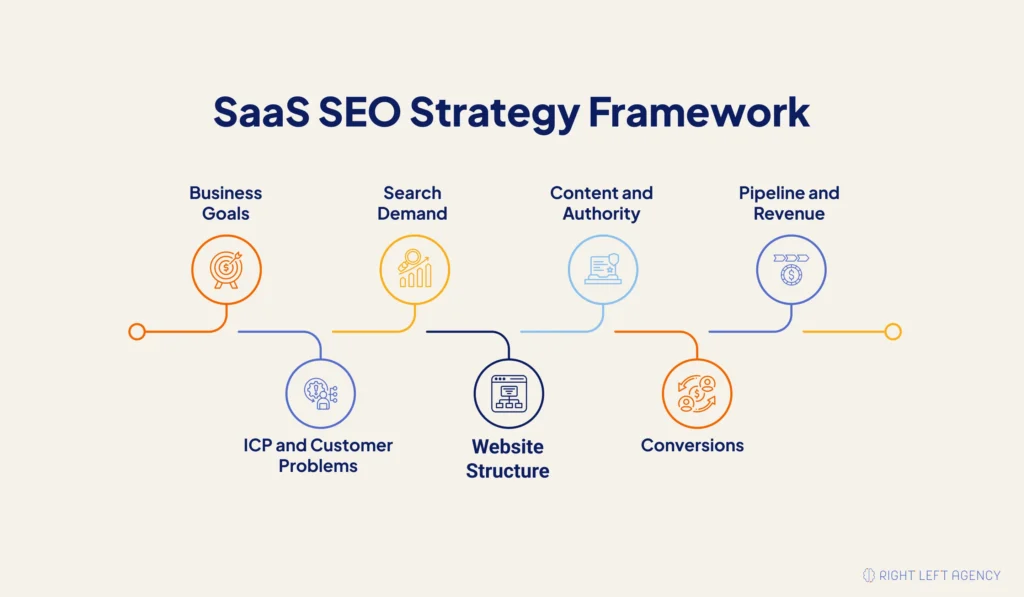
Each layer supports the next. Weakness in one area can reduce the effectiveness of the entire strategy.
How to Build a SaaS SEO Strategy
The following steps should generally be completed in sequence. Mature SaaS companies may work across technical SEO, content, authority, and conversion optimization simultaneously, but every activity should support the same strategic direction.
Step 1: Define the Business and Revenue Goals
Start by defining what SEO should achieve for the business.
Focus on meaningful actions, such as:
- Free trials
- Freemium signups
- Demo requests
- Contact inquiries
- Product-qualified leads
- Sales opportunities
Then identify the products, audiences, or markets that matter most. Small-business and enterprise buyers often need different SEO priorities because their search behavior and buying journeys differ.
Work backward from goals such as revenue, qualified pipeline, trial volume, conversion rate, and customer acquisition cost.
For example, if you want 100 more organic trials each month, estimate how much qualified traffic you need based on your current conversion rate.
Keep the plan realistic. Your goals should match the available time, expertise, budget, and team ownership. SEO should support the wider SaaS marketing strategy, not operate on its own.
Step 2: Define the ICP, Buying Committee, and Customer Problems
Your ideal customer profile helps you focus on search opportunities that can attract real buyers.
Separate company-level traits from the people involved in the purchase.
Company traits may include:
- Industry
- Company size
- Revenue
- Technology stack
- Location
- Growth stage
- Compliance needs
The buying committee may include users, managers, executives, technical evaluators, security teams, and procurement.
Each person searches differently. Users may want a faster workflow, while executives focus on ROI, security, and implementation risk.
For each audience, identify:
- Key problems
- Desired outcomes
- Objections
- Buying criteria
- Trigger events
Use language from sales calls, customer interviews, support tickets, reviews, onboarding conversations, and customer success teams.
Then turn repeated questions into search topics. For example, frequent Salesforce integration questions may justify an integration page, guide, or help article.
Step 3: Audit the Existing Organic Search Position
Before creating a new SaaS SEO plan, review the website’s current performance, assets, and gaps.
Assess five key areas.
Technical Performance
Check whether search engines can access, understand, and index important pages.
Focus on:
- Crawlability and indexation
- Site structure
- JavaScript rendering
- Redirects and canonicals
- XML sitemaps
- Page experience
- Mobile usability
Prioritize issues by business impact. A problem affecting a pricing or feature page matters more than a minor issue on a low-value URL.
Existing Content
Identify:
- Pages already attracting qualified traffic
- Pages ranking between positions 4 and 20
- Outdated or declining content
- Duplicate or overlapping pages
- Content that brings traffic but no conversions
Use the findings to decide which pages should be improved, refreshed, merged, redirected, or removed.
A page already ranking in position eight may offer a faster return than creating a new one.
Commercial Page Coverage
Check whether buyers can find the pages they need to evaluate the product.
Look for gaps in:
- Product and feature pages
- Use-case pages
- Industry pages
- Integration pages
- Comparison and alternative pages
- Pricing, trial, and demo pages
These gaps often deserve priority because they limit high-intent traffic and conversions.
Authority
Review:
- Relevant backlinks
- Referring domains
- Branded search demand
- Expert or media mentions
- Partner links
- Customer proof
The goal is not to collect more links. It is to build enough relevant authority to compete for priority topics.
Measurement
Make sure organic activity connects to real business outcomes.
Review:
- Google Search Console
- Analytics events
- Trial and demo tracking
- Product analytics
- CRM attribution
- Assisted conversions
Without reliable tracking, teams may keep investing in traffic that never becomes customers.
Step 4: Build a Product-Led Keyword and Topic Map
Product-led keyword research focuses on problems your SaaS product can genuinely solve. It helps teams prioritize relevant opportunities instead of chasing high search volume alone.
Group keywords by product relevance
Common keyword groups include:
- Problem and solution keywords
- Feature and use-case keywords
- Industry and role-based keywords
- Integration and workflow keywords
- Comparison and alternative keywords
- Pricing, implementation, template, and support keywords
For example, a project management platform may target “how to manage agency projects” alongside higher-intent terms such as “agency project management software.”
Evaluate business potential
Assess each keyword based on:
- ICP and product relevance
- Search intent
- Conversion potential
- Search demand and difficulty
- Existing authority
- Competitive gaps
- Required resources
Business value should usually matter more than search volume. A lower-volume keyword tied to an urgent customer problem can generate better leads than a broad, high-traffic topic.
Cluster related keywords
Group keywords with the same intent into one page.
For each cluster:
- Choose one primary topic.
- Add supporting questions and entities.
- Select the correct page type.
- Assign it to an existing or planned URL.
- Avoid separate pages for minor keyword variations.
| Keyword Cluster | Search Intent | Product Relevance | Conversion Potential | Recommended Page Type | Priority |
|---|---|---|---|---|---|
| Problem | Informational | Medium | Low–medium | Guide or article | Based on strategic importance |
| Category | Commercial | High | High | Category or solution page | High |
| Feature | Commercial | High | High | Feature page | High |
| Use case | Commercial | High | High | Use-case page | High |
| Comparison | Commercial investigation | High | High | Comparison page | High |
| Integration | Commercial | High | Medium–high | Integration page | Medium–high |
The result should be a keyword-to-page map, not a spreadsheet of disconnected terms.
Step 5: Map Search Intent to the SaaS Customer Journey
Not every searcher is ready to start a trial or request a demo.
The page type, message, proof, and CTA should match the visitor’s current level of awareness.
| Journey Stage | Searcher Need | Typical Queries | Recommended Content | Appropriate CTA |
|---|---|---|---|---|
| Problem awareness | Understand a problem | How-to, why, definition, benchmark | Guides, research, checklists | Related guide, template, newsletter |
| Solution exploration | Explore approaches | Best methods, categories, use cases | Solution and use-case pages | Product tour, case study |
| Vendor evaluation | Compare products | Best tools, alternatives, comparisons | Comparison and alternative pages | Demo, trial, comparison guide |
| Decision | Reduce purchase risk | Pricing, security, implementation | Pricing, trust, and implementation pages | Start trial or book demo |
| Adoption and retention | Use the product successfully | Tutorials, troubleshooting, integrations | Documentation and help content | Use feature, upgrade, contact support |
Top-of-funnel content should guide readers toward the next logical step.
For example, a guide about reducing customer onboarding delays could link naturally to a workflow feature page, a relevant case study, and an onboarding template.
SEO can also support retention. Documentation, tutorials, and integration guides help customers adopt the product and discover more value after signup.
Step 6: Match Keywords With the Correct Page Types
Every keyword should be assigned to the page type that best matches the searcher’s intent.
Product and Feature Pages
Use these pages for product capabilities, category terms, and high-intent feature searches. Explain what the feature does, which problem it solves, and how users benefit.
Solution and Use-Case Pages
Use-case pages target specific workflows, roles, problems, or outcomes. They should connect the customer’s situation directly with the product’s practical value.
Industry Pages
Industry pages address sector-specific workflows, terminology, integrations, and requirements. Each page should contain genuine industry relevance rather than generic copy with a changed industry name.
Integration Pages
Integration pages explain what the connection enables, how the workflow operates, and who benefits from using the products together.
Comparison and Alternative Pages
These pages support buyers evaluating competing products or approaches. Compare capabilities, ideal use cases, limitations, pricing considerations, and implementation needs honestly.
Pillar Pages
Pillar pages provide broad coverage of an important product-relevant subject and connect readers with narrower supporting resources.
Supporting Articles
Supporting articles answer focused questions, strengthen topical coverage, and guide readers toward relevant product or commercial pages.
Templates, Tools, and Original Resources
Templates, checklists, calculators, and free tools capture utility-based searches while supporting brand exposure and link acquisition.
Documentation and Help Content
Documentation supports technical discovery, product adoption, retention, and branded search demand.
Choosing the correct page type improves relevance, protects against cannibalization, and creates a better experience for searchers.
Step 7: Design the Site Architecture and Internal Linking System
Turn your keyword map into a clear website structure built around product-relevant topics.
Connect pillar pages with supporting articles, guides with feature pages, use cases with case studies, integrations with product pages, and comparison pages with demo or trial pages.
Keep important pages easy to find through navigation and contextual internal links. Use descriptive anchor text instead of vague phrases like “click here.”
This structure also helps prevent keyword cannibalization by giving each page a clear purpose and search intent.
For example, the Complete SaaS SEO Guide can cover the broader topic, while this SaaS SEO Strategy article focuses on planning, prioritization, execution, and measurement.
Step 8: Prioritize the SEO Roadmap
Most SaaS teams cannot tackle every SEO opportunity at once. Prioritize each task based on its business value, product relevance, conversion potential, ranking opportunity, required effort, and time to impact.
Start with the highest-impact work:
- Fix technical issues affecting important pages.
- Improve tracking and attribution.
- Optimize pages already close to ranking.
- Build missing bottom-of-funnel pages.
- Strengthen internal links.
- Create priority pillars and supporting content.
- Publish authority-building assets.
- Scale what drives qualified results.
- Refresh, merge, redirect, or remove weak content.
| Opportunity | Business Value | Ranking Opportunity | Conversion Potential | Effort | Recommended Action |
|---|---|---|---|---|---|
| Existing page ranking 6–15 | High | High | High | Low–medium | Optimize first |
| Missing high-intent feature page | High | Medium | High | Medium | Build early |
| Broad high-volume guide | Medium | Low–medium | Low | High | Build after foundations |
| Low-relevance traffic topic | Low | Medium | Low | Medium | Deprioritize |
Commercial pages often deserve priority over new blog content when buyers are already searching for relevant features, integrations, comparisons, or use cases.
Step 9: Establish the Technical SEO Priorities
Technical SEO should help important pages load, rank, and scale properly.
Focus on:
- Crawlability and indexation
- JavaScript rendering
- Sitemaps and robots directives
- Canonicals and redirects
- Duplicate pages
- Page speed and mobile usability
- URL structure and structured data
- International SEO
- Scalable templates and migrations
Prioritize fixes based on business impact. A small issue on a pricing or feature page may matter more than hundreds of errors on low-value pages.
SEO and development teams should also monitor website updates, redesigns, and migrations to prevent broken links, indexing issues, or missing content.
Step 10: Build a Repeatable Content and Optimization System
A sustainable content strategy depends on a process the team can repeat consistently.
Start with topic research and prioritization, then create a clear content brief with input from subject-matter experts. Use real product examples, complete editorial and SEO reviews, add relevant internal links, and check the conversion path before publishing.
Strong SaaS content should reflect customer language, search demand, product expertise, original insight, practical examples, and clear next steps.
Ownership should also be clear. SEO guides search intent and measurement, content manages production, product confirms accuracy, sales and customer success share buyer insights, and development handles technical updates.
Before publishing, make sure each page matches its intended search intent, supports claims with evidence, adds genuine value, avoids overlap, links to relevant commercial pages, and includes a suitable CTA.
Review and update content whenever the product, customer needs, competitors, or search results change.
Step 11: Build Authority for Search and AI Discovery
Competitive SaaS topics need more than strong on-page content. They also require credible authority from trusted sources.
Build that authority through:
- Original research and industry data
- Customer case studies
- Free tools, templates, and calculators
- Expert insights
- Integration and co-marketing partnerships
- Digital PR, webinars, and guest contributions
Focus on relevance, not link volume. A trusted mention from a customer, partner, expert, or respected industry publication is often more valuable than a random backlink.
The same principle applies to AI visibility. Clear expertise, original evidence, consistent terminology, and trusted mentions help both search engines and AI systems recognize your brand as a reliable source.
The goal is simple: become a trusted authority on the topics most closely connected to your product and customers.
Step 12: Turn Organic Traffic Into Trials, Demos, and Pipeline
SEO creates business value when qualified visitors take meaningful next steps. Match each CTA with the page’s search intent. Do not place the same demo request on every article.
Use contextual product mentions and create a logical path from informational content to commercial pages.
Relevant proof may include:
- Testimonials
- Case studies
- Customer logos
- Product screenshots
- Security information
- Integration details
- Verified results
Offer different conversion options based on readiness.
| Page Intent | Primary CTA |
|---|---|
| Informational | Read a related guide or access a resource |
| Problem-aware | Explore the related solution |
| Use-case research | View a product use case or case study |
| Comparison | Compare features or book a demo |
| High commercial intent | Start a trial or request a demo |
Reduce unnecessary friction. A visitor who wants to test a self-service product should not need to complete a long enterprise form.
Track direct and assisted conversions. A top-of-funnel article may introduce a future customer who later returns through branded search, visits a feature page, and starts a trial.
Step 13: Measure SEO Against Pipeline and Revenue
Measure SaaS SEO across four levels:
Visibility
Track impressions, non-branded clicks, keyword coverage, rankings, share of voice, and branded search growth. These metrics show whether more people are finding your brand.
Engagement
Monitor visits to commercial pages, internal-link clicks, CTA engagement, returning visitors, downloads, and product-tour activity. These signals show whether users are moving closer to conversion.
Conversions
Track trial signups, demo requests, qualified leads, trial-to-paid conversions, and assisted conversions.
Revenue
Measure organic pipeline, closed-won revenue, MRR or ARR, acquisition cost, CAC payback, customer lifetime value, and expansion revenue.
Connect data from search, analytics, product, marketing automation, and CRM platforms. Avoid relying only on last-click attribution because organic content often supports several stages of the buying journey.
Step 14: Review, Refresh, and Adapt the Strategy
A SaaS SEO strategy needs regular review, not a one-time setup.
Monthly Review
Check:
- Technical issues and indexation
- Rankings and organic clicks
- Conversions
- Internal-link opportunities
- New content performance
Quarterly Review
Review:
- Keyword and topic priorities
- Content decline
- Product and competitor changes
- Commercial content gaps
- Conversion and pipeline results
Annual Review
Reassess:
- ICP and positioning
- New products or markets
- Go-to-market strategy
- Website structure
- Resource allocation
Based on performance, refresh, expand, merge, redirect, reposition, remove, or repurpose content.
Product updates should also shape SEO priorities. New features, integrations, or markets can create fresh search opportunities across the website.
How the Strategy Changes by SaaS Growth Model
The core framework stays the same, but execution should match the company’s go-to-market model.
Product-Led SaaS
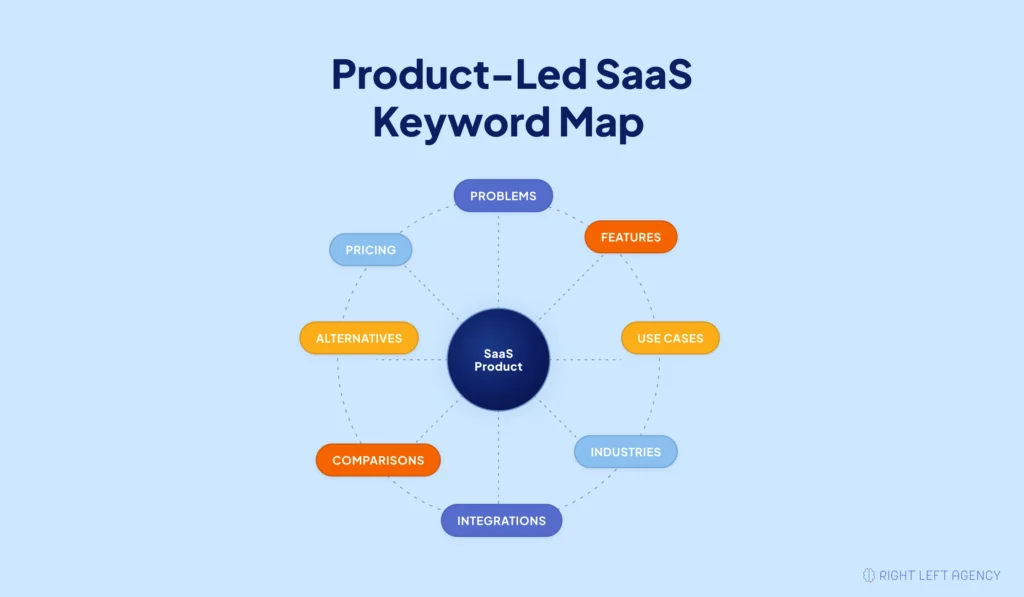
Product-led companies should focus on content that helps users discover, try, and adopt the product.
Priorities include:
- Free tools and templates
- Use-case and integration pages
- Feature-led content
- Trial-focused CTAs
- Product education
- Product-qualified lead tracking
SEO should create a clear path from search to product usage.
Sales-Led B2B SaaS
Sales-led SaaS companies need content that supports longer buying cycles and multiple decision-makers.
Priorities include:
- Industry and executive-level content
- ROI and case studies
- Security and compliance pages
- Implementation and comparison content
- Demo-focused CTAs
- Pipeline attribution
The content should reduce risk and help buyers make confident decisions.
Hybrid SaaS
Hybrid companies need separate journeys for self-service users and enterprise buyers.
Use product-led content to drive signups and adoption. Use sales-led content to support larger, more complex deals.
Track product signups and sales pipeline separately to measure both motions accurately.
Example 12-Month SaaS SEO Roadmap
The following roadmap turns the framework into a practical implementation sequence.
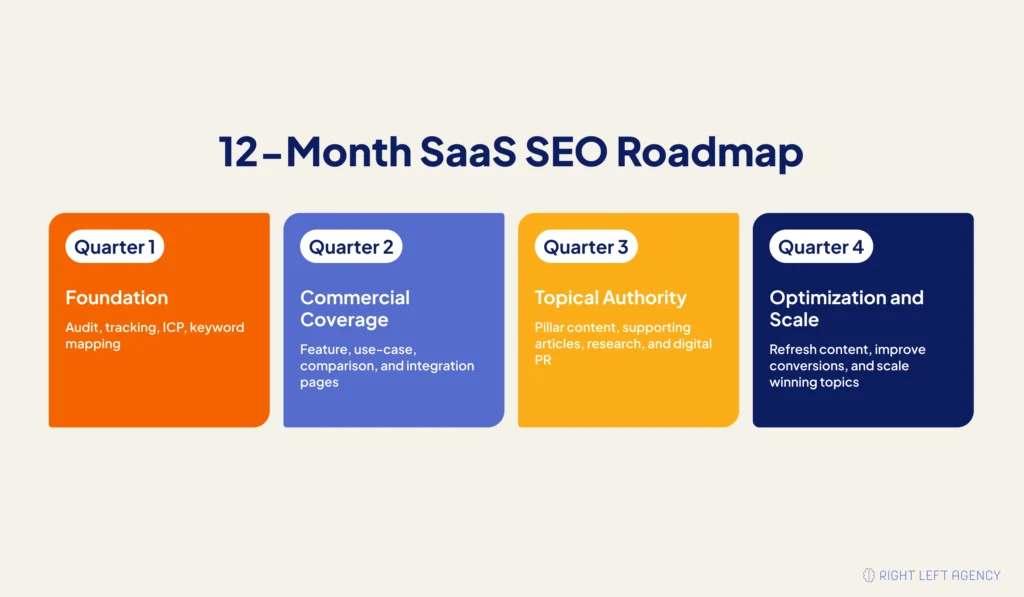
| Phase | Strategic Focus | Priority Actions |
|---|---|---|
| Quarter 1: Foundation | Research, measurement, and technical stability | Define goals, clarify the ICP, audit the site, fix tracking, identify technical blockers, and build the keyword and page map |
| Quarter 2: Commercial Coverage | Capture high-intent demand | Build or improve feature, use-case, integration, comparison, and solution pages; strengthen internal linking |
| Quarter 3: Topical Authority | Expand strategic coverage | Publish pillar and supporting content, launch original assets, and begin digital PR and partnership campaigns |
| Quarter 4: Optimization and Scale | Improve returns from existing assets | Refresh content, consolidate overlap, improve conversions, scale winning clusters, and review pipeline contribution |
Content production can begin during the first quarter once the initial research and architecture are clear. However, teams should avoid scaling publication before resolving major tracking, technical, or intent problems.
Authority campaigns should begin when the company has credible assets and priority pages worth promoting.
Common SaaS SEO Strategy Mistakes
Common mistakes include:
- Starting with keyword volume instead of business goals
- Targeting topics with little connection to the product
- Publishing only top-of-funnel content
- Ignoring feature, use-case, integration, and comparison pages
- Treating every keyword variation as a separate page
- Copying competitors without considering product positioning
- Separating SEO from product, sales, and customer success
- Publishing without an internal-linking plan
- Measuring traffic without tracking trials, demos, or pipeline
- Continuing to publish while outdated content declines
- Failing to assign ownership
- Treating SEO as a one-time campaign
SaaS SEO often generates traffic without signups because the strategy attracts broad audiences, targets low-value topics, or lacks clear conversion paths.
Publishing more content will not solve weak positioning, missing commercial pages, poor technical health, or inaccurate attribution.
When Should a SaaS Company Hire an SEO Agency?
An in-house team may be enough if the company already has an experienced SEO lead, subject-matter experts, development support, consistent content capabilities, and reliable performance tracking.
Agency support may be a better fit when growth has stalled, paid acquisition is carrying too much weight, specialist capacity is limited, or SEO efforts remain disconnected.
Look for a SEO services partner for SaaS companies that can align technical SEO, content, authority building, analytics, product positioning, and revenue goals.
Right Left Agency helps SaaS companies build a focused SEO roadmap, improve high-intent search visibility, and connect organic growth with trials, pipeline, and recurring revenue.
Final Thoughts
A SaaS SEO strategy is not an editorial calendar, keyword spreadsheet, or collection of isolated optimization tasks.
It connects customer problems, search demand, product positioning, website architecture, technical foundations, content, authority, conversion paths, and revenue measurement.
You do not need to implement every tactic at once. Begin with the gaps that combine strong business value, product relevance, conversion potential, and realistic ranking opportunity.
Fix technical access and measurement first. Strengthen high-intent commercial coverage. Then build topical authority, external credibility, and a repeatable optimization process.
Most importantly, evaluate performance through qualified trials, demos, pipeline, and revenue contribution—not traffic alone.
For broader education, explore the Complete SaaS SEO Guide. For implementation support, schedule a growth session to build a practical SEO roadmap around your product, audience, and revenue goals.
Frequently Asked Questions
What is a SaaS SEO strategy?
A SaaS SEO strategy is a structured plan that connects customer search demand with product-relevant pages, content, technical foundations, authority signals, conversion paths, and revenue goals. It guides what a SaaS company should target, build, prioritize, measure, and improve to generate qualified organic growth.
How do you create an SEO strategy for a SaaS company?
Set business goals, define the ideal customer profile, audit current performance, map keywords and topics, assign each cluster to the correct page type, prioritize execution, strengthen technical foundations, build authority, and measure trials, demos, pipeline, and revenue.
What should a SaaS SEO strategy include?
A complete strategy should include:
- Business and revenue goals
- ICP and buying committee research
- Keyword and topic mapping
- Website architecture
- Technical SEO priorities
- Content planning
- Authority building
- Conversion paths
- Attribution
- Refresh and review processes
What is the difference between a SaaS SEO strategy and a SaaS content strategy?
A SaaS SEO strategy covers the complete organic growth system, including technical SEO, keyword targeting, architecture, content, authority, conversions, and revenue measurement.
A SaaS content strategy focuses specifically on what content should be created, who it serves, which formats to use, and how it should be distributed, updated, and maintained.
How long does a SaaS SEO strategy take to produce results?
There is no fixed timeline. Results depend on the website’s existing authority, technical health, competition, resources, product demand, and the keywords being targeted.
Leading indicators such as improved crawling, indexation, rankings, and impressions usually appear before meaningful trial, pipeline, or revenue growth.
How often should a SaaS SEO strategy be reviewed?
Monitor performance monthly, review priorities quarterly, and complete a broader strategic review annually.
Additional reviews may be necessary after product launches, website migrations, market changes, positioning updates, or shifts in the go-to-market model.
Which metrics should SaaS companies use to measure SEO?
SaaS companies should prioritize:
- Qualified organic traffic
- Trial signups
- Demo requests
- Product-qualified leads
- Marketing-qualified leads
- Sales-qualified leads
- Organic pipeline
- Closed-won revenue
- Organic customer acquisition cost
- MRR or ARR influenced by organic search