Key Takeaways
- Audit conversion tracking and CRM data before changing PPC campaigns.
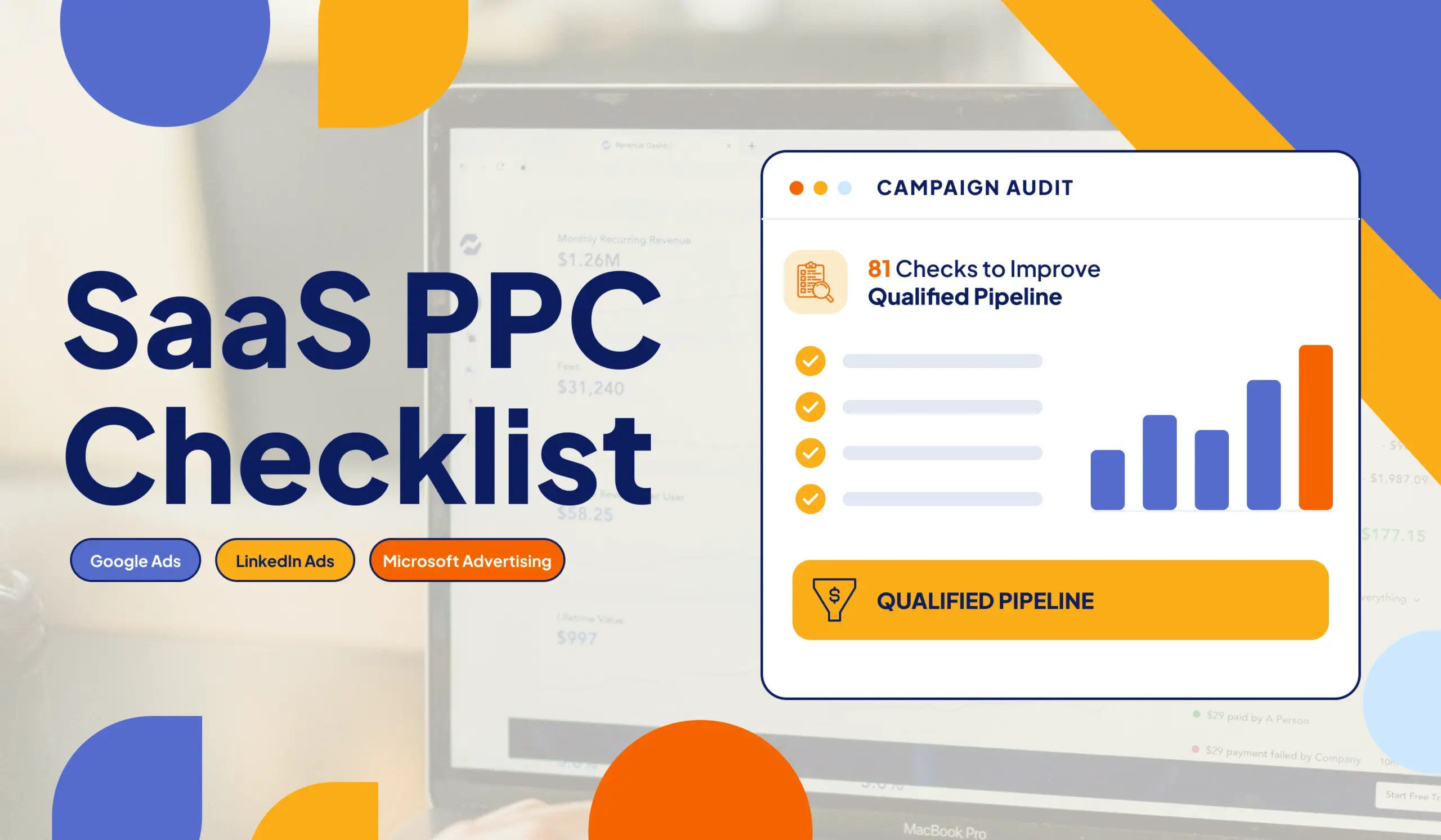
- Review 81 checks across Google Ads, LinkedIn, and Microsoft Advertising.
- Measure cost per SQL and opportunity, not just cost per lead.
- Check AI Max, Performance Max, and bidding settings for wasted spend.
- Use the free Excel checklist to score campaigns and prioritize improvements.
Your SaaS PPC campaigns may generate cheaper leads without producing qualified sales opportunities. When conversion tracking focuses on form submissions instead of qualified prospects, advertising platforms can optimize for volume rather than business value.
A structured SaaS PPC checklist helps identify these gaps across Google Ads, LinkedIn Ads, and Microsoft Advertising.
This guide covers 81 essential audit checks, from conversion tracking and CRM integration to campaign optimization and landing pages. Use the free Excel template to evaluate performance, identify wasted spend, and prioritize improvements that support qualified pipeline growth.
What Should a SaaS PPC Checklist Include?
A SaaS PPC checklist should assess whether paid advertising campaigns skblvlrcbip generate qualified leads and sales opportunities.
It should examine the complete acquisition process, from defining a profitable customer to connecting advertising activity with CRM outcomes.
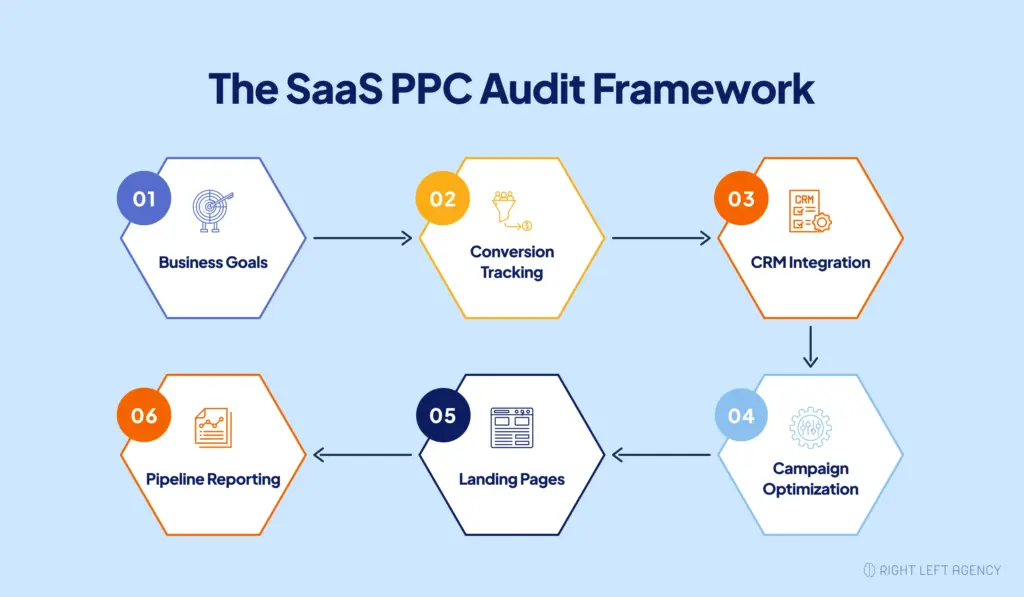
An effective B2B SaaS PPC audit covers 13 areas:
| Audit Area | Checks | Primary Objective |
|---|---|---|
| Business fit and unit economics | 4 | Establish acquisition spending limits |
| Conversion tracking and measurement | 11 | Verify meaningful conversion signals |
| CRM and offline conversion integration | 8 | Connect ads with sales outcomes |
| Account structure and settings | 9 | Control budgets and campaign intent |
| Keywords and search terms | 8 | Identify irrelevant traffic and wasted spend |
| AI Max and Performance Max | 8 | Evaluate automated campaign controls |
| Bidding and budget management | 5 | Align optimization with business value |
| Ads, assets, and messaging | 5 | Attract relevant prospects |
| Audiences and exclusions | 3 | Improve targeting efficiency |
| Landing pages and conversion paths | 7 | Convert relevant traffic into leads |
| LinkedIn Ads | 6 | Improve B2B lead quality |
| Microsoft Advertising | 2 | Evaluate additional search opportunities |
| Reporting and governance | 5 | Measure pipeline performance |
| Total | 81 | Evaluate SaaS PPC effectiveness |
These checks are most useful when completed in a logical sequence.
For example, improving ad copy may increase click-through rates, but that improvement does not necessarily increase pipeline if the account tracks unqualified form submissions as successful conversions.
Start with business economics and measurement. Then evaluate campaigns, automation, creative assets, and landing-page performance.
If your organization needs help evaluating these areas, explore Right Left Agency’s B2B SaaS paid search management approach.
For a separate assessment focused specifically on budget expansion decisions, read our guide on whether you should increase Google Ads spend.
SaaS PPC Audit: Quick Navigation
Use the following sections to review your account in order:
- Business Fit and Unit Economics
- Conversion Tracking and Measurement
- CRM and Offline Conversion Integration
- Campaign Structure and Search Intent
- AI Max and Performance Max
- Bidding, Creative, and Audience Targeting
- Landing Pages and Conversion Paths
- LinkedIn and Microsoft Advertising
- Reporting and Governance
SaaS PPC Audit Checklist
A complete step-by-step checklist to optimize your ad spend, lower CAC, and scale your SaaS.
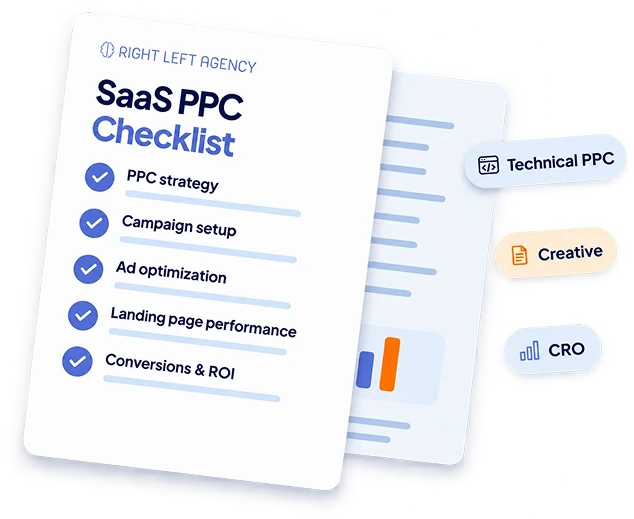
The audit template is designed to include:
- 81 audit checks: Evaluate campaign setup, tracking, automation, and reporting.
- Weighted scorecard: Identify critical, high-priority, and medium-priority issues.
- Audit verdict: Determine whether to scale, fix, pause scaling, or rebuild.
- Spend guardrails calculator: Estimate allowable acquisition costs.
- Action plan: Organize improvements by priority and ownership.
- Optimization schedule: Track weekly, monthly, and quarterly responsibilities.
How to Use the SaaS PPC Checklist
Review every applicable check and assign one of four statuses:
- Pass: The requirement is properly implemented and verified.
- Partial: Some elements work, but improvements are necessary.
- Fail: The requirement is missing, ineffective, or incorrectly configured.
- N/A: The requirement does not apply to your advertising account.
Each check receives a priority weight:
| Priority | Weight | Meaning |
|---|---|---|
| Critical | 3 | A foundational issue affecting measurement or performance |
| High | 2 | An important optimization opportunity |
| Medium | 1 | A recommended improvement |
A passing check earns its full weighted value. A partial check earns half, while a failed check receives zero.
Checks marked N/A are excluded from the applicable-score calculation.
The resulting score helps guide decisions:
| Audit Result | Suggested Interpretation |
|---|---|
| Incomplete | Fewer than 80% of applicable checks have been assessed |
| Stop Scaling | A critical tracking or CRM integration failure exists |
| Ready to Scale | Score of at least 80%, with no critical failures |
| Fix First | Score of at least 60%, but important problems remain |
| Rebuild | Score below 60% |
These thresholds are suggested internal decision rules, not established PPC industry benchmarks.
An audit score measures configuration and process readiness, not profitability. An account scoring 85% can still lose money if customer acquisition costs exceed sustainable limits.
Before increasing advertising spend, compare the checklist results with qualified pipeline performance, acquisition economics, and your organization’s sales capacity.
Phase 1: Business Fit and Unit Economics
Before reviewing advertising performance, determine what a profitable customer looks like.
A campaign can generate leads cheaply and still underperform financially if those leads rarely become paying customers.
Your audit should begin with customer acquisition economics and a documented ideal customer profile.
Business Fit Checklist: 4 Checks
- Critical: Define your ICP using company size, industry, geography, decision-maker roles, buying needs, and disqualification criteria.
- Critical: Calculate allowable lead, SQL, and opportunity acquisition costs using annual contract value (ACV), gross margin, and your customer acquisition cost (CAC) payback target.
- High: Define paid advertising objectives based on qualified pipeline, demand capture, or validated market testing.
- High: Match offers to buying intent, such as product demos for high-intent prospects and educational resources for research-stage buyers.
How Do You Calculate an Acceptable SaaS Cost per Lead?
A reasonable SaaS cost per lead depends on customer value, conversion rates, gross margin, and how much acquisition spending your business can support.
There is no universal target CPL that works for every SaaS company.
Consider the following hypothetical example.
| Metric | Example |
|---|---|
| Annual contract value | $24,000 |
| Gross margin | 78% |
| Target CAC payback period | 18 months |
| Maximum allowable CAC | $28,080 |
| Paid media allocation (50%) | $14,040 |
| Opportunity-to-customer win rate | 25% |
| SQL-to-opportunity rate | 50% |
| Lead-to-SQL conversion rate | 30% |
Based on these assumptions:
- Maximum cost per opportunity: $3,510
- Maximum cost per SQL: $1,755
- Maximum cost per lead: Approximately $527
The calculation works backward from allowable acquisition spending.
Monthly gross profit per customer:
$24,000 ÷ 12 × 78% = $1,560
Maximum allowable CAC:
$1,560 × 18 months = $28,080
Paid media allocation:
$28,080 × 50% = $14,040
Maximum cost per opportunity:
$14,040 × 25% = $3,510
Maximum cost per SQL:
$3,510 × 50% = $1,755
Maximum cost per lead:
$1,755 × 30% = $526.50
These numbers are illustrative planning assumptions, not SaaS industry benchmarks.
The model assumes stable customer revenue and gross margin during the payback period. The 50% paid-media allocation is also a hypothetical budgeting choice, not a standard CAC calculation.
Your actual limits should reflect retention, expansion revenue, sales expenses, software costs, and other acquisition-related spending.
Why Cost per Lead Alone Can Be Misleading
Imagine a SaaS company spends $15,000 on paid advertising and generates:
- 60 leads
- 15 sales-qualified leads
- 3 sales opportunities
Its acquisition metrics would be:
| Metric | Actual Cost | Allowable Cost |
|---|---|---|
| Cost per lead | $250 | $527 |
| Cost per SQL | $1,000 | $1,755 |
| Cost per opportunity | $5,000 | $3,510 |
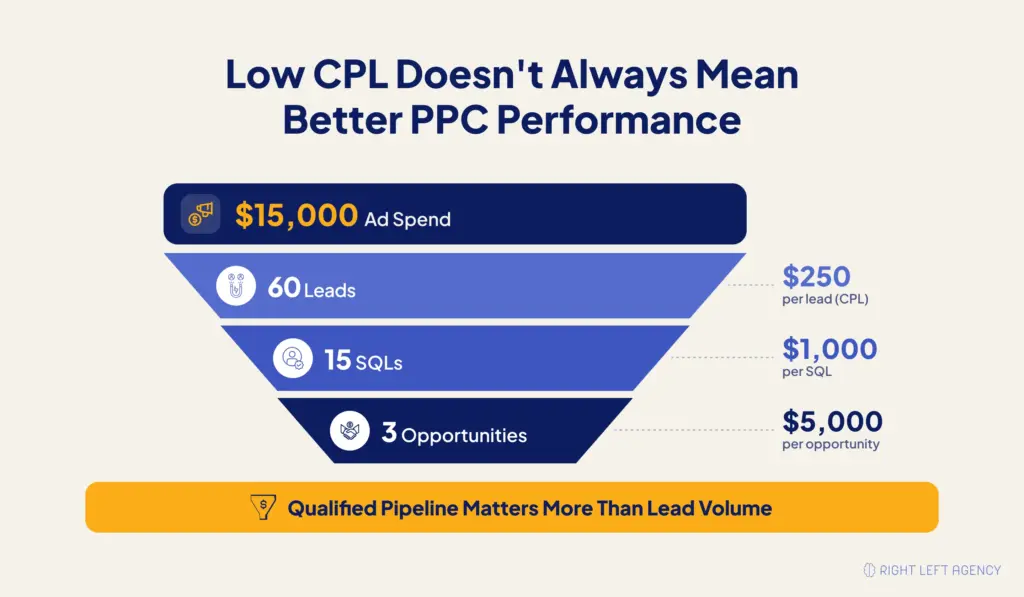
Although cost per lead is efficient, cost per opportunity exceeds the company’s calculated limit by efvxd 42%.
That difference suggests a qualification, conversion, or campaign targeting problem worth investigating.
The practical lesson: Evaluate paid advertising against the deepest reliable sales outcome available rather than assuming that lower CPL always indicates better performance.
Phase 2: Conversion Tracking and Measurement
Conversion tracking determines how advertising platforms evaluate campaign success.
For B2B SaaS companies, tracking only form submissions can produce misleading results because not every submission represents a qualified buyer.
Google Ads Smart Bidding uses conversion and value signals to guide its optimization decisions.
If the account primarily rewards low-quality conversions, advertising automation may prioritize similar traffic.
Conversion Tracking Checklist: 11 Checks
- Critical: Select a meaningful primary conversion, ideally a qualified demo, qualified lead, SQL, or opportunity when sufficient reliable data is available.
- Critical: Keep supporting micro-conversions, such as page views, scrolls, and content downloads, outside primary bidding goals unless deliberately used for a specific strategy.
- Critical: Check conversion counting settings and eliminate duplicate reporting between Google Ads tags, GA4 imports, and CRM uploads.
- Critical: Test lead forms, demo requests, booking confirmations, and other essential conversion events end to end.
- Critical: Verify auto-tagging and confirm that Google Click IDs survive applicable redirects, forms, and booking workflows.
- High: Review enhanced conversions settings and diagnostics where the feature applies and consent requirements permit.
- High: Check Consent Mode implementation and applicable consent signals for traffic subject to relevant privacy requirements.
- High: Assign meaningful conversion values that distinguish qualified opportunities from lower-value actions.
- High: Configure conversion windows to accommodate realistic sales qualification and offline import timing.
- High: Filter spam, invalid submissions, and duplicate leads from reporting and downstream optimization signals.
- Medium: For product-led SaaS businesses, track relevant activation milestones or product-qualified lead (PQL) events.
What Should SaaS Google Ads Count as a Primary Conversion?
The primary conversion should reflect a commercially meaningful action and provide sufficient reliable data for campaign optimization.
For example, an enterprise SaaS company may prefer SQLs or opportunities because the business values qualified meetings more than basic contact submissions.
However, accounts with limited conversion volume may need to begin with an earlier, well-qualified event.
A practical conversion structure might include:
| Conversion Event | Suggested Role |
|---|---|
| Page view | Engagement measurement |
| Whitepaper download | Secondary conversion |
| Unqualified demo submission | Secondary or diagnostic event |
| Qualified demo request | Potential primary conversion |
| Sales-qualified lead | Primary when sufficient volume exists |
| Sales opportunity | Primary or value-based bidding signal |
| Closed-won customer | Revenue attribution and value measurement |
The objective is not to make every conversion action primary. It is to help the advertising platform distinguish valuable outcomes from lower-intent activity.
Where to Check Conversion Settings in Google Ads
To review conversion optimization settings:
- Open Google Ads and navigate to Goals → Conversions → Summary.
- Locate the conversion goal you want to evaluate.
- Review its conversion actions and primary or secondary status.
- Confirm that the campaign uses the intended conversion goal for bidding.
- Check conversion diagnostics and compare reported events against CRM records.
Google notes that secondary conversion actions are generally used for observation rather than bidding. However, secondary actions included in custom goals can still influence bidding.
Therefore, verify both the action settings and the campaign’s selected goals.
Phase 3: Connect PPC Campaigns With CRM and Offline Conversions
B2B SaaS buying journeys often involve several stakeholders, multiple interactions, and weeks or months of evaluation.
A prospect might click a paid search ad today, request a demo later, and become a customer after several sales conversations. Without CRM integration, advertising platforms may not receive information about the outcome.
This limits the organization’s ability to connect marketing investment with sales performance.
CRM and Offline Conversion Checklist: 8 Checks
- Critical: Capture available click identifiers, including GCLID and other supported identifiers where applicable, alongside campaign parameters and lead records.
- Critical: Establish a reliable automated process for importing qualified offline conversions into supported advertising platforms.
- High: Track MQLs, SQLs, opportunities, and closed-won customers as distinct lifecycle stages, with appropriate values and reporting definitions.
- High: Monitor conversion import success, matching diagnostics, delays, and conversion-window eligibility.
- High: Record lead disqualification reasons in the CRM and analyze patterns by campaign.
- Medium: Use supported conversion adjustments where appropriate to correct inaccurate or retracted conversion records.
- Medium: Maintain consistent UTM naming conventions and campaign attribution rules.
- Medium: Measure lead-response times and identify delays between inquiry submission and sales follow-up.
What Changed With Google Ads Offline Conversions in 2026?
On June 15, 2026, Google restricted new adoption of offline conversion uploads through the Google Ads API.
The Data Manager API became the primary recommended integration method for new offline conversion import implementations.
Existing eligible integrations with qualifying historical activity can continue using the Google Ads API while preparing to migrate.
This means an existing integration does not automatically become unusable simply because the June 2026 date has passed.
However, SaaS advertisers should review whether their CRM connectors and custom integrations remain supported.
Check the following:
- Whether offline conversion uploads continue successfully.
- Whether the integration uses an eligible existing Google Ads API connection or the Data Manager API.
- Whether conversion match rates and diagnostics indicate missing data.
- Whether SQLs and opportunities reach the platform within applicable attribution windows.
Google also recommends enhanced conversions for leads, which can use appropriately processed first-party customer data to improve conversion matching.
How to Verify CRM Conversion Imports
Start by comparing recent CRM lifecycle events against the conversion data reported in the advertising platform.
For example, select a group of recent sales-qualified leads and verify whether their conversion events were successfully imported.
Review:
- Missing or unmatched records
- Conversion timestamps and attribution windows
- Lead identifiers and campaign attribution fields
- Import errors and processing delays
- Differences between CRM opportunity counts and advertising reports
Not every CRM opportunity will necessarily be attributed to advertising. The goal is to identify unexplained discrepancies and ensure that eligible conversion data is processed correctly.
Why CRM Integration Matters for SaaS Attribution
A CRM connection helps distinguish between marketing activity and actual pipeline contribution.
It can reveal whether a campaign generates genuine sales opportunities or mainly produces leads that sales teams eventually disqualify.
It can also support more accurate campaign comparisons when sales cycles are long.
Our guide to SaaS marketing attribution explains how to evaluate marketing influence across multiple customer touchpoints.
Phase 4: Review Campaign Structure, Keywords, and Search Intent
An effective SaaS PPC account should separate different types of search demand.
Someone searching for your product name has a different level of awareness than someone researching a problem your software solves.
Combining these audiences without meaningful reporting separation makes campaign performance harder to interpret.
A structured audit should examine both campaign organization and actual search queries.
Account Structure Checklist: 9 Checks
- Critical: Organize campaigns around meaningful intent categories, including branded, non-branded, competitor, and problem-aware searches, with appropriate budget controls.
- High: Separate branded and non-branded performance so existing brand demand does not hide new-customer acquisition results.
- High: Review Search Network settings, including Search Partners and Display expansion, against qualified conversion results.
- High: Verify location targeting and decide whether presence-based targeting or broader geographic intent makes sense.
- High: Review automatically applied recommendations and disable changes that conflict with your campaign strategy.
- Medium: Confirm targeted countries and regions align with your company’s sales and service capabilities.
- Medium: Group relevant keywords around closely related intent and suitable landing pages.
- Medium: Evaluate device and ad-schedule performance using downstream conversion quality.
- Medium: Review campaign change history for unexplained modifications.
Keywords and Search Terms Checklist: 8 Checks
- Critical: Review available search terms and insights regularly across applicable Search, AI Max, and Performance Max campaigns.
- High: Build negative keyword lists for irrelevant employment, educational, unrelated industry, and unsupported product searches.
- High: Exclude customer-support, account-login, and existing-customer queries from acquisition campaigns where appropriate.
- High: Review broad, phrase, and exact match strategies based on conversion quality and bidding readiness.
- High: Identify high-spend search terms or keyword groups that fail to produce qualified outcomes over an appropriate evaluation period.
- Medium: Evaluate competitor campaigns separately and use accurate, policy-compliant comparison messaging.
- Medium: Target relevant commercial-intent searches such as software alternatives, comparisons, and category-specific solutions.
- Medium: Review negative keyword conflicts, duplicate targeting, and inactive or ineffective keywords.
Which PPC Keywords Matter Most for B2B SaaS?
High-intent SaaS keywords generally indicate that a prospect is evaluating software or preparing to make a purchasing decision.
Common examples include:
- Best [software category] for [industry]
- [Software category] pricing
- [Competitor] alternatives
- [Product A] vs. [Product B]
- Enterprise [software category]
- [Software category] integration with [platform]
However, keyword intent must be interpreted in the context of your product, ideal customer profile, and average deal size.
A comparison keyword can attract qualified buyers for one SaaS product while generating low-value traffic for another.
The most useful keyword strategy consistently connects relevant search intent with measurable sales opportunities.
Phase 5: Audit AI Max and Performance Max Campaigns
Google’s AI-powered advertising capabilities have expanded significantly, increasing automation across targeting, ad creation, and landing-page selection.
For SaaS advertisers, these features may help discover additional relevant demand.
However, they can also make it harder to understand why campaigns serve for particular searches or send traffic to specific pages.
That makes automation controls an essential part of a modern SaaS PPC checklist.
AI Max and Performance Max Checklist: 8 Checks
- High: Identify Search campaigns using AI Max and document active settings, including search term matching, text customization, and final URL expansion.
- High: Review final URL expansion and apply appropriate URL exclusions to prevent irrelevant landing-page selections.
- High: Analyze AI Max search terms and evaluate available brand, location, and targeting controls.
- High: Review AI-generated ad text and assets for factual accuracy, brand consistency, and advertising compliance.
- Medium: Identify Dynamic Search Ads campaigns that require migration planning before the scheduled transition.
- Critical: Ensure Performance Max uses meaningful conversion goals, with qualified-event signals or reliable qualified proxies where sufficient data supports optimization.
- High: Review available Performance Max negative keyword controls, brand exclusions, search terms, and channel-level performance.
- Medium: Review placements, customer acquisition settings, and available audience exclusions to reduce irrelevant spend.
What Changed With AI Max in 2026?
Google moved AI Max for Search campaigns out of beta in April 2026.
Starting in September 2026, Google began automatically upgrading eligible Search campaigns using campaign-level broad match settings or automatically created assets.
The automatic upgrade for Dynamic Search Ads was postponed until February 2027.
As a result, SaaS advertisers should verify which campaigns have already transitioned and which settings remain active.
AI Max introduces capabilities such as:
Search term matching: Expands matching beyond existing keyword coverage using automated relevance signals.
Text customization: Uses available campaign assets and website information to generate or adapt advertising messages.
Final URL expansion: Allows Google to select relevant landing pages from a website rather than always using the advertiser’s specified final URL.
These capabilities can improve relevance, but each requires appropriate oversight.
For example, a B2B SaaS campaign promoting an enterprise software demo should avoid sending paid traffic to unrelated career, login, or support pages.
URL exclusions can help reduce these risks when final URL expansion is enabled.
Where to Review AI Max Settings
In Google Ads, open the relevant Search campaign and review its AI Max settings.
Check whether search term matching, text customization, and final URL expansion are active.
If final URL expansion is enabled, review the URL exclusions to ensure unsuitable pages are not eligible as landing pages.
You can also use AI Max search term reporting to examine automated matching and the landing pages selected for relevant traffic.
For a more detailed explanation, read our guide on which AI Max features to keep or turn off.
What Should You Check in Performance Max?
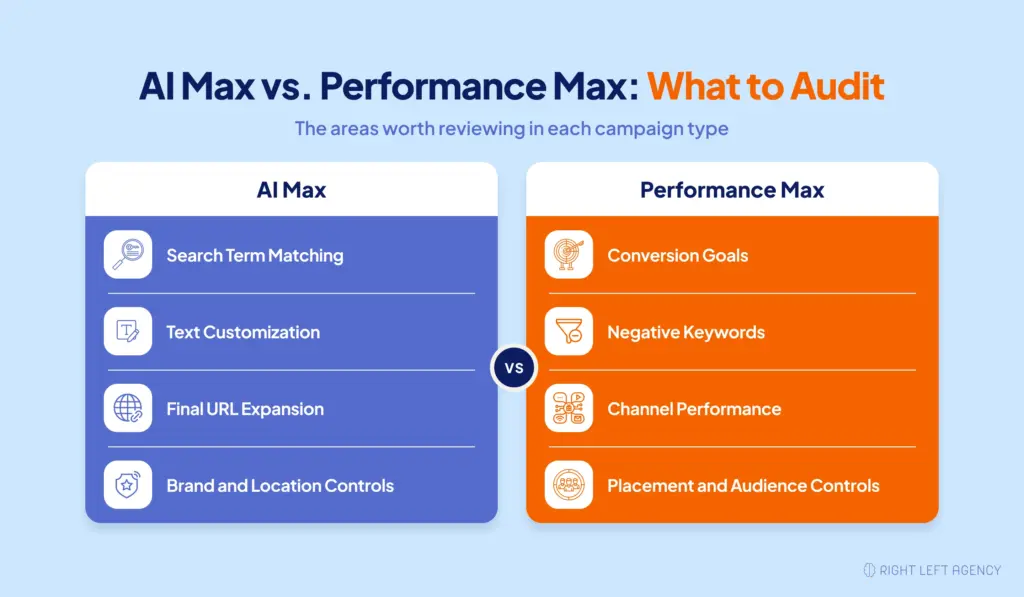
Performance Max can serve advertising across several Google inventory channels.
For SaaS businesses, this flexibility increases the importance of understanding where budget is being spent.
Google has introduced more campaign-level controls and reporting capabilities, including negative keyword support and channel performance reporting.
Performance Max supports up to 10,000 campaign-level negative keywords.
However, negative keywords primarily control relevant search queries. They do not provide a universal mechanism for blocking weak display or video placements.
Therefore, advertisers should examine search term insights, channel-level results, and available placement information together.
The objective is to determine whether Performance Max contributes qualified pipeline efficiently compared with alternative campaign strategies.
Phase 6: Evaluate Bidding, Advertising Creative, and Audience Targeting
Once tracking and conversion quality are reliable, review how the advertising platforms allocate budget.
Bid strategies should reflect business objectives, conversion volume, and customer economics.
Creative messaging should also help prospective customers understand whether the product meets their needs before they click.
Bidding and Budget Checklist: 5 Checks
- High: Select bidding strategies that fit the campaign’s conversion volume, data quality, and business objective.
- High: Establish CPA or ROAS targets using conversion value and allowable acquisition costs rather than relying exclusively on historical CPL.
- High: Review whether profitable, high-intent campaigns are constrained by budget while weaker campaigns continue spending.
- Medium: Monitor bidding strategy status and avoid unnecessary frequent changes that disrupt performance evaluation.
- Medium: Use appropriate data exclusions for qualifying tracking disruptions and review budget pacing regularly.
Ads and Messaging Checklist: 5 Checks
- High: Write responsive search ads that communicate the target customer, product benefit, supporting proof, and next step.
- High: Use qualifying language, such as industry, audience, or pricing information, where it can reduce irrelevant clicks.
- High: Align advertising promises, landing-page headlines, and conversion offers.
- Medium: Use relevant assets, including sitelinks, callouts, and structured snippets, to answer purchasing questions.
- Medium: Review ad asset performance and replace ineffective messaging through a controlled testing process.
Audience and Exclusion Checklist: 3 Checks
- High: Use eligible first-party customer and prospect audiences as targeting signals or exclusions where appropriate.
- Medium: Segment remarketing audiences by meaningful buying behavior, such as pricing-page visits or trial engagement.
- Medium: Evaluate audience performance and observation data to identify segments that contribute to qualified pipeline.
How Can SaaS Companies Reduce Low-Quality PPC Leads?
Reducing low-quality leads requires improvements across multiple campaign components, not simply adding more negative keywords.
Start by confirming that ads reach the right audience and promote an offer that matches their buying intent.
Then examine qualification information, landing-page messaging, and sales feedback.
For example, an enterprise SaaS company might clearly communicate its target customer size, required integrations, and product positioning before asking visitors to book a demo.
This can reduce unsuitable inquiries while giving serious buyers the information they need to proceed.
Our article about paid ads optimizing for lead sales doesn’t want explores how targeting and conversion measurement can influence lead quality.
Phase 7: Audit Landing Pages and Conversion Paths
Generating a relevant click is only part of a successful PPC campaign.
The landing page must communicate the product’s value, establish credibility, and provide a clear next step.
When the advertising message and landing page do not match, prospective customers may leave before converting.
Landing-page problems can also make campaign optimization less effective because relevant traffic fails to progress through the buying journey.
Landing Page Checklist: 7 Checks
- Critical: Match important search-intent groups with relevant landing pages rather than automatically directing every campaign to a generic homepage.
- High: Provide one clear primary conversion objective, such as booking a demo, starting a trial, or requesting pricing.
- High: Collect only useful qualification information and validate submissions without adding unnecessary friction.
- High: Make it easy for qualified prospects to schedule meetings or receive an appropriate next step.
- Medium: Test mobile usability, loading performance, and Core Web Vitals where applicable.
- Medium: Include relevant customer proof, validated claims, security credentials, and product information near conversion opportunities.
- Medium: Manage duplicate or paid-only landing-page variants with appropriate indexing and canonicalization decisions.
What Makes a High-Converting B2B SaaS Landing Page?
A strong SaaS landing page explains the product’s value to the right audience and makes the next step easy to understand.
Important elements include:
Clear value proposition: Explain what the product does and who it helps.
Message consistency: Match the advertising promise with the landing-page headline and supporting content.
Relevant proof: Provide appropriate case studies, customer feedback, technical information, or measurable results.
Effective qualification: Collect information that helps sales identify suitable opportunities.
Low-friction conversion: Make demos, trials, and contact options accessible without overwhelming visitors.
Mobile usability: Ensure the page works properly across devices.
For example, visitors searching for enterprise software integrations may benefit more from an integration-focused landing page than a general product overview.
Should Paid Landing Pages Be Noindexed?
Not every paid landing page needs a noindex directive.
If a landing page provides valuable, unique information that serves organic search intent, allowing indexing may be appropriate.
When multiple versions contain substantially similar content, a canonical URL can help indicate the preferred version.
Noindex is appropriate when a page genuinely should not appear in organic search results.
The correct choice depends on page purpose, duplication, and the broader SEO strategy.
For more guidance, explore our SaaS landing page strategy.
Phase 8: Review LinkedIn Ads and Microsoft Advertising
Google Ads is not the only platform worth reviewing in a B2B SaaS PPC audit.
LinkedIn provides professional and company-level targeting capabilities, while Microsoft Advertising offers another opportunity to capture relevant search demand.
Each platform requires its own performance evaluation and measurement approach.
LinkedIn Ads Checklist: 6 Checks
- High: Verify LinkedIn Insight Tag implementation and configure supported CRM lifecycle event sharing through the Conversions API.
- High: Build audiences using relevant company characteristics, professional targeting, and matched accounts; evaluate Audience Expansion and the Audience Network deliberately.
- High: Optimize Lead Gen Forms, maintain reliable CRM synchronization, and monitor lead quality by campaign.
- Medium: Organize campaigns around appropriate buying stages, including prospecting, consideration, and account-based marketing.
- Medium: Monitor audience frequency, creative fatigue, and messaging performance.
- Medium: Select attribution windows appropriate to the sales cycle and distinguish click-through from view-through conversions.
How Can LinkedIn Ads Improve SaaS Lead Quality?
LinkedIn’s professional targeting can help advertisers reach relevant companies and decision-makers.
However, targeting precision alone does not guarantee qualified leads.
CRM feedback remains essential.
LinkedIn’s Conversions API supports qualified-lead conversion types, allowing advertisers to share lifecycle outcomes for measurement and eligible optimization workflows.
LinkedIn also supports extended attribution windows of up to 365 days for certain conversion categories, including qualified leads, where supported by the applicable integration and configuration.
These extended windows do not apply universally to every conversion type.
Advertisers should remember that attribution windows determine how outcomes receive credit. They do not independently demonstrate incremental revenue.
LinkedIn recommends sharing conversion data promptly so the information remains useful for reporting and optimization.
Microsoft Advertising Checklist: 2 Checks
- Medium: Review imported Google Ads campaigns independently, including targeting, negative keywords, bidding, budgets, and conversion settings.
- Medium: Verify Universal Event Tracking (UET), offline conversion tracking, and relevant professional targeting options supported by the account.
Is Microsoft Advertising Worth Using for B2B SaaS?
Microsoft Advertising can provide additional search visibility for SaaS companies whose prospective buyers use its search network.
It also offers targeting capabilities that can be useful in certain B2B situations, including LinkedIn profile-based targeting options.
However, campaign performance should be evaluated independently from Google Ads.
Imported campaigns may require different keyword, bid, audience, and budget decisions.
A sensible starting point is to test relevant high-intent searches and compare qualified conversion performance before expanding investment.
Phase 9: Review SaaS PPC Reporting and Governance
A PPC audit should help your team make better decisions after the initial assessment.
Without consistent reporting and operational ownership, the same problems may return.
SaaS reporting should connect advertising activity with meaningful pipeline and customer acquisition outcomes.
Reporting and Governance Checklist: 5 Checks
- Critical: Report cost per SQL, cost per opportunity, qualified pipeline, and CAC-related metrics using consistent definitions.
- High: Separate branded, non-branded, and competitor campaign results.
- High: Conduct recurring lead-quality reviews with sales and use feedback to improve targeting, exclusions, and creative.
- High: Maintain appropriate ownership, billing access, and administrator permissions for advertising accounts.
- Medium: Document campaign changes, maintain experiment records, and evaluate important tests through controlled processes.
Which SaaS PPC Metrics Matter Most?
SaaS companies should evaluate metrics according to their stage in the acquisition process.
| Metric | What It Measures |
|---|---|
| Click-through rate (CTR) | How frequently impressions generate clicks |
| Cost per click (CPC) | Average advertising cost per click |
| Cost per lead (CPL) | Advertising spend divided by leads generated |
| Cost per SQL | Advertising spend divided by sales-qualified leads |
| Cost per opportunity | Advertising spend divided by qualified opportunities |
| Lead-to-SQL rate | Percentage of leads becoming sales-qualified |
| Opportunity win rate | Percentage of opportunities becoming customers |
| Pipeline generated | Value of opportunities attributed to advertising |
| Customer acquisition cost (CAC) | Total relevant acquisition cost per customer |
| CAC payback period | Time required to recover acquisition spending from customer gross profit |
CTR and CPC help advertisers understand campaign engagement and traffic costs.
However, they cannot independently establish whether advertising produces profitable customers.
Cost per SQL, cost per opportunity, and pipeline outcomes provide more useful evidence of commercial performance when tracking is reliable.
CAC should include relevant acquisition expenses beyond media spend when calculating true acquisition economics.
Recommended PPC Optimization Schedule
| Frequency | Recommended Activities |
|---|---|
| Weekly | Check search terms, campaign spending, tracking health, bidding status, and recent lead quality |
| Monthly | Review SQL and opportunity costs, CRM imports, creative performance, sales feedback, and channel performance |
| Quarterly | Complete the full PPC audit, update acquisition cost limits, review account access, and evaluate major campaign changes |
The exact schedule should reflect account size, spending levels, conversion volume, and operational risk.
High-spend accounts may require more frequent monitoring.
What Should You Fix First After a SaaS PPC Audit?
The most effective PPC improvement plan prioritizes problems according to their impact on measurement and business outcomes.
For most SaaS accounts, foundational tracking problems deserve attention before campaign-level optimizations.
Why Conversion Tracking Comes Before Campaign Optimization
The 81-point checklist uses a dependency-based approach.
Campaign settings, bidding strategies, and creative assets influence performance, but their effectiveness becomes difficult to evaluate when conversion data is unreliable.
For example, an account might report strong conversions from broad-match keywords. If those conversions primarily represent unqualified inquiries, increasing the campaign budget could amplify the underlying problem.
This explains why the checklist places conversion tracking and CRM integration ahead of bidding and creative optimization.
However, the sequence is a prioritization framework, not an absolute rule. An urgent account-security issue, broken landing page, or severe spending error may require immediate action regardless of its position in the checklist.
1. Correct Conversion Tracking
Verify that primary conversions represent meaningful actions and that duplicate or invalid events are not inflating performance.
2. Repair CRM Integration
Ensure that available click and campaign identifiers connect advertising activity to qualified leads and opportunities.
Check offline conversion imports and data quality.
3. Establish Acquisition Cost Limits
Define realistic allowable spending based on gross margin, customer value, conversion rates, and payback expectations.
4. Improve Campaign Structure and Search Intent
Separate important intent categories, identify irrelevant search queries, and reallocate spending based on qualified conversion performance.
5. Review Advertising Automation
Evaluate AI Max, Performance Max, bidding strategies, audience settings, and landing-page expansion controls.
Keep useful automation, but ensure it follows meaningful business objectives.
6. Improve Landing Pages and Lead Follow-Up
Align landing pages with campaign intent, strengthen relevant proof, simplify conversion paths, and reduce unnecessary response delays.
7. Reassess Budget Expansion
After addressing critical issues, evaluate whether conversion quality, capacity, and acquisition economics justify additional spending.
A strong audit score can support this decision, but it does not replace financial and performance analysis.
The purpose of this process is to identify what prevents advertising investment from producing qualified pipeline, not simply to maximize an audit score.
Get a Second Opinion on Your SaaS PPC Performance
A lower cost per lead does not always mean better advertising performance.
If your campaigns generate traffic and form submissions without contributing enough qualified pipeline, the underlying problem may involve conversion tracking, CRM integration, targeting, or landing-page performance.
At Right Left Agency, our paid search approach connects campaign strategy, buyer intent, conversion measurement, and ongoing optimization with business outcomes.
Rather than evaluating paid advertising only through clicks and lead volume, we focus on understanding which activities contribute to meaningful opportunities and where acquisition performance needs improvement.
Understand What Your Paid Search Investment Should Deliver
Use the SaaS PPC checklist to identify performance gaps, prioritize improvements, and understand whether your campaigns are ready for further investment.
If you need help interpreting your results, Right Left Agency can review your current setup and identify opportunities to improve campaign efficiency and lead quality.
Frequently Asked Questions
What is a SaaS PPC checklist?
A SaaS PPC checklist is a structured framework for evaluating paid advertising performance in software-as-a-service businesses. It covers conversion tracking, CRM integration, campaign targeting, bidding, advertising automation, landing pages, and reporting to identify problems affecting qualified lead generation.
How often should SaaS companies audit PPC campaigns?
Most SaaS companies benefit from a comprehensive quarterly PPC audit, supported by weekly performance monitoring and monthly lead-quality reviews. Additional audits are useful before major budget increases, account migrations, or agency transitions.
Should B2B SaaS Google Ads optimize for leads or pipeline?
B2B SaaS advertisers should prioritize qualified business outcomes when reliable conversion volume supports optimization. SQLs, qualified demos, and opportunities may provide stronger signals than raw form submissions. Lower-volume accounts may need an earlier qualified conversion event until sufficient downstream data becomes available.
What is included in a PPC audit checklist template?
A PPC audit checklist template typically includes checks for account structure, campaign settings, keywords, conversion tracking, bidding, audiences, creative assets, landing pages, and reporting. A more advanced SaaS template also includes CRM integration, acquisition economics, scoring, and action planning.
How long does a SaaS PPC audit take?
The time depends on account complexity, campaign volume, the number of advertising platforms, and CRM accessibility. A relatively straightforward Google Ads assessment may take one or two working days, while multi-platform accounts or complicated tracking problems can require more extensive analysis.
Does AI Max replace keywords in Google Ads?
No. AI Max expands the capabilities of Search campaigns through features such as search term matching, text customization, and final URL expansion. Existing keyword targeting remains relevant, but additional automation may extend campaign reach beyond the original keyword list.
Can this checklist be used for LinkedIn and Microsoft Advertising?
Yes. Many foundational checks apply across advertising platforms, particularly those covering business economics, conversion quality, CRM integration, and reporting. The checklist also includes dedicated LinkedIn Ads and Microsoft Advertising checks. Mark platform-specific requirements as N/A when they do not apply.
What is the difference between a PPC checklist and a PPC audit?
A PPC checklist identifies the items that should be reviewed, while a PPC audit evaluates those items, determines which problems exist, and recommends corrective actions. A checklist supports consistency, but a complete audit requires interpreting findings against business objectives and campaign performance.