Key Takeaways
- A SaaS content strategy is more than a blog plan. It is a full-funnel system that connects content to organic traffic, demo requests, trials, onboarding, and revenue.
- SaaS content needs to cover the entire customer lifecycle: awareness, consideration, decision, onboarding, retention, and expansion.
- Bottom-funnel content (comparison pages, alternative pages, pricing pages) drives faster revenue impact than top-funnel educational content, especially early on.
- Product-led content solves a real user problem first and shows how your product helps second. It is not a sales pitch.
- Stop measuring content success by traffic alone. Track demo requests, trial signups, pipeline influenced, activation rate, and retention.
- A structured 90-day roadmap can take your SaaS content from scattered blog posts to a full-funnel, revenue-connected content engine.
They had a content team, a publishing schedule, and a growing list of blog posts. Every week, new articles went live. Every month, traffic crept up a little. But demos? Trials? Revenue from content? Almost nothing.
This is a common problem for SaaS teams publishing without a clear content strategy. The content machine is running, but it is not connected to the outcomes that matter. The problem is not the lack of content. The problem is the lack of a clear plan.
A SaaS content strategy connects SEO, product messaging, buyer intent, and customer lifecycle goals so content supports organic traffic, demo requests, free trials, onboarding, and revenue.
If your content is not connected to those outcomes, the issue may not be content quality. It appears your team is publishing without a clear strategy.
What Is a SaaS Content Strategy?
A SaaS content strategy is a documented plan for creating, organizing, optimizing, distributing, and measuring content that helps a SaaS company attract the right audience, convert prospects, and retain customers.
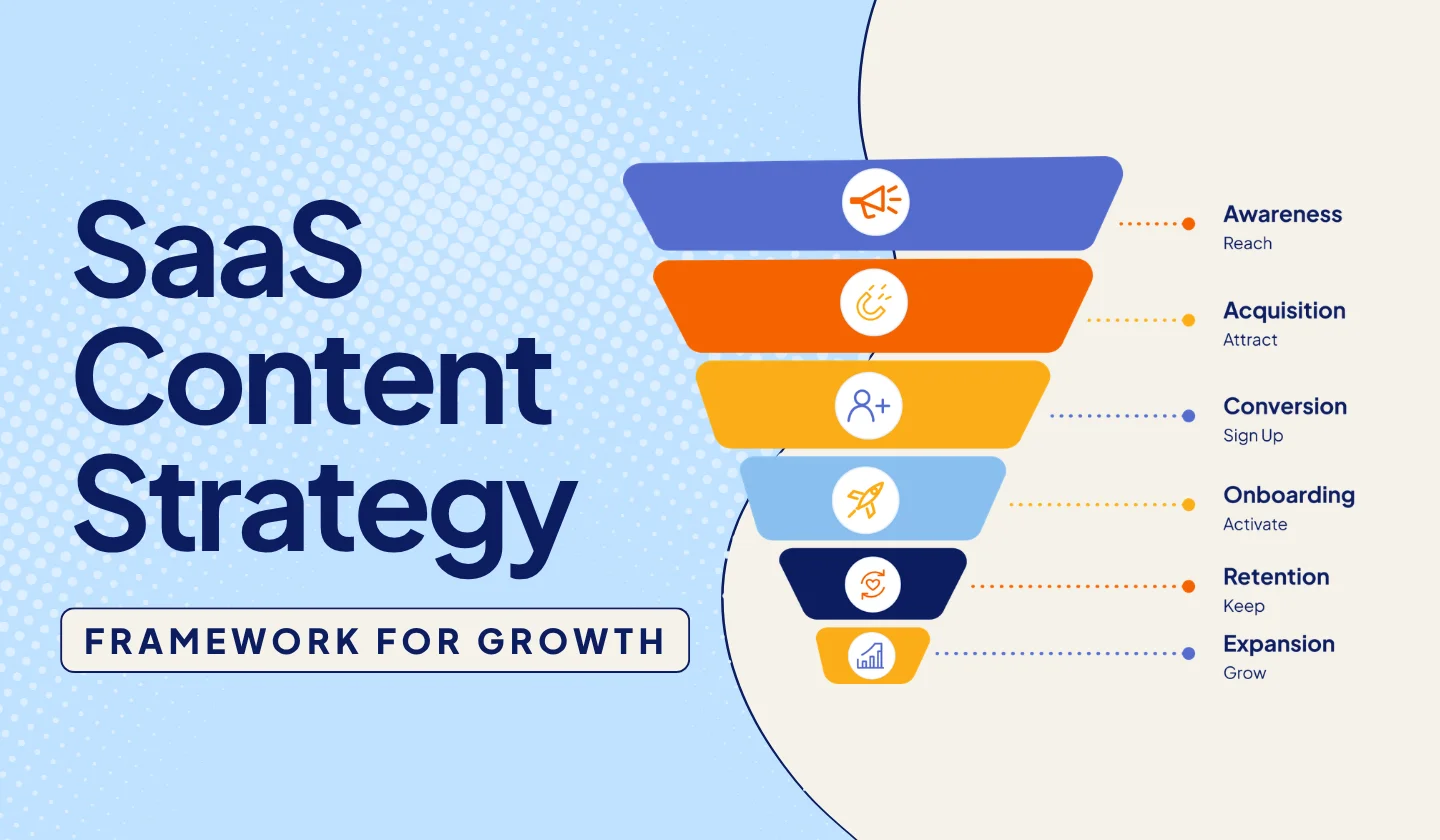
It covers the entire customer lifecycle, from the moment someone first discovers your product to long after they become a paying customer. That includes awareness, consideration, decision, onboarding, retention, and expansion. Every piece of content has a job. Every article, page, and email connects back to a business goal.
This is different from general content marketing. Most content marketing advice focuses on driving traffic and generating leads. SaaS content strategy goes much further. SaaS products have longer buying cycles. Multiple stakeholders are involved in the purchase decision. The features are often technical and need explanation. And because SaaS runs on recurring revenue through ARR and MRR, content needs to support the customer relationship long after the sale closes.
Why SaaS Companies Need a Content Strategy
Publishing blog posts without a strategy is like driving without a destination. You cover a lot of ground but end up nowhere useful.
Random content may bring traffic, but traffic alone does not create a pipeline. SaaS companies need content that attracts the right visitors, helps them understand the product, moves them toward a trial or demo, and keeps them engaged after they sign up.
Organic content can become one of the most valuable acquisition channels for SaaS companies because strong content continues to attract qualified visitors after publication. That is why content strategy and SEO need to work together.
A good B2B SaaS content strategy helps you:
- Increase qualified organic traffic by targeting keywords your ideal customers actually search for
- Generate demo requests by creating content that speaks to commercial intent
- Improve free trial signups through educational content that builds trust before the ask
- Support sales conversations by giving your team assets that address common objections
- Educate users so they activate faster and get more value from the product
- Reduce churn by helping customers succeed with ongoing educational content
- Drive retention and expansion through content that helps users discover more features and use cases
When content supports these outcomes, it can help reduce CAC pressure and improve LTV over time by attracting better-fit buyers and educating customers after signup. That is the real case for investing in a content strategy for SaaS.
How SaaS Content Strategy Differs from Regular Content Marketing
SaaS content strategy and general content marketing share some basic similarities. Both care about SEO, audience research, and quality writing, but SaaS content has a broader job.
It must explain complex products, support multiple stakeholders, reduce objections at every stage, drive demos or trials, and continue helping customers after signup.
| Factor | Regular Content Marketing | SaaS Content Strategy |
|---|---|---|
| Goal | Drive traffic and leads | Drive traffic, trials, demos, onboarding, and retention |
| Buyer journey | Often short and transactional | Long, multi-touch, multiple stakeholders |
| Product complexity | Usually simple to explain | Often technical, requires education |
| Content types | Blog posts, social, email | Blog, feature pages, use-case pages, comparison pages, help docs, onboarding emails |
| Conversion path | CTA to contact form or product page | CTA to demo, free trial, product tour, or content upgrade |
| Post-sale role | Minimal | Critical: onboarding, activation, retention, expansion |
| Measurement | Traffic, leads | Traffic, demo requests, trial signups, MQLs, pipeline, activation rate, retention, ARR |
SaaS content planning is more complex because the product is more complex. That is why B2B SaaS content marketing needs its own framework, not a repurposed general marketing playbook.
Set Clear Goals for Your SaaS Content Strategy
Before you pick a single keyword or write a single word, you need to know what you are trying to achieve.
Vague goals like “publish more blogs” or “get more traffic” will not get you anywhere meaningful. The best SaaS content goals connect directly to the metrics your business actually cares about.
Here is how to think about it:
- Grow qualified organic traffic: Attract visitors who match your ICP, not just anyone who clicks
- Increase demo bookings: Create commercial-intent content that drives a high-quality pipeline
- Increase free trial signups: Use educational content to build enough trust to earn a signup
- Support product adoption: Create content that helps new users activate and get value fast
- Reduce sales objections: Address concerns before they come up in a sales call
- Improve activation: Help users reach their “aha moment” faster through targeted content
- Improve retention: Keep customers engaged with content that helps them succeed
- Support expansion revenue: Show customers how to get more from the product over time
For example, if your SaaS company already gets organic traffic but demo requests are weak, the goal should not be “publish more blogs.” The goal should be to improve BOFU content, add stronger CTAs, create comparison pages, and internally link educational posts to product and demo pages.
When your content goals connect to MQL volume, SQL quality, pipeline value, and ARR growth, content stops being a cost center and becomes a revenue driver.
💡Pro Tip: Do not set content goals in isolation. Before writing a single brief, sit down with your sales, product, and customer success teams. Sales will tell you what objections keep stalling deals. Product will tell you which features users never discover. Customer success will tell you where new customers get stuck. Build your goals around those conversations, and every piece of content will have a real job from day one.
Understand Your ICP and Buyer Personas
Great SaaS content is not written for “anyone interested in project management software.” It is written for a specific person with a specific problem at a specific moment in their journey.
That requires a deep understanding of your ideal customer profile (ICP) and buyer personas. In B2B SaaS, you are often writing for multiple people involved in the buying decision. A CTO cares about security and integrations. A CMO cares about ROI. An end user cares about whether the product actually makes their day easier. Your content needs to speak to all of them without sounding like it was written for no one in particular.
In larger B2B SaaS deals, procurement, legal, or security teams may also need content that addresses compliance, pricing, risk, and implementation. The more complex the product, the more stakeholders you need to write for.
Before you start planning content, build out your audience research using this checklist:
- Job title and seniority level
- Industry and company size
- Pain points and daily frustrations
- Buying triggers (what makes them start searching)
- Common objections and hesitations
- Desired outcomes and success metrics
- Tools they already use and love
- How they search for solutions online
- Their role in the decision-making process
Your ICP directly shapes the type of content you create. If your ICP is a VP of Customer Success at a 200-person SaaS company, your content should focus on retention, onboarding, feature adoption, and churn reduction. If your ICP is a founder at an early-stage startup, the content may need to focus more on setup, affordability, speed, and simple workflows.
Skip this research, and every content decision that follows becomes a guess.
Map Content to the SaaS Funnel
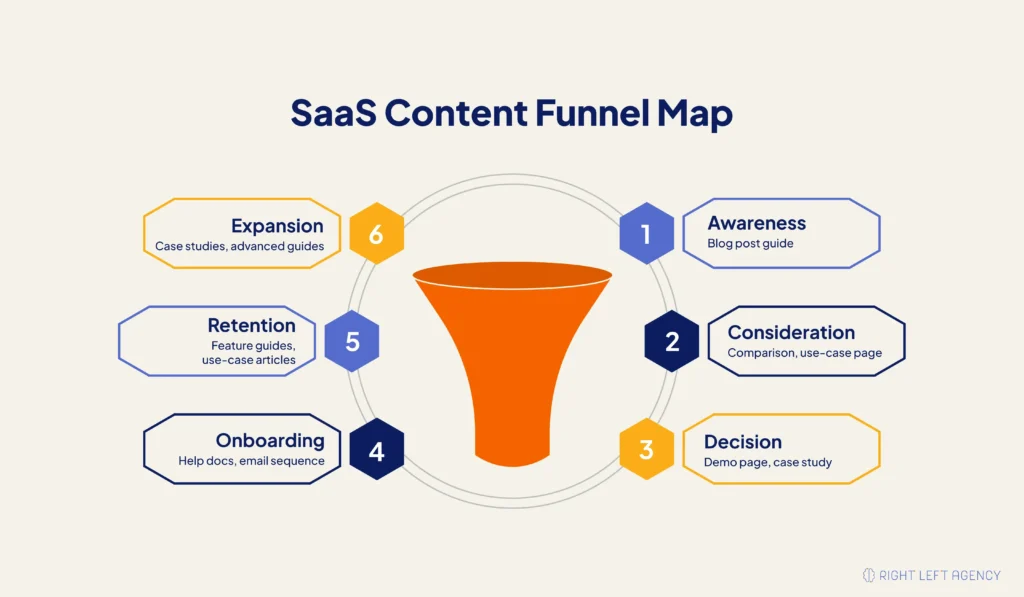
Most SaaS companies create content for the top of the funnel. They publish educational blog posts and hope visitors eventually convert. Some do. Most do not.
A full-funnel content strategy covers every stage of the SaaS customer journey, including what happens after someone becomes a customer. This is where most SaaS content strategies fall short. They stop at acquisition and ignore the stages where content can drive the most revenue impact: onboarding, retention, and expansion.
You can group these stages into TOFU, MOFU, BOFU, and post-sale content. TOFU attracts problem-aware buyers. MOFU educates solution-aware buyers. BOFU converts product-aware buyers. Post-sale content supports onboarding, retention, and expansion.
| Funnel Stage | User’s Question | Content Type | Example Topic | CTA |
|---|---|---|---|---|
| Awareness | “What is this problem I have?” | Blog post, guide | “What is sales pipeline management?” | Subscribe to the newsletter |
| Consideration | “What are my options?” | Comparison, use-case page | “Best CRM software for small teams” | Download template |
| Decision | “Is this the right tool for me?” | Demo page, case study | “How [Brand] helped [Company] cut onboarding time by 40%.” | Book a demo |
| Onboarding | “How do I get started?” | Help docs, email sequence | “Your first week with [Product]: a setup guide” | Watch product tour |
| Retention | “How do I get more value?” | Feature guides, use-case articles | “5 workflows you can automate with [Product]” | Explore integrations |
| Expansion | “What else can this tool do?” | Case studies, advanced guides | “How to use [Product] for team reporting.” | Compare plans |
When your SaaS content funnel covers all six stages, content works throughout the customer lifecycle, not just at the top.
Build a SaaS Keyword Strategy
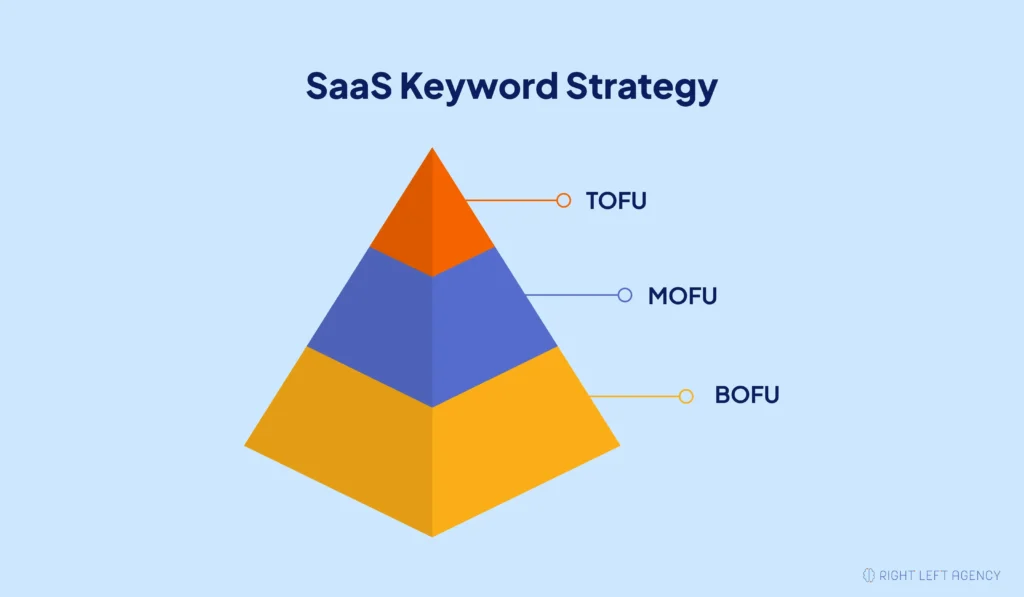
Keyword research for SaaS is not about chasing the highest search volume. It is about finding the keywords your ideal customers actually search for, that connect to your product, and that are likely to convert.
A 200-search-per-month keyword like “[Your Product] vs [Competitor]” can be more valuable than a 10,000-search-per-month keyword like “what is project management” if it attracts buyers closer to a decision. One brings people who are ready to evaluate. The other brings people who may never buy software at all.
Many SaaS teams say they have a content strategy, but in practice, their calendar is often built around keyword volume instead of buyer intent, product relevance, and conversion potential. That is one of the biggest reasons content does not generate a pipeline.
Your SaaS keyword research should cover all of these types:
| Keyword Type | Example | Funnel Stage |
|---|---|---|
| Informational keywords | “How to manage remote teams.” | TOFU |
| Problem-aware keywords | “Why is my sales pipeline stalling?” | TOFU / MOFU |
| Use-case keywords | “CRM for real estate agents” | MOFU |
| Feature keywords | “email automation software” | MOFU |
| Integration keywords | “[CRM] + Slack integration” | MOFU |
| Alternative keywords | “[Competitor] alternatives” | BOFU |
| Comparison keywords | “[Tool A] vs [Tool B]” | BOFU |
| Best software keywords | “Best project management tools for agencies” | BOFU |
| Pricing-related keywords | “[Software] pricing” | BOFU |
Product-led SEO connects these keywords to your product features and use cases so your content earns organic traffic and drives trial signups at the same time. That is the difference between blogging for traffic and building a SaaS SEO strategy that actually grows revenue.
Choose the Right SaaS Content Types
Blogs are not enough. Most SaaS companies treat their blog as their entire content strategy, then wonder why it is not working.
A proper SaaS content marketing plan includes multiple content types, each serving a different job:
| Content Type | Purpose |
|---|---|
| Blog posts | Drive organic traffic, educate, and build topical authority |
| Product pages | Convert visitors who already know what they want |
| Feature pages | Target feature-specific keywords and explain capabilities |
| Use-case pages | Show how the product helps specific roles or industries |
| Integration pages | Capture intent from users searching for connected tools |
| Alternative pages | Win traffic from competitors’ branded searches |
| Comparison pages | Help undecided buyers choose between options |
| Case studies | Build trust with real results and customer stories |
| Templates | Attract users with immediate value and generate leads |
| Whitepapers | Support enterprise sales and complex buying decisions |
| Webinars | Build relationships and generate a qualified pipeline |
| Knowledge base articles | Help users succeed and reduce support burden |
| Onboarding emails | Guide new users to activation |
| Customer education content | Drive retention and feature adoption |
The best SaaS content mix depends on your growth stage. Early-stage companies often need BOFU and product-led content first, while more mature SaaS companies can scale broader topic clusters and customer education programs.
Create Product-Led Content
Product-led content is one of the most powerful tools in a SaaS content strategy. It solves a real user problem while naturally showing how your product fits into the solution.
The keyword is “naturally.” Product-led content does not stuff your product into every paragraph or treat every article like a landing page. It leads with genuine helpfulness. The product shows up because it makes the article more useful, not because you forced it in.
Here is what that looks like in practice:
- “How to automate customer onboarding” naturally shows how your workflow tool fits into the process
- “Best CRM workflows for sales teams” demonstrates your product’s capabilities without feeling like a pitch
- “How to track project profitability” gives readers real value and shows exactly where your product helps
- “Invoice approval workflow template” gives readers something immediately useful and connects to your automation features
- A customer success platform writing about “how to reduce onboarding drop-off” can show a sample onboarding workflow and then demonstrate how the product helps track user progress
The best product-led content ranks well and converts readers into users. It works because it is helpful first and promotional second. Product-led content should not turn every article into a sales page. If the product example interrupts the reader’s learning experience, it reduces trust. The product should appear where it naturally helps solve the problem.
💡Pro Tip: The easiest way to find product-led content ideas is to look at what your support team gets asked most often. If ten customers a week ask “How do I set up automated invoicing?”, that question deserves a detailed content piece. You answer a real question and show your product solves a real problem at the same time.
Prioritize Bottom-Funnel Content
Most SaaS companies start with TOFU content because the search volumes look impressive, but high-volume educational keywords attract lots of visitors who may never need your product.
Bottom-funnel content often creates faster conversion impact because it targets buyers who are already comparing solutions, checking pricing, or preparing to make a decision. A startup that spends its first few months building BOFU content may see faster revenue impact than one that only publishes broad educational guides, especially when the product, ICP, and positioning are already clear.
Here are the BOFU content types that tend to drive the most conversions:
| Content Type | Example |
|---|---|
| Alternative pages | “Best Intercom alternatives for small teams” |
| Comparison pages | “[Tool A] vs [Tool B]: which CRM is right for you?” |
| Best-of lists | “Best project management software for creative agencies” |
| Pricing content | “[Software] pricing: is it worth it?” |
| Integration pages | “[Tool] + Slack integration: how to set it up.” |
| Use-case landing pages | “Client reporting software for marketing agencies” |
These pages target users who are actively evaluating options. They are in buying mode. When your site shows up with helpful, honest comparison and alternative content, you earn trust and earn conversions.
To prioritize which BOFU pages to build first, score each opportunity across these factors:
| Factor | Score 1-5 | Why It Matters |
|---|---|---|
| ICP fit | Does this topic attract the right buyer? | |
| Buying intent | Is the searcher close to a decision? | |
| Product relevance | Can your product naturally solve the problem? | |
| Ranking opportunity | Can you realistically compete for this keyword? | |
| Conversion potential | Can the page drive demos, trials, or sales conversations? | |
| Sales usefulness | Can sales use this asset in follow-ups? |
Create a SaaS Content Calendar
A strategy without an execution plan stays a strategy forever. A content calendar turns your keyword research, funnel mapping, and content mix into an organized publishing schedule.
A good SaaS content calendar keeps topics, keywords, writers, subject matter experts (SMEs), CTAs, and deadlines all in one place. It also helps you balance content across funnel stages so you are not accidentally publishing ten TOFU posts in a row while ignoring BOFU.
Here is a simple structure for your editorial calendar:
| Topic | Primary Keyword | Funnel Stage | Content Type | Writer | SME | CTA | Publish Date | Distribution Channel | Update Date | Target KPI | Priority | Status |
|---|---|---|---|---|---|---|---|---|---|---|---|---|
| How to track team productivity | team productivity tracking | TOFU | Blog post | Jane | Product team | Download template | May 5 | SEO, LinkedIn | Nov 5 | Rankings, signups | High | In progress |
| Best [Competitor] alternatives | [competitor] alternatives | BOFU | Alternative page | Mark | Sales | Start free trial | May 12 | SEO, Sales enablement | Nov 12 | Demo requests | High | Briefing |
| How to set up onboarding emails | Onboarding email sequence | MOFU | Blog post | Jane | Customer success | Book a demo | May 19 | SEO, Newsletter | Nov 19 | Assisted conversions | Medium | Not started |
Keep your content calendar visible, shared, and updated. It is the operational backbone of your SaaS content planning process.
Build Strong Content Briefs
Even the best writers miss the mark when the brief is vague. A strong content brief gives writers everything they need to produce content that matches search intent, speaks to the right audience, and drives the right action.
For SaaS content, briefs need both SEO context and product context. Here is what every brief should include:
- Primary keyword and search intent
- Secondary keywords to cover naturally
- Target audience and their stage in the journey
- Funnel stage and CTA
- Content angle and recommended structure
- Required sections and key points to hit
- Internal links to include
- Competitor insights from SERP analysis
- Product angle and where the product fits
- SME notes or quotes to include
For a BOFU page targeting “[Competitor] alternatives,” the brief should include comparison criteria, customer pain points, pricing objections, product screenshots, sales team objections, and a demo CTA.
When your briefs are thorough, your content hits the mark on the first draft. That saves time for writers, editors, and your SMEs.
Optimize SaaS Content for SEO and AEO
SaaS SEO is now a baseline requirement. But increasingly, you also need to optimize for answer engines, which include AI-powered search tools and Google’s AI Overviews. This is where answer engine optimization (AEO) comes in.
Optimize first for clarity and usefulness. Clear definitions, direct answers, structured headings, comparison tables, and practical examples help readers understand the content. They also make it easier for search engines and answer systems to interpret the page.
Here is how to optimize for both:
- Include a direct answer near the top of the page for any question-based keyword
- Use question-based H2s and H3s to match how people actually search
- Add comparison tables to make it easy to scan and pull out key information
- Include real examples and templates to improve practical value and time on page
- Use internal links to connect related content and build topical authority
- Add FAQ schema where relevant to improve visibility in search features
- Write clear definitions for technical terms early in the article
- Mention related entities naturally (tools, frameworks, roles, outcomes) throughout the content
- Keep paragraphs short so the content is easy to scan on any device
- Update content regularly to maintain rankings and reflect product changes
Write for the reader first. Then structure the page clearly so search engines and answer systems can understand the content.
Add Conversion Paths to Every Content Piece
Every content piece you publish should guide readers toward a logical next step. That step should match where they are in the funnel.
Sending a TOFU blog reader straight to a “Book a Demo” CTA often does not work. They are not ready. But offering a relevant template or a free checklist feels natural. It builds trust and keeps them in your ecosystem until they are ready to convert.
Here is a simple CTA framework based on the funnel stage:
- TOFU content: Download a template, subscribe to the newsletter, read a related guide
- MOFU content: Read a case study, compare plans, explore integrations, and view the product tour
- BOFU content: Start a free trial, book a demo, request a consultation, compare plans, or talk to sales
- Retention content: Watch a product tutorial, explore an advanced feature, sign up for training
Place CTAs where they match the reader’s intent. Early educational pages may need soft CTAs inside the body and at the end, while BOFU pages should make the demo or trial path visible above the fold and after key proof sections.
Every CTA should feel like a helpful next step, not a sales push. When the CTA matches the reader’s intent, conversion rates go up without any additional traffic.
Measure SaaS Content Performance
Traffic is a starting point. It is not the finish line.
SaaS companies that measure content performance only by pageviews often end up with a lot of traffic and very little revenue to show for it. The metrics that matter connect content to real business outcomes.
Here is a KPI framework for SaaS content performance:
| Metric Category | KPIs to Track | Where to Check |
|---|---|---|
| SEO performance | Organic traffic, keyword rankings, and click-through rate | Google Search Console, GA4 |
| Lead generation | Demo requests, trial signups, assisted conversions | GA4, CRM |
| Pipeline impact | Pipeline influenced, deals sourced from content | HubSpot, Salesforce |
| Activation | Trial-to-paid conversion, time to activation | Product analytics, CRM |
| Retention | Retention rate, churn reduction attributed to content | CRM, customer success tools |
| Expansion | Expansion revenue, upsell influenced by content | CRM, billing platform |
Do not evaluate metrics in isolation. High traffic with low demo requests may mean the topic is too top-funnel or the CTA is weak. Low traffic with strong sales influence may mean the page is valuable BOFU content that should be improved, not ignored. High rankings with low CTR may mean the title and meta description are not matching search intent.
💡Pro Tip: Set up a simple UTM tagging system for every CTA across your content. This makes it much easier to connect content touchpoints to demo bookings, trial signups, and closed deals inside your CRM. Even a basic attribution setup gives you far more data than most SaaS content teams work with.
Common SaaS Content Strategy Mistakes
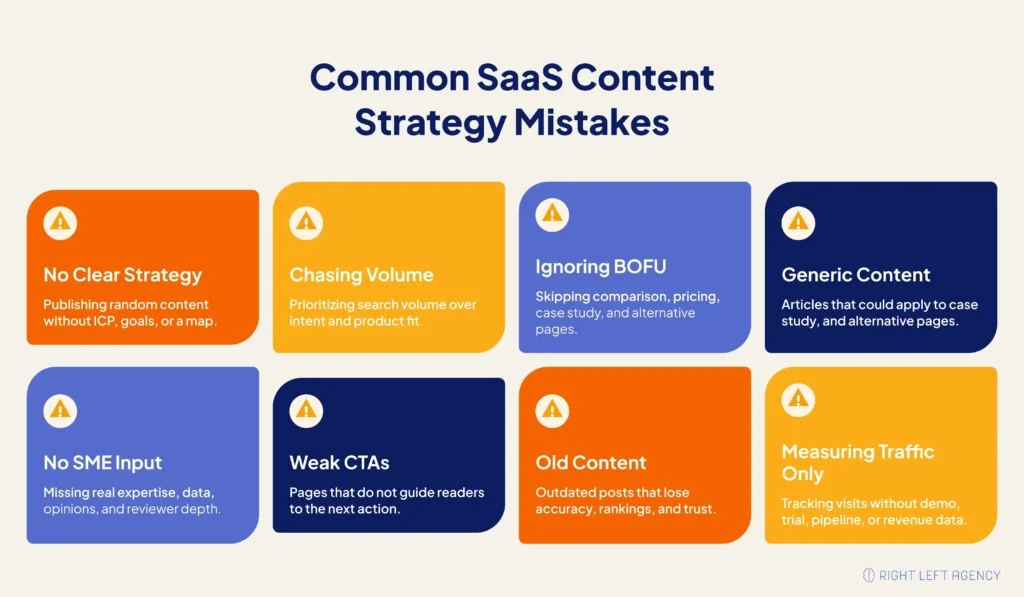
We see these mistakes constantly. Most of them are easy to fix once you know how to look for them.
Publishing without a strategy. Random content generates random results. Without a plan, there is no way to know what is working or why. Fix: Document your ICP, goals, keyword strategy, funnel map, and content calendar before you publish anything new.
Targeting only high-volume keywords. High volume does not mean high value. A keyword with 200 monthly searches and strong purchase intent beats a 10,000-search keyword that never converts. Fix: Prioritize buyer intent and product relevance over raw search volume.
Ignoring bottom-funnel content. BOFU content drives the most revenue-ready visitors. Skipping it is one of the most expensive content mistakes a SaaS company can make. Fix: Add comparison pages, alternative pages, pricing explainers, and case studies before scaling broad awareness content.
Writing generic content. If your article could apply to any product in your category, it is not working hard enough. Fix: Add product-specific examples, real data, and SME insights that only your team can provide.
Skipping SME input. The best SaaS content includes real expertise, real data, and real opinions. SME review adds the depth that separates useful content from forgettable content. Fix: Build SME interviews into your content production process, not as an afterthought.
Weak or missing CTAs. Every piece of content should lead somewhere. A page with no CTA is a dead end. Fix: Match the CTA to the funnel stage and place it where readers are most likely to act.
Not updating old content. Topical authority depends on keeping content accurate and current. Old, outdated posts drag down your overall rankings over time. Fix: Schedule a content refresh every 6 to 12 months for your highest-traffic and highest-intent pages.
Ignoring onboarding and retention content. Content does not stop being useful after someone converts. Help docs, onboarding guides, and advanced use-case content reduce churn and drive expansion. Fix: Treat post-sale content as a growth lever, not a support function.
Measuring only traffic. Traffic without conversion data tells you almost nothing about content ROI. Fix: Connect content to demo requests, trial signups, pipeline, and retention metrics.
Not linking content to product value. If readers finish your article and still do not understand how your product helps, the content is not doing its job. Fix: Add product-led examples and CTAs that naturally connect the topic to your product’s capabilities.
Should You Build Your SaaS Content Strategy In-House or Hire an Expert?
This is a question we get often, and the answer depends on your team’s current capabilities and where you are in your growth journey.
Building your SaaS content strategy in-house works well when your team has strong product knowledge, access to sales and customer insights, SEO expertise, and enough time to manage briefs, publishing, internal links, refreshes, and reporting.
Hiring a SaaS content strategist or agency makes sense when your content gets traffic but not pipeline, your BOFU pages are missing, your team lacks SaaS SEO expertise, or you need a clear roadmap before scaling content production.
Neither path is right for every company. Some teams start with an external partner to build the strategy and then bring execution in-house. Others hire a strategist to audit what exists and fill the gaps before scaling.
A common hybrid model is to keep product knowledge and approvals in-house while using an external strategist or agency for audits, keyword mapping, briefs, and content operations. This gives you the best of both: internal context and external execution support.
Example 90-Day SaaS Content Strategy Roadmap
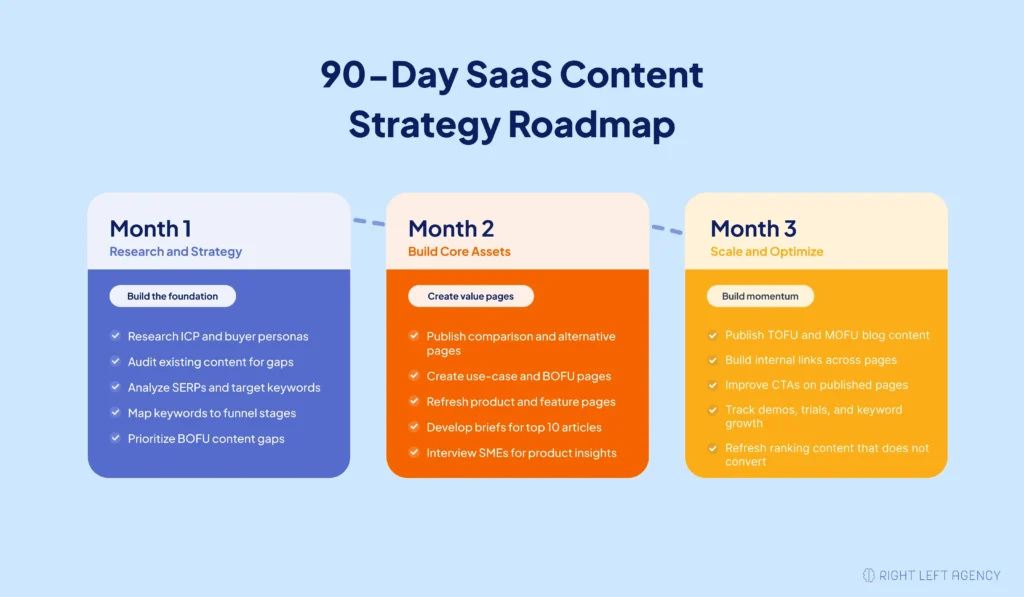
Use this as a starting point, not a fixed rule. A company with an existing content library may spend more time on audit and refresh. A new SaaS company may spend more time on ICP research and BOFU landing pages.
| Timeframe | Focus | Key Actions |
| Month 1: Research and Strategy | Build the foundation | Research your ICP and document buyer personas. Audit existing content for gaps. Analyze SERPs for your target keywords. Map keywords to funnel stages. Identify your biggest content gaps, especially at the BOFU level. |
| Month 2: Build Core Assets | Create high-value pages | Write and publish BOFU pages (comparison, alternative, use-case). Update or rebuild key product and feature pages. Develop content briefs for your top 10 priority articles. Interview SMEs and gather product insights. |
| Month 3: Scale and Optimize | Build momentum | Publish supporting blog content for TOFU and MOFU. Build internal links between new and existing content. Add or improve CTAs across all published pages. Track trial signups, demo requests, and keyword rankings. Refresh older content that ranks but does not convert. |
After 90 days, you will have a clear picture of what is working and where to invest next. The strategy becomes stronger as the data starts coming in.
Final Thoughts
A SaaS content strategy is not about publishing more. It is about publishing the right content, for the right audience, at the right stage of their journey.
When every piece of content serves a purpose, from driving organic traffic to supporting onboarding to reducing churn, content becomes one of your most powerful levers for sustainable growth.
If you are not sure where your biggest content gaps are, start with a SaaS content audit. It can help you identify missing BOFU pages, weak CTAs, underperforming content, and the best opportunities to prioritize next.
Frequently Asked Questions
What is a SaaS content strategy?
A SaaS content strategy is a documented plan for using content to attract, educate, convert, retain, and expand customers for a software-as-a-service product. It connects SEO, product messaging, and customer lifecycle goals so content supports organic traffic, demo requests, free trials, and recurring revenue growth.
Why is content strategy important for SaaS companies?
SaaS companies need a content strategy because random publishing does not drive predictable growth. A clear strategy helps you attract qualified organic traffic, educate prospects, generate demo requests, improve trial signups, support onboarding, reduce churn, and build a content engine that compounds over time.
How is SaaS content strategy different from regular content marketing?
SaaS content strategy addresses longer buying cycles, complex product features, multiple decision-makers, and recurring revenue models. It also requires post-sale content for onboarding, retention, and expansion. Regular content marketing typically focuses only on awareness and lead generation.
What types of content should SaaS companies create?
SaaS companies should create blog posts, feature pages, use-case pages, comparison pages, alternative pages, integration pages, case studies, templates, onboarding emails, and knowledge base articles. Each content type serves a specific stage of the customer lifecycle and a specific conversion goal.
How do you measure SaaS content performance?
Measure SaaS content performance across SEO (traffic, rankings, CTR), lead generation (demo requests, trial signups, assisted conversions), pipeline (deals influenced by content), and retention (churn reduction, expansion revenue). Traffic alone is not a meaningful measure of content ROI.
How often should a SaaS company publish content?
Consistency matters more than volume. Publishing two well-researched, intent-driven articles beats publishing five thin posts. Focus on search intent, product relevance, and business value. Quality and strategic alignment always outperform raw publishing frequency.
What is product-led content in SaaS?
Product-led content solves a real user problem while naturally showing how your SaaS product fits into the solution. It is helpful first and promotional second. Readers get genuine value from the article, and the product shows up as the logical tool to help them act on what they learned.
Should SaaS companies focus on top-funnel or bottom-funnel content first?
Early-stage SaaS companies typically benefit from BOFU content first. Bottom-funnel content targets users who are actively evaluating solutions and are closer to making a purchase decision. It generates faster pipeline impact than TOFU educational content, which can take many months to drive measurable results.
Should I hire a SaaS content strategist or build the strategy in-house?
You can build a SaaS content strategy in-house if your team understands the ICP, product positioning, SEO, content operations, and sales process. Hiring a SaaS content strategist or agency may make sense if your content gets traffic but not pipeline, BOFU pages are missing, or your team needs a clear roadmap before scaling production.