Key Takeaways
- Paid search agency fees depend on budget, scope, and campaign complexity.
- Management fees are generally separate from advertising spend.
- Agency services may include strategy, optimization, tracking, and reporting.
- B2B SaaS companies should prioritize qualified pipeline over lead volume.
- Compare deliverables and business outcomes before choosing an agency.
Two paid search agencies may charge $1,500 and $4,000 to manage the same Google Ads budget. But what explains the difference?
Paid search agency pricing depends on campaign complexity, strategy, optimization, tracking, and reporting. For B2B SaaS companies, the real value lies in generating qualified leads and supporting revenue growth.
This guide explains common pricing models, management fees, additional costs, and how to evaluate an agency’s value.
How Much Does Paid Search Agency Management Cost?
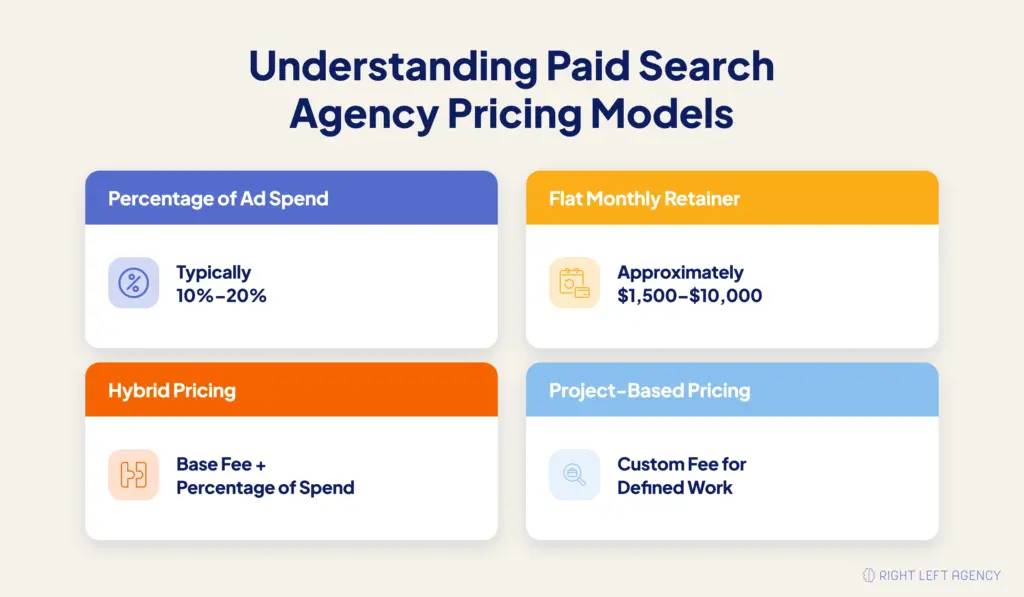
Paid search agencies typically charge 10%–20% of monthly ad spend or 1,500–5,000+ in monthly retainers, depending on campaign complexity, service scope, and reporting needs.
According to HawkSEM, monthly retainers can range from 1,500–10,000. PPC & Co lists a 15% management fee on the first $25,000 in ad spend. These are indicative US-market rates, not industry-wide averages.
Common Paid Search Agency Pricing Models
| Pricing Model | Indicative Cost | How It Works |
|---|---|---|
| Percentage-based | 10%–20% | Fee based on ad spend |
| Flat retainer | 1,500–5,000+ | Fixed monthly fee |
| Hybrid | Base fee + percentage | Combines both models |
| Project-based | Custom quote | One-time or defined work |
Example: A SaaS company spending $20,000 monthly on Google Ads with a 15% management fee pays $3,000 for agency services, bringing its total to $23,000 per month, excluding additional expenses.
Agency fees should be evaluated against included services, not price alone. For broader budgeting guidance, explore our SaaS marketing agency cost guide.
How Do Paid Search Agencies Structure Their Management Fees?
Most paid search agencies use percentage-based, flat-retainer, hybrid, or performance-based pricing. Each model has different benefits depending on budget, campaign complexity, and service scope.
Percentage-of-Ad-Spend Pricing
Agencies charge a percentage of monthly ad spend. For example, a 15% fee on a $10,000 budget equals $1,500, increasing to $4,500 if spending reaches $30,000.
This model scales with advertising investment, although higher spending doesn’t always mean more management work. Check minimum fees, pricing tiers, and budget approval terms.
Flat Monthly Retainer Pricing
Agencies charge a fixed monthly fee for agreed services, such as campaign strategy, optimization, testing, and reporting.
This provides predictable costs, but businesses should confirm what’s included, particularly landing-page optimization, conversion tracking, and CRM integration.
Hybrid and Performance-Based Pricing
Hybrid pricing combines a base retainer with a percentage of ad spend. Performance-based pricing links some fees to results, such as qualified leads or sales.
For B2B SaaS companies, long sales cycles and attribution challenges can complicate performance-based agreements. Clear conversion definitions, measurement methods, and responsibilities are essential.
Ultimately, choose a pricing model based on service scope, transparency, and accountability—not cost alone.
What Are You Actually Paying a Paid Search Agency For?
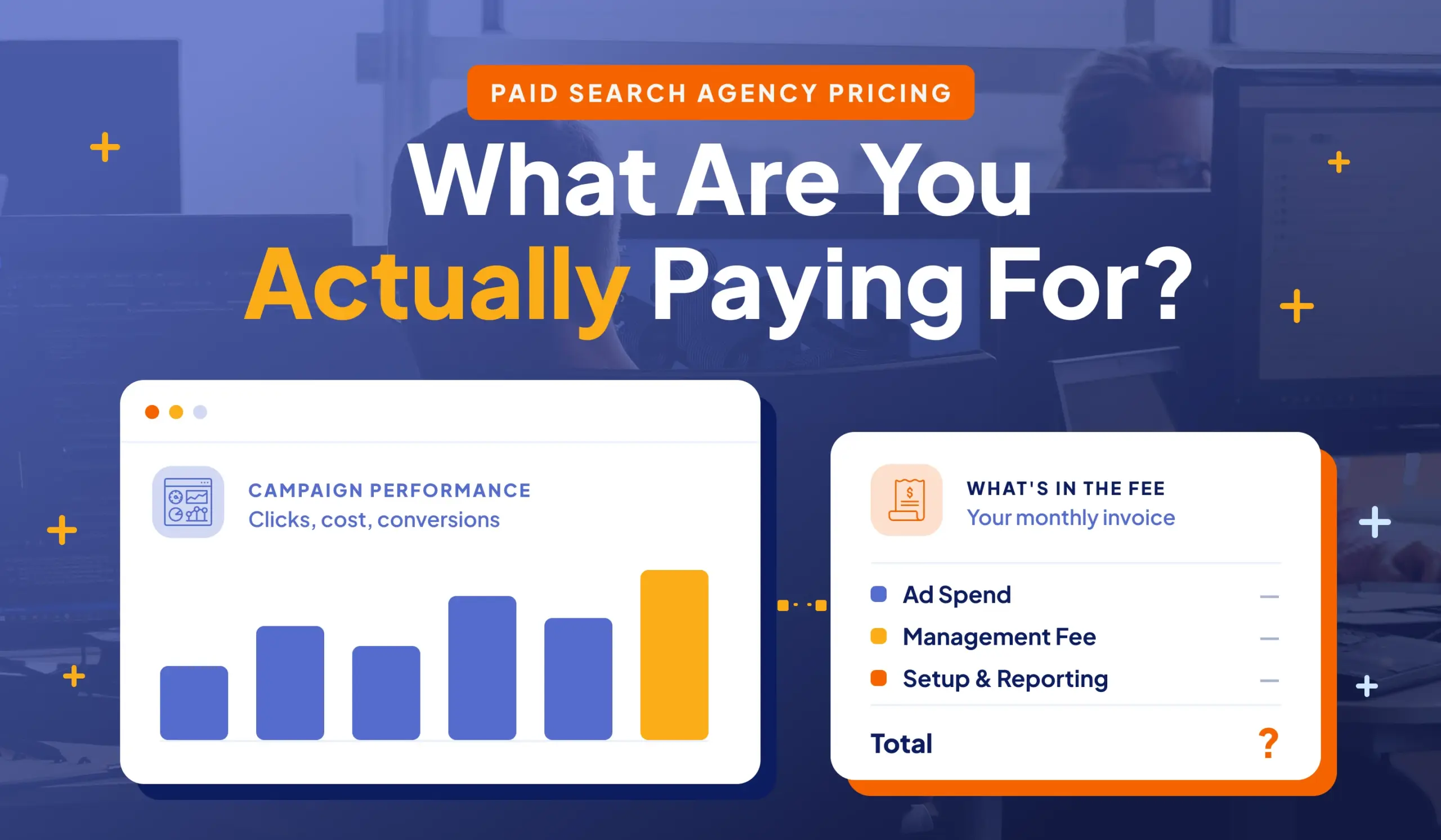
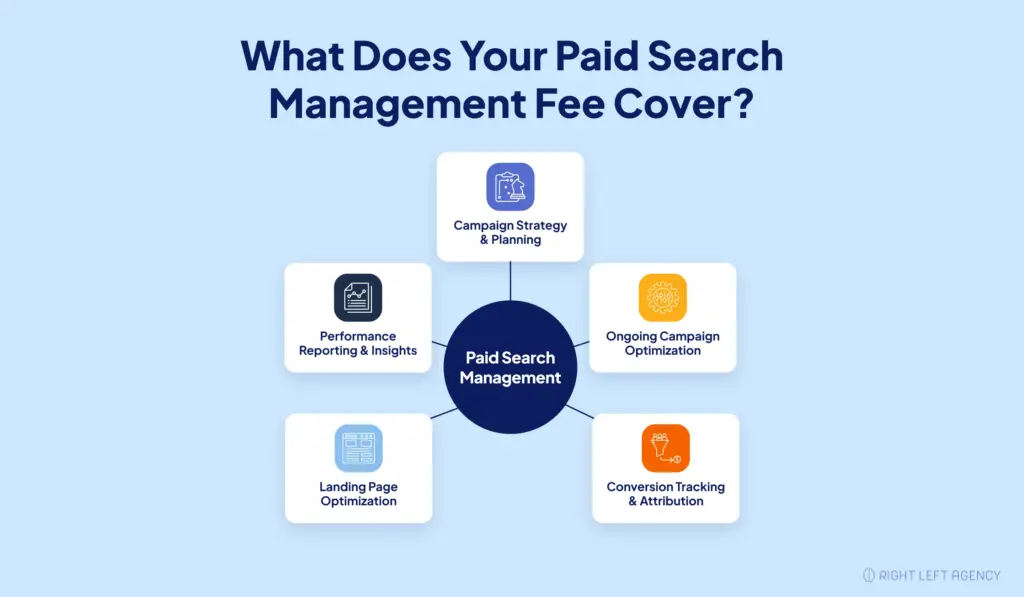
A paid search management fee typically covers campaign strategy, account setup, ongoing optimization, performance monitoring, and reporting. Depending on the agreement, it may also include conversion tracking, landing-page optimization, CRM integration, and strategic consulting.
Understanding these responsibilities helps businesses evaluate agency proposals based on deliverables rather than price alone.
1. Paid Search Strategy and Campaign Planning
Effective paid search management begins with understanding a company’s ideal customer profile (ICP), acquisition goals, target markets, and buyer journey.
Agencies use keyword research, competitor analysis, and search intent to build targeted campaigns. For example, someone searching for “enterprise project management software pricing” may have stronger purchase intent than someone searching for “what is project management software.”
The goal is to attract relevant prospects, not simply increase traffic.
2. Campaign Management and Continuous Optimization
Paid search agencies continuously monitor and refine campaigns to improve performance. Typical responsibilities include:
- Reviewing search terms and negative keywords
- Adjusting bids and budgets
- Testing ad copy and messaging
- Refining audience and geographic targeting
- Optimizing campaigns based on conversion quality
For B2B SaaS, this may mean prioritizing high-intent searches that generate qualified opportunities rather than inexpensive, low-quality leads.
Every significant optimization should have a clear purpose and measurable outcome.
3. Conversion Tracking, Attribution, and Reporting
Clicks and form submissions don’t always reflect actual business value. B2B SaaS companies need visibility into the customer journey:
Ad Click → Lead → Qualified Lead → Sales Opportunity → Customer
Agencies may use Google Ads, GA4, Google Tag Manager, and CRM platforms such as HubSpot or Salesforce to connect advertising performance with sales outcomes.
Google’s enhanced conversions for leads can improve offline conversion attribution using appropriately processed first-party data.
Advanced tracking and CRM integration may cost extra. Our B2B SaaS Google Ads audit guide explains what to evaluate before increasing ad spend.
4. Landing Page and Conversion Rate Optimization
Even effective ads can underperform when landing pages don’t match visitors’ expectations.
Agencies may analyze landing-page messaging, user experience, forms, and calls to action to improve conversions.
Some agencies provide CRO recommendations, while others include landing-page design, development, and testing. Confirm which services are covered by the management fee.
What Should a Paid Search Management Fee Cover?
| Service Area | Typical Responsibilities | Business Value |
|---|---|---|
| Campaign strategy | Keyword research, targeting, planning | Better acquisition alignment |
| Optimization | Bids, budgets, and ad testing | Improved spending efficiency |
| Conversion tracking | Tracking and attribution | Reliable performance measurement |
| Landing-page optimization | CRO analysis and testing | Better conversion opportunities |
| Reporting | Performance insights and recommendations | Greater accountability |
Services vary by agency, so confirm what’s included and what requires additional investment.
At Right Left Agency, our paid search approach focuses on identifying wasted spend, understanding buyer intent, validating conversion tracking, optimizing landing pages, and measuring qualified pipeline.
This connects campaign management with the business outcomes that matter most to B2B SaaS companies.
What Costs Are Usually Not Included in Paid Search Management Fees?
Paid search management fees don’t always cover every expense. Setup, creative work, tracking tools, and additional services may be billed separately.
Advertising Spend and Platform Costs
Advertising spend is generally separate from management fees and goes directly to platforms like Google Ads or Microsoft Advertising.
Total paid search investment = Ad spend + Agency fees + Additional expenses
Setup, Creative, Landing Pages, and Tools
Depending on the agreement, additional costs may include:
- Account setup and campaign restructuring
- Landing-page design and development
- Creative production
- Tracking and reporting tools
- CRM integration and advanced attribution
Some agencies include strategic recommendations but charge separately for implementation. Always request a clear scope of work outlining included services and additional expenses.
Contract Terms and Account Ownership
Review contract duration, cancellation terms, fee adjustments, and account ownership before signing.
Ensure your business understands its access to campaign data, tracking configurations, and reporting assets. Google’s account ownership guidance explains how manager-account permissions work.
If you’re changing providers, read our guide to switching SaaS PPC agencies to help protect account history and tracking continuity.
Why Do Some Paid Search Agencies Charge More Than Others?
Two agencies can manage the same advertising budget while handling significantly different workloads.
The difference often comes down to campaign complexity, specialist expertise, and the depth of services required.
Campaign complexity: Managing a single-product SaaS account in one market may require fewer resources than overseeing multiple products, countries, and customer segments.
Strategic involvement: An engagement involving acquisition planning, testing priorities, and regular strategic reviews may require more experienced resources than routine campaign maintenance.
Measurement requirements: Tracking demo requests is different from integrating advertising data with CRM records, qualified opportunities, and offline conversion reporting.
Creative and conversion responsibilities: Agencies supporting landing-page development, messaging experiments, and CRO may need additional specialist resources.
Reporting and collaboration: SaaS companies with multiple marketing leaders, sales teams, and regional stakeholders may require deeper analysis and more coordination.
Consider two businesses.
A smaller SaaS company runs a limited number of high-intent search campaigns and needs monthly performance reviews. Another operates across several markets, promotes multiple products, and needs to understand which campaigns influence enterprise sales opportunities.
The second engagement may cost more because its requirements are broader.
However, higher fees should reflect clearly defined responsibilities and relevant expertise, not assumptions about better results.
An agency charging more should explain what additional work it performs and why that work matters to the client’s acquisition goals.
How Can B2B SaaS Companies Tell Whether an Agency’s Fees Are Worth It?
A lower management fee doesn’t always mean better value. B2B SaaS companies should evaluate agency performance based on qualified opportunities, acquisition efficiency, and business outcomes.
Look Beyond Clicks, Leads, and Cost Per Lead
Clicks and lead volume don’t always reflect campaign success. A campaign generating fewer qualified leads may deliver more value than one attracting hundreds of low-quality inquiries.
Key B2B SaaS metrics include:
- Cost per qualified lead
- Lead-to-opportunity conversion rate
- Cost per qualified opportunity
- Qualified pipeline generated
- Customer acquisition cost (CAC)
- CAC payback period
These metrics provide a clearer picture of how paid search contributes to business growth.
Compare Total Investment Against Qualified Opportunities
Consider two hypothetical agencies managing the same advertising budget.
| Metric | Agency A | Agency B |
|---|---|---|
| Monthly ad spend | $15,000 | $15,000 |
| Management fee | $2,250 | $3,000 |
| Total monthly cost | $17,250 | $18,000 |
| Qualified opportunities | 10 | 15 |
| Cost per opportunity | $1,725 | $1,200 |
Although Agency B charges $750 more, it delivers a lower cost per qualified opportunity.
This demonstrates why agencies should be compared based on meaningful outcomes, not management fees alone.
Evaluate Strategic Value Alongside Performance Metrics
A valuable agency provides more than reports. It identifies tracking issues, optimizes budgets, improves campaign performance, and connects advertising decisions with sales outcomes.
For high-ACV SaaS companies, reliable measurement is especially important. Our guide to Google Ads for high-ACV B2B SaaS explains how to align bidding and measurement with qualified opportunities.
Ultimately, agency value depends on service quality, reliable measurement, and contribution to business goals.
What Should You Ask Before Hiring a Paid Search Management Agency?
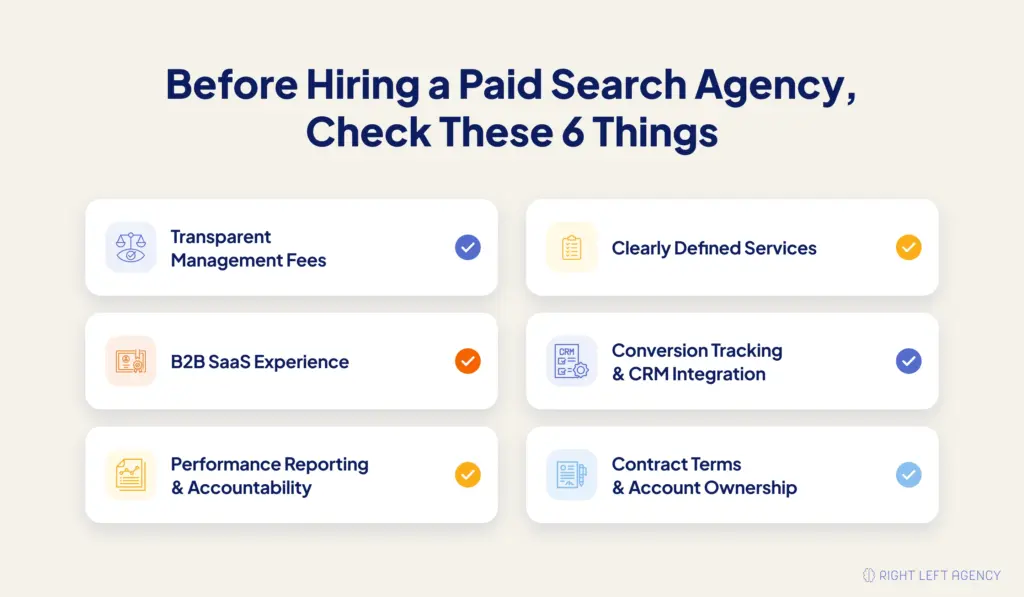
Before hiring a paid search agency, compare its pricing, services, performance expectations, and contract terms—not just the monthly fee.
Questions About Pricing and Scope
- What’s included in the management fee, and what costs extra?
- How do fees change as advertising spend increases?
Questions About Campaign Execution
- Who will manage the account, and what’s their B2B SaaS experience?
- How will campaigns be optimized and tested?
Questions About Measurement and Reporting
- How will qualified leads and CRM outcomes be tracked?
- What performance insights and recommendations will be provided?
Questions About Contracts and Ownership
- Who owns the advertising account, data, and campaign assets?
- What are the cancellation, transition, and additional fee terms?
Paid Search Agency Proposal Evaluation Checklist
Use this framework to compare proposals consistently.
Choosing a Paid Search Agency That Supports SaaS Growth
Paid search agency pricing should reflect the expertise, services, and business outcomes your company needs. Whether you’re struggling with irrelevant traffic or low-quality leads, the right agency should align campaign strategy, optimization, and measurement with your acquisition goals.
At Right Left Agency, our paid search management approach focuses on buyer intent, conversion performance, and qualified pipeline—not just clicks and leads.
Understand What Your Paid Search Investment Should Deliver
Unsure whether your agency fees deliver real value?
Right Left Agency’s Paid Search Opportunity Audit helps identify wasted spend, tracking gaps, and optimization opportunities.
Request a Paid Search Audit to discover where your paid search investment can perform better.
Frequently Asked Questions
1. How much do paid search agencies typically charge?
Paid search agencies commonly charge 10%–20% of monthly advertising spend or flat retainers ranging from approximately $1,500 to $10,000 per month, according to published agency pricing guides. Actual fees depend on campaign complexity, advertising budget, management scope, and reporting requirements.
2. Is advertising spend included in the agency management fee?
No, advertising spend is generally separate from the agency management fee. Advertising spend pays platforms such as Google Ads, while management fees cover services such as campaign strategy, optimization, tracking, and reporting. Additional services may incur separate costs.
3. Is a flat retainer better than percentage-based PPC pricing?
Neither pricing model is automatically better. Flat retainers provide predictable monthly costs, while percentage-based fees adjust with advertising spend. B2B SaaS companies should compare service inclusions, account complexity, and performance expectations before choosing a model.
4. Why do B2B SaaS paid search agencies charge different fees?
Agency fees vary based on campaign complexity, specialized expertise, conversion tracking requirements, and service scope. B2B SaaS companies with longer sales cycles, multiple products, and CRM attribution needs may require more comprehensive management than businesses running straightforward lead-generation campaigns.
5. How can I tell whether my paid search agency is worth the cost?
Evaluate performance beyond clicks and lead volume. Track qualified opportunities, cost per opportunity, pipeline contribution, and customer acquisition costs where measurable. Also assess whether the agency provides clear reporting, actionable recommendations, and services aligned with your acquisition goals.
6. What should I ask before signing a paid search agency contract?
Ask which services are included, what costs extra, who manages the account, and how performance will be measured. Confirm advertising account ownership, reporting responsibilities, cancellation terms, and how campaign data will be handled if you change agencies.