Key Takeaways
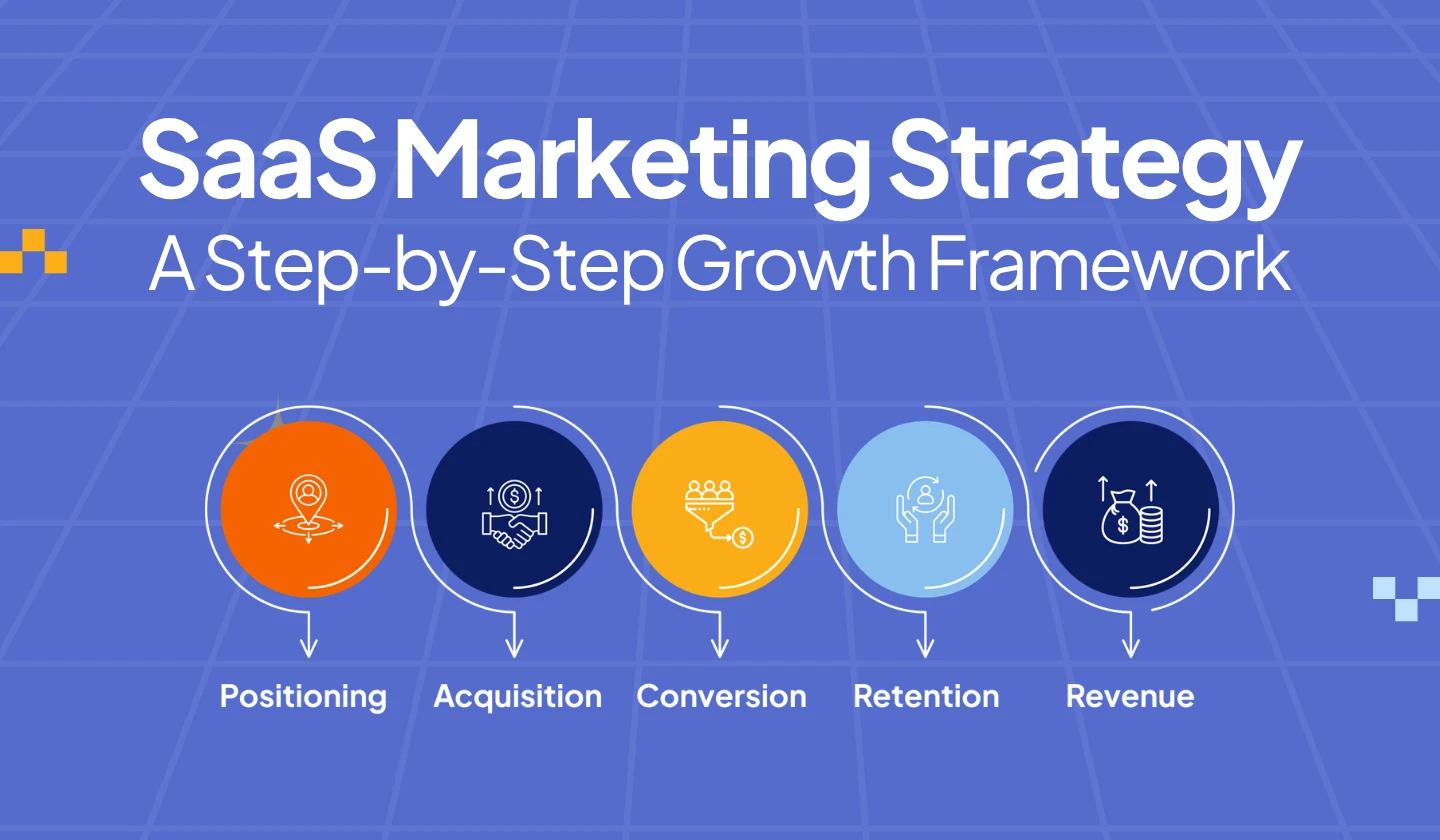
- SaaS marketing must connect acquisition, activation, retention, expansion, and recurring revenue growth.
- A focused ICP improves positioning, lead quality, conversion rates, and customer retention.
- The right growth model depends on product complexity, buying behavior, and contract value.
- Content should support every stage of the funnel, from awareness through purchase to expansion.
- Sustainable growth requires tracking CAC, LTV, activation, churn, MRR, ARR, and NRR.
What Is a SaaS Marketing Strategy?
A SaaS marketing strategy is a structured plan to attract, convert, retain, and expand customers for a software-as-a-service business. Unlike traditional marketing, it focuses on recurring revenue, customer retention, product adoption, and long-term growth.
Why SaaS Marketing Requires a Different Strategy
Traditional marketing sells a one-time transaction. SaaS sells a relationship — and that changes the entire playbook.
A Subscription Revenue Model Changes the Math
Every sale isn’t a finish line; it’s a starting point. Recurring revenue means predictable growth, but only if customers stick around long enough to pay back what it cost to acquire them. A single purchase decision doesn’t determine success; hundreds of renewal decisions do.
Customer Lifecycles Are Long, Not Linear
Unlike a retail purchase, SaaS customer value accumulates over years, not moments. A customer who churns in month three looks very different on a spreadsheet than one who’s still active in year three. That long tail means Customer Lifetime Value (LTV) has to anchor every acquisition decision. If Customer Acquisition Cost (CAC) doesn’t pay back well before typical churn hits, the growth model breaks.
Retention Is a Growth Lever, Not Just a Support Metric
SaaS growth does not stop when a customer signs up. Much of the value comes later through renewals, upgrades, and wider product use. Net Revenue Retention shows how well a company keeps and grows revenue from existing customers, so when customers stay longer, move to higher plans, or add more users, the business can grow without relying entirely on new customer acquisition. That is why retention deserves the same attention as acquisition: winning customers starts the relationship, but helping them succeed is what turns that relationship into lasting growth.
Product Adoption Is a Marketing Problem, Not Just a Product One
Activation impacts retention, which means product adoption isn’t confined to onboarding flows; it’s a marketing concern. If a prospect signs up but fails, then any money spent on top-of-the-funnel activities to acquire them is effectively lost. It is not enough for marketing to hand off leads at signup; rather, marketing needs to stay engaged until initial value is achieved.
These four dynamics mean that SaaS marketing is unique from other forms of marketing. It has to optimize for LTV over CAC, retention over pure acquisition, and adoption over vanity signups.
Core Components of a Successful SaaS Marketing Strategy
Nine elements go into creating a successful SaaS marketing strategy, each supporting the other. Leave out any one, and you’ll be surprised at how little the others can do for you. A robust acquisition channel will lose you money without retention, and an excellent ICP without positioning.
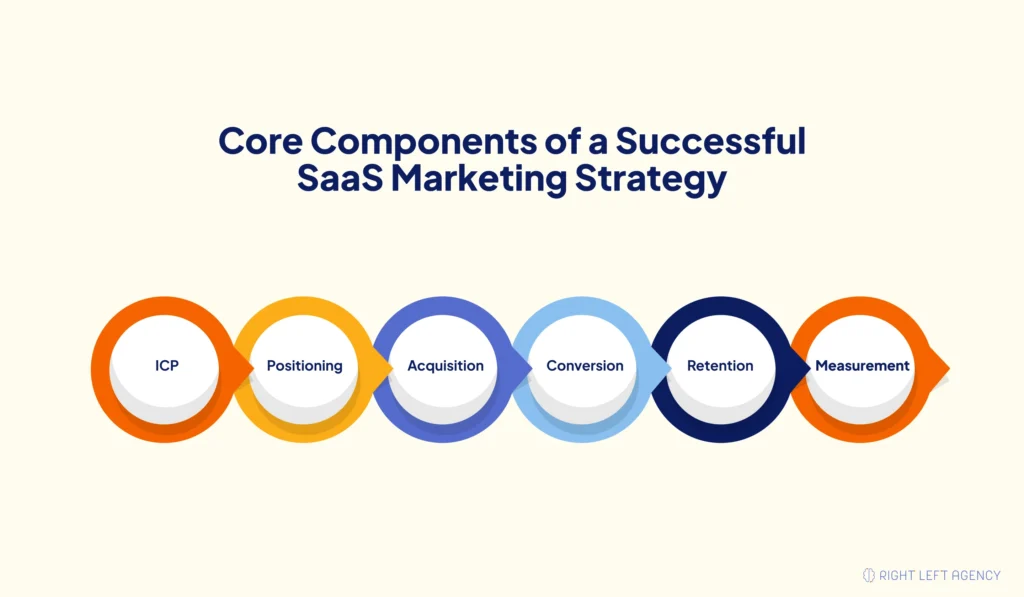
Step 1: Define Your Ideal Customer Profile
Here’s a mistake almost every SaaS company makes at some point: chasing anyone who could theoretically buy. An Ideal Customer Profile (ICP) is the fix — it forces you to get specific about which companies are actually worth going after, not just who might sign up, but who sticks around and grows into a bigger account.
Firmographics
This is the first filter, and it’s the easy part. Industry tells you whose day-to-day actually matches what the product does. Company size shapes nearly everything else. A 10-person startup and a 500-person company have completely different budgets, approval chains, and appetite for anything complicated. Revenue is the reality check: can this company actually afford the product long enough for it to matter, or are they going to churn the moment the invoice hits?
Pain Points
Firmographics tell you who could buy. Pain points tell you who actually needs to. This is where Jobs To Be Done (JTBD) thinking earns its keep. Instead of listing vague frustrations, get specific about the actual job someone is trying to get done when they start looking for something like this. A company that checks every firmographic box but isn’t feeling any real pain isn’t your ICP. They’re just a name that happened to fit the filter.
Buying Triggers
Even a company in real pain doesn’t wake up one random Tuesday and decide to buy. Something usually pushes them — a new hire, a failed audit, a deadline blown because of a process gap, a competitor’s tool getting shut down. Knowing what those triggers look like means marketing can show up exactly when urgency is highest, instead of guessing at timing and hoping.
Decision-Makers vs. Users
The person feeling the pain every day is often not the person who signs off on the purchase. A solid Buyer Persona has to account for both. There’s the end user whose actual workflow changes because of this product, and there’s the decision-maker weighing cost, risk, and whether this fits how the org operates. Build messaging for only one of these people, and it tends to backfire. Either the user loves it but has zero budget authority, or the buyer approves it without anyone ever proving it actually works day-to-day.
Example: Construction SaaS
Picture a construction project management platform. Its ICP looks something like this: mid-sized general contractors with 50–300 employees, $10M–$100M in annual revenue, juggling multiple job sites at once. Their pain isn’t “we need software” — it’s missed deadlines and blown budgets because field crews and the office aren’t talking to each other. The trigger is usually a specific, expensive failure that finally makes the gap impossible to ignore. The user is the project manager living in the tool every day. The decision-maker is the ops director or owner who’s really weighing one question: is this cheaper than the next blown project?
Step 2: Build Positioning and Messaging
Positioning is the decision that every other marketing choice depends on. Get it wrong, and no amount of budget, content, or clever campaigns will make up the difference — you’re just amplifying confusion faster.
Market Positioning: Market positioning defines where a product sits relative to everything else a buyer could choose, including doing nothing. It is not a slogan; it is a choice of which category to compete in, which alternatives to displace, and which buyers actually care. A good Positioning Statement is specific enough to rule out any credible competitor claims.
Value Proposition: Once positioning is set, the Value Proposition translates it into what the buyer actually gets. Not features — outcomes. A value proposition that outlines capabilities is a specification; a value proposition that identifies the exact outcome a customer is searching for is a strategy. It is here, moreover, that Product-Market Fit can be tested in the field: a value proposition that demands explanation probably means the fit isn’t as strong as the team thinks.
Competitive Differentiation: Every SaaS category eventually fills with similar-sounding tools. Differentiation is what survives after the initial pitch — the specific reason a buyer chooses this product when three others could technically do the job. It has to be defensible, not just different. A differentiator a competitor could copy next quarter isn’t a moat; it’s a head start.
Messaging Framework: The concepts of positioning and differentiation are only meaningful when articulated consistently. Messaging Framework is the tool that translates strategic considerations into words — headlines, website copy, sales scripts — that make sense whether the prospect comes across the company in a landing page, demo, or advertisement. Without one, everyone involved starts talking about the product in their own way, while the marketplace never gets the message.
Mini Framework: Problem → Outcome → Differentiator
A simple filter for testing any piece of messaging:
- Problem — What specific pain is this buyer feeling right now?
- Outcome — What changes for them once it’s solved?
- Differentiator — Why does this product deliver that outcome better than the alternative?
If a piece of copy can’t answer all three in a sentence or two, it’s still just a description and not positioning.
Step 3: Map the SaaS Customer Journey
A customer journey map shows how buyers move from recognizing a problem to adopting, renewing, and expanding with your product.
Without this map, many SaaS companies overinvest in awareness and underinvest in the stages where revenue is won or lost.
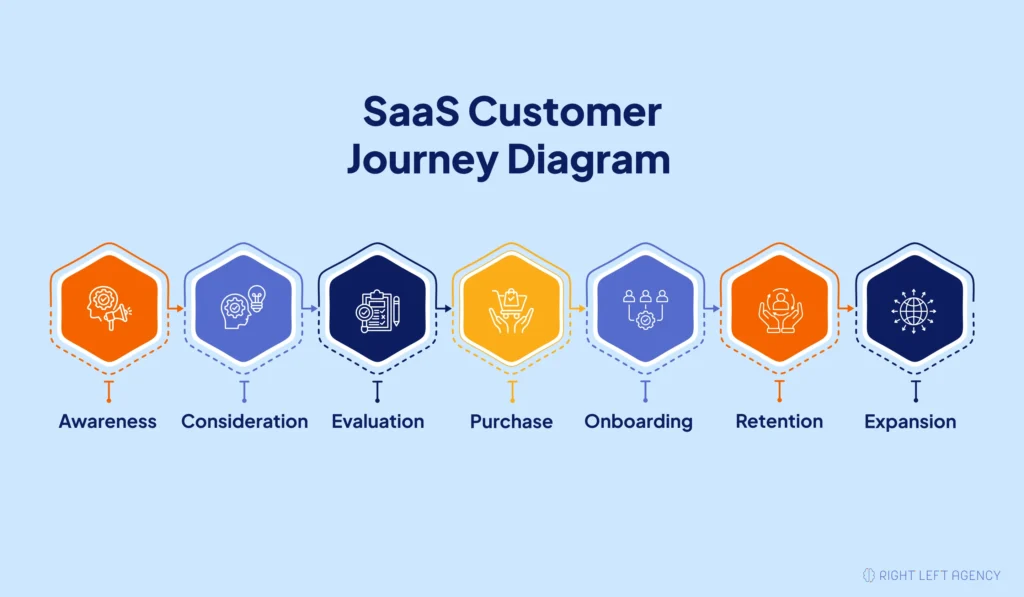
A typical journey includes seven stages. Each one carries its own goal, question, objection, and owner. Treating them as interchangeable is where most journey maps fall apart.
Awareness
- Customer goal: Understand why a problem is happening and whether it’s worth solving now.
- Customer question: Why is this problem happening?
- Main objection: This might not actually be a priority right now.
- Required content or experience: Guides, research, and educational content that names the problem before pitching a solution.
- Conversion action: Newsletter signup, guide download, or return visit.
- Responsible team: Content marketing / SEO.
- KPI: Organic traffic, content engagement rate.
Consideration
- Customer goal: Explore which approaches could realistically solve the problem.
- Customer question: Which approaches could solve it?
- Main objection: I don’t know enough about the options yet to commit to one.
- Required content or experience: Webinars, templates, category guides.
- Conversion action: Webinar registration or template download.
- Responsible team: Content marketing / Demand generation.
- KPI: MQLs generated, webinar attendance rate.
Evaluation
- Customer goal: Determine which specific product fits their needs.
- Customer question: Which product fits our needs?
- Main objection: This looks similar to two or three other tools I’m already comparing.
- Required content or experience: Comparisons, case studies, live demos.
- Conversion action: Demo request or trial signup.
- Responsible team: Product marketing / Sales.
- KPI: Demo-to-opportunity rate, trial signup rate.
Purchase
- Customer goal: Confirm the investment is worth the cost and risk.
- Customer question: Is the investment worth the cost and risk?
- Main objection: What if the ROI doesn’t materialize, or implementation fails?
- Required content or experience: Pricing pages, ROI tools, security and compliance information.
- Conversion action: Signed contract.
- Responsible team: Sales.
- KPI: Win rate, sales cycle length, CAC.
Onboarding
- Customer goal: Reach initial value as quickly as possible.
- Customer question: How do we get set up and start seeing results?
- Main objection: This is taking longer than expected to show any real value.
- Required content or experience: Setup guides, checklists, training.
- Conversion action: Completed activation event.
- Responsible team: Customer success / Product.
- KPI: Time to value, activation rate.
Retention
- Customer goal: Confirm the product is still delivering value.
- Customer question: Is the product still helping us?
- Main objection: We’re not getting as much out of this as we expected to by now.
- Required content or experience: Usage reports, ongoing education, customer success check-ins.
- Conversion action: Renewal.
- Responsible team: Customer success.
- KPI: Churn rate, product engagement rate.
Expansion
- Customer goal: Decide whether more teams, users, or use cases should adopt the product.
- Customer question: Should more teams or users adopt it?
- Main objection: Is the extra cost and rollout effort actually worth it right now?
- Required content or experience: Advanced use cases, upgrade paths, account reviews.
- Conversion action: Upsell, cross-sell, or seat expansion.
- Responsible team: Account management / Customer success.
- KPI: Net Revenue Retention (NRR), expansion revenue.
Step 4: Choose the Right SaaS Growth Model
Before picking channels or writing a single ad, there’s a bigger question to settle: how does this product actually get sold? Most SaaS companies default to whatever model is trendy, but the right answer depends entirely on how the product itself behaves — and getting it wrong means spending money fighting the product’s own nature.
Product-Led Growth (PLG)
PLG bets that the product can do the convincing before a salesperson ever gets involved. Two things have to be true for that bet to pay off.
- Self-serve onboarding. Someone has to go from “just signed up” to “actually using this” without a human walking them through it. Every extra form field or approval step is a chance to lose them before they’ve felt any value.
- Product adoption. The free or trial version has to be good enough to create real dependency on its own. No one’s there to talk up the features, so the product has to prove itself fast.
Slack is the textbook case here: individual teams adopted it and pulled it into their companies without any top-down sales push. Dropbox followed a similar shape — a generous free tier that let one person’s usage snowball into a whole team’s, and eventually a whole company’s.
Sales-Led Growth (SLG)
SLG puts a person in the loop early, which makes sense when a purchase is complicated, expensive, or needs sign-off from more than one person. The product isn’t expected to sell itself — the conversation is doing the heavy lifting.
Salesforce is the obvious example. Even though the company pioneered the free trial, its real growth engine was a direct enterprise sales force built to navigate complex, multi-stakeholder CRM rollouts. HubSpot leans on a similar structure — inbound content brings people in, but a sales team closes the bigger deals.
Hybrid Growth
Hybrid tries to get the best of both: self-serve for the easy cases, sales for the ones that need a human. Individuals and small teams move through a self-serve funnel on their own. Once an account starts showing signs of enterprise scale — more seats, security questions, multiple departments involved — sales steps in.
Monday.com runs this well, letting sales act on product usage signals instead of cold outreach. Atlassian is maybe the clearest example of all: it built its whole reputation on PLG, and self-serve still drives the majority of its bookings, but it added an enterprise sales layer once it realized some deals simply weren’t going to close through a signup form alone.
| Model | Sales Cycle | CAC | Scalability | Best Fit |
|---|---|---|---|---|
| Product-Led Growth | Short — days to weeks | Low | High — scales with product usage, not headcount | Simple, fast-to-value products purchased individually or in small teams |
| Sales-Led Growth | Long — weeks to months | High | Moderate — scales roughly with sales headcount | Complex, high-ACV products that require multiple stakeholders’ approval |
| Hybrid Growth | Varies by segment | Hybrid — low for self-serve, high for enterprise | Strong — self-serve scales volume, sales captures the margin | Products for individuals/SMBs and enterprises |
None of these models is objectively better — it comes down to how hard the buying decision actually is. Force a simple product through a sales process, and you’re just adding cost. Try to sell a complex, high-stakes product through pure self-serve and prospects will stall out waiting for someone to answer their questions. Most companies that start purely PLG or purely SLG end up drifting toward hybrid as they scale, simply because no single motion covers every customer forever.
Step 5: Build Your SaaS Acquisition Engine
Acquisition is where most of the marketing budget goes, and where most of it gets wasted. A real acquisition engine isn’t a list of channels — it’s a set of deliberate decisions about which channels to use, in what order, and how hard to push each one.
Channel Selection
The available channels break down into three groups: organic (SEO, content, thought leadership, partnerships), paid (Google Ads, LinkedIn Ads, retargeting), and demand generation (webinars, communities, email).
Channel selection should start from the ICP and how that buyer actually looks for solutions — not from whatever channel is trending in a LinkedIn post. A product bought by individual developers searching Google needs a different mix than one bought by VPs who respond to LinkedIn outreach and peer recommendations.
Channel Prioritization
No team has the budget or headcount to run every channel well at once. Prioritization means picking two or three channels that best match the ICP and growth model, giving them the time and iteration needed to mature, and deliberately leaving the rest alone for now. A channel run at 20% effort rarely produces 20% of the results. Most channels need a minimum threshold of investment before they start working at all.
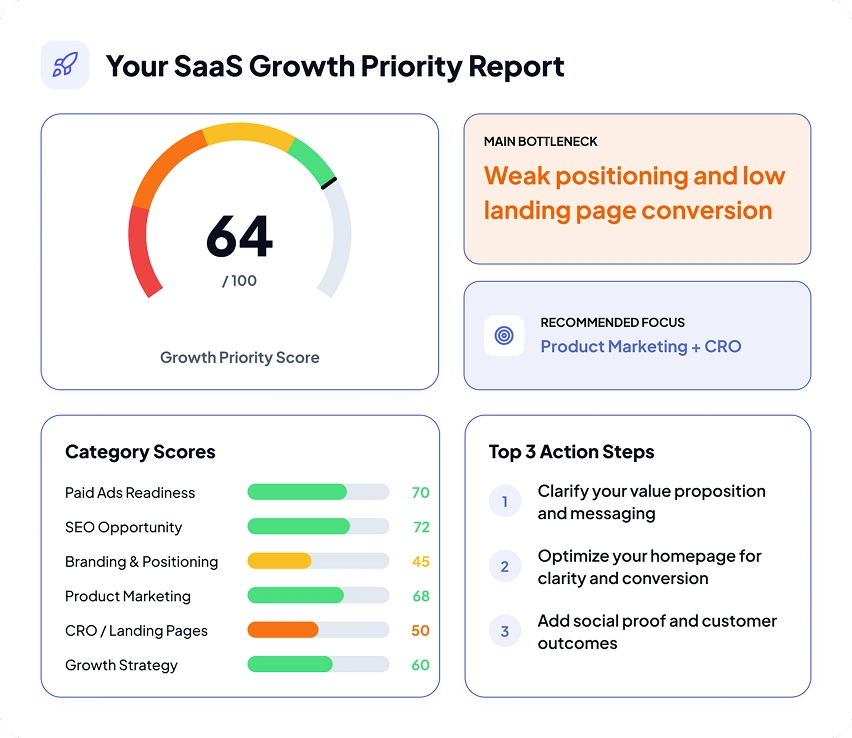
Free 3-Minute Diagnostic
What Should You Prioritize Next?
Not sure whether to focus on SEO, paid ads, positioning, CRO, or another growth area? Find your biggest growth opportunity in just a few minutes.
Organic Versus Paid Acquisition
Organic channels — SEO, content, thought leadership, partnerships — compound over time. A page ranking for a high-intent term keeps generating pipeline months after it was published, at close to zero marginal cost. Paid channels — Google Ads, LinkedIn Ads, retargeting — buy speed and predictability, but the results stop the moment spend stops.
The two aren’t competing strategies; paid is often the fastest way to test messaging and offers before an organic page has had time to rank, while organic builds the foundation that makes paid more efficient over time.
Channel Economics
Every channel has a different cost and payback profile. Paid search captures demand that already exists but is one of the more expensive per-click options in SaaS. LinkedIn Ads offer targeting Google can’t match — job title, company size, industry — but its CPMs run well above most other paid channels, which typically only pays off for higher-ACV products. Retargeting re-engages visitors who are already warm, which usually makes it one of the more cost-efficient paid tactics. Organic and partnership-driven channels have a longer ramp but a much lower cost per lead once they mature.
Understanding these differences prevents comparing a six-month-old blog post’s ROI to a Google Ads campaign that started last week.
Channel Fit by ACV and Growth Model
Channel choice should follow the growth model, not the other way around. Product-led, low-ACV products rely heavily on organic acquisition, self-serve SEO, and word-of-mouth — the economics of expensive paid channels rarely work when the average deal is small. Sales-led, high-ACV products can justify LinkedIn Ads and other costly channels because a single closed deal covers the spend many times over. Hybrid models typically split the budget: organic and low-cost paid channels to fill the self-serve funnel, and higher-cost channels like LinkedIn or partnerships to reach the accounts that need a sales conversation.
Resource Allocation
Budget and headcount should follow where the ICP actually spends time and where payback is fastest, not get split evenly across channels to avoid hard prioritization calls. This usually means concentrating the majority of resources on the one or two channels already showing signs of working, with a smaller, deliberate budget set aside for testing the next candidate channel.
Testing and Scaling Channels
New channels should be proven before they’re scaled. That means running a channel long enough to get a real read on CAC and conversion rate, not judging it after a single campaign. Once a channel proves its economics at a small budget, scaling it is a matter of adding spend while watching CAC for signs of saturation. A channel that isn’t proven shouldn’t get more budget just because it’s “supposed to work” for companies like this one.
Step 6: Create a SaaS Content Marketing Strategy
A content strategy without a funnel is just a publishing calendar. The strongest SaaS content programs are built around the actual questions buyers ask, matched to the right stage, format, and distribution channel — with a clear way to trace whether any of it moved revenue.
Buyer Questions
Every piece of content should start from a real question a buyer is asking, not a keyword or a topic idea. Early-stage buyers ask why a problem is happening; later-stage buyers ask how this product compares, what implementation looks like, or whether the ROI holds up. Content based on assumptions may rank, but it rarely converts because it answers questions your audience(buyer) never asked.
Funnel-Stage Content
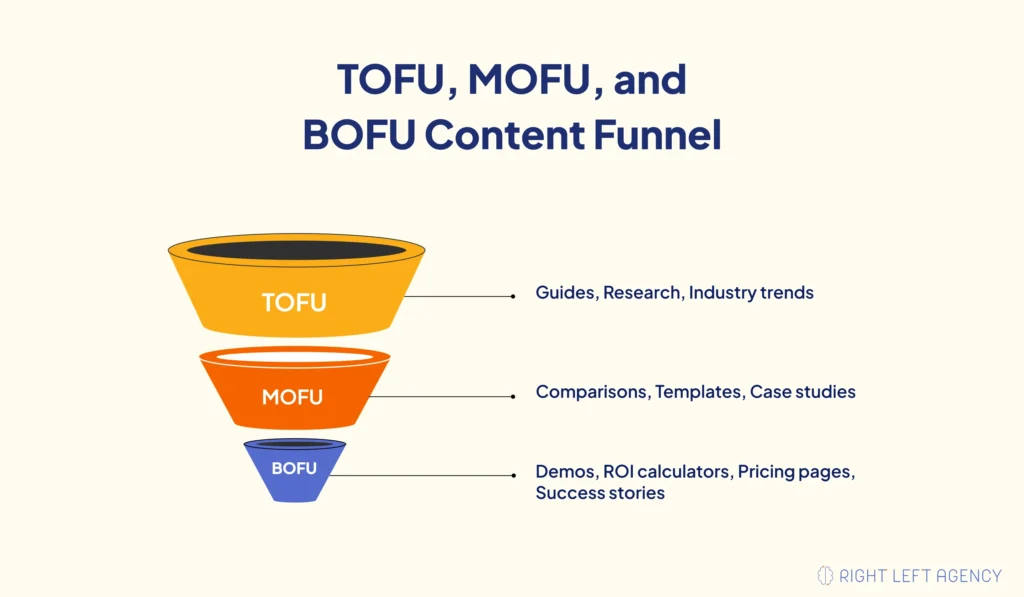
Mapping content to Top of Funnel (TOFU), Middle of Funnel (MOFU), and Bottom of Funnel (BOFU) is what turns a pile of blog posts into a system that actually moves people toward a decision.
- TOFU — Earning Attention: Meets someone before they know your product exists. Guides answer a broad question a buyer is likely searching for before they’ve narrowed down a solution category. Research offers original data or benchmarks other sites want to cite. Industry trends position the brand as paying attention to where the market is heading. TOFU should be judged on reach and trust-building, not immediate conversions. Converting too aggressively here usually backfires.
- MOFU — Building the Case: Serves someone who’s confirmed they have a problem and is now evaluating solutions. Comparisons help a prospect self-qualify rather than waiting for a sales call. Templates demonstrate expertise while giving something usable. Case studies offer proof that a similar company solved a similar problem. MOFU is where a lot of content strategies quietly fail — teams either skip straight from awareness content to a sales pitch, or produce comparison content so biased it damages trust instead of building it.
- BOFU — Closing the Gap: Serves someone close to a decision who needs a final push. Demos show, not tell, especially when tailored to the specific use case a prospect cares about. ROI calculators let a prospect see the business case in their own numbers. Success stories address the specific objections that come up right before a signature.
Content Formats
The right format follows the stage and the question, not a template. Long-form guides and research suit TOFU questions that need context. Comparison pages, templates, and case studies suit MOFU questions that need evidence. Interactive tools, tailored demos, and detailed success stories suit BOFU questions that need a final justification. A single evergreen question — “how does this compare to X?” — often deserves its own dedicated page rather than a paragraph buried inside a broader post.
Content Distribution
Publishing is not distribution. Owned channels (the blog, email list, in-product messaging) reach people already paying attention. Earned channels (backlinks, PR, third-party mentions) extend reach beyond the existing audience. Shared channels (partner co-marketing, communities, syndication) borrow trust and audience from someone else. Content built without a distribution plan behind it tends to sit unread regardless of how well it’s written.
Conversion Paths
Every piece of content needs a defined next step that matches where the reader is in the funnel — a newsletter signup for TOFU, a template or webinar registration for MOFU, a demo request or trial signup for BOFU. Content without a next step generates traffic that goes nowhere; the wrong next step (a demo CTA on a beginner’s guide) asks for more commitment than the reader is ready to give.
Content Measurement
Traffic and time-on-page are a starting point, not the finish line. Measurement should track how content performs by stage and by piece: which TOFU content actually feeds the funnel, which MOFU assets get referenced in sales conversations, which BOFU pages show up right before a closed deal. Aggregate traffic numbers hide which specific pieces are doing real work.
Content-to-Revenue Attribution
The final test of a content program is whether it can be traced to pipeline and revenue, not just engagement. Multi-touch attribution — tracking which content a customer interacted with before becoming an opportunity and eventually a closed deal — connects content output to business outcomes. Without this link, content teams can hit every traffic and engagement goal on the dashboard while the business still isn’t growing.
Step 7: Optimize Conversions Across the Funnel
Traffic and awareness only matter if they turn into signups, demos, and activated users. This is where Conversion Rate Optimization (CRO) earns its place as a core discipline, not an afterthought bolted onto a marketing plan.
Landing Pages
Every landing page is a hypothesis about what a visitor needs to see to take the next step. Headline clarity, above-the-fold value props, and social proof placement all shape whether someone stays or bounces. Small changes — a rewritten CTA, a repositioned testimonial — often move conversion more than a full redesign.
Trial Signups
The signup form is the first real friction point. Every additional field is a chance to lose someone. The highest-converting flows ask for the minimum required to get a user into the product, then collect the rest post-signup when the user already has a reason to stay.
Demo Requests
For higher-touch SaaS products, the demo request form serves a different job than a trial signup — it’s qualifying, not just capturing. The form, the confirmation flow, and the speed of follow-up all influence whether a request turns into a booked call and, eventually, a closed deal.
Product Onboarding
Conversion doesn’t end at signup. Onboarding is where a free trial or new account either turns into an activated user or churns silently in week one. Guided setup, early wins, and clear next steps determine whether the work done earlier in the funnel pays off.
Testing and Behavior Analysis
None of this should run on guesswork. A/B testing turns page and flow changes into evidence rather than opinion, isolating which specific variable moved the needle. Alongside it, user behavior analysis — session recordings, heatmaps, funnel drop-off reports — shows where people hesitate or abandon, which is often more revealing than the conversion rate alone. Together, they let a team optimize based on what visitors actually do, not what a landing page was assumed to communicate.
The funnel isn’t linear in practice; visitors loop back, compare, and return. However, treating each stage as its own optimization target, backed by testing and real behavior data, is what turns a leaky funnel into a compounding one.
Step 8: Retention and Expansion Strategies
Customer retention begins before the sale. Marketing creates expectations. Sales reinforces them. Onboarding and product performance determine whether the company keeps its promise.
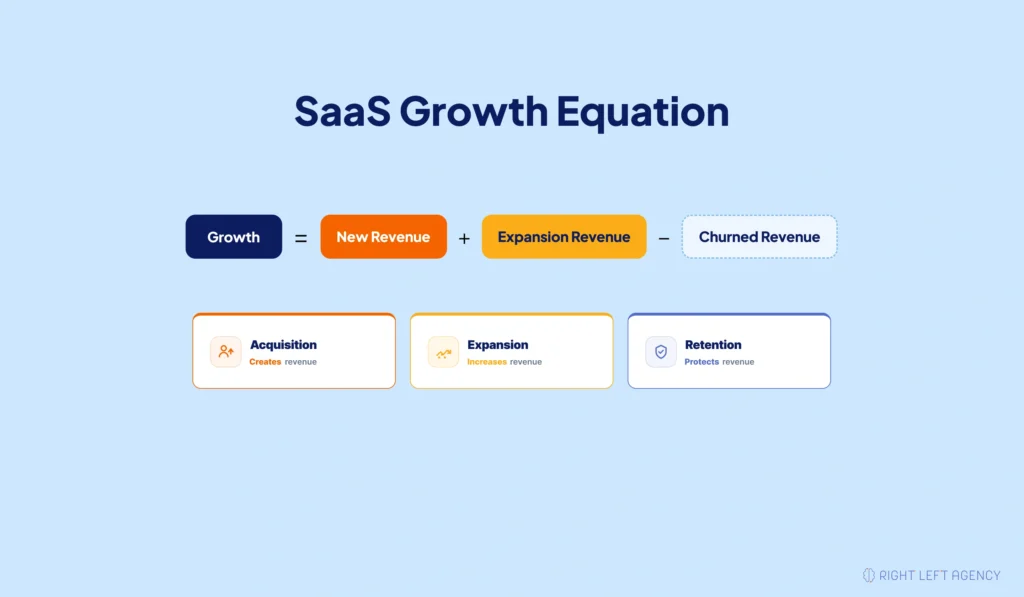
A simple growth equation captures the whole picture:
Growth = New Revenue + Expansion Revenue − Churned Revenue
Acquisition adds revenue. Retention protects it. Expansion increases the value of existing accounts.
Activation Event
Every product has a moment where a new user first experiences real value — sending the first message, completing the first project setup, generating the first report. Defining this activation event precisely is the foundation of retention work, because everything upstream (onboarding design) and downstream (churn prediction) gets measured against it.
Time to Value
Time to value is how long it takes a new customer to reach that activation event. The shorter this window, the less likely a customer churns before they’ve experienced the product’s core benefit. Guided setup, role-based checklists, data migration support, templates, and integration all exist to compress this window.
Customer Health Signals
Completed setup steps aren’t enough on their own. Health signals track whether users are performing the specific actions connected to long-term value — feature adoption depth, login frequency, seats actively used, and engagement from multiple people on the account rather than a single champion.
Lifecycle Segmentation
Not every customer needs the same retention treatment. Segmenting accounts by lifecycle stage — newly onboarded, actively adopting, stable, at-risk, expansion-ready — lets marketing and customer success tailor communication instead of sending the same generic update to a brand-new account and a five-year customer.
Churn Warning Signs
A customer can exit the relationship because of reduced use, a change in requirements, or a lack of perceived value. Warning signs typically show up before a cancellation request: declining login frequency, unused seats, unanswered support tickets, or a champion leaving the company. Catching these early turns retention from reactive to proactive.
Customer Education
Lifecycle communication can introduce relevant features, new use cases, workflow improvements, integrations, training resources, product updates, and performance summaries. Communication must be appropriate to the customer’s position, strategy, account size, behavior, and maturity — a new user needs onboarding tips; a mature account needs advanced use cases.
Win-Back Campaigns
Not every churned customer is gone for good. A win-back campaign targets recently lapsed accounts with a specific reason to return — a new feature that addresses their original objection, a pricing change, or evidence that the product has meaningfully improved since they left. These campaigns work best when they’re specific to why that account churned in the first place, not a generic “we miss you” email.
Expansion Triggers
Expansion revenue may come from additional users, higher usage, premium features, advanced plans, new departments, additional products, or professional services. The best time to discuss expansion is usually after a customer has achieved a clear result. For example, a construction platform might begin with one project team, then expand when the customer adds more projects, offices, financial users, or reporting workflows. Usage data itself often signals the trigger before the customer raises it.
Net Revenue Retention
Net Revenue Retention (NRR) measures the revenue generated by an existing customer base over time, accounting for expansion, downgrades, and churn. An NRR above 100% means your existing customers are generating more revenue over time, even before you acquire anyone new. It shows that renewals, upgrades, and account expansion are doing more than offsetting churn; they are actively driving growth.
Feedback From Churn and Renewal Interviews
Every renewal, expansion, and cancellation is a data point. Reviewing why customers renew, expand, reduce usage, or cancel — through direct interviews, not just survey dropdowns — feeds back into ICP criteria, positioning, sales qualification, onboarding, content, product development, and customer success. This closes the loop and stops marketing from repeatedly attracting customers who were unlikely to succeed in the first place.
Step 9: Track the SaaS KPIs
Every strategy in this guide eventually has to prove itself in a number. These seven metrics are the core dashboard for that — track them together, and you’ll know whether the growth machine is actually healthy, not just busy.
| KPI | Definition | Formula | Why It Matters |
|---|---|---|---|
| Monthly Recurring Revenue (MRR) | Monthly predictable subscription revenue | The total of all subscription revenue received that month | The heartbeat of any subscription-based business. After stripping out one-off payments and up-sells, MRR measures if there is actual growth happening on the recurring revenue base |
| Annual Recurring Revenue (ARR) | Yearly measure of MRR | MRR × 12 | Used to gauge yearly momentum and serves as a benchmark for the leadership and investors to compare the company to others in the space at various growth stages |
| Customer Acquisition Cost (CAC) | Cost of getting a paying customer | Sales & Marketing Cost / Number of Customers Acquired | This sets the limit on how aggressive the growth can be for the company. Growth becomes unsustainable if CAC starts increasing faster than the lifetime value of a customer |
| Lifetime Value (LTV) | Total revenue brought in by a customer during their lifetime | Revenue per account x Average Customer Life | Meaningless without CAC. It’s not enough that LTV is positive; it should be several multiples of CAC for a good SaaS business |
| CAC Payback Period | Months needed to recoup what it cost to acquire a customer | CAC ÷ (MRR per customer × gross margin) | Catches the risk a healthy LTV: CAC ratio can hide — a long payback period can strain cash flow even when the long-term math looks fine |
| Churn Rate | Percentage of customers or revenue lost in a given period | Customers lost ÷ customers at start of period | The leak in acquisition has to be outrun. Ignore it, and every growth number upstream is quietly being recalculated downward |
| Trial-to-Paid Conversion Rate | Percentage of users from trials or freemium who convert to paid accounts | Paid conversions ÷ total trial users | A low conversion rate here doesn’t usually mean the sales team isn’t working hard enough; it almost always means a problem upstream |
The numbers only make sense together
Strong MRR growth means less than it looks like if CAC payback has stretched past 18 months. A great LTV: CAC ratio doesn’t help if trial-to-paid is quietly sliding. The value of this dashboard isn’t any single metric; it’s watching how acquisition cost, retention, and conversion move against each other over time.
Common SaaS Marketing Mistakes to Avoid
Even well-financed SaaS businesses make the same basic mistakes. None of them are exotic — they’re just easy to miss when a team is moving fast.
Weak Positioning: When positioning is vague or borrowed from a competitor’s template, every other channel has to work harder to compensate. Prospects can’t know what makes this product special, and so they fall back on price or features comparison – not a battle that any SaaS company wants to engage in.
Too Many Channels: Allocating funds between five channels in equal 20% portions doesn’t usually compete with running two channels effectively. The more channels one jumps between looking for a quick win, the less likely those channels receive enough iteration to reach maturity.
Ignoring Retention: The marketing process that ends by signing a contract isn’t really investing in the other half of the growth engine. If there is hidden churn in every single cohort, all additional investment into acquisition won’t help much.
Measuring Vanity Metrics: Impressions, traffic numbers, and social media followers look good on a PowerPoint presentation but don’t give insights about the company’s growth. Metrics should be able to link back to pipeline, revenue, or retention; otherwise, the team can be successful against every single goal but fail to grow the business.
Poor ICP: An imprecise ICP results in getting a lot of leads that won’t convert, or will convert into churn-prone customers because the product wasn’t suitable for them from the start. A fuzzy ICP quietly undermines every stage downstream.
Most SaaS companies don’t fail because of acquisition. They fail because growth systems break after acquisition.
That’s the pattern underneath all five mistakes above: they’re rarely acquisition problems in disguise. They’re systems problems — in positioning, focus, retention, measurement, and targeting — that surface only after the top of the funnel is already working. Fixing acquisition is the easy part. Fixing what happens after is where most strategies actually break.
Real SaaS Marketing Strategy Examples
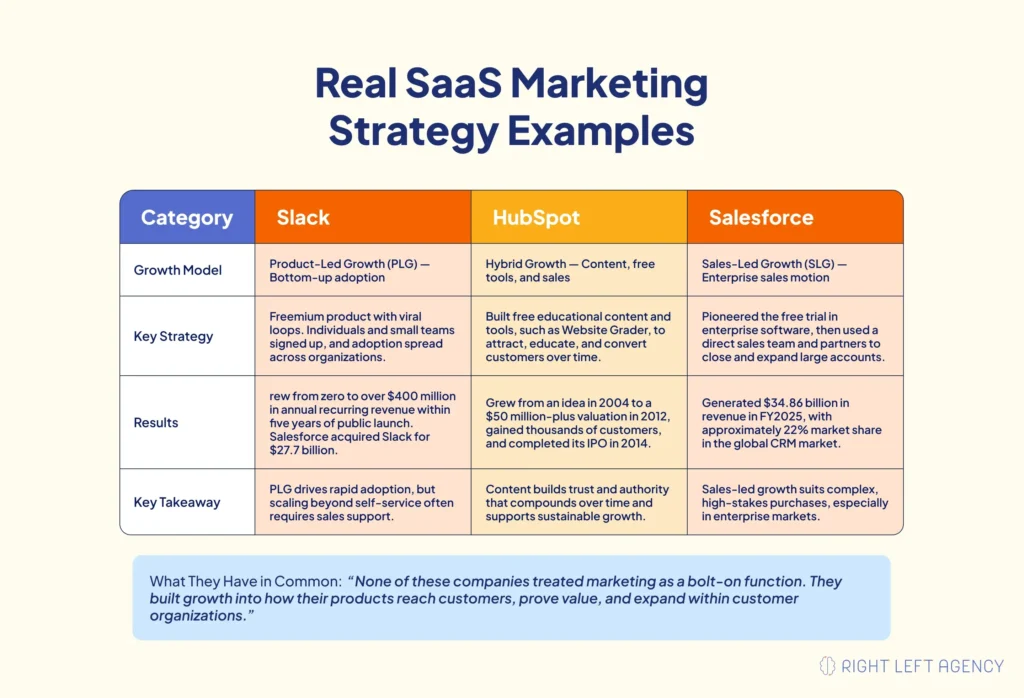
Frameworks are easier to trust when you can see them play out in companies people already know. Here’s how three SaaS giants applied different growth models and what each one teaches.
Here’s a shorter, more natural version:
Slack: Product-Led Growth
Slack made it easy for individuals and small teams to start using the product without a long approval process. As more people joined, usage spread across departments and larger organizations.
That bottom-up growth helped Slack scale quickly. But as enterprise customers came in, sales support became necessary for security reviews, procurement, and company-wide rollouts.
Takeaway: A strong product can drive adoption, but larger deals often need human support.
HubSpot: Content-Driven Growth
HubSpot built demand through useful content, courses, templates, and free tools such as Website Grader.
Instead of pushing for a sale immediately, the company helped marketers solve real problems first. That approach built trust, attracted qualified prospects, and created a natural path into its products.
Takeaway: Content works best when it is genuinely useful and closely connected to the product.
Salesforce: Sales-Led Growth
Salesforce used a sales-led model designed for complex enterprise purchases. Free trials helped prospects explore the product, while sales teams and partners supported evaluation, procurement, implementation, and expansion.
This approach suited a product with long sales cycles, multiple stakeholders, and high-value contracts.
Takeaway: Sales-led growth works well when the purchase is complex and requires guidance.
What These Companies Have in Common
Slack, HubSpot, and Salesforce followed different growth models, but each built marketing into the way customers discovered and experienced value.
Slack used the product, HubSpot used education, and Salesforce used a structured sales process.
The lesson is not to copy one model. Choose the approach that fits your product, customers, pricing, and buying process.
When Should You Work With a SaaS Marketing Agency?
Some companies do need agencies, and sometimes an external partner is required to solve a growth challenge. Certain tell-tale signs indicate that a gap exists and that there isn’t enough capacity within internal teams to address it.
Growth Has Plateaued
When traffic, sign-ups, or pipeline numbers stop growing, it’s rarely because of a lack of effort. The reason is typically an outdated strategy that’s no longer compounding. An outside agency will be able to spot what’s really impeding growth, rather than trying to push the same strategy harder
Positioning Is Confusing
When your team can’t articulate in one sentence why a prospect would choose your business over a competitor, every channel downstream is fighting against gravity. It’s difficult for an internal team, too close to their own product, to fix the positioning problem.
CAC Is Rising
Rising acquisition costs always imply that channels are saturated, the target market has shifted, or the messaging is out of date. Left uncorrected, this can go unnoticed for quite some time until it causes more serious problems.
Conversion Rates Are Low
If traffic looks fine but signups, demos, or trials lag, the issue lies in the marketing funnel — pages, landing pages, or onboarding weren’t optimized for conversion.
Internal Resources Are Limited
Marketing is distributed across areas such as content marketing, demand generation, product marketing, and more — and when a team is spread across all of them at once, none of those functions gets the depth of attention it needs.
None of these five signs necessarily means the internal marketing team isn’t doing good work. Instead, they often indicate that the team needs a partner who can help implement and maintain strategies beyond their current capacity.
The ideal marketing agency won’t replace the internal team but will work alongside it, providing the expertise and outside perspective needed to push existing marketing strategies further once these challenges are addressed.
Conclusion
An effective SaaS marketing strategy begins with knowing the customer.
It helps define the right target market, creates the right positioning, captures the entire journey, and selects the appropriate growth model based on how the customer buys.
After that, acquisition, content, conversion, onboarding, retention, and measurement all come into play.
MRR, ARR, CAC, LTV, activation, churn, and NRR help you understand whether your company is creating sustainable recurring revenue or just activity.
SaaS organizations rarely lack another disconnected strategy. What they lack is a comprehensive solution that bridges customer wants with product benefits and recurring revenue.
Get a SaaS Growth Strategy Audit by Right Left Agency and discover where you fall short when it comes to positioning, acquisition, conversion, retention, and measurement.
Frequently Asked Questions
What is a SaaS marketing strategy?
A SaaS marketing strategy is a strategic approach towards getting, converting, keeping, and scaling customers in a subscription-based software business. It integrates positioning, acquisition, product adoption, customer success, and performance management towards ensuring a continuous flow of income streams.
How do you develop a SaaS marketing strategy?
Define the ideal customer profile and the problem that your product solves. Clearly define positioning, the customer journey, and the growth model, whether it is product-led, sales-led, or hybrid. Develop acquisition, conversion, onboarding, retention, expansion, and reporting systems based on customer behaviors.
What is an example of SaaS marketing?
HubSpot is an example. It engages its audience through blog articles, tutorials, free tools, etc. These sources help bring people into the world of their product offerings and lead them towards adoption and paid conversion.
What is the best SaaS growth model?
The best model depends on product complexity, contract value, customer preferences, and buying requirements. Product-led growth suits simple self-service products. Sales-led growth fits complex enterprise solutions. Hybrid growth works when smaller customers prefer self-service while larger organizations need sales and implementation support.