Key Takeaways
- Rising ad spend without profitable growth may signal the need for specialist support.
- Product feed issues can limit Google Shopping performance.
- Performance Max requires strategic oversight alongside automation.
- Accurate tracking and product margins are essential for evaluating ROAS.
- Specialist support makes sense when campaign complexity exceeds internal expertise.
Your ecommerce store is generating traffic through Google Ads, but increasing your advertising budget is not producing the sales growth you expected. The problem may involve campaign targeting, product feeds, conversion tracking, or profitability.
Hiring an ecommerce paid search agency makes sense when your campaigns require expertise your internal team cannot consistently provide. A specialist can identify performance gaps, improve campaign management, and connect advertising decisions to business outcomes.
Here are seven signs your ecommerce business may need specialist paid search support.
What Does an Ecommerce Paid Search Agency Do?
An ecommerce paid search agency plans, manages, and optimizes advertising campaigns designed to generate online purchases through search-driven platforms.
Unlike general PPC management, ecommerce paid search requires an understanding of product catalogs, Google Merchant Center, inventory availability, product margins, customer acquisition costs, and purchase behavior.
The services commonly include:
- Google Search Ads: Targeting shoppers researching or comparing relevant products.
- Google Shopping Ads: Promoting products through listings featuring product information, images, and prices.
- Performance Max: Using Google’s automated campaign system to reach potential customers across Search, Shopping-related inventory, YouTube, Display, and other eligible Google surfaces.
- Product feed optimization: Improving product titles, descriptions, attributes, and data quality.
- Conversion tracking: Measuring purchases, transaction values, and advertising attribution.
- Campaign optimization: Managing budgets, bidding, product segmentation, and performance testing.
Performance Max is not exclusively a paid search campaign. It operates across multiple Google advertising channels, but managing it is often an important part of an ecommerce advertising program.
An effective specialist should understand how these capabilities work together to support profitable customer acquisition.
7 Signs It’s Time to Hire an Ecommerce Paid Search Agency
Not every decline in advertising performance requires a new agency.
However, the following problems may indicate that your paid search program needs more specialized attention.
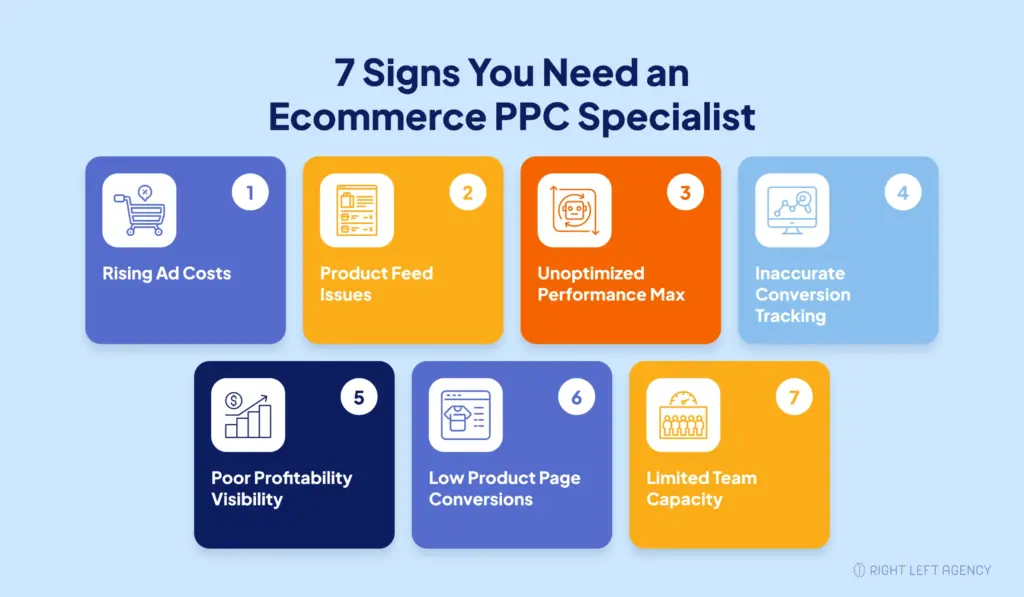
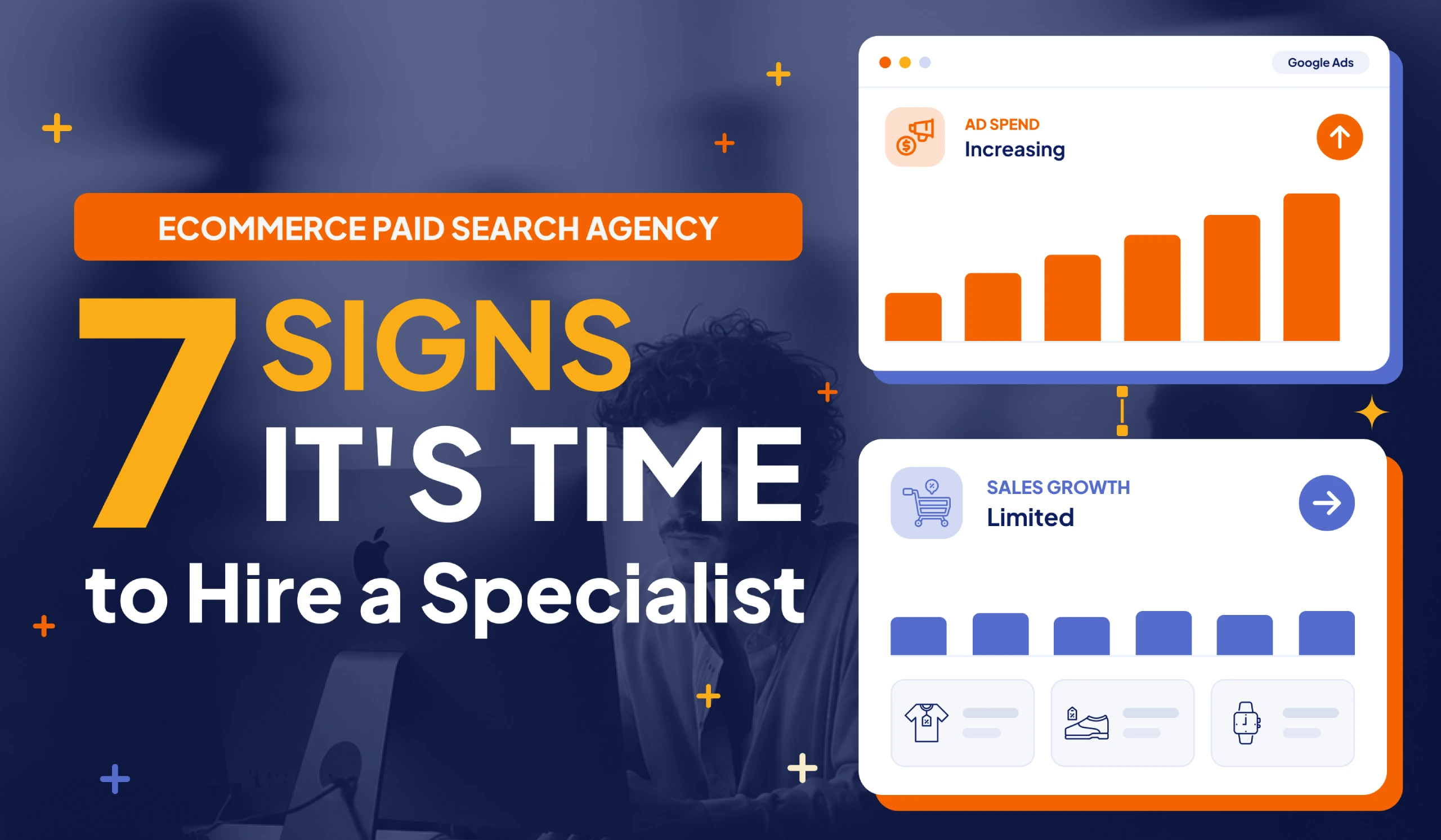
1. Your Ad Spend Is Increasing, but Sales Growth Isn’t Keeping Up
Increasing your Google Ads budget without proportional sales growth may indicate declining advertising efficiency.
Common warning signs include:
- Advertising costs grow faster than revenue.
- Cost per acquisition (CPA) continues to rise.
- Campaign performance declines as budgets increase.
- Additional spending generates limited new sales.
Competition, seasonality, and changing customer demand can also affect results.
For example, if advertising spend increases by 30% but campaign-attributed revenue grows by only 5% over a comparable period, your team should investigate profitability before increasing the budget again.
An ecommerce paid search specialist can evaluate targeting, bidding, budget allocation, and conversion performance to identify improvement opportunities.
When to consider hiring: Increasing ad spend is not generating sustainable growth, and your team cannot identify why.
2. Your Google Shopping Campaigns Have Persistent Product Feed Problems
Google Shopping relies on accurate product information to display relevant ads.
Incorrect titles, prices, availability, images, or product identifiers can limit visibility and campaign performance.
Google’s Merchant Center product data specifications explain how missing or incorrect attributes can affect product eligibility.
Common warning signs include:
- Product disapprovals or limited eligibility.
- Incorrect pricing or availability.
- Missing product identifiers or variant details.
- Important products receiving limited exposure.
For example, a clothing retailer with inaccurate size or color attributes may struggle to display the correct product variants.
An ecommerce Google Ads specialist can diagnose feed errors, improve product data, and address Merchant Center issues.
When to consider hiring: Recurring feed problems restrict product visibility, and your team lacks the expertise to resolve them.
3. Performance Max Campaigns Are Running Without a Clear Optimization Strategy
Google Performance Max automates advertising across multiple channels, but effective results still depend on accurate conversion data, campaign objectives, product information, and creative assets.
Warning signs include:
- Campaign goals are disconnected from profitability.
- Products with different margins lack appropriate strategic differentiation.
- Product-level performance is rarely reviewed.
- Search insights and channel reporting are overlooked.
- Campaign changes lack proper evaluation.
Google’s Performance Max reporting tools help advertisers evaluate campaign activity and identify optimization opportunities.
A specialist can assess campaign structure, product segmentation, conversion goals, and creative strategy to ensure automation supports business priorities.
An Ecommerce Example From Right Left Agency
Right Left Agency worked with Palermo Body, a skincare brand, using Google Performance Max, Meta advertising, and founder-led video creative.
The integrated approach combined automated advertising with customer-focused storytelling. The published case study reports improved advertising engagement and conversion performance.
This demonstrates the importance of aligning automation, creative strategy, and customer acquisition goals.
When to consider hiring: Your team relies on campaign automation but cannot clearly identify what drives performance.
4. You Can’t Trust Your Conversion Tracking or Revenue Attribution
Inaccurate conversion data can lead to poor advertising decisions, especially when ecommerce platforms such as Shopify or WooCommerce are connected with Google Ads and Google Analytics 4 (GA4).
Common tracking problems include:
- Duplicate or missing purchase events.
- Incorrect transaction values or currencies.
- Inconsistent conversion recording.
- Refunds and cancellations not reflected appropriately.
- Unexplained differences between advertising and sales reports.
Some reporting differences are normal because platforms use different attribution models, conversion windows, and reporting methods.
However, significant discrepancies require investigation.
A paid search specialist can validate purchase events, transaction values, and attribution settings. Google’s conversion adjustments can also help eligible advertisers account for returned or canceled purchases.
When to consider hiring: Your team cannot reliably connect advertising spend with purchases and revenue.
5. Your Campaigns Ignore Product Margins and Customer Acquisition Costs
Return on ad spend (ROAS) is useful, but it does not automatically measure profitability. Two products may generate the same advertising ROAS while delivering very different financial outcomes.
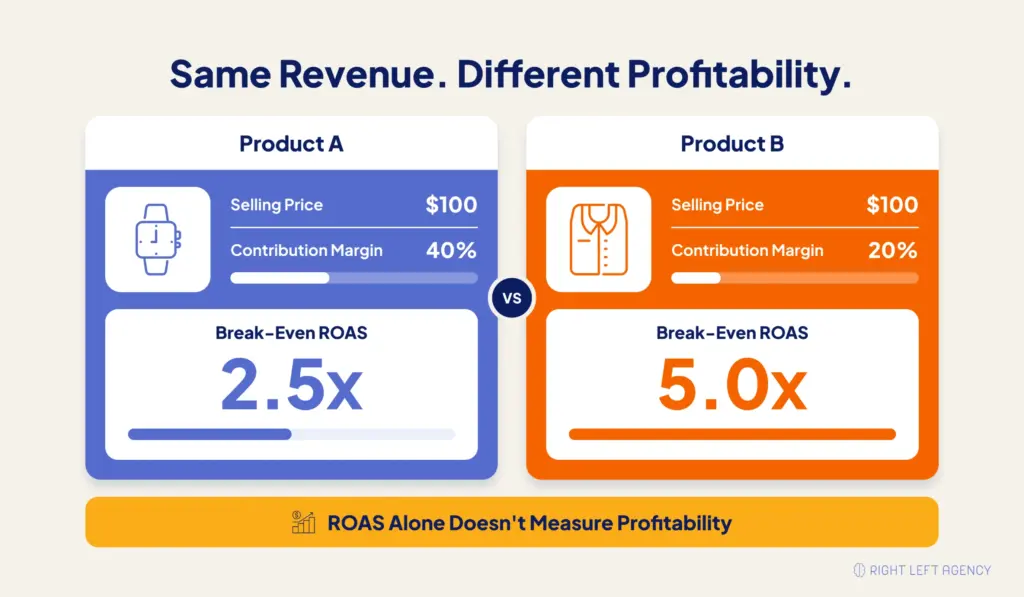
Consider two hypothetical products selling for $100.
Product A
- Selling price: $100
- Variable costs before advertising: $60
- Contribution margin before advertising: 40%
- Simplified break-even ROAS: 2.5x
Product B
- Selling price: $100
- Variable costs before advertising: $80
- Contribution margin before advertising: 20%
- Simplified break-even ROAS: 5.0x
These examples assume the stated costs include the relevant variable order expenses. They exclude additional fixed costs and agency fees.
A campaign achieving 3.0x ROAS could contribute positively on Product A while losing money on Product B.
This is why ecommerce paid search strategies should consider:
- Product and category margins.
- Customer acquisition costs.
- Shipping and fulfillment expenses.
- Discounts and promotional costs.
- Return rates.
- Repeat-purchase behavior and customer lifetime value.
An ecommerce PPC specialist can help establish performance targets based on these commercial considerations rather than treating the same ROAS target as suitable for every product.
That does not mean every product requires a separate campaign. Campaign structures should reflect available data, advertising volume, and practical management requirements.
When to consider hiring: Your team measures advertising success primarily through ROAS without understanding which products or customer segments support profitable growth.
6. Your Ads Generate Traffic, but Your Product Pages Don’t Convert
Paid search performance depends on more than campaign targeting. Even relevant advertising traffic can fail to generate purchases when the shopping experience creates friction.
For example, a shopper might click an advertisement for a specific product but land on a generic category page without the expected item.
The advertisement generated interest, but the landing experience failed to match the shopper’s expectations.
Common conversion barriers include:
- Product pages that do not match advertised offers.
- Slow or difficult mobile shopping experiences.
- Unclear product descriptions or specifications.
- Unexpected shipping costs.
- Limited payment options.
- Complicated checkout processes.
- Missing delivery or return information.
Before assuming advertising traffic is low quality, examine conversion rates across relevant campaigns, products, devices, and landing pages.
An ecommerce paid search agency with conversion optimization expertise can help determine whether performance problems originate in advertising, the shopping experience, or both.
At Right Left Agency, our ecommerce marketing services connect paid advertising with website optimization, creative development, and performance measurement.
This approach helps address the broader customer journey rather than evaluating campaign metrics in isolation.
When to consider hiring: Your campaigns attract relevant shoppers, but persistent landing-page or checkout problems remain unresolved.
7. Your Team Can’t Keep Up With Campaign Optimization and Seasonal Demand
Ecommerce advertising becomes more operationally demanding as product catalogs, campaigns, promotions, and sales channels expand.
A small internal team may manage initial campaigns successfully but struggle when the business launches additional products or enters new markets.
This pressure often increases during major promotional periods, such as Black Friday, Cyber Monday, and seasonal sales events.
Campaign management may require coordination between advertising, merchandising, inventory, creative, and website teams.
Warning signs include:
- Campaign performance is reviewed inconsistently.
- Product launches happen without updated advertising plans.
- Promotional ads continue running after offers expire.
- Inventory changes are not reflected promptly in product feeds.
- Testing is repeatedly postponed because the team is overloaded.
- Advertising decisions depend on one employee with limited availability.
Hiring an agency can provide access to additional expertise and operational capacity.
However, outsourcing should not remove internal accountability.
Your business still needs someone responsible for communicating product priorities, margins, promotional plans, and performance expectations.
When to consider hiring: Campaign complexity and operational demands have exceeded the resources or expertise your internal team can reliably provide.
When Should You Keep Paid Search Management In-House?
Hiring an ecommerce paid search agency is not always the best next step. Some businesses need to resolve foundational problems before investing in ongoing external management.
Your Product Economics Are Not Yet Viable
If product margins cannot support sustainable customer acquisition, better campaign management alone may not solve the problem.
Review pricing, fulfillment costs, return rates, and contribution margins before substantially increasing advertising investment.
You Haven’t Validated Customer Demand
A new store with limited sales history may benefit more from controlled testing than a large ongoing agency engagement.
The immediate objective may be understanding which products, audiences, and offers can generate viable demand.
Your Internal Team Has the Required Expertise
An experienced internal specialist may already be capable of managing campaigns effectively.
In that situation, a focused account audit or specialist consultation could be more appropriate than replacing the team.
Your Website Has Major Conversion Barriers
If customers cannot complete purchases reliably, increasing traffic may simply increase advertising costs.
Fix critical checkout problems, product availability issues, and other major customer-experience barriers first.
The decision to hire an agency should depend on the expertise required to solve your current challenges, not simply your advertising budget.
Four Questions to Ask Before Hiring an Ecommerce Paid Search Agency
Before committing to external management, evaluate whether specialist support can solve a clearly defined business problem.
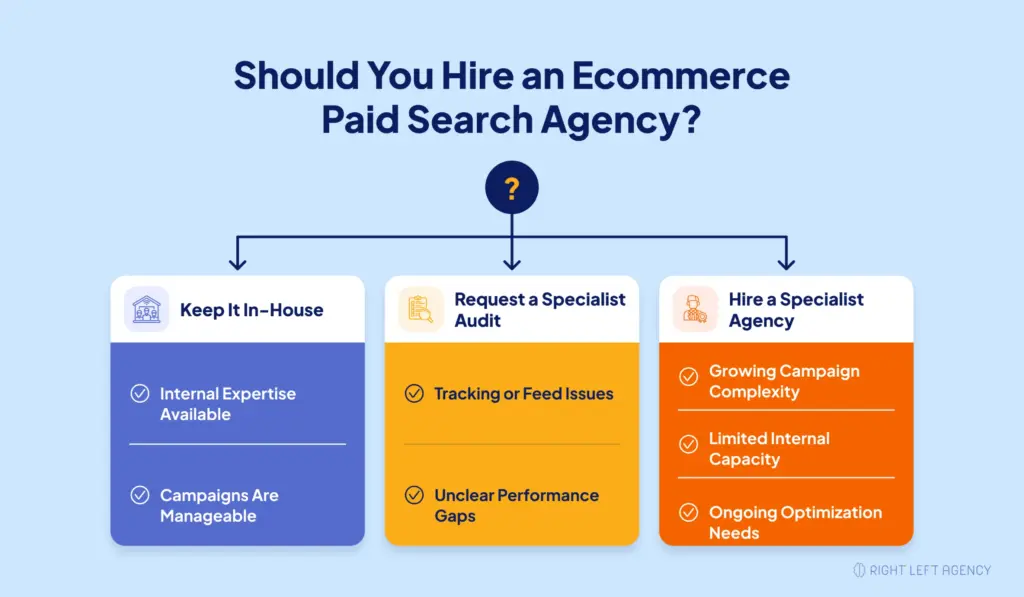
Ask yourself:
- Can our internal team identify why campaigns are underperforming? If your team cannot distinguish between targeting, bidding, product feed, and conversion problems, an external audit may help establish priorities.
- Do we have reliable purchase and revenue tracking? Without trustworthy conversion data, it becomes difficult to evaluate campaign changes or hold an agency accountable for results.
- Are our advertising targets connected to product profitability? ROAS alone may not reveal whether campaigns generate sufficient contribution margin to support acquisition costs.
- Would external expertise solve a problem our team cannot address consistently? Consider whether you need technical specialization, additional operational capacity, or a more comprehensive advertising strategy.
If the main challenges involve internal expertise, measurement accuracy, or increasingly complex campaign management, hiring a specialist may be appropriate.
If the problems originate in pricing, product demand, or fundamental website functionality, resolving those issues may be the better first investment.
What Should You Look for in an Ecommerce Paid Search Agency?
Once you identify a need for specialist support, evaluate potential partners based on the problems they can solve.
1. Relevant Ecommerce Experience
Ask for examples involving businesses with similar product catalogs, margins, customer behavior, and growth challenges.
Experience managing lead-generation campaigns does not automatically demonstrate expertise in ecommerce product advertising.
2. Google Shopping and Merchant Center Knowledge
Confirm that the agency understands product feeds, Shopping campaign management, Merchant Center diagnostics, and product-level reporting.
These capabilities are particularly important for retailers with frequently changing inventory or large catalogs.
3. Strong Measurement Capabilities
Ask how the agency validates purchase tracking, transaction values, attribution, and revenue reporting.
A reliable measurement foundation should come before aggressive campaign expansion.
4. Profitability-Focused Reporting
A useful report should explain more than advertising ROAS.
Ask how the agency evaluates acquisition costs, product economics, new-customer performance, and business growth.
5. Clear Responsibilities and Account Ownership
Confirm who will manage the account and what the service agreement includes.
Your business should maintain appropriate access to its advertising accounts, analytics properties, product feeds, and historical data.
6. A Realistic Optimization Plan
A specialist should explain which problems they would investigate first and how they would prioritize improvements.
Be cautious of agencies that guarantee specific revenue increases before understanding your account and business model.
For additional selection criteria, see our guide on how to choose an ecommerce digital marketing agency.
What Should Happen During Your First 30 Days With an Agency?
A productive initial engagement should prioritize understanding and measurement before making unnecessary campaign changes.
The exact sequence depends on the account’s condition.
Days 1–10: Account and Measurement Review
The agency should establish appropriate access and review:
- Google Ads and Merchant Center configuration.
- Existing campaign performance.
- Purchase conversion tracking.
- Product feed quality.
- Business goals and product economics.
The objective is to identify major risks, performance gaps, and potential opportunities.
Days 11–20: Strategy and Prioritization
Based on the findings, the agency should recommend improvements to campaign structure, targeting, conversion measurement, product segmentation, or landing pages.
Recommendations should be prioritized according to potential impact, confidence, implementation effort, and dependencies.
Days 21–30: Implementation and Reporting
The agency can begin implementing agreed improvements and establish reporting against relevant business metrics. Initial changes may include correcting tracking issues, resolving product feed problems, or testing campaign adjustments.
The first month should establish account understanding, clear ownership, priorities, and the next testing cycle. It should not be treated as a guarantee of immediate revenue growth.
Make Your Next Ecommerce Advertising Decision Based on Profitability
An ecommerce paid search agency should go beyond managing bids and budgets to improve campaign performance, conversion tracking, and profitability.
If rising ad costs, product feed issues, or limited internal expertise are holding back growth, specialist support may help.
At Right Left Agency, we connect paid advertising with creative strategy, website optimization, and performance measurement to identify opportunities for sustainable ecommerce growth.
Identify What’s Limiting Your Ecommerce Advertising Growth
Increasing ad spend will not solve every ecommerce growth problem. Before changing campaigns or hiring an agency, identify whether your biggest obstacles involve targeting, product feeds, tracking, or conversion performance.
Right Left Agency helps ecommerce brands evaluate these challenges and connect paid advertising with creative strategy and measurable business outcomes.
Explore our ecommerce marketing services to see how we approach advertising performance and growth.
Frequently Asked Questions
What is the difference between an ecommerce PPC agency and a paid search agency?
An ecommerce PPC agency may manage paid search, shopping advertising, display, remarketing, and paid social campaigns. An ecommerce paid search agency focuses primarily on search-driven acquisition, including Google Search and Shopping. Many also manage Performance Max, which operates across multiple Google channels. The actual service scope matters more than the agency label.
How much does an ecommerce paid search agency cost?
Ecommerce paid search agency pricing depends on monthly advertising spend, product catalog complexity, campaign scope, and required technical support. Agencies commonly charge flat monthly retainers, percentage-of-spend fees, or hybrid arrangements. When comparing proposals, confirm whether Google Shopping feed optimization, Merchant Center management, conversion tracking, creative development, reporting, and landing-page improvements are included. A lower management fee may not represent better value if essential services cost extra.
Can an ecommerce paid search agency improve ROAS?
An agency may improve ROAS by addressing campaign targeting, product feed quality, conversion measurement, bidding, or landing-page performance. However, improvements are not guaranteed. ROAS should also be evaluated alongside acquisition costs, product margins, and other profitability measures.
Should a Shopify store hire a Google Ads specialist?
A Shopify store may benefit from specialist support when campaigns become difficult to manage, purchase tracking is unreliable, or advertising growth requires expertise beyond the internal team. Smaller stores with simple campaigns and experienced internal staff may not need ongoing agency management.
How long does it take to see results from ecommerce PPC management?
Some technical fixes and campaign changes can be implemented quickly. Evaluating their commercial impact may require several weeks or longer, depending on conversion volume, purchase cycles, campaign history, and testing requirements. A credible agency should agree on evaluation periods and explain uncertainty rather than promise immediate results.