Key Takeaways
- SaaS SEO transforms quality organic traffic into signups, demos, pipeline and revenue.
- SaaS teams should prioritize keywords based on customer intent, product fit, and conversion potential.
- A strong SaaS SEO strategy requires content, technical SEO, internal linkages, and clear conversion funnels.
- Organic search works best when each page has a clear next step for visitors, whether that’s a free trial, demo request, product tour, checklist, template, or case study.
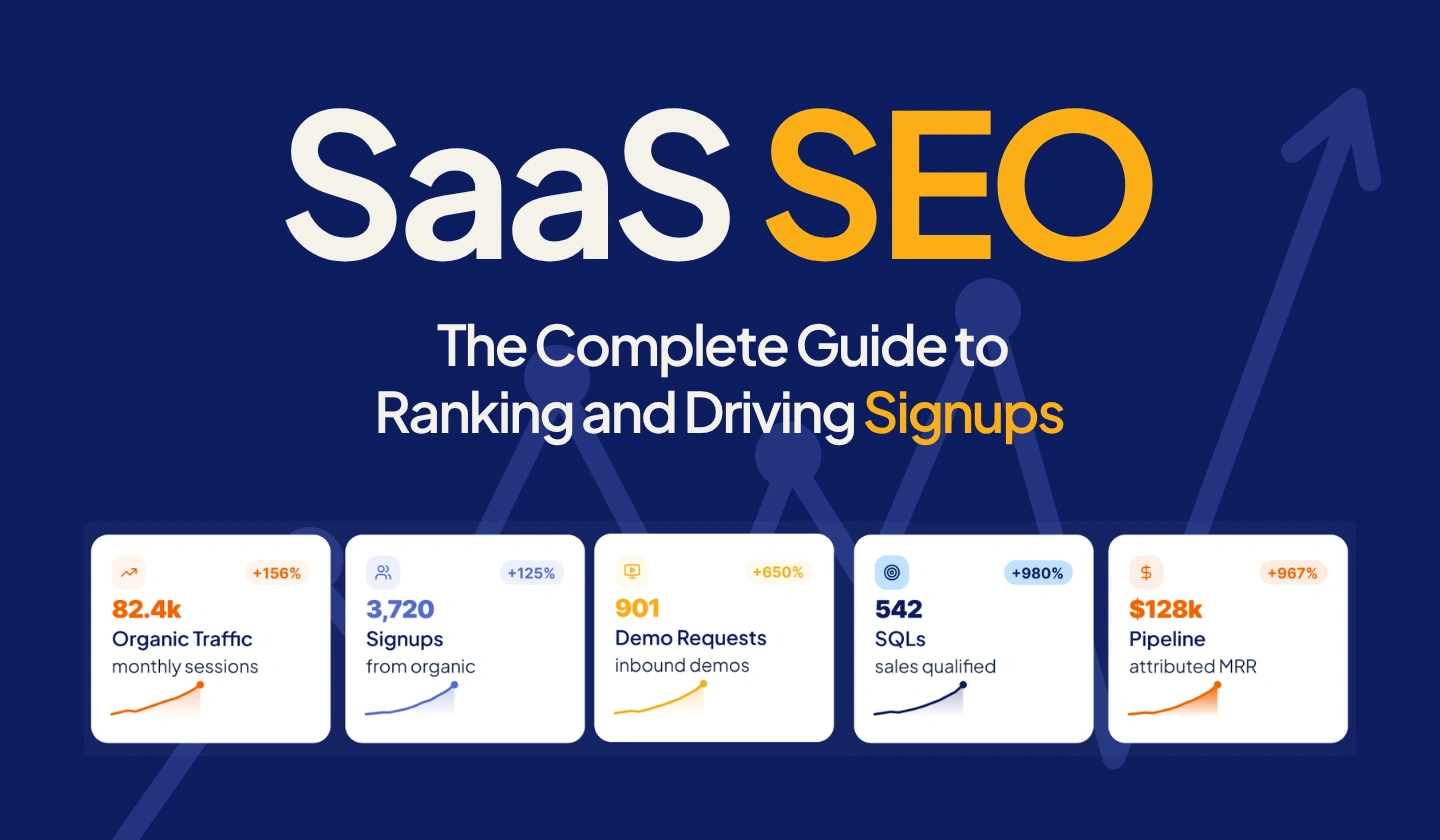
- SaaS teams should measure SEO by business outcomes including organic signups, demo requests, SQLs, trial activation, pipeline value, CAC, and revenue influence.
What Is SaaS SEO?
SaaS SEO is search engine optimization for software companies. It helps SaaS companies rank for relevant searches, bringing in buyers at different phases of their journey and leading visitors to important activities like starting a free trial, booking a demo, joining a waitlist, or becoming a sales-qualified lead.
Many SaaS companies work with specialized SaaS SEO services to build keyword strategies, optimize product-led pages, improve technical foundations, and create conversion paths that support pipeline growth.
SEO for SaaS for a software company is not just blog post publishing. It is keyword research framework, product-led content, organic traffic, SaaS product and feature pages, website performance, AI search visibility, internal linking, and conversion optimization.
Many SaaS teams publish weekly blog posts, watch impressions climb, and still face the same problem at the end of the quarter: organic search is not producing enough free trials, demo requests, or qualified pipeline. The issue is not always traffic. It is often the gap between search intent, product value, and conversion.
A strong SaaS SEO strategy connects keyword research, content, technical improvements, internal links, product messaging, and conversion-focused CTAs so your site does more than rank — it helps the right buyers take action.
It helps SaaS teams:
- Rank for software-related keywords that match buyer intent
- Attract problem-aware and solution-aware visitors
- Support both product-led growth and sales-led growth
- Drive free trial signups and demo requests
- Reduce dependency on paid acquisition over time
- Build long-term organic pipeline
- Improve authority in a competitive software category
For product-led SaaS companies, SEO should not stop at acquisition. It should also guide visitors toward activation moments such as creating an account, using a template, connecting an integration, inviting a teammate, or completing the first product action.
The goal is simple: bring in the right traffic and give that traffic a clear reason to take the next step.
Why SaaS SEO Matters for Ranking, Signups, and Pipeline
Organic search matters because SaaS buyers rarely convert after one interaction. They search for symptoms, compare solutions, read guides, check alternatives, evaluate integrations, and look for proof before they talk to sales or create an account.
That makes organic search one of the most important channels for long-term SaaS growth. It can capture early-stage demand, support mid-funnel education, and convert high-intent buyers when they are ready to act.
If your team is also working on broader demand creation, this connects naturally with a complete SaaS lead generation strategy.
A strong SaaS SEO strategy can improve:
- Visibility for problem-aware searches
- Qualified traffic from users already researching a solution
- Free trial and demo conversion opportunities
- Lower long-term customer acquisition cost
- Sales enablement through useful content
- Retargeting audiences for paid media
- Authority across important product categories
- Pipeline influenced by organic content
For example, someone searching “how to reduce customer churn” might not be ready to buy today. But if they later search “best customer success software,” read a comparison page, and book a demo, your organic content helped shape that journey.
In practice, organic growth for SaaS works best when content is connected to a clear business outcome. Traffic is useful, but qualified signups, SQLs, pipeline, and revenue are what make the channel valuable.
How SaaS SEO Is Different From Traditional SEO
SaaS SEO uses the same foundation as traditional SEO, but the strategy is different. SaaS buyers tend to have longer sales cycles, more stakeholders, more touchpoints, and more complex conversion paths.
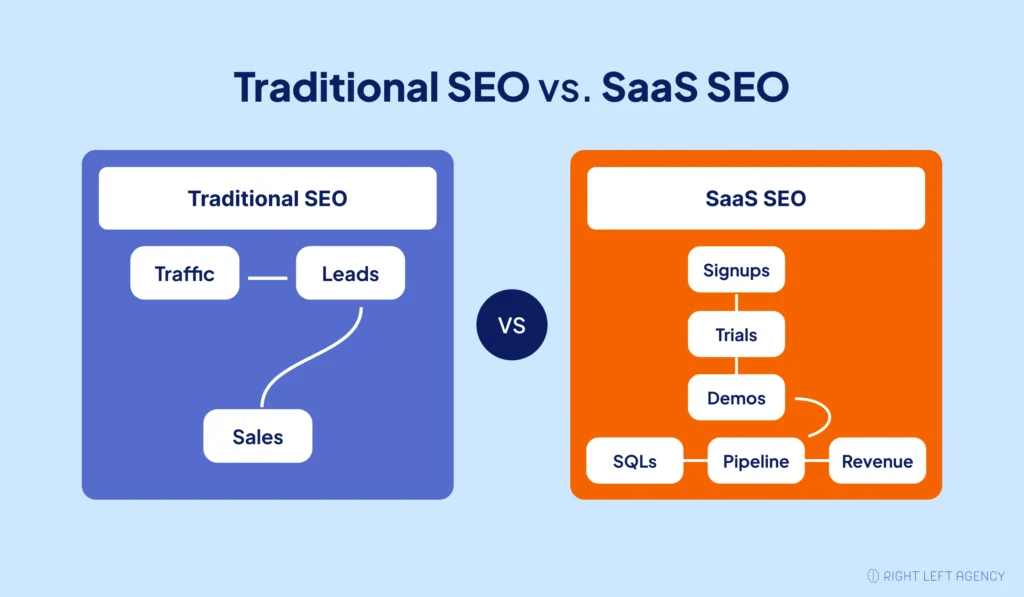
While a typical SEO strategy might focus on traffic, leads, or ecommerce sales, B2B SaaS SEO needs to connect rankings to product education, trial signups, demo requests, MQLs, SQLs, pipeline, and revenue.
| Area | Traditional SEO | SaaS SEO |
| Main goal | Traffic, leads, or sales | Signups, trials, demos, pipeline, and revenue |
| Buyer journey | Often shorter | Longer and multi-touch |
| Content focus | Informational and transactional pages | Blog, feature, use case, comparison, alternative, integration, and product-led pages |
| Conversion path | Form fill or purchase | Free trial, product signup, demo request, or sales conversation |
| Metrics | Rankings, traffic, conversions | Rankings, signups, SQLs, pipeline, CAC, and ARR |
| Strategy | Keyword and content focused | Keyword, content, product, funnel, and conversion focused |
This difference matters because SaaS buyers need more than information. They need education, proof, positioning, product clarity, and a clear path to action. For a deeper look at how SaaS buyers move from awareness to conversion, review this guide on the SaaS marketing funnel.
SaaS SEO’s Unique Challenges
SaaS SEO is distinct in the sense that software purchasers don’t usually convert after one search or one page visit. They investigate problems, compare tools, evaluate features, check proof, and typically engage many individuals before signing up, booking a demo, or becoming a customer.
Long and Multi-Touch Purchase Journeys
The challenge: SaaS purchasers have a long road to convert. They may watch educational content, compare vendors, go through to pricing pages, read case studies, and return through branded search or paid adverts.
In B2B SaaS, one buyer may do the research, another may analyze the features, and a decision-maker may approve the purchase afterward. That makes it impossible to tie a term, page, or visit to the ultimate signup or request for a demo.
How SaaS SEO can help fix this: A great SaaS SEO strategy provides content for every level of the funnel. Early research is documented in blog posts, use case pages help facilitate evaluation, comparison pages collect buying intent, and internal links lead users to free trials, demos, and product pages.
Complex Product & Feature Positioning
The challenge: SaaS products generally tackle many challenges for different consumers, teams, sectors, and workflows, making it hard to explain the product clearly on one page.
For example, a project management platform might be used by agencies, software teams, operations teams, and executives. Various audiences may seek various problems, features, and outcomes.
How SaaS SEO can fix this: SaaS organizations need to establish specific feature pages, use case pages, industry pages, and integration pages. This lets each page target a distinct search intent and gives buyers a better incentive to join up or request a trial.
Merging Bottom-Funnel Pages and Educational Content
The challenge: Many SaaS firms publish too much top-of-funnel content and not enough content for buyers that are ready to compare, analyze, or convert.
A SaaS blog could rank for generic themes like productivity, cooperation, or automation, but that traffic might not be ready to buy. Not all traffic is good (qualified) traffic
How SaaS SEO can fix this: The content strategy needs to mix informative pieces with high-intent pages like comparison pages, alternative pages, use case pages, integration pages, and product-led templates. This helps organic traffic go from learning to assessment and conversion.
Measuring the SEO Impact Beyond Traffic
The challenge: It’s difficult for SaaS teams to prove if SEO is driving actual business outcomes. Traffic and rankings don’t necessarily reveal if organic search is producing signups, SQLs, pipeline, or revenue.
Example: Someone might see the company for the first time on a blog article, then return again via a comparison page, then book a demo after clicking on a branded ad. If tracking is poor, SEO may not be getting credit for its involvement in the customer journey.
How SaaS SEO can fix this: SaaS teams need to link SEO reporting with GA4, Google Search Console, CRM data, and pipeline reporting. Track not only traffic, but also organic signups, demo requests, MQLs, SQLs, trial activation, assisted conversions, and organic pipeline value.
Buyer Journeys That Are Long and Multi-Touch
The challenge: In SaaS, a customer may enter with an issue-aware search, consume instructional information, compare different tools, look at alternatives, and then come back later via sponsored search or paid retargeting. It can also be the same with founders, marketing executives, sales teams, financial teams, and technical decision-makers in B2B SaaS.
A long buyer journey indicates that consumers interact with many sites, channels, and messages before they register, request a demo, or become a customer.
How SaaS SEO can fix this: By providing content for all stages of the funnel. Blog postings can raise awareness, use case sites can describe how relevant the product is, comparison pages can assist with evaluation, and feature pages can lead high-intent viewers to a free trial or demo.
Traffic That Doesn’t Convert (Low Intent)
The challenge: Low-intent traffic is when people land on the site but have little connection to the product or buying path.
This is where SaaS businesses target broad, high-volume keywords merely because they seem tempting in SEO tools. For example, a workflow automation SaaS might rank for “productivity tips,” but that traffic might not be ready to compare software or join a trial.
How SaaS SEO can fix this: SaaS SEO can assist, helping you rank your keywords for product fit, search intent, funnel stage, and conversion potential. Instead of just chasing traffic, SaaS teams should create sites around problem-aware, solution-aware, comparison, alternative, integration, and use case keywords that are closer to signups and pipeline.
Complicated Website Structure
The challenge: Complex website structures might confuse search engines and consumers about which pages are the most significant.
This arises in SaaS because websites generally have blogs, feature pages, use case pages, industry pages, integration pages, help docs, pricing pages, product updates, and sometimes app subdomains. Pages that are significant can get hidden, duplicated, or detached from the rest of the site.
How SaaS SEO can fix this: SaaS SEO can assist with clean site architecture, topic clusters, strong internal linking, simple URL structures, and stronger links between instructional content and product sites. This helps users progress seamlessly from learning to evaluation, and helps search engines comprehend the role of each page.
The SEO-Revenue Connection Problem
The challenge: Revenue attribution is the problem of demonstrating how organic search drives signups, demos, pipeline, and customers.
That’s what happens in SaaS, where conversions happen over several sessions and channels. A user could start with a blog post, then go to a comparison page, click on a paid ad, watch a webinar, and then book a demo. Weak tracking may mean SEO doesn’t get credit for affecting the journey.
How SaaS SEO can fix this: SaaS SEO can help by combining Google Search Console, GA4, CRM data, signup tracking, demo forms, and pipeline reporting. SaaS teams should be evaluating organic signups, demo requests, SQLs, pipeline value, trial activation, CAC, and revenue influence rather than just rankings and traffic.
Start With Business Intent, Not Just Search Volume
Many SaaS companies make the mistake of choosing keywords only because they have high search volume. That approach can create traffic, but it often attracts visitors who are too broad, too early, or too far from the product.
The better approach is prioritizing keywords based on business intent. A keyword with 100 searches a month and a strong product fit can be more valuable than a keyword with 5,000 searches and no buying intent.
Before targeting a keyword, evaluate:
- Search intent: What is the user really trying to solve?
- Product relevance: Does your software naturally fit the problem?
- Funnel stage: Is the keyword awareness, consideration, or decision stage?
- Conversion potential: Could the visitor become a signup, demo, or opportunity?
- Ranking difficulty: Can your site realistically compete?
- Content gap: Do competitors answer the query better than you?
- Internal linking value: Can the page support product or use case pages?
- Sales insight: Does your sales team hear this pain point on calls?
Use this simple scoring framework to prioritize keywords:
| Keyword Factor | Score 1–5 | What to Check |
| Product fit | 1–5 | Does the product naturally solve this problem? |
| Buyer intent | 1–5 | Is the searcher close to evaluation or action? |
| Ranking difficulty | 1–5 | Can the site realistically compete? |
| Conversion value | 1–5 | Could this keyword create signups, demos, or pipelines? |
| Content gap | 1–5 | Can your page offer something better than competitors? |
For example, a broad keyword like “team productivity tips” may bring traffic, but it may not create many qualified signups. A more specific keyword like “workflow automation software for operations teams” has clearer product fit and stronger buying intent.
This is where many organic growth programs for SaaS become stronger. Instead of chasing every keyword, the team focuses on search terms that support the buyer journey and the business model.
SaaS Keyword Research Framework
SaaS keyword research should map keywords to the full buyer journey. Some visitors are just learning about a problem. Others are comparing tools. Some are actively looking for an alternative to a competitor.
The best keyword strategy covers all of these moments and connects each keyword type to the right page format.
| Funnel Stage | Keyword Type | Example | Best Page Type |
| Awareness | Problem keywords | How to reduce customer churn | Educational blog post |
| Awareness | “What is” keywords | What is onboarding software | Definition guide |
| Consideration | Solution keywords | Best onboarding software | Listicle or comparison guide |
| Consideration | Use case keywords | Onboarding software for SaaS teams | Use case page |
| Decision | Alternative keywords | Intercom alternatives | Alternative page |
| Decision | Comparison keywords | HubSpot vs Salesforce | Comparison page |
| Decision | Integration keywords | CRM Slack integration | Integration page |
| Product-led | Template or tool keywords | Customer onboarding checklist | Template or free tool page |
This framework helps SaaS teams avoid a content strategy that is too blog-heavy. Educational content is useful, but high-intent commercial pages often have a clearer path to signups and demos.
For a product-led SaaS company, template and tool keywords may drive the first signup. For a sales-led B2B SaaS company, comparison, alternative, and use case keywords are often closer to demo requests and opportunity creation.
The best strategy balances top-of-funnel content, bottom-funnel SEO, and product-led assets that give users immediate value.
Content Types That Drive Rankings and Signups
A strong SaaS content strategy should include more than educational blog articles. Blog posts are important for awareness, but they are only one part of the organic growth system.
To drive signups, SaaS companies need content assets that match specific search intent and conversion moments. These assets should support the full journey from first visit to product evaluation, just like a well-built SaaS marketing strategy connects audience, funnel, channels, and growth goals.
Important SaaS content types include:
- Educational blog posts: Useful for awareness-stage users who are researching problems, trends, and strategies.
- Feature pages: Help users understand specific product capabilities and why they matter.
- Use case pages: Connect the product to a specific problem, workflow, or team need.
- Industry pages: Show how the product solves problems for a specific vertical.
- Comparison pages: Capture buyers who are evaluating two or more solutions.
- Alternative pages: Target competitor-aware searches and explain why someone may choose your product.
- Integration pages: Capture users searching for tools that work with their existing tech stack.
- Template and tool pages: Support product-led SEO by giving users something useful before they sign up.
- Case studies: Build trust and help convert visitors who need proof before taking action.
| Content Type | Funnel Stage | Conversion Goal |
| Educational blog post | Awareness | Template, checklist, newsletter, or related guide |
| Use case page | Consideration | Product tour, case study, demo request |
| Feature page | Consideration | Free trial, demo, or product exploration |
| Comparison page | Decision | Book a demo or start a free trial |
| Alternative page | Decision | Product signup or sales conversation |
| Integration page | Consideration/decision | Trial, activation, or integration setup |
| Template or free tool | Product-led | Create a free account or start using the product |
Each page type should have a clear job. A blog post may educate. A use case page may qualify. A comparison page may convert. A case study may reduce risk. Together, they create a search journey that supports real growth.
How SaaS SEO Converts Traffic Into Signups
Ranking is only the first step. SaaS SEO becomes valuable when organic visitors take meaningful actions, such as starting a free trial, booking a demo, downloading a template, or joining a product workflow.
That means every important page needs a conversion strategy. A top-of-funnel guide should not use the same CTA as a high-intent comparison page. The CTA should match the visitor’s intent and readiness.
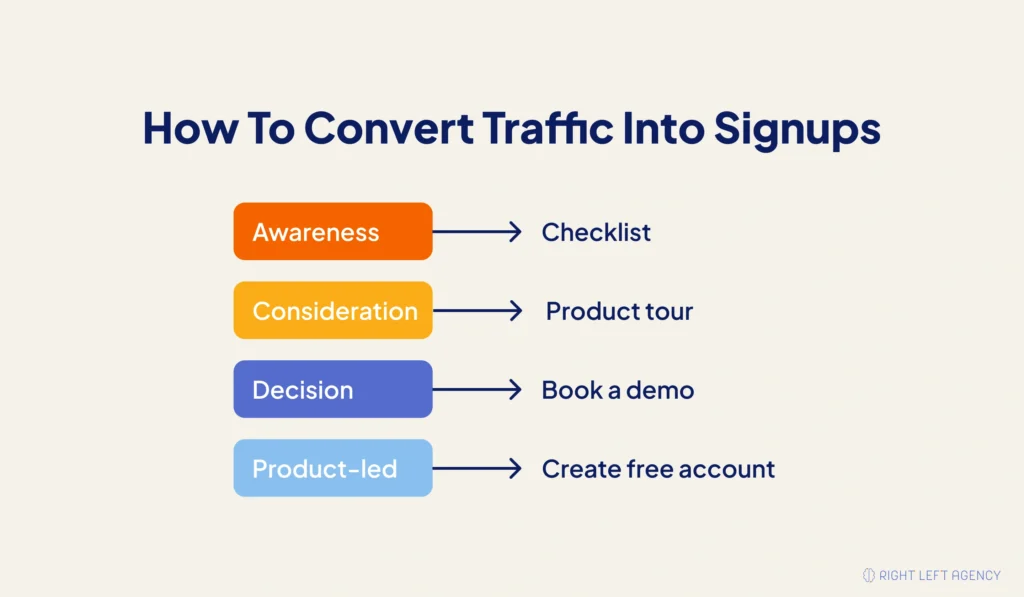
| Search Intent | Page Type | Best CTA |
| Awareness | Blog guide | Checklist, template, related guide |
| Education | Definition article | Download guide or explore use case |
| Consideration | Use case page | Product tour or case study |
| Evaluation | Comparison page | Book a demo or start a free trial |
| Competitor research | Alternative page | See why teams switch or talk to sales |
| Product-led intent | Template or tool page | Create free account |
| Enterprise intent | Industry or solution page | Talk to sales |
To improve organic signup conversion:
- Match CTAs to search intent
- Use free trial CTAs on product-led pages
- Use demo CTAs on sales-led and enterprise pages
- Add in-content CTAs inside educational blog posts
- Link guides to relevant product and use case pages
- Add testimonials, customer logos, or case studies near conversion points
- Use templates, calculators, or free tools as signup paths
- Reduce friction on trial and demo forms
- Track organic conversion rate by landing page
For example, a visitor reading “what is project management software” may not be ready for a demo. A better CTA could be a checklist, template, or related guide. But someone searching “best project management software for agencies” may be closer to a trial or demo request.
This is how SaaS companies turn organic search from a traffic channel into a signup channel.
How to Optimize SaaS Product and Feature Pages
Product and feature pages are often underused SEO assets. Many SaaS teams write these pages only for existing website visitors, not for people searching on Google. That creates missed opportunities.
A strong product or feature page should explain what the feature does, why it matters, who it is for, and how it helps the buyer solve a real problem. It should also give visitors a clear path to start a trial, book a demo, or explore related features.
A strong SaaS feature page should include:
- Problem statement
- Feature explanation
- Workflow example
- Product screenshot or short demo visual
- Use cases by team, role, or industry
- Relevant integrations
- Security, compliance, or reliability proof if needed
- Customer proof, testimonials, or case studies
- Clear CTA
- FAQ for buyer objections
For example, instead of writing a thin page titled “Automation,” a SaaS company could create a page around “customer onboarding automation software.” The page could explain onboarding workflows, automated reminders, CRM integrations, reporting, customer examples, and free trial options.
To optimize these pages, include:
- A clear H1 with the product, feature, or use case keyword
- Problem-solution messaging above the fold
- Benefit-focused copy, not only technical feature descriptions
- Product screenshots, short videos, or simple visuals
- Use cases that show how different teams apply the feature
- Customer examples, testimonials, or case study references
- Internal links to related blog posts, use cases, and integrations
- A clear CTA such as “Start Free Trial” or “Book a Demo”
- FAQ content that addresses buyer objections
This makes the page more useful for search engines, buyers, and sales teams.
Technical SEO for SaaS Websites
Technical SEO is the process of making it easier for search engines to crawl, render, understand, and index your website. This is a big deal for SaaS companies because many have product pages, blogs, documentation, help centers, app subdomains, pricing pages, and JavaScript-heavy experiences.
SaaS websites are often plagued by duplicate landing pages, JavaScript-rendered product content, thin integration pages, indexed app subdomains, and disconnected blog or documentation structures, which dilute authority and make it more difficult for search engines to understand which pages should rank.
For example, a SaaS company may have 200 integration pages, but if most of them use the same template with thin copy, Google may struggle to see which pages are truly useful. Adding unique use cases, setup details, screenshots, FAQs, and internal links can make those pages more valuable for both users and search engines.
Use this checklist:
- Check crawlability and indexability in Google Search Console
- Submit and maintain an updated XML sitemap
- Review robots.txt rules to avoid blocking important pages
- Use canonical tags for duplicate or similar pages
- Improve page speed and Core Web Vitals
- Test mobile usability across important templates
- Review JavaScript rendering for critical content
- Add schema markup where it supports rich results
- Fix broken links and redirect chains
- Manage duplicate content across blog, docs, and landing pages
- Keep URL structures clean and descriptive
- Make sure product, use case, and comparison pages are internally linked
The goal is not technical perfection. The goal is to make the site easy to crawl, easy to understand, and easy for users to navigate. This is where experienced technical SEO services can help identify and resolve issues that limit organic visibility.
Internal Linking Strategy for SaaS Growth
Internal linking is one of the most powerful but underused tactics for SaaS websites. Many software companies publish dozens of articles, but those articles do not guide readers toward product pages, use cases, or demo opportunities.
A better internal linking strategy connects educational content to commercial pages. It helps users move from learning about a problem to understanding how your product solves it.
Best practices include:
- Link blog posts to relevant feature pages
- Link educational guides to use case pages
- Link comparison pages to demo or trial pages
- Use descriptive anchor text instead of vague phrases like “click here”
- Build topic clusters around product categories
- Update older articles with links to newer product pages
- Link case studies from related product and industry pages
- Avoid irrelevant links that do not help the reader
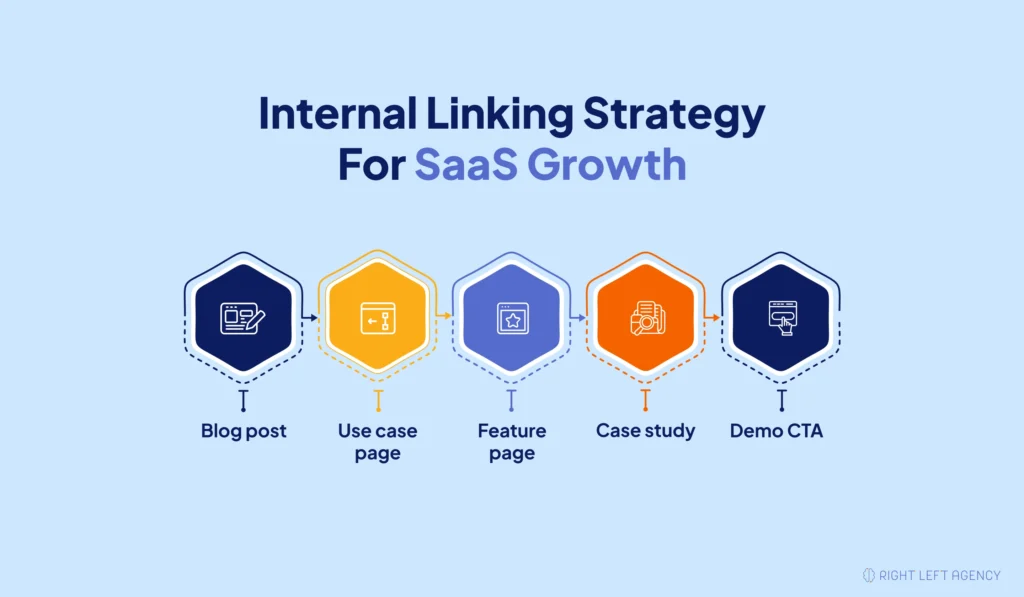
Example internal link path:
Blog post: “How to improve customer onboarding” → Use case page: “Customer onboarding software” → Feature page: “Automated onboarding workflows” → Case study → Demo CTA.
Link Building and Authority for SaaS Websites
Backlinks still matter because they help build authority, trust, and visibility, but SaaS link building should focus on quality and relevance, not volume.
The best backlinks usually come from useful assets, partnerships, original insights, and industry credibility. Spammy link tactics may create short-term movement, but they do not build a durable organic growth channel.
Useful SaaS link building methods include:
- Digital PR around company data or market insights
- Partner and integration pages
- Guest articles on relevant industry websites
- Original research reports
- Data studies and benchmark reports
- Customer or partner case studies
- Podcast appearances and expert interviews
- Thought leadership from founders or product leaders
- Relevant SaaS directories where buyers actually search
For SaaS brands, authority is not only domain-level. The goal is to become associated with a category, problem, or use case. A project management SaaS company, for example, should earn links from operations, productivity, agency management, and collaboration-related sources.
A strong backlink strategy should support topical authority. If your company sells customer success software, links from SaaS, customer experience, support, retention, and revenue operations websites are more valuable than unrelated links from random domains.
AI Search Optimization for SaaS SEO
AI search is changing how SaaS buyers discover answers. Instead of typing short keywords only, users now ask longer, more specific questions such as “What is the best onboarding software for a B2B SaaS team?” or “How can SaaS companies reduce churn with automation?” This means SaaS content must be clear enough for both people and AI search systems to understand, summarize, and cite.
AI search optimization does not replace SaaS SEO. It strengthens it. The goal is to make your content easier to extract, trust, and recommend across AI Overviews, AI Mode, answer engines, and generative search experiences.
SaaS SEO Metrics You Should Track
SaaS teams should not measure organic performance only by traffic and rankings. Those metrics matter, but they do not tell the full story.
To understand whether organic search is having a business impact, connect SEO reporting to signups, demos, qualified leads, pipeline, activation, and revenue. This is especially important when measuring broader SaaS marketing ROI, because SEO often influences more than one touchpoint before a lead becomes revenue.
| Metric | Why It Matters |
| Organic traffic | Shows whether visibility is growing |
| Keyword rankings | Shows search visibility for target queries |
| Organic signups | Shows whether search traffic drives product adoption |
| Demo requests | Shows sales-led conversion impact |
| MQLs and SQLs | Shows lead quality from organic search |
| Pipeline generated | Connects organic search to revenue potential |
| Organic pipeline value | Shows the value of SEO-generated opportunities |
| Trial activation rate | Shows whether organic signups become active product users |
| CAC | Shows acquisition efficiency |
| Organic conversion rate | Shows how well traffic turns into action |
| Assisted conversions | Shows search influence across the buyer journey |
| Organic assisted revenue | Shows how SEO supports multi-touch revenue creation |
Use tools such as Google Search Console, GA4, HubSpot, Salesforce, or another CRM to connect search visibility with funnel performance.
The most important question is not “Did traffic increase?” It is “Did the right traffic move closer to becoming revenue?”
Common SaaS SEO Mistakes to Avoid
Many SaaS companies struggle with organic search because they treat it like a publishing checklist instead of a growth system. They create content, but the content does not connect to product value, buyer intent, or conversion paths.
Avoid these common mistakes:
- Targeting only high-volume keywords
- Ignoring bottom-funnel comparison and alternative pages
- Publishing generic blog content without product relevance
- Failing to link educational content to product pages
- Leaving feature and use case pages thin or vague
- Measuring traffic instead of signups, SQLs, or pipeline
- Ignoring technical issues that block crawlability or indexation
- Creating content without sales or customer insights
- Forgetting to update old content
- Using CTAs that do not match search intent
- Treating organic search as separate from paid media and sales
Bad approach:
Publishing “10 productivity tips” because it has a high search volume.
Better approach:
Publishing “best workflow automation software for operations teams” because it connects directly to product value and buying intent.
Another bad approach:
Writing a generic “CRM guide” with no link to product pages, use cases, integrations, or demo CTAs.
Better approach:
Creating a CRM topic cluster that includes educational content, use case pages, integration pages, comparison content, and a clear path to trial or demo.
A SaaS company can rank for hundreds of keywords and still fail if those keywords do not attract the right buyers. The best strategy is built around product fit, buyer pain, conversion intent, and measurable business outcomes.
90-Day SaaS Organic Growth Roadmap
A practical roadmap helps SaaS teams move from scattered content to a focused growth system. The first 90 days should prioritize high-impact fixes, conversion-focused pages, and measurable improvements.
| Timeline | Focus | Priority |
| Days 1–15 | Audit | Rankings, traffic, indexed pages, technical issues, conversion paths |
| Days 16–30 | Keyword mapping | Funnel stages, product fit, bottom-funnel opportunities |
| Days 31–60 | Page improvements | Feature, use case, comparison, alternative, and integration pages |
| Days 61–90 | Growth system | Topic clusters, internal links, CTAs, tracking, and reporting |
Days 1–15: Audit Current Organic Performance
Review rankings, traffic, indexed pages, technical issues, top landing pages, and conversion paths. Identify which pages already drive impressions but need better content, CTAs, or internal links.
Days 16–30: Map Keywords by Funnel Stage
Separate awareness, consideration, decision, and product-led keyword opportunities helps your team understand which pages should educate, compare, convert, or help with product uptake.
Days 31–45: Fix High-Intent Pages First
Begin with feature pages, use case pages, comparative pages, alternative pages, integration pages, and pricing adjacent material. These pages have a closer intent to sign up and demo than large instructional postings.
Days 46–60: Build Topic Clusters Around Product Categories
Create supporting content around your core product problems. Each cluster should include educational articles, use case pages, and internal links to product-focused pages.
Days 61–75: Improve Internal Links and CTAs
Connect old blog posts to relevant product, feature, and use case pages. Match CTAs to intent, such as free trials for product-led pages, demos for sales-led pages, and templates for awareness-stage content.
Days 76–90: Track Impact on Signups and Pipeline
Measure organic signups, demo requests, SQLs, pipeline, and assisted conversions. Use reporting to determine what to revise, add, or remove.
This roadmap keeps the work on track. Rather than publishing in perpetuity, SaaS teams optimize the pages that are most likely to impact revenue.
How Organic Search Supports Paid Media and Demand Generation
Organic search and paid media should not work in silos. SaaS companies that help each other can increase visibility, decrease wasted spend, and build better conversion paths.
Organic content can inform paid keyword strategy, boost retargeting audiences, landing page message, and educate buyers who aren’t ready to convert from an ad on the first click.
This creates a stronger link between SEO, paid search, social advertisements, retargeting, and paid advertising performance.
Organic search can support paid media by helping teams:
- Find out which search keywords have real buyer intent
- Build retargeting audiences from high-intent content visitors
- Create landing page messaging using organic search data
- Long-term reduction of paid acquisition dependency
- Complement email nurture with educational content
- Comparisons and other searches for snatching
- Increase CAC efficiency over time.
For example, if paid search shows that “competitor alternative” keywords convert into demonstrations, the SEO team can create alternative pages to capture that demand organically. If LinkedIn Ads are getting engagement around a certain pain point, that insight can be turned into a blog cluster, use case page, or lead magnet.
For SaaS organizations operating Google Ads, LinkedIn Ads, or Meta ads, organic content can help warm up buyers before and after the paid click. This makes paid media more efficient as prospects have more context, more trust, and more reasons to convert.
Conclusion
SaaS SEO is not about publishing more blog posts or chasing rankings that never convert. It is about building a search-driven growth system that connects keyword intent, product positioning, technical performance, internal links, and conversion paths to real business outcomes.
The strongest SaaS teams focus on the searches their buyers actually make, build pages that match each stage of the journey, and measure success through signups, demos, pipeline, CAC, activation, and revenue. Building this system requires the right combination of strategy, technical execution, content optimization, and measurement. Our SaaS SEO services help teams connect organic search with qualified pipeline.
When organic search is built this way, it becomes more than a visibility channel — it becomes a reliable path to qualified growth.
If this sounds like something you need help with, contact us today.
Right Left Agency helps SaaS teams turn search demand into qualified pipeline by improving high-intent pages, strengthening conversion paths, and connecting SEO insights with paid media, CAC, and revenue performance.
Frequently Asked Questions
What is SaaS SEO?
SaaS SEO is the process of optimizing a software company’s website, content, technical structure, and conversion paths to attract qualified organic traffic. The goal is not only to rank higher in search engines, but also to turn visitors into free trial users, demo requests, product signups, SQLs, pipeline, and revenue.
How is SaaS search optimization different from regular SEO?
SaaS search optimization is more focused on long buyer journeys, product education, use case pages, comparison content, free trials, demo requests, and pipeline impact. Regular SEO may focus mostly on traffic or simple conversions, while SEO for SaaS must support product-led growth, sales-led conversations, and recurring revenue.
How does organic search drive SaaS signups?
Organic search is a SaaS company’s way of getting signups by ranking pages for buyer-intent keywords and bringing visitors to the next steps in the sales cycle. Someone may start with an educational article, move to a use case page, compare options, and finally start a trial or book a demo. Clear CTAs and internal links help ease that process.
What keywords should SaaS companies target?
SaaS companies should target a mix of problem-aware, solution-aware, comparison, alternative, integration, use case, and product-led keywords. The best keywords aren’t the highest-volume terms. They’re the terms that align with buyer pain, product value, funnel stage, and conversion potential.
What are the most important SaaS search metrics?
The key metrics are organic traffic, keyword rankings, organic signups, demo requests, MQLs, SQLs, pipeline generated, trial activation rate, CAC, organic conversion rate, assisted conversions, and organic assisted revenue. Rankings and traffic show visibility, but signups, pipeline, and revenue show if the channel is actually helping to grow.
How long does SaaS SEO take to drive signups?
SaaS SEO can start improving qualified traffic within a few months, but signup growth depends on keyword difficulty, website authority, content quality, conversion paths, and sales cycle length. Early gains often come from optimizing existing high-intent pages, while larger growth usually comes from consistent content, technical improvements, and stronger internal linking.