Key Takeaways
- SaaS marketing ROI should measure revenue impact across the full customer journey, not just leads or demo requests.
- Full-funnel marketing connects acquisition, conversion, retention, and expansion to show how marketing supports long-term growth.
- The most important metrics include CAC, LTV, LTV: CAC ratio, CAC payback period, NRR, churn, and marketing-influenced pipeline.
- SaaS teams should use multiple attribution methods because one model rarely captures the full buyer journey.
- Marketing ROI becomes clearer when teams connect CRM, product analytics, and revenue data in one full-funnel dashboard.
SaaS marketing ROI is rarely obvious from a single campaign report. A demo request may not close for months. A free trial may become paid only after onboarding. A customer may expand into a higher plan or churn before CAC is recovered. That is why SaaS teams need a full-funnel ROI model, not just a lead-counting report.
A strong strategy connects brand, demand generation, conversion, onboarding, retention, and expansion revenue across the complete SaaS customer journey. For B2B SaaS teams, the real question is not only “How many leads did marketing generate?” It is, “How much ARR, MRR, LTV, retention, and expansion did marketing influence?”
This guide shows how to measure SaaS marketing ROI across acquisition, conversion, retention, and expansion. You’ll learn which revenue metrics matter, how to calculate ROI, how to handle attribution, and how to build a dashboard that helps leadership see marketing’s contribution to growth. If you still need to create your SaaS sales funnel, read this SaaS marketing funnel guide first.
What Does ROI Mean in Full-Funnel SaaS Marketing?
Full-funnel SaaS marketing ROI is the financial return generated by marketing activities across the entire customer lifecycle, from acquisition and activation to retention, expansion, and referrals.
In SaaS marketing, ROI should be tied to revenue, not vanity metrics. Leads, traffic, and impressions can be useful leading indicators, but they only prove ROI when they connect to pipeline, closed-won revenue, retention, or expansion. Full-funnel ROI of SaaS marketing may include returns from:
- New customer acquisition — the most obvious, but often the most expensive
- Lower CAC — marketing efficiency improving over time through organic and brand channels
- Higher trial-to-paid conversion rates — better activation from PLG or onboarding programs
- Shorter sales cycles — educated prospects who arrive with fewer objections
- Improved retention — lifecycle and customer education programs, reducing churn
- Higher expansion MRR — upsell and cross-sell campaigns growing account revenue
- Better net revenue retention (NRR) — keeping and growing revenue from existing customers
- Increased referral revenue — happy customers driving lower-cost acquisition
A strong marketing return-on-investment model looks beyond lead volume. It shows how marketing supports SaaS revenue growth before, during, and after the first closed-won deal.
Why SaaS Marketing ROI Is Different From Traditional Marketing ROI
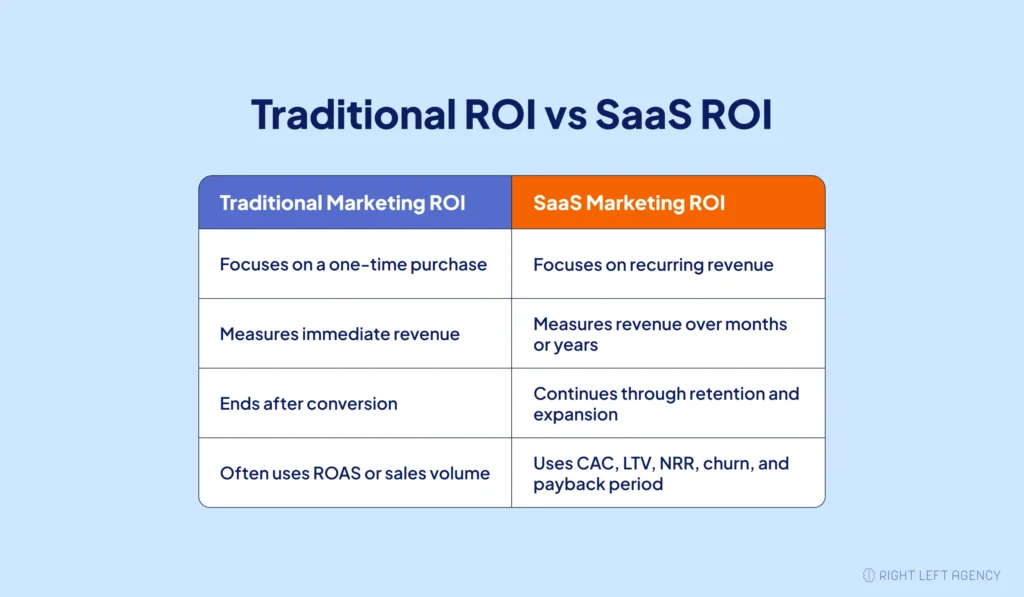
Marketing ROI in traditional businesses is straightforward. Spend money, make sales, calculate the difference. The deal is made, the money is recorded, and the ROI calculation concludes. For SaaS marketing ROI, it is more complicated. In a subscription model, a customer acquired this month may not become profitable for six to eighteen months, depending on CAC, gross margin, churn, and payback period. That is why SaaS teams need to measure recurring revenue, retention, expansion, and customer lifetime value instead of only immediate sales.
To assess SaaS marketing performance accurately, teams need to consider customer lifetime value, churn rate, gross revenue retention, net revenue retention, and expansion revenue. A campaign that generates 50 customers with high churn may look successful at first, but hurt profitability over 12 months. In contrast, a strategy that lowers churn by even a few percentage points can have a major impact on ARR, especially for companies with a large customer base.
| Traditional Marketing ROI | SaaS Marketing ROI |
|---|---|
| Focuses on a one-time purchase | Focuses on recurring revenue |
| Measures immediate revenue | Measures revenue over months or years |
| Ends after conversion | Continues through retention and expansion |
| Often uses ROAS or sales volume | Uses CAC, LTV, NRR, churn, and payback period |
How to Calculate Full-Funnel SaaS Marketing ROI
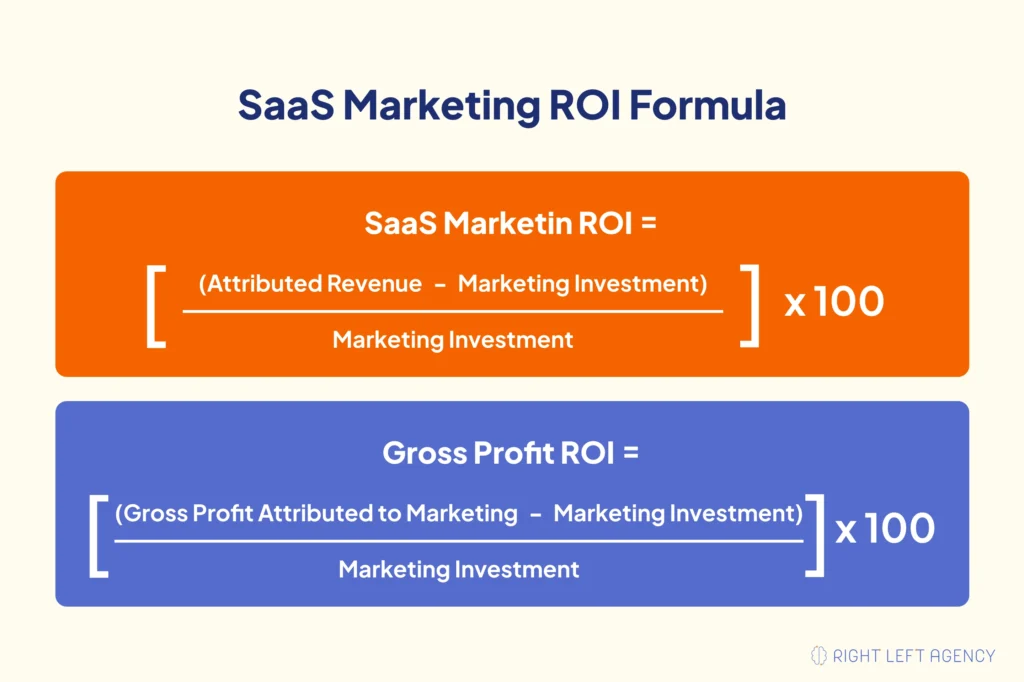
The basic SaaS marketing ROI formula is:
SaaS Marketing ROI = [(Attributed Revenue – Marketing Investment) / Marketing Investment] x 100
Attributed revenue can include marketing-sourced closed-won revenue, marketing-influenced revenue, and expansion revenue tied to lifecycle or customer marketing campaigns. Pipeline value can also be tracked, but it should be reported separately from actual revenue so teams do not overstate ROI.
For a more finance-friendly view, use gross profit instead of revenue:
Gross Profit ROI = [(Gross Profit Attributed to Marketing – Marketing Investment) / Marketing Investment] x 100
Marketing investment refers to paid advertising, content creation, SEO services, email solutions, creative design, agency fees, analytics software, marketing campaigns, and marketing team salaries.
In case you need a more finance-friendly approach, use gross profit in your ROI formula to prevent misrepresentations that may happen when sales, hosting, customer support, onboarding, or services have high costs.
Assume a SaaS company invests $50,000 into a full-funnel marketing process and generates $200,000 of new revenue and expansion revenue driven by these marketing activities. The formula will look like this:
($200,000 − $50,000) / $50,000 × 100 = 300%
This gives a 300% marketing ROI. However, SaaS companies should also consider CAC payback, LTV: CAC ratio, pipeline efficiency, churn rate, and attribution accuracy when evaluating marketing performance.
Example: Full-Funnel SaaS Marketing ROI Calculation
Below is an example of how to calculate SaaS ROI.
A B2B SaaS company spends $75,000 in the first six months on SEO content creation, LinkedIn advertising, retargeting ads, email nurturing, demo landing pages, onboarding emails, and expansion campaigns.
| Result | Value |
|---|---|
| Marketing investment | $75,000 |
| New customers acquired | 40 |
| Average first-year contract value | $6,000 |
| First-year new revenue | $240,000 |
| Expansion revenue influenced | $35,000 |
| Total attributed revenue | $275,000 |
| ROI | 266% |
Calculation:
($275,000 – $75,000) / $75,000 x 100 = 266%
It’s important to note that we used first-year revenue in this calculation. However, if the business has good retention rates and expansion, the ROI might be even greater than this figure.
This is a simplified example. A real SaaS ROI model should also account for gross margin, churn, CAC payback, sales cycle length, and confidence in the attribution model.
Conversely, high customer churn or low gross margins could bring down the total return on investment.
That’s why SaaS companies should compare first-year revenue ROI, gross profit ROI, CAC payback, and LTV: CAC before making budget decisions.
Expert note: The best ROI model depends on how your SaaS company grows. A sales-led SaaS company may need to prioritize marketing-influenced pipeline, win rate, and sales cycle length. A PLG company may need to focus more on activation, trial-to-paid conversion, PQLs, and product adoption.
A Simple 4-Layer Model for Measuring SaaS Marketing ROI
A useful way to measure full-funnel performance is to separate ROI into four layers. This gives CMOs, CFOs, and RevOps teams a clearer view of where marketing creates value.
| ROI Layer | What to Measure | Why It Matters |
|---|---|---|
| Acquisition ROI | CAC, CPL, channel quality, ICP fit | Shows whether marketing attracts the right prospects efficiently |
| Conversion ROI | Trial-to-paid rate, demo-to-close rate, win rate | Shows whether demand turns into customers |
| Retention ROI | Activation, churn, product adoption, GRR | Shows whether customers stay and reach value |
| Expansion ROI | Upsell, cross-sell, expansion MRR, NRR | Shows whether customer accounts grow over time |
This framework helps teams avoid a narrow view of performance. Marketing may not always create the cheapest leads, but it should help create better-fit customers, stronger retention, and higher lifetime value.
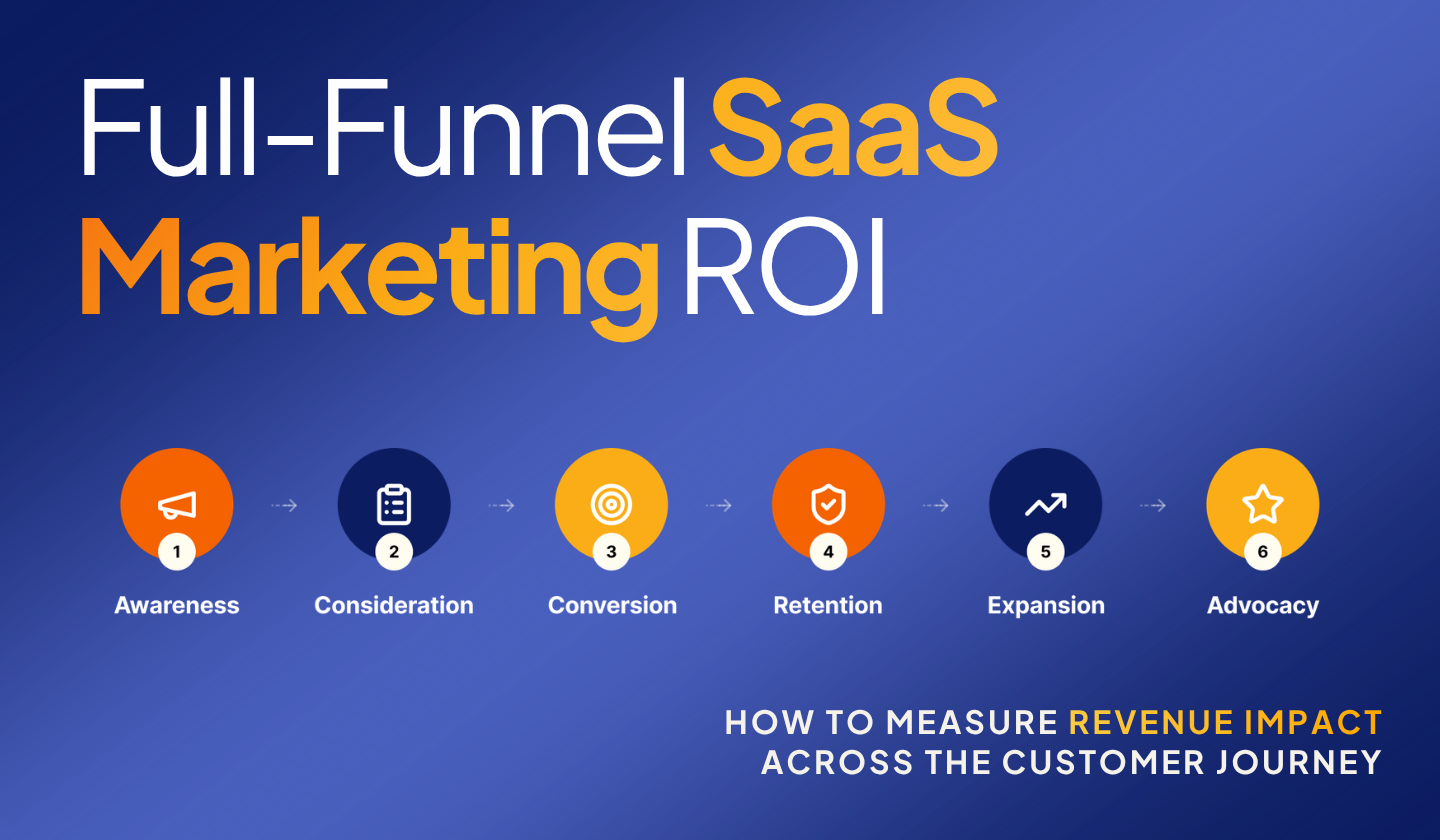
Full-Funnel SaaS ROI by Funnel Stage
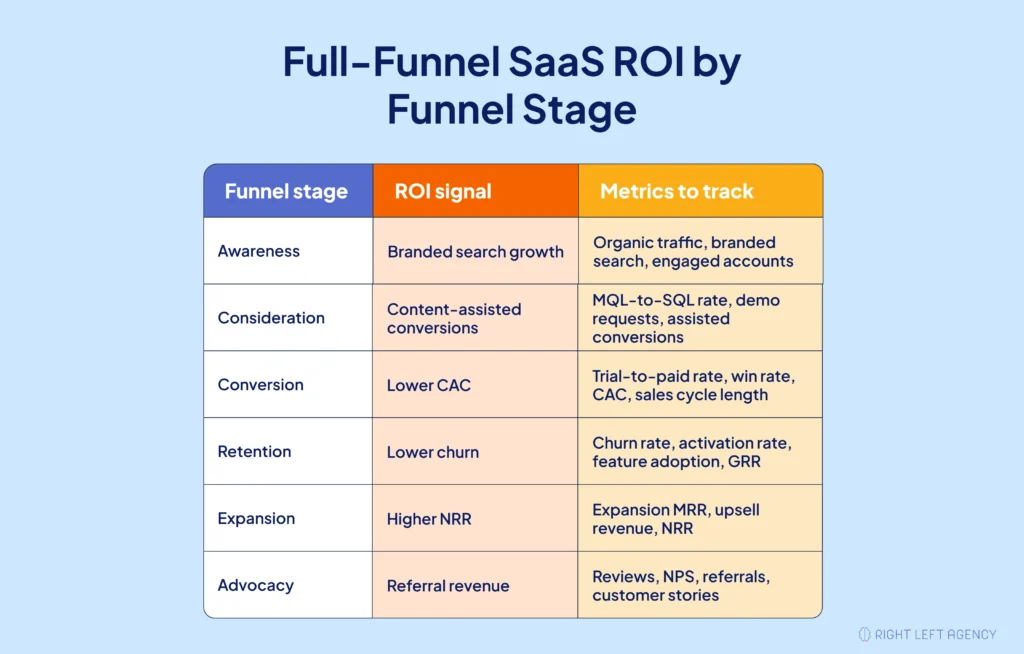
This section does not re-explain every funnel stage. Instead, it shows how each stage contributes to revenue impact and what signals to track.
| Funnel Stage | ROI Signal | What Does It Tell You | Metrics to Track |
|---|---|---|---|
| Awareness | Branded search growth | More people are actively looking for your brand | Organic traffic, branded search, engaged accounts |
| Consideration | Content-assisted conversions | Educational content is influencing buying decisions | MQL-to-SQL rate, demo requests, assisted conversions |
| Conversion | Lower CAC | Marketing is improving acquisition efficiency | Trial-to-paid rate, win rate, CAC, sales cycle length |
| Retention | Lower churn | Marketing is attracting and supporting better-fit customers | Churn rate, activation rate, feature adoption, GRR |
| Expansion | Higher NRR | Existing customers are growing in value | Expansion MRR, upsell revenue, NRR |
| Advocacy | Referral revenue | Customers are reducing future acquisition costs | Reviews, NPS, referrals, customer stories |
The best SaaS funnel ROI model connects each stage to a financial signal. This helps leaders see whether marketing is improving revenue efficiency, not just lead volume.
The Metrics That Actually Prove Full-Funnel SaaS Marketing ROI
Customer Acquisition Cost (CAC)
CAC measures the total cost required to acquire a new customer. In a SaaS ROI model, CAC should be analyzed by channel, campaign, ICP segment, contract value, and retention quality.
Lifetime Value to Customer Acquisition (LTV: CAC) Ratio
This metric compares the lifetime value of each customer to their cost of acquisition. It allows teams to determine whether marketing is bringing in profitable customers.
If the ratio is poor, it indicates high costs of customer acquisition, inadequate pricing, high churn, or ineffective marketing that brings in customers who aren’t well-suited for the product. A better ratio typically signifies a good fit, better retention, and efficient growth.
CAC Payback Period
CAC payback period shows how long it takes to recover acquisition spend. This matters because SaaS companies often invest upfront before recurring revenue compounds.
Early-stage software companies will prioritize CAC payback rather than simply a return on investment figure. CAC payback that is too long can affect a company’s cash flow despite favorable LTV figures.
Marketing-Sourced Pipeline
A marketing-sourced pipeline is a pipeline created directly by marketing. It is useful for campaigns that generate new opportunities through SEO, paid search, paid social, webinars, email, or gated assets.
This metric helps show how marketing contributes to future ARR. It should be paired with win rate and closed-won revenue. This prevents teams from overvaluing a pipeline that never converts into revenue.
Marketing-Influenced Pipeline
Marketing-influenced pipeline includes opportunities where marketing helped move the buyer forward, even if marketing was not the source of the deal.
For example, a buyer may read blog posts, attend a webinar, compare competitors, see retargeting ads, and later book a demo after sales outreach. If you only measure the final touchpoint, you may undercount marketing’s role in the buying journey.
Trial-to-Paid Conversion Rate
Trial-to-paid conversion is vital for product-led growth companies. It shows whether users who enter the product are reaching enough value to become customers.
For PLG SaaS, activation and trial conversion should be treated as marketing ROI signals, not only product metrics. Marketing plays a part in shaping expectations, onboarding, use case education, and product adoption.
Net Revenue Retention
Net revenue retention will indicate whether your existing revenue stream is increasing or decreasing after factoring in churn, downgrades, upgrades, and expansion.
Strong NRR means customers are renewing and expanding. This proves that marketing, lifecycle email, onboarding, customer education, and customer success content can support long-term growth.
Churn Rate
A churn rate indicates whether clients churn after purchase. It could indicate that marketing is bringing in poor-fitting clients or creating incorrect client expectations.
High churn rates from certain channels require a revisit of customer fit, message, onboarding, and product adoption. A channel shouldn’t be valued solely based on the cost of acquisition if the customer doesn’t stay.
How Full-Funnel Marketing Improves SaaS ROI
Full-funnel marketing connects each stage of the customer journey so teams can improve revenue efficiency, not just lead volume. The process not only enhances lead generation but also ensures lead quality, reduces SaaS CAC, reduces sales cycles, and even expands opportunities.
Improving Lead Quality
By applying a full-funnel growth strategy that addresses customer challenges, a company will attract prospects that match its ICP and are closer to purchasing something. The use of content, targeting, segmentation, and nurture campaigns will allow filtering out poor-quality leads even before they get to sales reps.
Increases Win Rates and Efficiency
High-quality leads increase win rates, pipeline efficiency, and productivity among the sales team. Furthermore, high-quality leads ensure that sales don’t waste their time engaging with prospects that won’t convert into paying customers.
Decreases CAC Over Time
Using full-funnel marketing initiatives, a business can reduce its CAC over time by minimizing reliance on costly acquisition tactics, such as pay-per-click ads, and creating sustainable demand through SEO, word-of-mouth campaigns, and branded search.
While paying for demand through campaigns is beneficial for quick growth, some other techniques listed above can be helpful in increasing efficiency and ensuring long-term success.
Shortens the Sales Cycle
The combination of educational material, comparison pages, case studies, webinars, and nurture campaigns allows for educating prospects before engaging them in conversation with sales.
As a result, it lowers objections and shortens the process since the customers become more informed about their needs and the product.
Increases Retention
Full-funnel marketing is not limited to conversion. Customer onboarding, education, lifecycle marketing emails, and customer success marketing enable fast user adoption and access to the product value. User adoption can lead to improved retention rate, better gross renewal rate, and higher lifetime value.
Creates Expansion Revenue
Customer marketing contributes to upselling and cross-selling initiatives. Customers are educated about more complex functionalities, premium plans, additional services, and alternative applications. Such campaigns generate extra revenue from existing customers without paying for the cost of acquiring another customer. This makes SaaS lifecycle marketing a powerful factor in expanding MRR and NRR.
How to Attribute Revenue Across the Full SaaS Funnel
Despite its flaws, attribution cannot be overlooked since SaaS customers come into contact with advertising, search engine results, reviews, webinars, sales emails, trial periods, peer references, and success stories before becoming buyers.
The most effective strategy would involve analyzing marketing-driven revenue as well as marketing-inspired revenue, for which information from marketing, sales, and the product should be combined. The use of various attribution methods is recommended.
| Attribution method | Best for | Limitation |
|---|---|---|
| First-touch attribution | Understanding initial discovery | Overcredits awareness |
| Last-touch attribution | Understanding the final conversion source | Ignores earlier influence |
| Multi-touch attribution | Understanding the full journey | Requires cleaner tracking |
| Self-reported attribution | Capturing dark social and word of mouth | Depends on user memory |
| CRM attribution | Connecting marketing to the pipeline | Needs consistent sales data |
| Product analytics | Measuring activation and retention | May miss pre-signup influence |
A practical attribution setup usually combines three views: first-touch for discovery, last-touch for conversion, and CRM campaign influence for the pipeline. For B2B SaaS, self-reported attribution is also useful because buyers often hear about a brand through peers, communities, podcasts, review sites, or dark social before they ever click a trackable link.
Useful tools include Google Analytics 4, HubSpot, Salesforce, Mixpanel, and Amplitude. For setup guidance, use the official resources for Google Analytics 4 attribution, HubSpot attribution reporting, Salesforce Campaign Influence, and Mixpanel product analytics.
Expert note: For many B2B SaaS companies, marketing-influenced revenue is more realistic than marketing-sourced revenue alone. Buyers rarely convert from one clean touchpoint, especially in complex sales cycles.
What to Include in a Full-Funnel SaaS ROI Dashboard
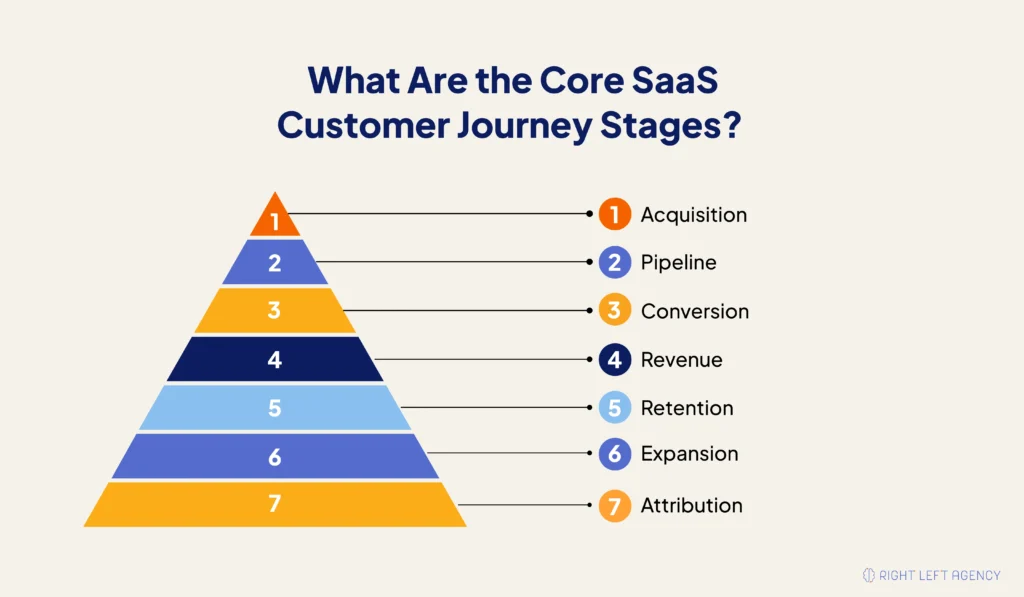
The ideal SaaS ROI dashboard needs to demonstrate the impact of marketing on the areas of acquisition, pipeline, conversion, revenue, retention, expansion, and attribution together on a single screen.
| Dashboard Section | Metrics to Include | Why It Matters |
|---|---|---|
| Acquisition | Traffic, source, CPL, CAC | Shows how efficiently marketing attracts prospects |
| Pipeline | MQLs, SQLs, opportunities, pipeline value | Shows revenue potential |
| Conversion | Demo-to-close rate, trial-to-paid rate, win rate | Shows funnel efficiency |
| Revenue | ARR, MRR, ACV, closed-won revenue | Shows financial impact |
| Retention | Churn, activation, product adoption, GRR | Shows customer quality |
| Expansion | Expansion MRR, upsell rate, NRR | Shows long-term return |
| Attribution | First touch, last touch, multi-touch, self-reported source | Shows marketing influence |
A useful reporting structure may leverage GA4, HubSpot, Salesforce, Looker Studio, Mixpanel, Amplitude, CRM data, and product analytics. The idea isn’t more dashboards. The idea is better decision-making.
Common Mistakes That Make SaaS Marketing ROI Look Worse Than It Is
Measuring only last-touch conversions.
Last-touch attribution often makes SEO, content, brand, webinars, and nurture campaigns look less valuable than they are. Use it to understand the final conversion point, but do not use it as the only source of truth for budget decisions.
Ignoring retention and expansion.
Retention, upsell, cross-sell, and expansion MRR contribute significantly to the total revenues generated from SaaS products. If they are ignored, it means that the contribution of marketing over a period is underestimated.
Treating all leads as equal.
The quantity of leads does not equal quality leads. ICP, lead generation costs, sales cycle duration, LTV, and retention matter a lot.
Measuring ROI too early.
Brand building, SEO, nurtures, and lifecycle campaigns usually need a little bit longer for their performance to kick in.
Separating marketing data from sales and product data.
Marketing metrics do not give the whole picture of funnel performance. You also need to look at CRM, product, and financial data.
Overvaluing vanity metrics.
Impressions, clicks, and pageviews are useful but do not show ROI on their own. Revenue attribution and conversion rates do.
Ignoring sales cycle length.
The sales cycle may be long, which indicates a lag in the ROI. The company needs to measure its campaign periods based on the opportunities, velocity, and wins.
Not tracking customer quality by channel.
Some channels may attract customers who churn more quickly. Some channels may generate fewer customers but have higher retention, higher contract value, and higher lifetime value.
When Full-Funnel SaaS Marketing Produces the Highest ROI
The most effective approach to implementing a full-funnel SaaS marketing strategy is when the problems related to growth are interconnected through acquisition, conversion, retention, and expansion.
| Signal | What It Usually Means |
|---|---|
| CAC is rising | Paid acquisition may be overused, or targeting may be too broad |
| Paid channels are less efficient | The team may need SEO, lifecycle marketing, and brand demand |
| The sales cycle is too long | Prospects may need better education and proof before sales calls |
| Trial users are not converting | Activation, onboarding, or messaging may need improvement |
| Churn is hurting growth | Marketing may be attracting poor-fit customers or setting wrong expectations |
| Traffic is high, but the pipeline is weak | Content may not match ICP, intent, or buying stage |
| Sales and marketing disagree on lead quality | Definitions for MQLs, SQLs, and PQLs may need alignment |
| Customers are not expanding | Lifecycle and customer marketing may be underdeveloped |
| Leadership wants revenue proof | Reporting may need stronger attribution and a dashboard structure |
This is particularly relevant for CMOs, CFOs, and RevOps leads who rely heavily on proving their return on marketing investment with numbers.
How to Improve Full-Funnel SaaS Marketing ROI
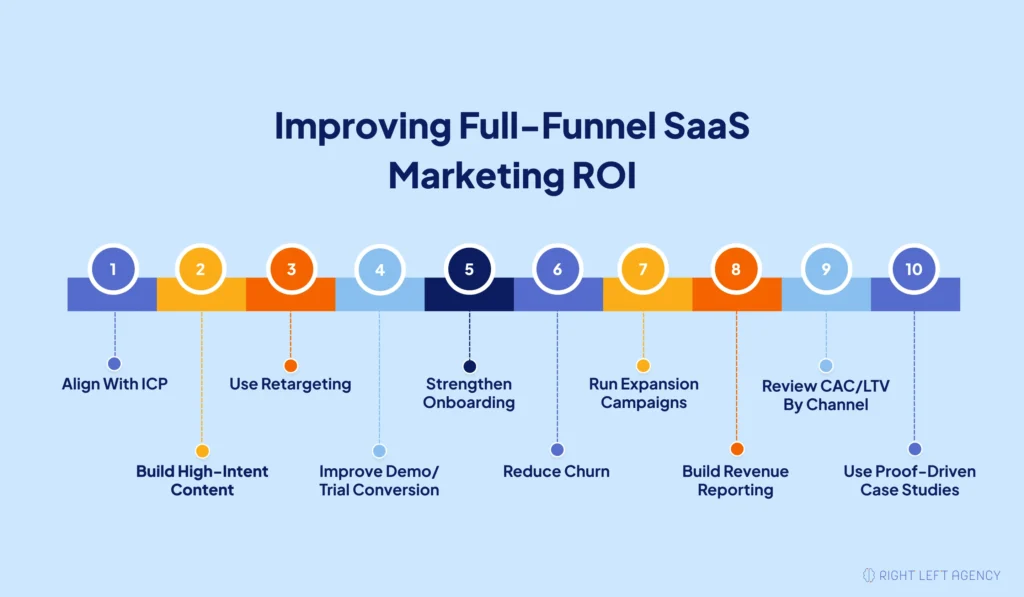
Align campaigns with ICP and lifecycle stage.
Map each campaign to a specific ICP segment, pain point, lifecycle stage, and conversion goal. For example, use comparison content for buyers evaluating alternatives and onboarding emails for users who have not reached activation.
Build content for high-intent and mid-funnel queries.
Build comparison pages, use-case pages, pain-point content, templates, and product-led guides for buyers who are actively evaluating solutions.
Use retargeting to move prospects from awareness to consideration.
Use proof points, demos, testimonials, case studies, and educational content to move brand-aware prospects closer to consideration.
Improve demo and trial conversion paths.
Reduce unnecessary form fields, clarify CTAs, improve landing page messaging, and remove extra trial steps.
Strengthen onboarding and activation.
Onboarding emails, in-app assistance, product education, and success milestones should all be utilized.
Create customer education content to reduce churn.
Tutorials, playbooks, product guides, webinars, and resources for success can help adoption.
Run expansion campaigns for existing customers.
Use product usage, plan limits, feature adoption, and customer health data to trigger upsell, cross-sell, and add-on campaigns.
Build reporting around revenue, not just leads.
The metrics include pipeline, won revenue, CPA, LTV, NRR, churn, and customer health scores.
Review CAC and LTV by channel every quarter.
Target channels where customers are profitable, not those that provide cheap leads.
Use proof points in case studies to drive more conversions.
Properly aligned customer stories reduce risk and can assist with conversion rate optimization.
These steps improve SaaS funnel optimization, full-funnel optimization, SaaS conversion optimization, and long-term growth efficiency.
When to Work With a Full-Funnel SaaS Marketing Agency
A full-funnel SaaS marketing agency makes sense when your team has separate SEO, paid media, email, CRO, and analytics efforts but no shared revenue model. The right partner should help connect strategy, execution, attribution, and reporting so marketing can be evaluated by pipeline, CAC efficiency, retention, and expansion — not just campaign activity.
Right Left Agency positions itself as a growth-focused partner for SaaS companies, with services across paid advertising, SEO, email marketing, and full-funnel strategy. Its SaaS marketing services page emphasizes holistic, full-funnel growth, while its services include paid advertising, email marketing, SEO, web development, and conversion optimization support.
An agency may make sense if you need help with:
- Building a full-funnel growth strategy through SaaS marketing services
- Reducing CAC with better-paid advertising
- Creating revenue-focused SEO content
- Strengthening nurture and lifecycle campaigns with email marketing
- Improving conversion rates
- Connecting marketing activity to pipeline and revenue
- Using case studies to improve buyer trust
Final Thoughts: Full-Funnel SaaS Marketing ROI Is Bigger Than Lead Generation
This ROI does not live in a single campaign report or a monthly lead count. It lives in the compounding effect of acquiring better-fit customers, converting them more efficiently, retaining them longer, and growing their accounts over time. When CAC, LTV, retention, and expansion all move in the right direction together, the financial return from marketing becomes clearer and easier to defend.
The best SaaS teams measure acquisition, conversion, retention, and expansion together. They do not treat these as separate department metrics, but as a unified view of revenue growth across the customer journey. They build attribution frameworks, connect CRM and product analytics, and report on pipeline and revenue outcomes — not just activity.
Want to understand where your SaaS funnel is leaking revenue?
Book a growth session with Right Left Agency to identify the channels, lifecycle stages, and conversion points with the highest ROI potential.
FAQ
What is full-funnel SaaS marketing ROI?
Full-funnel SaaS marketing ROI measures the revenue impact of marketing across the entire customer journey, including acquisition, activation, conversion, retention, expansion, and referrals. Instead of only measuring leads or demos, it shows how marketing contributes to the pipeline, customer quality, recurring revenue, and long-term growth.
How do you calculate SaaS marketing ROI?
To calculate SaaS marketing ROI, deduct marketing costs from attributed revenues, divide that result by marketing costs, and multiply it by 100.
Formula:
SaaS marketing ROI = [(Attributed Revenue – Marketing Investment) / Marketing Investment] x 100
The CAC, LTV, payback period, and attribution confidence need to be assessed, too.
What metrics matter most for SaaS marketing ROI?
The most useful SaaS ROI metrics include:
- CAC
- LTV
- LTV: CAC ratio
- CAC payback period
- NRR
- GRR
- Churn rate
- Marketing-sourced pipeline
- Marketing-influenced pipeline
- Trial-to-paid conversion rate
- Win rate
- Sales cycle length
How long does it take to see ROI from full-funnel SaaS marketing?
The full-funnel marketing ROI timeline depends on channel, sales cycle, and ACV. Paid media may show faster signals, while SEO, brand, retention, and lifecycle marketing usually take longer. For many B2B SaaS teams, 6 to 18 months gives a more realistic view of ROI.
Why is full-funnel marketing better than only focusing on lead generation?
Full-funnel marketing vs. lead generation comes down to revenue quality. Lead generation focuses on capturing contacts. Full-funnel marketing improves lead quality, shortens the sales cycle, increases retention, creates expansion revenue, and improves customer lifetime value.
Can brand marketing impact SaaS ROI?
Yes. Brand marketing can improve SaaS marketing ROI by increasing direct traffic, branded search, trust, sales velocity, and conversion efficiency. It may not always receive direct attribution, but it can make buyers more familiar with the company before they speak with sales.