Key Takeaways
- Choose an agency that understands your fintech product, buyers, and sales process.
- Verify technical expertise, compliance workflows, and relevant project results.
- Prioritize buyer-focused SEO and content that supports purchasing decisions.
- Evaluate performance through qualified leads and pipeline, not traffic alone.
- Review team responsibilities, pricing, and a realistic 90-day plan before signing.
Hiring a fintech content marketing agency requires more than finding a team that writes articles and improves search rankings.
Fintech companies must explain complex financial products, build credibility, address compliance requirements, and reach buyers with different technical and business priorities.
An agency might increase organic traffic without attracting the decision-makers your sales team needs.
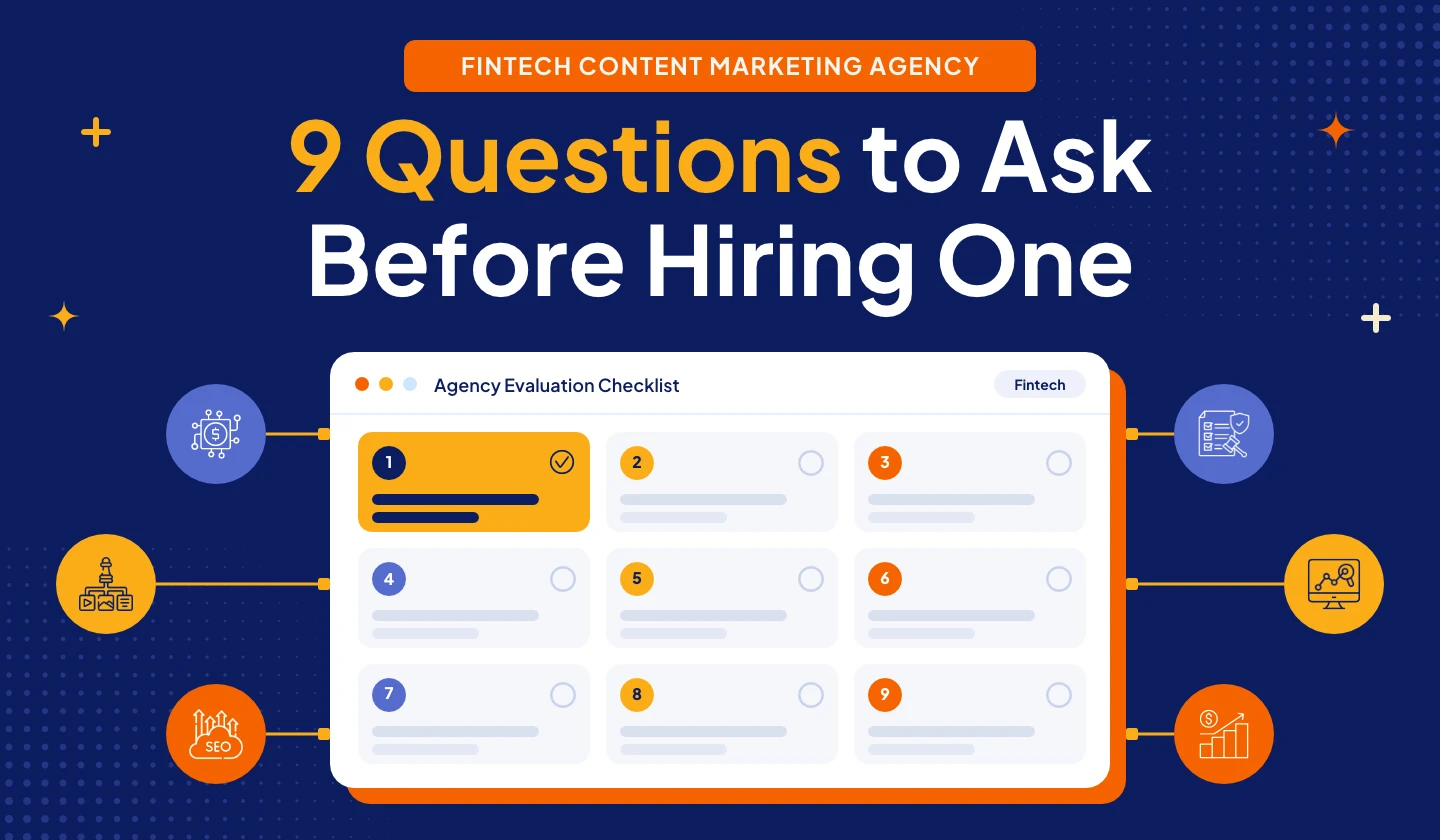
Before hiring a fintech content marketing agency, evaluate its industry experience, technical expertise, compliance workflow, SEO strategy, content distribution, and ability to connect marketing activities with qualified business opportunities.
This guide covers nine essential questions, the evidence to request, and the warning signs to consider before choosing a partner.
What Does a Fintech Content Marketing Agency Do?
A fintech content marketing agency helps financial technology companies attract relevant audiences, explain complex products, establish credibility, and support customer acquisition through strategic content.
Depending on its capabilities, an agency may offer:
- Content strategy: Audience research, keyword planning, and editorial calendars.
- Fintech SEO: Improving organic visibility for commercially relevant searches.
- Technical content: Articles, white papers, product guides, and case studies.
- Thought leadership: Expert-led content addressing industry challenges.
- Content distribution: Email campaigns, LinkedIn, and sales enablement.
- Performance reporting: Tracking conversions, qualified leads, and pipeline contribution.
Fintech content marketing differs from general B2B content because financial products often involve complex technical requirements, multiple decision-makers, and additional scrutiny of product claims.
For a broader explanation of content planning, see our guide to fintech content marketing strategies.
9 Questions to Ask Before Hiring a Fintech Content Marketing Agency
1. Does the Agency Understand Your Fintech Business Model and Target Audience?
Fintech includes payments, lending, banking infrastructure, financial automation, and other specialized markets. Each has different customers, purchasing concerns, and technical requirements.
An agency should understand your business model, ideal customer profile (ICP), product capabilities, and buying process before recommending content topics.
For example, a B2B payment infrastructure provider may need content addressing several stakeholders:
- Finance leaders: Transaction costs, reconciliation, and financial controls.
- Technical teams: API capabilities, integrations, and reliability.
- Operations teams: Settlement processes and workflow efficiency.
- Compliance teams: Security, regulatory requirements, and operational risk.
Content addressing only one audience may not support the complete purchasing decision.
An effective agency should identify these stakeholders, understand their concerns, and develop content that addresses relevant questions throughout the buying journey.
Ask: “How will you identify our target buyers and create content that addresses their different purchasing concerns?”
Evidence to request: A sample ICP profile, buyer journey map, or stakeholder research framework.
Red flag: The agency recommends generic fintech topics without understanding your product, customers, or sales process.
2. Can the Agency Demonstrate Relevant Fintech Experience and Measurable Results?
A portfolio featuring recognizable fintech brands does not automatically prove an agency can deliver the services your company needs.
Ask what the agency contributed to previous projects and how it measured results.
Relevant evidence includes:
- Technical articles and industry-specific content samples.
- Fintech SEO strategies and performance reports.
- Buyer-focused landing pages and conversion improvements.
- Qualified lead and sales pipeline outcomes.
- Case studies with clearly explained responsibilities.
Distinguish content visibility from business impact.
An article attracting thousands of visitors may deliver less commercial value than a specialized comparison guide reaching a smaller group of active buyers.
For example, Right Left Agency’s Billd case study describes a fintech acquisition initiative involving advertising budget allocation, landing-page improvements, and lead quality.
The case study demonstrates a broader fintech acquisition approach, not content-specific SEO performance. Understanding that distinction is important when evaluating agency results.
More importantly, an agency should recognize when additional content is not the immediate solution.
A fintech company may already attract relevant visitors but struggle to convert them into qualified opportunities. In that situation, improving buyer messaging, landing-page experiences, or lead qualification may be more valuable than expanding the editorial calendar.
Ask: “Can you show a relevant project, explain your responsibilities, and demonstrate how success was measured?”
Evidence to request: One detailed case study, two relevant content samples, and a performance report explaining measurable outcomes.
Red flag: Impressive traffic statistics or growth percentages without context, attribution, or supporting evidence.
3. How Does the Agency Ensure Technical Accuracy and Subject-Matter Expertise?
Fintech content must explain complicated financial and technical concepts accurately.
Misleading descriptions of payment processing, APIs, financial automation, or product capabilities can confuse buyers and undermine trust.
Consider a payment reconciliation platform.
Its content should accurately explain which activities are automated, supported integrations, and relevant limitations.
Claiming that a platform eliminates every manual finance task would be misleading if it automates only selected workflows.
A reliable agency should use a structured process:
- Review approved product documentation.
- Interview internal subject-matter experts.
- Research authoritative sources.
- Develop detailed content briefs.
- Verify technical claims.
- Incorporate expert feedback before publication.
AI-assisted tools can support research and drafting, but they do not replace technical verification.
Google’s helpful content guidance emphasizes original value, reliable information, and evidence of expertise.
Ask: “Who verifies technical information, and how will your writers collaborate with our product specialists?”
Evidence to request: An anonymized technical content brief, fact-checking checklist, and example of subject-matter expert revisions.
Red flag: Complex financial content produced without documented research or technical review.
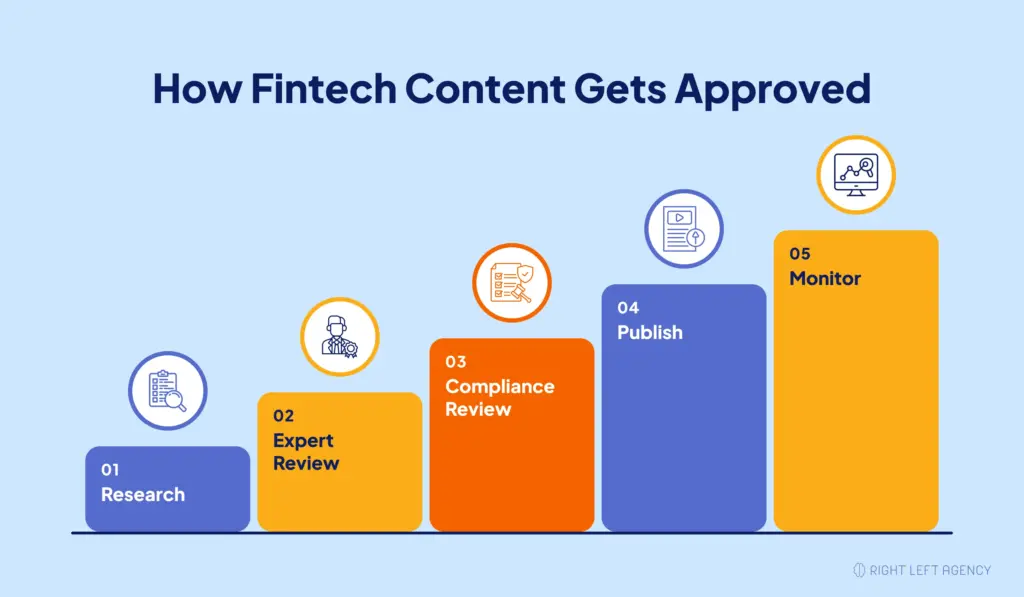
4. What Is the Agency’s Process for Compliance Review and Financial Claims?
Financial marketing requirements vary depending on the product, jurisdiction, and regulated activities involved.
A fintech software provider and a regulated financial services firm may face different marketing obligations. Before publishing, companies should determine which requirements apply to their products, audiences, and operations.
For example:
- The Federal Trade Commission addresses truthful and substantiated advertising claims within its jurisdiction.
- FINRA Rule 2210 governs relevant communications by FINRA member firms.
- The UK’s Financial Conduct Authority regulates applicable financial promotions.
These requirements do not apply identically to every fintech company.
Your agency should understand the importance of compliance coordination and establish a review process involving appropriate internal specialists.
Content requiring scrutiny may include:
- Financial performance and savings claims.
- Product capabilities and limitations.
- Security and compliance statements.
- Customer testimonials.
- Required disclosures and supporting documentation.
A documented workflow should establish who approves technical statements, verifies evidence, and authorizes publication.
The agency can coordinate compliance-aware content creation, but it should not replace qualified legal or regulatory reviewers.
Ask: “How do you verify financial claims and coordinate legal or compliance approvals before publication?”
Evidence to request: A documented approval workflow showing review responsibilities, source verification, sign-off stages, and version control.
Red flag: Guaranteed compliance claims or recommendations to publish without necessary approvals.
5. How Will the Agency Build an SEO Strategy That Attracts Qualified Fintech Buyers?
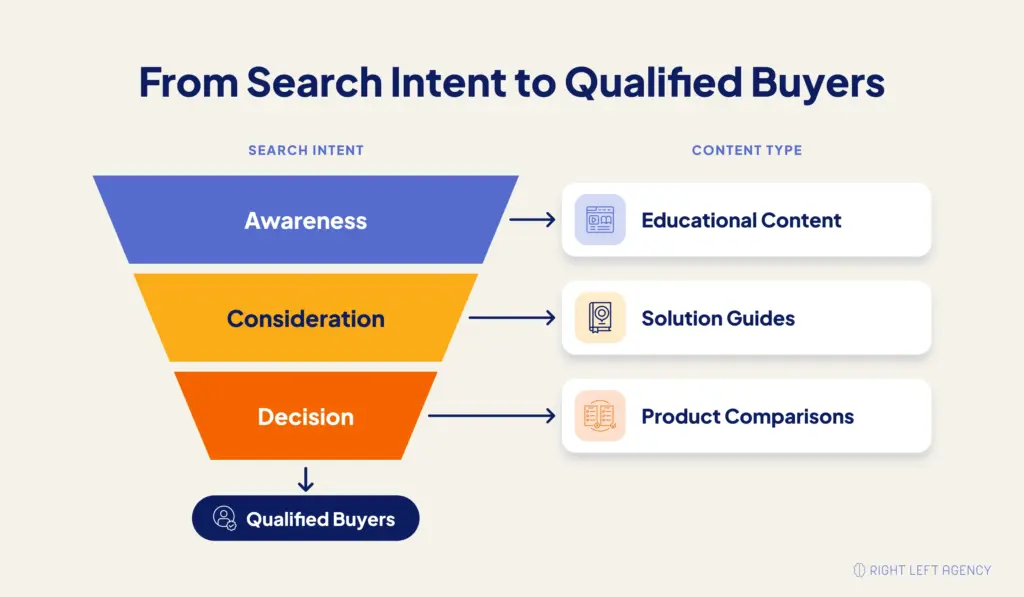
Publishing more content does not necessarily generate more customers.
A fintech content marketing agency should prioritize keywords based on search intent, product relevance, and commercial opportunity.
Consider a payment reconciliation software company.
Its content opportunities may include:
- Informational: What is payment reconciliation?
- Problem-aware: How to reduce reconciliation errors.
- Solution-aware: Automated payment reconciliation software.
- Decision-stage: Payment reconciliation software comparisons.
Each search represents a different buyer need.
Educational articles may introduce potential customers to a problem. Comparison guides may help decision-makers evaluate solutions.
A strong SEO strategy should combine:
- ICP-focused keyword research.
- Search intent and competitor analysis.
- Content gap identification.
- Product and solution page optimization.
- Internal linking and conversion pathways.
- Technical SEO and content performance reviews.
The agency should also understand AI-assisted search visibility.
Clear explanations, original insights, accurate sources, and accessible content can support discoverability across search experiences.
However, no agency can guarantee placement in AI-generated answers.
Google’s AI search documentation confirms that foundational SEO practices remain relevant for AI Overviews and AI Mode.
Right Left Agency’s SEO approach connects search intent, relevant content, and conversion opportunities to broader acquisition goals.
Ask: “How will you prioritize content that attracts qualified buyers rather than simply increasing traffic?”
Evidence to request: A keyword opportunity map showing search intent, business relevance, recommended content types, priorities, and conversion goals.
Red flag: Focusing exclusively on high-volume keywords or guaranteeing rankings and AI citations.
6. How Will the Agency Distribute Content and Support the Sales Process?
Creating valuable content is only part of a successful marketing strategy.
Your target customers must also discover and use it throughout their buying journey.
Depending on the audience, distribution may include:
- Organic search and LinkedIn.
- Email newsletters and nurture campaigns.
- Partner marketing and webinars.
- Paid content promotion.
- Sales enablement materials.
For example, an embedded finance implementation guide could attract organic visitors, support LinkedIn thought leadership, and help sales teams address technical questions.
This creates several uses for one well-researched resource.
Distribution is particularly valuable when fintech purchasing decisions involve multiple stakeholders and longer evaluation periods.
Technical guides, implementation checklists, customer stories, and product comparisons can help buyers address internal questions and objections.
However, the agency should prioritize channels where your target customers are active rather than recommending every available platform.
Ask: “How will you distribute our content and support the sales process after publication?”
Evidence to request: A distribution plan showing how one content asset will be promoted, repurposed, and used by sales.
Red flag: No defined strategy beyond uploading articles to the website.
7. How Will the Agency Measure Content Marketing ROI and Pipeline Contribution?
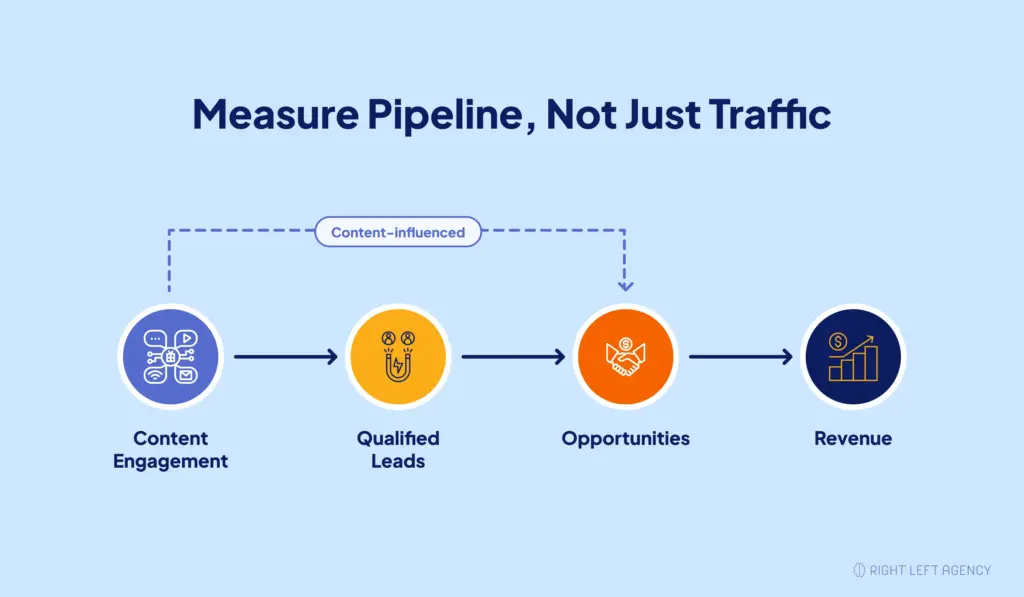
Search rankings, impressions, and organic traffic help measure visibility.
However, these metrics alone cannot demonstrate revenue impact.
For B2B fintech companies, more meaningful measurements may include:
- Qualified demo requests.
- Marketing-qualified leads (MQLs).
- Sales-qualified leads (SQLs).
- Sales opportunities.
- Content-sourced pipeline.
- Content-influenced pipeline.
- Customer acquisition cost (CAC).
A capable agency should explain how these metrics connect to website analytics, conversion tracking, and CRM reporting.
It should also clarify attribution limitations.
Content-sourced pipeline refers to opportunities credited to content as their originating acquisition source under an agreed attribution method.
Content-influenced pipeline refers to opportunities with documented content interactions during the buying journey.
These categories may overlap and should not automatically be combined.
For example, a prospect might discover your company through an article, later click a paid advertisement, attend a webinar, and eventually request a demo.
Multiple interactions contributed to that journey.
A reliable reporting framework should distinguish documented evidence from assumptions about which channel caused the sale.
Ask: “How will you connect content performance to qualified opportunities and revenue?”
Evidence to request: A sample dashboard showing organic conversions, CRM lead stages, pipeline reporting, attribution rules, and measurement limitations.
Red flag: Equating traffic growth with revenue or promising a guaranteed content marketing ROI.
8. Who Will Create, Review, and Manage Your Content?
The specialists presenting an agency’s proposal may not be the people executing the work.
Before hiring, clarify who will manage strategy, research, writing, editing, optimization, and reporting.
A content team may include:
- Content strategist: Establishes priorities and editorial direction.
- Technical writer: Researches and develops industry-specific content.
- Editor: Reviews accuracy, clarity, and quality.
- SEO specialist: Optimizes content for relevant search demand.
- Project manager: Coordinates production, communication, and approvals.
- Internal experts: Verify product information and technical claims.
The exact team structure can vary. Clear accountability matters more than headcount.
Ask how content moves from briefing to publication, how revisions are managed, and who resolves technical questions.
For example, if internal compliance review requires two weeks, that dependency should be included in the publishing schedule.
A defined workflow helps maintain consistency and prevents avoidable delays.
Ask: “Who will manage our content, and what does the research, review, and approval process look like?”
Evidence to request: An editorial workflow, responsibility matrix, sample production calendar, and escalation process.
Red flag: Unclear delivery responsibilities or no documented quality-control process.
9. What Are the Pricing, Deliverables, Contract Terms, and First 90-Day Expectations?
The least expensive agency is not necessarily the most cost-effective.
A lower monthly fee may cover article writing but exclude strategy, technical research, SEO implementation, or distribution.
Before signing, clarify:
- Fees and payment terms.
- Content deliverables and timelines.
- Research and editing responsibilities.
- SEO, design, and distribution inclusions.
- Reporting and revision policies.
- Content ownership and termination terms.
You should also request a realistic 90-day execution plan.
Days 1–30: Research and strategy
Review existing content, understand the product and ICP, assess competitors, and prioritize opportunities.
Days 31–60: Content execution
Develop priority assets, optimize relevant pages, coordinate approvals, and begin distribution.
Days 61–90: Performance evaluation
Review early search visibility, engagement, conversions, and available pipeline indicators. Adjust priorities based on the findings.
These are planning milestones, not guaranteed ranking or revenue outcomes.
Ask: “Can you provide a detailed scope, transparent pricing, ownership terms, and a realistic 90-day plan?”
Evidence to request: A statement of work, deliverable schedule, staffing plan, and sample performance review.
Red flag: Vague deliverables, unrealistic guarantees, or unclear contract terms.
How to Compare Fintech Content Marketing Agencies Before Making a Decision
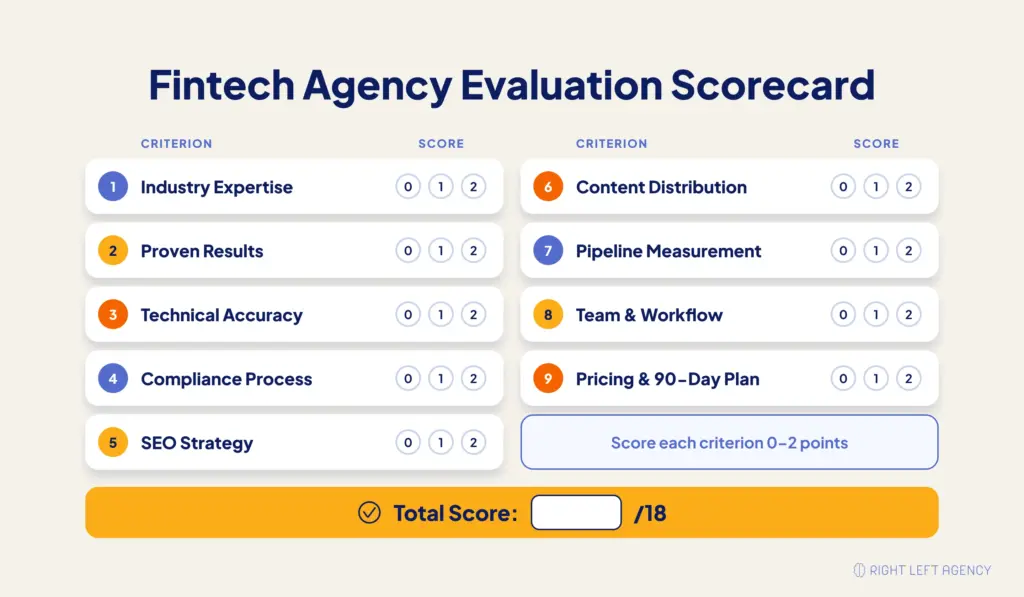
After your discovery calls, evaluate shortlisted agencies using consistent criteria.
Use a Fintech Agency Evaluation Scorecard
Score each of the nine questions from 0 to 2:
- 0: No satisfactory answer or credible evidence.
- 1: Reasonable explanation with limited proof.
- 2: Clear explanation supported by relevant evidence.
| Evaluation Criteria | Maximum Score |
|---|---|
| Fintech industry understanding | 2 |
| Relevant experience and results | 2 |
| Technical accuracy | 2 |
| Compliance workflow | 2 |
| Buyer-focused SEO | 2 |
| Content distribution | 2 |
| Pipeline measurement | 2 |
| Delivery team and process | 2 |
| Pricing and 90-day plan | 2 |
| Total | 18 |
This framework is a practical comparison tool, not an industry certification.
Before comparing total scores, eliminate agencies that cannot demonstrate reliable technical verification, appropriate compliance coordination, or transparent reporting.
A high overall score should not compensate for weaknesses in these essential areas.
Before signing, request actual content samples, a documented approval workflow, a sample performance report, and a proposed 90-day scope.
These materials can reveal more about execution quality than a sales presentation.
When Should a Fintech Company Hire a Content Marketing Agency?
A fintech company should consider hiring a content marketing agency when its product and target market are sufficiently established, content supports customer acquisition, and its internal team needs additional expertise or execution capacity.
Signs You May Need an Agency
- Your website attracts traffic but few qualified leads.
- Internal experts lack time to produce content consistently.
- You need technical guides, comparisons, or decision-stage resources.
- Existing content does not address key stakeholders.
- Content performance is disconnected from pipeline reporting.
When Hiring May Be Premature
An agency may not be the right first investment if product positioning remains unclear, your ideal customer profile is undefined, or internal experts cannot support technical reviews.
Your main growth challenge may also involve targeting, lead qualification, or website conversions rather than content production.
Identify the underlying problem before expanding marketing activity.
Choose a Fintech Content Marketing Partner Based on Your Growth Needs
Choosing the right fintech content marketing agency requires more than comparing prices, portfolios, or publishing volume.
Your partner should understand your customers, explain complex products accurately, coordinate necessary reviews, and connect content performance with meaningful business outcomes.
At Right Left Agency, our fintech marketing approach connects SEO, content, paid media, website conversion, and measurement around qualified pipeline.
Rather than recommending more content automatically, we focus on identifying whether search visibility, buyer messaging, lead quality, conversion performance, or measurement presents the greatest growth opportunity.
Find Out What’s Holding Your Fintech Growth Back
Not sure whether your fintech company needs more content, better SEO, or stronger conversion paths?
Right Left Agency helps identify the acquisition challenges that deserve attention before you increase marketing investment.
Book a Growth Fit Call to explore how a more connected marketing strategy could support your fintech growth objectives.
Frequently Asked Questions
What Should I Look for in a Fintech Content Marketing Agency?
Look for relevant fintech expertise, technical accuracy, compliance coordination, buyer-focused SEO, credible work samples, and transparent reporting. The agency should understand your target customers and explain how its services support business growth.
How Much Does a Fintech Content Marketing Agency Cost?
Pricing varies based on strategy, technical complexity, deliverables, research, distribution, and reporting requirements. Agencies may offer retainers or project-based agreements. Compare the full scope of services rather than price per article.
How Long Does Fintech Content Marketing Take to Show Results?
Timelines depend on competition, existing website visibility, content quality, distribution, and sales cycles. Early search and engagement improvements may precede measurable pipeline results. Fixed ranking or revenue timelines should not be guaranteed.
Can a General B2B SaaS Agency Handle Fintech Content Marketing?
Yes, if it demonstrates appropriate technical expertise, research capabilities, editorial processes, and compliance coordination. Specialized fintech experience can be valuable, but actual execution capabilities matter more than agency positioning.
Should Fintech Companies Hire an Agency or Build an In-House Team?
An internal team provides product familiarity and close collaboration. An agency can offer specialized expertise and additional capacity. A hybrid model can combine internal technical knowledge with external strategy, content production, and optimization.