

Key Takeaways
- Retention begins with customer fit.
- Customers renew because they achieve meaningful outcomes.
- Faster time to value reduces early churn risk.
- Lifecycle marketing reinforces value after acquisition.
- Retention requires shared ownership across the business.
What Is SaaS Customer Retention and Why Does It Matter?
SaaS customer retention is a company’s ability to keep customers and recurring revenue over time by helping customers achieve ongoing value. It directly affects churn, renewals, customer lifetime value, CAC recovery, profitability, and revenue predictability.
The eight core retention strategies are acquiring high-fit customers, aligning promises with measurable outcomes, accelerating time to value, increasing product adoption, building behavior-based lifecycle marketing, detecting churn risk, proving value across stakeholders, and expanding successful accounts while preventing billing churn.
Acquisition alone is insufficient because the initial sale only begins the customer relationship. Sustainable SaaS growth depends on whether customers remain long enough to recover acquisition costs, renew, and expand.
SaaS Customer Retention Definition
SaaS customer retention is the ability to keep customer accounts and their recurring revenue during a defined period by consistently delivering the outcomes customers purchased the product to achieve.
Retention can be evaluated at two primary levels:
- Logo retention measures the percentage of customer accounts retained.
- Revenue retention measures the percentage of recurring revenue retained after cancellations and downgrades.
A company may retain most customers but still lose substantial revenue if several large accounts cancel or reduce spending. SaaS teams should therefore evaluate customer retention and revenue retention together.
For a broader view of how acquisition, conversion, retention, and expansion work together, read this SaaS marketing guide.
Why Retention Is a Growth and Profitability Issue
Retention is a growth and profitability issue because customers must remain long enough for a SaaS company to recover acquisition costs and generate sustainable recurring revenue.
Acquiring a customer requires investment in marketing, sales, onboarding, and implementation. When an account churns before those costs are recovered, the company may generate revenue without producing a healthy return.
Stronger retention can support more predictable Monthly Recurring Revenue and Annual Recurring Revenue, longer customer relationships, higher customer lifetime value, more efficient CAC recovery, and greater expansion potential. It can also make revenue forecasting more reliable.
Retention should not automatically be described as more profitable than acquisition in every situation. Its financial contribution depends on gross margin, support costs, contract value, implementation requirements, and the resources needed to retain the customer.
The practical question is whether a company acquires customers who can stay long enough to support healthy SaaS unit economics.
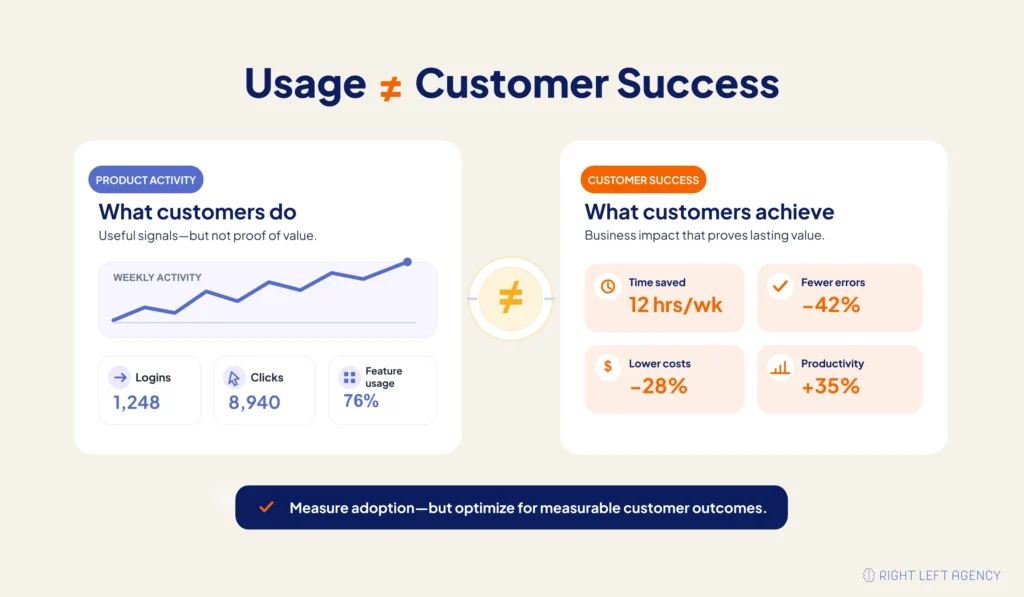
Product Usage Is Not the Same as Customer Success
Product usage indicates engagement, but customer outcomes indicate whether the product created meaningful value.
A customer can log in regularly and still fail to achieve the result that justified the purchase. Frequent activity may even reflect inefficient workflows, repeated errors, or difficulty completing an important task.
| Product usage | Customer outcomes |
|---|---|
| Shows what customers do inside the product | Shows what customers achieve because of the product |
| Includes logins, sessions, actions, and feature use | Includes time saved, errors reduced, or processes improved |
| Helps identify adoption patterns | Helps prove business value |
| Acts as a customer-health indicator | Acts as a renewal and expansion driver |
| May reveal engagement or friction | Reveals whether the purchase delivered results |
Usage remains useful. Declining activity, incomplete workflows, and low feature adoption can signal risk. However, SaaS teams should interpret activity in relation to the outcome the customer intended to achieve.
Why SaaS Customers Churn
Customer churn is the loss of customer accounts or recurring revenue during a defined period.
SaaS customers churn when the product, service, experience, price, or relationship no longer supports their needs. They may also churn because payment or administrative problems interrupt an otherwise healthy subscription.
Churn can begin before purchase and emerge at any stage of the customer lifecycle. Effective diagnosis therefore requires more than a cancellation survey.
Voluntary Churn vs. Involuntary Churn
Voluntary churn results from an intentional customer decision, whereas involuntary churn usually results from billing, payment, or administrative problems.
| Factor | Voluntary churn | Involuntary churn |
|---|---|---|
| Customer intent | Customer chooses to cancel, downgrade, or not renew | Customer may intend to remain |
| Common causes | Poor fit, weak value, pricing concerns, product limitations, or poor support | Failed payments, expired cards, billing errors, or administrative problems |
| Useful data | Exit surveys, interviews, product usage, and support history | Payment failures, card-expiration data, and dunning records |
| Primary response | Improve fit, outcomes, adoption, support, and value communication | Improve reminders, retries, card updates, and recovery workflows |
These churn types require different interventions. A feature-adoption campaign will not fix an expired card, while payment retry logic will not resolve a customer-value problem.
Churn Can Begin Before the Customer Signs Up
Churn can begin before purchase when a company attracts customers whose needs, resources, or expectations do not align with the product.
A customer may be willing to buy but unable to succeed. The account may depend on an unavailable capability, lack a required integration, have insufficient implementation resources, or expect a result the product cannot realistically deliver.
Marketing and sales influence retention by setting accurate expectations. Overpromising capabilities or overlooking product limitations creates an expectation gap that onboarding and customer success may not be able to repair.
Retention-led acquisition evaluates customers by their likelihood of activating, achieving value, renewing, and expanding—not only by their willingness to purchase.
Lifecycle Causes of Churn
Lifecycle churn occurs when post-purchase barriers prevent customers from realizing or recognizing value.
Common causes include:
- Complicated onboarding
- Slow time to value
- Unclear activation milestones
- Low adoption of important features
- UX friction
- Missing integrations
- Unresolved support issues
- Inadequate customer education
- Weak stakeholder alignment
- Champion loss
- Limited evidence of ROI
- Late renewal preparation
- Pricing or contract inflexibility
A self-service customer may leave because the product feels difficult to learn. An enterprise account may leave because procurement, finance, IT, or an executive sponsor cannot justify renewal.
Mapping the B2B SaaS customer journey can help teams identify where customer expectations, activation, adoption, and renewal confidence begin to break down.
Build a Churn-Reason Taxonomy
A churn-reason taxonomy is a structured system for categorizing why customers cancel, downgrade, fail to renew, or become inactive.
Useful categories include customer fit, unsupported use cases, missing capabilities, integration problems, implementation failure, slow time to value, low product adoption, UX friction, support problems, pricing pressure, stakeholder change, competitive replacement, failed payments, and billing errors.
Avoid relying only on vague labels such as “too expensive” or “not using the product.” These answers may describe the final complaint rather than its root cause.
A customer may select “too expensive” during cancellation because weak onboarding prevented the account from experiencing enough value to justify the price. Combine cancellation data with sales notes, support tickets, product analytics, interviews, and billing records to uncover the underlying problem.
Analyze Churn by Segment, Source, and Cohort
Churn should be analyzed by customer segment, acquisition source, pricing plan, use case, and cohort to identify which customers produce durable revenue.
Useful breakdowns include:
- Company size and industry
- Use case and pricing plan
- Contract type
- Marketing channel and campaign
- Landing page
- Sales source
- Onboarding path
- Signup cohort
A campaign may generate many trials or demos but still produce weak economics if those customers fail to activate or churn quickly.
Cohort analysis is especially important because aggregate churn can hide deterioration. Overall retention may appear stable even when newer customer groups perform worse than earlier cohorts.
Which SaaS Retention Metrics Should You Track?
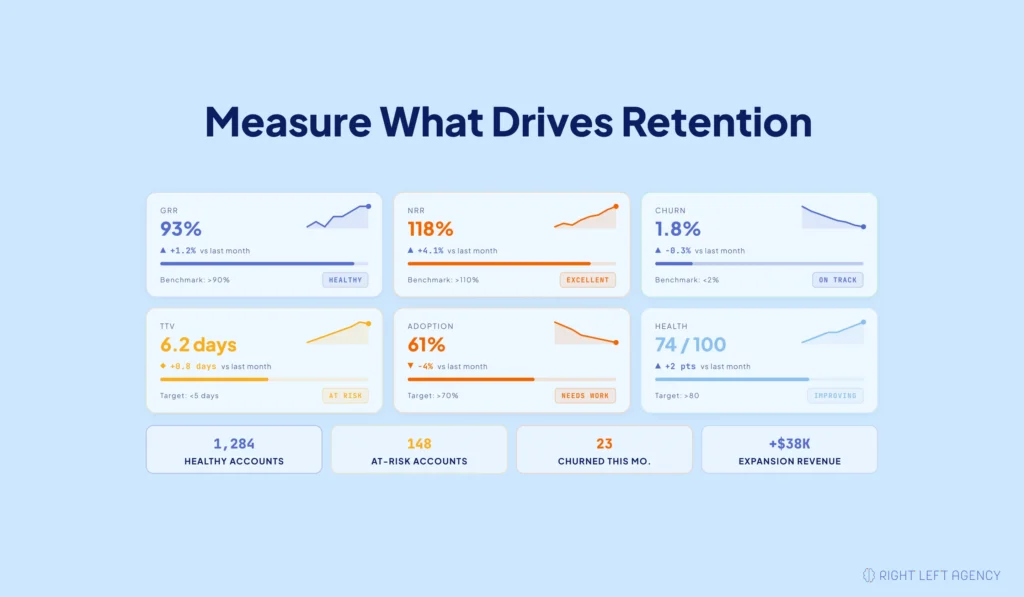
The most important SaaS retention metrics are customer retention rate, logo churn, revenue churn, GRR, NRR, activation rate, time to value, feature adoption, customer health, outcome-achievement rate, LTV, CAC payback, and cohort retention.
Financial metrics show what happened. Behavioral, experience, and outcome metrics help explain why it happened.
| Metric | What it measures | Primary use |
|---|---|---|
| Customer retention rate | Percentage of customer accounts retained | Logo retention |
| Logo churn | Customer accounts lost | Account-level churn |
| Revenue churn | Recurring revenue lost | Financial churn |
| GRR | Revenue retained before expansion | Revenue protection |
| NRR | Revenue retained after expansion | Retention plus growth |
| Activation rate | Customers completing an important first action | Early adoption |
| Time to value | Time required to reach meaningful value | Onboarding efficiency |
| Feature adoption rate | Use of important product capabilities | Product engagement |
| Customer health score | Combined engagement and risk signals | Proactive intervention |
| Outcome-achievement rate | Customers reaching the promised result | Customer success |
| LTV | Expected value generated across the relationship | Unit economics |
| CAC payback | Time required to recover acquisition cost | Acquisition profitability |
Customer Retention Rate and Logo Churn
Customer retention rate measures the percentage of customer accounts that remain during a defined period.
Customer retention rate
((Customers at the end of the period − New customers acquired during the period) ÷ Customers at the beginning of the period) × 100
Logo churn measures the accounts lost during that period.
Logo churn rate
(Customer accounts lost during the period ÷ Customer accounts at the beginning of the period) × 100
These metrics treat every account as one logo. Losing a small account and losing an enterprise customer have the same logo impact, even though the revenue consequences differ.
Customer retention should therefore be reviewed alongside revenue churn, GRR, and NRR.
GRR, Revenue Churn, and Downgrades
Gross Revenue Retention measures recurring revenue retained after cancellations and downgrades, excluding expansion revenue.
GRR
((Starting recurring revenue − Churned revenue − Downgrade revenue) ÷ Starting recurring revenue) × 100
GRR shows how effectively a SaaS company protects the revenue it already has before upgrades offset losses.
Downgrades may indicate low utilization, budget pressure, weak stakeholder adoption, poor product value, incorrect package selection, or reduced customer needs.
A company can maintain strong logo retention while experiencing weak GRR if large customers reduce their spending.
NRR and Expansion Revenue
Net Revenue Retention measures recurring revenue retained after cancellations and downgrades while including upgrades and account expansion.
NRR
((Starting recurring revenue − Churned revenue − Downgrade revenue + Expansion revenue) ÷ Starting recurring revenue) × 100
GRR excludes expansion revenue, while NRR includes upgrades, additional seats, add-ons, and account growth.
| Metric | Includes cancellations | Includes downgrades | Includes expansion |
|---|---|---|---|
| Customer retention rate | At account level | Usually not | No |
| GRR | Yes | Yes | No |
| NRR | Yes | Yes | Yes |
NRR shows whether existing customer revenue is shrinking, stable, or expanding. However, strong expansion should not be used to ignore concentrated churn within important segments.
Activation, Time to Value, and Feature Adoption
Activation, time to value, and feature adoption are leading indicators of future retention.
Activation rate measures the percentage of customers who complete an important early action.
Time to value measures how quickly a customer reaches the first meaningful product outcome.
Feature adoption rate measures how many eligible customers use a capability that supports their goals.
Meaningful activation events may include publishing the first campaign, completing the first workflow, importing usable data, inviting a team, connecting an integration, or producing the first report.
Avoid using account creation or login as the main activation event unless those actions reliably predict future success.
Time-to-value expectations should reflect product complexity. Self-service products may demonstrate value quickly, while enterprise platforms may require data migration, security approval, training, and implementation.
Customer Health, NPS, CSAT, and CES
A customer health score combines engagement, outcomes, feedback, support activity, and risk signals to estimate account health.
Possible inputs include activation progress, important feature adoption, usage decline, outcome progress, missed milestones, unresolved support issues, survey responses, stakeholder participation, renewal timing, payment problems, and champion loss.
NPS, CSAT, and CES provide useful feedback but should not be used alone. A satisfied customer may still fail to achieve the required business outcome, while a frustrated implementation-stage customer may remain committed because the product creates substantial value.
Outcome-Achievement Rate
Outcome-achievement rate measures the percentage of eligible customers who reach an agreed success outcome within a defined period.
Outcome-achievement rate
(Customers who achieved the defined outcome ÷ Customers eligible to achieve it) × 100
The metric requires a starting baseline, a defined target result, a realistic timeframe, and a consistent measurement method.
Customer outcomes may include time saved, costs reduced, errors prevented, faster workflow completion, or improved service delivery. Do not present unverified percentage improvements as guaranteed results.
LTV, CAC Payback, and Cohort Retention
LTV, CAC payback, and cohort retention connect retention performance to acquisition efficiency.
Customer lifetime value estimates the value generated across the customer relationship. CAC payback estimates how long it takes to recover acquisition costs. The LTV-to-CAC ratio compares expected customer value with acquisition cost. Cohort retention tracks how groups acquired during a specific period behave over time.
These metrics help teams determine whether customers remain long enough to repay CAC and which acquisition sources produce the strongest long-term economics.
Leading vs. Lagging Retention Metrics
Leading indicators help teams identify risk before churn occurs. Lagging indicators confirm customer or revenue loss after it has happened.
| Leading indicators | Lagging indicators |
|---|---|
| Activation rate | Customer retention rate |
| Time to value | Logo churn |
| Feature adoption | Revenue churn |
| Usage decline | GRR |
| Customer health score | NRR |
| Support-ticket patterns | Renewal rate |
| Outcome progress | LTV |
| Stakeholder engagement | CAC payback |
Leading metrics should trigger intervention. Lagging metrics should show whether the overall retention program is improving.
Eight Core SaaS Customer Retention Strategies
The eight core SaaS customer retention strategies are acquiring high-fit customers, aligning promises with outcomes, accelerating time to value, increasing adoption, building behavior-based lifecycle marketing, detecting churn risk, proving stakeholder value, and growing successful accounts while preventing billing churn.
Cross-functional ownership is the operating layer supporting all eight strategies.
1. Acquire Customers Who Are Likely to Succeed
Retention-led acquisition focuses on customers who are likely to activate, achieve value, renew, and expand—not simply customers who are ready to purchase.
Qualification should consider required product capabilities, integration needs, data availability, implementation resources, budget, use case, expected outcomes, product maturity, and stakeholder commitment.
Not every customer who can buy should be acquired. Accounts that depend on unavailable features or unrealistic outcomes can create short-term revenue and long-term churn.
Define a High-Retention ICP
A high-retention ideal customer profile should be based on post-sale success data, not only closed-won opportunities.
Compare customer segments using retention, GRR, NRR, activation, product adoption, support requirements, outcome achievement, expansion behavior, CAC payback, and customer lifetime value.
These indicators reveal which customer groups the company can repeatedly serve successfully.
Connect Acquisition Metrics to Retention Metrics
Measure activation, retention, CAC payback, LTV-to-CAC, and NRR by channel, campaign, landing page, segment, pricing plan, and sales source.
The campaign with the highest conversion rate may not produce the strongest long-term customers. Retention data should therefore influence targeting, channel investment, positioning, and sales qualification.
2. Align Product Promises With Customer Outcomes
Product promises should be converted into measurable customer outcomes before onboarding begins.
Marketing and sales should document why the customer purchased, the starting baseline, the desired business result, a realistic timeframe, how success will be measured, and what each party must do.
This information should transfer directly to onboarding and customer success. Without that continuity, customers may receive a technically correct implementation that fails to address the reason they purchased.
Translate Product Promises Into Measurable Results
A measurable success plan connects product capabilities to customer-specific results.
Relevant outcomes may include saving employee time, reducing errors, lowering operational costs, improving workflow visibility, completing work faster, or improving team consistency.
Each outcome should include a baseline, target, timeframe, measurement method, and owner. Avoid presenting unverified improvements as guaranteed results.
3. Accelerate Onboarding and Time to Value
Effective onboarding helps customers reach meaningful value before confusion or frustration weakens confidence.
Useful onboarding elements include guided setup, interactive walkthroughs, in-app checklists, templates, sample data, contextual guidance, activation milestones, early success checkpoints, and personalized support.
The onboarding experience should prioritize the shortest realistic path to customer value rather than introducing every product capability at once.
Measure the First Meaningful Customer Outcome
The first meaningful outcome should demonstrate value, not merely account activity.
For example, a reporting platform should not define activation as “the customer logged in.” A stronger milestone would be importing live data and generating the first report that a manager can use in a real meeting.
Track the time between purchase and this outcome. Then identify where customers become delayed, confused, or inactive.
Adapt Onboarding to Customer Complexity
Onboarding should reflect the customer’s segment, use case, technical requirements, and product complexity.
Self-service products may rely on automated guidance, templates, and educational content. Enterprise platforms may require stakeholder discovery, data migration, integrations, security reviews, training, and implementation planning.
Do not impose one universal activation timeline or 90-day benchmark across every product and customer type.
4. Increase Product Adoption and Remove UX Friction
Product adoption supports retention when customers use the capabilities required to achieve their goals.
Track the behaviors that distinguish healthy accounts, including key workflow completion, adoption of high-value features, team collaboration, integration usage, and meaningful recurring activity.
Use product analytics, session replay, heatmaps, interviews, and support data to identify incomplete workflows, repeated errors, confusing interfaces, and steps that require more effort than the value they produce.
Use Product Education to Reinforce Value
Customer education should help users apply the product to real problems.
Useful formats include tutorials, knowledge-base articles, advanced workflow guides, integration instructions, product academies, webinars, feature announcements, and role-specific training.
Education should appear when customers need it. Contextual guidance triggered by an incomplete workflow is often more useful than broad communication sent to the entire customer base.
Distinguish Engagement From Outcome Achievement
Engagement shows that customers interact with the product. Outcome achievement shows that those interactions created meaningful value.
Use product activity as a diagnostic signal and customer outcomes as the primary evidence for renewal and expansion.
5. Build Lifecycle Marketing Around Customer Behavior
Lifecycle marketing delivers relevant communication across onboarding, adoption, engagement, renewal, reactivation, and expansion.
Important campaigns include onboarding sequences, activation reminders, usage-triggered messages, feature-adoption campaigns, customer education, inactivity alerts, re-engagement, win-back communication, renewal reminders, and expansion campaigns.
Segment Customers by Behavior and Lifecycle Stage
Customers should be segmented according to their current behavior and needs.
Useful segments include customers who have not activated, activated customers with low adoption, healthy accounts, inactive users, at-risk accounts, customers approaching renewal, expansion-ready accounts, recently cancelled users, and accounts with failed payments.
Segmentation can also reflect pricing plan, account health, outcome progress, use case, and stakeholder role.
Combine Automation With Human Intervention
Automation works well for routine reminders, education, inactivity alerts, and payment communication.
Human support is more appropriate when a high-value account shows declining adoption, an important workflow is blocked, the internal champion leaves, a strategic stakeholder raises concerns, or renewal approaches with unresolved risk.
Create escalation rules so automated signals trigger personal intervention when necessary. A structured email marketing program can support onboarding, adoption, re-engagement, and renewal without treating every customer the same.
6. Detect Churn Risk and Provide Proactive Support
Proactive retention identifies risk before customers reach the cancellation stage.
Monitor usage decline, missed activation milestones, low feature adoption, unresolved support issues, negative feedback, missed outcome milestones, stakeholder inactivity, payment problems, and champion loss.
A health score should always connect to an intervention. A risk alert that only appears in a dashboard does not protect revenue.
Create Risk-Specific Intervention Playbooks
Different account conditions require different responses.
| Customer condition | Recommended response |
|---|---|
| Strong fit, low adoption | Improve onboarding and activation |
| Strong fit, unresolved issue | Provide targeted support |
| Strong fit, unclear value | Demonstrate outcomes and ROI |
| Weak fit, unrealistic needs | Avoid disproportionate retention efforts |
| Weak fit, missing capability | Reassess positioning or product priorities |
| Wrong customer segment | Improve acquisition targeting |
Use self-service support for routine problems and human assistance for strategic, technical, or complex blockers.
Close the Customer Feedback Loop
Combine NPS, CSAT, CES, support data, interviews, churn reasons, exit surveys, and product behavior.
Categorize the feedback, identify recurring patterns, assign ownership, implement improvements, and communicate relevant changes to customers.
Feedback should improve the product, messaging, onboarding, customer education, and support experience—not remain isolated in survey reports.
7. Prove Value Across the B2B Buying Committee
B2B SaaS retention requires value to be visible to all relevant stakeholders, not only active users.
An account may churn even when end users like the product. Executives may question ROI, procurement may challenge pricing, IT may raise security or integration concerns, or the internal champion may leave.
Match Retention Value to Each Stakeholder
| Stakeholder | Value to demonstrate |
|---|---|
| Executive buyer | ROI, strategic impact, and cost savings |
| Department leader | Productivity and team performance |
| Administrator | Manageability, control, and security |
| End user | Ease of use and daily usefulness |
| Finance or procurement | Utilization and pricing justification |
| IT or security | Reliability, compliance, and integration |
For example, end users may value an automation platform because it reduces repetitive work. Finance may need proof that the saved time justifies the subscription, while IT may need evidence of reliable and secure integration.
Monitor stakeholder engagement and rebuild alignment when responsibilities or decision-makers change.
Make Renewal a Continuous Value-Communication Process
Renewal preparation should include adoption progress, outcomes achieved, utilization, stakeholder engagement, unresolved risks, support history, and future priorities.
Business reviews and value reports should document progress throughout the customer lifecycle rather than immediately before the renewal date.
8. Grow Expansion Revenue and Prevent Billing Churn
Expansion increases account value after customers achieve success, while billing recovery protects recurring revenue that would otherwise be lost unnecessarily.
Expansion opportunities may appear when customers add teams, seats, use cases, capacity, or advanced product requirements.
Expand Only After Value Has Been Demonstrated
Upselling and cross-selling should follow evidence that the customer has received value.
Position an upgrade, add-on, or seat increase as the next step in customer success rather than an isolated sales push.
Use product behavior and customer-outcome data to identify expansion readiness, but include human judgment for strategic accounts. High usage alone does not always mean a customer is ready to expand.
Build an Involuntary-Churn Recovery Process
An involuntary-churn recovery process should include card-expiration reminders, failed-payment notifications, automated retry logic, clear card-update instructions, payment-method flexibility, dunning sequences, internal escalation, and account-recovery communication.
For example, when a payment fails, send an immediate notification with a secure update link, retry the charge according to the billing schedule, and alert the account owner if a high-value subscription remains unresolved. Once payment succeeds, confirm that access will continue.
Pause or downgrade options may also prevent permanent cancellation when customers experience temporary budget or usage changes.
Make Retention a Cross-Functional Responsibility
Cross-functional ownership is the operating layer supporting all eight retention strategies.
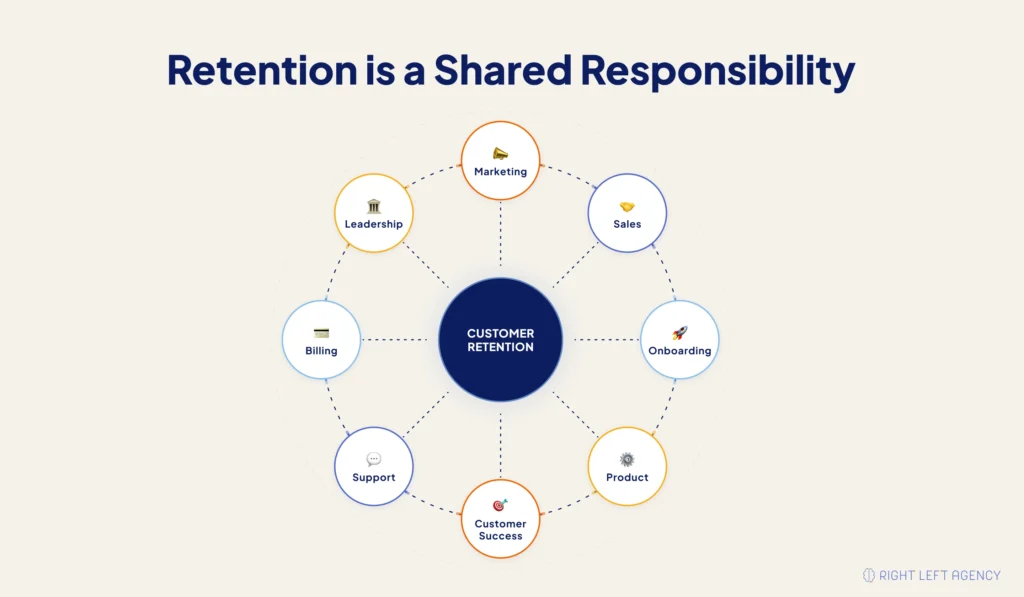
Customer success may coordinate retention, but it does not control every factor that causes churn. Marketing affects expectations, sales affects qualification, product affects adoption, support affects problem resolution, and billing affects involuntary churn.
Use connecting lines to show that retention is a shared responsibility.
Define Retention Responsibilities by Team
| Team | Retention responsibility |
|---|---|
| Marketing | Set accurate expectations and educate customers |
| Sales | Qualify fit and document desired outcomes |
| Onboarding | Reduce friction and accelerate value |
| Product | Support customer goals and remove adoption barriers |
| Customer success | Guide adoption, measure outcomes, and prepare renewals |
| Support | Resolve blockers before they affect customer value |
| Finance or billing | Prevent failed-payment churn |
| Leadership | Align priorities, ownership, incentives, and resources |
Churn insights should flow back into targeting, positioning, sales qualification, onboarding, product priorities, pricing, customer education, and support.
How to Build a Prioritized SaaS Retention Program
A prioritized SaaS retention program begins with diagnosis. Companies should identify where and why revenue is being lost before launching new tools, campaigns, or processes.
Step 1. Establish Your Retention Baseline
Establish a baseline using financial, behavioral, experience, and customer-outcome metrics.
Measure customer retention, logo churn, GRR, NRR, activation, time to value, feature adoption, customer health, outcome achievement, LTV, and CAC payback.
Break the results down by segment, plan, use case, acquisition source, and cohort. Document any data limitations instead of creating false precision.
Step 2. Diagnose Churn Across the Full Funnel
Diagnose whether churn originates in acquisition, expectations, onboarding, product use, support, renewal, stakeholder alignment, or billing.
Combine cancellation data, sales notes, product analytics, support history, interviews, surveys, and payment records.
Look beyond the customer’s final cancellation answer. The stated reason may be the last symptom of an earlier problem.
Step 3. Define Customer Outcomes and Value Milestones
Define what successful customers should achieve, how progress will be measured, and when important milestones should occur.
Document the starting baseline, desired outcome, first meaningful value milestone, ongoing adoption milestones, measurement method, expected timeframe, and team responsibilities.
These definitions help teams distinguish product activity from actual customer progress.
Step 4. Prioritize by Impact, Fit, and Recoverability
Prioritize retention problems according to revenue impact, customer fit, frequency, and recoverability.
Ask how much revenue is affected, whether the customers are a strong fit, whether the issue can be corrected, whether the solution addresses a root cause, and whether the improvement will benefit future customers.
Do not invest equally in every churn-risk account. A high-fit customer blocked by an implementation problem may be recoverable, while an account that depends on an unavailable capability may not be.
Step 5. Launch Targeted Campaigns and Interventions
Match each intervention to the diagnosed problem.
Improve qualification when acquisition produces weak-fit customers. Update messaging when expectations are inaccurate. Redesign onboarding when customers fail to activate. Use education when adoption is low, product improvements when workflows create friction, support escalation when blockers remain unresolved, stakeholder reporting when renewal value is unclear, and dunning when payments fail.
Define the audience, trigger, owner, expected behavior, intended customer outcome, and measurement period for every intervention.
Step 6. Measure Results and Feed Insights Back
Measure whether interventions improve performance by segment and cohort.
Track faster activation, shorter time to value, stronger feature adoption, better outcome achievement, improved renewal performance, stronger GRR and NRR, and lower involuntary churn.
Feed the results back into acquisition, positioning, onboarding, product development, support, and billing.
Common SaaS Customer Retention Mistakes
SaaS retention programs fail when teams launch isolated tactics without diagnosing customer fit, value realization, lifecycle risk, and revenue loss.
Treating Retention as a Customer Success-Only Responsibility
Retention depends on customer targeting, sales promises, product quality, onboarding, support, billing, and leadership decisions.
Assign team responsibilities, shared metrics, and clear feedback loops rather than placing the entire burden on customer success.
Measuring Product Activity Instead of Customer Outcomes
Logins and feature use show engagement but do not independently prove success.
Connect important product behaviors with measurable customer outcomes, renewal performance, and expansion.
Waiting Until Renewal to Demonstrate Value
Waiting until renewal makes it difficult to rebuild stakeholder confidence after concerns have developed.
Document adoption, outcomes, utilization, and ROI throughout the relationship.
Automating Every Customer Interaction
Automation improves scale but may fail to resolve strategic or complex risks.
Automate routine communication while escalating high-value and high-risk accounts to people.
Ignoring Involuntary Churn
Failed payments and expired cards can cause customers who intended to stay to leave.
Use reminders, payment retries, dunning, card updates, and account-recovery communication.
Trying to Save Every Customer
Some accounts are poor fits or depend on capabilities the product cannot provide.
Prioritize customers based on fit, account value, and recoverability rather than applying the same effort to every account.
Using Universal Retention Benchmarks
There is no single retention benchmark that applies to every SaaS business.
Performance depends on customer segment, contract length, product category, annual contract value, CAC, implementation complexity, pricing model, expansion potential, and gross margin.
Use relevant internal cohorts and closely comparable business contexts.
Using Unsupported Performance Claims
Unsupported claims create inaccurate expectations and can contribute to churn.
Avoid guaranteed retention improvements, universal 90-day success windows, fixed subscription recommendations, and unsupported percentage outcomes. Use verified evidence and customer-specific targets.
Build Retention Around Customer Outcomes, Not Isolated Tactics
SaaS retention improves when companies acquire customers who can succeed, help them reach measurable value quickly, reinforce that value throughout the lifecycle, identify risks early, and align every team around renewals and expansion.
Retention starts before purchase. Targeting and qualification determine whether customers have the needs, expectations, and resources required for success.
After purchase, onboarding should accelerate the first meaningful outcome. Product analytics and customer education should then help customers adopt the capabilities required to reach their goals.
Lifecycle marketing reinforces value through timely education, re-engagement, renewal communication, and expansion campaigns. Customer health scores and proactive support help teams intervene before risk becomes cancellation.
For B2B SaaS companies, value must also be visible to executives, users, administrators, finance, procurement, and IT. Renewals become more predictable when each stakeholder understands how the product supports their priorities.
Financial metrics such as GRR and NRR should be evaluated alongside activation, adoption, customer feedback, support activity, and outcome achievement. Different causes of churn require different interventions, and account expansion should follow demonstrated value.
Retention insights should ultimately improve acquisition targeting, positioning, qualification, onboarding, product development, customer education, support, billing, and leadership priorities.
Need a Coordinated SaaS Retention Strategy?
Right Left Agency helps SaaS companies connect acquisition, onboarding, customer journeys, lifecycle marketing, and retention around measurable growth outcomes.
Frequently Asked Questions
What Are the Best SaaS Customer Retention Strategies?
The best SaaS customer retention strategies are acquiring high-fit customers, aligning promises with outcomes, accelerating time to value, increasing adoption, using lifecycle marketing, detecting churn risk, proving stakeholder value, and preventing billing churn.
Cross-functional ownership supports every strategy.
How Can a SaaS Company Reduce Customer Churn?
A SaaS company can reduce churn by diagnosing why customers leave and matching each cause with the correct intervention.
Improve customer fit, set accurate expectations, accelerate value, remove adoption barriers, provide proactive support, communicate outcomes, prepare for renewal, and recover failed payments.
What Is the Difference Between GRR and NRR?
Gross Revenue Retention (GRR) excludes expansion revenue, while Net Revenue Retention (NRR) includes upgrades, additional seats, add-ons, and account growth.
GRR measures revenue protection before expansion. NRR measures retention after both revenue losses and expansion.
How Does Onboarding Affect SaaS Retention?
Onboarding affects retention by shaping activation, time to value, customer confidence, and early product adoption.
Effective onboarding helps customers complete the workflows that lead to meaningful value.
What Is Involuntary Churn in SaaS?
Involuntary churn is customer loss caused by failed payments, expired cards, billing errors, or administrative problems rather than an intentional cancellation.
It can be reduced through reminders, retry logic, dunning, card-update workflows, payment flexibility, and account-recovery communication.
Who Is Responsible for SaaS Customer Retention?
SaaS customer retention is shared across marketing, sales, onboarding, product, customer success, support, billing, and leadership.
Each team controls a different part of customer fit, expectations, value delivery, renewal, and revenue protection.