Key Takeaways
- SaaS marketing is a full-funnel growth engine that powers awareness, acquisition, activation, conversion, retention, and expansion.
- It’s not just about more traffic or leads. SaaS marketing has to link campaigns to demos, trials, pipeline, CAC, LTV, retention, and revenue.
- Your ideal SaaS marketing strategy depends on your ICP, ACV, sales cycle, growth stage, pricing model, and whether you’re sales-led or product-led.
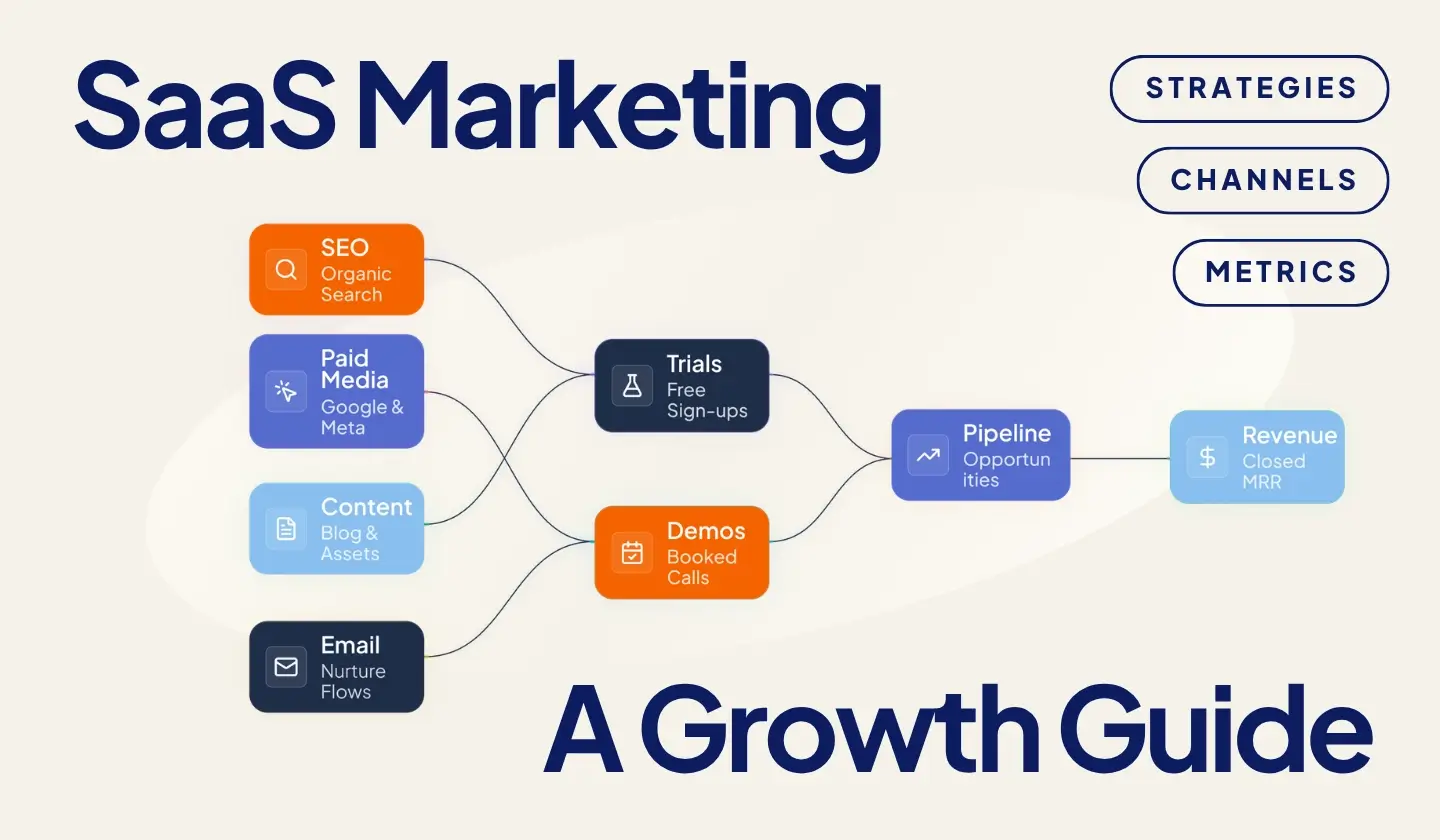
- Different jobs require different channels. SaaS companies need SEO to attract demand, content to inform, paid media to accelerate, lifecycle email to activate, and customer marketing to retain.
- SaaS marketing success is not just about vanity metrics but about pipeline quality, client acquisition efficiency, activation, churn, and expansion revenue.
A SaaS team can publish content, run ads, send emails, and still struggle to turn attention into qualified demos, free trials, and revenue. The problem is typically not the absence of marketing activities. It’s because the strategy is out of sync with the buyer journey, product experience, sales process, and retention goals.
SaaS marketing is the process of obtaining, converting, maintaining, and growing clients for a software as a service business. It generates demand, builds pipeline, improves activation, reduces churn, and grows recurring revenue using channels such as SEO, content marketing, paid media, email, product-led growth, lifecycle marketing, and customer marketing.
A strong SaaS marketing strategy helps companies understand and improve:
- What channels attract qualified buyers
- Which campaigns drive leads, trials, and demonstrations
- What material do prospects see before they convert?
- Which touchpoints help sales talks
- What lifecycle campaigns drive product adoption
- Improved customer retention marketing efforts
- Pipeline, ARR, and revenue-generating operations
It’s not about getting more traffic or more leads. What you really want is a predictable system that brings in the right consumers, helps them understand your offer, and drives them to a clear commercial consequence.
For example, a B2B SaaS company might employ SEO to drive problem-aware buyers, sponsored search to acquire demo-ready demand, lifecycle emails to activate trial users, and customer marketing to boost renewals. These actions combine into a continuous growth system, not isolated campaigns.
Why SaaS Marketing Is Different From Traditional Marketing
SaaS providers don’t just sell a product and leave you alone. They sell recurring access to software; therefore, marketing needs to promote acquisition pre-sale and retention post-sale. This makes the strategy more sophisticated than typical marketing.
In B2B SaaS, the buyer journey is generally protracted, complicated, and impacted by several people. A prospect might read a blog article, check out alternatives, go to a webinar, click on a retargeting ad, speak to sales, go into a trial, and then chat to finance or operations before becoming a customer.
This is where B2B SaaS marketing differs from B2C.
B2B SaaS Marketing vs B2C SaaS Marketing
SaaS marketing looks different depending on whether the product is sold to businesses, teams, or individual users.
| Factor | B2B SaaS Marketing | B2C SaaS Marketing |
| Buyer | Teams, companies, buying committees | Individual users |
| Sales cycle | Longer and more complex | Usually shorter |
| Conversion path | Demo, sales call, trial, procurement | Signup, free trial, freemium, upgrade |
| Content needs | Case studies, comparisons, ROI, security, integrations | Product benefits, reviews, ease of use |
| Metrics | SQLs, pipeline, CAC, LTV, retention | Signups, activation, paid conversion, churn |
The SaaS Marketing Funnel
The SaaS marketing funnel shows how buyers move from first discovering a product to becoming customers and expanding over time. A good funnel does not stop at acquisition. It also supports activation, retention, and expansion because those stages directly affect MRR, ARR, CAC payback, and long-term growth.
| Funnel Stage | Goal | Common SaaS Marketing Activities | Primary Metric |
| Awareness | Build visibility | SEO, thought leadership, social content | Branded search, organic traffic |
| Acquisition | Capture demand | Landing pages, paid search, lead magnets | Demo requests, trial signups |
| Activation | Help users experience value | Onboarding emails, product education | Activation rate |
| Conversion | Turn users into customers | Case studies, sales enablement | Trial-to-paid conversion |
| Retention | Reduce churn | Lifecycle emails, webinars | Retention, churn |
| Expansion | Grow customer revenue | Upsell campaigns, product updates | Expansion revenue |
A SaaS company that only focuses on the top of the funnel may get more visitors but still struggle with revenue. A company that supports every stage can turn traffic into qualified opportunities, users into active customers, and customers into expansion revenue.
Use this funnel to analyze where growth is falling apart. If traffic is up but demonstrations aren’t, the problem may be acquisition to conversion. If trials are expanding, but paid customers are not, then the issue may be activation or onboarding. If customers leave quickly, the issue may be retention, not acquisition.
Best SaaS Marketing Strategies
The best SaaS marketing strategies depend on the company’s stage, ICP, pricing model, ACV, sales cycle, and go-to-market motion. An early-stage SaaS company needs clarity and customer learning, while a scaling B2B SaaS company needs stronger demand generation, attribution, sales enablement, and revenue reporting.
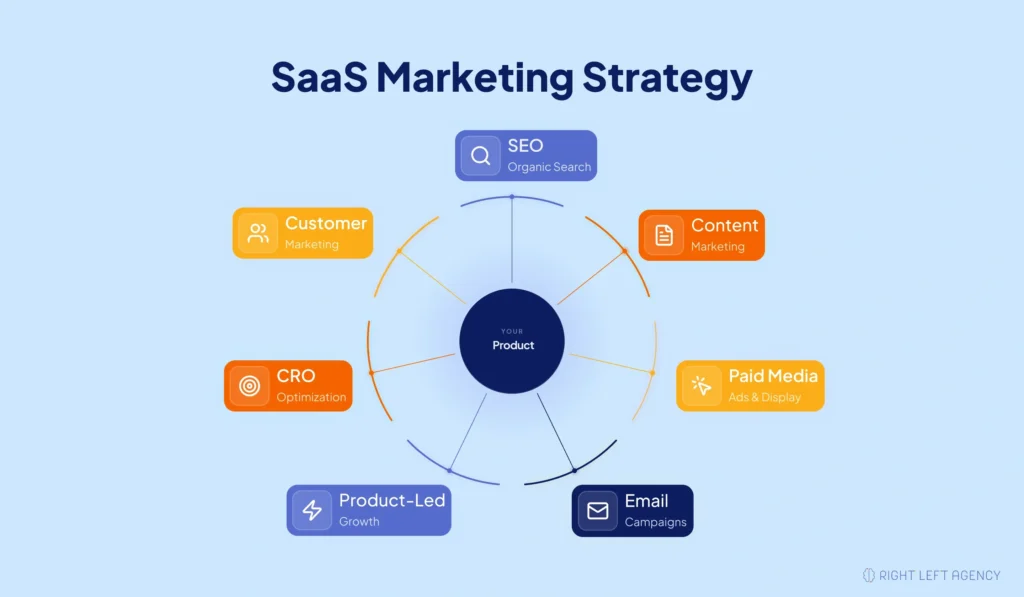
1. SaaS SEO
SaaS SEO helps software companies rank for high-intent searches and create organic visibility over time. This is particularly important as SaaS purchasers generally investigate problems, compare tools, seek out other options and use cases before speaking to sales.
A good SaaS SEO plan should include informative blog content, use case pages, comparison pages, integration pages, alternative pages, price and support content, and bottom-funnel pages. SaaS firms need to do more than target generic keywords; they should focus on buyer-intent themes that correlate to demos, trials, and qualifying pipeline.
For example, a project management SaaS shouldn’t only target “project management tips.” It should also target terms such as “best project management software for agencies,” “Asana alternatives,” “project management tool for construction teams,” and “how to track project profitability.” These searches show a higher buying intent.
2. SaaS Content Marketing
SaaS content marketing educates customers, builds trust, boosts demand development, and helps sales teams answer common objections. It works best when material is linked to the product positioning, customer pain points, and funnel stage.
Blogs, tutorials, templates, case studies, product-led articles, comparison pages, webinars, reports, and sales enablement assets are all good SaaS content. The aim here is not to provide more stuff. The goal is to provide content that helps the right buyer comprehend the problem, evaluate the solution, and take the next step.
Good content should also help sales interactions. ROI can be shown via a case study. A comparison page can assist a buyer in deciding between tools. A use case page might demonstrate how the solution helps to solve a certain workflow problem.
3. Paid Media
Paid media helps SaaS companies grab demand faster than organic channels alone. Google Ads may target buyers actively seeking a solution, while LinkedIn Ads can reach decision-makers by job title, organization size, industry, or account list.
But paid media for SaaS should not be measured on impressions, clicks, or even CPL. Those metrics can look great while pipeline remains anemic. Better SaaS paid media reporting should measure SQLs, opportunities, pipeline generated, CAC, and affected revenue.
If your paid campaigns are generating cheap leads but not many qualifying chances, assess your overall B2B SaaS lead generation strategy before increasing spend.
4. Product-Led Growth
Product-led growth relies on the product experience to attract, activate, and convert consumers. This strategy generally involves free trials, freemium plans, onboarding routines, in-product prompts, templates, and usage-based upgrade pathways.
Product-led SaaS organizations require marketing to be well aligned with product and lifecycle teams. It should also generate signups. It should help users get to the “aha moment” faster, boost activation, and discover product-qualified leads for sales or expansion.
These product-led metrics are: signup-to-activation rate, feature uptake, trial-to-paid conversion rate, product-qualified leads, and expansion revenue.
5. Email and Lifecycle Marketing
Email marketing and lifecycle marketing can help SaaS organizations convert leads, onboard trial users, educate customers, and prevent churn. This is key as many SaaS purchasers aren’t ready to convert in one visit.
Lifecycle campaigns include welcome emails, onboarding sequences, product education emails, trial reminder emails, case study emails, reactivation campaigns, and expansion campaigns. These touchpoints keep purchasers and users involved throughout a longer journey.
Strong lifecycle system to support acquisition and retention. It helps prospects go towards demos or trials and helps consumers continue to perceive value once they sign up.
6. Conversion Rate Optimization
Conversion rate optimization allows SaaS companies to convert more of their existing visitors into demos, trials, SQLs, and customers. Why is this important? Because more traffic does not mean more revenue.
SaaS CRO should focus on landing pages, pricing pages, demo pages, forms, CTAs, onboarding processes, and product signup experiences. Small modifications in messaging, proof, form length, site structure, or CTA clarity can enhance the whole funnel.
Say, a demo page with ambiguous copy and no social proof might get hits, but not convert. A stronger page should clearly communicate who the product is for, what problem it solves, what results purchasers can expect, and why they should trust the company.
7. Customer Marketing
Customer marketing is about current customers. This is often forgotten, but for SaaS it is vital as retention and expansion have a direct impact on long-term revenue.
Customer marketing can help with onboarding, product uptake, customer education, upsells, referrals, reviews, testimonials, and advocacy. It allows the client to get more value out of the product and gives the corporation more opportunity to grow LTV.
A SaaS company that does customer marketing right can reduce attrition, improve expansion revenue, and provide additional proof points for future acquisition initiatives.
SaaS Marketing Channels: Which Ones Should You Use?
SaaS companies should not try to use every marketing channel at once. The right mix depends on the audience, budget, ACV, sales cycle, product complexity, growth stage, and whether the company is sales-led or product-led.
| Channel | Best For | SaaS Use Case | Limitation |
|---|---|---|---|
| SEO | Compounding organic growth | Capture high-intent searches | Takes time to build results |
| Content Marketing | Buyer education | Explain problems, use cases, and solutions | Needs strong strategy |
| Paid Search | Capturing existing demand | Demo and pricing intent keywords | Can increase CAC if unmanaged |
| LinkedIn Ads | B2B targeting | Reach decision-makers and buying committees | Often expensive |
| Email Marketing | Nurture and retention | Convert leads and onboard users | Requires segmentation |
| Webinars | Education and trust | Engage mid-funnel and enterprise buyers | Needs promotion and follow-up |
| Review Sites | Commercial investigation | Build trust and capture comparison traffic | Competitive environment |
| Partnerships | Expansion and reach | Integration marketing and co-marketing | Takes time to build |
A low-ACV product-led SaaS company might focus on SEO, onboarding, lifecycle mailings, and product referrals. For a high-ACV B2B SaaS company, you may need LinkedIn Ads, webinars, case studies, ABM, and sales enablement because the sales cycle is longer and trust is more important.
The best channel isn’t usually the one with the most traffic. The best channel is the one that brings in the right buyer, supports the right funnel stage, and drives qualified pipeline or retention.
How to Build a SaaS Marketing Plan
A SaaS marketing plan should connect strategy, positioning, channels, content, conversion paths, lifecycle campaigns, and measurement. Without a plan, teams often create random content, launch disconnected campaigns, and struggle to understand what is actually working.
| Timeline | Focus | Actions |
| Days 1–30 | Foundation | Define ICP, audit channels, clarify positioning, map funnel |
| Days 31–60 | Build | Create BOFU pages, improve landing pages, set up nurture, launch paid tests |
| Days 61–90 | Optimize | Review SQLs, pipeline, CAC, activation, and conversion paths |
1. Define your ICP
Understand your desired customer profile. Company size, Industry pain points, Buying role, Budget Urgency, Current workflow. Why are you switching?
2. Clarify your positioning
Explain what the product does, who it helps, what problem it solves, and why it’s different from alternatives. Strong positioning makes every campaign easier to understand.
3. Map the SaaS buyer journey
Identify what buyers need at awareness, consideration, decision, activation, retention, and expansion stages. Each stage should have specific content, offers, and CTAs.
4. Choose the right channels
Select channels based on audience behavior, ACV, sales cycle, budget, and company stage. An enterprise SaaS company may need LinkedIn, webinars, and ABM, while a product-led SaaS company may focus more on SEO, onboarding, and lifecycle campaigns.
5. Create content for each funnel stage
Build educational content, use case pages, comparison pages, case studies, product pages, webinars, email sequences, and sales enablement assets. Each content type should have a clear role.
6. Build clear conversion paths
Create specific CTAs for demo requests, free trials, webinar signups, contact forms, and newsletter subscriptions. Make the next step obvious and relevant to the buyer’s stage.
7. Measure pipeline, CAC, and retention
Track traffic and leads, but also results. A good reporting system should link marketing to MQLs, SQLs, opportunities, pipeline, CAC, LTV, churn, and revenue.
A growth-stage B2B SaaS startup, for instance, may design a 90-day plan around three priorities: strengthen ICP messaging, establish bottom-funnel SEO pages, and test paid search campaigns related to demo requests. It shouldn’t be “more marketing activity.” It should be “more qualified sales interactions and improved pipeline visibility.”
SaaS Marketing Metrics Teams Should Track
SaaS teams should not measure marketing success only by impressions, clicks, traffic, or lead volume. Those numbers matter, but they do not show whether marketing is creating qualified pipeline, efficient acquisition, or long-term revenue.
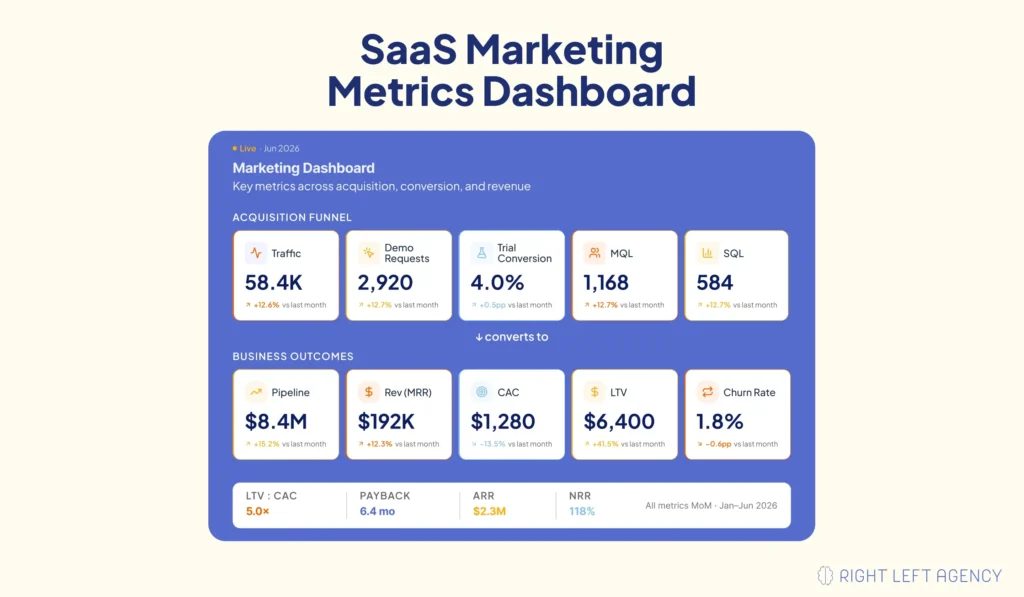
| Metric | Why It Matters | What to Do With It |
| Website traffic | Shows visibility and demand growth | Segment by source, funnel stage, and ICP fit |
| Demo request rate | Measures high-intent conversion | Review which pages and campaigns drive demos |
| MQL-to-SQL rate | Measures lead quality | Improve targeting, scoring, and qualification |
| Pipeline generated | Connects marketing to revenue potential | Prioritize channels that create real opportunities |
| CAC | Shows acquisition efficiency | Compare CAC by channel and customer segment |
| Churn rate | Shows retention health | Improve onboarding, lifecycle emails, and customer education |
| Expansion revenue | Shows growth from existing customers | Build customer marketing and upsell campaigns |
A good SaaS dashboard should have both leading and lagging indicators. Traffic and conversion rates are early indicators, whereas pipeline, CAC, retention, and revenue are indicators of whether marketing is helping the organization expand sustainably.
Traffic, conversion rate, and demo requests are the main indicators. Pipeline, CAC, CAC payback, churn, and expansion revenue are business metrics. SaaS teams require both.
Early measurements reveal movement, and revenue metrics prove if marketing builds sustainable growth. For a deeper understanding of revenue measurement, see SaaS marketing ROI.
SaaS Marketing for Different Growth Stages
Marketing priorities for SaaS companies vary at different phases of the company. If you’re a startup seeking to discover message-market fit, you shouldn’t imitate the playbook of an enterprise SaaS company with a full revenue staff.
- Early Stage SaaS: Focus on ICP clarity, positioning, customer interviews, founder-led content, SEO foundations, and initial customer acquisition.
- Growth-stage SaaS: Focus on demand gen, content scaling, paid media testing, conversion optimization, CRM reporting, and lifecycle marketing.
- B2B SaaS (sales-led): Focus on ABM, LinkedIn ads, webinars, sales enablement, case studies, and pipeline attribution.
- Product-led SaaS: Focus on free trial conversion, onboarding, product analytics, activation, lifecycle emails, and product qualified leads.
- Enterprise SaaS: Focus on building trust, establishing thought leadership, account-based marketing, review presence, case studies, sales enablement, and long-cycle nurture.
The trick is matching strategy to the business model. In general, a low-ACV self-serve SaaS offering needs efficient acquisition and high activation. A high-ACV enterprise SaaS solution often requires trust-building, many touchpoints, sales enablement, and lengthier nurture.
Common SaaS Marketing Mistakes to Avoid
Many SaaS startups fail because they conflate activity with progress. More content, more money on ads, more leads generated – they won’t automatically lead to growth if you don’t have a strategy that’s related to the correct buyer and the right revenue KPIs.
SaaS marketing blunders to stay away from:
- Targeting broad keywords lacking buyer intent
- Measuring only traffic
- Making content without precise product positioning
- Running paid ads without tracking conversions
- Optimizing for CPL instead of CAC and revenue
- Neglecting onboarding and retention
- Treating all leads equally
- Failing to align sales and marketing
- Disregarding client feedback
- Scaling channels before validating message-market fit
One of the biggest misconceptions is approaching marketing as a top-of-funnel-only activity. In SaaS, marketing needs to support the entire journey, from first touch to renewal and expansion.
Sales alignment is important too. Pipeline quality suffers when marketing defines a qualified lead one way and sales defines it another way.
How SaaS Marketing Supports Pipeline and Revenue
SaaS leaders care about growth outcomes, not just marketing activities. A campaign may look good on the ad dashboard, but if it’s not generating SQLs, opportunities, retention, or revenue, it’s not really helping the business.
A SaaS team can’t enhance what they can’t measure. That’s where pipeline reporting, CRM hygiene, attribution, and sales feedback need to be included in the marketing system, not separate reporting exercises.
It helps to increase revenues by:
- Attracting high-fit buyers
- Educating prospects before sales calls
- More demo and trial conversions
- Enhanced MQL to SQL quality
- Content and case studies for sales enablement
- Reducing CAC with better targeting
- Lifecycle marketing to increase retention
- Increasing revenue via consumer marketing
SaaS teams need to know which channels and touchpoints are influencing the pipeline, not simply which campaign caused the previous click.
Read SaaS marketing attribution to learn more about this.
Final Thoughts
SaaS marketing works best when regarded as a connected growth system, not a series of separate efforts. The best SaaS teams combine positioning, SEO, content, paid media, lifecycle marketing, sales enablement, and customer marketing with one main objective: turning the right buyers into retained, profitable customers.
If you’re creating activity but not enough qualified pipeline with your SaaS marketing, start with an audit of your ICP, channels, conversion paths, CRM reporting, and lifecycle campaigns. That will tell you if your next step is better positioning, stronger demand capture, better nurture, CRO, or professional help.
Right Left Agency is here for all the solutions.
Frequently Asked Questions
What is SaaS Marketing?
SaaS Marketing is the process of attracting, converting, retaining, and expanding customers for a software-as-a-service company. It uses channels like SEO, content marketing, paid media, email marketing, lifecycle marketing, and customer marketing to create awareness, generate leads, drive demos or trials, support product adoption, and grow recurring revenue.
Why is SaaS marketing different from traditional marketing?
SaaS marketing is different because SaaS companies depend on recurring revenue, product adoption, retention, and long-term customer value. Traditional marketing often focuses on one-time purchases, while SaaS marketing must support acquisition, onboarding, renewals, expansion, and churn reduction. This makes metrics like CAC, LTV, churn, ARR, and CAC payback more important.
What are the best SaaS marketing strategies?
The best SaaS marketing strategies include SaaS SEO, content marketing, paid media, product-led growth, email marketing, conversion rate optimization, and customer marketing. The right mix depends on the company’s ICP, ACV, sales cycle, growth stage, and whether the business is sales-led or product-led.
What are the most important SaaS marketing metrics?
The most important SaaS marketing metrics include demo request rate, free trial conversion rate, MQL-to-SQL rate, SQL-to-opportunity rate, pipeline generated, CAC, CAC payback, LTV, churn rate, expansion revenue, and marketing ROI. These metrics help teams understand whether marketing is creating qualified growth, not just traffic or leads.
How do SaaS companies generate leads?
SaaS companies generate leads through SEO, content marketing, paid search, LinkedIn ads, webinars, comparison pages, review platforms, partnerships, lead magnets, and email nurture campaigns. The strongest lead generation systems focus on buyer intent, ICP fit, and pipeline quality.
Is SEO important for SaaS companies?
Yes, SEO is important for SaaS companies because buyers often search before they speak with sales. They look for solutions, alternatives, comparisons, integrations, use cases, pricing information, and educational content. A strong SaaS SEO strategy helps capture demand, build trust, reduce reliance on paid acquisition, and create compounding organic growth over time.