Key Takeaways
- Construction SaaS adoption fails when field users don’t see daily value.
- Software must fit real jobsite workflows, devices, connectivity, and conditions.
- Field users should influence software selection, demos, and rollout decisions.
- Ongoing training and clear ownership are essential after go-live.
- Adoption should be measured through usage, workflow completion, and workarounds.
If you market or sell construction software, you’ve probably heard some version of this after a deal closes: the contract is signed, the rollout is scheduled, and three months later a foreman is back on WhatsApp and a superintendent is still keeping a paper log on the dash of his truck. Nobody churned. Nobody complained. The software just quietly stopped being used where the work actually happens.
That gap — between “purchased” and “actually running the jobsite” — is where most Construction SaaS growth problems start. And while it usually lands on Customer Success or Product to explain, a meaningful piece of it starts earlier, in how the product gets sold, demoed, and onboarded in the first place.
Construction SaaS Doesn’t Fail at Purchase — It Fails in Daily Use
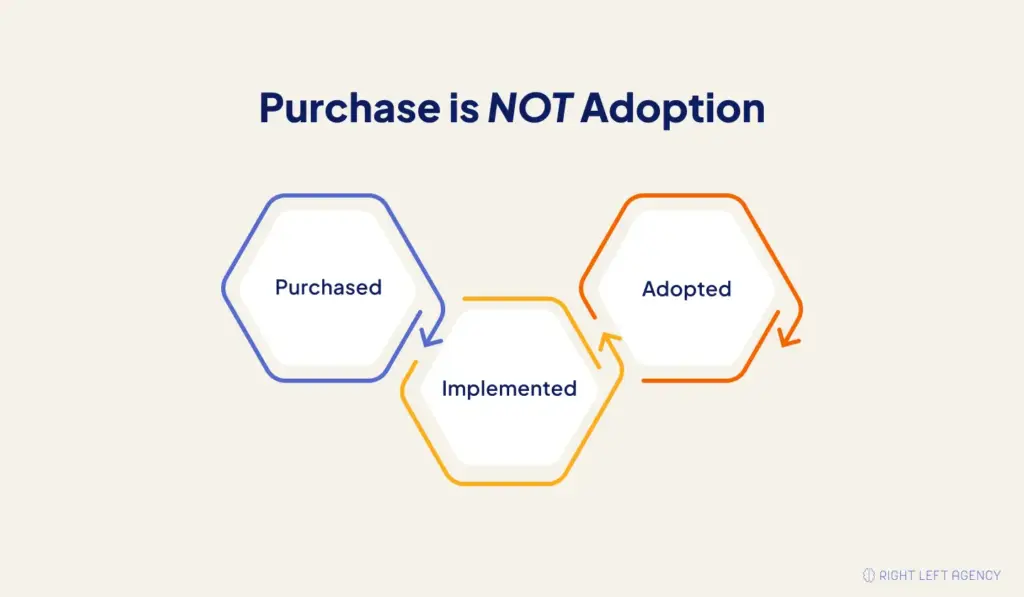
Purchasing, implementing, and adopting construction software are three different events, and treating them as one is the root of most construction software adoption problems. Purchase is a signature from the buying committee. Implementation is configuration, data migration, and a training session. Adoption is what happens after that — whether the people entering data in the field keep doing it, unprompted, once the rollout team moves on to the next account.
A completed rollout doesn’t guarantee any of that. It guarantees the software works and someone was shown how to use it once. Construction SaaS adoption tends to fail when the product fits what the buying committee needed to see in a demo better than it fits what the person on the jobsite needs to get through a Tuesday — a mismatch that shows up weeks after go-live, not during it.
This is also the pattern behind RLA’s approach to ConTech and construction SaaS marketing: the companies with the steadiest field adoption tend to be the ones that treat go-to-market and rollout as one connected system, not two handoffs.
Why Construction SaaS Adoption Fails
The easiest explanation — “construction workers resist technology” — is also the least useful one, and it’s worth rejecting before going further. Field crews adopt tools constantly: phones, WhatsApp, project photos, GPS on equipment. What they resist is software that costs them more time than it gives back. The seven patterns below are the actual mechanisms behind most construction software adoption failures.
The Software Was Built for Management, Not the Field
Most Construction SaaS platforms are demoed around dashboards, reporting, and executive visibility — because that’s what closes the deal with the buying committee. But the person generating that dashboard data is a foreman or superintendent who never sees the dashboard. When the value of a tool accrues almost entirely to the executive who bought it and barely at all to the person entering the data, the entering stops the moment nobody’s watching.
Common Jobsite Tasks Take Too Many Steps
A daily log or material request that takes six taps and two screens loses to a WhatsApp message every time, especially mid-shift with gloves on and a foreman waiting on an answer. Adoption isn’t a training problem if the underlying task is simply slower in the new system than in the old workaround.
The Product Doesn’t Match Real Jobsite Conditions
Offline functionality, glove-compatible touch targets, screen visibility in direct sunlight, and battery life aren’t edge cases for construction software — they’re baseline requirements. A platform that assumes reliable connectivity and a clean office environment will lose to paper on a site with patchy signal, regardless of how strong the feature set is.
The New System Creates More Work Than the Old One
When a new platform doesn’t integrate with the ERP, accounting, or scheduling tools already in use, field staff end up entering the same information twice — once in the new system, once in whatever actually drives payroll or billing. Duplicate entry is one of the clearest signals that a tool has added a step rather than removed one, and WhatsApp and Excel remain the real competitive bar for construction crews, not another SaaS platform.
The Wrong People Chose the Software
When evaluation and demos happen only with executives, the people who’ll use the tool daily — foremen, superintendents — get a finished decision instead of a voice in it. Software chosen without field input tends to solve the problems visible from the office, not the ones visible from the jobsite.
Training Was Treated as a Launch Event
A single onboarding session at go-live doesn’t hold up against jobsite turnover, subcontractor rotation, and the reality that most people forget an unused workflow within weeks. Adoption needs role-specific, ongoing reinforcement — not a one-time walkthrough that assumes everyone trained on day one is still on the crew at day ninety.
Nobody Owns Adoption After Go-Live
This is the pattern that most separates ConTech companies with strong retention from ones without it. Once implementation wraps, there’s often no named executive sponsor, internal champion, or CS owner accountable for whether field usage actually holds. And it’s rarely framed as something marketing has a hand in — even though pre-sale messaging and post-sale content both shape whether the field ever buys in. Billd’s approach to educating subcontractors rather than just selling to them is a useful reference point for what ownership of the “after the sale” story can look like in construction fintech and ConTech alike.
The Jobsite Adoption Failure Framework
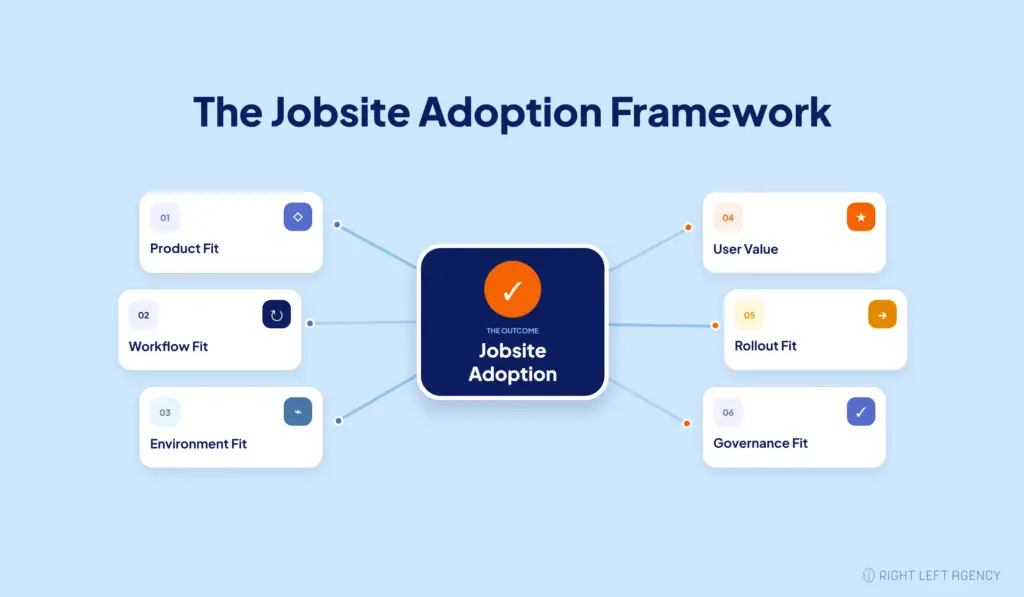
The seven causes above cluster into six layers. Naming them gives ConTech teams a shared diagnostic language instead of a list of loosely related symptoms:
- Product Fit — Does it solve a real operational problem for the person using it, not just the person who bought it?
- Workflow Fit — Does it make a jobsite task faster, or does it add steps?
- Environment Fit — Does it work under real jobsite conditions — offline, gloved, in the sun?
- User Value — Does the person entering data get anything back for entering it?
- Rollout Fit — Were the right users trained, and trained on an ongoing basis?
- Governance Fit — Are integrations, data ownership, and adoption metrics actually defined and owned?
A useful way to apply this framework is diagnosing the symptom first, then asking whether it traces to a product problem or a rollout problem:
| Symptom | Likely Product Problem | Likely Rollout Problem |
|---|---|---|
| Workers never start using the app | Poor field UX, no clear value to the user | Field team wasn’t involved in selection or trained well |
| Team keeps reverting to WhatsApp | Task takes too many steps in-platform | No enforced workflow standard, no accountability |
| High support ticket volume | Confusing or unintuitive workflows | Training ended at go-live, no reinforcement |
| Duplicate data entry across tools | Missing integrations with ERP/accounting | No governance owner for the data flow |
Most adoption failures aren’t purely one or the other — they’re a Rollout Fit problem masking a Product Fit problem, or vice versa. The framework’s value is forcing that distinction before assigning blame.
How to Tell Where Adoption Is Breaking
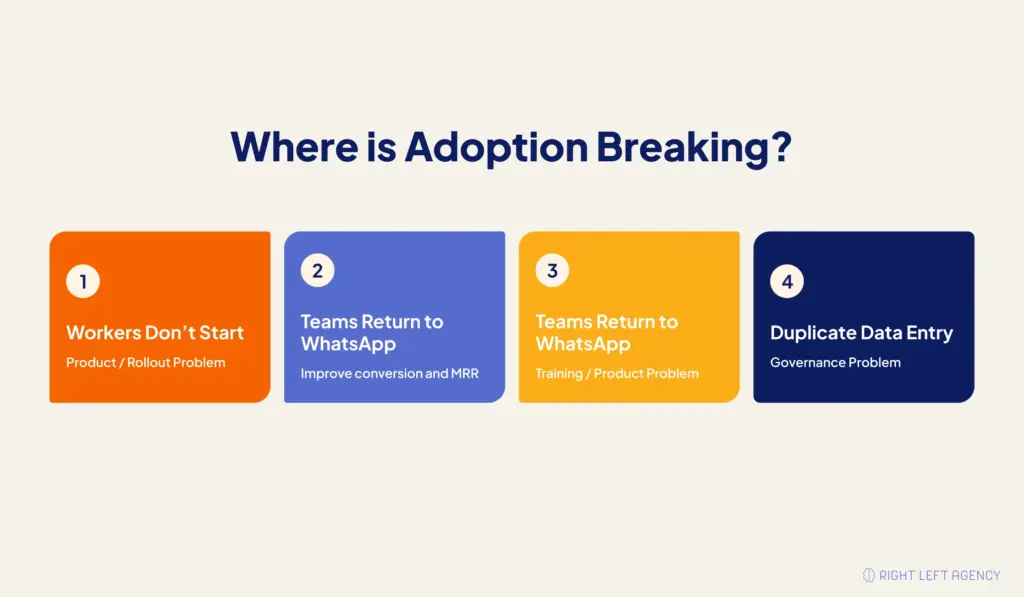
Check usage by role. Adoption gaps are rarely uniform — a superintendent might be fully engaged while foremen and subs barely open the app. Role-level usage data points straight to which layer of the framework is failing.
Measure workflow completion. What percentage of daily logs, RFIs, or material requests are actually finished inside the platform, versus started and abandoned? Low completion rates usually mean a Workflow Fit problem.
Measure time required for common tasks. If a task takes noticeably longer in the platform than the workaround it replaced, that’s a direct, measurable friction signal — not a training gap.
Track workarounds. A rising rate of WhatsApp messages, texted photos, or paper logs running alongside the “official” system is one of the clearest early-warning signs available, and it’s almost always visible before churn conversations start.
Watch support and training dependency. A high volume of repeat support tickets or re-training requests for the same workflow points to Rollout Fit or Product Fit issues, not a one-off user error.
Look for duplicate data entry. If field staff is entering the same information in two systems, that’s a Governance Fit failure — the integrations or data ownership were never resolved.
The Metrics That Actually Show Construction SaaS Adoption
| Metric | What It Reveals |
|---|---|
| Weekly active users, by role | Whether adoption is uniform or concentrated in the office |
| Workflow completion rate | Whether tasks are finished in-platform or abandoned |
| Time per common task | Friction relative to the old workaround |
| WhatsApp/Excel workaround rate | Whether the “unofficial” system is still doing the real work |
| 30/60/90-day retention | Whether early usage becomes a habit or fades |
| Duplicate-entry rate | Integration and governance gaps |
| Support ticket dependency | Whether the workflow itself is the problem, not user error |
What Construction SaaS Vendors Should Change
This is where marketing and growth teams have more influence than they’re usually credited with. Field adoption isn’t purely a product or CS outcome — it’s shaped by what gets promised in the sales process and reinforced (or not) after the deal closes.
Design around field workflows. Build messaging, demos, and onboarding sequences around the actual daily tasks a foreman or superintendent performs, not just the reporting layer executives see.
Give field users immediate value. If the app doesn’t return something useful to the person entering data — a faster material request, a clearer schedule — in the first session, adoption is already at risk.
Demo real tasks, not dashboards. This is the single highest-leverage change available. A ConTech sales process that only shows reporting and executive visibility sells the buying committee but tells the field nothing about why the tool is worth using. Demoing fewer taps on a material request or a faster daily log — during the sales process itself, not just in onboarding — sets accurate expectations for the people who’ll actually run the software.
Pilot before company-wide rollout. A contained pilot with a defined success bar surfaces Workflow and Environment Fit problems before they scale across every crew and site.
Introduce one workflow at a time. Rolling out daily logs, RFIs, scheduling, and billing simultaneously overwhelms field users. Sequencing workflows gives each one a real chance to become habit before the next is layered on.
Build continuous training into the rollout. Treat onboarding as an ongoing content and enablement function — including refreshers for subcontractor turnover — rather than a single go-live event.
Instrument adoption from day one. Track the metrics above from the start of the rollout, not three months in when a renewal conversation is already at risk.
Make data portable. Field teams trust systems more when they know their data isn’t locked in — export and portability reduce a quiet source of resistance to full engagement.
Marketing’s role doesn’t end at the signature. A ConTech company that treats pre-sale messaging, sales enablement for the field champion, and post-sale adoption content as one connected system tends to see steadier NRR and shorter CAC payback than one that hands adoption entirely to CS once the contract closes — the same principle behind RLA’s broader construction SaaS marketing strategies.
If field adoption is the constraint on your growth numbers, Book a Growth Fit Call and get a ConTech Growth Plan built around where adoption is actually breaking down.
What Good Adoption Looks Like After 30, 60, and 90 Days
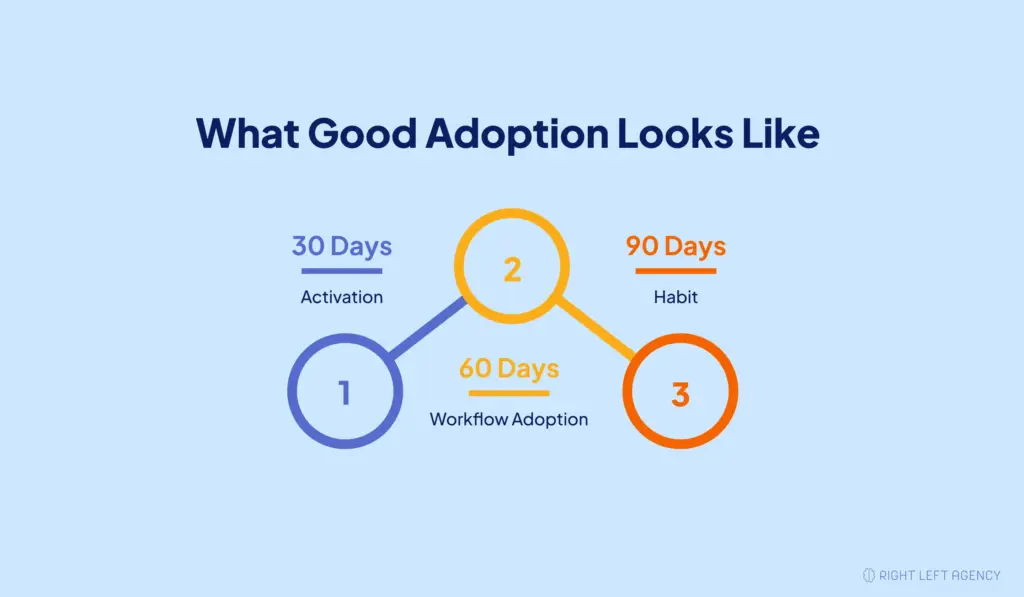
By 30 days, initial habit formation should be visible — the target user group is opening the app regularly without prompting, even if usage is still shallow.
By 60 days, workflow completion should be climbing — daily logs, RFIs, or material requests are being finished in-platform rather than started and abandoned for a workaround.
By 90 days, usage should be embedded — retention holds without active reminders, and workaround channels like WhatsApp and paper logs have measurably declined rather than persisted alongside the platform.
Construction SaaS Adoption Checklist
Product Fit
- Does the tool solve a problem the field user actually has, not just the buying committee?
Workflow Fit
- Does each core task take fewer steps than the workaround it replaces?
Environment Fit
- Does it work offline, with gloves, and in direct sunlight on an active site?
Rollout Fit
- Were field users — not just executives — involved in the evaluation and trained on an ongoing basis?
Governance Fit
- Is there a named owner for adoption after go-live, and are integrations/data ownership resolved?
Metrics
- Are role-based usage, workflow completion, and workaround rate being tracked from day one?
Free 3-Minute Diagnostic
Not sure which layer is breaking first?
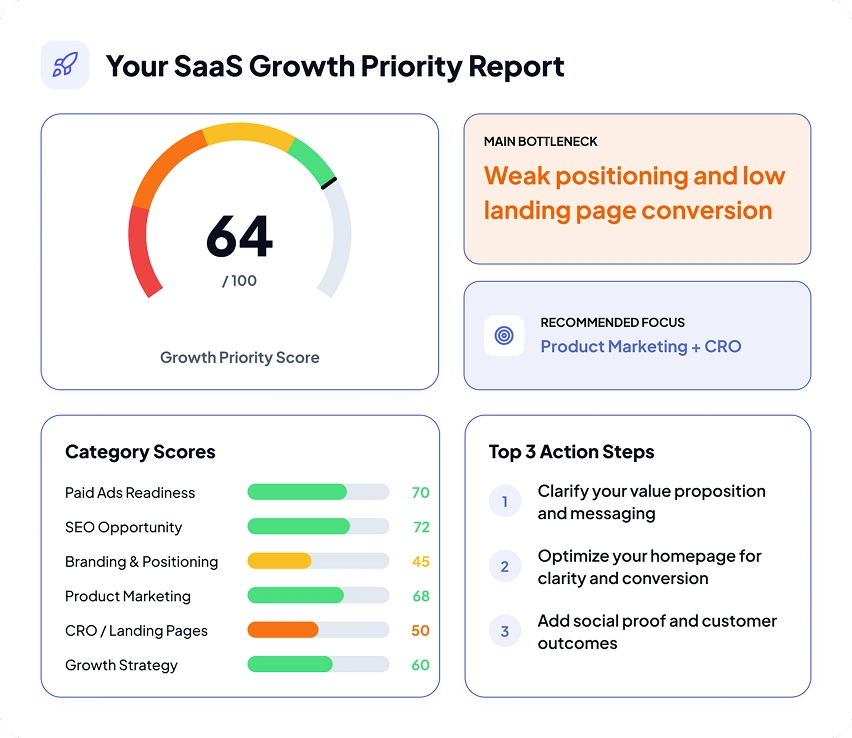
The SaaS Growth Priority Finder walks through a version of this same diagnostic for your broader growth stack.
Final Thoughts
Construction SaaS adoption does not fail because field crews are unwilling to use technology. It fails when the software creates more friction than the workflow it replaces.
Winning the contract is only the first step. Sustainable adoption depends on whether the product fits real jobsite conditions, makes everyday tasks easier, delivers clear value to field users, and is supported by continuous training and clear ownership after launch.
For ConTech SaaS companies, that means adoption cannot belong to Product or Customer Success alone. Marketing, sales, product, and CS need to align around the same field-user experience—from the first message and demo through onboarding and the first 90 days of usage.
The companies that close the gap between purchased and adopted will not only improve product usage. They will also build stronger retention, expansion, and more sustainable SaaS growth.
FAQ
Is jobsite adoption failure a marketing problem or a product problem?
Usually both, in different proportions. Product determines whether the tool fits the field; marketing and sales determine whether the field ever understood what the tool was for and how it would make their day easier.
How does poor field adoption show up in growth metrics like NRR and CAC payback?
Low field usage predicts churn and stalled expansion well before a renewal conversation happens, since a tool that isn’t embedded in daily workflows rarely survives a budget review.
What should ConTech marketing teams do differently to support field adoption?
Shift part of the sales and onboarding narrative toward the field user’s actual tasks — not just the executive dashboard — and treat post-sale content as part of the marketing function, not a hand-off to CS.
Why do construction crews resist new software even after leadership approves it?
Most of the time they aren’t resisting the technology itself — they’re rejecting a tool that’s slower than their existing workaround for the same task.
Should marketing be involved in onboarding and customer-success content?
Yes, where it touches messaging and reinforcement of value — marketing already understands how to communicate benefit clearly, which is exactly what sustained adoption content needs.