Key Takeaways
- SaaS trial conversion starts with attracting the right users, not more signups.
- Faster time-to-value helps users experience product value before they lose interest.
- Activation should measure meaningful outcomes, not just completed onboarding steps.
- Upgrade decisions improve when paid value is clear and tied to user behavior.
- Trial optimization requires improving acquisition, onboarding, conversion, and retention together.
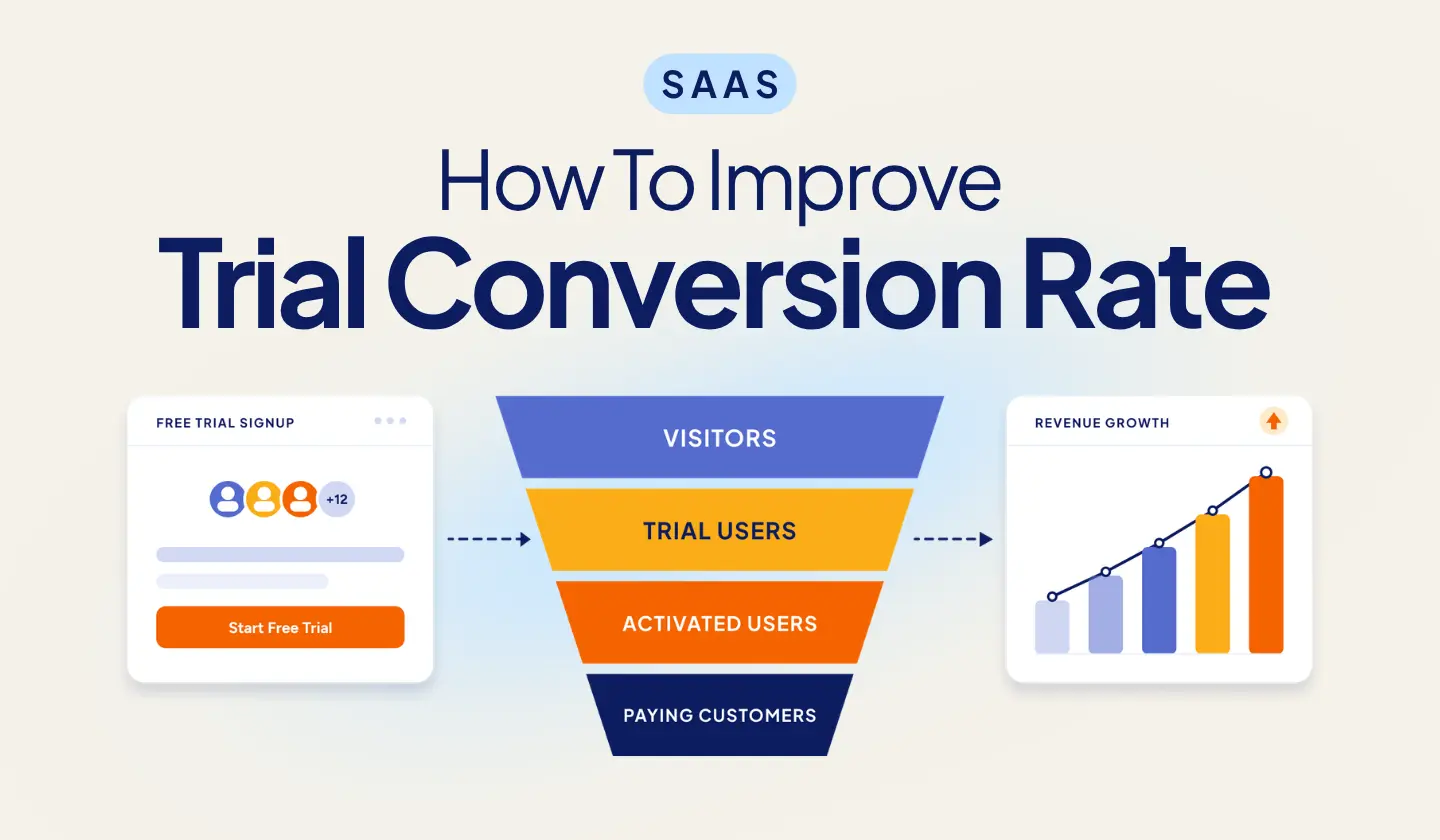
- SaaS trial conversion is a full-funnel problem involving acquisition quality, product experience, and revenue optimization.
SaaS companies often increase trial signups but fail to increase revenue because more people trying the product doesn’t mean more people reaching the moment where the product proves itself. The signup line goes up. The paid customer count doesn’t move. That gap is where most SaaS growth teams get stuck.
Improving SaaS free trial conversion rate requires improving every stage between signup and revenue: attracting the right users, helping them reach activation faster, delivering product value, and creating clear upgrade paths.
The instinct is to treat this as a marketing problem — run more ads, tweak the pricing page, add an exit-intent popup before the trial expires. Sometimes that helps. More often, it doesn’t, because trial conversion isn’t a single lever. It’s the output of everything that happens between the moment someone lands on your site and the moment they decide your product is worth paying for: who you’re attracting, how fast they reach value, and whether the product experience actually earns the upgrade.
This article breaks down why trials leak users at each stage and lays out a five-stage framework — Acquire, Activate, Deliver Value, Convert, Retain — for fixing the full trial-to-revenue funnel instead of patching the parts that are easiest to see.
What Is SaaS Free Trial Conversion Rate?
SaaS free trial conversion rate is the percentage of trial users who become paying customers. It’s the metric that tells you whether your trial is actually generating revenue, not just signups.
This distinction matters more than it sounds. Signup volume measures interest. Conversion rate measures whether that interest translates into paying customers. A SaaS company can double trial signups through paid acquisition and still see flat or declining revenue if the added volume comes from users who were never going to convert — the wrong audience, poor targeting, or curiosity clicks with no real intent to buy.
SaaS teams track this metric because it shows whether their acquisition, product experience, and value delivery are effectively moving users toward purchase.. Traffic and signup numbers can be manufactured with spend. Conversion rate can’t — it reflects whether the product, onboarding, and messaging actually deliver on what got someone to sign up in the first place.
How to Calculate SaaS Free Trial Conversion Rate
The standard formula:
Paid Customers From Trials ÷ Total Trial Users × 100
For example, if 500 people start a trial in a month and 40 convert to paid, the trial conversion rate is 8%. Some teams calculate this on a rolling cohort basis (all signups from a given month, tracked through their full trial window) rather than a fixed monthly snapshot, since trial length varies and a straight month-over-month count can understate or overstate the real rate depending on when users convert in the trial period.
Why Trial Conversion Rate Matters for SaaS Growth
Three reasons this metric sits at the center of SaaS growth planning:
- Revenue impact. Trial conversion rate directly multiplies every dollar spent on acquisition. Improving it from 3% to 6% doubles the revenue generated from the same traffic and ad spend, without acquiring a single additional visitor.
- Customer acquisition efficiency. A low conversion rate means CAC is effectively higher than it appears, because it’s being spread across fewer paying customers. Fixing conversion is often cheaper than fixing acquisition.
- Growth scalability. Acquisition spend can be increased almost indefinitely; a broken conversion funnel just multiplies the waste at scale. Fixing trial conversion is what makes scaling acquisition worthwhile in the first place.
Why SaaS Free Trial Users Don’t Convert
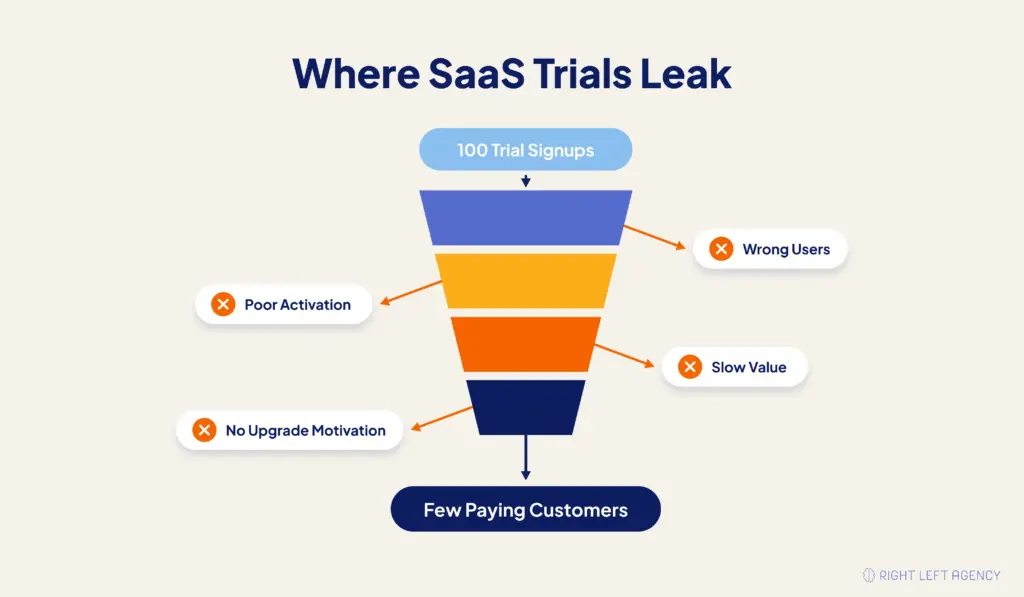
Most trial conversion problems trace back to one of three root causes: the wrong users are entering the trial, the right users never reach the product’s value moment, or the trial experience itself creates enough friction that users give up before either of the first two things has a chance to happen.
Wrong Users Enter the Trial
Not every signup was ever a real prospect. When acquisition is optimized for signup volume rather than qualified demand, trials fill up with people who don’t match the ideal customer profile (ICP) — the wrong company size, the wrong use case, or no real budget authority. No amount of onboarding polish converts a user who was never going to buy.
This usually traces back to paid acquisition strategy: broad-match keywords, vague ad copy that promises everything to everyone, or landing pages that don’t pre-qualify visitors before they sign up. The fix starts upstream, in SaaS PPC campaign targeting and landing page messaging — not in the trial itself.
Users Never Reach the Product Value Moment
Completing setup is not the same as experiencing value. A user can finish onboarding — connect an integration, fill out a profile, click through a tour — and still never see the outcome that would make them want to pay. Setup is administrative. Value is experiential.
This is the insight that separates well-converting trials from the rest: users convert after they experience the outcome the product promises, not after someone explains it to them. A product tour that describes a feature is not a substitute for the user actually using that feature to solve their own problem.
Trial Experience Creates Too Much Friction
Every additional step between signup and value is a chance for the user to leave. Common friction points:
- Long signup forms that ask for information the product doesn’t need yet
- Mandatory tutorials before users can touch the actual product
- Complex configuration required before any output is visible
- Empty dashboards with no data, no sample content, and no clear next action
Individually, none of these feel like dealbreakers. Together, they add up to a trial that asks for effort before it’s proven any value — which is backward from what actually converts.
The SaaS Trial Conversion Growth Framework
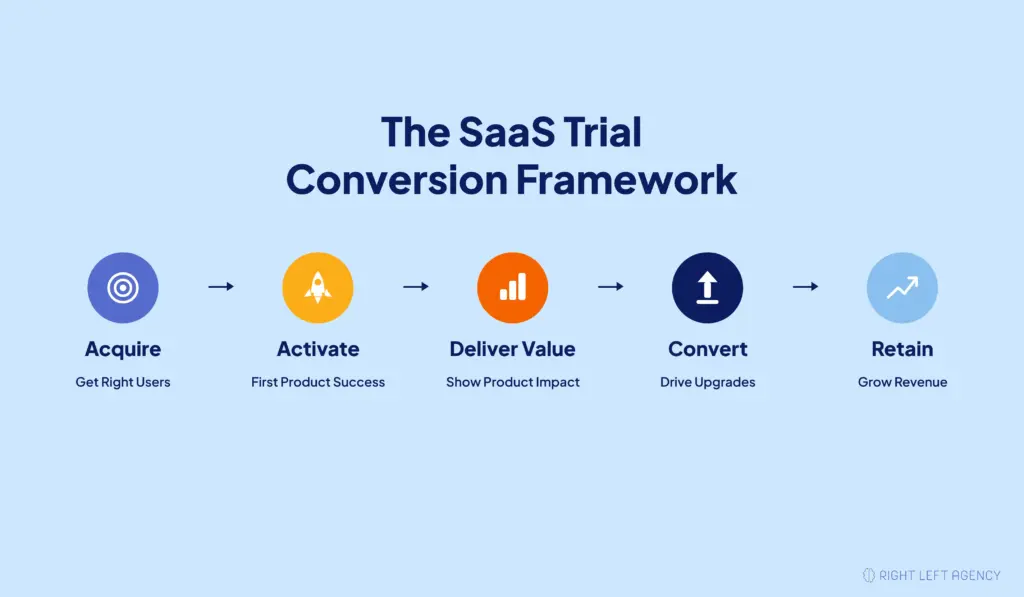
Fixing trial conversion means treating it as one connected funnel, not a set of isolated tactics. The framework below covers the full path from first touch to retained revenue:
Acquire → Activate → Deliver Value → Convert → Retain
Each stage compounds. A strong activation stage can’t fix a trial filled with the wrong users. A great conversion offer can’t save a trial where nobody reached value. The stages have to work in sequence.
Stage 1: Attract the Right Trial Users
Conversion problems often start before anyone signs up. If the acquisition strategy optimizes for the cheapest possible signup rather than the most qualified one, the entire downstream funnel is fighting an uphill battle.
Getting this stage right means:
- ICP targeting — building campaigns around the specific roles, company sizes, and use cases that historically convert, not broad category interest
- Intent-based campaigns — prioritizing keywords and channels that signal active buying intent over generic awareness terms
- Landing page messaging — matching the page’s promise precisely to what the product delivers, so expectations are calibrated before signup
- Qualification questions — using signup-flow questions (company size, use case, role) to route users into the right onboarding path, not just to collect data
Questions worth asking regularly: Are we attracting users who actually need this product, or users who clicked because the ad was compelling? Are campaigns being optimized for revenue per signup, or just signup volume?
Stage 2: Reduce Time-to-Value
Time-to-value is the amount of time required for a user to experience meaningful value from a SaaS product. This is the single highest-leverage lever in trial conversion, because it reflects the core insight from how trial users actually behave: they convert after experiencing an outcome, not after being told about one.
Reducing time-to-value means restructuring the trial around a first success milestone rather than a feature walkthrough:
| Traditional Trial | Optimized Trial |
|---|---|
| Watch tutorials | Complete first action |
| Configure settings | Use smart defaults |
| Learn features | Experience outcome |
Practical levers for cutting time-to-value:
- Faster first success milestone — identifying the single action that correlates most strongly with eventual conversion, and building the entire first session around getting users to it
- Guided setup — replacing open-ended configuration with a short, opinionated path to a working result
- Smart defaults — pre-filling settings with sensible defaults instead of asking users to configure everything before seeing output
- Templates — giving users a working example to modify instead of a blank canvas to build from scratch
Stage 3: Improve SaaS Activation
Activation rate is often measured as onboarding completion — but that measures whether a user finished a checklist, not whether they experienced the product’s value. Real activation should be defined by a genuine product milestone: the point at which a user has done something that reliably predicts they’ll continue using (and eventually pay for) the product.
What counts as an activation milestone varies by product category:
- A messaging tool’s activation moment might be a user’s first conversation
- A project management tool’s activation moment might be a user’s first completed project or task
- An analytics tool’s activation moment might be a user generating their first useful report
The common thread across categories: activation is defined by an action that produces a real result for the user, not by how many onboarding steps they clicked through.
Stage 4: Create Upgrade Motivation
Reaching activation doesn’t automatically create urgency to pay. Users need a clear, specific reason the paid tier is worth the cost — and that reason needs to show up at the right moment, not just at trial expiry.
This stage covers:
- Paid value communication — making the specific benefit of upgrading concrete (more usage, more seats, a feature the user has already bumped into a limit on) rather than abstract (“unlock premium features”)
- Upgrade timing — surfacing the upgrade prompt when the user is actively engaged and has just hit a real limitation, not on a fixed countdown regardless of behavior
- Feature comparison — showing plan differences in the context of what the user has actually used, not a generic pricing table
- ROI messaging — connecting the cost of upgrading to the business outcome the user has already started to see in the trial
Stage 5: Improve Retention Signals
Trial conversion isn’t the finish line — it’s the point where the relationship with a paying customer begins. Optimizing purely for the moment of conversion, without regard for whether the user actually adopts the product afterward, produces customers who churn quickly and erase the gains from a higher conversion rate.
This stage connects conversion to long-term revenue through:
- Product adoption tracked past the conversion moment, not just up to it
- Expansion opportunities — identifying converted customers who are good candidates for additional seats or higher tiers based on usage patterns
- Churn reduction — treating early post-conversion usage as a leading indicator, and intervening before disengagement becomes cancellation
Improve SaaS Onboarding Experience Without Overwhelming Users
Good onboarding isn’t more education — it’s less friction between signup and outcome. The instinct to teach every feature up front usually works against conversion, because it delays the moment a user experiences value in favor of the moment they understand the full product.
Avoid front-loading onboarding with:
- Feature-by-feature walkthroughs of the entire product
- Long, multi-step product tours before any real usage
- Excessive educational content before the user has done anything
Instead, build onboarding around:
- Personalized onboarding paths based on the qualification data collected at signup
- Progress indicators that show users how close they are to their first result
- Trigger-based emails sent based on actual behavior (or inactivity), not a fixed drip schedule
- In-app guidance that appears contextually, when it’s relevant to what the user is doing
Deliver One Important Outcome First
Users don’t sign up for a SaaS trial to explore a product. They sign up to solve one specific problem. Onboarding should be built around that single problem, not the product’s full feature set.
User Goal → One Action → First Result → Expansion
Everything else — the rest of the feature set, the advanced configuration, the secondary use cases — can wait until after the user has experienced the first result that brought them to the trial in the first place.
Use Templates and Sample Data to Create Faster Wins
Starting from a blank state adds setup work before any value is visible. Templates and sample data remove that step:
Project management example —
Before: Create workspace → Configure settings → Add team members → Build first project from scratch
After: Open a ready-made project → Complete the first task inside it
The second path gets a user to a real result in minutes instead of requiring them to build the entire environment before they can evaluate anything.
Align Trial Experience With Buyer Intent
Different roles enter the same trial for different reasons, and a single generic onboarding path underserves most of them. Personalizing the trial experience to what each role actually needs increases the odds that each one reaches their own version of value.
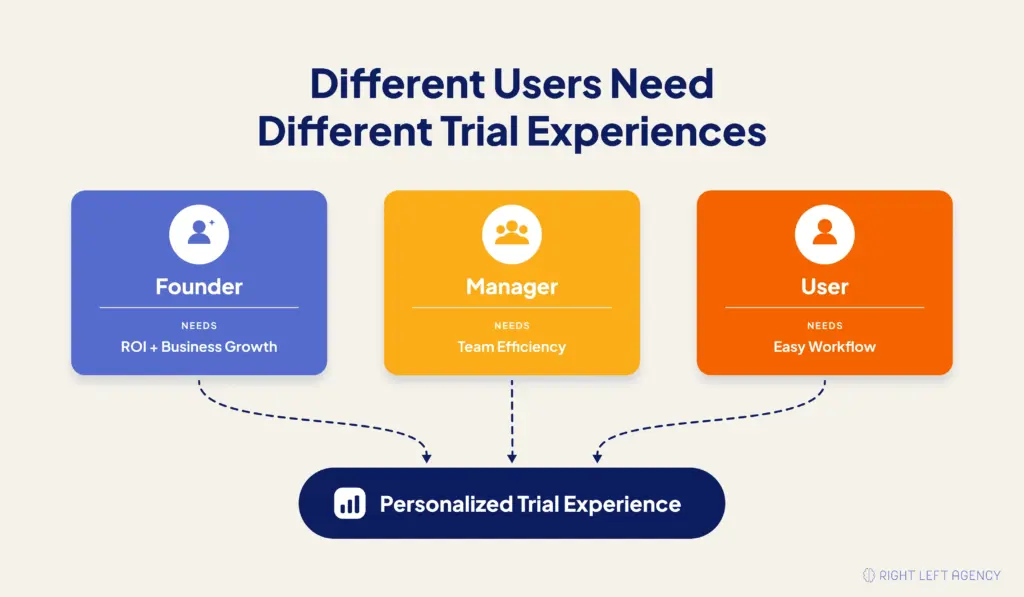
Founder Journey
Founders and business owners evaluating a SaaS product are usually looking for ROI and business impact — will this move a number they care about (revenue, cost, time saved at a business level) rather than a workflow detail.
Manager Journey
Managers evaluating a tool for their team are typically focused on workflow improvement — will this make their team’s process faster, clearer, or easier to manage, and will it be something their team will actually adopt?
Individual User Journey
Individual contributors using the trial directly care most about product usability — is this easy to use day-to-day, does it fit into how they already work, and does it make their specific task easier?
Improve Trial Conversion With Lifecycle Marketing
Once a trial starts, lifecycle marketing keeps users engaged with the right message at the right moment — based on what they’ve actually done in the product, not a generic countdown to trial expiry. This means behavioral triggers (a message sent because a user did or didn’t do something specific), segmentation (different messages for different user types or use cases), and personalization based on actual usage data.
SaaS Trial Email Sequence
A behavior-aware trial email sequence typically follows this structure:
- Day 0: Welcome message that sets a clear activation goal — the one action the user should take first
- Day 3: Feature education, but only for features relevant to the user’s stated use case
- Day 7: A success story or use case that mirrors the user’s own situation
- Before expiry: An upgrade incentive tied to what the user has actually accomplished in the trial so far
The sequence should adjust based on behavior — a user who hasn’t taken the Day 0 action shouldn’t receive the same Day 3 email as one who has.
Use Product Qualified Leads (PQLs) to Identify High-Intent Users
A product qualified lead is a trial user whose in-product behavior signals genuine buying intent — separate from and often more reliable than demographic or firmographic fit alone. Tracking PQL signals lets sales and lifecycle marketing prioritize the trial users most likely to convert, instead of treating every signup with equal urgency.
Common PQL signals include:
- Completing key activation actions (not just signing up)
- Adding teammates or collaborators to the account
- Using premium or gated features during the trial
- Returning to the product frequently across multiple sessions
Trial users showing several of these signals at once are the highest-priority group for direct outreach, timely upgrade prompts, or sales assistance — while low-signal users are better served by automated nurture rather than manual attention.
Optimize Pricing and Upgrade Experience
Even a well-activated trial user can stall at the pricing decision if the paid value isn’t clear or the upgrade path is confusing. Common commercial barriers:
- Users don’t understand paid value — the trial doesn’t make clear what’s different (or better) about paying versus continuing to use the free tier or letting the trial lapse
- Upgrade timing is unclear — there’s no obvious moment where upgrading makes sense, so users default to inaction
- Pricing doesn’t match usage — plan tiers don’t map cleanly to how the user actually uses the product, making it hard to know which plan to pick
This is also where a dedicated conversion rate optimization (CRO) pass tends to pay off — testing pricing-page structure and upgrade-prompt placement against actual usage data rather than guessing.
Solutions worth building into the trial experience:
- Feature comparison shown in context of what the user has used, not a static pricing page
- Usage limits that are visible before they’re hit, not discovered as a hard wall
- Upgrade prompts triggered by relevant usage moments (hitting a limit, using a gated feature) rather than a fixed schedule
- ROI messaging that connects the plan cost to the outcome the trial has already demonstrated
Test and Measure SaaS Trial Conversion Improvements
Trial conversion optimization isn’t a one-time project — it’s an ongoing experimentation practice. Treating it as a single redesign misses the fact that ICP, product, and market conditions all shift over time.
SaaS Trial Conversion Experiments
| Area | Tests |
|---|---|
| Signup | Form length |
| Onboarding | First action prompted |
| Messaging | Value proposition framing |
| Pricing | Upgrade CTA placement and copy |
| Send timing and triggers |
SaaS Trial Metrics to Track
Acquisition metrics:
- Trial signup rate
- Customer acquisition cost (CAC)
- Traffic source quality
Activation metrics:
- Activation rate
- Time-to-value
Revenue metrics:
- Trial-to-paid conversion rate
- Expansion revenue
- Churn
Tracking all three categories together — not just the conversion rate itself — is what makes it possible to diagnose where in the funnel a problem is occurring, rather than just knowing that conversion is underperforming.
When SaaS Companies Need Conversion Optimization Support
Improving trial conversion rarely comes down to a single fix. In practice, it usually requires coordinated work across acquisition strategy, landing page optimization, onboarding and product messaging, conversion rate optimization (CRO), paid growth management, and ongoing growth experimentation — which is a lot to run in-house alongside actually building the product.
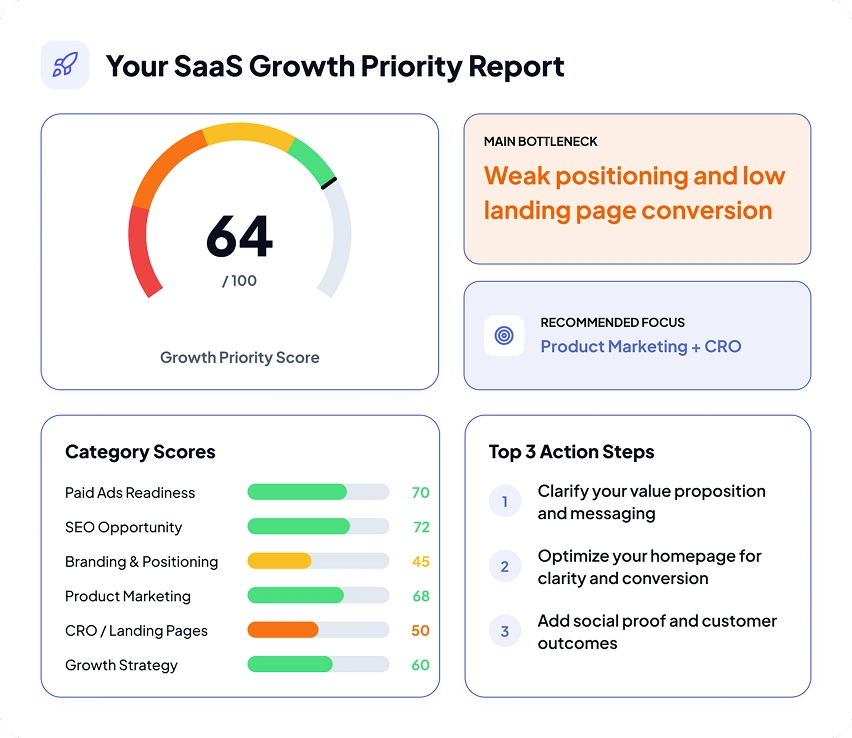
This is the point where SaaS teams typically bring in outside growth support: not to run isolated tactics, but to diagnose and fix the funnel end-to-end, from the first ad click through to retained revenue. A SaaS growth audit is usually the right starting point — a structured review of where the funnel is actually leaking before committing to a fix.
Calculate Your SaaS Trial Conversion Rate
Use the calculator below to see where your funnel stands. Enter your trial signups, activated users, paid customers, and revenue to get your trial-to-paid conversion rate, activation rate, and an estimate of the revenue opportunity available by closing the gap to a stronger conversion benchmark.
Free Diagnostic Tool
Find Out What Your Trial Funnel Is Actually Costing You
Enter your trial signups, activated users, and paid customers to see your conversion rate and revenue opportunity.
FAQs
What is SaaS free trial conversion rate?
It’s the percentage of trial users who become paying customers, calculated as paid customers from trials divided by total trial users, multiplied by 100.
How is trial conversion calculated?
Using the formula: Paid Customers From Trials ÷ Total Trial Users × 100. Some teams calculate this per signup cohort rather than by calendar month for more accurate tracking.
What is a good SaaS trial conversion rate?
This varies significantly by trial model and industry — opt-in trials (no credit card required) typically convert at lower rates than opt-out trials (credit card required upfront), since opt-out trials pre-filter for higher intent. Rather than benchmarking against an industry-wide number, track your own rate over time and by segment.
Why are SaaS trial users not converting?
Most commonly: the wrong users are entering the trial, activated users never reach a real value moment, or the trial experience has too much friction between signup and first result.
Why do users abandon free trials?
Typically because they hit friction (long forms, complex setup, empty product state) before experiencing any value, or because they were never a strong ICP fit to begin with.
Where do SaaS trial funnels leak?
At every stage of the framework: poor-fit users at acquisition, low activation due to unclear first actions, weak time-to-value due to onboarding overload, and low upgrade motivation due to unclear paid value.
How quickly should SaaS users experience value?
As quickly as the product allows — the goal is to compress the path to a first meaningful result, ideally within the first session, rather than over the full length of the trial.
What improves time-to-value?
Guided setup, smart defaults, templates, and sample data that get users to a working result without requiring them to build their environment from scratch.
How can SaaS onboarding improve conversions?
By focusing on one outcome first instead of teaching the full feature set, and by personalizing the path based on what the user is actually trying to accomplish.
Should SaaS products show all features during trials?
Generally no — front-loading every feature delays the moment a user reaches value. Introduce additional features progressively, after the core outcome has been delivered.
Should SaaS trials require credit cards?
It depends on the business model. Opt-out (credit card required) trials tend to convert at higher rates because they pre-qualify for intent, but they also reduce top-of-funnel signup volume. Opt-in trials generate more signups but at lower conversion rates. The right choice depends on sales capacity and how much friction the ICP will tolerate.
How should SaaS companies encourage upgrades?
By tying upgrade prompts to real usage moments (hitting a limit, using a gated feature) and to demonstrated value, rather than relying solely on a countdown to trial expiration.