

Key Takeaways
- The B2B SaaS customer journey doesn’t end at the sale. Retention, adoption, and advocacy stages drive just as much revenue as acquisition.
- Most SaaS journeys are non-linear. Mapping every touchpoint across all buyer roles helps you show up at the right moment for the right person.
- Strong onboarding is the single biggest lever for long-term retention. Getting customers to their first win fast reduces early churn significantly.
- Marketing and sales need a shared ICP, shared metrics, and clean hand-offs to create a journey that converts and retains.
- Tracking both leading indicators (product usage, engagement scores) and lagging indicators (churn rate, NRR) gives you the full picture of journey health.
- Review and update your customer journey map regularly. As your product evolves and your customer base shifts, the journey changes too.
Most B2B SaaS companies spend time and money getting new leads. But the real growth happens when you understand what your customers go through, from the moment they first hear about you to the day they become your biggest advocates.
That’s what the B2B SaaS customer journey is all about. And if you’re not actively managing it, you’re likely leaving a lot of revenue on the table.
In this guide, we’ll walk you through every stage of the SaaS customer journey, how to map it, which metrics to track, and how to optimize it for long-term growth.
Let’s dive in.
What Is the B2B SaaS Customer Journey?
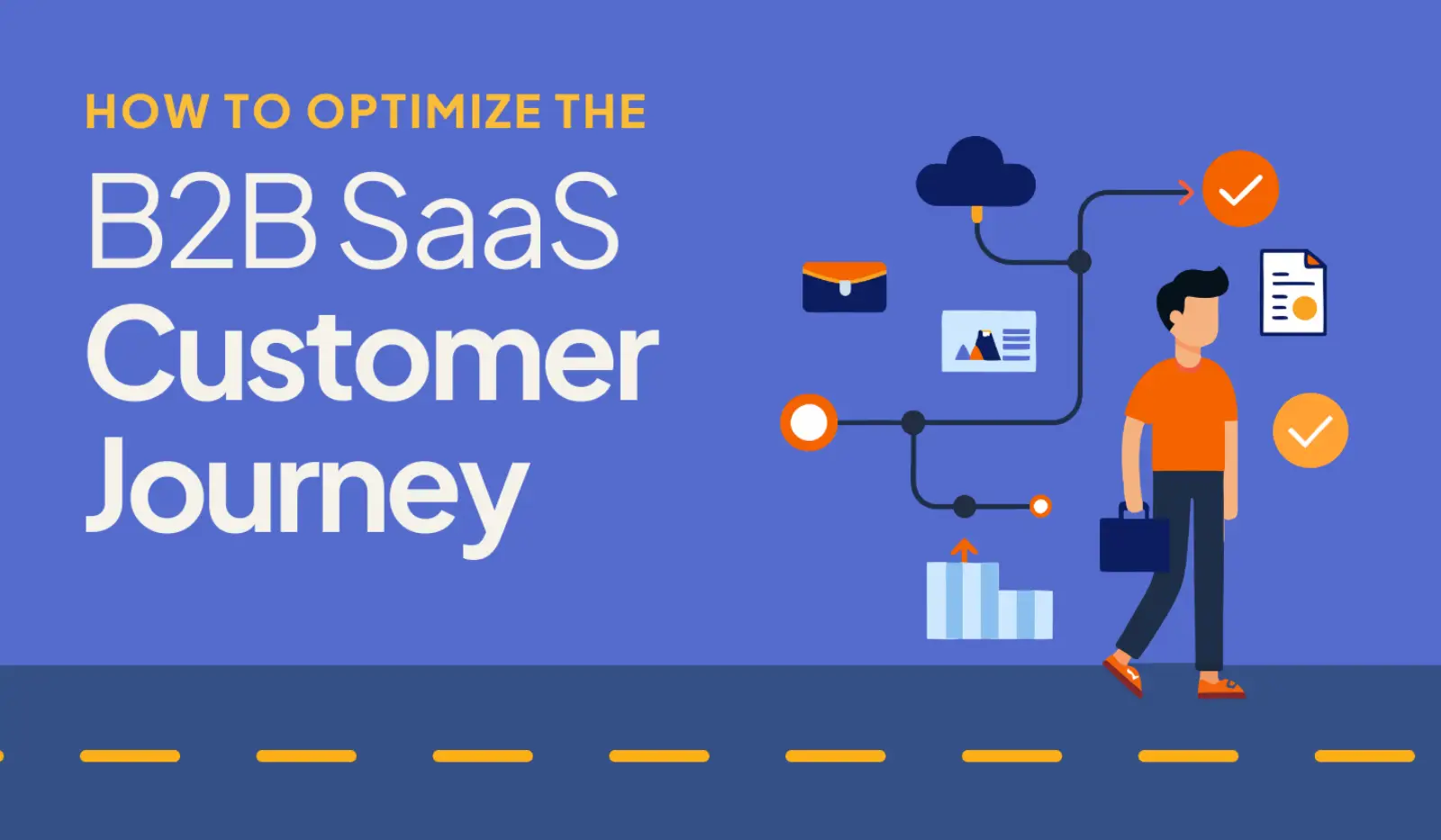
The B2B SaaS customer journey is the complete path a customer takes with your product, from first discovering your brand to becoming a loyal, paying user who recommends you to others.
Unlike buying a physical product, the SaaS customer journey doesn’t end at the purchase. It actually begins there. Customers pay monthly or annually, so every renewal is a new decision to stay. That makes the post-sale experience just as important as the pre-sale one.
How It Differs From Traditional B2B Buying
In traditional B2B, the goal is a one-time transaction. You sell, they buy, and it’s done. In SaaS, you sell access to ongoing value. If customers don’t see that value consistently, they leave. The relationship has to keep earning their business every billing cycle.
Why the SaaS Journey Is Non-Linear
The SaaS buyer journey doesn’t follow a straight line. A prospect might read three blog posts, attend a webinar, sign up for a trial, go quiet for two weeks, and then book a demo. They move between touchpoints based on their needs, timelines, and internal conversations. Mapping this complexity is what helps you show up at the right moment.
The Role of Multiple Decision-Makers
In B2B SaaS, you’re rarely selling to one person. A typical buying group includes an end user, a manager, a finance approver, and sometimes an IT or security reviewer. Each person has different questions, concerns, and priorities. A strong customer journey strategy speaks to all of them.
The Revenue Lifecycle Connection
The customer journey maps directly to your Monthly Recurring Revenue (MRR). Acquisition drives new MRR. Adoption and retention protect existing MRR. Expansion grows it. When you optimize the journey, you improve all three.
Why Is the B2B SaaS Customer Journey Critical for Growth?
The B2B SaaS customer journey is critical for growth because it shapes how much it costs to acquire a customer, how long they stay, and how much revenue they generate over their lifetime.
The average annual churn rate for B2B SaaS companies sits at around 4.91%. This may not seem significant at first, but the cost of replacing a lost customer is steep: acquiring a new customer costs 5 to 7 times more than keeping an existing one (Source: HubiFi, 2025).
If your onboarding is poor and customers churn in month two, all that acquisition spend disappears. Optimizing the journey helps you protect that investment.
Revenue Impact Across the Lifecycle
Every stage of the customer journey connects to revenue. Weak awareness means fewer leads. Poor onboarding means low activation. Low adoption leads to churn. On the other hand, when each stage works well, you build a compounding growth engine.
CAC Efficiency and Retention Economics
Customer Acquisition Cost (CAC) only makes sense when measured against Lifetime Value (LTV). A customer who churns after 90 days has a terrible LTV:CAC ratio. Strong onboarding and adoption extend customer lifetime and fix that ratio over time.
Cross-Team Alignment
The journey also brings your marketing, sales, product, and customer success teams onto the same page. Without it, each team works in a silo and creates gaps in the customer experience. With it, everyone knows what happens before and after their part of the process.
Benefits for Mid-Market SaaS Companies
For mid-market B2B SaaS companies, optimizing the customer journey makes it easier to compete with both nimble startups and large enterprise vendors. Mid-market customers expect a personalized experience but rarely get the white-glove treatment that enterprise deals come with. A well-mapped journey fills that gap and drives stronger retention, upsells, and referrals.
What Are the Core SaaS Customer Journey Stages?
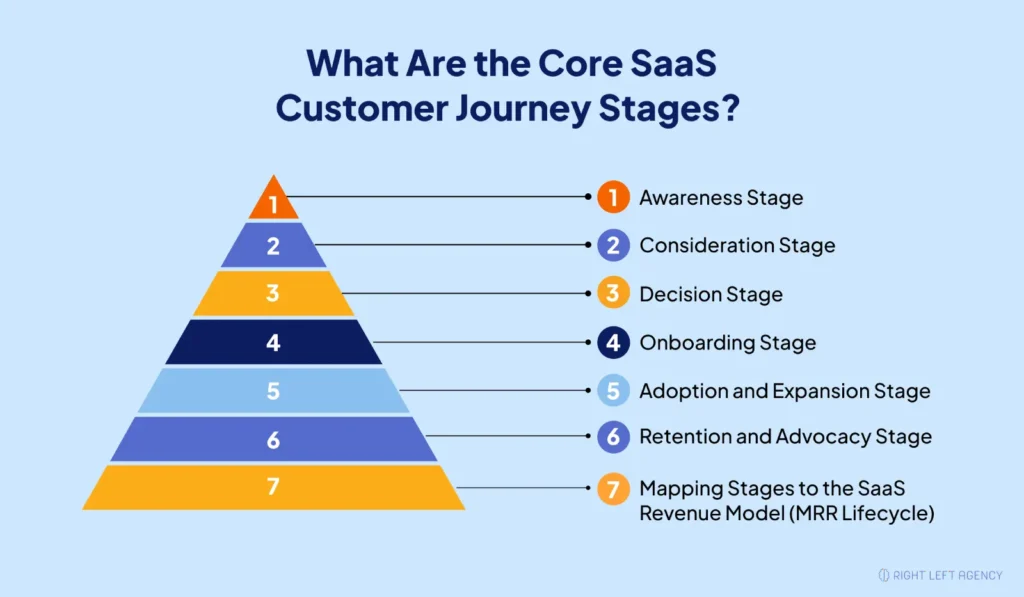
The core SaaS customer journey stages are Awareness, Consideration, Decision, Onboarding, Adoption and Expansion, and Retention and Advocacy. Each stage serves a different purpose and calls for a different strategy.
Let’s walk through each one.
Awareness Stage
At this stage, your future customer realizes they have a problem. Maybe their team is wasting hours on manual reporting. Maybe their current tool no longer fits their needs. They start looking for solutions, but they don’t know you yet.
Your job here is to be findable. Blog content, SEO, LinkedIn posts, podcast appearances, paid ads, and word-of-mouth all play a role. You’re not selling yet. You’re educating.
Key goal: Get in front of the right people with the right message.
Consideration Stage
Now they know who you are, and they’re sizing up their options. They’re reading comparison posts, watching demos, and talking to peers. This is where inbound marketing in the SaaS buyer journey does a lot of heavy lifting.
Your job here is to build trust and show what makes you different. Case studies, product walkthroughs, free trials, and detailed feature pages help prospects see why your solution fits their situation.
Key goal: Help them choose you over the competition.
Decision Stage
The prospect is ready to buy, or close to it. Maybe they’ve had a demo, and they’re aligning internal stakeholders. Maybe they’re on a trial and reviewing results.
At this stage, sales steps in to handle objections, work with procurement, and close the deal. Pricing pages, ROI calculators, security documentation, and customer references all help here.
Key goal: Remove friction and close the deal.
Onboarding Stage
This is where a lot of SaaS companies lose customers before they even get started. Onboarding is the bridge between buying and actually using the product well.
Research from INSAIM found that 63% of customers consider the onboarding experience a deciding factor when subscribing to a SaaS product. It’s not just about setup — it’s the first real test of whether your product delivers on its promise.
Good onboarding is fast, personalized, and tied to the customer’s goals. It gets users to their first meaningful outcome, often called “time to value,” as quickly as possible.
Key goal: Get customers to their first win fast.
💡 Pro Tip: If your onboarding takes longer than three days to get users to their first meaningful action, you’re losing people before they’ve had a real chance to see the value. Map your onboarding steps and cut anything that doesn’t move users toward that first win.
Adoption and Expansion Stage
Once customers are past the initial setup, the goal is to get them deeper into the product. They should be using core features regularly and discovering new ones that add more value.
This stage is also where expansion revenue comes from. As customers grow, they need more seats, more features, or higher tiers. A strong adoption strategy naturally opens the door to upsells and cross-sells.
Key goal: Deepen product usage and grow account revenue.
Retention and Advocacy Stage
Retained customers are the backbone of SaaS revenue. Customers who stay long enough become advocates. They write reviews, refer colleagues, and appear in your case studies.
B2B SaaS companies using product usage data to guide their customer success efforts report retention rates that are 15% higher than companies that rely on relationship management alone. The median NRR across B2B SaaS in 2025 is 106%, with top performers exceeding 120% (Source: Wudpecker, 2025).
Customer success plays a big role here through regular check-ins, health scores, and proactive outreach. Happy customers don’t just renew. They grow with you.
Key goal: Renew, expand, and turn customers into promoters.
Mapping Stages to the SaaS Revenue Model (MRR Lifecycle)
Each stage ties to a part of your MRR lifecycle. Awareness and consideration feed new MRR. The decision converts it. Onboarding and adoption protect it. Retention keeps it. Expansion grows it. Advocacy multiplies it through referrals. When you see the journey through this lens, every optimization decision has a clear revenue outcome attached to it.
How Does the SaaS Buyer Journey Differ from the Customer Journey?
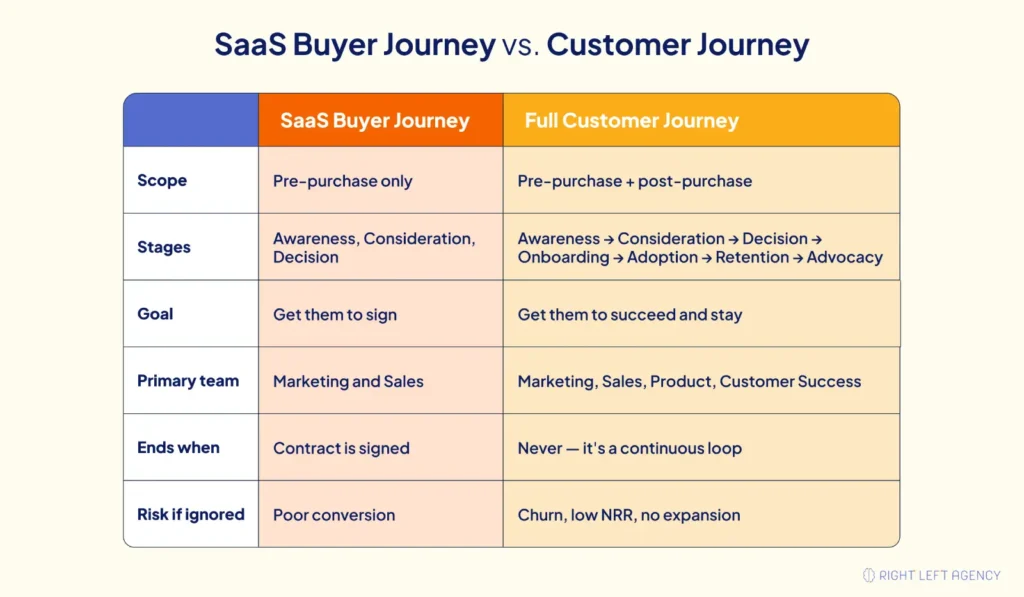
The SaaS buyer journey covers the pre-purchase phase, from awareness to decision. The full customer journey includes everything that comes after too, including onboarding, adoption, retention, and advocacy.
Think of the buyer journey as the front door and the customer journey as the whole house. Focusing only on the buyer journey means you’re only paying attention to getting people in the door. What happens once they’re inside matters just as much.
| Criteria | SaaS Buyer Journey | Full Customer Journey |
|---|---|---|
| Scope | Pre-purchase only | Pre-purchase + post-purchase |
| Stages | Awareness, Consideration, Decision | Awareness → Consideration → Decision → Onboarding → Adoption → Retention → Advocacy |
| Goal | Get them to sign | Get them to succeed and stay |
| Primary team | Marketing and Sales | Marketing, Sales, Product, Customer Success |
| Ends when | Contract is signed | Never — it’s a continuous loop |
| Risk if ignored | Poor conversion | Churn, low NRR, no expansion |
Buying committee behavior in B2B SaaS
In B2B SaaS, the buying committee adds a layer of complexity you don’t see in most consumer purchases. Marketing needs to build awareness with multiple personas at the same time. Sales needs to manage multi-threaded conversations. And the hand-off to customer success needs to account for who the actual users are, not just who signed the contract.
Trial-led vs. sales-led journey paths
Some SaaS companies run a product-led growth model where users sign up for a free trial, experience the product, and upgrade on their own. Others run a sales-led model where discovery calls and demos drive the process. Many do both. Your journey map needs to reflect whichever path your customers actually take.
Where inbound marketing fits
Inbound marketing does its best work in the awareness and consideration stages. When prospects search for solutions on Google, your blog posts, comparison content, and case studies are already there waiting for them. The goal is to attract and educate, so that by the time prospects reach your sales team, they’re already warm.
How to Create a SaaS Customer Journey Map (Step-by-Step)
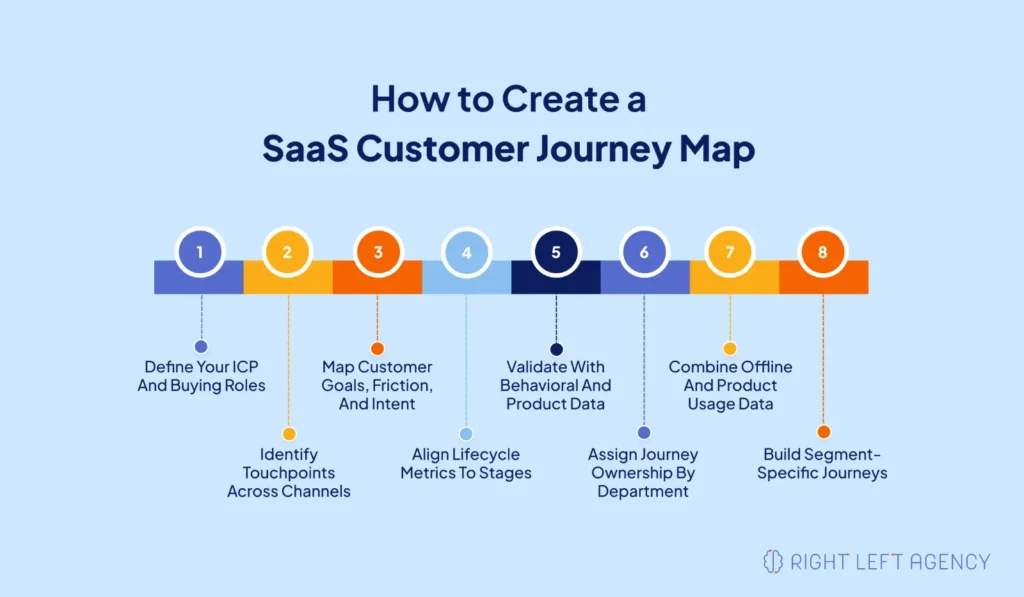
A SaaS customer journey map is a visual document that captures every step your customer takes, what they’re thinking, what friction they face, and what they need at each point.
Here’s how to build one.
Step 1: Define Your ICP and Buying Roles
Start with your Ideal Customer Profile (ICP). Who are you trying to reach? What’s their company size, industry, and tech stack? Then define the roles involved in buying and using the product. Common roles include the economic buyer, the champion, the end user, and the IT approver. Each one needs a row in your journey map.
Step 2: Identify Touchpoints Across Channels
List every place a customer interacts with your brand. That includes organic search, social media, email, sales calls, the product itself, support tickets, and renewal conversations. You’ll likely find gaps you didn’t know existed.
Step 3: Map Customer Goals, Friction, and Intent
For each stage and each role, ask: what does this person want to accomplish? What’s stopping them? What are they feeling? This exercise often surfaces the fact that you’re solving the wrong problems or talking about the wrong things at the wrong time.
Step 4: Align Lifecycle Metrics to Stages
Each stage needs metrics attached to it. Awareness tracks impressions and organic traffic. Consideration tracks MQL volume and trial sign-ups. Decision tracks close rate. Onboarding tracks time-to-value and activation rate. Adoption tracks feature usage. Retention tracks NRR and churn.
Step 5: Validate with Behavioral and Product Data
Don’t build your journey map on assumptions. Use product analytics, session recordings, support tickets, and customer interviews to confirm or challenge what you’ve mapped. Real data tells the truth.
💡 Pro Tip: Don’t rely on surveys alone to validate your journey map. Watch real session recordings of new users going through onboarding for the first time. You’ll spot friction points in 20 minutes that survey data would take months to surface. Tools like Hotjar or FullStory make this easy.
Step 6: Assign Journey Ownership by Department
Every stage needs an owner. Marketing owns awareness and consideration. Sales owns the decision. Product and customer success share onboarding. Customer success owns adoption and retention. Without clear ownership, things fall through the cracks.
Step 7: Combine Offline and Product Usage Data
Most journey maps only show marketing touchpoints. But the product is a touchpoint too. Combining CRM data (what happened before the sale) with product usage data (what happened after) gives you a complete picture.
Step 8: Build Segment-Specific Journeys
An SMB customer buying on a self-serve basis has a very different journey from an enterprise customer going through a six-month procurement process. Mid-market sits somewhere in between. Build separate maps for each segment so your strategy is precise, not generic.
What Touchpoints Matter Most in a B2B SaaS Customer Journey?
The most important touchpoints in a B2B SaaS customer journey are the ones where customers make decisions: the first meaningful piece of content they read, the first product interaction, the onboarding experience, and the first renewal conversation.
Marketing touchpoints include search-driven blog content, paid ads, email sequences, social proof, webinars, and gated assets. These build awareness and nurture interest before a sales conversation ever happens.
Sales interactions include discovery calls, demos, proposal reviews, and negotiations. These are high-intent moments where deals are won or lost. Strong enablement, clear ROI messaging, and fast response times matter a lot here.
Product experience touchpoints are often the most underestimated. The sign-up flow, the onboarding checklist, the first dashboard a user sees, and in-app tooltips are all touchpoints. If any of them create confusion, you’re losing customers before they’ve had a real chance to see the value.
Customer success touchpoints include onboarding calls, QBRs (Quarterly Business Reviews), health check-ins, renewal conversations, and upsell discussions. These touchpoints shape whether a customer renews or churns.
Self-serve vs. high-touch journeys
In a self-serve model, product touchpoints do most of the work. Your in-app experience, help docs, and email sequences guide users without human support. In a high-touch model, customer success managers handle more of that personally. Most mid-market SaaS companies need a hybrid of both.
How to Integrate Marketing and Sales Funnels in the SaaS Customer Journey
Marketing and sales funnels are not separate things in SaaS. There are two views of the same customer journey. When they run in isolation, you get misaligned messaging, poor lead quality, and broken hand-offs.
Unified Lifecycle Stages
The first step to alignment is agreeing on shared lifecycle stages and definitions. What makes someone an MQL? When does an MQL become an SQL? What does “activated” mean for your product? These definitions need to be consistent across marketing, sales, and product.
Lead Qualification Across Journey Stages
Marketing qualifies leads on intent signals: what they’ve read, what they’ve downloaded, and how long they’ve spent on the pricing page. Sales qualify on fit: budget, authority, need, and timing. Both layers matter. A high-intent lead who doesn’t fit your ICP is still the wrong lead.
Shared Metrics and Pipeline Accountability
When marketing owns MQLs and sales owns revenue, there’s no shared accountability. When both teams measure themselves on pipeline quality and closed revenue, they work toward the same goal. Revenue operations (RevOps) is often the function that makes this alignment stick.
The Hand-Off Model: Marketing to Sales to Product to Success
Every transition in the customer journey needs a clean hand-off. Marketing passes warm leads to sales with full context. Sales passes new customers to customer success with detailed notes. Customer success loops in the product team when feature requests or adoption gaps come up. Each hand-off is a point of potential failure if the process isn’t tight.
How to Measure Lead Quality Across the SaaS Customer Journey
To measure lead quality across the SaaS customer journey, combine demographic fit with behavioral signals and track how leads convert at every stage from MQL to retained customer. Use five core methods: demographic and behavioral qualification scoring, product-qualified lead (PQL) identification, intent-based lead scoring, multi-touch revenue attribution, and lifecycle conversion benchmarking.
Let’s explain one by one.
Behavioral vs. Demographic Qualification
Demographic signals (company size, industry, title) tell you whether someone fits your ICP. Behavioral signals (visited pricing page, watched a demo video, completed a trial) tell you how interested they are. The best leads score high on both.
Product-Qualified Leads (PQLs)
A PQL is a user who has shown meaningful engagement in your product during a trial. They’ve reached a usage threshold that predicts conversion. PQLs are often the highest-quality leads in a product-led growth motion because they’ve already experienced the value firsthand.
Intent Signals and Scoring Models
Lead scoring models combine firmographic data, engagement signals, and product behavior to assign a score that predicts the likelihood of buying or churn. These models need regular calibration based on what actually converts and what doesn’t.
Revenue Contribution by Stage
Tracking which channels, campaigns, and touchpoints contribute to closed revenue helps you invest in what works. Multi-touch attribution models do this better than first-touch or last-touch alone.
Lifecycle Conversion Benchmarks
Knowing your industry benchmarks for trial-to-paid conversion, MQL-to-SQL rates, and onboarding activation helps you spot where your funnel underperforms. Common B2B SaaS benchmarks: trial-to-paid conversion of 15 to 25%, and MQL-to-SQL rates of 13 to 20%.
Key Metrics to Track at Each SaaS Customer Journey Stage

Tracking the right metrics at each stage helps you catch problems early and double down on what’s working.
Acquisition Metrics
- Website traffic by channel
- MQL and SQL volume
- Cost per acquisition (CPA)
- Trial sign-up rate
- Pipeline generated by the source
Activation Metrics
- Time to first meaningful action
- Activation rate (percentage of trials reaching key milestones)
- Onboarding completion rate
- Time-to-value (TTV)
Engagement Metrics
- Daily and monthly active users (DAU/MAU)
- Feature adoption rate
- Session frequency and depth
- In-app NPS scores
Expansion Metrics
- Expansion MRR
- Upsell and cross-sell conversion rate
- Net Revenue Retention (NRR) from expansion
Retention Metrics
- Monthly and annual churn rate
- Net Revenue Retention (NRR) overall
- Customer Lifetime Value (LTV)
- Renewal rate
How to Use Your SaaS Journey Metrics Effectively
To use your SaaS journey metrics effectively, pair leading indicators like product usage and engagement scores with lagging indicators like churn rate and NRR, so you act early instead of reacting late. Use multi-touch attribution to see which touchpoints actually drive closed revenue, and benchmark against peers with a similar ACV using sources like OpenView Partners or ChartMogul.
Attribution Models for the SaaS Journey
First-touch attribution gives credit to the first touchpoint. Last-touch gives credit to the one right before conversion. Multi-touch attribution spreads credit across all touchpoints. For complex B2B SaaS journeys with long sales cycles, multi-touch gives the most accurate picture.
Leading vs. Lagging Indicators
Lagging indicators like churn rate and closed revenue tell you what already happened. Leading indicators like product usage frequency and engagement scores tell you what’s likely to happen. Track both, but act on the leading ones early.
Mid-Market SaaS Benchmarking Approach
Mid-market SaaS companies should benchmark against peers with a similar ACV and sales motion. Enterprise benchmarks don’t apply to a $10K ACV product, and SMB benchmarks don’t reflect the complexity of a $50K deal. Look for segment-specific data from sources like OpenView Partners, Bessemer Venture Partners, or ChartMogul.
Common Challenges in Managing the SaaS Customer Journey
Even with the best intentions, managing the B2B SaaS customer journey is hard. Here are the most common challenges we run into.
Data Silos Across Teams
Marketing has data in HubSpot. Sales has data in Salesforce. The product has data in Mixpanel. Customer success has data in Gainsight. When these systems don’t talk to each other, you get an incomplete picture of your customer. You can’t optimize a journey you can’t see in full.
Misalignment Between Marketing and Product
Marketing promises one thing in campaigns. The product delivers something slightly different. That gap erodes trust fast, especially during onboarding when customer expectations are at their highest.
Incomplete Customer Visibility
Most teams only see their slice of the journey. Marketing doesn’t know what happens after a lead converts. Sales doesn’t know what happens in-product after the deal closes. Without full-lifecycle visibility, you can’t connect early-stage behavior to downstream outcomes.
Scaling Personalization
When you have 50 customers, personalization is easy. When you have 5,000, you need automation and segmentation. Building personalized experiences at scale without losing the human touch is one of the hardest things to pull off in SaaS.
Trial Conversion Bottlenecks
Many SaaS companies get solid trial sign-up numbers but poor conversion to paid. This usually points to an activation problem. Users aren’t reaching the value moment before the trial ends, and there’s no strong process to re-engage them.
How to Optimize the B2B SaaS Customer Journey for Revenue Growth

To optimize the B2B SaaS customer journey for revenue growth, work across all six stages systematically rather than fixing one area at a time. Focus on the eight highest-impact areas: tightening your ICP, reducing time-to-value in onboarding, driving product adoption, managing churn proactively with health scores, building advocacy loops, running continuous experiments, segmenting journeys by company size, and aligning teams through a shared RevOps framework. Companies that optimize the full lifecycle consistently outperform on Net Revenue Retention and LTV:CAC ratio.
Optimization isn’t a one-time project. It’s an ongoing process of finding gaps, running experiments, and improving each stage over time.
Improve Acquisition Quality
Better acquisition starts with a tighter ICP definition. When you know exactly who you’re targeting, you write sharper copy, run more focused ads, and attract leads more likely to convert and stay. Review your customer base every quarter and identify the traits your best customers share.
Optimize the Onboarding Experience
Onboarding is where you earn the right to keep a customer. Map every step of the onboarding process and find where users drop off. Simplify setup flows, use in-app guidance, and get customers to their first value moment as fast as you can. Even a one-week reduction in time-to-value can meaningfully improve activation rates.
Drive Product Adoption
Low adoption is an early warning sign of churn. Use in-app messaging, email campaigns, and customer success outreach to guide users toward features they haven’t explored yet. Set adoption milestones and celebrate them with customers when they hit them.
Reduce Churn and Increase Expansion
Check customer health scores every week. When a customer shows signs of disengagement, reach out before they submit a cancellation request. On the expansion side, build a regular cadence of account reviews where you connect product usage to business outcomes and introduce relevant upgrades.
Build Advocacy Loops
Happy customers are your best marketing channel. Build a formal advocacy program. Ask for G2 or Capterra reviews right after a customer wins. Create a referral incentive. Turn top customers into case study subjects. This creates a loop that feeds back into your acquisition stage.
Journey Experimentation Framework
Treat the journey like a product. Run experiments at every stage. Test different onboarding sequences, email subject lines, CTA placements, and sales talk tracks. Document what you learn and build a shared knowledge base your teams can use.
Lifecycle Segmentation Strategy
Not every customer needs the same journey. Segment by company size, use case, and product tier. Build different journeys for each segment, especially for onboarding and expansion where context matters most.
Revenue Operations Alignment Model
RevOps ties the journey together operationally. It aligns data, tools, processes, and metrics across marketing, sales, and customer success. If you don’t have a dedicated RevOps function yet, even informal alignment meetings between team leads can close a lot of gaps.
SaaS Customer Journey Map Example (Mid-Market B2B Scenario)
Let’s walk through a real-world example of the SaaS customer journey for a mid-market B2B company, say a 200-person professional services firm adopting a project management SaaS tool.
Awareness: A director of operations searches “best project management software for agencies” and finds your blog post. She shares it with her VP. They both follow you on LinkedIn.
Consideration: Two weeks later, she signs up for your newsletter, downloads a comparison guide, and watches a demo video on your site. Your marketing automation scores her as an MQL. A sales rep reaches out with a personalized email that references the guide she downloaded.
Decision: After a discovery call and a live demo, they start a 14-day trial with three team members. Sales stays engaged, answers IT’s questions about data security, and connects the VP with a customer reference in the same industry. They sign a 12-month contract.
Onboarding: A customer success manager runs a kickoff call, puts together a 30-day onboarding plan, and sets up a shared Slack channel for quick support. The team finishes onboarding in 10 days and runs their first project successfully.
Adoption and Expansion: After three months, 90% of the team uses the product daily. The CSM spots that two other departments could benefit and sets up an expansion conversation. Six months in, the company added 30 more seats.
Retention and Advocacy: At the annual review, the company renews and agrees to participate in a case study. Their operations director speaks at your user conference.
Touchpoints by stage: Blog content, LinkedIn, email nurture, sales outreach, demo, trial, onboarding call, in-app guides, CS check-ins, QBR, renewal call, case study.
Ownership: Marketing (awareness), sales (consideration through decision), product and CS (onboarding), CS (adoption, retention, advocacy).
Optimization opportunities: Shorten the trial to 10 days with a faster setup wizard. Add a mid-trial check-in email for users who haven’t invited teammates yet. Launch a peer community to accelerate advocacy.
Tools for Mapping and Optimizing the SaaS Customer Journey
You don’t need every tool on this list. But having the right stack makes it much easier to see the full journey and act on what you find.
Product analytics tools like Mixpanel, Amplitude, or Heap help you understand how users behave inside the product, where they get stuck, and which features drive retention.
Behavioral analytics platforms like FullStory or Hotjar let you watch session recordings and heatmaps to catch friction in the UX, especially during onboarding.
Customer success platforms like Gainsight or ChurnZero help you track customer health scores, automate outreach triggers, and manage renewal and expansion conversations.
Revenue attribution tools like Dreamdata, Triple Whale, or Bizible connect marketing touchpoints to closed revenue across the full multi-touch journey.
CRM platforms like Salesforce or HubSpot tie the buyer journey data together and serve as the source of truth for pipeline and account management.
Journey mapping tools like Miro, Lucidchart, or Custellence help you build, visualize, and share your journey maps across teams.
Conclusion: Turning the B2B SaaS Customer Journey into a Revenue Engine
The B2B SaaS customer journey is not a funnel you fill from the top. It’s a full lifecycle that starts before the first touchpoint and continues long after the contract is signed.
When you map it well, you see exactly where customers get stuck, where they find value, and where they decide to stay or leave. That visibility shifts you from reactive firefighting to a proactive revenue strategy.
The SaaS companies that grow consistently treat the customer journey as a shared asset across marketing, sales, product, and customer success. They measure each stage, run experiments, and keep improving the experience for every customer segment.
Not sure where your customer journey is breaking down?
Most SaaS companies lose revenue not because their product is weak, but because their marketing, sales, and customer success stages don’t connect. At Right Left Agency, we help B2B SaaS companies build and optimize the full customer journey, from first-touch acquisition to expansion and advocacy.
See How We Help SaaS Companies Grow →
FAQs
What is a B2B SaaS customer journey map?
A B2B SaaS customer journey map is a visual document that outlines every stage a customer goes through with your product, from first awareness to long-term advocacy. It captures touchpoints, goals, friction points, and ownership by team.
How do you build a SaaS customer journey map?
Start by defining your ICP and buying roles. Then identify every touchpoint across channels. Map what customers want and what stops them at each stage. Attach metrics to each stage, validate with real data, and assign ownership by team.
What data is needed to map a B2B SaaS customer journey?
You need CRM data (deals, pipeline, close rates), product usage data (activation, feature adoption, session frequency), marketing data (traffic, conversions, attribution), and customer feedback (surveys, interviews, support tickets).
Who owns the customer journey in a SaaS company?
No single team owns the entire journey. Marketing, sales, product, and customer success each have specific stages. Revenue operations typically owns the overall framework and data alignment.
How do you measure success in a SaaS customer journey?
Key success metrics include activation rate, time-to-value, feature adoption rate, NRR, churn rate, LTV:CAC ratio, and expansion MRR.
What metrics indicate customer journey health in SaaS?
Strong health indicators include daily active usage, onboarding completion rate, feature breadth (the number of features a customer actively uses), support ticket volume, and NPS scores.
How do you improve customer retention in B2B SaaS?
Monitor health scores proactively. Invest in strong onboarding. Build a regular cadence of success touchpoints like check-ins and QBRs. Identify at-risk customers early and reach out before they decide to leave.
Why is customer journey optimization important for mid-market SaaS companies?
Mid-market SaaS companies face competition from both ends of the market. Optimizing the journey helps them deliver an enterprise-quality experience without enterprise-level resources, which has a direct impact on retention and expansion.
How does inbound marketing support the SaaS buyer journey?
Inbound marketing brings in prospects who are actively searching for solutions. It builds brand awareness, nurtures consideration-stage leads with useful content, and warms up buyers before the first sales conversation happens.
How do marketing and sales align across the SaaS customer journey?
Alignment starts with shared definitions (MQL, SQL, activation), shared metrics (pipeline quality, closed revenue), and regular cross-functional reviews. RevOps is typically the function that holds this alignment together operationally.