Key Takeaways
- SaaS specialization should be proven through relevant evidence.
- Qualified demand matters more than traffic volume alone.
- The agency should understand your product before planning content.
- You should meet the people who will deliver the work.
- Pricing, scope, ownership, and cancellation terms should be transparent.
- A weighted scorecard can reduce subjective decision-making.
How Do You Choose the Right B2B SaaS SEO Agency?
Choose a B2B SaaS SEO agency by looking beyond rankings, traffic, and content volume. Evaluate how well the agency understands your product, customers, buying journey, technical environment, conversion goals, and revenue model.
A practical selection process looks like this:
- Confirm that your company is ready for outside SEO support.
- Look for relevant SaaS experience, not just general SEO success.
- Review how the agency plans to learn your product and market.
- Evaluate its content, technical SEO, and conversion capabilities.
- Ask who will implement the recommendations.
- Review how the agency measures qualified demand and pipeline.
- Meet the people who will actually work on your account.
- Check pricing, scope, ownership, and cancellation terms.
- Compare every shortlisted agency using the same scorecard.
- Start with a pilot when you still have concerns about fit.
The goal is not to find an agency that can simply increase organic traffic. The goal is to find a team that can attract the right audience and guide those visitors toward meaningful commercial actions.
Determine Whether Your SaaS Company Is Ready for an SEO Agency
An agency is most useful when your SaaS company already has a working product, a reasonably clear audience, validated positioning, measurable conversion actions, and internal experts who can support the work.
You do not need to have everything figured out. However, an agency cannot build an effective search strategy when nobody can explain who the product is for or why customers choose it.
Use an Agency-Readiness Checklist
Use the following checklist before you begin speaking with agencies.
| Readiness question | Why it matters |
|---|---|
| Can we clearly describe our ideal customer profile? | The agency needs to know which buyers and problems to target. |
| Do we understand the problems customers are trying to solve? | Real customer problems should shape the content strategy. |
| Are our main use cases and positioning reasonably clear? | SEO may amplify weak or confusing messaging. |
| Do we know our primary conversion action? | The strategy should support demos, trials, signups, or another clear goal. |
| Can we track conversions accurately? | Without reliable tracking, performance becomes difficult to evaluate. |
| Does our website already convert some visitors? | More traffic will not fix a broken funnel. |
| Do we understand our sales motion? | Product-led and sales-led companies need different approaches. |
| Can our internal experts support the agency? | Writers need access to real product and customer knowledge. |
| Is someone responsible for the relationship? | Delayed feedback and unclear ownership can slow everything down. |
| Have we defined our commercial goals? | The agency needs a clearer target than “increase traffic.” |
Your answers do not need to be perfect. They should simply give the agency enough direction to make smart decisions.
Consider Growth Stage and Market Validation
Early-stage SaaS companies should be careful about scaling SEO before validating their audience, positioning, and product demand.
At this stage, customer interviews may be more useful than publishing twenty articles. Small paid-search tests can also help you understand which messages, keywords, and offers attract the right people.
That does not mean early-stage companies should ignore SEO. You can still fix technical problems, improve core pages, create a clear website structure, and begin building content around proven customer needs.
The risk comes from investing heavily in topics that have not been validated. An agency should not recommend aggressive content production before understanding whether the audience, problem, and conversion path are real.
Compare Agency, In-House, and Hybrid Models
Before comparing providers, decide which operating model makes the most sense for your company.
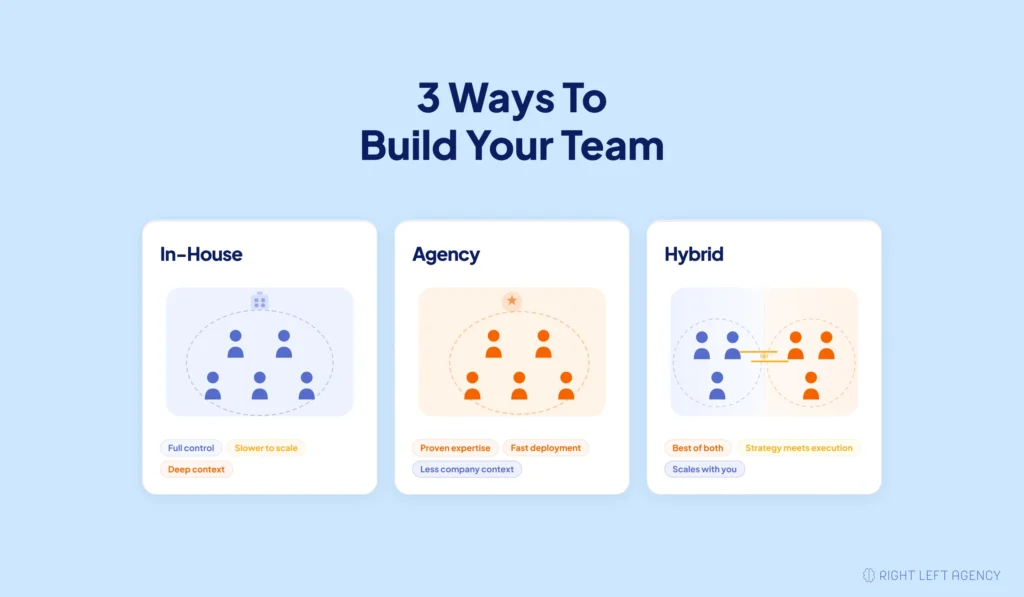
| Model | Best suited for | Main advantage | Main limitation |
|---|---|---|---|
| In-house | Companies that need close daily collaboration | Greater control and internal knowledge | Higher hiring and management costs |
| Agency | Lean teams that need specialist support quickly | Faster access to experience and established processes | Less control over daily execution |
| Hybrid | Companies with strong internal knowledge but specialist gaps | Flexible balance of control and execution | Responsibilities must be clearly divided |
Choose an In-House Team When Control and Internal Ownership Matter Most
An in-house team may be the better choice when SEO requires constant collaboration with product, engineering, compliance, or leadership teams.
It can also make sense when your company has enough budget and workload to support several specialists. A complete internal SEO function may require strategy, content, technical SEO, development, analytics, and digital PR.
The total cost is more than salary. You also need to consider recruitment, benefits, tools, training, management, and the time required to replace people when they leave.
Choose an Agency When Speed and Specialist Capacity Matter Most
An agency may be the better option when your marketing team is small, important work keeps getting delayed, or you lack specialist expertise.
The right agency can bring strategy, content, technical SEO, development support, conversion optimization, digital PR, and reporting into one working process.
A strong partner should provide B2B SaaS SEO services that combine these capabilities into a measurable organic growth system.
This can be faster than building a complete team from scratch. It also gives you access to people who have already solved similar problems across other SaaS companies.
Choose a Hybrid Model When Capabilities Are Split
A hybrid model works well when your internal team understands the product and market but needs help with specialist execution.
For example, your team may own positioning, customer research, approvals, and performance targets. The agency may handle technical SEO, content production, digital PR, programmatic SEO, or AI-search monitoring.
This model can work extremely well, but only when responsibilities are clear. Both teams should know who owns strategy, implementation, communication, reporting, and final decisions.
What Makes a B2B SaaS SEO Agency Different?
B2B SaaS SEO is not just regular SEO with software-related keywords.
A qualified agency should understand how organic search connects to a recurring-revenue business, a software product, a longer buying journey, and several possible conversion paths.
Understanding Recurring-Revenue Economics
A SaaS-focused agency should understand the business metrics behind customer acquisition.
These may include:
- Customer acquisition cost
- Customer lifetime value
- Monthly recurring revenue
- Annual recurring revenue
- Payback period
- Trial-to-paid conversion
- Retention
- Churn
- Expansion revenue
A campaign can generate cheap leads and still perform poorly. Those leads may never activate, convert, or remain customers long enough to become profitable.
The agency does not control every part of the revenue cycle. Product quality, onboarding, pricing, sales, and customer success also influence performance. Still, the agency should understand how organic acquisition fits into the wider system.
Understanding the Full SaaS Funnel
A SaaS SEO strategy should consider what happens after someone visits the website.
The journey may look like this:
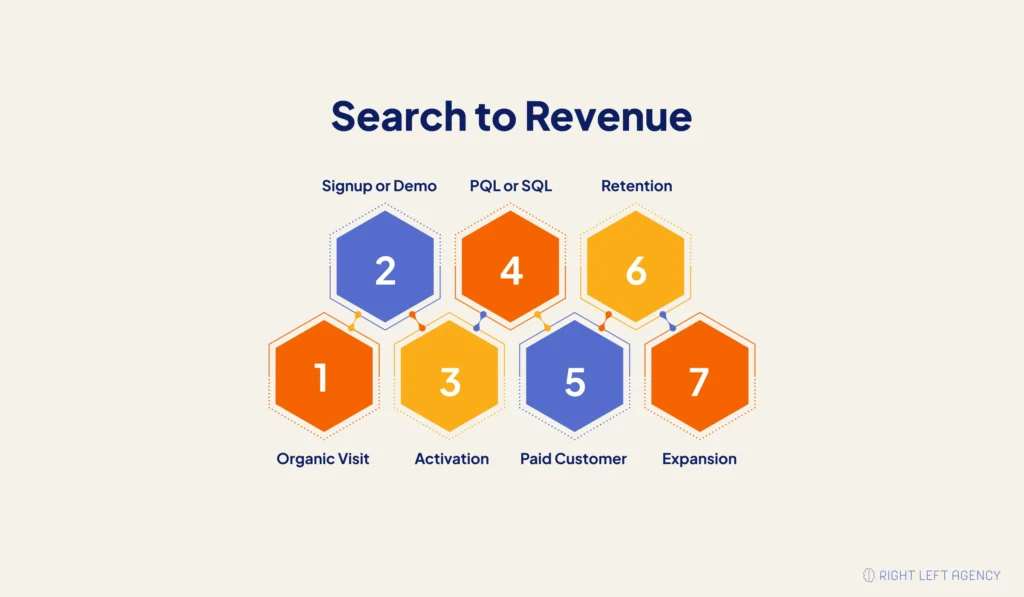
A product-qualified lead, or PQL, is a user whose behavior inside the product suggests real purchase potential.
For example, a project management platform may consider someone a PQL after they create a workspace, invite teammates, and use a premium feature. In that case, signup volume alone does not tell the full story.
A useful agency will ask what happens after the first conversion. It will also understand that marketing can influence activation and revenue, but cannot control those outcomes alone.
Understanding Product-Led and Sales-Led Buying Motions
Product-led and sales-led SaaS companies need different SEO strategies.
A product-led company may focus on:
- Free trials
- Freemium signups
- Product activation
- Feature discovery
- Self-serve conversion
A sales-led company may focus on:
- Demo requests
- Buying committees
- Solution evaluation
- Qualified pipeline
- Longer sales cycles
Some SaaS companies use a sales-assisted model. A user may discover the product through search, start using it independently, and later speak with sales.
The agency should adapt its page types, calls to action, reporting, and content priorities to the way your customers actually buy.
Delivering Multidisciplinary SEO and AI-Search Execution
A complete SaaS SEO program often involves several skills working together.
The agency may need to provide strategic leadership, customer research, keyword analysis, product-led content, technical SEO, development support, conversion optimization, internal linking, digital PR, analytics, and AI-search monitoring.
The challenge is not always knowing what to do. The challenge is getting the work published and implemented.
A technically accurate audit has little value when the changes remain inside a document for six months. Before hiring an agency, ask who will implement each recommendation, how the work will be tested, and how quickly changes can go live.
How to Evaluate a B2B SaaS SEO Agency
A B2B SaaS SEO agency should be judged through evidence, strategic thinking, implementation ability, reporting, and transparency.
Do not rely only on agency awards, impressive logos, or confident sales presentations.
1. Verify Relevant SaaS Experience and Evidence
Relevant experience matters more than broad industry claims.
An agency that helped a self-serve scheduling tool may not automatically be the right fit for an enterprise cybersecurity platform with a twelve-month sales cycle.
Look for experience that matches your:
- Business model
- Product complexity
- Growth stage
- Audience
- Sales motion
- Conversion model
- Industry or market
Evidence to Request
Ask the agency to share:
- Detailed SaaS case studies
- Product and feature pages
- Use-case and comparison content
- Technical SEO examples
- Content briefs
- Reporting dashboards
- Conversion or pipeline outcomes
- AI-search examples when relevant
A strong case study should explain what the original problem was, how the agency diagnosed it, what it changed, and what happened next.
Client logos without context do not tell you what the agency actually contributed.
2. Assess Product, ICP, and Customer-Research Processes
A strong agency should not begin by downloading a list of keywords and sending you a twelve-month content calendar.
It should first learn how the product works, who buys it, why customers care, and which objections slow down the decision.
A good research process may include:
- Customer interviews
- Sales-call recordings
- Support conversations
- CRM data
- Product analytics
- Competitor research
- Subject-matter expert interviews
These sources show the agency how customers speak, which problems matter most, and what information buyers need before making a decision.
Without that knowledge, even polished content can feel generic.
3. Evaluate the Buying-Intent and Content Strategy
Buying-intent keywords are searches used by people who are actively researching problems, comparing options, or preparing to make a purchase.
A strong SaaS content strategy may include:
- Educational guides
- Topic clusters
- Feature pages
- Use-case pages
- Industry pages
- Integration pages
- Product pages
- Comparison pages
- Competitor-alternative pages
- Trial and demo landing pages
The mix should reflect your audience.
An enterprise cybersecurity platform may need detailed industry pages, integration content, compliance resources, and sales-led conversion paths. A self-serve scheduling product may benefit more from templates, comparisons, feature content, and signup-focused pages.
Product-led content should help readers solve a real problem while naturally showing how the product fits into the solution. It should not read like an advertisement disguised as an article.
4. Review Technical SEO and Implementation Capabilities
Technical SEO recommendations are useful only when someone can implement them.
These capabilities are core parts of effective technical SEO services for SaaS websites. Ask whether the agency can support:
- Crawlability and indexing
- JavaScript SEO
- Core Web Vitals
- Schema markup
- Website architecture
- Documentation architecture
- Internal linking
- Conversion tracking
- Developer collaboration
- Publishing workflows
Some agencies have development resources. Others work with your internal engineering team.
Both approaches can work. The important thing is knowing who owns each task, how long implementation may take, and how the agency will confirm that the changes were completed correctly.
5. Evaluate Content Quality and Conversion Support
SaaS content should sound like it was written by someone who understands the product and the customer.
Look for content that:
- Addresses specific problems
- Uses accurate terminology
- Explains real workflows
- Includes relevant examples
- Shows product differentiation
- Uses expert input
- Connects naturally to product pages
- Guides readers toward an appropriate next step
The agency should also review your landing pages and conversion paths.
More organic traffic will not help much if the page is confusing, the offer is weak, or the call to action does not match the visitor’s intent.
6. Verify AI Search and GEO Capabilities
Generative Engine Optimization, or GEO, focuses on improving how a brand is discovered, understood, and referenced in AI-generated answers.
Ask the agency which platforms it monitors, how it measures visibility, and what it actually changes.
A credible GEO process may involve:
- Clear entity relationships
- Direct answers
- Structured content
- Trusted references
- Third-party brand mentions
- Digital PR
- Strong backlinks
- Consistent product information
A good agency should also explain which GEO activities are already part of strong SEO and which services are genuinely additional.
Be cautious when an agency charges more for standard SEO work simply because it has been renamed “AI SEO.”
7. Examine Measurement, Attribution, and Reporting
A qualified agency should report more than rankings, impressions, and traffic.
| Measurement level | Example metrics |
|---|---|
| Visibility | Rankings, impressions, share of search, AI visibility |
| Engagement | Qualified visits, page engagement, assisted journeys |
| Conversion | Trials, signups, demos, activation, PQLs |
| Pipeline | MQLs, SQLs, sourced pipeline, influenced pipeline |
| Revenue | Paid conversions, CAC indicators, revenue influenced |
The most useful metrics depend on your business model.
A sales-led platform may generate only ten organic demo requests in a month, but two could turn into major opportunities. A product-led tool may generate hundreds of signups, but very few may activate.
The agency should help you understand quality, not just quantity.
B2B attribution is rarely perfect. Buyers may read several articles, compare vendors, visit review platforms, click ads, and speak with sales before converting. Reporting should reflect that reality.
8. Meet the Actual Delivery Team
Always meet the people who will work on your account.
Ask:
- Who leads strategy?
- Who manages communication?
- Who writes the content?
- Who handles technical work?
- Who manages digital PR?
- Is any work outsourced?
- How much senior oversight is included?
The people presenting the proposal may not be the people delivering the work.
Ask each team member about their role, experience, and availability. You should know who is responsible when work becomes delayed or performance falls below expectations.
9. Review Pricing, Scope, Contracts, and Ownership
The proposal should clearly explain what is included and what costs extra.
Review:
- Monthly or project pricing
- Setup fees
- Content production
- Development support
- Digital PR costs
- Reporting frequency
- Contract duration
- Cancellation terms
- Notice periods
- Account access
- Asset ownership
- Final handover
Your company should retain control of its website, domain, hosting, analytics, Search Console, content, research, and strategic documents.
Also ask what happens to files, dashboards, accounts, website assets, and links when the relationship ends. The exit process should be clear before you sign.
How to Compare Shortlisted Agencies Objectively
Once you have a shortlist, compare every agency using the same criteria.
This makes the final decision less dependent on presentation style, personality, or headline pricing.
Use a Weighted Agency Scorecard
Score each agency from one to five.
| Evaluation category | Suggested weight | What a strong score requires |
|---|---|---|
| SaaS and recurring-revenue expertise | 15% | Clear understanding of SaaS economics and buying motions |
| Product, ICP, and buying-intent strategy | 20% | Research-led and commercially relevant priorities |
| Content, technical, and implementation capability | 15% | Ability to turn strategy into live improvements |
| Relevant evidence and case studies | 15% | Proof connected to conversions or pipeline |
| Measurement and revenue accountability | 15% | Reporting beyond traffic and rankings |
| Team quality and operating fit | 10% | Experienced specialists and clear communication |
| Pricing, contracts, and ownership | 10% | Transparent scope and client-controlled assets |
You can adjust the weights.
A technically complex SaaS platform may place more importance on development and JavaScript SEO. A content-heavy company may give more weight to editorial quality and customer research.
The scorecard should guide the discussion, not replace judgment.
Review Case Studies as Problem–Strategy–Outcome Narratives
Do not focus only on the final percentage increase.
Ask the agency to walk you through the full story:
- What was the original business problem?
- How did the team diagnose it?
- Why did it choose that strategy?
- What work did it complete?
- What changed?
- What limitations affected the result?
- What would the team do differently now?
A thoughtful answer shows how the agency thinks. A traffic graph without context does not.
Compare Proposals Using the Same Criteria
Review each proposal against the same areas:
- Priorities
- Deliverables
- Responsibilities
- Dependencies
- Timelines
- Team allocation
- Measurement
- Reporting
- Contract terms
- Ownership
Price should be part of the decision, but it should not decide for you.
A cheaper agency may become more expensive if the strategy is weak, implementation is slow, or your internal team has to redo the work.
What Does a B2B SaaS SEO Agency Cost?
There is no universal price for a B2B SaaS SEO agency.
As a broad planning reference, some monthly engagements may range from $3,000 to $15,000. Actual pricing depends on the market, scope, product complexity, content volume, technical requirements, and seniority of the team.
Factors That Influence Pricing
Pricing may increase when the engagement includes:
- Detailed customer research
- Competitor analysis
- High content volume
- Senior strategic support
- Technical implementation
- Development work
- Digital PR
- Conversion optimization
- AI-search monitoring
- Complex attribution
- Multiple products or markets
A smaller retainer may cover strategy and limited content. A larger engagement may include technical work, development, authority building, and deeper reporting.
Retainer, Project, Pilot, and Hybrid Engagements
A monthly retainer works well for ongoing strategy, content, technical improvements, and reporting.
A project engagement may be more suitable for a technical audit, website migration, content strategy, or architecture redesign.
A pilot can help you test the agency’s thinking, communication, and execution before making a longer commitment.
A hybrid arrangement allows your internal team to retain strategic control while the agency handles selected specialist work.
Hidden or Additional Costs to Clarify
Ask whether the quoted price includes:
- Onboarding
- Content writing
- Design
- Development
- Landing pages
- Digital PR
- Link acquisition
- Reporting tools
- Additional meetings
- Out-of-scope implementation
- Transition support
A clear proposal should separate included work from optional services. It should also explain how changes in scope will affect the price.
What Should the First 90 Days Include?
The first 90 days should create clarity, establish priorities, and begin implementation.
They should not be treated as a guaranteed deadline for rankings, pipeline, or revenue.
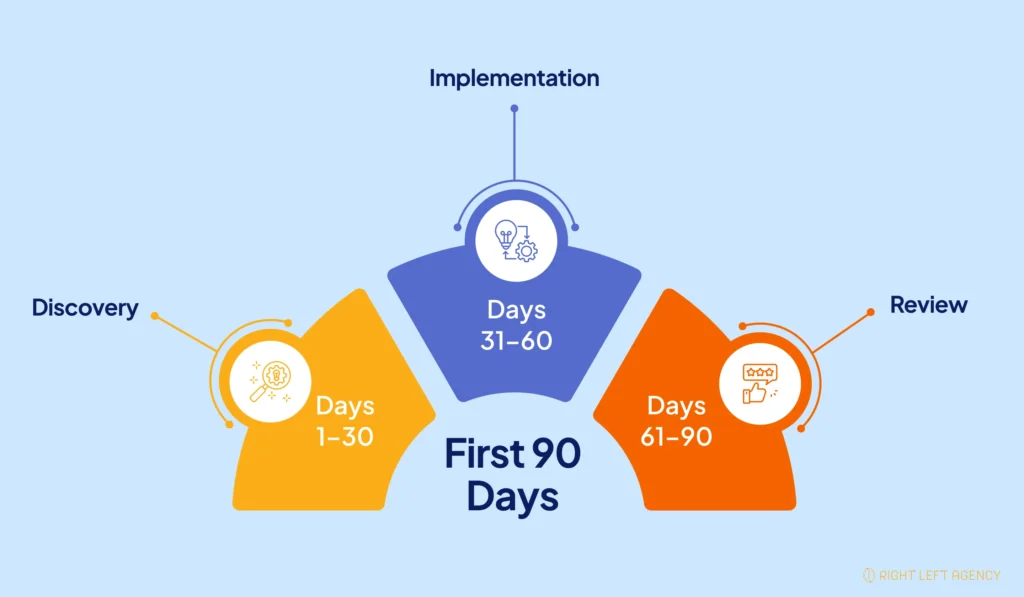
Days 1–30—Discovery, Research, and Measurement
During the first month, the agency should focus on:
- Product discovery
- ICP research
- Stakeholder interviews
- Sales and customer insights
- Technical and content audits
- Conversion tracking
- Buyer-journey mapping
- Priority identification
- Approval workflows
- Internal responsibilities
By the end of this phase, both teams should understand what the agency is targeting, why those priorities matter, and how progress will be measured.
Days 31–60—Strategy and Initial Implementation
The next phase should move from research into action.
This may include:
- High-priority technical fixes
- Content architecture
- Product-page improvements
- Bottom-of-funnel content
- Internal linking
- Reporting dashboards
- Publishing processes
- AI-search baselines when relevant
The work should reflect what the agency learned during discovery. A generic strategy created before research should raise concerns.
Days 61–90—Execution Review and Next-Stage Plan
During the final phase, both teams should review:
- Implementation quality
- Early visibility signals
- Conversion indicators
- Publishing bottlenecks
- Technical dependencies
- Initial content performance
- Ongoing priorities
- Future scope
One common mistake is allowing the first 90 days to become an extended audit period.
Research matters, but you should also see implementation momentum. At the end of the period, decide whether to maintain, expand, or reduce the engagement.
Red Flags to Avoid When Hiring a SaaS SEO Agency
Some warning signs appear before the contract is signed. Others become visible when you ask more detailed questions.
Pay close attention to guarantees, vague reporting, hidden delivery teams, and unclear ownership.
Strategy and Performance Red Flags
Be cautious when an agency:
- Guarantees rankings or immediate revenue
- Focuses only on traffic or article volume
- Cannot connect its work to qualified demand
- Uses the same strategy for every SaaS company
- Starts publishing before learning the product
- Targets keywords without commercial reasoning
- Provides recommendations without an implementation plan
A strong agency should be able to explain why each priority matters and how it supports the buyer journey.
Evidence and Team Red Flags
Warning signs include:
- No relevant SaaS examples
- Logos without detailed case studies
- Senior staff during sales but junior staff during delivery
- Hidden roles and responsibilities
- Undisclosed outsourcing
- Limited access to strategic leadership
- Processes explained through unnecessary jargon
Transparency matters because the delivery team has more influence on the results than the sales presentation.
AI-Search Red Flags
Challenge an agency that:
- Sells AI SEO without defining the service
- Cannot name the platforms it monitors
- Guarantees AI citations or pipeline
- Cannot explain how GEO differs from SEO
- Uses metrics you cannot verify
- Treats GEO as essential for every SaaS company
AI-search visibility can be valuable, but it should be supported by a clear process, practical measurement, and real commercial relevance.
Commercial and Ownership Red Flags
Avoid agencies that:
- Use unclear pricing
- Hide additional fees
- Push long contracts before proving competence
- Retain ownership of content or accounts
- Restrict administrative access
- Use removable link networks
- Provide no cancellation or handover process
You should not lose access to your website, content, data, or strategic assets when the engagement ends.
Questions to Ask a B2B SaaS SEO Agency Before Hiring
The right questions can reveal more than a polished proposal.
Use the following questions during your agency calls.
Product and Market Questions
- How will you learn about our product and market?
- How will you research our ideal customer profile?
- Which internal teams and data will you need?
- How will you identify customer pain points and objections?
- How will our positioning influence the strategy?
- How will you understand our sales cycle and buying committee?
Strategy and Deliverable Questions
- Which page types would you prioritize first?
- How will you balance educational and bottom-of-funnel content?
- Will you improve product and conversion pages?
- How will you handle technical implementation?
- What should the first 90 days include?
- How will the strategy reflect our growth model?
Team and Process Questions
- Who will lead our strategy?
- Who will complete the daily work?
- What SaaS experience does each person have?
- Will any work be outsourced?
- How much access will we have to senior specialists?
- How will you manage approvals and publishing delays?
Measurement Questions
- Which business metrics will you track?
- How will you distinguish qualified traffic?
- How will you connect SEO to trials, demos, and pipeline?
- How will you handle multi-touch attribution?
- What happens when performance is weaker than expected?
- What will reporting meetings cover?
Pricing and Ownership Questions
- What is included in the quoted price?
- Which services cost extra?
- What is the minimum contract term?
- What are the cancellation requirements?
- Who owns the content, data, website, accounts, and research?
- What happens to every asset when the engagement ends?
Do not judge the answers only by how confident they sound.
Look for clear processes, relevant examples, realistic limitations, and defined responsibilities.
Make the Final Hiring Decision
The final decision should balance strategy, evidence, implementation, reporting, team quality, pricing, and operational fit.
Recommended Selection Process
Use this process:
- Confirm that your company is ready.
- Define commercial goals and conversion metrics.
- Shortlist agencies with relevant experience.
- Request detailed case-study walkthroughs.
- Meet the actual delivery teams.
- Score each proposal using the same criteria.
- Review pricing, ownership, and cancellation terms.
- Start with a limited engagement when uncertainty remains.
- Expand after the agency proves its strategic and operational value.
A pilot does not have to be a small content package. It could focus on a technical issue, a content strategy, or a defined group of high-intent pages.
Use Strategic Fit as the Final Tie-Breaker
When two agencies receive similar scores, choose the team that understands your product, customers, buying motion, and internal working style more clearly.
The strongest agency may not be the largest or the cheapest.
It should be the team with the most credible plan, the strongest delivery process, and the clearest commitment to protecting your assets and commercial goals.
Communication also matters. A good partner should challenge weak assumptions, explain decisions clearly, and work well with your internal teams.
Choose a Partner Accountable to Business Outcomes
The best agency is not necessarily the one promising the most articles, traffic, or rankings.
Choose the team that understands your market, can turn recommendations into action, measures qualified outcomes, and gives you full control over your assets.
Verify the evidence. Meet the delivery team. Compare proposals fairly. Review the exit terms before signing.
When the right partner is in place, SEO becomes more than a traffic channel. Professional SEO services for SaaS companies help connect buyer demand with product discovery, qualified pipeline, and sustainable growth.
Ready to understand where your strongest organic growth opportunities are? Book a B2B SaaS SEO consultation with Right Left Agency to review your visibility, conversion paths, content gaps, and highest-priority opportunities.
Frequently Asked Questions
Is Hiring a B2B SaaS SEO Agency Worth It?
Hiring an agency can be worthwhile when your company has clear growth goals but lacks the time or specialist skills to execute effectively. The value depends on company readiness, agency quality, implementation speed, and commercial alignment.
When Should an Early-Stage SaaS Company Hire an SEO Agency?
An early-stage company should consider hiring an agency after validating its audience, customer problems, positioning, and conversion paths. Basic technical SEO can begin earlier, but large-scale content production should not rely on untested assumptions.
How Much Does a B2B SaaS SEO Agency Cost?
As a broad planning reference, some monthly retainers may range from $3,000 to $15,000. Actual pricing depends on geography, scope, technical complexity, content volume, authority building, and the seniority of the team.
How Long Does SaaS SEO Take to Produce Results?
There is no universal timeline. Technical improvements and early visibility gains may appear first, while qualified conversions, pipeline, and revenue usually require longer-term work across marketing, product, and sales.
Should a SaaS Company Hire an Agency or Build an In-House Team?
Choose an agency when speed and specialist capacity matter most. Build an internal team when close control and long-term ownership justify the recruitment and management costs. A hybrid model can combine internal knowledge with external expertise.
What Should a SaaS SEO Agency Report?
A SaaS SEO agency should report visibility, qualified traffic, trials, demos, activation, PQLs, SQLs, conversion rates, pipeline, and relevant revenue indicators. The final reporting framework should reflect your business model and goals.
Can an SEO Agency Guarantee Rankings or Revenue?
No credible agency can guarantee specific rankings or revenue. Search algorithms, competitors, implementation, product conversion, sales performance, and market conditions all affect results.
Should a SaaS SEO Agency Offer AI-Search Optimization?
An agency should understand AI-search discovery when it matters to your audience. It should clearly define the process, explain which platforms it monitors, and avoid vague or guaranteed claims.