Key Takeaways
- More trial signups don’t necessarily mean more customers — and can sometimes mean fewer.
- Weak conversion often starts with acquisition quality, not onboarding quality.
- Activation should measure a meaningful outcome, not a completed checklist.
- Time-to-value matters more than how many features a user has seen.
- Evaluate ICP fit and engagement together, not separately.
- Trial structure, pricing, and follow-up should change only after you’ve diagnosed where the funnel is actually breaking.
Your SaaS free trial signups are growing, but paid customers are not keeping pace. That does not automatically mean onboarding is the problem.
A trial signup shows interest, not purchase intent. Even activated users may not convert because they are outside your ICP, the value does not justify the price, or the plan does not fit their needs.
The mistake many SaaS teams make is treating trial conversion as an onboarding problem. In reality, conversion is a full go-to-market system: attracting the right users, setting the right expectations, helping them reach value, and creating a clear reason to buy.
What Is a Good SaaS Free Trial Conversion Rate?
There is no universal SaaS free trial conversion rate. Performance varies by trial type, audience, product complexity, pricing, acquisition channel, and sales motion.
That is why industry benchmarks should be treated as context, not a target. Conversion should also be measured alongside retention and customer quality, since a high trial-to-paid rate means little if customers churn quickly.
Opt-In vs Opt-Out Trial Conversion
Trial structure has a major impact on conversion rates.
An opt-in free trial allows users to start without entering payment information. This reduces signup friction and usually increases trial volume, but it also allows more low-intent users to enter the funnel.
An opt-out trial requires payment information before the trial begins. The additional commitment reduces signup volume but tends to create a more qualified trial population.
This means the two models should not be compared directly. A higher conversion rate from a credit-card-required trial may partly reflect stronger qualification before users ever enter the product.
Why Industry Benchmarks Can Be Misleading
Industry averages can provide useful context, but several factors influence what a healthy conversion rate looks like:
- Acquisition source: High-intent organic or branded traffic may convert differently from broad paid campaigns.
- Product complexity: A simple SaaS tool may demonstrate value much faster than an enterprise platform requiring integrations or configuration.
- Customer type: B2C, SMB, mid-market, and enterprise buyers behave differently.
- ACV: Higher-value products often involve more stakeholders and longer buying decisions.
- Trial model: Freemium, no-card trials, credit-card trials, and sales-assisted evaluations attract different levels of intent.
- Sales motion: Self-serve products and sales-assisted SaaS should not be evaluated using identical expectations.
- Sample size: Small datasets can make conversion rates appear stronger or weaker than they really are.
A benchmark only becomes useful when the companies behind it resemble your product, audience, pricing, and go-to-market model.
Why Your Own Funnel Benchmarks Matter More
Your historical funnel data is usually more useful than a broad industry average.
Track conversion by acquisition source, ICP segment, use case, trial model, activation, paid conversion, and post-conversion churn.
Your overall conversion rate may look healthy while one channel drives many low-quality trials and another brings fewer but more valuable customers. Segmenting the data helps reveal whether the real problem is conversion or the quality of users entering the funnel.
Trial Signups Don’t Mean Purchase Intent
Not every person who starts a free trial is a real buyer. Some are researching options, comparing competitors, lack budget authority, or fall outside your ICP.
Low-friction signup forms can increase trial volume, but they also attract users with little purchase intent. Signup intent shows interest. Purchase intent means the user has a real problem, budget, authority, and a reason to buy.
That difference matters. If trial activity is high but paid conversions are low, the problem may not be onboarding. It may be acquisition quality and too many unqualified users entering the funnel.
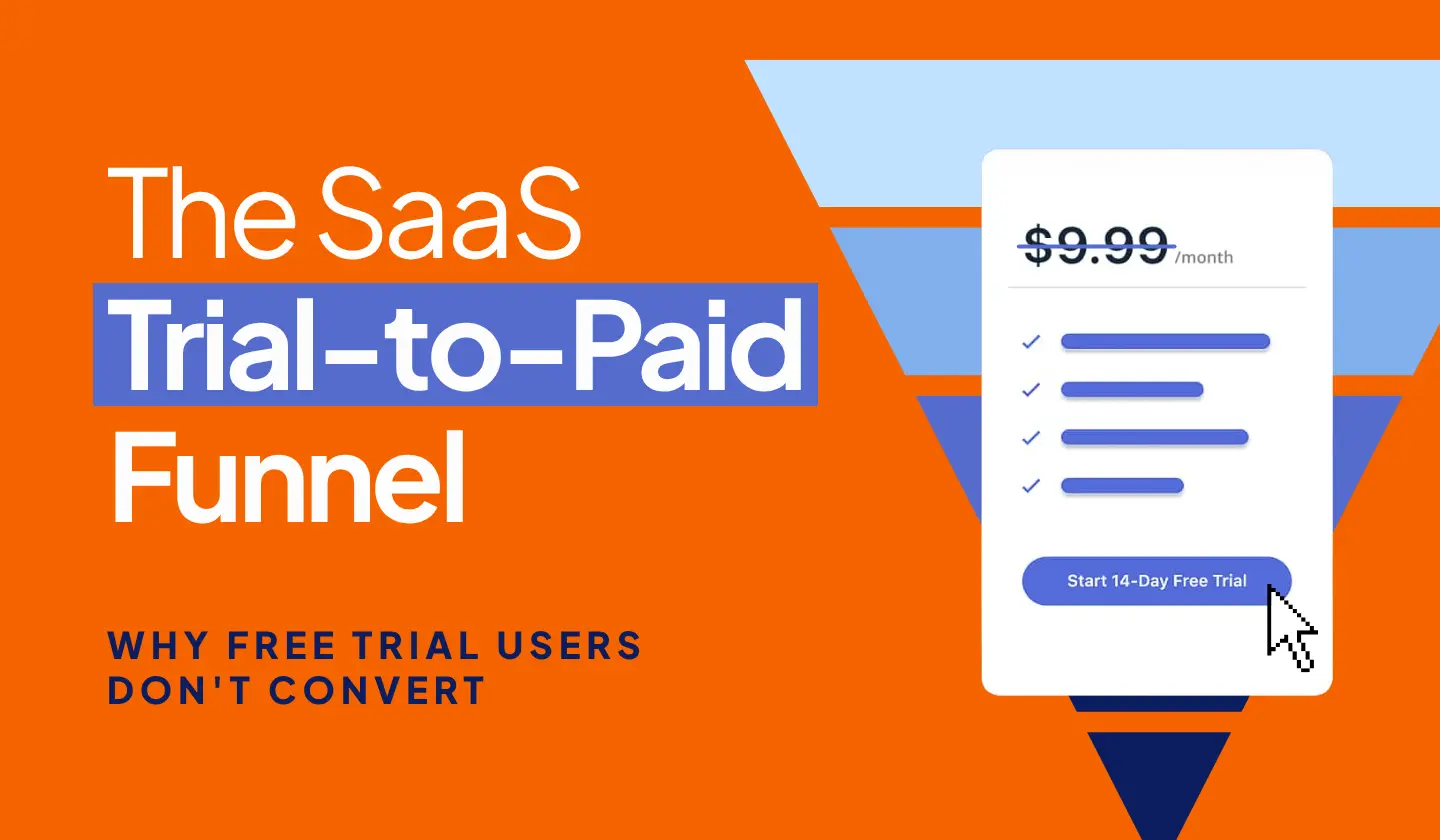
The SaaS Trial-to-Paid Funnel
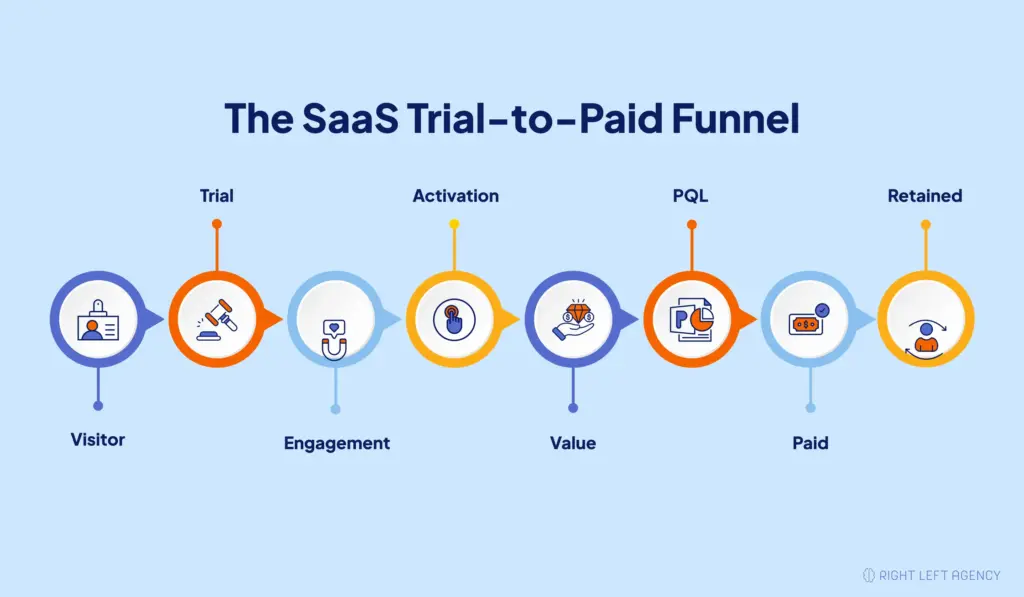
Every trial moves through the same conceptual stages, whether or not a team is actually tracking each one:
Visitor → Trial → Engagement → Activation → Value → Product Qualified Lead (PQL) → Paid → Retained
- Visitor-to-trial rate — how many visitors actually start a trial.
- Activation rate — how many trial users complete a meaningful action tied to the product’s core value.
- Time-to-value (TTV) — how long it takes a user to reach that meaningful outcome.
- PQL rate — how many activated users show behavior and fit signals that indicate real purchase potential.
- Trial-to-paid rate — how many trial users become paying customers.
- Post-conversion churn — how many paying customers stay paid.
Teams that only track trial starts and paid conversions are measuring the two endpoints of a multi-stage process and guessing at everything in between. A drop-off between activation and PQL looks identical to a drop-off between engagement and activation if you’re not measuring the stages separately — but the fix for each is completely different.
9 Reasons SaaS Free Trial Users Don’t Convert
1. You’re Attracting Users Outside Your ICP
If trial signups increase but engagement and paid conversions stay low, the issue may be poor audience fit rather than onboarding.
Campaigns optimized for low-cost registrations often attract users who do not match your target company size, role, industry, use case, or buying ability.
What to check:
- Are trial users matching your ICP?
- Which acquisition channels produce paying customers?
- Are users signing up because they have a real problem or because the trial is free?
Fix: Improve ICP targeting and optimize acquisition campaigns for qualified users, not just more trial volume.
2. Your Marketing Promise Doesn’t Match the Product Experience
If users sign up but leave shortly after entering the product, the problem may be an expectation gap between your marketing message and the actual product experience.
Ads, search results, landing pages, and sales messaging create expectations before signup. When the product does not deliver on that promise, users lose interest.
The journey should remain consistent:
Ad or search intent → Landing page promise → Signup expectation → Product experience → Outcome
What to check:
- Does the product deliver the outcome promised in marketing?
- Are users expecting something different after signup?
- Does onboarding reinforce the same message that brought users in?
Fix: Align marketing messaging, landing pages, onboarding, and product experience around the same customer outcome.
3. Users Don’t Know What to Do After Signup
If users sign up but never complete the first meaningful action, the problem may be unclear onboarding or too much friction before value.
Users should quickly understand what to do next, why it matters, and what outcome they will achieve.
What to check:
- Is the first action obvious?
- Are users required to complete unnecessary setup steps?
- Does onboarding guide users toward value or only explain features?
Fix: Create a focused onboarding path that moves users toward the first meaningful outcome as quickly as possible.
4. Users Complete Onboarding but Never Truly Activate
If users complete onboarding but still do not convert, the problem may be that your activation milestone does not represent real product value.
Completing setup, opening dashboards, or clicking features does not mean users experienced the reason they signed up.
Define Activation Around the User’s Intended Outcome
Activation should measure the moment when users achieve the outcome they wanted from the product.
For example, if users sign up to automate weekly reports, activation is successfully generating that report, not simply creating an account.
What to check:
- Does your activation event represent meaningful value?
- Are you measuring actions or outcomes?
- Which activated users eventually become customers?
Fix: Redefine activation around customer outcomes, not product activity.
5. Time-to-Value Is Too Long
If users show interest but disappear before understanding the product’s benefit, the problem may be that value arrives too late.
Integrations, imports, setup steps, and configuration can delay the moment when users experience why the product matters.
What to check:
- How many steps exist between signup and first value?
- Which setup steps are actually necessary?
- Where do users drop off before reaching the core outcome?
Fix: Remove unnecessary friction and shorten the path from signup to meaningful value.
6. Your Trial Explains Value Instead of Delivering It
If users complete tours, read documentation, or explore features but still do not convert, the problem may be that the trial teaches the product without proving its value.
Explaining what the product can do is different from helping users experience what it can do.
What to check:
- Are users learning features instead of achieving outcomes?
- Does onboarding focus on education or progress?
- How quickly do users reach the aha moment?
The difference:
Explaining value:
Tour → Tooltip → Documentation
Delivering value:
Signup → Core Action → Meaningful Outcome
Fix: Help users achieve a useful outcome first, then introduce additional features.
7. The Free Experience Gives Users No Reason to Upgrade
If users continue using the free version but do not purchase, the problem may be that the free experience already solves enough of their problem.
A free plan should demonstrate value while still creating a clear reason to upgrade.
What to check:
- Does the free plan solve the complete customer problem?
- Is the paid plan providing meaningful additional value?
- Are users reaching a natural upgrade point?
The Paywall Should Follow Value, Not Prevent It
The stronger sequence is:
Experience value → Want more value → Upgrade → Purchase
Fix: Design free and paid plans so users experience value first, then upgrade for expanded outcomes.
8. Pricing Doesn’t Match Perceived Value
If users activate but still refuse to buy, the problem may be pricing, packaging, or unclear value perception rather than onboarding.
Users may understand the product but feel the price does not match the expected business impact.
What to check:
- Are users objecting to price after experiencing value?
- Does packaging match customer needs?
- Is the difference between free and paid plans clear?
Fix: Improve pricing, packaging, and value communication so customers understand why upgrading makes sense.
9. Marketing Stops Once the Trial Starts
If users start trials but become inactive before purchasing, the problem may be a lack of support after signup.
A trial should be treated as the beginning of the customer journey, not the end of marketing.
What to check:
- Are inactive users receiving relevant guidance?
- Are high-intent users identified for sales follow-up?
- Are emails based on user behavior or only trial timing?
Fix: Use behavioral lifecycle marketing, re-engagement, and sales outreach to support qualified users.
However, the order matters:
Deliver value first → Optimize follow-up second
No email sequence can convert users who never experience meaningful product value.
How to Diagnose Where Your Trial Funnel Is Breaking
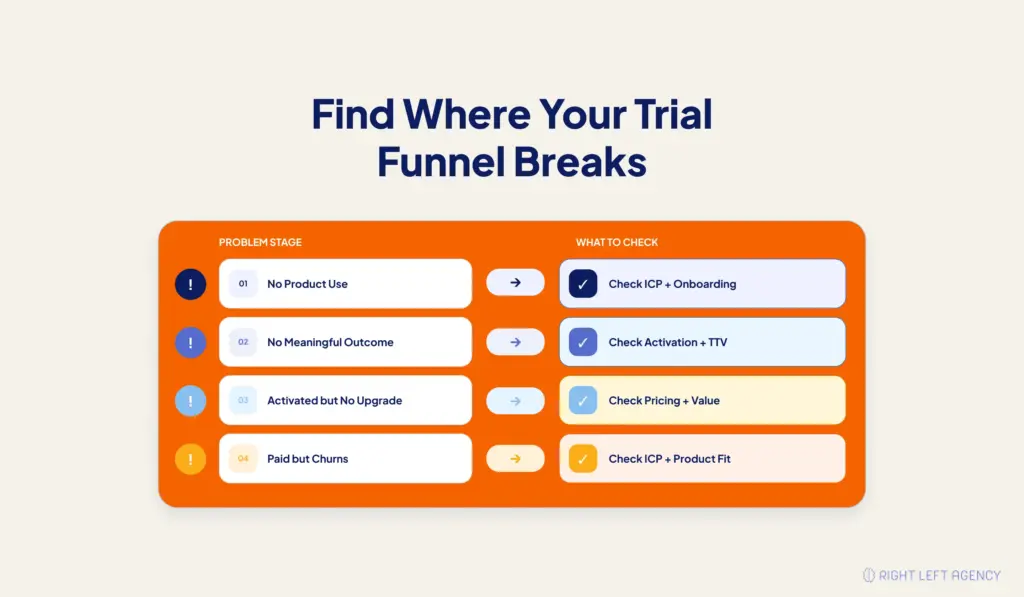
Different symptoms point to different root causes. Use the pattern of what you’re seeing to decide what to investigate first, rather than defaulting to the same fix every time.
| What You See | Likely Problem | Investigate First |
|---|---|---|
| Lots of trials, almost no product use | Acquisition or onboarding | ICP fit + first-session behavior |
| Users start but never reach an outcome | Activation / time-to-value | Activation funnel, step by step |
| Strong activation, weak upgrade rate | Pricing / perceived value | Upgrade objections, plan fit |
| Some sources convert far better than others | Acquisition quality | Channel-level conversion, not blended average |
| High usage, low purchase | Buyer intent/monetization | ICP fit + pricing/packaging |
| Paid customers churn quickly after converting | Expectation/product fit | Acquisition promise + ICP accuracy |
Don’t Guess Why Trial Users Aren’t Converting
Funnel data tells you where users drop off. It doesn’t tell you why. That’s where direct conversation with real users closes the gap between a hypothesis and a confirmed root cause.
Talk to Active Trial Users
Ask what they’re getting out of the product and what, specifically, would make them pay for it. Their answer tells you what your current activated-user value proposition actually is — which is sometimes different from what marketing assumes it is.
Talk to Users Who Disappeared
Ask what they expected when they signed up and where that expectation and the experience diverged. This is the fastest way to find a message-to-product mismatch that funnel data alone can’t surface.
Talk to Activated Users Who Didn’t Buy
This group is the most valuable to interview and the most commonly skipped. They reached value and still said no — which points to pricing, packaging, missing features, budget, or an internal procurement blocker, not an onboarding failure.
A few starting questions work across all three groups: What were you hoping to accomplish when you signed up? Did you accomplish it? What stopped you from paying?
Segment Trial Users by ICP Fit and Engagement
Not every trial user deserves the same treatment, and applying one playbook to all of them wastes effort on people who were never going to convert while under-serving the ones who were.
| High Engagement | Low Engagement | |
|---|---|---|
| High ICP Fit | Convert | Activate |
| Low ICP Fit | Evaluate | Deprioritize |
High Fit + High Engagement
These are your clearest conversion opportunities. Focus on pricing clarity, packaging fit, and — where the deal size justifies it — direct sales intervention.
High Fit + Low Engagement
This is an activation problem, not a lost cause. Focus on onboarding, expectation-setting, and reducing time-to-value for exactly this segment.
Low Fit + High Engagement
Worth a closer look before writing off: this could represent a viable secondary ICP the product wasn’t originally positioned for, or it could be non-commercial usage that will never convert. The two look identical in engagement data alone.
Low Fit + Low Engagement
Limit lifecycle investment here. These are the trials least likely to produce a return on further nurture spend.
Why Acquisition Channel Quality Affects Trial Conversion
Not all traffic carries the same intent, even when it lands on the same signup form. Branded search and problem-aware organic content tend to bring users who already understand roughly what they need. Paid social and broad-match paid search can generate high trial volume from users earlier in — or entirely outside — a buying process. Referral and partner traffic often carries pre-qualified intent from the referring relationship. Review-platform traffic tends to be actively comparing alternatives, which is a different intent signal than someone who searched for a specific problem.
Measuring conversion in aggregate hides all of this. Measuring it by source shows which channels are actually producing paying customers versus which are producing cheap signups that inflate a vanity metric.
Stop Optimizing Marketing for Trial Signups Alone
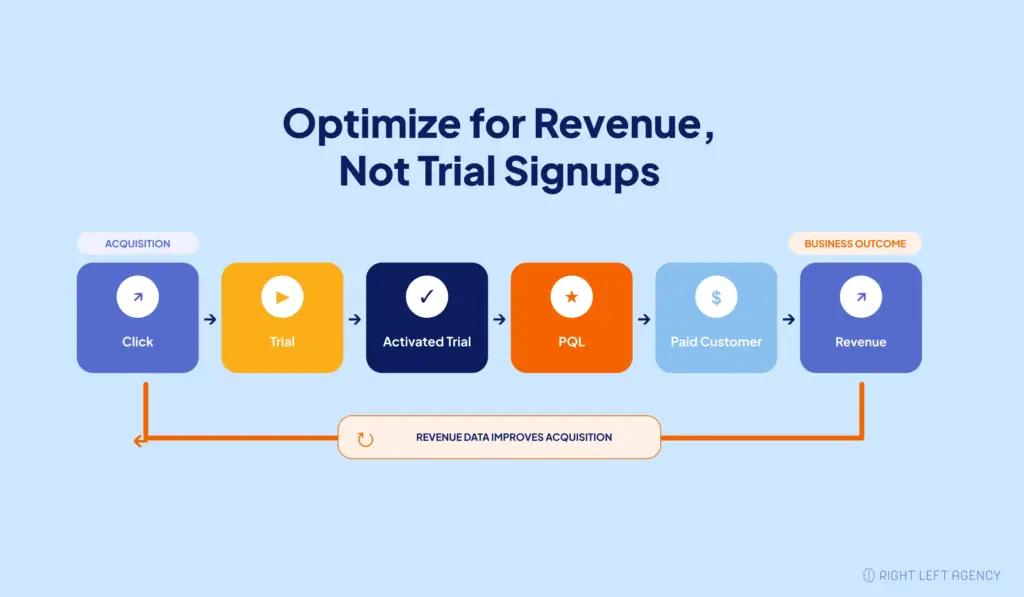
If acquisition is measured on clicks, registrations, trial starts, and cost-per-lead, it will optimize for exactly those things — and none of them guarantee revenue. The more useful set of metrics follows the user further down the funnel:
Click → Trial → Activated Trial → PQL → Paid Customer → Revenue
Shifting the reporting metric from “trial starts” to “activated trials,” “PQLs,” and “paid customers acquired” changes what acquisition actually optimizes for. It also creates a feedback loop: downstream customer and revenue data should inform which channels get more budget, not just top-of-funnel volume.
How Marketing Can Improve Trial-to-Paid Conversion
Improve ICP Targeting
Qualify for fit — company size, role, use case, budget, and intent — rather than optimizing purely for signup volume.
Align Campaign Messaging With Product Reality
Keep the promise consistent across the ad, the landing page, onboarding, and the product itself. Every point where that promise breaks is a point where expectation-driven churn can happen.
Optimize Around the Activation Event
Define the specific outcome that constitutes real value, and design the first session to guide users toward it — rather than measuring setup completion as a proxy for progress.
Reduce Time-to-Value
Remove steps that aren’t strictly necessary for the first outcome. Push deeper configuration to after that first value moment, not before it.
Use Behavioral Lifecycle Marketing
Trigger outreach based on what a user has actually done — or hasn’t done — rather than relying on a single generic drip sequence for every signup.
Identify and Prioritize PQLs
Common PQL signals include use of a critical feature, repeat sessions, completed integrations, data imports, team invitations, workflow completion, and hitting a plan limit. These behaviors tend to correlate with real purchase intent far more reliably than login count alone.
Feed Paid-Customer Data Back Into Acquisition
Source-level conversion, customer quality, CAC, and retention data should flow back into channel and campaign decisions — closing the loop between acquisition spend and actual revenue outcomes.
Before Changing Your Trial Model, Find the Root Cause
Before changing your trial model, confirm whether the problem is actually trial structure. A weak conversion rate caused by poor ICP targeting, unclear activation, or weak value delivery will not automatically improve with a credit-card requirement or shorter trial period.
A different trial model can change who enters your funnel, but it cannot fix a product that attracts the wrong users, fails to deliver value quickly, or does not create enough reason to buy.
Start by identifying whether the issue is:
- Acquisition quality: Are the right users entering the trial?
- Activation: Are users reaching the product’s core value?
- Time-to-value: Are users getting results quickly enough?
- Commercial fit: Does the paid plan create enough additional value?
Only after these areas are understood should you evaluate whether changing your trial structure makes sense.
Your Trial Structure May Be Attracting Browsers Instead of Buyers
Every trial model trades some combination of signup volume for buyer qualification. More friction generally means fewer signups and a higher-intent population; less friction means more signups and a wider range of intent mixed in.
No-Card Free Trial
Lowest entry friction, broadest range of user intent. Produces the most signups and the widest spread between casual browsers and real buyers.
Credit-Card-Required Trial
Higher upfront commitment filters out low-intent signups before they enter the funnel, typically at the cost of total signup volume.
Paid Trial
A stronger qualification filter — users who pay something upfront have demonstrated real intent. Treat this as one option among several, not a universally superior model; it depends heavily on price point and buyer expectations in your category.
Freemium
Carries a specific risk worth naming directly: if the free tier fully solves the user’s problem, there’s structurally no reason for them to ever pay, no matter how good the product experience is.
Hybrid Trial
Lets users understand or configure value before being asked for payment commitment — a middle ground between opt-in and opt-out models.
Sales-Assisted Trial or Interactive Demo
Often a better fit than a self-serve trial for complex B2B SaaS, enterprise evaluation cycles, buying committees, and implementation-heavy products where a self-serve trial can’t realistically demonstrate full value alone.
How Long Should a SaaS Free Trial Be?
There’s no universal best duration. Trial length should be based on how long a qualified user actually needs to reach meaningful value — not an arbitrary industry default like “14 days” borrowed from a competitor.
A trial that’s too short can cut users off before they’ve reached the outcome that would have convinced them to pay. A trial that’s too long can remove the urgency that pushes an activated user to actually convert instead of leaving the decision for later. The right length depends on your product’s complexity and how quickly a well-fit user can reasonably get to a real result — match the trial to that timeline rather than a round number.
Sometimes the Conversion Problem Is Really a Product-Market Fit Problem
Every diagnostic path in this article eventually leads to one stronger possibility: some users experience real value, keep using the product, and still never pay — not because of price, not because of a missed follow-up, but because the problem the product solves isn’t severe enough to justify the cost for them.
Repeated use without willingness to pay is a meaningful signal on its own. It’s different from low activation, and it’s different from a straightforward pricing objection. Conversion tactics can improve how efficiently a strong offer converts qualified users — they can’t manufacture demand for a product solving a problem that isn’t painful enough to pay for. If this pattern shows up consistently across an activated, well-fit user segment, the more useful question shifts from “how do we optimize this trial” to “does this offer solve something valuable enough?”
Metrics to Track Beyond Trial Conversion Rate
| Metric | What It Shows |
|---|---|
| Visitor-to-trial rate | Top-of-funnel signup efficiency |
| Trial-to-activated rate | Whether signups are reaching real engagement |
| Activation rate | Share of trials reaching a meaningful outcome |
| Time-to-value | Speed from signup to first real result |
| PQL rate | Share of trials showing genuine purchase potential |
| PQL-to-paid rate | Effectiveness of sales/lifecycle follow-up on qualified users |
| Trial-to-paid rate | Overall conversion, headline number |
| Source-level conversion | Which channels produce customers, not just signups |
| ICP-level conversion | Whether targeting is actually reaching the right users |
| CAC by source | Acquisition efficiency by channel |
| Post-conversion churn | Whether converted customers stay converted |
| LTV / payback/retention | Whether the whole motion is actually profitable |
Trial conversion rate in isolation can look healthy while the business underneath it isn’t — a channel producing a high conversion rate but fast post-conversion churn isn’t actually a strong channel; it just looks like one until the retention data catches up.
What Good SaaS Trial Conversion Optimization Looks Like
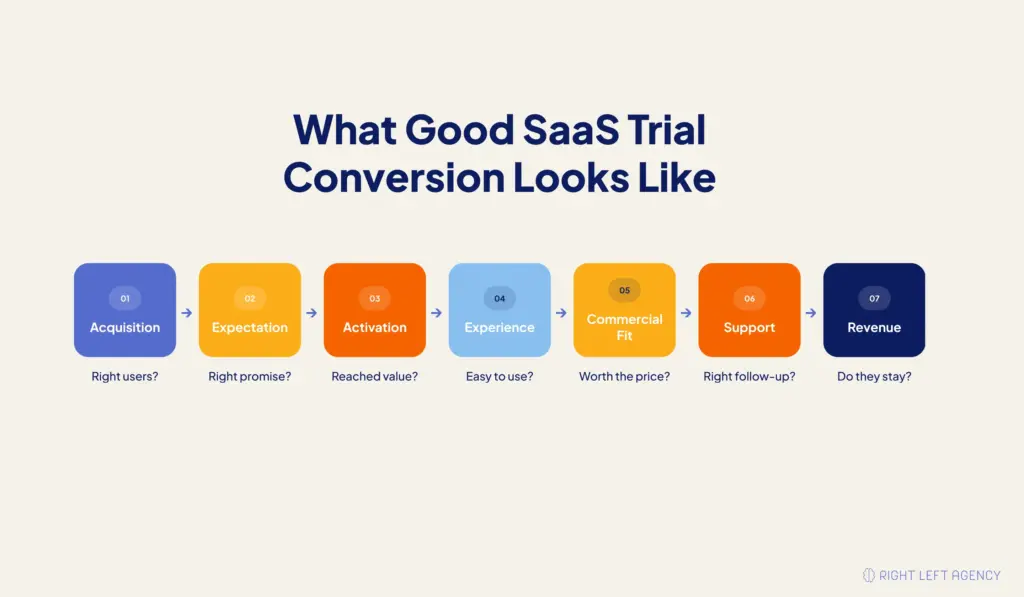
Every reason covered in this article maps to one link in the same chain:
Acquisition → Expectation → Activation → Experience → Commercial Fit → Conversion Support → Revenue
Acquisition Fit
Are the right users starting trials in the first place?
Expectation Fit
Does the product match the promise that got them to sign up?
Activation Fit
Do they reach the outcome that actually demonstrates the product’s value?
Experience Fit
Can they reach that value without unnecessary friction along the way?
Commercial Fit
Does the value they experienced justify the price and the plan they’d need to buy?
Conversion Support
Are qualified, engaged users getting the right nurture or sales attention at the right time?
Revenue Fit
Do the customers who convert actually retain — or does early churn expose a fit problem further upstream?
Weak SaaS free trial conversion is usually a go-to-market alignment problem, not an isolated onboarding problem. Diagnosing it means walking the whole chain — acquisition, expectation, activation, value, monetization, and follow-up — instead of defaulting to the first fix that’s easiest to ship.
Final Thoughts
Low SaaS free trial conversion is rarely solved by changing one onboarding screen or sending more reminder emails. The real problem can start anywhere in the funnel — from attracting the wrong users to failing to deliver value quickly, misaligned pricing, or weak follow-up with high-intent prospects.
Start by identifying where qualified users actually drop off. Measure ICP fit, activation, time-to-value, PQLs, trial-to-paid conversion, and retention instead of looking at trial signups alone.
Once you know where the funnel is breaking, fix that specific stage first. The goal is not simply to generate more trials. It is to attract the right users, help them experience meaningful value quickly, and turn that value into sustainable revenue.
FAQ
What is a typical SaaS free trial conversion rate?
There’s no single typical rate — it depends heavily on the trial model. Recent SaaS benchmark studies show that conversion rates vary significantly by trial model, with credit-card-required trials often converting at higher rates because they filter users earlier. However, these numbers should only be compared against similar products, audiences, and buying motions.
Should SaaS free trials require a credit card?
It depends on the tradeoff you want to make. Credit-card-required trials filter out low-intent signups and convert at a meaningfully higher rate, but they also reduce total signup volume — so the total number of paying customers produced can go either way depending on your funnel. There’s no universally “better” choice; it’s a volume-versus-qualification decision specific to your product and price point.
How long should a SaaS free trial be?
Match the length to how long a qualified user genuinely needs to reach meaningful value, not an arbitrary industry-standard number like 14 days. Too short cuts users off before they see real value; too long removes the urgency that pushes an activated user to actually convert.
What counts as a real activation event?
An activation event should reflect the specific outcome the user signed up to achieve — not a generic action like logging in or clicking through a tour. If someone signed up to automate a weekly report, activation is that report being generated successfully, not “visited the dashboard.”
Is freemium better than a time-limited free trial?
Neither is universally better — they solve different problems. Freemium carries a specific risk: if the free tier fully solves the user’s need, there’s no commercial reason for them to ever upgrade, regardless of product quality. A time-limited trial creates a natural decision point that freemium doesn’t.
Why would a well-fit user activate but still not pay?
This usually points to a pricing, packaging, or product-market fit issue rather than an onboarding issue. If it’s isolated to a few accounts, check pricing clarity and plan fit. If it’s a consistent pattern across an entire well-fit, activated segment, it may signal the problem you’re solving isn’t painful enough for that segment to pay for.
Should sales contact free trial users directly?
Selectively, and based on PQL signals — not every signup. Users who show fit and meaningful engagement (critical feature use, repeat sessions, completed integrations, team invitations) are worth a direct outreach; low-fit or low-engagement users generally aren’t a good use of sales time.
Can lifecycle emails fix a low trial conversion rate on their own?
Only partially. Behavioral emails and re-engagement nudges can catch users who are close to activation but haven’t quite reached it. They can’t manufacture value a user never actually experienced — if the product never delivered a meaningful outcome, no email sequence will convert that user.