Key Takeaways
- Choose based on coordination needs, not the number of services an agency offers.
- Full-service agencies fit teams needing cross-channel strategy, execution, and pipeline ownership.
- Specialist agencies work best for focused channel problems requiring deeper expertise.
- The biggest difference is who owns attribution, priorities, and growth decisions.
- The right agency model depends on growth stage, GTM complexity, and internal marketing maturity.
The right model depends on three things: how complex your go-to-market motion is, how much marketing maturity you have in-house, and how much coordination cost you’re willing to absorb across vendors — not on which agency lists more services.
This isn’t a “full-service wins” argument. Specialists win outright in specific scenarios — a narrow channel bottleneck, or a strong internal lead who just needs deep execution in one discipline. That’s also a different question from “agency or in-house” — if you haven’t decided to bring in an outside partner at all, start there; this piece assumes you have.
By the end, you’ll have a decision framework — the RLA Budget Fit Matrix — not just a list of pros and cons.
What Is a Full-Service SaaS Marketing Agency?
A full-service SaaS marketing agency runs multiple marketing disciplines — SEO, paid acquisition, content, CRO, and branding — under one team, with a single point of contact who owns the pipeline number.
Day-to-day, that means one strategist (or small pod) is looking across channels at once, not just executing inside one. If paid spend and organic content are both feeding the same funnel, a full-service partner is the one deciding how budget moves between them when one channel outperforms the other. Reporting rolls up to a single dashboard tied to pipeline, not five separate channel reports you have to reconcile yourself. SaaS marketing services is a working example of what that looks like in practice: strategy, execution, and reporting held by one team rather than split across vendors.
What a full-service agency is responsible for that a specialist isn’t: the connective tissue between channels — deciding what to prioritize when priorities conflict, and answering for the whole pipeline number, not just their slice of it.
What Is a Specialist SaaS Marketing Agency?
A specialist SaaS marketing agency focuses on one or two disciplines — technical SEO, paid search, or ABM, for example — and goes deeper on that discipline than a generalist team typically can.
That depth is the trade-off: a specialist SEO partner lives inside crawl budgets, schema, and search intent mapping all day, every account. A specialist paid search team is testing bid strategies and audience segments across a portfolio of accounts, which compounds into pattern recognition a generalist splitting time across five channels won’t develop as fast. What you give up is coordination — a specialist optimizes what they can see inside their channel, and someone else has to own how that channel fits with everything else you’re running.
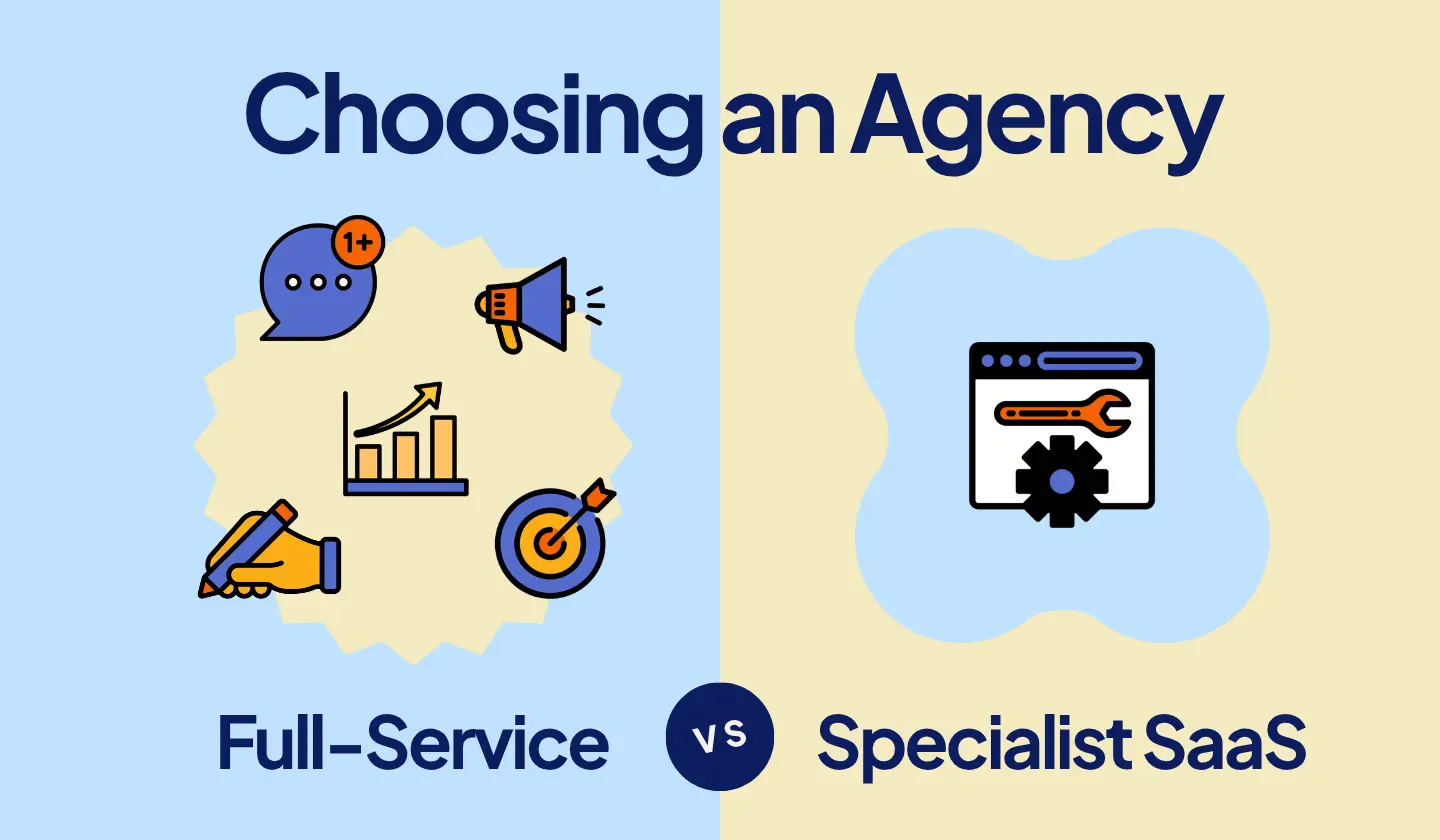
Full-Service vs. Specialist SaaS Agency: Key Differences
The difference comes down to who owns coordination across channels versus who owns depth within one.
| Factor | Full-Service Agency | Specialist Agency |
|---|---|---|
| Scope | Multiple channels (SEO, paid, content, CRO, branding) under one team | One or two disciplines, executed deeply |
| Coordination overhead | Low — one point of contact manages cross-channel priorities | Higher — you (or an internal lead) coordinate across vendors |
| Pipeline attribution | Owned by the agency, reported as one number | Owned by you, stitched together across vendor reports |
| Channel depth | Broad, but distributed across disciplines | Deep — often ahead of what a generalist team can reach in that one channel |
| Speed to execute a single channel | Slower to reach top-tier depth in any one channel | Faster — that channel is the entire focus |
| Cost structure | Generally a higher retainer, but consolidates work multiple vendors would otherwise split | Generally lower per-vendor cost, but coordination time is a real cost you’re absorbing internally |
| Scalability | Scales by adding scope within the same relationship | Scales by adding more specialist vendors, each with its own onboarding |
| Typical stage fit | GTM rebuilds, growth-stage companies needing coordinated pipeline | Narrow bottlenecks, or teams with a strong internal generalist already coordinating strategy |
| Reporting | Unified, pipeline-level | Channel-level, requires internal synthesis |
On cost specifically: full-service retainers are generally priced higher than a single specialist engagement, but that comparison only tells half the story. Total cost of ownership includes the internal time spent coordinating across two, three, or four specialist vendors — reconciling reports, resolving conflicting recommendations, and deciding where budget should move when one channel underperforms. For some teams, that coordination time is genuinely worth absorbing. For others, it’s a hidden cost that erases the savings on paper.
The Real Difference Isn’t Services Offered — It’s Coordination Cost and Attribution
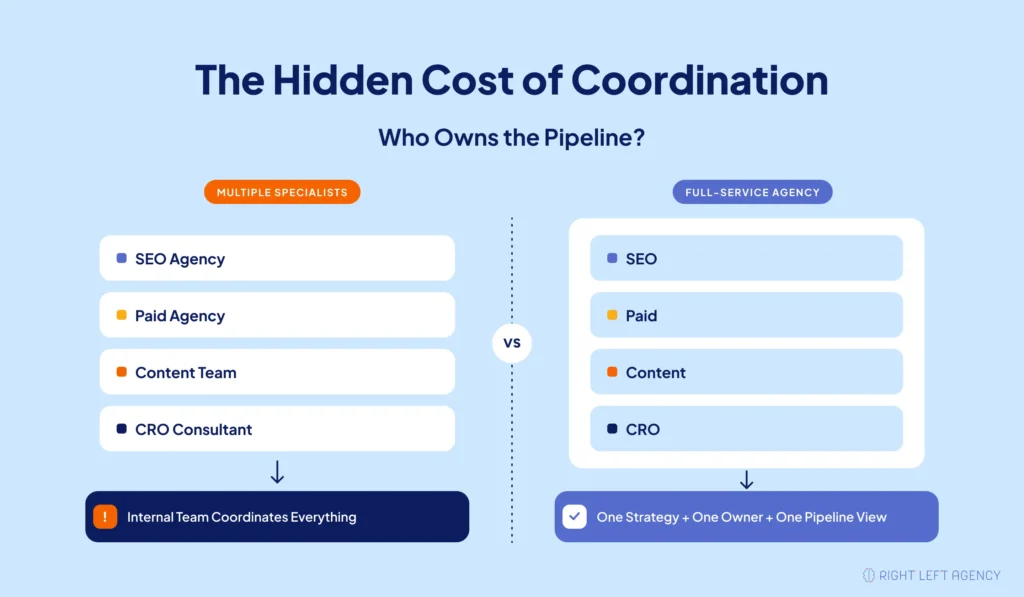
When SEO, paid, CRO, and creative sit with four different vendors, no one owns the pipeline number.
Here’s what that looks like in practice: your SEO vendor reports rising organic traffic, your paid vendor reports a healthy cost-per-lead, your CRO vendor reports an improved conversion rate on the pages they touched — and pipeline is still flat. Each vendor is technically hitting their metric. None of them is responsible for the number that actually matters, because none of them can see the whole system. When you want to shift budget from underperforming paid spend into content that’s finally gaining traction, that’s not one conversation — it’s three, with three different account teams who don’t share context and aren’t incentivized to agree with each other’s read on what’s working.
The core claim: services offered is the wrong axis to compare on. The real question is who’s accountable for the pipeline number when channels have to trade off against each other — and whether that accountability sits with one team or gets split across as many vendors as you have channels.
This is why switching agencies often traces back to coordination breakdowns rather than any single channel underperforming, and why attribution gets fragmented the moment ownership is split — each vendor’s dashboard tells a locally true story that doesn’t add up to an accurate picture of the whole funnel.
When to Choose a Full-Service SaaS Marketing Agency
Choose full-service if any of the following describes where you are:
- You don’t have an internal marketing team, or the one you have doesn’t have bandwidth to coordinate multiple vendors on top of everything else they own.
- You’re already running several disconnected channels, and it’s causing visible problems — conflicting priorities, no one who can explain how the pieces fit together, budget decisions made channel-by-channel instead of holistically.
- You’re mid-GTM rebuild — new positioning, a rebrand, or a repositioning that needs every channel moving in the same direction at once, not adjusting independently on different timelines.
- You’re an established SaaS company trying to reduce dependency on paid media across several channels simultaneously, which requires coordinated execution, not one specialist optimizing one lever.
When to Choose a Specialist SaaS Marketing Agency
Choose a specialist if any of the following describes where you are:
- You have a specific, narrow growth bottleneck — a paid-search account that needs a rescue, for example — rather than a systemic, cross-channel problem.
- You already have a strong internal generalist or marketing leader coordinating strategy and managing vendors, who just needs deep technical execution in one channel.
- You have an existing, validated GTM strategy and need one channel executed at a level higher than your internal team can reach on its own.
Where Specialists Have a Genuine Advantage
Deeper platform and technical expertise for the same slice of budget, and the highest ROI you’re likely to get within a single channel — but only when someone else already owns cross-channel coordination. If a paid-search specialist’s recommendations conflict with your content strategy and no one’s job is to reconcile that, the depth stops mattering regardless of how good the specialist is.
If you already have that internal coordination in place, or you’re dealing with a genuinely narrow point-problem, look at how to choose a content marketing agency or how to choose a B2B SaaS SEO agency for what good specialist selection looks like in practice.
Choosing Based on SaaS Growth Stage
Growth stage shapes which model fits, though it’s a modifier, not the whole answer on its own.
Seed and early-stage SaaS companies often need positioning, ICP definition, and messaging clarity before channel scale-up makes sense at all — which usually points toward a specialist or a narrow, focused engagement rather than a full coordination layer with nothing yet to coordinate. Series A/B growth-stage companies typically need a predictable, coordinated pipeline across more than one channel at once, which is where full-service tends to earn its cost. Enterprise SaaS companies need scale and multi-channel execution regardless of stage, but which model fits them depends more on internal team maturity than on stage alone — a well-staffed enterprise marketing org might only need specialist depth layered on top of what they already run.
Two modifiers worth weaving in rather than treating as separate decisions: PLG motions tend to concentrate spend and attention on a narrower set of channels (product, lifecycle, self-serve conversion) where specialist depth can go further faster, while sales-led motions with longer, more complex cycles tend to need coordination across more touchpoints — content, paid, sales enablement — which favors full-service. Sales cycle complexity compounds this: the longer and more multi-threaded the cycle, the more channels are involved in a single deal, and the more coordination cost matters.
The RLA Budget Fit Matrix: A Framework for Deciding
The matrix runs on four axes: ARR/stage, GTM motion, primary bottleneck, and channel scope.
Rather than treating “which model fits me” as a single yes/no question, plot your situation against those four variables and the answer tends to fall out on its own. A few concrete scenarios show how:
- Early-stage SaaS validating a single channel. Low ARR, GTM motion still being tested, bottleneck is “we don’t know if paid search can work for us yet,” channel scope is narrow by necessity. This points toward a specialist or a tightly scoped engagement — there isn’t yet a system to coordinate.
- Growth-stage SaaS needing predictable, coordinated pipeline. Series A/B, GTM motion validated but scaling, bottleneck is “our channels aren’t working together,” channel scope is broad. This points toward full-service — the coordination problem is the actual bottleneck.
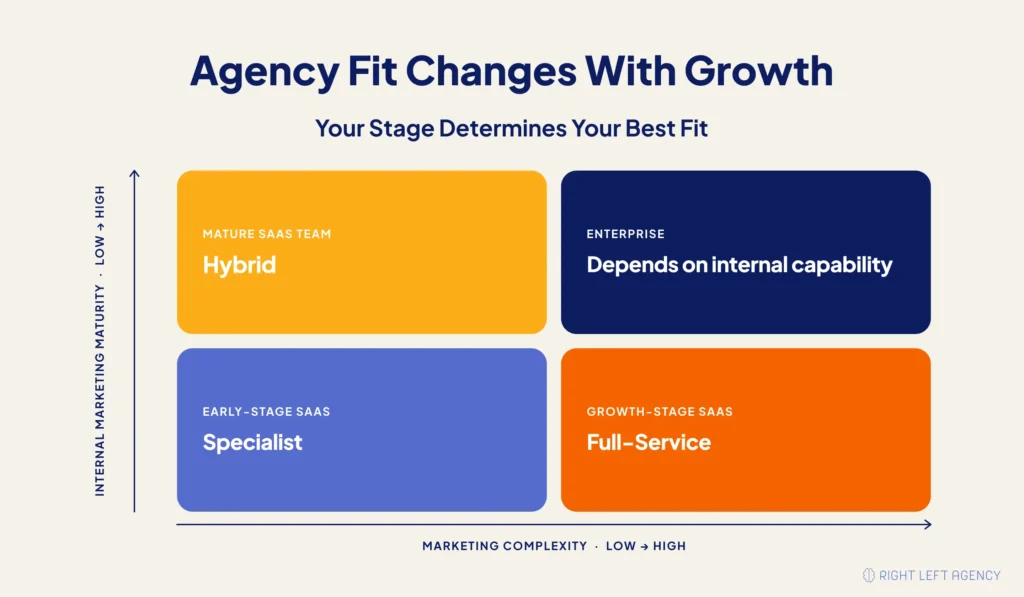
- Established SaaS trying to reduce paid-media dependency. Later-stage, GTM motion mature, bottleneck is “we’re overexposed to rising CAC on paid,” channel scope needs to expand into organic and content simultaneously. This points toward full-service, since diversifying channels while keeping pipeline stable requires coordinated execution, not one new specialist vendor added on top of an already-fragmented stack.
- Company mid-GTM-rebuild needing full coordination. Any stage, GTM motion actively changing, bottleneck is “our whole positioning and channel mix needs to move together,” channel scope is everything at once. This points toward full-service — a rebuild by definition can’t be executed in disconnected pieces.
If you want to run your own numbers through this rather than map it manually, our SaaS Growth Priority Finder walks through the same variables interactively. For the budget allocation side of this decision specifically, see our guide to SaaS marketing budget allocation.
Can You Combine Both? The Hybrid Model
Yes, and it’s often the right answer — most companies don’t actually face a binary choice.
Two versions of this show up often: an internal marketing lead (or a fractional CMO) who owns strategy and vendor coordination, paired with a full-service partner supplying execution capacity across channels — the internal person is the coordination layer, the agency is the hands. Or, a full-service partner runs the core engine — the channels that need to move together — while a single-point specialist handles one channel that needs more depth than the full-service team’s generalist coverage can reach. Both versions work because they’re deliberate: someone has explicitly decided who owns coordination and who owns depth, rather than ending up with four vendors by accretion because each was hired to solve a different fire at a different time.
If a fractional CMO is already part of your setup or under consideration, that’s usually the cleanest way to run the first hybrid version — one person owns the coordination role permanently instead of it defaulting to whoever’s most stressed about the pipeline number that quarter.
How to Evaluate Any SaaS Marketing Agency Before You Hire
Once you know which model fits, the next question is which specific vendor to trust with it.
Questions to Ask Before You Sign
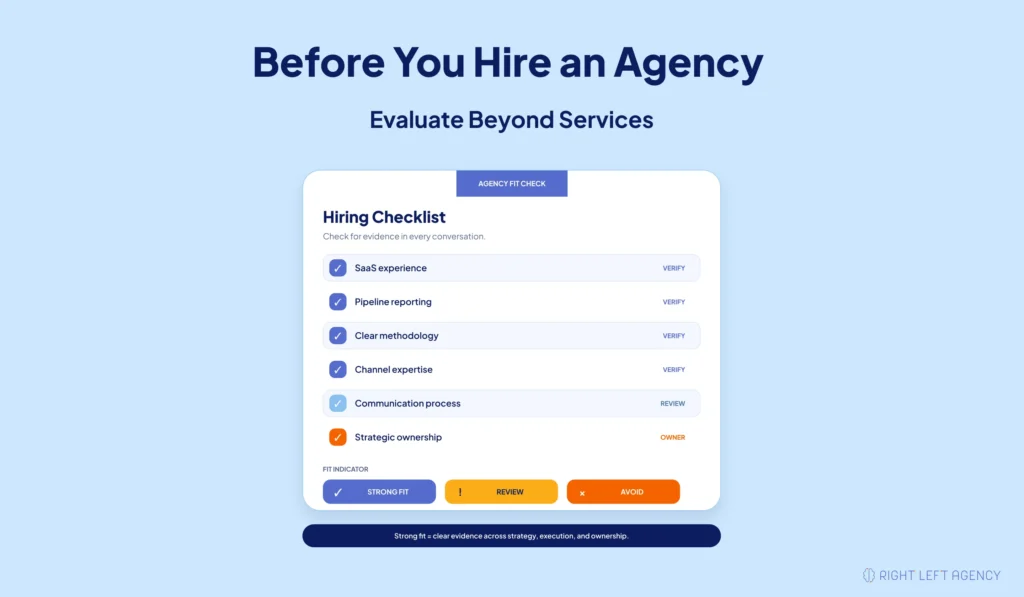
Ask how the agency reports on pipeline, not just channel-level metrics — traffic and click-through rates are easy to report and easy to hit without moving the number that matters. Ask how cross-channel priorities get reallocated when one channel underperforms: is that a scheduled quarterly review, or does it happen reactively, and who makes the call? Ask what actually happens in month one — audit, strategy document, first campaign live — so you know what “progress” is supposed to look like before you’re three months in wondering if anything’s happening.
Agency Evaluation Checklist
- Relevant SaaS experience — not just B2B experience broadly, but experience with recurring-revenue metrics and SaaS buying cycles specifically
- Pipeline-level reporting, not just channel metrics
- Technical capability appropriate to your stack and channels
- Strategic depth — can they explain why a tactic fits your specific situation, not just that it’s a best practice
- A clear single point of contact and communication cadence
- A brief, honest note on AI-search visibility as part of the broader SEO conversation — worth asking about, but not a reason on its own to pick one vendor over another
How to Measure Agency ROI
Tie agency activity back to pipeline and CAC, not traffic or rankings on their own. Rising organic traffic or improving keyword positions are leading indicators, not the result — the actual test is whether qualified pipeline is growing at a CAC that makes sense for your unit economics. An agency that can’t connect their reporting to that chain isn’t measuring the thing you’re actually paying for.
Where Right Left Agency Fits (and Where We Don’t)
RLA is built for: SaaS companies that need coordinated execution across more than one channel — GTM rebuilds, growth-stage companies whose channels aren’t working together, and established companies trying to diversify away from paid-media dependency without losing pipeline in the process. If coordination cost is your actual bottleneck, that’s the problem our model is built to solve.
RLA isn’t the right fit for a company with a strong internal marketing lead who just needs one channel executed more deeply — that’s a specialist engagement, and we’d rather tell you that than take on work that isn’t the best use of your budget. We’re also not the right fit for a narrow, single-channel rescue project where the rest of your marketing system is already working fine.
If the framework above places you in full-service territory, our services and case studies are the next place to look.
FAQ
Can I start with one specialist and add a full-service partner later?
Yes — this is common for early-stage companies validating a single channel before their GTM motion is established enough to need coordination across several. As you move into growth stage and add channels, revisit whether coordination cost has become the bigger problem.
What happens when priorities shift between channels in a full-service model?
A full-service partner reallocates budget and attention across channels as one decision, made by one team with visibility into all of them — rather than requiring you to convene separate vendors and reconcile conflicting recommendations yourself.
How do you avoid a full-service agency being mediocre at everything?
By staffing channel work with people who specialize within the agency, even though the client relationship is unified. The risk is real if an agency spreads a small generalist team across too many disciplines — ask directly who’s executing each channel and what their specific background is in it, rather than assuming “full-service” means “one generalist doing five jobs.”
Is a specialist agency cheaper than full-service?
Usually cheaper on a per-vendor basis, but that comparison leaves out the coordination time you’re absorbing internally once you have more than one specialist vendor. Whether that trade-off is worth it depends on whether you have someone internally who can (and wants to) own that coordination.
When should a SaaS company use multiple specialists instead of one full-service partner?
When you already have an internal lead coordinating strategy and vendor relationships, and each specialist is solving a genuinely separate, well-defined problem rather than needing to work together as a system.
What’s the difference between full-service and in-house-plus-one-agency?
In-house-plus-one-agency keeps coordination internal, with the agency contributing execution depth in one area. Full-service puts coordination in the agency’s hands across every channel it covers. Both can work — the difference is where the coordination role actually sits.