Key Takeaways
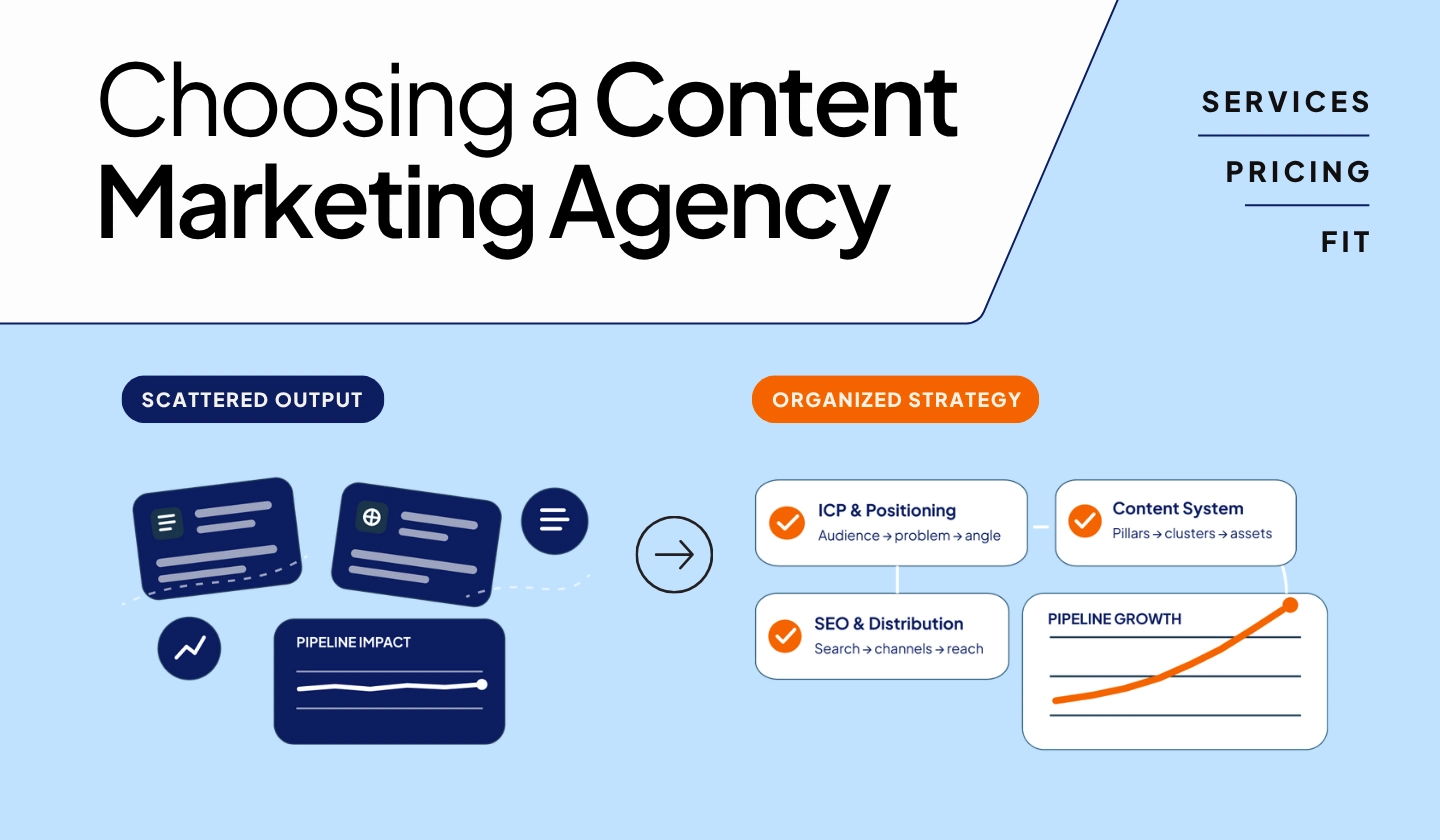
- Choose an agency based on the constraint limiting qualified pipeline, not promised content volume.
- Confirm who owns strategy, buyer research, bottom-funnel content, distribution, and measurement.
- Compare operating models before comparing retainers because similar scopes can hide different levels of strategic ownership.
- Require reporting that connects content with CRM activity, sales-accepted leads, opportunities, and pipeline.
- Do not hire an agency when the real constraint is product-market fit, sales follow-up, SME availability, or unrealistic expectations.
How to Choose a SaaS Content Marketing Agency
Choose a SaaS content marketing agency by matching its operating model to your funnel constraint, not to its output volume. Evaluate strategic ownership, SaaS buyer fluency, bottom-funnel capability, pipeline measurement, and pricing structure. Ask for a content-to-pipeline example rather than a portfolio, and confirm who writes, who edits, and who owns strategy.
- Diagnose whether content is actually your constraint.
- Decide which operating model fits that constraint.
- Set a realistic budget band before you take calls.
- Score each agency against nine criteria.
- Ask the eight questions that separate strategists from production shops.
- Normalize the proposals so you’re comparing like for like.
- Check the red flags and the exit terms.
- Agree what success looks like at 90 days before you sign.
The process starts before you build a shortlist. First, identify what is actually preventing content from contributing to the qualified pipeline.
Without that diagnosis, you can hire a capable agency to solve the wrong problem.
Start by Diagnosing Whether Content Is Actually Your Constraint
A constraint is the single upstream limiter preventing your content program from contributing more effectively to the pipeline. Content production may be the constraint, but it often is not.
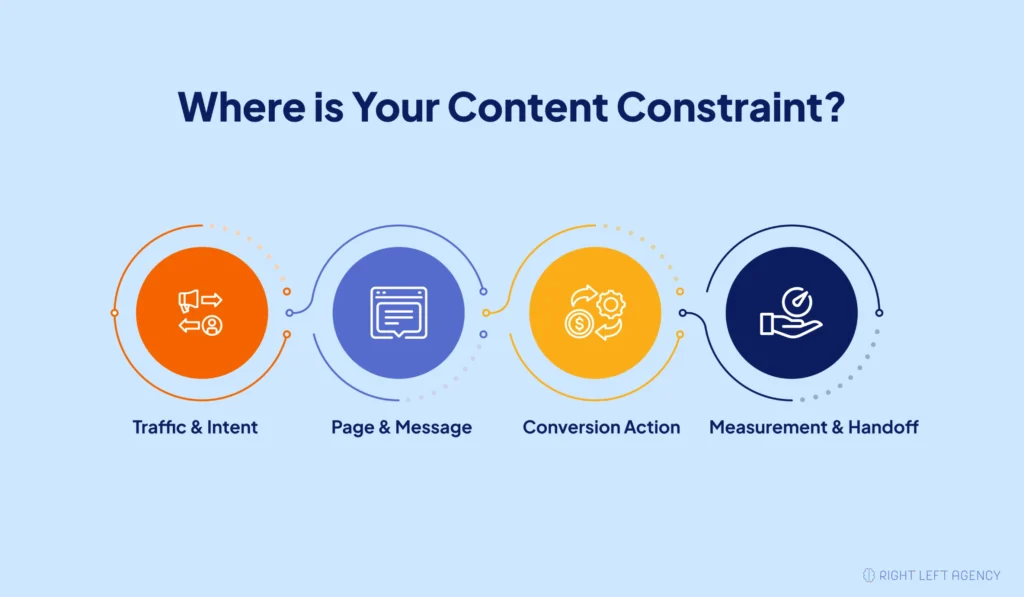
For example, growing traffic with stagnant demo requests may indicate weak search intent or conversion rather than insufficient publishing. Strong content cannot compensate for an unvalidated offer, a broken lead handoff, or a sales team that does not follow up consistently.
Run a SaaS Website Conversion Audit to diagnose whether content is your real constraint before increasing production.
If your bottleneck spans content, search, conversion, and acquisition, a broader SaaS growth marketing model may fit better. If visitors reach relevant pages but rarely act, conversion rate optimization may deserve priority.
The agency that helps a SaaS company whose content is not converting is the one structured to solve the failing layer. That may be a content partner, an SEO-led team, a CRO specialist, or a full-funnel partner. Start with the constraint, then choose the operating model.
Signs Your Constraint Isn’t Content Production
- Traffic rises while demos stay flat → intent or conversion problem
- Relevant pages rank, but visitors do not act → page or message problem
- Leads arrive, but sales follow-up is inconsistent → handoff problem
- Publishing is frequent but mostly top-of-funnel → strategy problem
- Writers constantly wait for internal experts → SME availability problem
- Your offer is still unvalidated → product or positioning problem
Find Out Whether Content Is Actually Your Constraint — Book a Growth Fit Call
What a SaaS Content Marketing Agency Actually Does
A SaaS content marketing agency plans, researches, creates, distributes, and measures content designed to move B2B SaaS buyers through the buying journey. A strong agency connects content strategy with search intent, customer insight, sales enablement, AI visibility, conversion, and pipeline rather than treating publishing volume as the outcome.
Its core functions can include:
- Content strategy
- Buyer and customer research
- Editorial production and SME interviews
- SEO, AEO, GEO, and AI search integration
- Distribution
- Sales enablement content
- Measurement
The important question is what sits outside the scope. Design, technical SEO, CRO, customer interviews, distribution, CRM implementation, or content refreshes may quietly remain your team’s responsibility.
Confirm those boundaries before comparing proposals.
Content Marketing Agency vs. SEO Agency vs. Freelance Writer
A content marketing agency usually owns the broader editorial and buyer-journey system, an SEO agency primarily owns search visibility, and a freelance writer usually executes an existing strategy. Some partners combine content strategy with SEO and AI visibility, but you should confirm exactly who owns intent selection, editorial direction, and measurement.
| Option | Owns | Doesn’t Typically Own / Best When |
|---|---|---|
| Content marketing agency | Strategy, research, editorial production, funnel content, often distribution | Deep technical SEO or wider growth work may sit outside scope. Best when you need an ongoing content operating system. |
| SEO agency | Search intent, keyword research, technical SEO, internal linking, organic visibility | Buyer research and sales enablement may vary. Best when search performance is the main constraint. |
| Freelance writer | Assigned content production | Usually does not own GTM strategy, distribution, or pipeline measurement. Best when your internal strategy is already strong. |
The Four Agency Operating Models
An agency’s operating model determines who owns decisions, what your budget funds, and which constraint the engagement can realistically solve.
| Model | Strategic Ownership | Typical Cost Driver | Best Fit | Common Failure Mode |
| Strategy-led partner | High | Senior thinking and research depth | Strategy or decision-content constraint | Lower output than volume-focused buyers expect |
| Production/throughput shop | Low to moderate | Content volume | Clear strategy with a capacity problem | Produces more without fixing intent or conversion |
| Content + SEO integrated | Moderate to high | Search and editorial integration | Search-intent and organic visibility constraint | Distribution may remain underserved |
| Full-funnel growth partner | High | Cross-functional strategy and measurement | Several connected funnel constraints | Too broad when you only need production |
Strategy-Led Partner
A strategy-led partner prioritizes senior thinking, customer understanding, and editorial direction. Choose this model when you need someone to decide what deserves to be created and how content should support buyer progression.
The trade-off is usually less emphasis on maximum publishing volume.
Production / Throughput Shop
A production shop is built for efficient output. It works when your strategy, positioning, funnel coverage, and measurement already exist and writing capacity is the clear bottleneck.
It struggles when weak topic selection or conversion is the underlying problem.
Content + SEO Integrated
This model combines content planning with search intent, keyword research, topical authority, internal linking, and related SEO work.
It fits companies whose primary constraint is discoverability or intent selection. Ask separately who owns distribution, CRO, and opportunity-level measurement.
Full-Funnel Growth Partner
A full-funnel partner coordinates content with functions such as SEO, CRO, paid acquisition, and measurement.
Choose this model when the problem crosses several stages of the funnel rather than sitting entirely inside content production.
What Drives Cost, and Where Scope Creep Hides
Price differences between SaaS content marketing agencies usually reflect differences in operating model and scope, not arbitrary positioning.
Seven factors drive cost most directly:
- Strategist seniority: how much senior decision-making the engagement receives.
- Research depth: customer, sales, and SME interviews require more work than desk research alone.
- Volume: more or more complex assets increase production requirements.
- Design and multimedia: diagrams, graphics, video, and supporting assets expand scope.
- Distribution: promotion beyond publishing requires additional resources.
- SEO integration: search intent, internal linking, technical SEO, AEO, and GEO deepen engagement.
- Measurement build: CRM fields, attribution workflows, and reporting infrastructure require implementation.
A lower-priced proposal may be perfectly reasonable if your team already owns several of those responsibilities.
Engagement Models: Retainer, Per-Asset, Project Sprint, Hybrid
A retainer fits ongoing strategy and execution. Per-asset pricing fits teams that already own strategy. A project sprint works for defined audits or initiatives. A hybrid model combines recurring strategic work with variable execution.
Content engagements shorter than three months usually leave too little time for research, production, distribution, measurement, and iteration to operate as one system. Treat roughly 90 days as a minimum learning window, not a guaranteed results deadline.
Where Scope Creep Hides
Check the SOW for:
- Revision limits
- Strategy sold separately from production
- Research or SME interview fees
- Change-request rules
- Tool and account ownership
For verified market benchmarks and deeper ROI considerations, see how much a SaaS marketing agency costs.
The Nine Criteria to Score Every Agency Against
Strategic ownership means a clearly identified person decides what gets written, why it matters, and how it supports the commercial objective.
Score every proposal against the same nine criteria instead of relying on presentation quality or portfolio appeal.
| # | Criterion | What “Good” Looks Like | Weight |
|---|---|---|---|
| 1 | Strategic ownership | A named senior strategist owns priorities and outcomes | High |
| 2 | SaaS buyer fluency | Customer, sales, and SME research tied to your GTM motion | Medium |
| 3 | Funnel coverage | Demonstrable bottom-funnel and decision-stage capability | High |
| 4 | Search and AI visibility | Strong intent selection and credible AI-answer retrievability | Medium |
| 5 | Distribution | A plan beyond publishing | Medium |
| 6 | Measurement | CRM, opportunity, and pipeline reporting with honest attribution limits | High |
| 7 | Editorial quality system | Defined research, review, editing, and fact-checking | Medium |
| 8 | Commercial model | Clear scope, revision limits, and change handling | Medium |
| 9 | Exit terms | Client owns content, data, and accounts with a defined transition | Medium |
Criterion 3: Can They Actually Produce Bottom-Funnel Content?
Agencies that produce bottom-funnel SaaS content understand evaluation and decision-stage questions, not just high-volume informational searches. Ask for examples of comparison pages, decision content, sales enablement assets, and content tied to demo or trial intent. More importantly, ask why those assets were prioritized and how they supported the buyer’s decision.
Bottom-funnel capability requires understanding objections, alternatives, buying criteria, ACV, and GTM motion. It is not simply another article format.
For named-provider research, use this shortlist of SaaS marketing agencies.
Criterion 4: Search and AI Visibility Competence
A capable agency should understand both SEO and how content becomes retrievable and citable in AI-generated answers. That requires strong search intent, clear answer structures, topical relationships, useful entity coverage, and content designed around the real questions buyers ask.
Some agencies combine SEO and blog content strategy effectively. The important distinction is whether one team genuinely owns intent selection and editorial strategy rather than placing two disconnected services under one proposal.
See AI search optimization for SaaS for the broader framework.
Criterion 6: Can They Connect Content to Pipeline?
Content agencies focused on qualified leads should connect content activity with CRM fields, sales-accepted leads, opportunities, and pipeline rather than stopping at rankings or pageviews. Ask how first-touch or multi-touch attribution reaches HubSpot or Salesforce and how the agency distinguishes useful evidence from claims the data cannot prove.
Attribution has limits. A single article rarely deserves full credit for a complex B2B SaaS opportunity.
The objective is a credible chain from content interaction to sales-accepted lead to opportunity, with uncertainty stated clearly.
Read more about how to connect content to pipeline.
Criterion 9: Exit Terms Most Buyers Forget to Ask About
Confirm that your company owns the content, research, data, analytics access, and accounts created during the engagement.
The SOW should also define notice periods, access transfer, file handoff, and transition responsibilities. Unclear exit terms create unnecessary commercial risk later.
Eight Questions to Ask on the Pitch Call
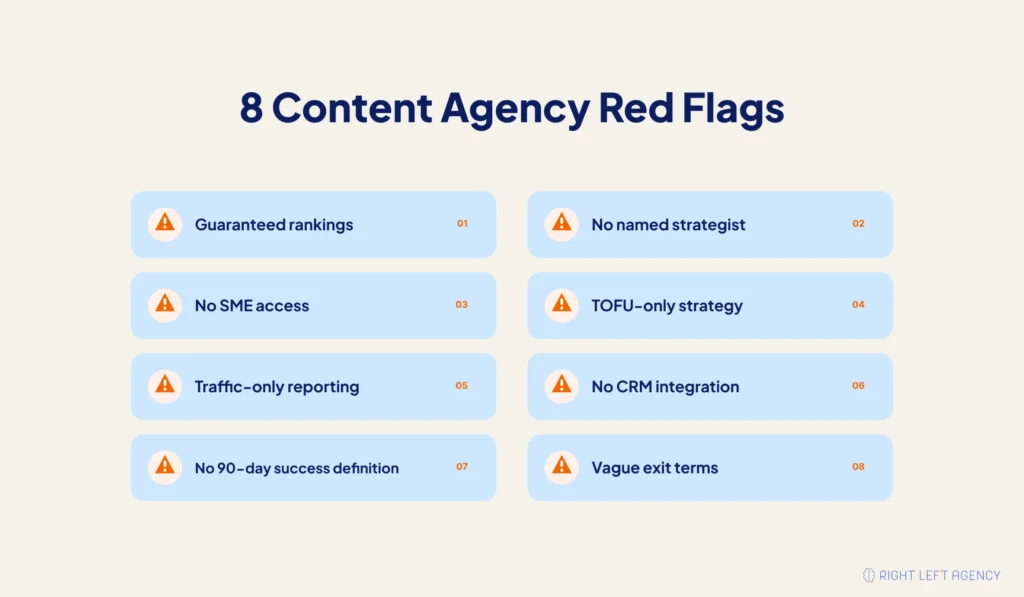
- Who decides what gets written and why? The answer that should worry you: topics come mainly from keyword volume or whatever you request.
- Who will be the senior strategist on our account? The answer that should worry you: the pitch strategist disappears after onboarding.
- How will you learn our buyers, GTM motion, and sales objections? The answer that should worry you: a brand brief replaces customer, sales, and SME input.
- Show me how you approach bottom-funnel content. The answer that should worry you: every example is top-of-funnel education.
- What happens after an article is published? The answer that should worry you: nobody owns distribution.
- How do you connect content to a qualified pipeline? The answer that should worry you: reporting ends at rankings, sessions, or MQL volume.
- What is included in revisions and scope changes? The answer that should worry you: limits and change-request rules are unclear.
- What happens to our content, data, and accounts if we leave? The answer that should worry you: ownership and transition terms are vague.
How to Normalize Proposals That Aren’t Like for Like
Proposal normalization means adjusting different proposals to a common basis so you compare what each engagement actually provides rather than comparing totals that hide different operating models.
| Dimension | Normalize For |
|---|---|
| Team seniority | Who actually works on your account |
| Output volume | Number and complexity of assets |
| Strategic ownership | Who controls priorities and funnel decisions |
| Tool inclusion | Which search, reporting, and workflow tools are included |
| Data ownership | Who controls data and accounts |
| Reporting depth | Traffic reporting versus CRM and pipeline reporting |
| Contract flexibility | Minimum term, notice period, and change rules |
If one proposal costs substantially less, identify which of these responsibilities moved back to your team before deciding it offers better value.
Red Flags
What a Good First 90 Days Looks Like
A good first 90 days should establish the strategy, operating system, measurement foundation, and leading indicators needed to evaluate the engagement. They should not be presented as guaranteed pipeline results.
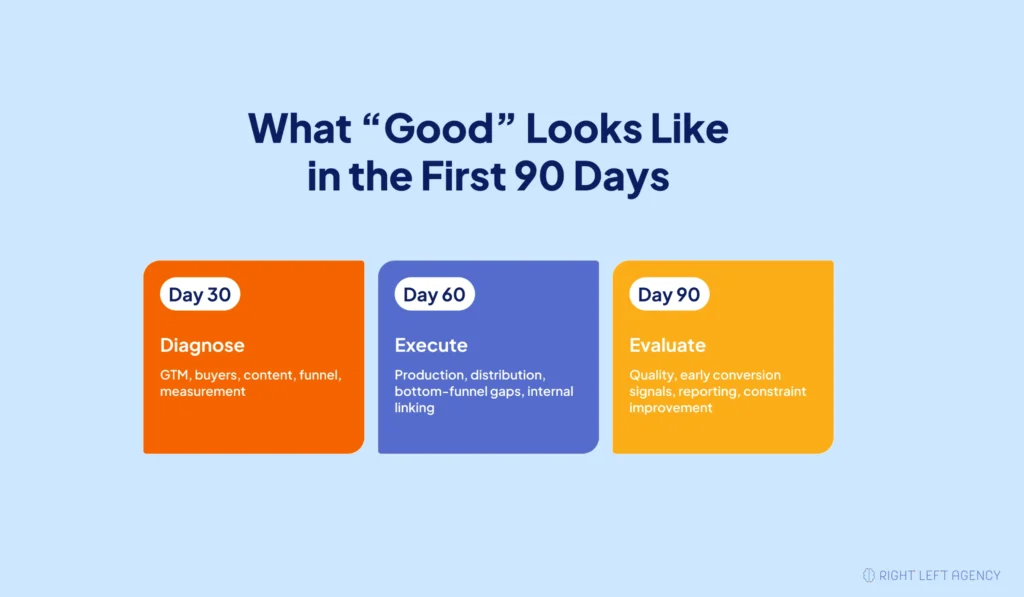
Day 30: The agency should understand your GTM motion, buyer journey, existing content, search opportunities, funnel gaps, SME process, and measurement setup. Strategic ownership should be clear.
Day 60: Priority content should be moving through production and distribution. Bottom-funnel gaps, internal linking, refresh opportunities, and measurement workflows should be actively addressed.
Day 90: You should be able to judge execution quality, strategic decisions, operating rhythm, early conversion signals, reporting quality, and whether the original constraint is improving.
How Long Before Content Produces Pipeline?
Content does not have one reliable pipeline timeline for every SaaS company. A reasonable evaluation begins with at least a 90-day operating window. At the same time, meaningful pipeline contribution may take longer depending on your starting authority, sales cycle, ACV, funnel coverage, distribution, and conversion path. Treat timelines as planning assumptions, never guarantees.
A sales-led company with a long buying cycle will naturally evaluate content differently from a PLG company with a shorter path to activation.
When Hiring a Content Marketing Agency Is the Wrong Decision
Hiring a content marketing agency is the wrong decision when content capacity is not the problem.
Wait or choose another resourcing model if:
- You are still pre-product-market-fit.
- Your offer or positioning remains unvalidated.
- Sales lacks a reliable follow-up process.
- You expect guaranteed commercial results inside one quarter.
- Your budget cannot fund the strategic ownership you actually need.
- Your real bottleneck is SME availability rather than writing capacity.
In those situations, another publishing team can increase output while leaving the constraint untouched.
Agency, In-House, Freelancer, or Hybrid
Choose an agency when you need an operating system or capabilities your internal team lacks. Choose in-house when deep company knowledge and continuous ownership matter most. Choose a freelancer when strategy already exists, and execution is the bottleneck. Choose a hybrid model when internal leadership should retain strategy while outside specialists expand capacity.
For the full resourcing comparison, see the guide on agency vs. an in-house content team.
Who Right Left Agency Is, and Isn’t, Right For
Right Left Agency is suited to SaaS companies whose content constraint spans strategy, search intent, bottom-funnel coverage, conversion, and measurement rather than production alone. It is not the right fit if you mainly want the lowest-cost article throughput, cannot provide access to internal expertise, or expect guaranteed pipeline within a fixed short-term window.
Making the Decision
Choose a SaaS content marketing agency by matching the agency’s operating model to the constraint preventing content from contributing to the qualified pipeline.
Diagnose first. Then use the nine-criterion scorecard, pitch-call questions, normalized proposals, red flags, and 90-day expectations to compare your shortlist on the same basis.
If you still cannot identify whether the constraint is content, search intent, conversion, or measurement, solve that question before buying more output.
Frequently Asked Questions
What Does a SaaS Content Marketing Agency Do?
A SaaS content marketing agency develops and operates content for the B2B SaaS buyer journey. Its scope can include strategy, customer and SME research, editorial production, SEO and AI visibility, distribution, sales enablement, and measurement. Strong agencies connect those activities to buyer progression and pipeline rather than treating publishing volume as success.
How Much Does a Content Marketing Agency Cost Per Month?
Monthly pricing varies significantly with strategist seniority, research depth, content volume, design, distribution, SEO integration, and measurement scope, so there is no single reliable industry-wide figure. For a fuller breakdown of what drives cost and how to benchmark a specific proposal against your own scope, see how much a SaaS marketing agency costs.
Is a Content Marketing Agency Worth It?
A content marketing agency can be worth the investment when your constraint requires strategic ownership or capabilities your internal team cannot efficiently provide. It may not be worthwhile when you lack product-market fit, have weak sales follow-up, cannot provide SME access, or simply need extra writing capacity against an already effective strategy.
How Long Does Content Marketing Take to Work for SaaS?
Use at least the first 90 days to evaluate strategy, execution, measurement, and leading indicators rather than expecting guaranteed pipeline. Commercial impact can take longer depending on your starting authority, ACV, sales cycle, distribution, existing content, and conversion path. Any timeline should therefore be treated as a planning range, not a performance guarantee.
What Questions Should I Ask Before Signing?
Ask who owns strategy, how the agency connects content to qualified pipeline, and who owns your content, data, and accounts when the engagement ends. Those three questions quickly expose strategic ownership, measurement maturity, and commercial risk. Then evaluate buyer research, bottom-funnel capability, distribution, revision limits, and the team actually assigned to you.
How Do I Know if a Content Agency Is Actually Driving a Pipeline?
A content agency should connect content interactions with CRM activity, sales-accepted leads, opportunities, and pipeline rather than stopping at rankings and pageviews. Review first-touch or multi-touch attribution alongside HubSpot or Salesforce data, while recognizing attribution’s limits. The objective is credible opportunity-level evidence, not perfect causality for every influenced deal.