Key Takeaways
- Diagnose the real problem before switching agencies.
- Judge performance by qualified pipeline, not activity metrics alone.
- Fix attribution and internal issues before changing partners.
- Secure accounts, data, assets, and knowledge before giving notice.
- Preserve what works, validate the system, then optimize after handoff.
Should You Actually Switch SaaS Marketing Agencies?
Switch SaaS marketing agencies when the team cannot execute the work or when the engagement cannot support the outcome your business needs. Do not switch when the real problem is broken attribution, an unvalidated offer, or poor sales follow-up. Those problems usually follow you to the next agency.
Switching should be a commercial decision, not a reaction to one frustrating meeting or one disappointing month.
Start with a simpler question:
What is actually preventing marketing from creating a qualified pipeline?
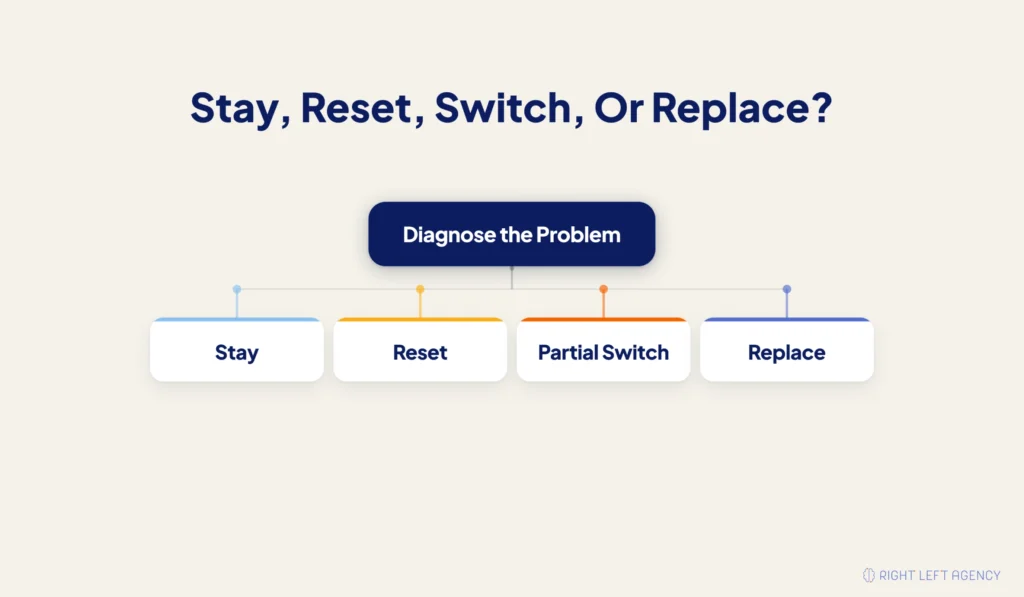
The answer usually points to one of four outcomes:
- Stay when performance and strategic alignment remain healthy.
- Reset when the work is sound but communication or process has broken down.
- Partial switch when one channel or capability has become the main constraint.
- Replace when several structural problems exist across strategy, execution, ownership, or team quality.
If your SaaS growth marketing system is still working, changing agencies can introduce risk without solving anything.
If the agency itself is the constraint, staying simply delays the decision.
The goal is to identify which situation you are actually in.
Why SaaS Agency Underperformance Has Four Different Causes
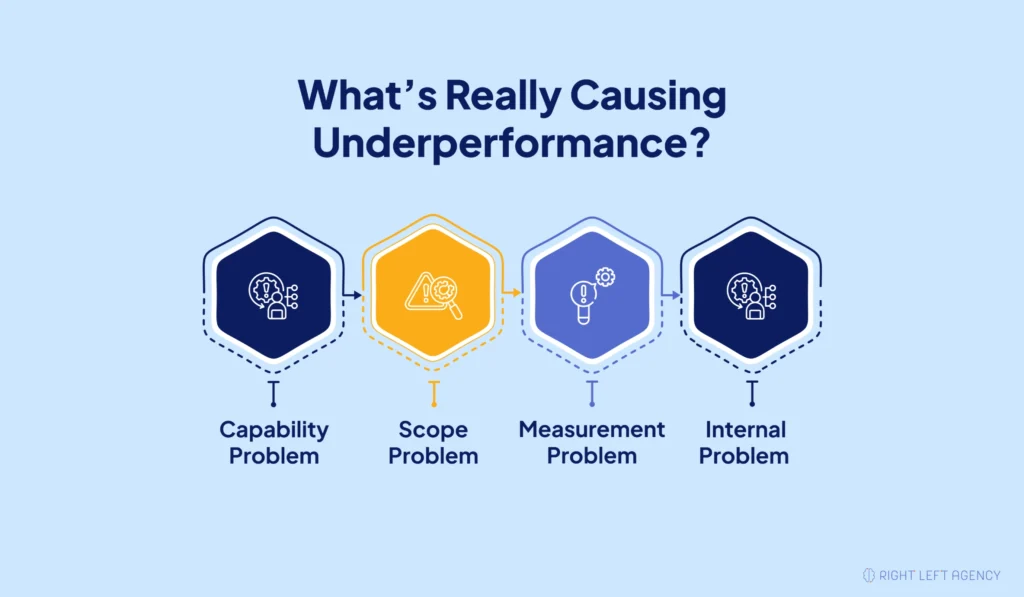
SaaS agency underperformance usually comes from four places: capability, scope, measurement, or an internal business problem. Capability and scope problems may justify changing agencies. Measurement and internal problems usually need to be fixed first because replacing the agency does not remove the underlying constraint.
Capability problem — the team cannot execute at the required level
A capability problem means the agency no longer has the skills, experience, strategic depth, or seniority your business requires.
Watch for campaigns that launch on schedule but rarely improve, recommendations that repeat quarter after quarter, and a team that struggles to explain why performance changed or what should happen next.
Another sign is a mismatch between the agency’s experience and your current SaaS model — a team built for low-ACV self-serve acquisition may struggle with enterprise buying committees, longer sales cycles, or sales-led growth.
Ask whether the agency can diagnose problems and adapt its strategy using real performance evidence. If the answer is consistently no, you probably have a capability problem.
Decision: Switching may be justified.
Scope problem — the retainer was never funded for the outcome
A scope problem happens when the engagement is too small for the result being expected. The agency may be doing competent work, but the agreement simply does not fund enough strategy, production, testing, reporting, or optimization to deliver it — a limited retainer cannot realistically support deep SEO strategy, content production, paid media, CRO, lifecycle marketing, attribution work, and executive reporting at the same time.
Compare three things:
- What outcome leadership expects
- What the SOW actually includes
- What resources are available to deliver it
If those three do not match, poor results do not automatically mean poor execution.
Decision: Renegotiate the scope or switch to a partner that can support the required engagement.
Measurement problem — the work may be working, but nobody can prove it
A measurement problem exists when marketing activity cannot be reliably connected to qualified pipeline or revenue. If reporting stops at clicks, form fills, MQLs, or platform conversions, leadership may not know whether marketing is actually influencing SQLs and opportunities.
The full chain should remain visible:
Agency → Channel → Lead → SQL → Opportunity → Pipeline → CAC → Revenue
If that chain breaks between your advertising platforms, GA4, CRM, lead routing, or attribution setup, replacing the agency does not automatically solve the problem.
The next agency inherits the same broken measurement system.
Decision: Fix measurement before deciding whether execution has failed.
Internal problem — the constraint is inside your business
Some marketing problems sit outside the agency’s control.
Common examples include:
- An unclear ICP
- Weak positioning
- An unvalidated offer
- Limited market demand
- Poor sales follow-up
- No internal marketing owner
- Unrealistic growth expectations
These issues often look like acquisition problems because marketing sits at the top of the visible funnel.
But if every channel struggles with the same offer, or qualified leads arrive and sales do not progress, replacing the agency may only change who gets blamed.
Decision: Fix the internal constraint before changing partners.
How Do I Know If My Marketing Agency Is Underperforming?
A marketing agency is underperforming when its work consistently fails to create the agreed business outcomes and the team cannot explain or correct the gap. Look for patterns across qualified pipelines, lead quality, strategy, reporting, account ownership, and SaaS fit. One weak metric or one bad month is not enough evidence.
Pipeline is flat while activity metrics look healthy
Traffic is growing, impressions and clicks look healthy, MQL volume may even be increasing — but SQLs, opportunities, and pipelines are not moving. Activity is only useful when it contributes to the commercial outcome the program was built to support.
Check attribution first. If CRM and channel tracking are reliable, flat pipelines may point to targeting, messaging, conversion, or channel capability problems. If attribution is broken, you cannot confidently make that diagnosis yet.
Likely cause: Capability or measurement problem.
Lead quality is declining
Lead volume can look healthy while sales acceptance steadily falls. That often happens when campaigns optimize toward cheaper conversions rather than qualified demand — but it can also happen when your ICP changes and marketing never receives a clear update.
Compare current campaign targeting against the criteria your sales team actually uses to qualify accounts. If targeting has drifted despite a clear ICP, the agency may have a capability problem. If nobody internally agrees on the ICP, the constraint is inside the business.
Likely cause: Capability or internal problem.
Reporting cannot connect activity to pipeline
Useful reporting should tell you more than what happened inside an advertising platform.
Leadership should be able to understand:
- Which channels create qualified leads
- Which leads become SQLs
- Which SQLs become opportunities
- How much pipeline each channel creates
- What that means for CAC and future investment
If the agency consistently reports traffic, CPL, clicks, and form submissions without connecting them to pipeline, you may have either a reporting capability issue or a broader measurement problem — the distinction matters, because a better dashboard will not fix missing CRM attribution. Before increasing paid spend on the strength of a report like this, it’s worth auditing what the campaigns are actually producing.
Likely cause: Measurement or capability problem.
Strategy no longer evolves
A healthy marketing strategy changes when the evidence changes: search demand shifts, competitors reposition, sales feedback surfaces new objections, or certain content starts influencing more qualified opportunities. Your strategy should respond.
If the agency presents the same plan quarter after quarter regardless of what the data shows, it may have moved from strategic management into routine execution. Ask what the team learned last quarter and what changed because of it. If the answer is unclear, investigate further.
Likely cause: Capability problem.
The senior strategists disappeared after the pitch
The senior team that helped win your account should not completely disappear once delivery begins. That doesn’t mean a senior strategist needs to perform every task — it means there should be clear senior ownership of strategy, prioritization, and difficult decisions.
Compare the team structure you were sold with the team actually managing the account. If junior execution has replaced strategic oversight and nobody senior is accountable for performance, the relationship may have a structural capability problem.
Likely cause: Capability problem.
Marketing and sales disagree about performance
Marketing says the campaigns are working. Sales says the leads are poor. Before choosing a side, inspect the system connecting them.
Check:
- ICP criteria
- Lifecycle stages
- Lead scoring
- Lead routing
- Opportunity-source fields
- Sales response times
- CRM attribution
The disagreement often exposes a definition or process problem rather than immediately proving poor agency performance.
If both teams use different definitions of a qualified lead, no campaign report will resolve the dispute.
Likely cause: Measurement or internal problem.
You do not own your accounts, data or assets
Lack of account ownership is both a relationship warning and a transition risk. Your company should understand who controls critical advertising accounts, analytics properties, CRM systems, website assets, creative files, and reporting dashboards — don’t wait until after termination to resolve this. Audit ownership before giving notice so you know what needs to be secured, transferred, or documented. (More on exactly what to check further down.)
Likely cause: Structural relationship problem and potential reason to prepare an exit.
Your SaaS stage or GTM motion has outgrown the agency
Sometimes the agency hasn’t failed — your company has simply changed. A team that was a strong fit for an early-stage PLG company may not be the right partner once the business moves into larger ACVs, outbound-supported demand generation, enterprise buying committees, or a sales-led GTM model.
Treating this as incompetence creates unnecessary conflict. Treating it as a fit problem leads to a more productive transition.
Likely cause: Fit problem rather than execution failure.
Before You Blame the Agency, Rule Out These Problems
Before firing your agency, rule out problems that another agency would inherit. Check attribution, positioning, ICP clarity, market demand, budget, conversion performance, lead routing, sales follow-up, and channel expectations. If the growth system itself is broken, switching agencies can disrupt without improving the underlying result.
Broken attribution
If you cannot reliably connect opportunities and closed-won revenue to acquisition sources, you cannot properly evaluate marketing performance — you may have good campaigns that look weak, or weak campaigns that appear healthy. Fix the attribution setup before making a major agency decision.
Positioning and ICP definition
An agency needs a clear answer to three questions: who are you trying to reach, why should those buyers care, and why should they choose your product over another option? If sales, founders, product, and marketing give different answers, acquisition will reflect that confusion. An agency cannot out-execute unclear positioning indefinitely.
Product-market fit and market demand
Marketing can capture existing demand and help create new demand. It cannot manufacture durable product-market fit. If every channel produces the same weak response from the intended customer, investigate the product, market, and offer before deciding the operator is the problem.
Budget below the channel threshold
Channels need enough activity and investment to generate useful learning. If a paid-search campaign receives too little working spend to generate meaningful conversion data, the agency has limited room to optimize — the same principle applies to CRO without enough traffic or content programs without enough consistent production. Review how the budget is allocated across channels before assuming execution has failed.
Landing page and conversion problems
Good traffic cannot compensate for a weak conversion experience. If qualified prospects reach your site but do not convert, review:
- Message match
- Offer clarity
- Proof
- Page speed
- Form friction
- CTA placement
- Conversion tracking
Audit the site before assuming acquisition is the only problem.
Slow sales follow-up and lead routing
A strong lead can quickly become a “bad lead” when it receives no response.
Check how quickly inbound leads are assigned, contacted, and progressed.
Also check whether leads are routing to the correct team or territory.
Marketing performance should not be judged without understanding what happens after the form submission.
Wrong channel expectations
Different channels work on different timelines and solve different problems.
SEO should not be judged like paid search.
Paid search should not be expected to create a large market where very little search demand exists.
CRO cannot generate meaningful test learning without enough traffic.
Set expectations around how each channel actually contributes to growth.
How Long Should You Give a SaaS Marketing Agency Before Switching?
There is no single fair deadline for every SaaS marketing agency. Paid search produces feedback faster than SEO and content, while CRO and lifecycle work depend on traffic and testing volume. Set channel-specific review points before the engagement starts and judge both leading indicators and pipeline outcomes.
A useful expectation framework is:
- 0–90 days: foundations, tracking, research, testing, and early indicators
- 3–6 months: stronger paid and CRO learning, pipeline signals, and early organic progress
- 6–12+ months: compounding SEO and content performance and more mature attribution
These are expectations, not guarantees.
Paid search
Paid search gives you relatively fast feedback because campaigns begin generating search-query, conversion, and audience data quickly.
But do not judge the entire relationship on the first-month CPL.
Look at whether the agency is improving search intent, qualified conversions, SQL volume, pipeline efficiency, and wasted spend before you increase paid spend.
SEO and content
SEO and content need a longer judgment window.
At 90 days, the most useful evidence may be technical improvements, indexing, ranking movement, content quality, qualified organic traffic, and early pipeline influence.
Judging an SEO agency purely on closed-won revenue after one quarter can lead to a premature decision.
CRO and lifecycle
CRO depends on traffic volume and the number of tests you can run with useful signal.
Lifecycle performance depends on the size and quality of the audience moving through your funnel.
Low volume naturally slows learning.
Set the review checkpoint before the problem appears
Agree in advance on:
- What should be true after 90 days
- Which leading indicators matter
- Which commercial indicators matter
- When strategy will be reviewed
- What would trigger a reset or replacement discussion
A predefined review point is much fairer than deciding retrospectively that the agency “should have done more.”
Stay, Reset, Partial Switch, or Replace: The SaaS Agency Decision Matrix
You do not have to choose between tolerating the current relationship and firing the agency completely. Match the decision to the diagnosed problem. Healthy performance may need only a reset. One weak capability may justify a partial switch. Full replacement makes sense when several structural problems exist at once.
| Situation | Decision |
|---|---|
| Performance healthy, communication issue | Reset relationship |
| One weak channel | Replace channel owner |
| Strategy misaligned but execution competent | Strategic reset |
| Reporting or ownership problems | Prepare exit |
| Multiple structural failures | Replace agency |
| Product / ICP / PMF issue | Fix internally before replacing agency |
Stay
Stay when the agency still has the right capabilities, performance is commercially healthy, and both sides remain strategically aligned.
Do not introduce transition risk simply because the relationship has become temporarily frustrating.
If the agency responds well to feedback and still produces meaningful progress, staying may create more value than switching.
Reset
Reset the relationship when the underlying work is sound but communication, reporting, planning, or accountability needs improvement.
A useful reset conversation should define:
- What is not working
- What needs to change
- Who owns each change
- Which KPIs matter
- When you will review progress
Avoid vague requests such as “be more proactive.”
Make the expected change observable.
Partial switch
A partial switch moves one channel or capability while keeping the parts of the relationship that still work.
For example, you might retain your existing agency for SEO but move paid search management to another partner.
This is often the lowest-risk option because you do not rebuild the entire marketing system to solve one specific problem.
Full replacement
Replace the agency when several structural issues exist at once.
These may include:
- Weak strategy
- Poor execution
- Limited transparency
- Unclear account ownership
- Little senior involvement
- Repeated measurement failures
- No meaningful connection to pipeline
When multiple problems persist after reasonable attempts to reset the relationship, another reset may simply delay the transition.
What to Secure Before You Tell Your Agency You’re Leaving
Before telling your agency that you plan to leave, secure access to the systems, data, assets, and knowledge required to keep marketing running. Conduct this audit before giving notice. The goal is not secrecy. The goal is to understand what your company controls and what still needs to be transferred.
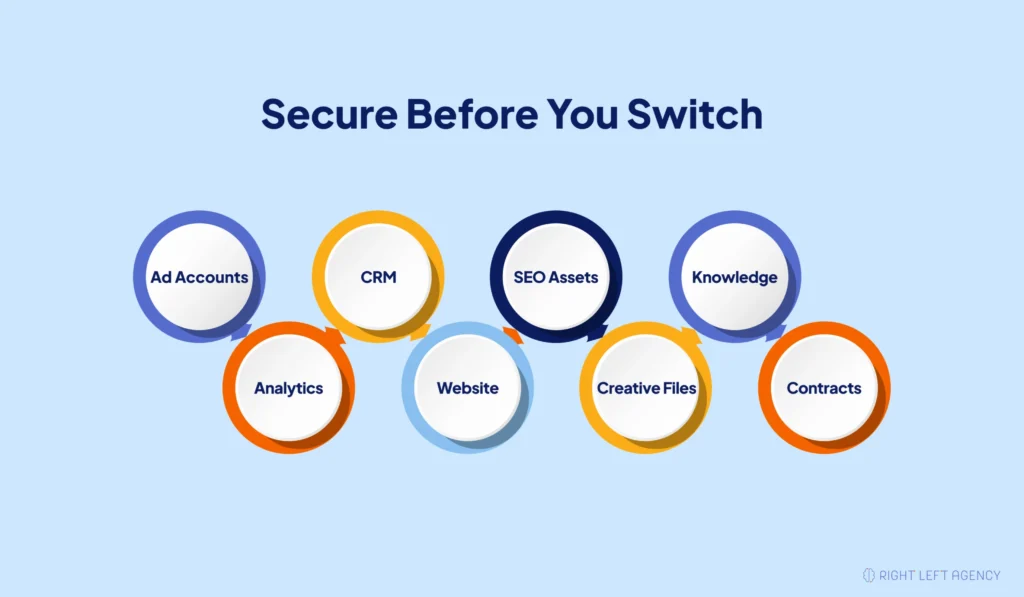
Advertising accounts
Check Google Ads, LinkedIn Ads, Meta, Microsoft Ads, and any manager-account relationships.
Who owns the Google Ads account — the client or the agency? Don’t assume the answer. Confirm who has administrative access, whether the account is connected through an agency manager account, and what changes when the relationship ends. Your company should be able to continue using historical campaign data without rebuilding the advertising account simply because the agency changes.
Analytics and measurement
Check access to GA4, Google Tag Manager, Google Search Console, Looker Studio, conversion configurations, and attribution reporting. Don’t wait until the final week of a handover to discover that one agency employee holds the only administrator role — document both access and configuration so the new agency understands how measurement currently works before changing it.
CRM, lifecycle, and routing
Document the systems connecting marketing to sales.
That may include:
- HubSpot or Salesforce
- Lifecycle stages
- Lead scoring
- Routing rules
- Opportunity-source fields
- Marketing automation
- Product analytics
- Segment or other CDP dependencies
- Reverse-ETL workflows
Preserving the flow of information matters more than simply retaining the login.
Website, CMS and landing pages
Confirm ownership and access for the CMS, hosting, DNS, landing-page tools, forms, scripts, and deployment workflow. Also document CRO experiments and landing-page version history — a page may still be online after the transition, but the new team needs to know why the current version exists and what was tested before it.
Content and SEO assets
Collect:
- Content briefs
- Unpublished drafts
- Keyword research
- Editorial calendars
- Backlink records
- Ranking history
- Technical SEO documentation
- Existing content plans
Also record any SEO changes that were already planned, so the new team doesn’t unknowingly repeat work or reverse decisions without understanding the history.
Creative and brand assets
Secure editable source files, not only final exports. Also collect:
- Messaging frameworks
- Positioning work
- ICP research
- Interview notes
- Win/loss research
- Call recordings
- Sales enablement assets
The goal is to preserve the thinking behind the creative, not only the finished files.
The knowledge that isn’t in any account
Some of the most valuable marketing information never appears in a dashboard.
Ask the outgoing agency to document:
- Failed experiments
- Winning experiments
- Negative keywords
- Excluded audiences
- Creative learnings
- Messaging learnings
- Landing-page findings
- SEO and link-building history
- Sales feedback
- Conversion insights
- Budget seasonality
If you transfer the logins but lose this knowledge, the new agency may spend months paying to relearn lessons your business already paid for.
Contract mechanics — notice periods and termination clauses
Read the actual agreement before giving notice.
Review:
- Notice requirements
- Termination clauses
- Final invoicing
- In-flight deliverables
- Data ownership
- IP assignment
- Tool licences
- SOW obligations
There is no universal agency notice period.
Your signed contract determines the process.
If it helps to work through this systematically, Right Left Agency will walk your team through an ownership and handover audit as part of an initial growth strategy conversation — no obligation to switch attached.
How to Switch SaaS Marketing Agencies Without Losing Pipeline
The safest agency transition follows four steps:
Preserve → Validate → Stabilize → Improve.
Do not let a new agency rebuild working campaigns or tracking simply to show activity. Capture the baseline, secure ownership, transfer knowledge, clarify responsibilities, validate the current system, and only then begin meaningful optimization.
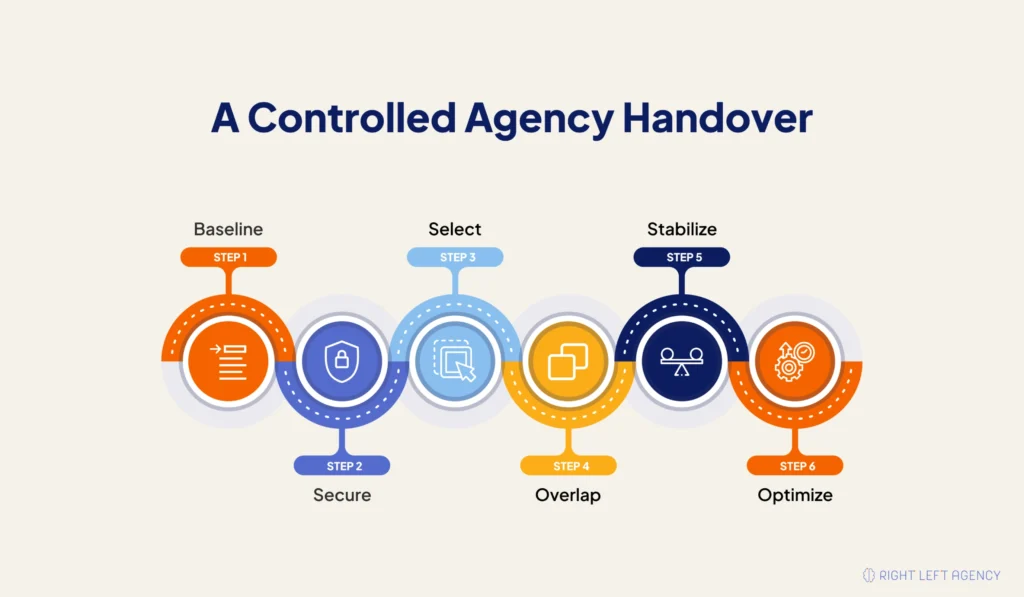
Phase 1 — Establish the pipeline baseline before you give notice
Capture performance before the transition changes anything.
Record at least:
- 90-day pipeline generated
- SQL volume
- Opportunity volume
- Win rate
- Channel CAC
- Cost per SQL
- Pipeline generated per dollar spent
- Lead-to-SQL conversion
- SQL-to-opportunity conversion
- Sales velocity
A pipeline baseline captured before notice is the only reliable way to determine whether the new agency improved performance, performance declined, or measurement simply changed. Save both overall and channel-level data.
Phase 2 — Secure accounts, data and knowledge
Complete the ownership audit before handoff begins. Confirm administrative access instead of depending on shared credentials, and export critical historical reporting. Document:
- Attribution logic
- CRM workflows
- Campaign history
- Exclusions
- Experiments
- Unfinished work
- Known tracking issues
The successor needs context, not just passwords.
Phase 3 — Select the replacement before you terminate
Whenever possible, select and contract the replacement before ending the current relationship.
This gives the incoming agency time to review the system and identify gaps before it becomes responsible for performance.
The new team can check:
- Access requirements
- Tracking dependencies
- CRM connections
- Campaign structure
- Landing pages
- Reporting
- In-flight work
Terminating first can turn the notice period into a countdown toward a gap in ownership.
Phase 4 — Run a controlled overlap
There are three common transition models.
A hard cutover ends the old agency’s responsibility and transfers ownership immediately.
A soft overlap keeps both agencies involved briefly while the incoming team validates the system.
A channel-by-channel migration moves responsibilities gradually, such as paid search first and SEO later.
Overlap costs more because you may temporarily pay two agencies.
That cost can still make sense when the account is complex, and the alternative is lost knowledge, broken tracking, or unclear ownership.
Who owns what during the overlap
| Responsibility | Old Agency | Internal Team | New Agency |
|---|---|---|---|
| Existing campaign optimization | Lead until handoff | Approve major changes | Observe and validate |
| Budget approval | Recommend | Final approval | Review assumptions |
| Tracking changes | Document setup | Approve | Validate before editing |
| Creative production | Finish agreed work | Prioritize | Prepare next work |
| Reporting | Provide history | Reconcile business data | Validate reporting |
| Lead routing | Document dependencies | Own rules | Validate integrations |
| Website deployments | Finish agreed work | Control access | Review before changes |
| SEO changes | Document plans | Approve | Validate before implementation |
The internal team should remain the continuity layer.
Never allow a transition where both agencies assume the other one owns a revenue-critical task.
Phase 5 — Stabilize before optimizing
The incoming agency should first prove that the current system still works.
Validate:
- Conversion tracking
- CRM routing
- Paid campaign delivery
- Analytics
- Landing pages
- Attribution
- Reporting
- Lifecycle automations
Only then should major optimization begin.
What to freeze during the transition
Avoid unnecessary changes to high-performing campaigns, conversion actions, CRM mappings, URLs, proven landing pages, lead-routing rules, budget distribution, and attribution configuration until the incoming team has validated the baseline.
The trade-off is temporary restraint.
You may delay a promising experiment or campaign restructure.
That delay is often worth it because changing several systems at once makes it much harder to identify what caused a performance problem.
Phase 6 — Optimize after handoff
Optimization starts after the baseline, tracking, attribution, reporting, and lead flow have been validated.
The first changes should respond to known problems, not a desire to rebuild everything.
A useful first-90-day approach for the new agency is:
Days 1–30: Validate. Confirm tracking, access, reporting, campaign structure, CRM connections, and baseline performance.
Days 31–60: Stabilize. Fix genuine gaps without disrupting working systems.
Days 61–90: Improve. Prioritize the highest-confidence opportunities and begin controlled optimization.
The transition principle remains:
Preserve → Validate → Stabilize → Improve.
How to Measure Pipeline Continuity During the Transition
Pipeline continuity means leads, SQLs, opportunities, attribution, and follow-up remain measurable and operational while agency ownership changes. You do not need every metric to remain perfectly flat. You do need enough consistency to identify whether a change reflects normal performance variation or a broken part of the revenue system.
Pipeline Continuity Scorecard
Monitor the same measures before, during, and after handoff:
- Demo or qualified lead volume remains explainable.
- SQL creation continues without unexplained gaps.
- Opportunity creation remains traceable to source.
- Paid conversion tracking continues working.
- CRM lead routing continues correctly.
- Lifecycle sequences enroll the right contacts.
- First-touch attribution remains interpretable.
- Multi-touch attribution remains interpretable.
- Closed-won opportunities retain source information.
- Sales follow-up does not slow because ownership changed.
- Board reporting uses consistent definitions.
A short-term dip does not automatically mean the transition has failed.
Seasonality, media pacing, sales cycles, budget changes, or normal campaign variance can affect results.
A genuine break looks different.
Warning signs include:
- Conversion volume suddenly drops to zero
- Leads stop reaching the CRM
- Opportunity-source fields disappear
- Lead routing stops working
- Paid spend continues while CRM leads collapse
- Dashboards no longer match CRM reporting
Preserving the connection between pipeline and source is especially important during the change.
Otherwise, leadership cannot fairly compare performance before and after the transition.
How to Evaluate the Replacement SaaS Marketing Agency
Choose the replacement agency based on the problem you need to solve, not the quality of its sales deck. Evaluate SaaS-stage fit, GTM experience, ACV familiarity, delivery-team seniority, reporting depth, account ownership, contract terms, references, and the agency’s ability to connect channel work to qualified pipeline.
Pricing matters, but it should not dominate this decision, and the broader agency-versus-in-house question deserves its own evaluation rather than a rushed answer here.
For the replacement itself, ask:
- Has the agency worked with a similar ACV?
- Does it understand your typical sales cycle?
- Does it understand your SaaS stage?
- Has it worked with PLG, sales-led, or hybrid GTM models?
- Who will actually manage the account?
- Which senior strategist stays involved?
- How does reporting connect channels to SQLs and opportunities?
- Who owns the accounts and data?
- Can references discuss difficult periods, not only wins?
- What happens if you need to leave?
- How will the agency protect existing campaign learning?
- What will the first 90 days look like?
A good replacement should be able to explain what it plans to preserve before explaining what it plans to change.
What to require in your next agency contract
Use the next contract to reduce future transition risk.
Where appropriate, require:
- Client-controlled accounts from day one
- Reporting tied to agreed pipeline outcomes
- A named senior owner
- Clear data portability
- A defined notice process
- Clear IP assignment
- Clear treatment of in-flight work
- Transparent scope-change rules
A good contract should protect both sides during the relationship and make a future exit manageable.
Common SaaS Agency Switching Mistakes
The biggest agency-switching mistakes happen when companies move too quickly: they terminate before securing access, change campaigns before validating the baseline, lose attribution during handoff, or transfer accounts without transferring knowledge. Treat the switch as a controlled RevOps and marketing transition rather than a simple vendor replacement.
Avoid these mistakes:
- Terminating before securing accounts. Confirm ownership and administrative access first.
- Giving notice before capturing the baseline. You need pre-transition performance for comparison.
- Rebuilding working campaigns immediately. Preserve what works until the new team validates it.
- Breaking tracking during cutover. A measurement problem can look like a pipeline problem.
- Skipping overlap on a complex account. Short-term duplicate cost may reduce much larger execution risk.
- Treating the switch as only a marketing task. Sales, RevOps, analytics, and web teams may all have dependencies.
- Transferring logins without transferring knowledge. Historical learning is part of the asset.
- Switching when the problem was internal. A new agency will inherit the same constraint.
- Setting no review checkpoint for the new agency. Define expectations before the next relationship begins.
When Right Left Agency Is — and Isn’t — the Right Fit
Right Left Agency is more likely to fit SaaS companies that want marketing connected to a qualified pipeline, expect transparent account ownership, and need acquisition, conversion, and measurement decisions to work together.
It may not be the right fit if you only need the cheapest execution resource, cannot provide the CRM and sales context needed to evaluate pipeline, or expect marketing to compensate for unresolved product-market-fit problems.
The first step should be diagnostic. Determine whether the current constraint is capability, scope, measurement, or an internal business problem before deciding whether changing agencies is the right move.
If that diagnostic is where you’re stuck, that conversation is a reasonable place to start — with us or with whoever you’re currently working with. You can talk it through with our team whether or not switching turns out to be the right call.
Frequently Asked Questions
Will switching agencies hurt my SEO rankings?
Switching agencies does not automatically hurt SEO rankings. The greater risk comes from unnecessary changes to URLs, content, internal links, technical settings, or existing optimization during the handoff. Preserve the current SEO baseline and let the incoming team validate the site before making major changes.
Is it ever better to fix the relationship than switch?
Yes. A reset is often better when performance remains healthy, but communication, reporting, responsibilities, or strategic alignment has weakened. Define what needs to change, assign owners, and set a review date. If the reset works, you avoid the cost and risk of a full transition.
Can I switch mid-contract?
Possibly. Your contract determines the available options. Review termination terms, notice requirements, fees, data ownership, IP language, and treatment of in-flight work before acting. If immediate termination is not practical, you can often use the remaining contract period to prepare the handover.
Should I run a pilot with the new agency first?
A pilot can work when the project or channel can be isolated and measured without creating conflicting ownership. It is less useful when your problem spans paid acquisition, CRM attribution, lifecycle automation, CRO, and RevOps because a narrow pilot may not test the capabilities you actually need.