Key Takeaways
- Choose based on the constraint, not the model.
- Company stage changes the right marketing structure.
- A hybrid model can solve both leadership and execution gaps.
- Compare total marketing capability, not retainers alone.
- Move to full-time leadership when marketing needs daily ownership.
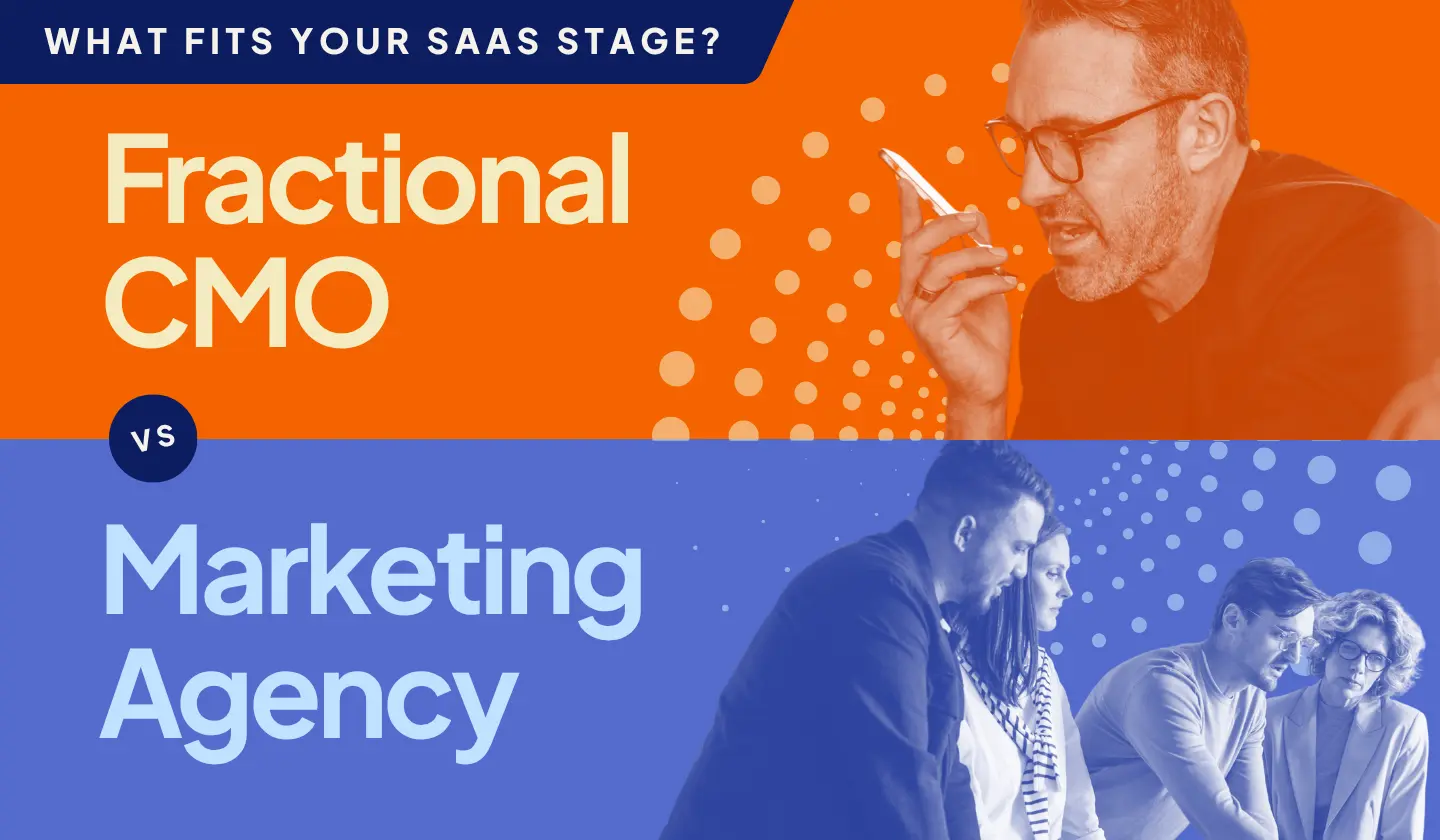
A fractional CMO provides senior marketing leadership. A marketing agency provides the specialists who execute campaigns. For SaaS companies, the right choice depends on your stage, growth constraint, team, and sales motion.
The real question isn’t simply fractional CMO vs marketing agency. It’s: Do you need direction, execution, or both?
This guide helps you decide using product-market fit, ARR, team structure, ownership, cost, and realistic 90-day expectations.
Fractional CMO vs Marketing Agency: The Short Answer
A fractional CMO primarily owns marketing direction and prioritization. A SaaS marketing agency primarily provides execution capacity across SEO, paid search, content, CRO, lifecycle marketing, creative, automation, and RevOps.
Choose a fractional CMO when execution exists, but senior ownership is missing. Choose an agency when strategy is clear, but your team lacks bandwidth or specialist expertise. If both gaps exist, a hybrid model may fit better.
For another operating-model comparison, see the SaaS marketing agency vs in-house guide.
Side-by-Side Comparison for SaaS Teams
The core difference is ownership: a fractional CMO leads the marketing system, while an agency executes within an agreed scope.
| Area | Fractional CMO | Marketing Agency |
|---|---|---|
| Primary role | Senior marketing leadership | Specialist execution |
| Core ownership | Strategy, priorities, coordination | Campaigns, channels, optimization |
| Best fit | Leadership gap | Execution-capacity gap |
| Ramp-up focus | Diagnosis, positioning, GTM | Audits, setup, campaigns |
| Cost structure | Fractional leadership engagement | Retainer, project, or channel engagement |
| Accountability | Overall marketing direction | Results within agreed scope |
| Long-term path | Can bridge toward full-time leadership | Can remain an execution partner |
A strong agency may contribute strategy within its specialty, but it doesn’t automatically own your full go-to-market system. Likewise, a fractional CMO doesn’t automatically provide the people needed to run every channel.
For cost context, see how much a SaaS marketing agency costs.
The Real Decision: Do You Need Direction, Execution, or Both?
The fastest way to choose is to diagnose the constraint.
You have a strategy problem
You likely need leadership when ICP or positioning keeps changing, priorities shift frequently, sales and marketing disagree on lead quality, nobody owns outcomes, or reporting focuses on activity instead of qualified pipeline.
This is primarily a leadership gap. More campaigns won’t fix unclear direction.
You have an execution-capacity problem
You likely need an agency when ICP, positioning, goals, and channel priorities are clear but your team cannot execute consistently.
For example, one generalist may be managing SEO, paid media, content, CRO, reporting, and lifecycle campaigns. The problem isn’t strategy. It’s capacity.
You have both problems
If neither direction nor execution exists, hiring only one side creates another bottleneck. An agency without strategy can produce expensive activity. A fractional CMO without execution resources can create a plan that never launches.
That usually points toward a staged or hybrid model.
Which Model Fits Your SaaS Stage?
Stage matters because marketing needs change as product-market fit, team size, sales motion, and revenue complexity increase.
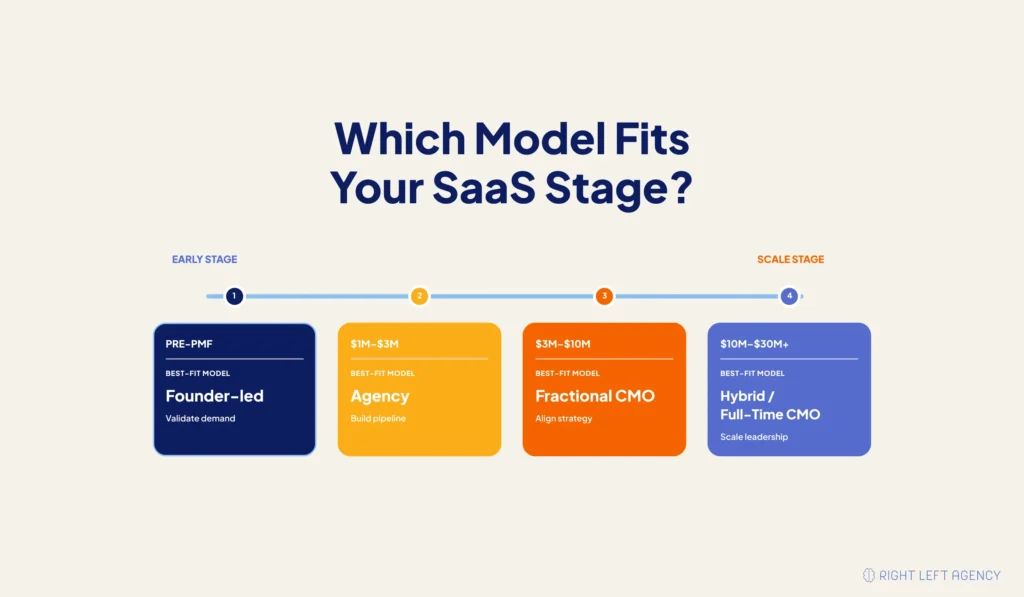
Pre-PMF / under ~$1M ARR
Pre-PMF companies usually need founder-led customer learning more than a full agency or fractional leadership model.
Focus on who urgently needs the product, why they buy, which segments retain, which messages resonate, and which acquisition signals repeat. Use narrow outside support for customer research, landing pages, paid-search tests, technical SEO, positioning, or conversion tracking.
The goal is learning before scale.
$1M–$3M ARR
At this stage, companies are often turning early traction into a repeatable go-to-market motion. Marketing may still be founder-led, owned by one generalist, or supported by a small team.
A focused agency fits when ICP, positioning, growth goals, conversion events, and lead-quality criteria are clear. A low-ACV PLG business may prioritize activation, conversion, and CAC payback. A higher-ACV sales-led business may focus more on qualified pipeline, opportunity creation, win rate, and sales-cycle length.
If channel selection is unclear, see the SaaS marketing channels guide.
$3M–$10M ARR
This is where senior ownership often becomes more important. You may now have internal marketers, agencies, paid acquisition, SEO, content, product marketing, automation, and RevOps.
At this point, coordination and prioritization can become the bottleneck. Someone needs to decide where budget goes, how marketing aligns with sales, which metrics matter, and who owns each outcome.
For sales-led SaaS, that can mean connecting activity to qualified, sourced, and influenced pipeline, opportunity rate, win rate, ACV, CAC, CAC payback, LTV: CAC, and sales cycle.
This is where a fractional CMO often becomes more relevant.
$10M–$30M+ ARR
At this stage, SaaS companies often need a hybrid model or a path toward permanent internal leadership.
The organization may have multiple specialists, agencies, product marketers, RevOps resources, segments, and channels. Fractional leadership can coordinate that complexity temporarily, but when daily management becomes permanent, a full-time VP Marketing or CMO becomes more appropriate.
For broader planning, see SaaS marketing budget allocation and how to define your ideal customer profile.
Who Owns What? Fractional CMO vs Agency RACI
In a hybrid model, the fractional CMO typically owns direction while the agency owns execution.
| Marketing Function | Fractional CMO | Agency | Leadership/Internal Team |
|---|---|---|---|
| Positioning / ICP / GTM | A/R | C | C |
| Marketing priorities | A/R | C | I |
| Budget recommendation | A/R | C | C |
| Final company budget | R | I | A |
| Paid / SEO strategy | A | R | C |
| Paid / SEO execution | C | A/R | I |
| Website / CRO priorities | A | R | C |
| RevOps / attribution | A | R | C |
| Hiring / vendor management | A/R | I | C |
| Executive reporting | A/R | C | I |
R = Responsible, A = Accountable, C = Consulted, I = Informed.
The exact model varies. What matters is knowing who is accountable when performance misses the target.
Cost: Compare Total Marketing Capability, Not Monthly Retainers
Compare the total cost of capability, not one retainer against another.
That means accounting for leadership, execution, internal salaries, media spend, tools, analytics, creative or development support, management time, recruiting, and onboarding.
A useful way to frame it:
Leadership + execution + media + technology + internal management = total cost of capability
A fractional CMO may still need marketers or agencies to execute. An agency may still need a senior internal owner. The cheapest monthly option can therefore be the wrong economic choice.
For more detail, see the SaaS marketing agency cost guide.
What the First 90 Days Should Look Like
The first 90 days should produce clearer decisions, working systems, and early performance signals.
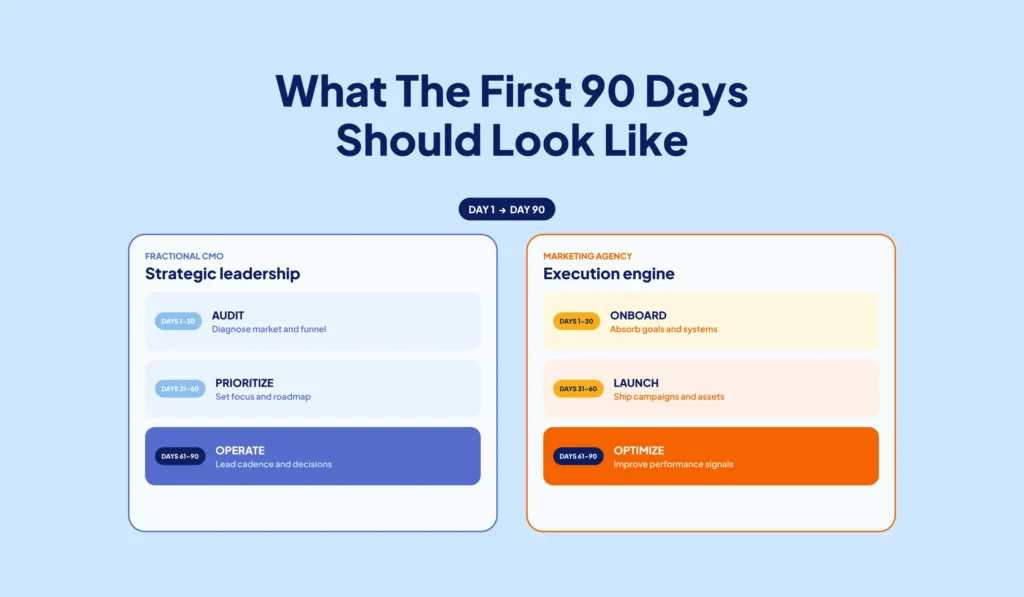
Fractional CMO: 30/60/90-day outputs
Days 1–30: Audit the business, ICP, positioning, funnel, channels, team, analytics, and budget.
Days 31–60: Define GTM priorities, channel focus, measurement, responsibilities, vendor needs, and the execution roadmap.
Days 61–90: Establish reporting cadence, implement strategic changes, identify resource gaps, and set the next-quarter roadmap.
Agency: 30/60/90-day outputs
Days 1–30: Complete onboarding, analytics review, channel audits, tracking, competitive review, and campaign planning.
Days 31–60: Launch campaigns, content, SEO work, landing-page improvements, and tests.
Days 61–90: Optimize targeting, keywords, creative, content, landing pages, and budget using early signals.
For long SaaS sales cycles, qualified demos, opportunities, conversion rates, pipeline quality, and early CAC signals may matter more than closed-won revenue this early.
Hybrid: operating cadence and handoffs
A hybrid model needs clear decision rights, shared reporting, weekly execution reviews, monthly strategic reviews, defined approvals, and sales feedback.
The fractional CMO should reduce ambiguity, not create another approval layer.
When a Fractional CMO Is the Better Fit
A fractional CMO is the better fit when execution exists, but senior coordination doesn’t.
Typical signs include having marketers but no senior marketing leader, multiple specialists requiring coordination, founder-managed vendors, weak sales-marketing alignment, unclear budget allocation, or reporting disconnected from business outcomes.
The key condition is execution capacity. Strategy without people to implement it creates another bottleneck.
When a SaaS Marketing Agency Is the Better Fit
A SaaS marketing agency is the better fit when strategy is reasonably clear, but execution capacity is missing.
This often happens when the company knows its ICP, positioning, funnel, and growth priorities but lacks specialists in SEO, paid search, content, CRO, or lifecycle marketing.
The agency adds bandwidth without replacing the person accountable for overall marketing direction.
When You Need Both
A SaaS company may need both when it lacks senior marketing ownership and execution capacity.
The fractional CMO owns direction, priorities, alignment, and reporting. The agency owns campaigns, content, paid media, SEO, CRO, and optimization.
Key takeaway: A hybrid model works when strategy and execution stay separate but aligned.
When You Need Neither Yet
Your SaaS company may need neither model if product-market fit is still uncertain. Pre-PMF teams usually need customer learning more than marketing scale.
Focus on who buys, why they buy, which segments retain, and which messages resonate. Keep external support narrow—such as research, testing, positioning, or technical execution—until those signals become clearer.
When to Move From Fractional to a Full-Time VP/CMO
Move from a fractional CMO to a full-time VP Marketing or CMO when marketing requires continuous internal leadership. Key signals include a growing team, multiple agencies, more complex go-to-market needs, heavier reporting, and frequent cross-functional decisions.
The typical path is:
Founder-led → external execution → fractional leadership → full-time marketing leadership
The transition should happen when the role requires daily ownership, not simply at a specific ARR milestone.
How to Evaluate a Fractional CMO or SaaS Agency
Choose a fractional CMO or agency based on your stage, sales motion, and biggest capability gap. Evaluate:
- SaaS experience: ARR, ACV, CAC, retention, and pipeline knowledge.
- Sales-motion fit: Experience with PLG, sales-led, or enterprise models.
- Stage fit: Relevant experience at your maturity level.
- Clear ownership: Defined responsibilities and accountability.
- Reporting quality: Connection to pipeline, opportunities, and revenue.
- Data access: You retain access to accounts, CRM data, and dashboards.
- Operating cadence: Clear review and communication rhythm.
- Contract terms: Understand scope, minimum terms, and cancellation rules.
- Conflicts: Check for direct competitor relationships.
- Team transparency: Know who will actually work on your account.
- Measurement: Focus beyond clicks, impressions, and MQLs.
- Transition planning: Ability to evolve with your internal team.
The goal is to fill the capability you lack, not buy the broadest offer.
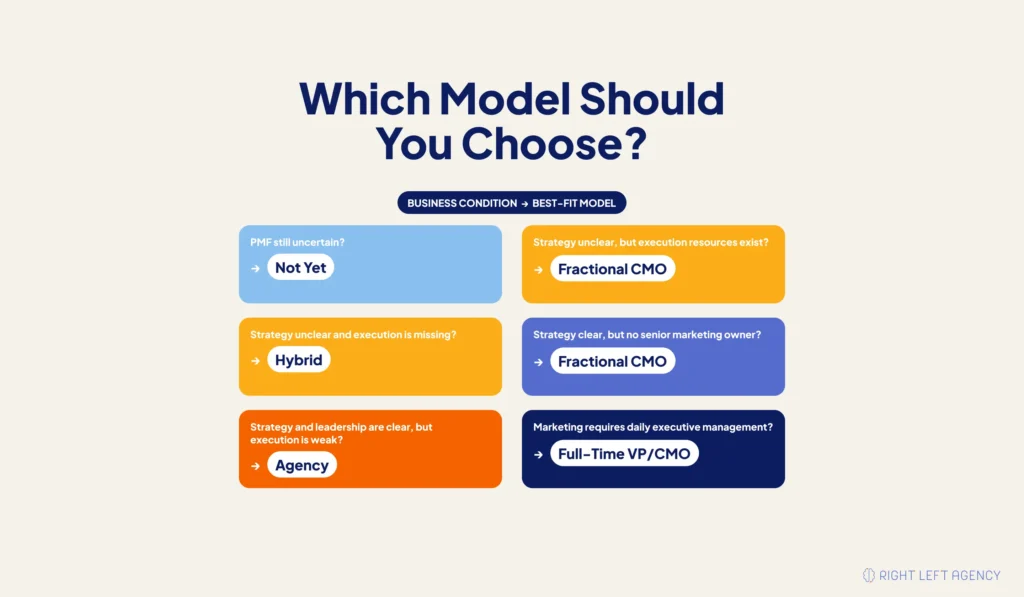
Decision Scorecard: Which Model Should You Choose?
The simplest decision framework starts with product-market fit, then separates leadership gaps from execution gaps. Work through these questions in order.
Common Mistakes That Waste SaaS Marketing Budget
SaaS companies waste budget when the marketing model doesn’t match the real constraint.
- Hiring an agency before strategy is clear. More execution won’t fix an unclear ICP or positioning.
- Hiring a fractional CMO without execution support. Strong strategy still fails when nobody can implement it.
- Relying only on agencies as complexity grows. Multiple specialists need senior ownership and coordination.
- Choosing based on price alone. Compare total capability, not the lowest retainer.
- Ignoring company stage. Your marketing structure should evolve as the business grows.
Final Recommendation: Choose the Constraint, Then the Model
The best choice starts with your constraint.
If strategy is clear but execution is weak, consider an agency. If execution exists but nobody owns direction, consider fractional leadership. If both gaps exist, consider a hybrid. If product-market fit is uncertain, you may need neither yet. If marketing requires daily executive management, move toward full-time leadership.
For many SaaS companies, the model evolves as the business grows — starting founder-led, adding focused execution support, layering in fractional leadership once coordination becomes the bottleneck, and eventually justifying a full-time marketing leader.
Start by diagnosing the constraint. Then buy the capability that solves it.
Not sure what your biggest marketing constraint is? Use Right Left Agency’s SaaS Growth Priority Finder to identify whether your next priority is acquisition, messaging, conversion, product marketing, measurement, or growth strategy.
FAQs
Is a fractional CMO cheaper than hiring a full-time CMO?
A fractional CMO can require less commitment than building a full-time executive role, but compensation alone does not show the complete cost. Include execution resources, technology, internal management time, recruiting, benefits, and supporting specialists when comparing the two models.
Can an agency replace the need for a CMO entirely?
An agency can provide meaningful strategy and execution expertise, but it does not automatically replace the need for someone accountable for company-wide marketing direction.
Does a fractional CMO execute campaigns directly?
It depends on the engagement. Some fractional leaders contribute directly to strategic projects, while others primarily manage priorities, people, vendors, measurement, and executive decisions.
How many hours per week does a fractional CMO work?
There is no single workload that applies to every engagement. The required involvement depends on company stage, team size, strategic complexity, meeting cadence, responsibilities, and available execution resources.