


Key Takeaways
- Start with revenue and pipeline goals, not a fixed percentage split.
- Allocate more budget to the main growth constraint, whether that is traffic, conversion, CAC, retention, or measurement.
- Treat the marketing budget as total investment, including media, people, content, CRO, tools, creative, and testing.
- Balance short-term demand capture with longer-term investments such as SEO, content, lifecycle, and brand visibility.
- Review the mix regularly and reallocate based on qualified pipeline, CAC, payback, conversion quality, and execution capacity.
Where should your next marketing dollar go?
More Google Ads may generate pipeline faster. SEO and content can build a more sustainable acquisition engine. CRO may deliver a better return if you already have traffic but struggle to convert it. And sometimes the problem is not the channel mix at all. It is weak execution or measurement.
A SaaS company should allocate marketing budget based on its revenue target, required pipeline, biggest growth constraint, unit economics, channel maturity, and ability to execute.
That means there is no single percentage split every SaaS company should copy.
This guide shows you how to work backward from revenue, decide what deserves investment, balance short-term pipeline with long-term growth, and reallocate budget as your business changes.
SaaS Marketing Budget Allocation at a Glance
SaaS marketing budget allocation is the process of distributing your total marketing investment across channels, people, technology, production, conversion, measurement, and experimentation.
The goal is not to give every channel a share. It is to fund the activities most likely to support your current revenue and pipeline requirements.
The Direct Answer
The best SaaS marketing budget allocation depends on what is preventing the business from growing efficiently.
If qualified traffic is the constraint, invest in demand capture. If conversion is weak, prioritize CRO. If paid CAC keeps rising, strengthen organic acquisition. If reporting is unreliable, fix measurement before making major budget decisions.
Your broader SaaS marketing strategy should determine the mix—not the other way around.
The Seven-Step Allocation Process
- Define the revenue objective.
- Calculate the required pipeline.
- Diagnose the main funnel constraint.
- Define the total available investment.
- Give each channel a clear business role.
- Reserve resources for execution and testing.
- Measure performance and reallocate.
For the broader channel context, see our complete SaaS marketing guide and SaaS marketing channels.
What Counts as a SaaS Marketing Budget?
A total SaaS marketing budget includes much more than what you pay Google, LinkedIn, or another advertising platform.
If one company reports only media spend while another includes salaries, agencies, software, creative, and development, their budgets are not directly comparable.
| Budget category | What it covers |
|---|---|
| Media | Advertising platform spend |
| People | Salaries, management, operations |
| External expertise | Agencies, freelancers, fractional specialists |
| Content and creative | Research, writing, design, video, campaign assets |
| CRO | Landing pages, forms, messaging, development, testing |
| Technology | CRM, analytics, SEO and automation tools |
| Testing | Controlled experiments and emerging opportunities |
Media Spend
Working media is the money paid directly to advertising platforms.
It can include paid search, paid social, retargeting, ABM media, and experimental campaigns across platforms such as Google Ads, LinkedIn Ads, Meta Ads, Microsoft Ads, or Reddit Ads.
Working media is only one component of total marketing investment.
Internal People and Management
Include salaries, management, marketing operations, coordination, and specialist resources.
A strategy may require SEO, paid media, content, design, CRO, lifecycle, and analytics expertise even if those costs never appear inside an advertising account.
Agencies, Freelancers, and Fractional Specialists
Agency retainers, freelancers, fractional strategists, and specialist delivery costs should also be included.
These resources are part of what it costs to turn marketing plans into actual campaigns and pipeline.
Content and Creative Production
Content spending can include research, writing, design, video, landing-page assets, commercial content, and sales enablement.
SEO and content often work closely together, but they are not interchangeable. Content can influence organic acquisition, paid campaigns, buyer education, sales conversations, and conversion.
CRO and Website Implementation
CRO deserves a dedicated budget when existing traffic is not producing enough pipeline.
Investment may include landing pages, forms, CTAs, product and pricing pages, messaging tests, design, development, and experimentation.
Technology, Analytics, and Attribution
CRM systems, GA4, Search Console, Looker Studio, marketing automation, SEO platforms, attribution tools, and reporting infrastructure all support better execution and budget decisions.
AI-search monitoring may also become part of this investment as visibility across Google AI Overviews, ChatGPT, Perplexity, and other answer engines becomes more important.
Testing Reserve
A testing reserve protects money for new creative, messages, audiences, channels, and emerging opportunities.
The supplied planning framework uses 10%–20% as contextual guidance, but the appropriate reserve depends on company maturity, available budget, and how much experimentation is genuinely required.
Start With Revenue and Pipeline Goals, Not Channel Percentages
Your allocation should begin with the business outcome marketing must support.
Instead of asking, “How much should we spend on SEO?”, ask, “What pipeline must marketing generate, and what is preventing us from generating it?”
Define the Revenue Objective
Start with:
- Target ARR or revenue.
- Net-new versus expansion revenue.
- Planning period.
- Marketing’s expected contribution.
This gives every channel a business outcome to work toward.
Work Backward Through the Funnel
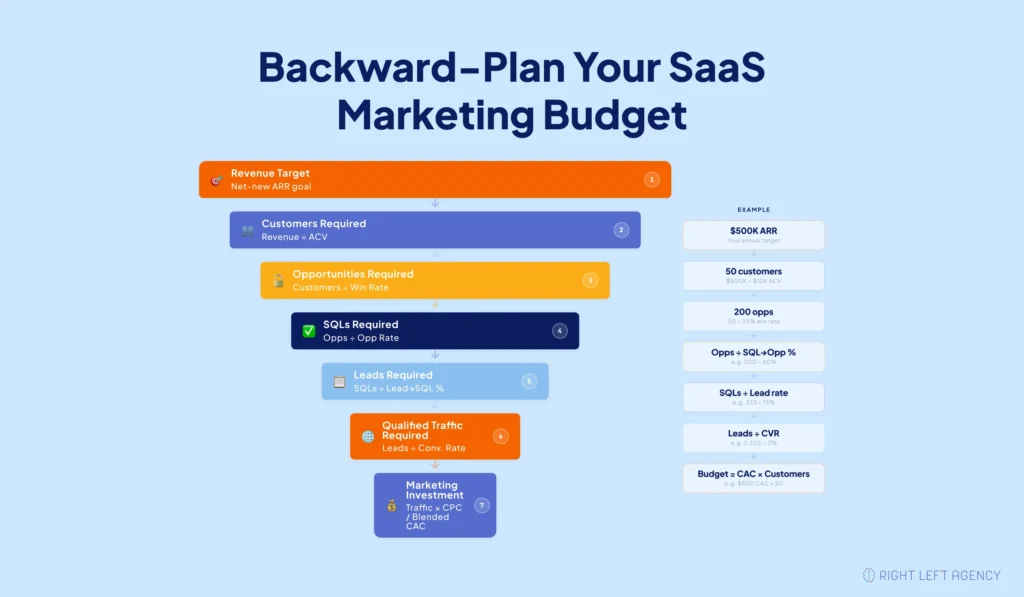
Translate the revenue target into the number of customers, opportunities, leads, and qualified visitors required.
Calculate Required Customers and Opportunities
Suppose a SaaS company wants $500,000 in net-new ARR and has a $10,000 average annual contract value.
It needs 50 new customers.
If 25% of qualified opportunities become customers, the company needs roughly 200 opportunities.
This is a planning example, not a benchmark.
Calculate Required Leads and Traffic
Now continue backward using the company’s own funnel rates.
If 40% of SQLs become opportunities, 200 opportunities require approximately 500 SQLs.
From there, use your real lead-to-SQL and visitor-to-lead rates to estimate how much qualified demand is required.
This is the foundation of a strong B2B SaaS marketing plan.
Establish CAC and Payback Limits
CAC is the total cost required to acquire a customer. CAC payback shows how long it takes to recover that cost.
Use CAC, LTV: CAC, ACV, gross margin, retention, and sales-cycle length to decide what the company can sustainably spend.
A 3:1 LTV: CAC ratio and sub-12-month CAC payback appear in the supplied research as common planning references. They are not universal targets.
For deeper measurement, see SaaS marketing ROI and SaaS marketing attribution.
Determine Whether the Problem Is Budget, Allocation, or Execution
These are different problems.
- Budget problem: The company cannot fund enough activity to reach the required volume.
- Allocation problem: Enough money exists, but it is concentrated in the wrong activities.
- Execution problem: The strategy is reasonable, but targeting, creative, content, landing pages, or follow-up are weak.
Before asking leadership for more money, identify which problem you actually have.
Diagnose the Main Growth Constraint Before Allocating Spend
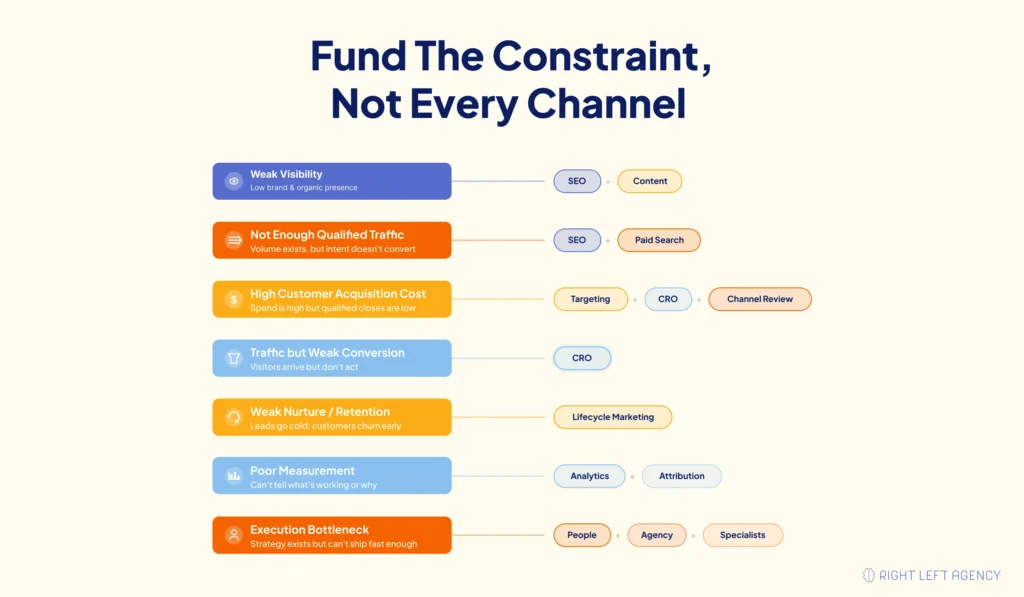
The next investment should address the bottleneck limiting growth.
Your SaaS marketing funnel can help locate that constraint.
Weak Category Visibility
Prioritize SEO, content, authority, and AI-search visibility when competitors dominate important category, solution, comparison, and commercial searches.
This may also involve entity-based content, structured data, schema markup, and content designed to be understandable across traditional and AI-assisted search experiences.
Insufficient Qualified Traffic
Increase demand capture when too few relevant buyers reach the website.
SEO and high-intent paid search can both support this problem. The priority is qualified traffic, not raw session growth.
High Acquisition Cost
Rising CPC, CPA, CAC, or payback can point to poor targeting, paid-media dependency, weak conversion, or low lead quality.
Find the cause before simply increasing spend.
Weak Conversion and Lead Quality
If traffic grows while pipeline stays flat, CRO deserves attention.
Review landing pages, forms, product pages, pricing, comparisons, messaging, and sales acceptance.
Our SaaS landing-page strategy explains this conversion layer in more detail.
Weak Nurture, Retention, or Expansion
When sales cycles are long, or churn is high, acquisition may not be the best place for the next dollar.
Improving retention can strengthen LTV and NRR, which in turn can make customer acquisition economics more sustainable.
Weak Attribution and Reporting
B2B SaaS buyers rarely convert after one interaction.
One person may discover an article, another engage with a LinkedIn campaign, and a decision-maker later request a demo. Last-click reporting can miss those relationships.
Use CRM opportunity data alongside direct and assisted channel contribution.
Limited Execution Capacity
Do not fund more channels than your team can execute properly.
Every channel needs a minimum viable level of budget, creative, traffic, ownership, and time to produce interpretable data.
Spreading resources too thinly can make several good channels look ineffective.
How to Split Spend Across SEO, Paid Media, Content, CRO, and Supporting Activities
Each investment should have a defined business role and a realistic evaluation period.
| Investment | Primary outcome | Time horizon | Prioritize when | Main metrics |
|---|---|---|---|---|
| SEO | Sustainable demand capture | Compounding | Organic/category visibility is weak | Qualified traffic, pipeline |
| Paid media | Faster demand capture | Immediate/near-term | Pipeline or market feedback is urgent | CAC, pipeline |
| Content | Education and differentiation | Near-term/compounding | Buyers need education | Assisted pipeline |
| CRO | More value from traffic | Near-term | Conversion is weak | Conversion, pipeline/visitor |
| Analytics | Better decisions | Ongoing | Attribution is unreliable | Pipeline by channel |
| Lifecycle | Retention and expansion | Ongoing | Nurture or NRR needs improvement | NRR, expansion |
SEO: Sustainable Demand Capture and Category Visibility
SEO should receive more budget when search demand exists, but competitors own the category.
Investment can include technical SEO, commercial pages, content optimization, digital PR, structured data, authority building, and AI-search visibility.
Do not overinvest when product-market fit remains unclear, or the company lacks implementation capacity.
See our guide to SEO for SaaS.
Paid Media: Faster Demand Capture and Message Testing
Paid media is useful when you need faster demand capture, pipeline, or feedback on positioning.
Demand-Capture Channels
Paid search can capture buyers actively researching a category, solution, competitor, alternative, or pricing decision.
Influence Channels
LinkedIn, Meta, retargeting, webinars, and other influence channels can support demand creation and buying-committee education even when they do not receive the final conversion.
Experimental Channels
New platforms and formats should run within predetermined budgets, evaluation windows, and stop criteria.
See our SaaS PPC strategy.
Content: Education, Differentiation, Organic Growth, and Sales Enablement
Content can capture search demand, create demand, explain complex products, support sales, and improve differentiation.
Increase investment when buyers need more education, your sales cycle is long, or sales teams lack strong decision-support assets.
CRO: More Pipeline From Existing Traffic
CRO becomes more valuable when you already have qualified traffic but underperform on demos, trials, forms, or pipeline.
Before paying for substantially more traffic, improve what happens after visitors arrive.
Analytics and Attribution: Revenue Accountability
Measurement should connect marketing activity with qualified pipeline, CAC, revenue influence, and assisted contribution.
Without it, reallocation becomes guesswork.
Creative: Campaign and Landing-Page Performance
Creative affects paid performance, landing-page conversion, message clarity, and testing velocity.
A media budget without sufficient creative support may struggle to scale efficiently.
Lifecycle, Retention, and Expansion
As SaaS companies mature, more budget should support nurture, onboarding communication, customer education, retention, upsell, and expansion.
People, Technology, and Testing
Leave enough budget to actually operate the strategy.
Channels without ownership, tools, creative, development, or testing capacity rarely perform as expected.
How Channel Time Horizons Should Affect the Mix
Do not judge every investment over the same period.
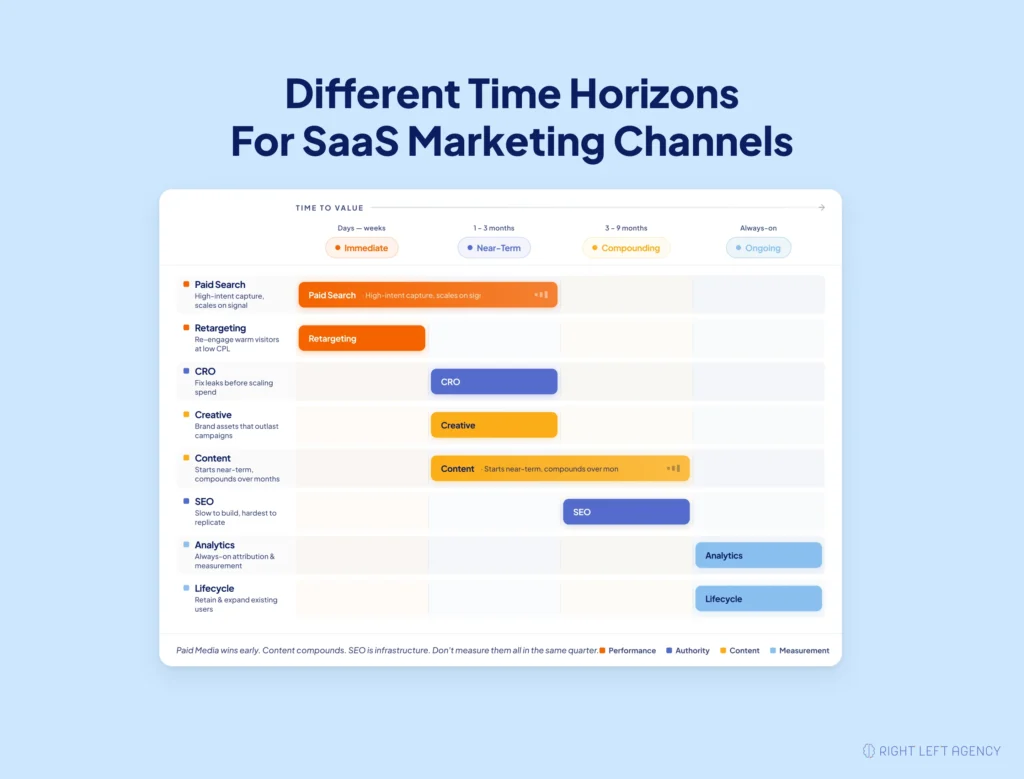
Immediate Demand and Testing
Paid search, retargeting, and offer testing can provide faster signals when immediate pipeline matters.
Near-Term Conversion Improvement
CRO, landing pages, creative, nurture, and sales-enablement work can improve the productivity of existing demand.
Compounding Demand Capture
SEO, content, authority, and category visibility generally require sustained investment but can reduce long-term dependence on paid acquisition.
Strategic Growth Infrastructure
Analytics, attribution, martech, internal capability, and customer marketing improve decisions across every time horizon.
The right mix usually combines several horizons rather than choosing only “short term” or “long term.”
Recommended Allocation by SaaS Growth Stage and Business Situation
The allocation should change as the company matures and as the constraint changes.
| Situation | Primary investment | Supporting investment | Limit | Key KPI |
|---|---|---|---|---|
| Early stage | High-intent validation | Focused content/CRO | Broad diversification | CAC learning |
| Growth stage | Proven acquisition | SEO, content, CRO | Unproven expansion | Qualified pipeline |
| Established | Organic/category growth | Lifecycle/CRO | Paid dependency | Acquisition efficiency |
| Enterprise | ABM/influence | Nurture/content | Lead-volume tactics | Opportunity pipeline |
| Strong traffic, weak conversion | CRO | Messaging/content | More traffic | Pipeline/visitor |
Early-Stage SaaS Validating Acquisition Channels
Concentrate limited resources around one or two high-intent opportunities.
Prioritize learning, positioning, focused content, conversion fundamentals, and CAC validation.
Growth-Stage SaaS Building Predictable Pipeline
Scale proven acquisition while building SEO, content, CRO, analytics, and specialist execution.
This is usually the point where repeatability matters more than simply finding a channel that works.
Established SaaS Reducing Paid-Media Dependency
Maintain profitable paid demand capture while investing more deeply in organic visibility, category authority, content, retention, and expansion.
Enterprise SaaS With a Long Sales Cycle
Long sales cycles and high ACV increase the importance of ABM, LinkedIn, thought leadership, nurture, sales enablement, account-level reporting, and assisted attribution.
SaaS With Strong Traffic but Weak Conversion
Shift incremental budget toward CRO rather than buying more visitors.
Fix high-intent pages, offers, forms, CTAs, messaging, and lead quality first.
SaaS With High Paid-Media Dependency
Avoid abrupt cuts to profitable campaigns.
Use paid-search data to guide SEO and content investments while improving conversion and gradually building alternative acquisition sources.
Budget Allocation by SaaS Go-to-Market Model
GTM model changes what marketing must accomplish.
Product-Led SaaS
PLG companies should emphasize product acquisition, trials, self-serve conversion, product-led SEO, onboarding, lifecycle automation, and CRO.
The funnel may tolerate a lower-touch acquisition model, so product usage and conversion signals matter heavily.
Sales-Led SaaS
Sales-led businesses need qualified demand, demo conversion, nurture, sales enablement, and opportunity-level attribution.
Lead quality often matters more than sheer lead volume.
Enterprise SaaS
High ACV and long cycles require buying-committee influence, ABM, executive content, webinars or events, LinkedIn, nurture, and longer attribution windows.
Hybrid SaaS
Hybrid models should separate self-serve and sales-assisted economics.
Each funnel can have different CAC expectations, CTAs, conversion rates, landing pages, and reporting while sharing SEO and content infrastructure.
Example Monthly SaaS Marketing Budget Allocations
These examples illustrate how allocation might work. They are not benchmark recommendations.
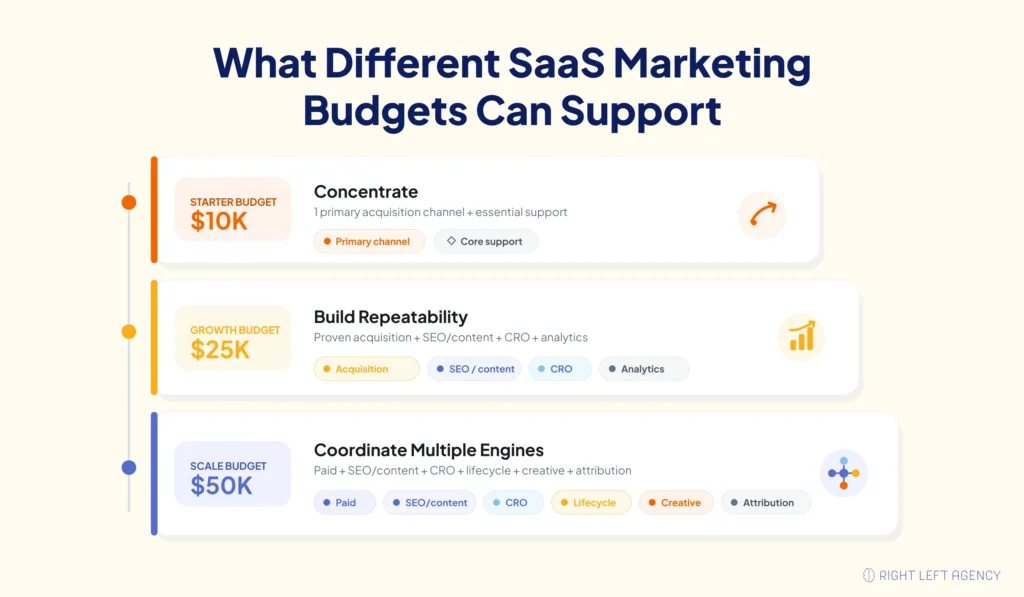
Example $10,000 Monthly Budget
Assumption: Early-stage SaaS with founder or internal execution support.
| Category | Example |
|---|---|
| Primary acquisition | $4,000 |
| SEO/content | $2,000 |
| CRO | $1,000 |
| Analytics/tools | $1,000 |
| Specialist support | $1,000 |
| Testing | $1,000 |
At this level, concentration matters more than broad channel coverage.
Example $25,000 Monthly Budget
Assumption: Growth-stage SaaS with one proven acquisition channel and some internal ownership.
| Category | Example |
|---|---|
| Paid demand capture | $8,000 |
| SEO/content production | $5,000 |
| CRO | $2,500 |
| Creative | $2,000 |
| Analytics/tools | $1,500 |
| External specialist support | $3,500 |
| Testing | $2,500 |
External support is shown separately so it is not confused with media or production costs.
Example $50,000 Monthly Budget
Assumption: Established SaaS running coordinated multi-channel acquisition.
| Category | Example |
|---|---|
| Paid media | $15,000 |
| SEO/content production | $9,000 |
| CRO | $4,000 |
| Creative | $4,000 |
| Lifecycle | $3,000 |
| Analytics/tools | $3,000 |
| Agency/specialist execution | $7,000 |
| Testing | $5,000 |
How to Adapt the Examples
Change the mix based on ACV, sales cycle, current traffic, conversion, growth stage, retention, channel maturity, and internal capacity.
Two companies with the same $25,000 budget may need completely different allocations.
Build, Buy, Hire, or Use a Hybrid Model?
The budget works only if someone can execute it well.
In-House Team
Best when consistent workload and strategic importance justify permanent roles.
You gain control and institutional knowledge but take on salary, recruitment, management, software, and specialist-coverage costs.
SaaS Growth Marketing Agency
An agency can provide access to multiple specialists without building every capability internally.
Compare the total investment—not the retainer alone—with the cost and capacity of alternative models.
Freelancers and Fractional Specialists
Useful for focused workstreams and flexible capacity.
The tradeoff is additional coordination, especially when several specialists work independently.
Software and AI-Assisted Execution
AI and software can improve research, production, automation, and analysis.
They do not replace strategy, expertise, review, or accountability.
Hybrid Model
An internal marketing owner supported by external specialists can balance knowledge, control, and capability breadth.
Execution-Model Decision Framework
Compare options using cost, speed, control, specialist depth, management burden, scalability, and measurement maturity.
For more detail, compare a SaaS marketing agency with an in-house team or review typical SaaS marketing agency costs.
How to Measure Marketing-Budget Performance
Judge allocation through business outcomes, not activity alone.
Pipeline and Revenue Metrics
Prioritize qualified pipeline, opportunities, net-new ARR, pipeline per marketing dollar, and influenced revenue.
Unit-Economics Metrics
Track CAC, LTV, LTV:CAC, CAC payback, Marketing Efficiency Ratio, churn, and NRR where relevant.
The supplied research identifies NRR above 100% as a desirable planning reference, not a guaranteed standard for every SaaS business.
Channel-Specific Metrics
SEO and Content
Qualified organic traffic, non-brand visibility, conversions, assisted pipeline, organic CAC, and AI-search visibility.
Paid Media
Qualified conversions, CPA, CAC, pipeline, payback, and ROAS where appropriate.
CRO
Visitor-to-lead conversion, demo or trial conversion, lead quality, incremental lift, and pipeline per visitor.
Lifecycle and Retention
Nurture progression, expansion pipeline, NRR, churn, and upsell contribution.
Attribution and Assisted Pipeline
Evaluate the full journey where possible.
Content may create awareness. Paid media may reinforce the message. Search may capture demand later. Sales may then convert the account.
That is why CRM opportunity data and assisted contribution matter alongside direct conversions.
Reporting to Leadership
Show:
- Pipeline and revenue impact.
- CAC and payback.
- Leading versus lagging indicators.
- Channel time horizons.
- Important assumptions.
- Allocation changes and why they were made.
When to Reallocate the SaaS Marketing Budget
Treat your initial allocation as a hypothesis that needs evidence.
Increase Investment
Increase budget when qualified pipeline grows, CAC remains sustainable, payback meets your target, conversion quality holds, and sufficient additional demand exists.
Maintain Investment
Maintaining spend can be the right choice when performance is stable, more data is needed, the channel has a longer evaluation window, or it contributes meaningful assisted pipeline.
Scaling is not always the right move if additional spend would reduce efficiency.
Reduce or Consolidate Investment
Reduce investment when budget is spread too thinly, channels overlap, sales cannot handle additional volume, or production capacity limits performance.
Stop or Replace a Channel
Do not stop a channel because of a few weak days.
Use a predetermined test window and check whether:
- Enough budget was deployed.
- Enough qualified data was collected.
- Execution issues were corrected.
- Direct or assisted pipeline appeared.
- CAC remained unsustainable.
Only then can the test produce a useful decision.
Review Cadence and Testing Governance
Monitor performance monthly, make broader strategic reallocations quarterly, and reset assumptions during annual or formal planning cycles.
Every experiment should have a defined budget, duration, success metric, and stop criterion.
Common SaaS Marketing Budget Allocation Mistakes
Poor allocation can make otherwise effective marketing look unsuccessful.
Copying a Universal Percentage Split
Benchmarks cannot account for your stage, ACV, sales cycle, conversion, or internal capacity.
Spreading a Small Budget Across Too Many Channels
Give a smaller number of channels enough resources to generate meaningful evidence before diversifying.
Confusing Media Spend With Total Marketing Investment
Advertising is only one part of the cost required to generate pipeline.
Scaling Traffic Before Fixing Conversion
More traffic increases waste when your conversion path is already broken.
Producing Content Without Distribution or Attribution
Content needs visibility, distribution, sales usage, conversion paths, and measurement.
Overdepending on Paid Media
Profitable paid acquisition can remain valuable, but excessive dependence increases exposure to rising media costs and platform changes.
Underfunding Analytics and Attribution
Poor measurement produces poor reallocation decisions.
Ignoring Execution Capacity
Budgeting without capable owners, creative, development, or sales follow-up will underperform.
Connecting Agency Fees Directly to Ad Spend
Percentage-of-spend pricing can create incentive concerns when higher fees are tied mainly to increasing media spend rather than improving qualified pipeline or efficiency.
The pricing model itself is not automatically a problem. Alignment matters.
Ignoring Retention and Expansion
As SaaS businesses mature, better retention and NRR can strengthen LTV and make acquisition economics more flexible.
Failing to Protect Testing Budget
Do not fund experimentation only when money happens to remain at the end of the month.
Protect it deliberately.
Build Your Recommended SaaS Marketing Budget With the Free Tool
The framework explains how allocation decisions should work. The tool applies those decisions to your specific SaaS situation.
Information the Tool Should Request
Inputs may include:
- Current ARR.
- Growth stage.
- Monthly budget.
- Revenue or pipeline target.
- ACV.
- Sales cycle.
- GTM model.
- Traffic and conversion.
- CAC.
- Main constraint.
- Current channels.
- Available internal resources.
Information the Tool Should Return
The result can show:
- Recommended percentage split.
- Monthly dollar allocation.
- Primary and secondary priorities.
- Underfunded areas.
- Potentially overfunded areas.
- Channel time horizons.
- KPIs.
- Review date.
- Execution considerations.
Get Your Recommended SaaS Marketing Budget Split
Use our free tool to see how you should allocate budget across SEO, paid media, content, and CRO based on your growth stage, goals, and current marketing constraints.
Build My Budget Allocation
Frequently Asked Questions
How do you split a SaaS marketing budget?
Start with the revenue target and work backward to required pipeline, opportunities, leads, and qualified traffic. Then fund the primary constraint while reserving enough budget for execution, CRO, measurement, and testing.
What percentage of revenue should a SaaS company spend on marketing?
There is no universal percentage. The appropriate investment depends on growth stage, goals, unit economics, retention, available capital, and what the company includes within its marketing-budget definition.
How should a SaaS startup allocate its first marketing budget?
Concentrate on one or two high-intent acquisition opportunities, focused commercial content, basic conversion support, measurement, and controlled testing. Avoid premature channel diversification.
How much should go to SEO versus paid media?
Prioritize paid media when faster demand capture and testing are important. Increase SEO when relevant search demand exists, and you need stronger category visibility, compounding acquisition, or lower long-term paid dependency.
Should content and SEO have separate budgets?
They can. SEO covers technical visibility, optimization, and authority, while content also supports product education, differentiation, sales enablement, distribution, and conversion.
How much should be reserved for CRO?
There is no standard percentage. CRO deserves more investment when significant qualified traffic already exists, but demo, trial, lead, or pipeline conversion remains weak.
Should agency fees be included in the marketing budget?
Yes. Agency fees are part of total marketing investment alongside media, internal people, software, content, creative, and other execution costs.
How often should a SaaS marketing budget be reviewed?
Monitor performance monthly, consider strategic reallocation quarterly, and reassess the broader plan during annual or formal planning cycles. Individual tests should follow their own predefined evaluation windows.
Your SaaS marketing budget should change as your constraints change.
Early on, the priority may be proving one acquisition channel. Later, it may be increasing conversion, reducing paid dependence, building organic visibility, improving retention, or strengthening attribution.
The goal is not to fund every marketing channel. It is to coordinate the right channels and execution resources around qualified pipeline, sustainable acquisition economics, and long-term growth.
Use the SaaS Marketing Budget Allocation Tool to turn this framework into a recommended split for your own growth stage and constraints.
If you need broader strategic and execution support, learn how a SaaS growth marketing partner can coordinate acquisition, conversion, content, and measurement around the same revenue goals.
Get Your Recommended SaaS Marketing Budget Split
Build My Budget Allocation