

Key Takeaways
- A SaaS blog strategy should support revenue goals, not just publishing targets.
- Customer intelligence and keyword research should work together.
- Prioritize topics by pipeline potential.
- Build connected content journeys.
- Measure content through analytics and CRM data
What Is a SaaS Blog Strategy?
A SaaS blog strategy connects customer needs, search demand, product use cases, content, conversion paths, distribution, and measurement.
It defines:
- Who the blog targets
- Which customer problems to address
- What topics to prioritize
- How content supports the product
- Where readers should go next
- How results will be measured
A content calendar only shows what to publish and when. A strategy explains why each topic matters and how it supports signups, trials, demos, pipeline, and revenue.
For example, “publish eight articles this month” is an activity. “Generate qualified signups from operations teams” is a business goal.
The blog should support the company’s wider acquisition and revenue strategy, not operate as a separate publishing channel.
Why SaaS Blogs Generate Traffic but Fail to Create Pipeline
SaaS blogs often generate traffic without creating pipeline because they attract broad interest instead of qualified buyers.
High-volume keywords may bring visitors, but those readers will not convert if they do not match the ICP or need the product.
This usually happens when teams choose topics based only on search volume, publish generic content, use weak internal links, or show the same CTA to every reader.
A beginner may need a helpful guide, while a buyer comparing tools may be ready for a trial, demo, or case study.
Traffic metrics alone also hide the real picture. Rankings and clicks show visibility, but qualified leads, opportunities, and revenue show business impact.
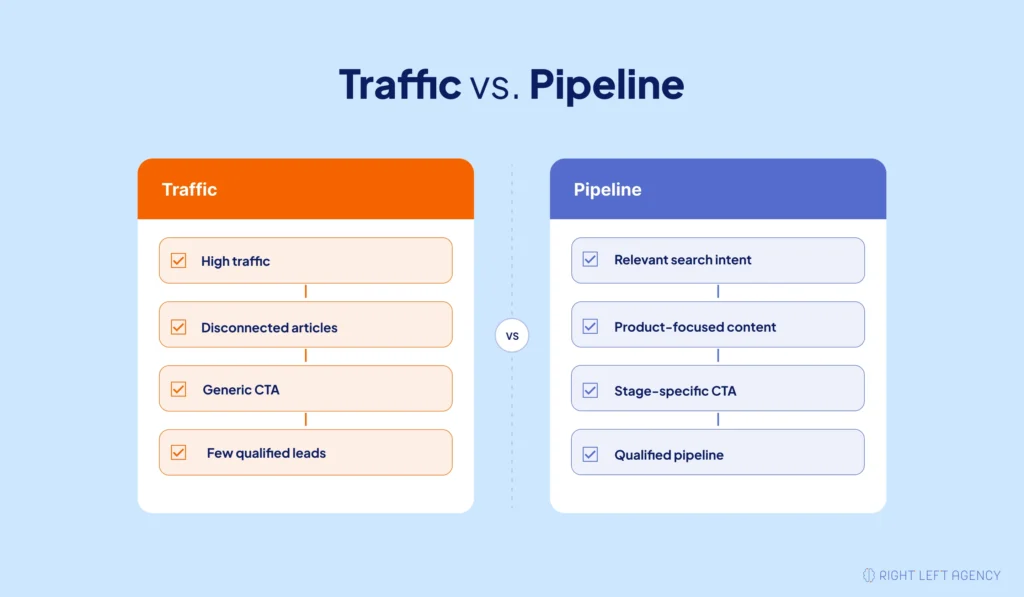
| Traffic-First Blog | Pipeline-Focused Blog |
|---|---|
| Prioritizes search volume | Prioritizes intent and product relevance |
| Publishes disconnected topics | Builds connected customer journeys |
| Uses one CTA everywhere | Matches the CTA to reader readiness |
| Tracks pageviews and rankings | Tracks qualification and pipeline |
| Explains topics generically | Adds product, customer, and expert evidence |
| Treats publication as the finish line | Distributes, refreshes, and improves content |
| Separates content from sales | Connects content with CRM outcomes |
A commercially underperforming blog often shows a clear pattern: organic traffic increases while product-page visits, signups, qualified leads, and opportunities remain flat.
How to Build a SaaS Blog Strategy That Generates Pipeline
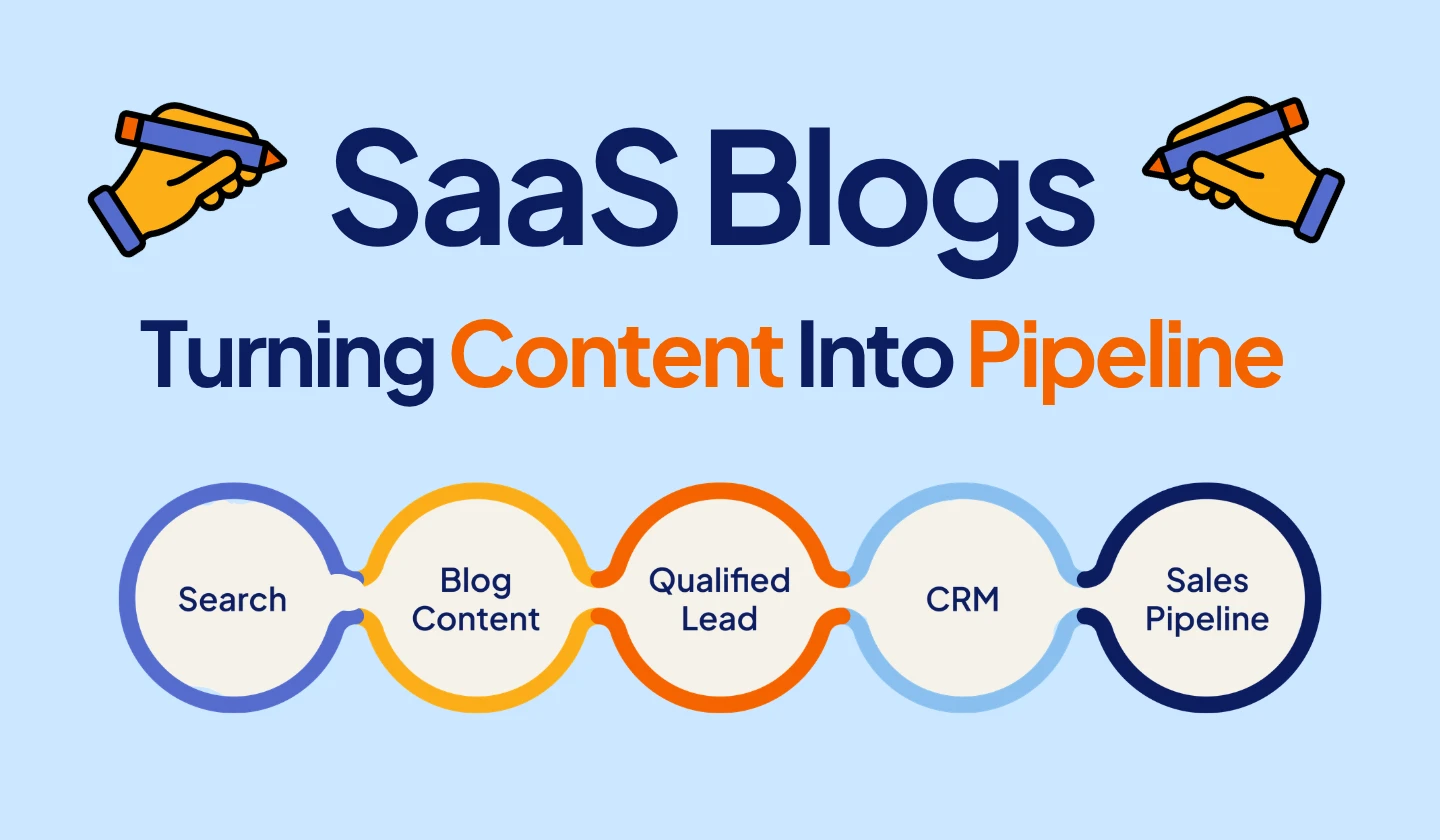
A pipeline-focused SaaS blogging strategy follows a connected sequence:
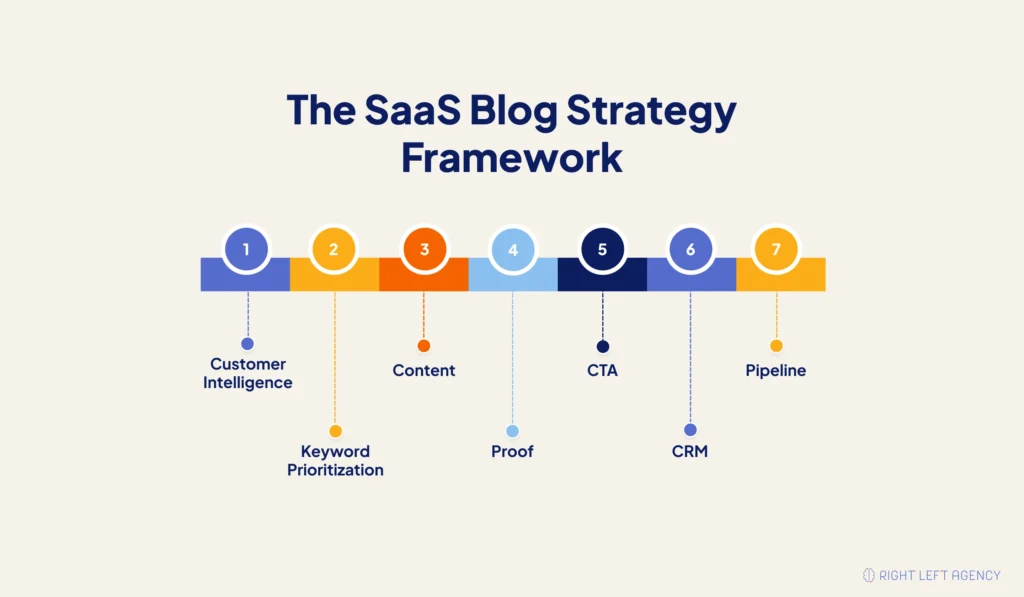
The process includes ten steps:
- Define the blog’s role.
- Build customer intelligence.
- Map customer problems to the buying journey.
- Prioritize product-relevant search demand.
- Balance content across funnel stages.
- Build topic clusters and internal-link paths.
- Design conversion paths.
- Create a publishing roadmap.
- Distribute and improve published content.
- Measure pipeline contribution.
Each step supports the next. Weak customer research leads to poor topic choices. Poor topic choices attract poorly matched readers. Those visitors rarely become qualified opportunities.
1. Define the Blog’s Role in the Revenue Strategy
Before choosing keywords, define what the blog should achieve.
A SaaS blog can support:
- Demand creation
- Demand capture
- Product education
- Lead nurturing
- Sales enablement
- Customer expansion
The priority will depend on the company’s stage. An early-stage SaaS business may focus on capturing existing demand, while a more established company may use content to educate buyers, support longer sales cycles, or enter new markets.
Keep business goals separate from publishing tasks.
“Publish ten articles” is an activity.
“Generate qualified trial signups from finance teams” is a business goal.
| Blog Role | Typical Outcome | Example Metric |
|---|---|---|
| Demand creation | Build relevant awareness | Visits from target accounts |
| Demand capture | Convert active demand | Demo or trial conversions |
| Product education | Explain use cases | Product-page visits |
| Lead nurturing | Support continued evaluation | Return visits and downloads |
| Sales enablement | Help active opportunities | Content-influenced pipeline |
| Customer expansion | Promote more capabilities | Expansion-related engagement |
The team should also define which conversions matter, such as newsletter signups, resource downloads, product-page visits, trials, demos, signups, or consultations.
2. Build the Strategy Around the ICP and Customer Intelligence
Keyword tools show what people search for, but not always what truly matters to them.
A strong SaaS blog strategy starts with a clear ideal customer profile, or ICP. Define it by industry, company size, team, workflow, use case, business model, product maturity, buying situation, and technical needs.
Then identify everyone involved in the buying decision, from end users and team leaders to technical reviewers and procurement. Customer insights help you understand their real problems, priorities, objections, and language.
Sources of Customer Intelligence
Won-deal CRM data
Won opportunities reveal the industries, company profiles, use cases, and buying triggers associated with successful customers.
Sales and discovery calls
These conversations uncover pain points, desired outcomes, common objections, competing solutions, and evaluation questions.
Prospecting conversations
Outbound responses show which problems feel urgent, which messages resonate, and which positioning fails to connect.
Customer-success calls
Customer-success teams hear how customers use the product, where adoption becomes difficult, and which outcomes create long-term value.
Support tickets and calls
Support interactions reveal recurring tasks, workflow problems, technical concerns, and knowledge gaps.
Product feedback
Feature requests and interviews show what customers are trying to accomplish and where current solutions fall short.
Founder and subject-matter expert interviews
Founders, product specialists, sales representatives, and technical experts can explain customer behavior, market changes, and product differentiation.
Information to Extract
Create a simple research document that captures:
- Customer problems
- Key tasks and workflows
- Current tools and alternatives
- Common objections
- Buying triggers
- Desired outcomes
- Success criteria
- Customer language
- Evaluation questions
For example, keyword research may show demand for “workflow automation software,” while sales calls reveal that prospects often say, “We need to stop copying data from our CRM into spreadsheets.”
Keyword data shows how people search. Customer language shows how they describe the problem. Use both insights in the content brief before writing.
3. Map Customer Problems to the Buying Journey and Product
A SaaS blog should connect customer problems with relevant product use cases without sounding overly promotional.
Map topics to the buying journey:
- TOFU: Readers are learning about a problem.
- MOFU: Readers are exploring possible solutions.
- BOFU: Readers are comparing products, pricing, or vendors.
Product-led content works best when it teaches first and introduces the product naturally.
A simple jobs-to-be-done structure is:
- Explain the current process.
- Show its limitations.
- Present a better approach.
- Introduce the product where it fits.
- Support the recommendation with evidence.
This keeps the content useful while creating genuine product interest.
Top-of-Funnel Content
TOFU content helps readers understand a problem or concept.
Common formats include:
- Definitions
- Beginner guides
- How-to articles
- Industry challenges
- Early-stage jobs-to-be-done topics
Use low-friction CTAs such as a related guide, newsletter, video, or downloadable resource.
Middle-of-Funnel Content
MOFU content helps readers compare approaches and explore solutions.
Common formats include:
- Templates
- Checklists
- Frameworks
- Benchmarks
- Best-software lists
- Use-case guides
- Team- or industry-specific content
The goal is to encourage lead capture, product exploration, or further evaluation.
Bottom-of-Funnel Content
BOFU content supports an active buying decision.
Common formats include:
- Alternatives pages
- Product comparisons
- Pricing guides
- Reviews
- Product-versus-product articles
- Category-plus-audience pages
The next step may be a trial, demo, product signup, or sales conversation.
Focus on topics that clearly connect to the product. Irrelevant traffic may increase visits without improving customer acquisition.
4. Research and Prioritize Keywords by Pipeline Potential
Search volume alone does not show business value. A keyword with 100 monthly searches can generate more pipeline than one with 10,000 if it has stronger product fit, clearer buying intent, and better ICP relevance.
Prioritize keywords based on:
- ICP relevance
- Product fit
- Commercial intent
- Funnel stage
- Conversion potential
- Search demand
- Ranking difficulty
- Available evidence
- Topic-cluster value
Use Google Search Console, Google Keyword Planner, Ahrefs, or Semrush alongside customer research. Keyword tools show what people search for. Customer insights explain why those searches matter.
Offer Keywords
Offer keywords describe the type of software or solution a prospect wants.
Common formulas include:
- Best [product category]
- [Product category] software
- [Product category] platform
- [Product category] tool
- [Product category] solution
These keywords often show strong commercial intent because the searcher already understands the solution category.
Industry and Audience Keywords
These terms combine a product category with an industry, team, company size, workflow, or use case.
Examples include:
- Proposal software for sales teams
- Proposal software for fintech companies
- Proposal software for HR teams
- Reporting software for small agencies
- Scheduling tools for distributed support teams
These searches may have lower volume, but they often show clearer audience and product relevance.
Competitor Keywords
Competitor-related searches capture active evaluation demand.
Relevant formats include:
- [Competitor] alternatives
- [Competitor] pricing
- [Competitor] review
- [Product A] versus [Product B]
- Best alternatives to [Competitor]
Competitor content should remain accurate and balanced.
A useful comparison explains who each option serves, what it does well, where it may be limited, and which buying situations make it appropriate.
Jobs-to-Be-Done Keywords
Jobs-to-be-done keywords describe a task, workflow, or desired outcome rather than a software category.
Examples include:
- How to automate client onboarding
- How to reduce manual reporting
- How to track customer health
- How to improve sales handoffs
- How to centralize project approvals
These topics create product demand when they explain the existing workflow, identify its limitations, teach a better method, and introduce the product only where relevant.
Validate the Format Through the SERP
Search intent determines the correct page format.
Review the search engine results page before assigning a keyword to the blog. The dominant results may indicate that searchers expect:
- A how-to guide
- A listicle
- An alternatives page
- A comparison article
- A product page
- A service page
- A category page
- A template or tool
Not every keyword should become a blog post.
A high-intent term such as “[product category] software” may require a product or category page. Turning it into a broad educational article may create a mismatch between the page and the searcher’s expectations.
Use a Practical Topic-Prioritization Score
Score opportunities according to the criteria that matter to the business.
| Criterion | Question to Ask |
|---|---|
| ICP relevance | Does the topic attract the right companies and buyers? |
| Product relevance | Can the product credibly help solve the problem? |
| Commercial intent | Does the query suggest evaluation or purchase interest? |
| Funnel stage | How close is the reader to a decision? |
| Conversion potential | Is there a logical next step? |
| Search demand | Is there evidence of recurring demand? |
| Ranking feasibility | Can the site realistically compete? |
| Available evidence | Can the team add examples, data, or expertise? |
| Cluster value | Does the topic strengthen a strategic subject area? |
Do not rely on a universal weighting formula. A new SaaS company may give greater priority to product relevance and commercial intent. An established brand may have more room to invest in broad authority-building content.
Decision rule: Prioritize topics that combine customer relevance, product fit, clear intent, useful evidence, and a logical conversion path.
Connected Example: From Customer Problem to Pipeline
Consider a SaaS company that sells proposal software to B2B sales teams.
Customer interviews reveal a recurring problem: sales representatives spend too much time creating proposals manually, and managers struggle to maintain pricing consistency.
The team could build the following content path:
- Customer problem: Manual proposals slow down sales.
- Search query: How to automate sales proposals.
- Article format: A jobs-to-be-done guide.
- Product use case: Automated templates and approval workflows.
- Internal link: Proposal software for sales teams.
- MOFU resource: Sales proposal template.
- BOFU content: Product A versus Product B.
- CTA: Start a trial or request a product walkthrough.
- CRM outcome: Track whether the reader becomes a qualified opportunity.
This is how one customer problem can guide keyword selection, content format, internal linking, conversion, and attribution.
5. Balance TOFU, MOFU, and BOFU Content
A balanced SaaS content funnel supports awareness, evaluation, and purchase.
Many teams direct most of their resources toward broad TOFU topics because those keywords have higher search volume. The result is often a large audience with limited buying intent.
A pipeline-focused program should give early attention to MOFU and BOFU opportunities where product relevance is already clear.
The following 50-30-20 framework provides a useful starting point:
| Funnel Stage | Suggested Starting Allocation | Common Topics | Reader Readiness | Suitable CTA | Example Metric |
|---|---|---|---|---|---|
| MOFU | 50% | Use cases, templates, software lists, frameworks | Evaluating solutions | Product exploration or resource | Qualified leads |
| BOFU | 30% | Alternatives, comparisons, reviews, pricing | Preparing to decide | Trial, demo, or consultation | Opportunities |
| TOFU | 20% | Definitions, problems, how-to guides | Learning | Related content or newsletter | Engaged relevant visits |
This model is not a universal rule.
The right mix depends on market maturity, existing content, product complexity, sales-cycle length, search demand, website authority, and current pipeline needs.
An early-stage company may begin with product-category, use-case, industry, comparison, and alternatives content before investing heavily in broad awareness topics.
6. Build Topic Clusters and Commercial Internal-Link Paths
A topic cluster connects a pillar page, supporting articles, and relevant commercial pages around one clearly defined subject.
The pillar page covers the broad topic. Supporting pages answer narrower questions related to customer problems, workflows, industries, use cases, comparisons, and buying stages.
Internal links create the relationships between these pages.
For example, a SaaS content marketing cluster may include:
- A SaaS content marketing pillar guide
- A SaaS blog strategy article
- A SaaS keyword research guide
- A SaaS topic-cluster guide
- A content attribution article
- A blog conversion guide
- A content marketing service page
Connect this section with your SaaS topic-cluster guide for the full planning process.
This architecture supports topical authority and helps readers move from education to evaluation without forcing a product pitch.
Example Commercial Content Journey
A relevant commercial path may look like this:
Problem article → solution guide → use-case page → comparison page → demo or trial
A reader may begin with an article about reducing manual client reporting. That article links to a guide about automated reporting workflows. The guide leads to a relevant product use-case page, which then links to a comparison or product tour.
Not every reader needs to follow the same sequence. Each link should answer the next logical question rather than push everyone toward the same destination.
Suggested Cluster Categories
A complete SaaS blogging strategy may include clusters around:
- Foundational strategy
- Audience and customer research
- Keyword research
- Product-use-case content
- Funnel-stage content
- Competitor and comparison content
- Topic clusters
- Content distribution
- Content refreshing
- Conversion optimization
- Measurement and attribution
Each new article should strengthen a strategic topic rather than exist as an isolated page.
7. Design Every Article Around a Conversion Path
Every article needs a next step.
Before drafting, define:
- Target reader
- Search intent
- Funnel stage
- Product relationship
- Conversion objective
- Required evidence
- Next logical action
The CTA should match the reader’s readiness.
A generic “Book a demo” banner may underperform on early-stage content because it asks for more commitment than the reader is ready to provide. A related guide, checklist, or newsletter may create a more natural next step.
Contextual links inside the article can also be more effective than promotional banners. A reader learning about a workflow may click a related use-case page because it helps answer the next question.
Match CTAs to Reader Readiness
| Funnel Stage | Appropriate Next Step |
|---|---|
| TOFU | Related guide, newsletter, video, or educational resource |
| MOFU | Template, checklist, framework, benchmark, or product exploration |
| BOFU | Demo, free trial, product signup, or sales consultation |
After the first conversion, the journey should continue through email nurturing, product onboarding, retargeting, or sales follow-up.
Connect this section with your SaaS landing page strategy guide for more conversion guidance.
Treat High-Intent Articles Like Educational Sales Pages
High-intent articles should satisfy the search query while helping buyers make a confident decision.
They should:
- Answer the query completely
- Demonstrate the relevant use case
- Address buyer pain points
- Explain the business impact
- Present accurate differentiation
- Include customer evidence
- Link to relevant commercial pages
- Offer an appropriate demo, trial, or sales CTA
A comparison article should not hide important limitations or force the company’s product into every recommendation. Balanced information creates more trust than aggressive positioning.
Add Evidence Before Asking for Action
Useful evidence may include:
- Original data
- Customer examples
- Case studies
- Product screenshots
- Product tours
- Subject-matter expert commentary
- Real workflows
- Transparent comparisons
Evidence gives the reader something useful that cannot be found in every competing article.
Pipeline principle: The strength of the CTA should reflect the reader’s intent, while the amount of evidence should reflect the size of the decision.
8. Create a Publishing Roadmap and Efficient Production Workflow
A strategy becomes useful when it turns into assigned, measurable work.
Begin by auditing existing content. Identify pages that should be retained, consolidated, refreshed, redirected, repositioned, or removed.
Start the new roadmap with topics that combine commercial intent, clear product relevance, and strategic cluster value.
Required Roadmap Fields
Every planned topic should include:
- Target audience
- Customer problem
- Primary keyword
- Search intent
- SERP format
- Funnel stage
- Product use case
- Topic cluster
- CTA
- Internal-link targets
- Evidence required
- Content owner
- Publish date
- Measurement goal
Reusable briefs and article structures can improve production speed without reducing quality.
The workflow should also include a repeatable subject-matter expert process. A writer may interview a sales representative, product specialist, founder, or customer-success manager using a standard set of questions.
Keep approvals focused. Product experts should verify product claims. SEO specialists should check search intent and optimization. Brand or legal reviewers should participate where necessary.
Too many general reviewers can slow production without improving the article.
Technical SEO Essentials
Every article should include:
- The target keyword in the title where natural
- A relevant meta description
- A short, descriptive URL
- One clear H1
- A logical heading hierarchy
- Strong mobile usability
- Reasonable page speed
- Scannable formatting
- Relevant internal links
Technical optimization cannot compensate for poor intent targeting, weak product relevance, or generic information.
9. Distribute, Refresh, and Improve Published Content
Publishing is the beginning of the content lifecycle.
Distribute articles through the channels where the ICP is active. These may include LinkedIn, email newsletters, customer communities, sales conversations, webinars, product updates, or relevant discussion platforms.
A useful article can also become:
- Short social posts
- Sales enablement material
- Email sequences
- Visual frameworks
- Videos
- Webinar talking points
- Product-education resources
Support important pages with contextual links from relevant existing content.
Refresh articles when:
- Search intent changes
- Competitors change
- Product capabilities change
- Pricing becomes outdated
- Examples or statistics become inaccurate
- Rankings or click-through rates decline
- Conversion performance remains weak
- New customer evidence becomes available
Use Google Search Console and analytics data to identify opportunities.
A page with high impressions and a low click-through rate may need a stronger title. An article with relevant traffic but weak conversion may need better proof, internal links, product alignment, or CTAs.
Do not update content according to an unsupported universal schedule. Prioritize pages where changed information or performance data justifies the work.
10. Measure the Blog’s Contribution to Pipeline
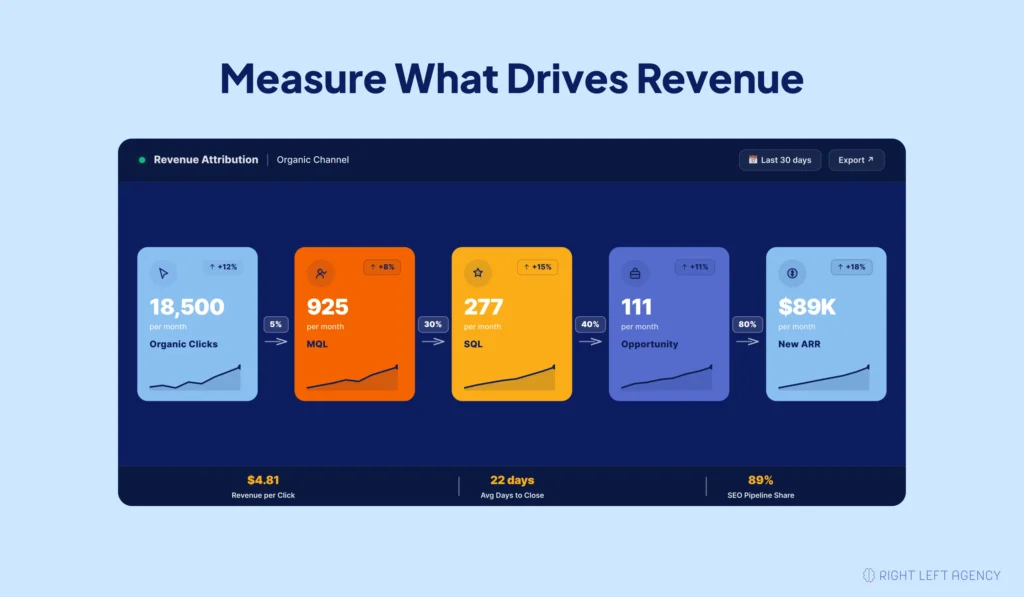
Traffic shows whether people find your content. It does not show whether that content drives revenue.
Track performance across three levels:
Search and Engagement
Monitor:
- Impressions
- Rankings
- Organic clicks
- Click-through rate
- Engaged sessions
- Scroll depth
- Return visits
These metrics show visibility and engagement.
Conversions
Track actions such as:
- CTA clicks
- Newsletter signups
- Resource downloads
- Product-page visits
- Trial starts
- Demo requests
- Product signups
These actions show progress, but lead quality matters more than volume.
Pipeline and Revenue
Connect conversions with:
- MQLs, SQLs, and PQLs
- Opportunities created
- Content-sourced pipeline
- Content-influenced pipeline
- Revenue influenced
- CAC and customer lifetime value
- ARR and MRR
Content-sourced pipeline comes from opportunities where content captured the first trackable conversion. Content-influenced pipeline includes opportunities where content supported the buying journey.
Basic Attribution Workflow
- Track key content touchpoints.
- Connect forms, signups, and trials with CRM contacts.
- Follow lead qualification and opportunity progress.
- Report sourced and influenced pipeline separately.
- Compare results by topic, cluster, intent, and funnel stage.
- Use the findings to improve the roadmap.
Google Analytics 4 and Google Search Console show traffic and engagement. HubSpot, Salesforce, or another CRM connects those actions with leads, opportunities, and revenue.
A low-traffic keyword may create strong opportunities, while a high-traffic keyword may produce few qualified leads.
Measurement principle: Search metrics show visibility. Analytics shows behavior. CRM data shows business impact.
Attribution does not need to be perfect. It only needs to be reliable enough to guide better content decisions.
Turn your content data into an action plan. Request a SaaS content strategy audit to uncover topic gaps, weak conversion paths, internal-link opportunities, and tracking issues.
Example 90-Day SaaS Blog Strategy Roadmap
A 90-day roadmap should establish the strategic foundation, publish high-intent content, and create a system for ongoing improvement.
It should not promise rankings or pipeline within a fixed period.
| Month 1: Research and Architecture | Month 2: High-Intent Production | Month 3: Cluster Expansion and Optimization |
|---|---|---|
| Define business goals and conversions | Publish priority MOFU and BOFU content | Publish supporting jobs-to-be-done content |
| Audit existing articles | Create comparison and alternatives pages | Build commercial internal-link paths |
| Document the ICP and buying journey | Build category-plus-audience content | Distribute priority articles |
| Review CRM and customer conversations | Add product examples and evidence | Review early performance data |
| Identify commercial keyword categories | Add stage-specific CTAs | Improve weak CTAs and proof |
| Map pillar and commercial pages | Link content to product pages | Update weak page structures |
| Define analytics and CRM tracking | Confirm measurement goals | Build the next quarterly roadmap |
Month 1: Research and Architecture
Define the blog’s business role, priority audience, conversion events, and reporting requirements.
Audit existing content, review customer conversations, identify commercially relevant keywords, and map the relationships between pillar pages, supporting articles, use-case pages, comparisons, and product pages.
Configure attribution requirements during this stage rather than waiting until after publication.
Month 2: High-Intent Production
Publish the strongest MOFU and BOFU opportunities.
These may include use-case guides, comparison pages, alternatives content, software lists, and category-plus-audience pages.
Add product examples, expert insight, customer evidence, and relevant commercial links.
Month 3: Cluster Expansion and Optimization
Publish supporting educational and jobs-to-be-done articles.
Strengthen internal links, distribute priority pages, and review early search and conversion signals. Improve titles, proof, page structure, and CTAs where the data reveals a problem.
Use the findings to plan the next quarter.
Common SaaS Blog Strategy Mistakes
Small strategic mistakes can compound across hundreds of articles.
| Mistake | Better Approach |
|---|---|
| Choosing topics based only on search volume | Evaluate intent, ICP fit, product relevance, and conversion potential |
| Publishing disconnected articles | Build clusters around customer problems |
| Ignoring low-volume commercial keywords | Prioritize relevance and buying intent |
| Creating every keyword as a blog post | Match the format with the SERP |
| Publishing only TOFU content | Build a balanced content portfolio |
| Neglecting product use cases | Connect problems with relevant workflows |
| Using one CTA on every page | Match the CTA to reader readiness |
| Writing biased competitor content | Use accurate and balanced comparisons |
| Depending only on keyword tools | Combine keyword data with customer intelligence |
| Excluding internal experts | Include sales, support, product, and customer-success insights |
| Producing generic explanations | Add evidence, examples, and original expertise |
| Using weak internal linking | Build contextual paths to commercial pages |
| Never refreshing content | Update pages based on accuracy and performance |
| Measuring only traffic | Track qualification, pipeline, and revenue |
| Scaling without a clear purpose | Publish only when the page serves a distinct intent |
Random publishing creates activity without building a connected customer journey.
A calendar may stay full while commercially important content gaps remain untouched.
Should You Build the Strategy In-House or Work With an Agency?
The right execution model depends on expertise, capacity, product access, stakeholder availability, and measurement maturity.
An in-house team usually has stronger access to product knowledge, customer conversations, and internal experts. Its specialist SEO experience or production capacity may be limited.
An experienced SaaS marketing agency may provide strategy, research capacity, SEO systems, production support, and an external perspective. However, the agency still needs access to internal experts and accurate product information.
A hybrid model combines internal subject expertise with external strategy or execution support.
| Consideration | In-House | Agency | Hybrid |
|---|---|---|---|
| Product knowledge | Strong | Requires onboarding | Shared |
| Specialist SEO expertise | Varies by team | Depends on agency capabilities | Combined |
| Production capacity | Limited by internal resources | Can scale with scope | Flexible |
| SME access | Direct | Must be coordinated | Direct with external support |
| Strategic perspective | Internal | External | Balanced |
| Brand familiarity | High | Builds over time | Shared |
| Operational control | Direct | Requires coordination | Collaborative |
An in-house model may work well when the company has experienced strategists, writers, SEO specialists, analysts, and accessible subject-matter experts.
External support may be useful when the business lacks a clear framework, needs greater production capacity, or struggles to connect content with conversions and attribution.
When evaluating an agency, do not focus only on publishing volume.
Assess whether the team can:
- Use customer and CRM research
- Understand the product and ICP
- Prioritize topics by commercial value
- Match content with search intent
- Build conversion paths
- Work with internal experts
- Measure qualification and pipeline
The SaaS company should retain ownership of product accuracy, customer knowledge, brand positioning, and final commercial decisions regardless of the execution model.
Final Thoughts
A strong SaaS blog strategy turns content into more than traffic. It connects customer needs, search intent, product relevance, internal links, conversion paths, and CRM data to support real business growth.
The most effective SaaS blogs do not publish randomly or chase search volume alone. They prioritize topics with clear audience fit and commercial value, guide readers through the buying journey, and measure success through qualified leads, opportunities, and pipeline.
When every article serves a clear purpose, the blog becomes a reliable customer-acquisition channel instead of just a collection of posts.
Frequently Asked Questions
What is a SaaS blog strategy?
A SaaS blog strategy is a system that connects customer needs, search demand, product use cases, content architecture, conversion paths, distribution, and measurement. It defines which audiences and problems the blog should target, how content supports the buying journey, and how performance connects with qualified leads, pipeline, and revenue.
How does a SaaS blog generate pipeline?
A SaaS blog generates pipeline by attracting people with relevant problems or buying intent, answering their questions, connecting those problems with appropriate product use cases, providing credible evidence, and offering a stage-specific next step. Analytics and CRM data then connect the conversion with qualification, opportunities, and revenue.
What content should a SaaS blog publish first?
A SaaS blog should usually begin with commercially relevant MOFU and BOFU opportunities where product fit and buying intent are clear. These may include use-case guides, product comparisons, competitor alternatives, category-plus-industry pages, category-plus-team pages, templates, and solution-focused content.
Should SaaS companies target low-volume keywords?
Yes. Low-volume keywords can be valuable when they attract the right audience and show strong commercial intent. A specific comparison, use-case, or industry keyword may generate fewer visits than a broad informational term but produce more qualified leads and sales opportunities.
What is the recommended TOFU, MOFU, and BOFU content mix?
A 50% MOFU, 30% BOFU, and 20% TOFU allocation can provide a useful starting point for a pipeline-focused program. It is not a universal rule. The final mix should reflect market maturity, product complexity, existing content, sales-cycle length, website authority, and available search opportunities.
How should a SaaS company measure blog ROI?
A SaaS company should connect traffic and engagement data with conversions, lead qualification, opportunities, pipeline, and revenue. Analytics platforms show acquisition and behavior, while CRM data reveals whether readers become MQLs, SQLs, PQLs, customers, or revenue-generating accounts.
How often should SaaS blog content be updated?
SaaS content should be updated when search intent, rankings, competitors, product details, pricing, examples, statistics, or conversion performance change. Prioritize pages where outdated information creates risk or performance data reveals a meaningful improvement opportunity.
How long does a SaaS blog strategy take to produce results?
The timeline depends on competition, website authority, content quality, internal links, indexing, publishing consistency, product demand, and conversion infrastructure. Some high-intent pages may create early engagement, while broader search growth usually requires sustained publishing and optimization.
How can SaaS blog content be optimized for AI search?
Use direct definitions, clear entity relationships, factual summaries, concise answers, structured headings, and scannable lists. Add original evidence, customer examples, expert commentary, product screenshots, and accurate comparisons to make the content easier for search engines and AI systems to understand and retrieve.