Key Takeaways
- SaaS keyword research should chase buyer intent, not search volume.
- Buyer-intent keywords fall into clear patterns: comparison, alternatives, pricing, use case, and integration searches. These sit closer to demos and signups than generic “how to” content.
- The strongest process starts with customer data (sales calls, support tickets, CRM notes), then expands into tools like Ahrefs, Semrush, and Google Search Console.
- Score every keyword by ICP fit, product fit, intent strength, revenue potential, and ranking feasibility before you commit writing time to it.
- Keyword research should shape your site’s architecture, not just your blog calendar. TOFU content should always link toward MOFU and BOFU pages.
- AI tools can speed up brainstorming, but every keyword idea still needs validation against real search data and customer language.
SaaS keyword research is the process of finding the search terms, topics, and intent patterns your ideal customers use before they choose a software solution. It’s not about chasing traffic. Every keyword should connect to something real: product awareness, a trial signup, a demo request, or recurring revenue.
The most common mistake in SaaS keyword research is treating it as a traffic exercise. Search volume feels like the easiest number to chase, but it doesn’t tell you whether a keyword can actually influence a demo, a trial, or revenue. The stronger approach shifts the focus from volume to intent, product fit, and conversion potential. It prioritizes buyer-intent topics that match customer pain points, product use cases, competitive comparisons, and decision-stage searches, even when those topics don’t look “high volume” in a keyword tool.
To find buyer-intent SaaS keywords:
- Define your ICP, pain points, and product use cases.
- Identify BOFU patterns like “best,” “alternatives,” “pricing,” “for,” and “vs.”
- Pull ideas from competitors, Google Search Console, sales calls, support tickets, Reddit, Quora, G2, and Capterra.
- Check the SERP to see whether the topic needs a blog post, landing page, comparison page, or feature page.
- Score each keyword by product fit, ICP fit, intent strength, conversion potential, and ranking feasibility.
- Build topic clusters that support your core service, feature, and solution pages.
What Is SaaS Keyword Research?
SaaS keyword research means finding and prioritizing the search terms that potential software buyers use while they learn about a problem, compare tools, evaluate options, and get ready to buy. Done right, it helps you build content and landing pages that reach qualified buyers at every stage of their journey, not just people who are casually browsing.
This is more than pulling a list from a keyword tool. Real SaaS keyword research connects search demand to how you position your product. It shows you the exact words your buyers use to describe their pain points. That should shape more than your blog calendar. It should influence your entire site structure, from feature pages to comparison pages.
When you research keywords well, you learn:
- What your customers actually search for
- Why they search for it
- What stage of the buying journey they’re in
- Which page on your site should answer that specific query
Why SaaS Keyword Research Should Focus on Buyer Intent, Not Just Search Volume
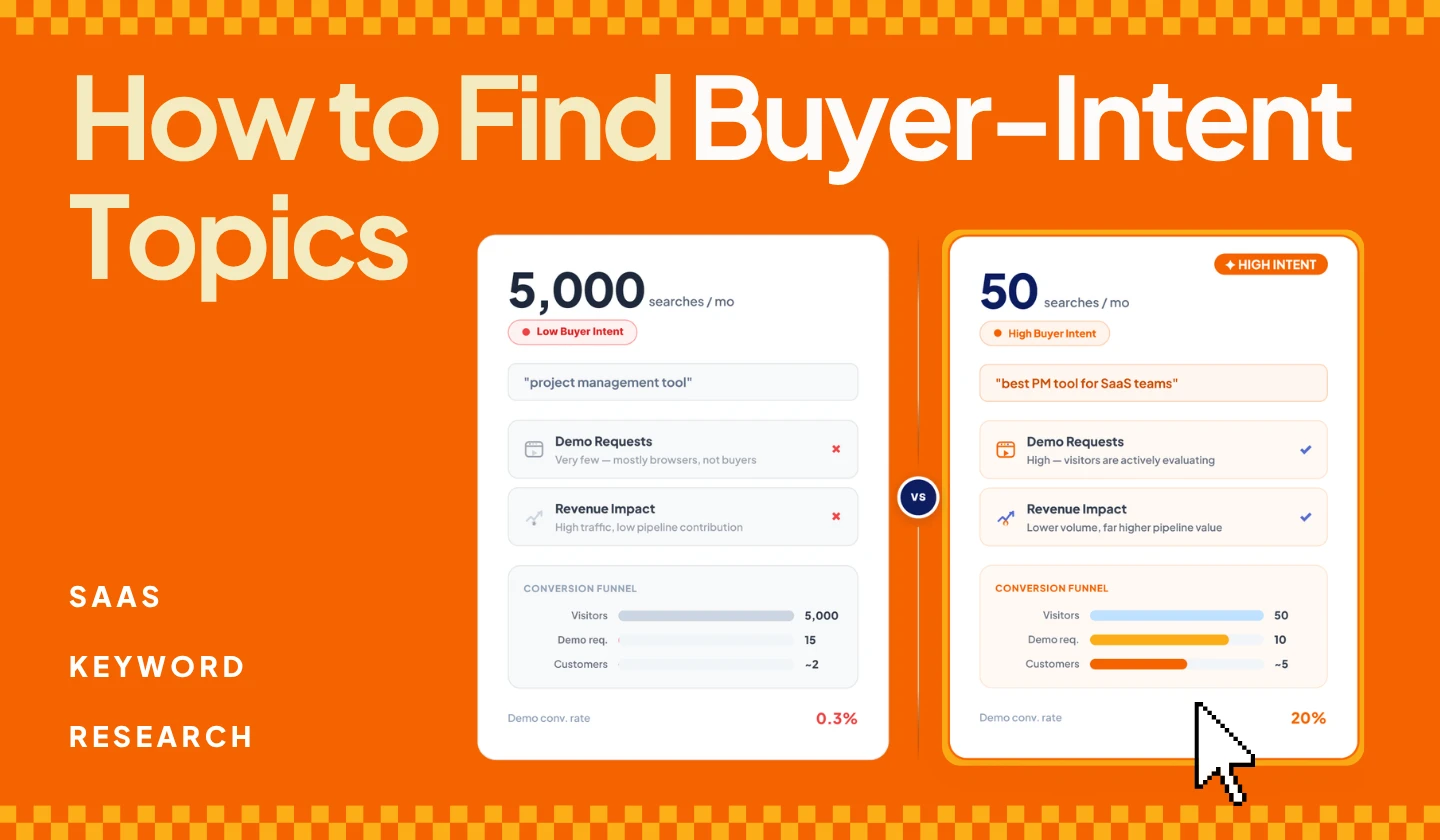
High-volume keywords look appealing on paper, but they usually pull in broad traffic that never converts. Lower-volume, decision-stage keywords tend to bring in people who are actively comparing tools or ready to buy. For a SaaS company, a keyword’s revenue potential matters more than its traffic potential.
Here’s the truth most SEO reports skip: a keyword with 50 monthly searches can beat a keyword with 5,000 searches if it attracts real buyers. SaaS companies need pipeline and recurring revenue, not vanity traffic that inflates a dashboard and does nothing for the bottom line. Buyer intent usually shows up in specific modifiers, like “best,” “pricing,” “alternatives,” “for,” “vs,” “software,” “tool,” and “platform.” These high-intent searches should map directly to demos, signups, free trials, or a sales conversation.
Example: “project management tips” brings in traffic. “best project management software for agencies” brings in a buyer.
This gap matters more than most teams realize. B2B buyers now complete roughly 70% of their purchase decision before they ever talk to a salesperson, and 80% of the time, they’re the ones who make first contact, according to a 2024 report from 6Sense Report. If your content isn’t showing up for the searches they run during that research window, you’re invisible for most of the decision.
Pro Tip: Before you write a single article, pull up your last 20 closed-won deals and ask your sales team what your buyers googled before they booked a demo. That list will outperform any keyword tool’s “suggested topics.”
The Main Types of Buyer-Intent SaaS Keywords
Buyer-intent SaaS keywords are search terms that signal someone is actively looking for a software solution, comparing vendors, checking pricing, or trying to solve a specific business problem. These usually sit in the middle or bottom of the funnel, and they deserve priority because they’re more likely to turn into demos, trials, and revenue.
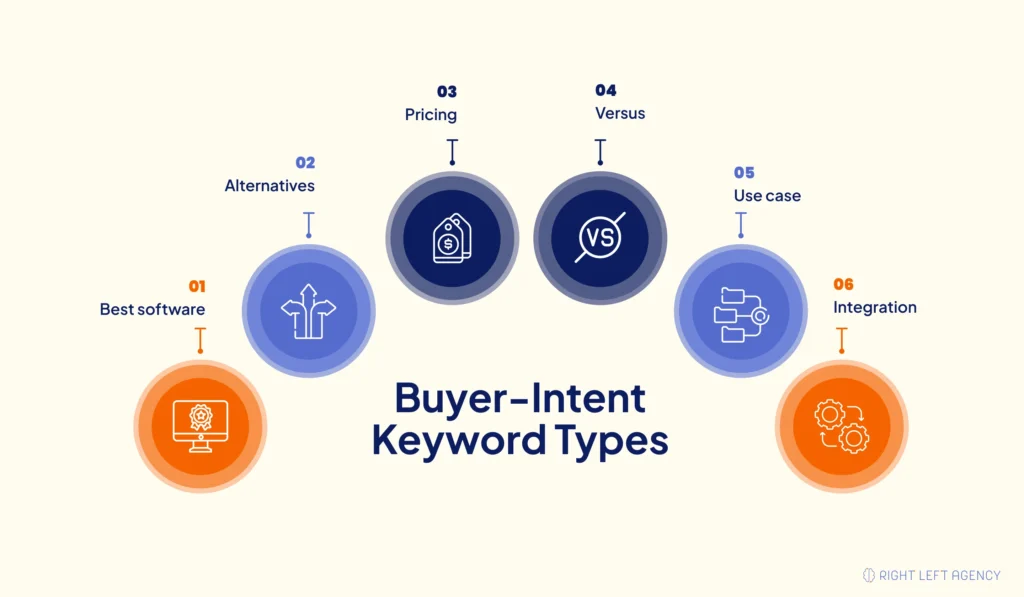
| Keyword Type | Search Pattern | Example | Funnel Stage | Best Page Type |
| Category | best + category + software | best CRM software for startups | BOFU | Listicle or solution page |
| Alternative | alternative to + competitor | HubSpot alternatives | BOFU | Alternatives page |
| Comparison | tool A vs tool B | Asana vs Monday | BOFU | Comparison page |
| Pricing | category/tool + pricing | project management software pricing | BOFU | Pricing/supporting page |
| Use Case | software for + use case | CRM for real estate teams | MOFU/BOFU | Use case page |
| Industry | software for + industry | accounting software for SaaS companies | MOFU/BOFU | Industry solution page |
| Feature | feature + software | automated lead scoring software | MOFU | Feature page |
| Integration | tool + integration | Slack CRM integration | MOFU/BOFU | Integration page |
| Migration | migrate from + tool | migrate from Trello to Asana | BOFU | Migration page |
| Problem-Aware | how to solve + pain point | how to reduce customer churn | TOFU/MOFU | Product-led blog |
Don’t stop at labeling keywords “informational” or “transactional.” That’s the textbook answer, and it doesn’t help you plan content. Classify each keyword by the SaaS business outcome it drives instead, whether that’s a signup, a demo, or a piece of content that supports a bigger cluster.
How to Do SaaS Keyword Research Step by Step
To do SaaS keyword research properly, start with customer and product intelligence, then build a keyword universe, classify intent, analyze the SERP, cluster related keywords, and prioritize based on business value. The strongest process blends SEO tools with real customer data, competitor insight, and conversion potential.
1. Start with ICP, Pain Points, and Product Use Cases
Before you open a keyword tool, split your research into two buckets: product signals and demand signals.
Product signals come from inside your business. Your ICP, your product’s core use cases, and the features that drive the most conversions all fall here. These signals tell you what your product can credibly compete for, and they keep your keyword strategy from turning into a traffic-chasing exercise.
Demand signals come from your buyers. The software category they compare you against, the tools they’re replacing, and the triggers that push them to start searching all fall here. These signals tell you what your audience is actively looking for, and where the real opportunity sits.
Ask these questions first:
- Who is the ideal customer, and what problem are they trying to solve? (product signal)
- What software category do they compare you against? (demand signal)
- What tools are they currently replacing? (demand signal)
- What feature or use case actually makes them convert? (product signal)
2. Build Seed Keywords from Product, Category, and Customer Language
Seed keywords describe your category, features, use cases, and customer problems in plain language. They form the first layer of your research before you expand into long-tail, comparison, and buyer-intent variations.
Pull your seeds from the same two buckets. Product signals, like your product category, feature names, and core use cases, show you the language that describes what you actually built. Demand signals, like competitor names, sales call transcripts, support tickets, and review site language, show you the words real buyers use when they’re comparing options or stuck on a problem.
Example: A customer onboarding SaaS might start with seeds like “customer onboarding software,” “user onboarding tool,” “product adoption platform,” and “onboarding automation.”
3. Expand Keywords Using SEO Tools and First-Party Data
Once you have your seed list, expand it with SEO tools, Google data, competitor research, and first-party insight. Don’t lean on volume alone here. Many of the highest-intent SaaS searches are long-tail or niche enough that traditional tools underreport them.
| Source | What It Reveals |
| Ahrefs / Semrush | Volume, difficulty, competitor rankings |
| Google Search Console | Existing impressions and low-hanging opportunities |
| Sales calls | Buyer language and objections |
| Support tickets | Pain points and feature questions |
| Reddit / Quora | Real user problems and zero-volume topics |
| G2 / Capterra | Competitor comparisons and decision criteria |
Community platforms deserve more attention than most SaaS teams give them. One widely upvoted r/SaaS Reddit thread makes the case that Reddit surfaces niche buyer language no keyword tool catches, since people describe problems in their own words rather than in search-friendly phrases.
Pro Tip: Search Reddit and G2 for your top three competitors by name. The complaints in those threads are often untapped keyword and content ideas your competitors haven’t addressed yet.
4. Analyze SERP Intent Before Choosing the Page Type
Watch for intent signals too, like the mix of content types on page one, whether ads or shopping-style results show up, the “People Also Ask” questions, and whether review or comparison sites are ranking. Together, these signals tell you how commercial the search really is.
5. Cluster Keywords by Topic, Intent, and Page Type
Keyword clustering groups related searches into single page-level opportunities instead of forcing you to write a separate article for every keyword variation. Group by SERP overlap, shared intent, and the page type needed to satisfy the search.
Example cluster: Main page: customer onboarding software Supporting topics: customer onboarding automation, customer onboarding checklist, customer onboarding best practices, customer onboarding software for SaaS, customer onboarding software pricing
Same intent and similar SERP means one page. Different intent and different SERP means separate pages. A BOFU modifier paired with product-specific intent usually means a commercial page, not a blog post.
6. Score Keywords by Buyer Intent and Business Value
A SaaS keyword deserves priority based on more than volume and difficulty. The strongest opportunities match your ICP, connect to your product, show real buying intent, carry conversion potential, and are realistic to rank for.
| Scoring Factor | What It Measures | Score |
| ICP Fit | Does this keyword attract the right buyer? | 1–5 |
| Product Fit | Can the product naturally solve the problem? | 1–5 |
| Intent Strength | Is the user researching, comparing, or ready to buy? | 1–5 |
| Revenue Potential | Could this influence demos, trials, MRR, or ARR? | 1–5 |
| SERP Feasibility | Can you realistically compete? | 1–5 |
| Content Leverage | Can this support a larger topic cluster? | 1–5 |
Add up the scores for a simple SaaS Keyword Opportunity Score. Don’t ignore a high-scoring keyword just because its search volume looks small. If it matches your product and buyer intent, it belongs on the roadmap.
Pro Tip: If two keywords score the same, give the tiebreaker to whichever one supports a bigger content cluster. A keyword that anchors five supporting articles is worth more long-term than one that stands alone.
How to Prioritize SaaS Keywords Across the Funnel
SaaS keywords should be prioritized by funnel stage, but BOFU and MOFU topics usually deserve your attention first since they sit closer to conversion. TOFU content still matters for topical authority, but it should always support your commercial pages through internal links and product-led examples.
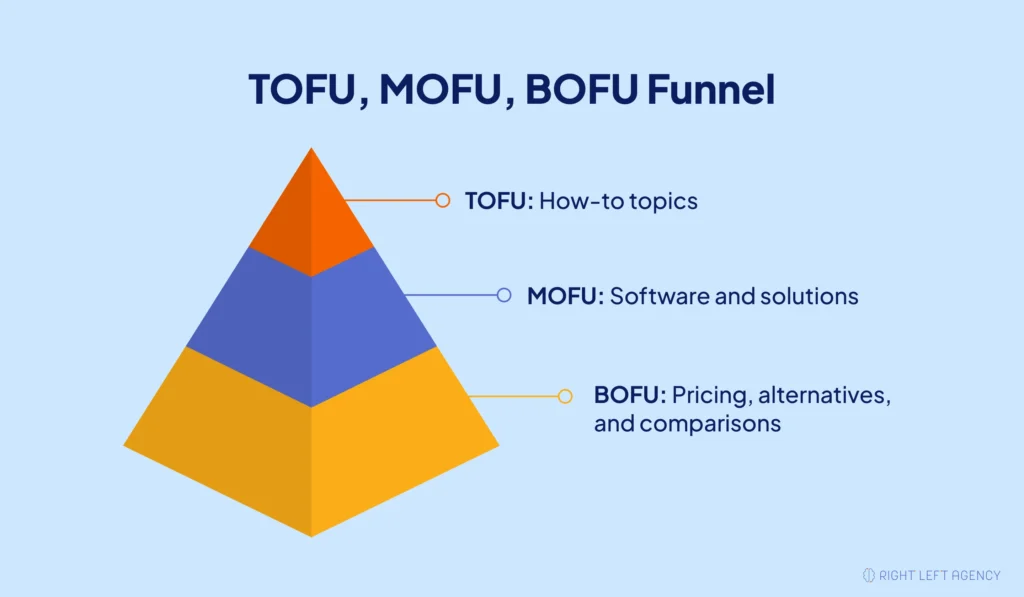
| Funnel Stage | Keyword Pattern | Example | Content Type | Goal |
| TOFU | what is, how to, guide, best practices | how to reduce churn | Blog guide | Educate and build authority |
| MOFU | software for, tools for, solution, platform | software for customer retention | Use case or solution page | Capture solution-aware users |
| BOFU | best, pricing, alternatives, vs, demo | best customer success software | Comparison/listicle/landing page | Drive demos and trials |
Don’t drop TOFU content from your plan. Just make sure every guide has a clear internal linking path toward your MOFU and BOFU pages, so readers move from learning about a problem to evaluating your solution.
How SaaS Keyword Research Fits Into SaaS Content Strategy
Keyword research should define what pages you build, which topics support the buyer journey, and how each piece of content connects back to your product. It should guide your blog, your feature pages, your solution pages, your comparison pages, and your internal linking, not just sit in a spreadsheet your writers glance at once.
A solid SaaS SEO strategy should shape your site architecture directly. Blog posts should support commercial pages. Product-led content should show real examples of how your SaaS solves a problem. Topic clusters should build authority around your core categories, and your internal linking should move readers from education toward evaluation.
Recommended linking pattern: TOFU guide → MOFU use case page → BOFU comparison page → demo/signup CTA
In SaaS SEO, keyword research isn’t just a blog planning exercise. It’s the foundation of your product-led content architecture.
How to Use Generative AI for SaaS Keyword Research
Generative AI can speed up your keyword research by brainstorming seed topics, grouping keywords, spotting intent patterns, and drafting content briefs. But treat AI output as a starting point, not a finished list. Every AI-generated keyword idea still needs validation against real SEO data, SERP results, and actual customer language.
- Feed the AI your ICP, product features, use cases, and competitors.
- Ask for seed keywords by funnel stage.
- Generate long-tail variations using modifiers like “best,” “for,” “vs,” “alternatives,” “pricing,” and “software.”
- Ask the AI to classify keywords by TOFU, MOFU, and BOFU.
- Validate volume, difficulty, and SERP intent in Ahrefs, Semrush, or GSC.
- Use AI to cluster keywords into page types and content briefs.
- Manually review every recommendation for product fit and buyer intent.
AI should support your keyword research. It shouldn’t replace your judgment about what your buyers actually need.
Best SaaS Keyword Research Tools and When to Use Them
The best SaaS keyword research tools surface search demand, competitor gaps, keyword difficulty, SERP intent, and existing opportunities you’re already ranking for. Combine that tool data with real customer conversations so you don’t end up building a strategy around traffic instead of qualified demand.
| Tool | Best Use Case |
| Ahrefs | Competitor keyword gaps, traffic potential, backlinks, difficulty |
| Semrush | Competitive research, keyword gap analysis, SERP tracking |
| Google Search Console | Existing impressions, low-CTR opportunities, hidden long-tail queries |
| Google Keyword Planner | Seed keyword expansion and paid-search validation |
| Google Trends | Demand trend validation |
| Reddit / Quora | Pain-point discovery and zero-volume topics |
| G2 / Capterra | Buyer language, comparisons, alternatives, feature expectations |
| CRM / Sales Calls | Objections, buying triggers, demo intent |
| Support Tickets | Product questions and customer pain points |
Buyer trust in these review platforms keeps climbing too. G2’s research found that 84% of B2B software buyers now use review sites before making a purchase decision. That makes G2 and Capterra two of the richest sources of real buyer language your content team has access to.
Common SaaS Keyword Research Mistakes to Avoid
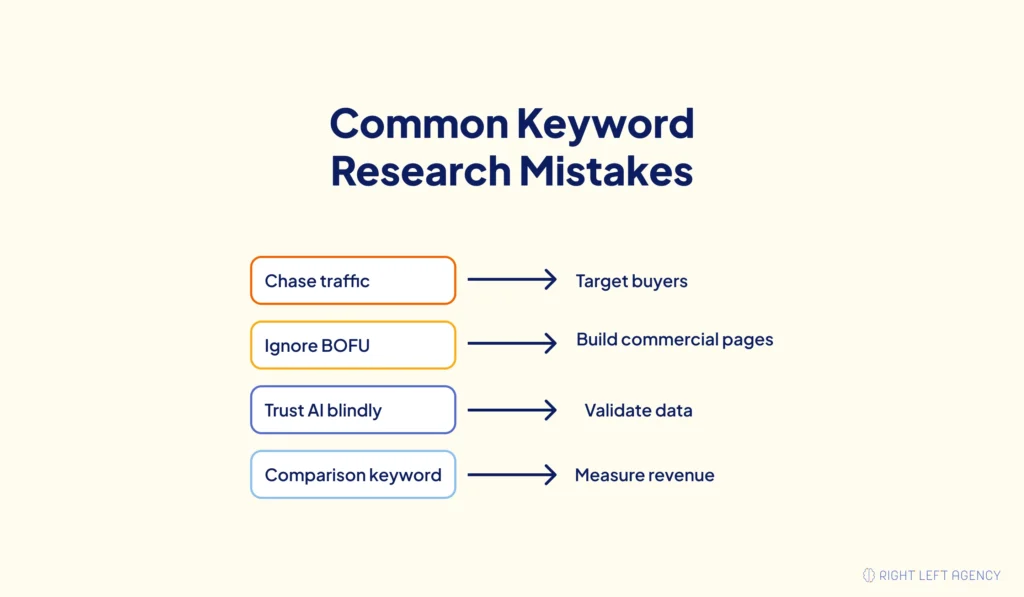
The most common mistake in SaaS keyword research is prioritizing volume before intent. Teams publish broad informational content without connecting it to product use cases, commercial pages, or a real conversion path, and they end up with traffic that never turns into pipeline.
Intent Mistakes
- Chasing high-volume keywords with poor product fit. A keyword can rank well and still bring in visitors who were never going to buy.
- Ignoring low-volume BOFU keywords. Low search volume doesn’t mean low value, especially when the keyword shows strong buying intent.
- Ignoring customer language from sales and support. Skipping this step means missing the exact phrases your buyers use to describe their problems.
- Using AI keyword ideas without validation. AI-generated keywords need a check against real search data and customer language before they earn a spot on the roadmap.
Content Structure Mistakes
- Publishing only blog content and neglecting commercial pages. Blog posts build awareness, but they can’t do the job of a comparison, pricing, or alternatives page.
- Skipping SERP analysis before writing. Writing before you check the SERP often means building the wrong format for the keyword.
- Treating every keyword variation as a separate page. This splits your authority across pages that should be one strong cluster.
- Skipping funnel-stage mapping. Without a clear TOFU, MOFU, or BOFU label, content ends up scattered instead of building toward a conversion.
Conversion Mistakes
- Not measuring demos, trials, and assisted conversions. Rankings and traffic alone won’t tell you whether your content is actually driving revenue.
- Publishing content with no internal links to conversion pages. Even the best-ranking article won’t convert if it never points readers toward the next step.
How to Measure the Success of SaaS Keyword Research
Rankings and traffic tell you part of the story. The better question is whether your organic search is attracting qualified users, supporting the buyer journey, and contributing to demos, trials, signups, pipeline, and recurring revenue.
Track organic rankings, impressions, and clicks alongside demo requests, free trial signups, product signups, assisted conversions, and pipeline influenced by organic search. Watch MRR or ARR influenced by content, your organic conversion rate, and how keywords move between funnel stages over time. Review GSC, GA4, CRM data, and attribution reports together, not in isolation, so you can see the full picture from search to revenue.
When Should You Hire a SaaS Keyword Research Agency?
Consider hiring a SaaS keyword research agency when your internal team doesn’t have the time, tools, or strategic bandwidth to connect keyword research with product positioning, content architecture, and revenue goals. This becomes especially clear when your organic traffic is growing, but your demos, trials, or pipeline aren’t following.
Some signs it’s time to bring in outside help:
- Your blog gets traffic but few conversions.
- You don’t have clear BOFU pages.
- Competitors dominate comparison and alternatives keywords.
- Your team can’t prioritize keyword opportunities effectively.
- Your SEO strategy is tool-led instead of revenue-led.
- You need a SaaS-specific content architecture, not a generic one.
Get a Free SaaS SEO Strategy Session: Speak with our SaaS SEO experts to uncover buyer-intent keyword opportunities and build a keyword strategy tailored to your growth goals.
Request a SaaS Keyword Research Audit: Get a professional review of your current keyword strategy, with clear recommendations to improve rankings, attract qualified traffic, and increase conversions.
SaaS Keyword Research FAQs
How do you conduct keyword research for a B2B SaaS product?
Start with ICP pain points, product use cases, sales conversations, competitor keywords, and search intent. Then group keywords by funnel stage, page type, and buyer intent. Prioritize topics that connect directly to demos, trials, pipeline, and revenue.
How does keyword research fit into SaaS content strategy?
It helps you decide which blog posts, feature pages, use case pages, comparison pages, and integration pages to build. It connects search demand with the buyer journey so your content supports awareness, evaluation, conversion, and long-term topical authority.
How can generative AI tools help with SaaS keyword research?
AI can brainstorm seed keywords, identify long-tail variations, classify intent, cluster topics, and draft content briefs. Always validate those ideas with SEO tools, SERP analysis, customer data, and a product-fit review before adding them to your strategy.
Should SaaS companies target low-volume keywords?
Yes. Target low-volume keywords when they show strong product fit, ICP fit, and buying intent. Many niche SaaS queries have limited reported volume but attract high-quality users who are close to requesting a demo or comparing software options.
What are the best buyer-intent keyword patterns for SaaS?
The strongest patterns include “best [category] software,” “[competitor] alternatives,” “[tool A] vs [tool B],” “[category] pricing,” “[software] for [industry],” “[feature] software,” “[tool] integration,” and “migrate from [competitor].”