

Key Takeaways
- Pricing strategy is not just about setting a price. It includes your pricing model, packaging, value metric, customer segments, and billing structure.
- Value-based pricing is often the strongest long-term approach for SaaS companies because it ties price to customer outcomes, but it requires strong customer research and a clear understanding of willingness to pay.
- Pricing models should match how customers get value from your product, whether that is by seat, usage volume, features, or a hybrid model.
- Early-stage SaaS teams should keep pricing simple. Growth-stage teams should focus on conversion and segmentation. Scaling teams should optimise for expansion revenue.
- Pricing should be reviewed regularly. It is not a one-time decision.
- Track MRR, ARR, churn, CAC, LTV, and net revenue retention together. No single metric tells the full story.
A SaaS company can have a product users love, a solid content strategy, and a sales team that knows how to close. But if the pricing does not match what customers believe the product is worth, revenue suffers. The team may not notice right away. They blame the market, the competition, or the sales process, but in many cases, pricing is part of the problem.
Many SaaS teams only discover their pricing is broken when churn starts climbing, trial-to-paid conversion drops, or expansion revenue stalls. By then, the damage is already done.
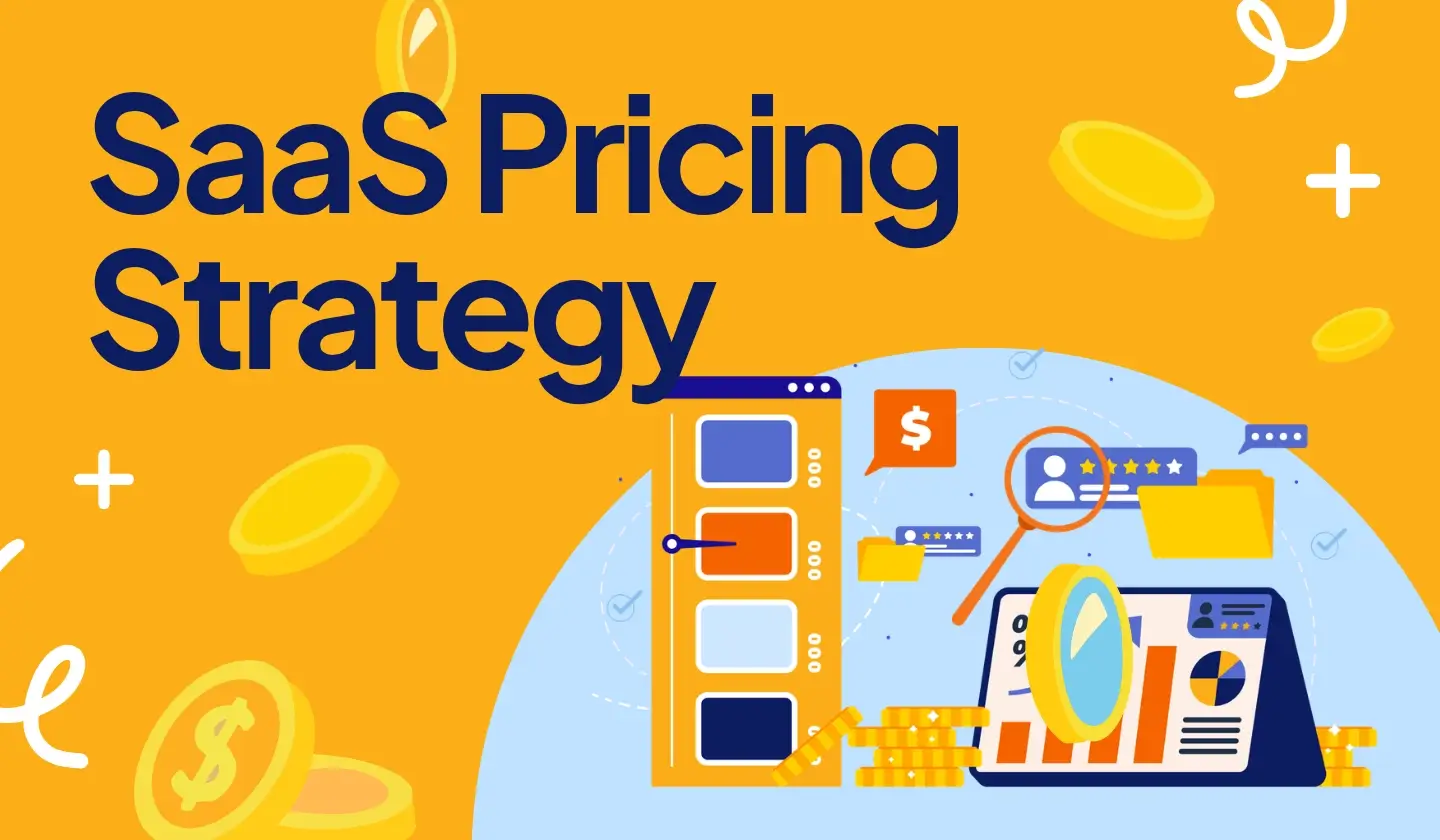
A SaaS pricing strategy is the structured approach a software company uses to package, position, and charge for its product. The right strategy aligns pricing with customer value, product usage, business goals, and recurring revenue growth. It connects what the product does with what customers are willing to pay, and builds a path to growing MRR and ARR over time.
In this guide, we cover everything you need to build or improve your SaaS pricing strategy. We walk through the most common SaaS pricing models, how to choose the right approach for your product and growth stage, which metrics to track, mistakes to avoid, and how to optimize your pricing page for conversion.
What Is a SaaS Pricing Strategy?
A SaaS pricing strategy is more than a number on a pricing page. It is the full system a company uses to decide how to price, package, and position its product for different customer segments.
Most SaaS teams focus only on the price point. But a subscription pricing strategy covers a much larger set of decisions:
- Pricing model — how customers are charged
- Pricing tiers — which plans exist and what they include
- Value metric — what drives the price, such as seats, usage, or features
- Feature packaging — what features sit in each tier
- Customer segmentation — who each plan is designed for
- Billing frequency — monthly, annual, or both
- Discounting rules — when and how discounts are offered
- Expansion revenue opportunities — upsells, add-ons, usage overages
When these elements are aligned, pricing becomes a growth lever, not just a revenue line. When they are out of sync, pricing becomes one of the biggest hidden drags on growth.
SaaS Pricing Strategy vs SaaS Pricing Model
These two terms get used interchangeably, but they mean different things. Mixing them up leads to bad pricing decisions.
A pricing model defines how customers are charged. A pricing strategy explains why the company prices that way and how pricing supports business goals.
| Term | Meaning | Example |
| SaaS pricing model | How customers are charged | Per-user, usage-based, tiered |
| SaaS pricing strategy | Why and how pricing supports growth | Value-based, penetration, expansion-based |
In simple terms, the model is the payment mechanism. The strategy is the business logic behind that mechanism.
A company using tiered pricing (model) may follow a value-based pricing strategy. Another company using the same tiered model may follow a penetration pricing strategy. The model is the mechanism. The strategy is the logic behind it.
Why SaaS Pricing Strategy Matters for Growth
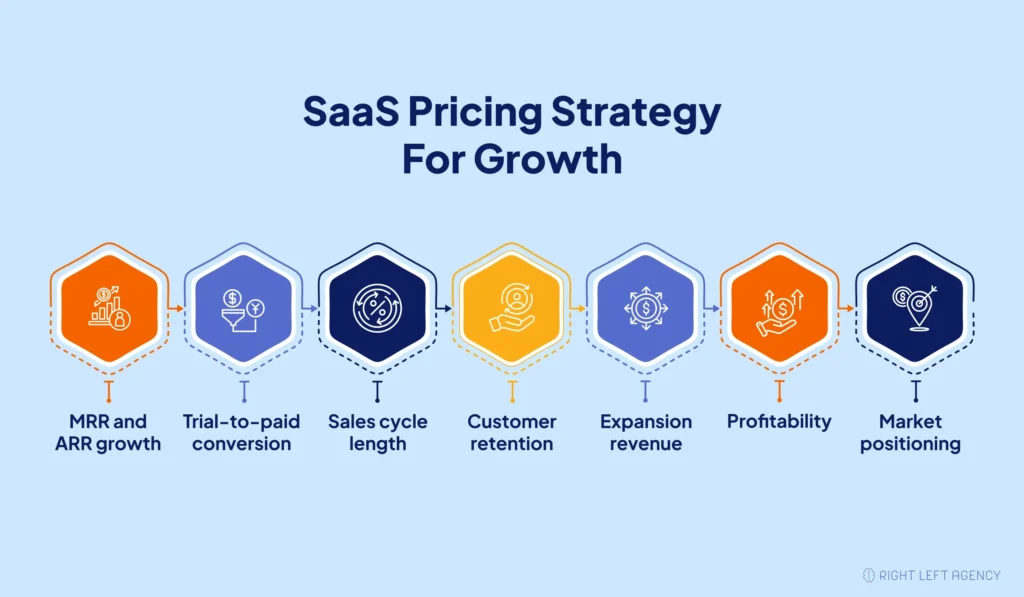
Pricing is one of the few levers in SaaS that touches every part of the business at once. Change your pricing, and you affect your conversion rate, sales cycle, churn risk, and MRR all at the same time.
Here is what a well-built SaaS monetisation strategy directly influences:
- MRR and ARR growth: The right pricing model captures more value from customers who get the most from your product.
- Trial-to-paid conversion: Clear, well-packaged pricing tiers reduce friction in the buying decision. Pricing that removes friction at this stage directly supports your broader SaaS demand generation efforts.
- Sales cycle length: Simple, self-serve pricing can shorten the buying cycle when the product is easy to understand, and the buyer does not need custom procurement.
- Customer retention: Pricing that aligns with perceived value can reduce churn risk because customers are more likely to feel the product is worth the cost.
- Expansion revenue: Usage-based or tier-based models create natural upgrade paths as customers grow.
- Profitability: Pricing that accounts for CAC and LTV protects margin.
- Market positioning: Price signals quality. A premium price positions the product differently than a low price, even if the features are the same.
Pricing should not be treated as a one-time decision. Most SaaS companies set pricing early and leave it untouched for years. That is a mistake. As the product matures, the customer base grows, and the market shifts, pricing needs to evolve too. SaaS pricing best practices consistently point to regular reviews as one of the clearest signs of a healthy pricing culture, and that same discipline applies across every stage of your SaaS marketing funnel.
Common SaaS Pricing Models
There is no single pricing model that works for every SaaS product. The right choice depends on how customers use the product, how they measure value, and what drives their decision to upgrade or cancel.
Here is a comparison of the most common SaaS pricing models:
| Pricing Model | Best For | Example Value Metric | Advantages | Risks |
| Flat-rate pricing | Simple SaaS products | N/A (one price) | Easy to understand | Limited segmentation |
| Per-user pricing | Collaboration tools | Seats/users | Predictable revenue | Can limit adoption |
| Per-active-user pricing | Team-based SaaS | Active users per month | Fairer than per-seat pricing | More complex billing |
| Tiered pricing | Most B2B SaaS products | Features, usage, support level | Supports segmentation | Needs careful packaging |
| Usage-based pricing | API, AI, data, and infrastructure tools | API calls, credits, events | Aligns price with usage | Revenue harder to predict |
| Feature-based pricing | Products with clear feature levels | Feature tiers | Easy to package value | Can restrict product adoption |
| Freemium pricing | PLG SaaS products | Free vs paid usage limits | Drives user acquisition | Can attract low-intent users |
| Hybrid pricing | Scaling SaaS products | Base fee + usage | Flexible and value-aligned | More complex to manage |
| Enterprise/custom pricing | Large accounts | Custom contract terms | Maximises contract value | Requires sales involvement |
No model wins across every situation. The best choice depends on your product type, how customers measure value, their usage behaviour, and your growth stage. Many scaling SaaS companies end up using a hybrid approach that combines two models, such as a base subscription fee plus usage-based overages.
How to Choose the Right SaaS Value Metric
A value metric is the unit your pricing is built around. It should reflect how customers actually get value from the product.
For some SaaS products, the value metric is users or seats. For others, it may be API calls, contacts, projects, credits, events, storage, transactions, or workflows. There is no universal answer. The right metric depends entirely on what your product does and how customers measure its impact.
A strong SaaS value metric is easy for customers to understand, closely tied to the outcome they care about, scalable as their usage grows, measurable in your billing system, and fair across different customer segments.
If the value metric feels disconnected from the result customers care about, pricing will feel unfair, even when the price itself is reasonable. That is one of the most common hidden reasons customers churn or resist upgrading.
| Product Type | Common Value Metrics |
| CRM | Seats, contacts, records |
| AI tool | Credits, outputs, tokens |
| Analytics platform | Events, tracked users, data volume |
| Support software | Agents, tickets, conversations |
| Developer / API tool | API calls, requests, compute usage |
| Project management | Users, projects, tasks |
Start by asking your best customers what they track to measure whether your product is working. The answer almost always points directly to the right value metric.
Popular SaaS Pricing Strategies
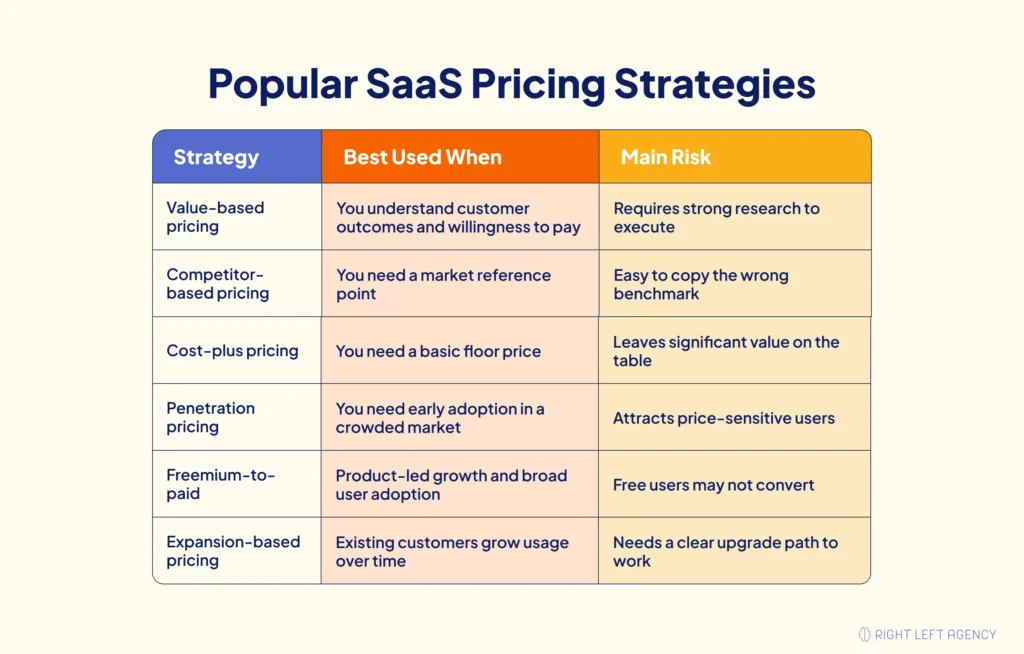
Pricing strategies guide the business logic behind pricing decisions. They explain why a company prices the way it does and what outcome the pricing is designed to produce.
Here is a quick comparison before we go deeper:
| Strategy | Best Used When | Main Risk |
| Value-based pricing | You understand customer outcomes and willingness to pay | Requires strong research to execute |
| Competitor-based pricing | You need a market reference point | Easy to copy the wrong benchmark |
| Cost-plus pricing | You need a basic floor price | Leaves significant value on the table |
| Penetration pricing | You need early adoption in a crowded market | Attracts price-sensitive users |
| Freemium-to-paid | Product-led growth and broad user adoption | Free users may not convert |
| Expansion-based pricing | Existing customers grow usage over time | Needs a clear upgrade path to work |
Value-Based Pricing
Value-based pricing sets the price based on what the customer believes the product is worth, not what it costs to build. This is often the strongest long-term strategy for SaaS companies because it ties revenue directly to the outcomes the product creates.
A company that helps sales teams close deals faster can price based on the revenue impact of that speed. If the product helps a rep close two more deals per month, the pricing can reflect a fraction of that revenue impact.
Value-based pricing in SaaS requires strong customer research, a clear understanding of your ICP, and confidence in your product’s outcomes. It is harder to execute than cost-plus or competitor-based pricing, but it typically produces higher revenue and better retention.
Competitor-Based Pricing
Competitor-based pricing uses market pricing as a reference point. It is a reasonable starting place, especially for early-stage companies that do not yet have enough customer data to anchor pricing on value.
The risk is copying competitor pricing without understanding whether it reflects your product, your customers, or your business goals. Competitors may be underpriced, overpriced, or pricing for a completely different customer segment.
Use competitor pricing as a benchmark, not a blueprint.
Cost-Plus Pricing
Cost-plus pricing adds a margin above the cost of building and delivering the product. It is simple to calculate but usually weak for SaaS. Software does not work like physical goods. The marginal cost of adding one more user is close to zero, but the value that user receives can be enormous.
Cost-plus pricing leaves most of that value on the table.
Penetration Pricing
Penetration pricing uses a lower price to enter a crowded market quickly. The goal is to build user volume, displace incumbent tools, or land large accounts that would otherwise need a longer sales process.
The downside is that low pricing attracts price-sensitive customers rather than outcome-driven ones. When you raise prices later, those customers churn. Penetration pricing works best when the plan includes a clear path to higher pricing as the product earns trust in the market.
Freemium-to-Paid Strategy
Freemium SaaS pricing gives users access to a free tier with limited features or usage. The goal is to build a large user base and convert a portion into paying customers when they hit a natural limit or need a feature that sits behind a paywall.
This strategy works well for product-led growth SaaS companies where the product sells itself through usage. The conversion rate from free to paid depends heavily on how clearly upgrade triggers are defined. Vague or weak triggers produce a large free user base that never converts.
Expansion-Based Pricing
Expansion-based pricing grows revenue from existing customers. Rather than relying only on new customer acquisition, the pricing model creates natural paths for customers to spend more as they grow.
This can happen through seat expansion, usage overages, premium feature add-ons, or higher-tier upgrades. Net revenue retention is the key metric here. A SaaS company with strong expansion revenue can grow ARR even when new customer acquisition slows.
How to Choose the Right SaaS Pricing Strategy
Choosing the right pricing strategy is one of the highest-leverage decisions a SaaS team makes. Here is a step-by-step SaaS pricing framework to guide that decision.
1. Define Your Ideal Customer Profile (ICP)
Know exactly who your best customers are, what problems they face, and what outcomes they want. Build pricing around the customers who get the most value from your product, not the broadest possible audience. If your ICP is still unclear, understanding your B2B SaaS lead generation challenges is a good place to start.
2. Identify Your Product’s Value Metric
The value metric is the unit that best captures how customers get value from your product. For an analytics SaaS, that might be the number of events tracked. For a CRM, it might be the number of contacts or seats. For an AI writing tool, it might be words or credits generated. Your pricing should scale with that metric.
3. Segment Customers by Use Case and Willingness to Pay
Different customer segments get different amounts of value from your product. A freelancer and an enterprise team both use the same project management tool, but they use it very differently and have very different budgets. Segmentation lets you capture more value from each group.
4. Choose a Pricing Model That Matches Product Value
Use what you learned about your value metric and customer segments to pick the model that best captures that value. Usage-based pricing fits products where value scales with volume. Per-user pricing fits well where value scales with team size.
5. Package Features Into Clear Pricing Tiers
Group features in a way that creates a natural upgrade path. The entry-tier plan should deliver genuine value. The mid-tier plan should serve your core ICP. The top-tier plan should serve power users or enterprise accounts.
6. Analyze Competitors Without Copying Them
Understand what competitors charge and how they package their products. Use that information to position your product clearly, but base your final pricing on your own value, not theirs.
7. Test Pricing With Real Users
Before committing to a pricing structure, validate it. Run pricing surveys, conduct customer interviews, and use willingness-to-pay research to understand what customers are actually willing to pay before you publish a pricing page.
8. Track Conversion, Churn, and Expansion Revenue
Once pricing is live, watch what happens across the full customer lifecycle. Are trials converting at a healthy rate? Are customers churning at a specific plan? Is expansion revenue growing or flat? These signals tell you whether pricing is working.
9. Review Pricing Regularly as the Product Matures
Set a cadence to revisit pricing at least once a year. As the product grows, new features get added, the customer base shifts, and the market changes. Pricing should keep up.
Pro Tip: Do not wait for a revenue problem to review pricing. Schedule a quarterly pricing review even when things look healthy. The best time to optimize pricing is before churn or conversion issues appear, not after.
SaaS Pricing Strategy by Business Stage
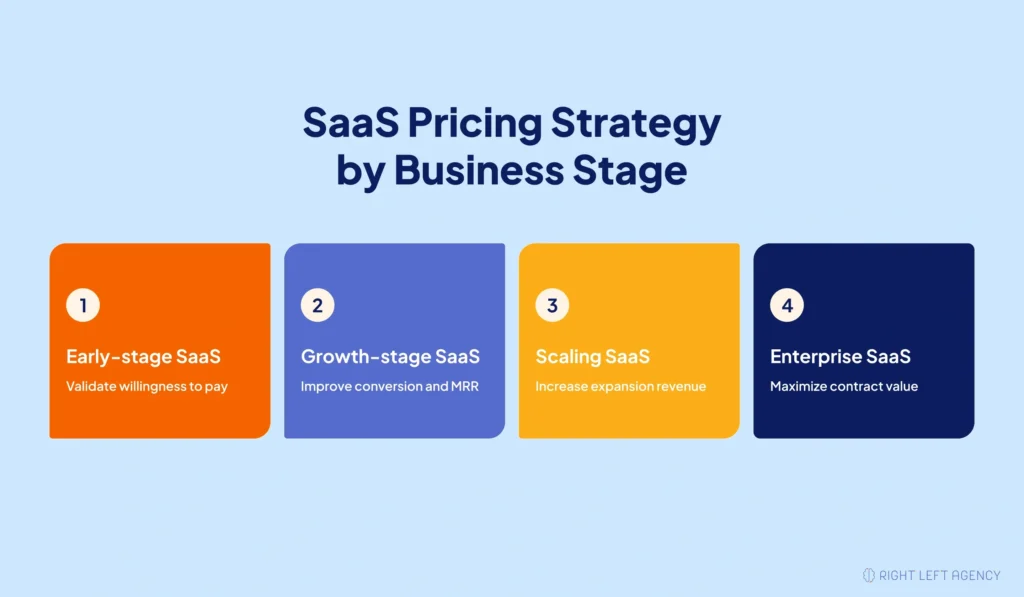
SaaS pricing should evolve as the company grows. What works at the seed stage will not work at Series B. Here is how pricing goals and strategy typically shift across stages.
| SaaS Stage | Pricing Goal | Best-Fit Pricing Strategy |
| Early-stage SaaS | Validate willingness to pay | Flat-rate, simple tiered, or early value-based pricing |
| Growth-stage SaaS | Improve conversion and MRR | Tiered pricing, freemium, value-based pricing |
| Scaling SaaS | Increase expansion revenue | Usage-based, hybrid, add-on pricing |
| Enterprise SaaS | Maximize contract value | Custom pricing, annual contracts, enterprise packaging |
A common mistake is applying enterprise-style pricing too early. If your product is still validating ICP, packaging, or willingness to pay, simple pricing is usually easier to test and easier for buyers to understand.
Before making a pricing change at any stage, gather input from multiple sources. Sales call recordings reveal where pricing objections appear. Product usage data shows which features drive the most value. Customer interviews surface what buyers actually compare when evaluating your price. Revenue metrics like churn rate and CAC payback period show whether current pricing is sustainable.
Pricing changes made without this foundation often fix the wrong problem.
SaaS Pricing Metrics You Should Track
Pricing decisions should be supported by data, not gut feeling. These are the metrics that matter most and what to do with each one.
| Metric | What It Shows | What to Do With It |
| MRR | Monthly recurring revenue | Track whether pricing changes improve predictable monthly revenue |
| ARR | Annual recurring revenue | Use it to evaluate long-term revenue growth and annual contract impact |
| ARPU | Average revenue per user | Identify whether your pricing captures enough value per customer |
| CAC | Customer acquisition cost | Compare against LTV and CAC payback to see whether pricing supports profitability |
| LTV | Customer lifetime value | Identify whether customers are valuable enough to justify acquisition cost |
| CAC Payback Period | Time needed to recover acquisition cost | Shows pricing and acquisition efficiency together |
| Churn Rate | Percentage of customers lost | Look for pricing, onboarding, or value-perception issues driving cancellations |
| Net Revenue Retention | Revenue retained and expanded from existing customers | Measure whether pricing creates natural expansion paths |
| Expansion Revenue | Revenue from upsells and add-ons | Evaluate whether tiers and add-ons encourage account growth |
Do not evaluate pricing metrics in isolation. High conversion with high churn may mean pricing attracts the wrong-fit customers. Low churn with weak expansion may mean your pricing tiers do not create a natural upgrade path. High discounting may signal weak value communication, poor sales enablement, or pricing that does not match buyer expectations.
Tracking these numbers alongside your full marketing spend gives you a clearer picture of SaaS marketing ROI across the entire customer lifecycle.
Common SaaS Pricing Mistakes to Avoid
Most pricing mistakes are avoidable. Here are the ones we see most often, along with how to fix them.
Mistake: Copying competitor pricing blindly
Fix: Use competitor pricing as a benchmark, but base your final pricing on your product value, customer segment, and willingness-to-pay research. Competitors may be priced wrong for their own market.
Mistake: Underpricing the product
Fix: Underpricing signals low value and attracts price-sensitive customers who churn faster. Run pricing surveys and value interviews before you lower prices. You may be worth more than you think.
Mistake: Creating too many pricing tiers
Fix: More tiers create more confusion. Most SaaS products work well with three to four tiers. If you need more, you may be trying to solve a segmentation problem with packaging.
Mistake: Choosing the wrong value metric
Fix: If your pricing metric does not match how customers get value, pricing feels unfair. Revisit your value metric by talking directly to customers about how they use the product and what matters most to them.
Mistake: Hiding pricing when buyers expect transparency
Fix: For most SaaS products, especially SMB-focused tools, a clear pricing page reduces friction and speeds up the buying decision. Only hide pricing when custom packaging is genuinely required.
Mistake: Offering discounts without rules
Fix: Uncontrolled discounting erodes margin and creates pricing consistency problems across accounts. Set clear rules for when discounts are offered, at what level, and who approves them.
Mistake: Not testing pricing regularly
Fix: Pricing should be tested and iterated like any other product decision. Run pricing experiments, interview churned customers, and use cohort analysis to see how pricing changes affect retention.
Mistake: Ignoring customer segments
Fix: A single pricing tier for all customer types almost always underserves some segments and overprices others. Segment by company size, use case, or usage behaviour and build pricing to match.
Mistake: Making upgrades unclear
Fix: Customers should always know what they get when they upgrade and why it is worth paying more. If upgrade triggers are vague, customers stay on lower tiers longer than they should.
Mistake: Treating pricing as a one-time decision
Fix: Set a regular review cadence. Review pricing at least annually, or any time there is a significant change in the product, market, or customer base.
Mistake: Changing pricing without a communication plan
Fix: Before changing pricing, decide which customers are affected, whether existing customers will be grandfathered, how sales and customer success will explain the change, and what timeline customers will receive. A price change without a communication plan is one of the fastest ways to damage customer trust.
SaaS Pricing Strategy Examples
Rather than listing specific brand names, it is more useful to look at pricing patterns by product category. Here is a quick summary, followed by details on each.
| SaaS Category | Common Pricing Model | Why It Fits |
| Project management | Per-user or tiered | Value usually grows with team size |
| CRM | Seat-based plus limits | Revenue value grows with users and records |
| AI SaaS | Credit-based or usage-based | Cost and value both scale with output volume |
| Analytics | Usage-based or tiered by volume | More data usually means more value |
| Customer support | Agent-based plus ticket volume | Value scales with support team and conversations |
| Developer tools | Usage-based | API calls or compute usage reflect actual consumption |
Project Management SaaS
Project management tools tend to use per-user or tiered pricing because value scales with team size. A solo user gets limited value from a project management tool. A team of fifty gets significant value. Pricing that grows with team size captures that dynamic well.
Most project management tools offer a free plan for small teams, a mid-tier plan for growing teams with more features and storage, and a business or enterprise plan for larger organisations that need admin controls, advanced reporting, and integrations.
CRM SaaS
CRM pricing often uses seat-based pricing as the primary model, sometimes combined with contact or record limits at higher tiers. The seat-based model works well because CRM value scales with the number of users actively managing relationships.
Enterprise CRM tiers typically move to custom pricing with annual contracts, reflecting the complexity of large deployments and the high switching cost for enterprise buyers.
AI SaaS
AI products often use credit-based or usage-based pricing because the cost to deliver AI outputs scales directly with usage. A user who generates 10,000 words per month costs more to serve than one who generates 1,000. Pricing that reflects this keeps the business sustainable.
Many AI SaaS products use a hybrid model: a base subscription that includes a set number of credits, plus overages for heavy users. This gives predictable revenue while capturing more value from power users.
Analytics SaaS
Analytics platforms often price based on event volume, data rows, monthly tracked users, or number of reports. The value metric aligns with scale: the more data a customer processes, the more value they get, and the more they pay.
Smaller customers can start on affordable plans that cover their current volume, and pricing scales naturally as their data needs grow. This makes analytics tools well-suited to usage-based or tiered-by-usage pricing.
Customer Support SaaS
Support tools often use agent-based pricing because support team size is the clearest proxy for value. More agents means more tickets handled, which means more value from the platform.
Some support tools also use ticket volume as a secondary pricing dimension, especially for chatbot or AI-assisted support features where the volume of automated interactions is the main cost driver.
Developer Tools
Developer tools, especially API products, almost always use usage-based pricing. API calls, compute units, data transfer volume, and request counts are natural value metrics because they reflect actual usage and product cost at the same time.
Many developer-focused products also offer free tiers with generous usage limits to encourage adoption, with pricing that kicks in at scale. This fits well with the product-led growth model common in developer-focused SaaS.
How to Test and Optimise Your SaaS Pricing
Pricing optimisation is not a one-time project. It is a continuous process. Here is how to approach it systematically.
1. Run Customer Interviews
Talk to current customers, churned customers, and prospects who did not convert. Ask directly what they thought about the pricing, what they compared you to, and what almost stopped them from buying.
2. Use Willingness-to-Pay Surveys
Tools like Van Westendorp price sensitivity surveys or Gabor-Granger analysis help you find the price range where customers feel the product is reasonably priced versus too expensive or suspiciously cheap.
3. Analyse Sales Call Recordings
Listen for pricing objections. Are they about the total price, the packaging, or a comparison to a competitor? Each type of objection points to a different fix.
4. Run Win/Loss Analysis
For deals that were lost, find out whether pricing was a factor. For deals that were won, find out whether pricing helped close or if the buyer would have paid more.
5. A/B Test Your Pricing Page
Test different plan names, tier structures, feature highlights, and CTAs. Even small changes to how pricing is presented can have a meaningful impact on SaaS pricing page conversion.
Be careful with pricing A/B tests. Showing different prices to similar customers can create trust issues if users compare plans later. For major pricing changes, customer research, sales feedback, cohort analysis, and controlled packaging tests may be safer than testing completely different prices in public.
6. Use Cohort Analysis
Look at retention and expansion revenue by the plan customers started on, the month they joined, and the channel they came from. Cohort data reveals which pricing configurations produce the best long-term outcomes.
7. Review Product Usage Data
Identify which features are used most heavily and which sit unused. Features with high usage often signal value that could be monetised differently. Features with low usage may not belong in a pricing tier at all.
8. Collect Churn Feedback
When customers cancel, ask why. If pricing is a recurring reason, find out whether the issue is the price itself or the perceived value relative to the price.
9. Run Packaging Experiments
Test different feature groupings across tiers and see how they affect upgrade rates. Sometimes moving a single feature between tiers has a significant impact on conversion.
Pricing changes carry real risk. A poorly communicated price increase can trigger churn. An untested packaging change can confuse buyers. Test changes carefully, communicate them clearly, and grandfather existing customers when possible to protect retention.
SaaS Pricing Page Best Practices
A strong pricing strategy can still underperform if the pricing page does not communicate it clearly. Here is what a high-converting SaaS pricing page includes.
- Make pricing tiers easy to compare side by side. Buyers should be able to scan across tiers and immediately understand what they get at each level.
- Highlight the recommended plan. Most SaaS buyers look for guidance. A visual callout or badge on the most popular plan reduces decision fatigue.
- Explain who each plan is for. A short sentence under each plan name helps buyers self-select quickly. For example, instead of “Pro Plan,” try “Growth Plan — for growing SaaS teams that need automation, integrations, and reporting across multiple users.”
- Use clear feature limits. Avoid vague language like “unlimited” or “advanced features” without explanation. Be specific about what each tier includes and where the limits are.
- Avoid confusing billing language. If you charge per seat, say so clearly. If there are usage overages, explain how they work before the buyer commits.
- Show monthly and annual pricing clearly. Let buyers toggle between billing frequencies and show the savings for annual billing in dollars, not just percentages.
- Add FAQs near the pricing table. Address the most common questions about billing, upgrades, and cancellation directly on the pricing page so buyers do not have to contact sales for answers.
- Include trust signals. Customer logos, testimonials, security badges, and review platform ratings reduce anxiety for buyers comparing multiple tools.
- Make the CTA clear for each plan. Each plan should have a distinct action button. Free Trial, Buy Now, and Get Started should all link to the right onboarding flow.
- Use “Contact Sales” only when custom pricing is genuinely required. If you hide pricing behind a sales call unnecessarily, you will lose buyers who expect transparency.
Getting your pricing page right is only one piece. Understanding which channels and touchpoints drive buyers to that page is equally important, as that is where SaaS marketing attribution becomes essential.
Should You Build SaaS Pricing In-House or Work With a Pricing Expert?
Some SaaS teams handle pricing entirely in-house. Others bring in outside support. Both can work. The right choice depends on what you are trying to solve and how much you have at stake.
Building pricing in-house works well when your team has clear customer segments, reliable usage data, regular sales feedback, and enough customer research to understand willingness to pay. It is usually sufficient for small pricing adjustments, early packaging tests, or simple tier updates. A strong SaaS content strategy can also support pricing success by educating buyers at every stage of the funnel.
Working with a SaaS pricing expert or growth partner may make more sense when pricing affects a major revenue decision, sales discounts are inconsistent, churn is rising, expansion revenue is weak, or the company is moving from SMB to mid-market or enterprise customers. External support can also help with pricing research, value metric identification, packaging design, pricing-page conversion, and go-to-market communication around a pricing change.
If you are unsure where to start, a pricing audit is often the best first step. It surfaces the gaps in your current strategy before you commit to a direction.
Final SaaS Pricing Strategy Checklist
Use this checklist after reading the guide to confirm your pricing strategy is complete and ready to test.
- Define your ICP clearly.
- Identify your product’s value metric.
- Choose the right pricing model for your product type and stage.
- Build clear pricing tiers with a natural upgrade path.
- Map features to customer value, not just cost.
- Research competitor pricing as a benchmark, not a blueprint.
- Interview customers to understand willingness to pay.
- Test pricing before publishing with surveys or pricing research tools.
- Track MRR, ARR, CAC, LTV, churn rate, and expansion revenue together.
- Review pricing at least once a year or when the product or market shifts significantly.
- Optimise your pricing page for clarity, comparison, and conversion.
Final Thoughts
A strong SaaS pricing strategy does not happen by accident. It is built through customer research, market analysis, careful packaging, and continuous testing. When pricing is aligned with customer value, product usage, and growth goals, it becomes one of the most powerful levers in the entire business.
The teams that get pricing right treat it as an ongoing priority, not a box to check once and forget. They review pricing regularly, listen to what customers say about it, watch the data, and make adjustments before problems grow.
If your pricing no longer matches how customers use the product, start with a pricing audit. Review your customer segments, value metric, packaging, conversion data, churn reasons, expansion revenue, and pricing-page performance. From there, you can decide whether the next step is better packaging, clearer pricing-page messaging, stronger sales enablement, or outside support.
FAQ
What is a SaaS pricing strategy?
A SaaS pricing strategy is the structured approach a software company uses to decide how to price, package, and position its product. It includes the pricing model, pricing tiers, value metric, customer segmentation, billing structure, and expansion revenue approach. Together, these decisions shape how the company grows recurring revenue.
What is the best pricing strategy for SaaS?
There is no single best strategy. The right approach depends on how customers get value from the product, the stage of the company, the target market, and competitive dynamics. Value-based pricing is typically the strongest long-term approach because it anchors price to customer outcomes rather than cost or competitor benchmarks.
What are the most common SaaS pricing models?
The most common SaaS pricing models are tiered pricing, per-user pricing, usage-based pricing, freemium, flat-rate pricing, feature-based pricing, and hybrid pricing. Most scaling SaaS companies move toward hybrid models that combine a base subscription with usage-based components.
What is value-based pricing in SaaS?
Value-based pricing sets the price based on the value a customer receives from the product, not what it costs to build. A company using this approach studies customer outcomes, quantifies the business impact of those outcomes, and prices accordingly. It requires deep customer research but tends to produce higher margins and better retention.
Is usage-based pricing better than seat-based pricing?
It depends on the product. Usage-based pricing works best when the value customers receive scales with how much they use the product, such as an API or AI tool. Seat-based pricing works better for collaboration tools where team size is the clearest proxy for value. Many companies use both in a hybrid model.
How many pricing tiers should a SaaS company have?
Most SaaS companies do well with three to four pricing tiers. Too few tiers limit segmentation. Too many create confusion. The right number depends on how distinct your customer segments are and how much differentiation exists between tiers in terms of features and value delivered.
What is the difference between a SaaS pricing model and a SaaS pricing strategy?
A pricing model describes how customers are charged, such as per seat, per usage unit, or per tier. A pricing strategy describes the overall logic behind pricing decisions, including why the company prices the way it does, how pricing supports growth goals, and how it will evolve. The model is the mechanism. The strategy is the reasoning behind it.
When should a SaaS company change its pricing?
A SaaS company should consider changing pricing when the product value has increased, the ICP has shifted, churn or discounting is rising, expansion revenue is weak, most customers choose the lowest plan, or the current pricing no longer matches how customers use the product.
What is a SaaS value metric?
A SaaS value metric is the unit pricing built around, such as users, seats, API calls, contacts, credits, events, projects, or storage. A good value metric grows with customer value, is easy to understand, and can be measured accurately in billing.