Key Takeaways
- B2B SaaS lead generation fails when companies chase lead volume instead of pipeline quality.
- A weak ICP often creates poor lead quality across the entire funnel.
- Sales and marketing need shared definitions for MQLs, SQLs, and a qualified pipeline.
- Paid media works best when campaigns are built around ICP, funnel stage, and revenue reporting.
- Tracking CPL alone hides pipeline problems; teams should also measure SQLs, CAC, and pipeline-generated.
- Fix funnel leaks before scaling spend, or you just amplify waste.
A SaaS team runs paid campaigns, publishes content every week, and finally starts seeing leads come in. But the sales team keeps pushing back — the leads are not ready, not qualified, or just not the right fit. That is when the real problem becomes clear: it is not a lead volume problem. It is a pipeline quality problem.
B2B SaaS lead generation challenges go beyond generating traffic or collecting form fills. They are the deeper obstacles that stop SaaS companies from building a consistent, revenue-generating pipeline. Poor ICP definition, weak sales and marketing alignment, rising CAC, and broken attribution all play a role. Understanding and fixing these problems is what separates companies that grow predictably from those that keep chasing the wrong leads.
What Are B2B SaaS Lead Generation Challenges?
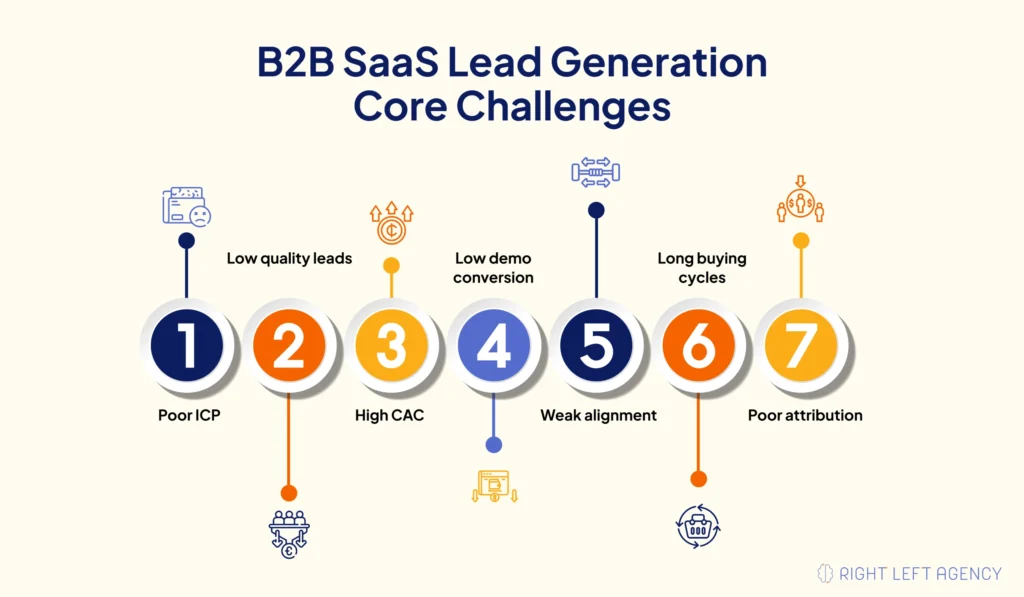
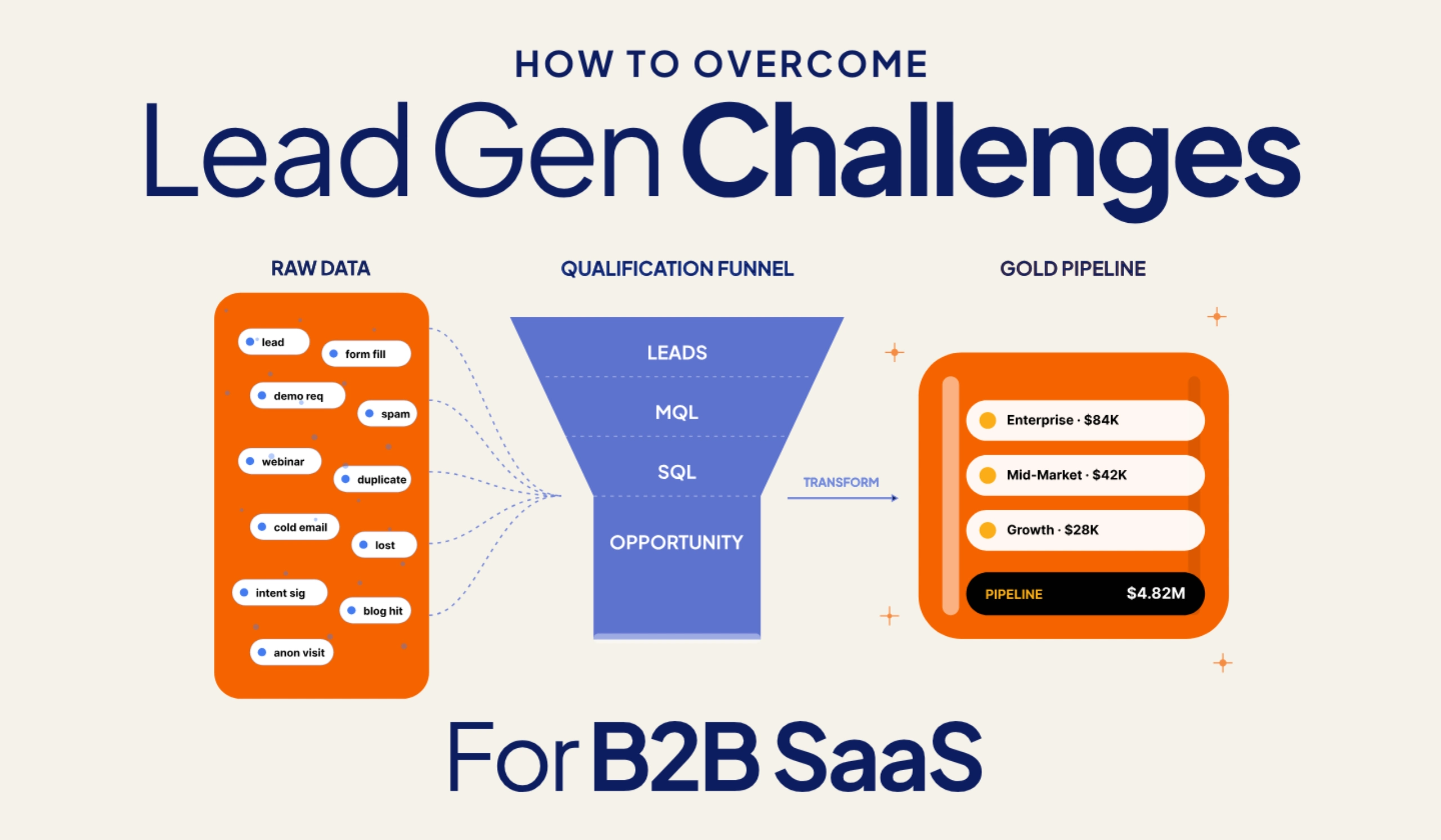
B2B SaaS lead generation challenges are the obstacles that prevent SaaS companies from attracting, qualifying, and converting the right business buyers into a pipeline and revenue.
These challenges often include:
- Poorly defined ICP — targeting too broadly and pulling in the wrong buyers
- Low lead quality — generating high volumes of leads that never become sales opportunities
- High customer acquisition cost (CAC) — spending more to acquire leads that do not convert
- Low demo or trial conversion rates — traffic and leads that drop off before engaging with sales
- Weak sales and marketing alignment — teams working toward different goals with different definitions
- Long buying cycles — leads that need more nurturing but get ignored after the first touchpoint
- Poor attribution — no clear picture of which campaigns actually drive the pipeline
Why B2B SaaS Lead Generation Is More Difficult Than Traditional Lead Generation
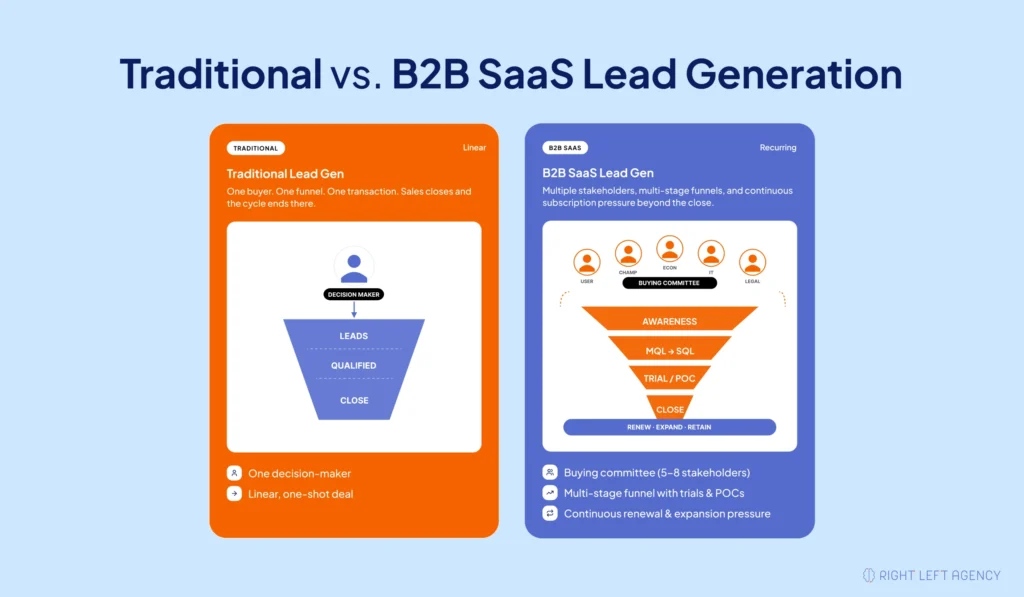
B2B SaaS is not like selling a physical product or a one-time service. The product is complex, the sale involves multiple decision-makers, and the revenue model is subscription-based. All of this makes the lead generation process much harder to get right.
Traditional lead generation often targets one decision-maker with a simple offer. In B2B SaaS, you are typically selling to a buying committee — a group of stakeholders with different priorities. Each person needs different information at different stages of the buyer journey. That alone makes demand generation more layered and expensive.
This is why a campaign can look successful in a dashboard but still fail to produce qualified sales conversations.
Here is what makes B2B SaaS lead generation particularly challenging:
- Longer sales cycles that require repeated touchpoints and content at every funnel stage
- Multiple decision-makers who each need to be educated and convinced separately
- Complex product education — buyers need to understand the problem and the solution before committing
- Subscription-based revenue creates higher pressure on CAC payback and long-term retention
- High competition across nearly every SaaS category drives up paid media costs fast
- Product-led growth and sales-led models each have very different nurturing needs
- Free trial and demo conversion requires strong conversion optimization, not just more traffic
Why B2B SaaS Lead Generation Fails and How to Improve It
Most B2B SaaS lead generation challenges are connected. A weak ICP hurts lead quality. Poor attribution hides campaign problems. Weak sales alignment stops leads from becoming pipelines. The sections below break down the most common issues, explain why they happen, and show how SaaS teams can fix them.
1. Targeting the Wrong ICP
Many SaaS companies start with a broad target audience because they want to capture as many leads as possible. The result is a long list of contacts that sales cannot work with. The leads may fit the general industry but not the specific company size, job title, or buying intent that actually converts.
When ICP targeting is weak, the entire funnel breaks. Paid media spend goes to the wrong audiences, content attracts unqualified visitors, and the sales team wastes time on low-fit prospects.
How to fix it:
- Build ICP profiles using data from your best existing customers — look at firmographics, job roles, company size, and industry
- Use a target account list for outbound and paid campaigns instead of broad interest targeting
- Add ICP qualification questions to your demo and trial forms to filter buyer intent early
Pro Tip: Interview your five best customers and five churned customers. The contrast shows you exactly who your ICP is and who it is not. Use those answers to shape your targeting and messaging.
2. Prioritizing Lead Volume Over Lead Quality
Volume-focused lead generation is one of the most common mistakes in B2B SaaS. When marketing optimizes for CPL and form fills, they often attract leads that never become SQLs or revenue. Sales gets frustrated, marketing defends the numbers, and the MQL-to-SQL gap widens.
The real goal is not more leads. It is a more qualified pipeline. A company with 50 high-fit leads will almost always outperform one with 500 low-intent leads. If your cost-per-lead looks great but your pipeline is thin, your targeting and qualification process needs a rebuild.
In many B2B SaaS funnels, the biggest drop happens between MQL and SQL. That gap shows whether marketing is attracting people who just look good on paper or buyers that sales can actually work with. Even a small improvement in lead qualification can have a meaningful impact on pipeline and revenue.
Better metrics to track instead of CPL alone:
- MQL-to-SQL conversion rate
- SQL-to-opportunity rate
- Pipeline value generated per campaign
- Revenue influenced by the channel
3. Weak Messaging That Attracts the Wrong Buyers
Messaging shapes who responds to your campaigns. Generic or feature-focused messaging attracts curious browsers rather than qualified buyers. If your ads and landing pages speak to everyone, they convert no one.
Strong messaging speaks directly to the ICP’s pain points, buying triggers, and desired outcomes. It filters out the wrong audience and pulls in buyers who are already looking for a solution like yours.
| Weak Messaging | Strong Messaging |
|---|---|
| Gets more leads fast | Builds a qualified pipeline that sales actually want |
| Lowers your CPL | Improves CAC efficiency with better-fit audiences |
| Scales your ads | Scales paid media without wasting budget on low-intent clicks |
4. High CAC and Rising Paid Media Costs
Paid media for B2B SaaS can become expensive when targeting and conversion paths are weak. Keywords on Google Ads and audiences on LinkedIn Ads come at a premium. When campaigns are not optimized for the pipeline, every ad dollar goes to waste.
CAC rises when targeting is off, landing pages do not convert, or teams scale spend before fixing funnel leaks. If your cost to acquire a customer keeps climbing, the problem is rarely just ad costs. It is almost always a funnel efficiency problem.
For example, if LinkedIn Ads are generating expensive demo requests but very few SQLs, the issue may not be LinkedIn itself. The problem could be broad job-title targeting, a weak offer, or a landing page that does not qualify intent.
How to fix it:
- Audit landing pages and offers before increasing ad spend
- Segment campaigns by funnel stage and buyer persona instead of running one broad campaign
- Improve CAC payback by focusing on higher-intent audiences and reducing time-to-close
- Track CAC at the channel level, not just as an overall blended average
5. Low Demo or Trial Conversion Rates
Getting traffic is step one. Converting that traffic into demo requests, trials, or qualified conversations is where most SaaS funnels lose momentum. If your conversion rate is low, the problem usually sits in the landing page, the offer, or the friction in the process.
Trial-to-paid conversion rates vary widely depending on product type, onboarding, pricing model, and whether the trial is opt-in or sales-assisted. Instead of relying only on industry benchmarks, SaaS teams should compare their own conversion rates by traffic source, ICP segment, and funnel stage. That is where the real gaps show up.
Buyers who land on a weak page will leave. They need clear messaging, social proof, and a simple path to the next step. Too many form fields, vague CTAs, and missing trust signals kill conversions before they happen.
How to fix it:
- Reduce form fields to what is necessary for qualification — three to five fields is the sweet spot for most B2B lead gen pages
- Add customer testimonials, case studies, and trust signals above the fold
- Make the CTA specific — “Book a 20-minute demo” converts better than “Get started”
- Run A/B tests on headlines, CTAs, and page layouts to find what resonates with your ICP
6. Poor Sales and Marketing Alignment
When sales and marketing define lead quality differently, the entire handoff breaks. Marketing sends over MQLs that sales does not trust. Sales ignores them. Marketing gets frustrated. Pipeline suffers.
Alignment is not just about communication. It requires a shared ICP definition, agreed MQL and SQL criteria, and a real feedback loop that lets sales inform campaign strategy. Without that, marketing keeps optimizing for the wrong outcomes.
Alignment checklist:
- Shared ICP definition agreed on by both teams
- Clear MQL and SQL criteria documented in a CRM such as HubSpot or Salesforce
- Regular sales feedback sessions to review lead quality by source and channel
- Pipeline-based reporting visible to both teams
- Lead scoring model based on real buying signals, not just activity
Pro Tip: Hold a monthly 30-minute sync between marketing and sales to review lead quality by channel. Use that session to adjust targeting, messaging, and qualification criteria based on what sales is hearing on calls.
7. Poor Attribution and Reporting
Most SaaS teams track clicks and CPL. Very few track the full journey from first touch to closed revenue. When attribution is broken, teams optimize for the wrong things. The campaigns that actually drive pipeline get cut while cheap, but useless, campaigns keep running.
Good attribution connects marketing activity to the pipeline and revenue. It shows which channels generate SQLs, which content influences deals, and exactly where the funnel leaks. Attribution will never be perfect, but it should be good enough to show which campaigns create qualified opportunities — not just clicks and form fills.
Better reporting metrics to track:
- Pipeline generated per channel and campaign
- Lead source quality — which sources produce SQLs, not just MQLs
- Revenue attribution by first touch and multi-touch
- CRM integration with Google Analytics 4, HubSpot, or Salesforce for a complete view
8. Long Buying Cycles and Weak Lead Nurturing
B2B SaaS buyers rarely book a demo on their first visit to your site. They research, compare, and evaluate options before they reach out. If you have no nurturing system in place, you lose them after the first touchpoint.
Long sales cycles need consistent engagement. Buyers at the top of the funnel need education. Those in the middle need proof. Those near the bottom need a clear reason to choose you over the competition.
Pro Tip: Set up a simple three-stage remarketing system: an awareness campaign for cold visitors, a case study campaign for engaged visitors, and a demo-focused campaign for people who visited your pricing or product pages. This gives warm visitors a more relevant next step instead of treating every visitor like they are ready to book a demo immediately.
Nurturing ideas that work:
- Email nurture sequences segmented by funnel stage — TOFU, MOFU, BOFU
- Remarketing campaigns on Google Ads, LinkedIn Ads, and Meta Ads for past visitors
- Case studies and comparison pages for mid-funnel buyers doing their research
- Webinars and live demos to re-engage warm leads who have gone quiet
- Triggered emails based on product activity for trial users
B2B SaaS Lead Generation Challenges: Problem, Cause, and Solution
Here is a quick summary of the most common challenges, why they happen, and how to fix them.
| Challenge | Why It Happens | How to Fix It |
|---|---|---|
| Poor lead quality | Broad targeting or weak ICP | Refine ICP and tighten qualification criteria |
| High CAC | Inefficient campaigns or weak funnel conversion | Fix funnel leaks before scaling spend |
| Low SQL rate | Poor qualification or weak sales handoff | Align sales and marketing on MQL and SQL definitions |
| Weak attribution | Tracking only CPL or clicks | Measure pipeline and revenue impact by channel |
| Long sales cycle | Complex buying process with multiple stakeholders | Use nurturing sequences and remarketing to stay visible |
How to Overcome B2B SaaS Lead Generation Challenges
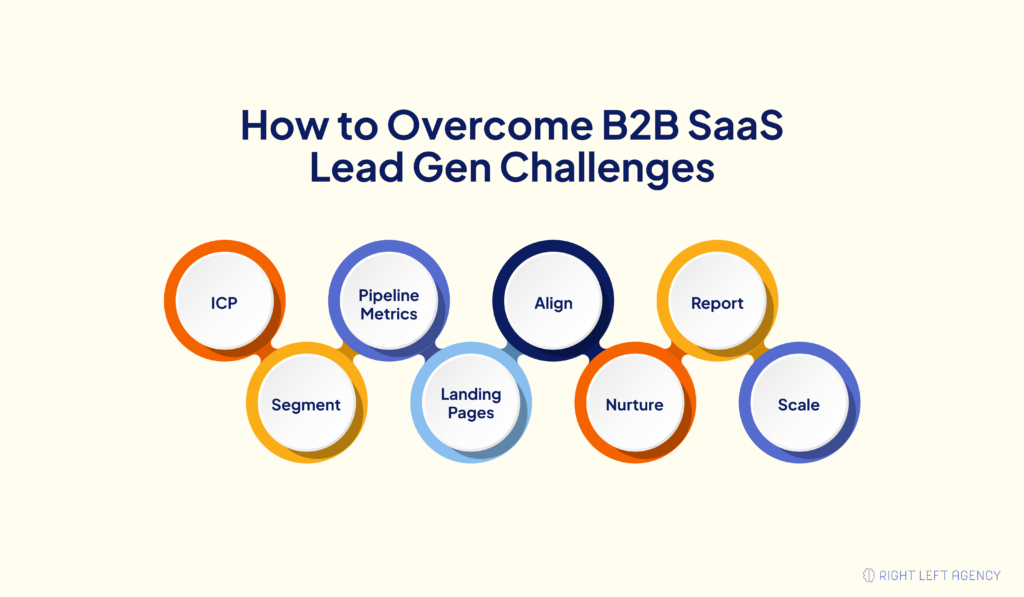
Once the core problems are clear, the next step is to fix them in the right order. Start with targeting and qualification before increasing budget, adding channels, or launching more campaigns.
Here is how to get started:
- Define a sharper ICP. Use data from your best customers to build detailed profiles. Include firmographics, job titles, company size, and buying triggers. Use this to filter campaigns and qualify leads earlier in the funnel.
- Segment campaigns by funnel stage. Not all buyers are at the same stage. Awareness campaigns should educate. Consideration campaigns should differentiate. Decision-stage campaigns should drive action. Mixing them up wastes budget.
- Focus on a qualified pipeline, not just CPL. Set pipeline targets alongside lead volume targets. Track MQL-to-SQL rate as a primary KPI. If CPL is low but the SQL rate is also low, you have a quality problem — not a volume problem.
- Improve landing pages and offers. Audit every landing page for clarity, trust signals, and conversion friction. Test specific CTAs, reduce form fields, and match the page message to the ad that brought the visitor there.
- Align sales and marketing. Set shared definitions for MQL, SQL, and pipeline. Build a regular feedback loop between teams. Make sure CRM data flows in both directions so both teams work from the same picture.
- Build nurturing and remarketing systems. Set up email sequences for leads that are not ready to buy yet. Use remarketing to stay visible to buyers who engaged but did not convert. Segment by funnel stage so the right content reaches the right buyer at the right time.
- Track SQLs, opportunities, and revenue. Move reporting beyond CPL and clicks. Pipeline generated, SQL-to-opportunity rate, and CAC by channel give a much clearer picture of what is actually working.
- Scale only after fixing funnel leaks. Scaling a broken funnel just means spending more money to get the same poor results. Fix targeting, messaging, and conversion before increasing ad spend.
B2B SaaS Lead Generation Metrics That Matter
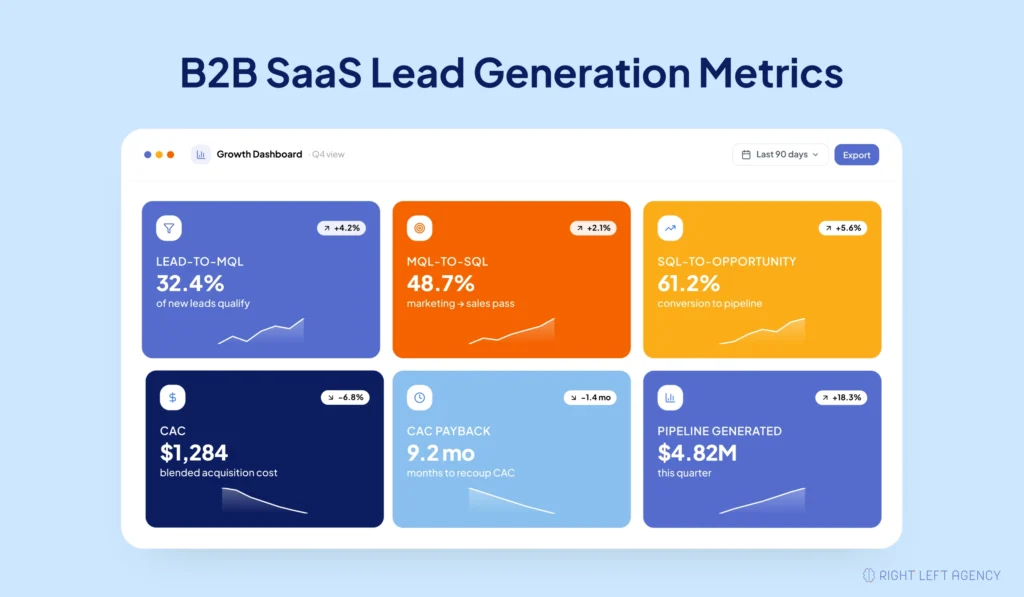
SaaS teams should measure lead generation success by pipeline quality and revenue impact — not just traffic and form fills. The table below covers the metrics that actually show whether your lead generation is working. These metrics are most useful when reviewed by channel, campaign, ICP segment, and funnel stage.
| Metric | What It Shows | Why It Matters |
|---|---|---|
| Lead-to-MQL rate | Lead quality from the top of the funnel | Shows if targeting and messaging attract the right buyers |
| MQL-to-SQL rate | Sales readiness of marketing-qualified leads | Shows if leads meet the criteria that sales actually cares about |
| SQL-to-opportunity rate | Pipeline quality accepted by sales | Shows if sales are converting qualified leads into active deals |
| CAC | Cost to acquire a paying customer | Shows acquisition efficiency across channels |
| CAC payback | Months to recover acquisition cost | Shows if growth is sustainable given subscription revenue |
| Pipeline generated | Total pipeline value created by marketing | Shows the direct business impact of lead generation efforts |
How This Supports a Pipeline-Focused Paid Media Strategy
Paid media is one of the most powerful levers in B2B SaaS lead generation. But it only works when it is built around pipeline quality, not just lead volume. Running ads without fixing ICP targeting, landing page conversion, and attribution is like filling a leaky bucket.
A pipeline-focused paid media strategy for SaaS companies treats every ad dollar as an investment in a qualified pipeline. It uses better-fit audience targeting, funnel-stage segmentation, and strong conversion paths to bring in buyers who are ready to evaluate your product.
Here is how paid media for SaaS companies can support that strategy:
- Build LinkedIn Ads, Google Ads, and Meta Ads campaigns around ICP-specific audiences — not broad interest targeting
- Run full-funnel paid media with separate campaigns for awareness, consideration, and conversion
- Use remarketing to re-engage visitors who have shown buying intent but have not yet converted
- Connect paid media reporting directly to CRM data to measure pipeline and revenue attribution
- Improve CAC efficiency by fixing landing page conversion before increasing spend
Common Mistakes to Avoid
Even teams with good intentions make the same lead generation mistakes. Here are the ones that cost SaaS companies the most:
- Optimizing only for CPL — cheap leads that never become customers are not a win-win
- Targeting too broadly — more reach does not mean a more qualified pipeline
- Sending all traffic to the same landing page — different audiences and funnel stages need different pages
- Ignoring sales feedback — if sales says leads are low quality, listen and adjust
- Scaling campaigns too early — adding budget before fixing funnel problems amplifies waste
- Skipping remarketing — most B2B buyers need multiple touchpoints before they convert
- Not tracking SQLs and pipeline — reporting only on MQLs or form fills misses the point entirely
- Treating all leads the same — lead scoring and segmentation exist for a reason; use them
Conclusion
Overcoming B2B SaaS lead generation challenges starts with understanding where the funnel is breaking. Volume is rarely the real issue. Lead quality, ICP alignment, conversion optimization, sales alignment, and pipeline attribution are where most SaaS companies lose ground.
Once your team fixes those foundations — sharper targeting, better messaging, clearer qualification, and pipeline-based reporting — lead generation becomes more predictable and revenue-focused. For B2B SaaS companies that want paid media to generate a qualified pipeline instead of just form fills, Right Left Agency can help build a strategy around better targeting, stronger conversion paths, and revenue-focused reporting.
Frequently Asked Questions
What are the biggest B2B SaaS lead generation challenges?
The biggest B2B SaaS lead generation challenges include poor ICP definition, low lead quality, rising CAC, weak sales and marketing alignment, poor attribution, and long buying cycles. Most of these challenges are connected. When ICP targeting is broad, lead quality drops. When attribution is weak, teams cannot identify which campaigns drive a qualified pipeline. Fixing each one requires a systematic look at the full funnel — from targeting to conversion to handoff.
Why do B2B SaaS leads fail to convert?
B2B SaaS leads often fail to convert because of poor targeting, weak messaging, low buying intent, friction on landing pages, and slow or inconsistent sales follow-up. When leads come from broad audiences or generic campaigns, they rarely match the ICP. Even when targeting is right, a confusing landing page or a delayed response can kill a deal. Lead quality and conversion optimization both need to work together for SQLs to turn into real opportunities.
How can B2B SaaS companies improve lead quality?
Improving lead quality starts with refining the ICP using data from existing customers. From there, companies need tighter qualification criteria, better audience targeting in paid campaigns, a lead scoring model that reflects real buying signals, and CRM-based reporting that tracks MQL-to-SQL conversion rates. Switching from CPL-focused reporting to pipeline-based reporting also forces the team to optimize for outcomes that matter to revenue — not just volume.
What metrics should B2B SaaS companies track for lead generation?
The most important B2B SaaS lead generation metrics are MQL-to-SQL rate, SQL-to-opportunity rate, CAC, CAC payback, and pipeline generated by channel. These metrics give a much clearer picture of whether lead generation is actually driving revenue. Tracking only CPL or form fills often hides serious pipeline problems. Revenue-focused metrics help both marketing and sales stay aligned on what good performance actually looks like.
Is paid media effective for B2B SaaS lead generation?
Yes, paid media can be highly effective for B2B SaaS lead generation when campaigns are built around the right ICP, funnel stage, messaging, and landing page experience. LinkedIn Ads, Google Ads, and Meta Ads all perform well when targeting is precise and the offer matches buyer intent. The difference between paid media that generates pipeline and paid media that burns budget usually comes down to how well campaigns are structured and how closely they connect to pipeline and revenue reporting. Learn more about how a B2B paid search agency can support this approach.
How is this different from SaaS lead generation strategies?
SaaS lead generation strategies cover the channels and tactics used to generate leads — content, paid media, SEO, outbound, and more. B2B SaaS lead generation challenges are the problems that prevent those strategies from producing a qualified pipeline. You can follow every strategy correctly and still see poor results if the underlying challenges — weak ICP, misaligned teams, broken attribution — are not addressed. This article focuses on identifying those root problems and fixing them, not adding more tactics to an already broken funnel.