Key Takeaways
- A structured RFP helps B2B companies compare paid search agencies against consistent criteria.
- Qualified leads, sales opportunities, and pipeline outcomes matter more than lead volume alone.
- Strong agency proposals demonstrate relevant experience, strategic thinking, and reliable measurement.
- Transparent pricing, clear responsibilities, and account ownership reduce engagement risks.
- A reusable RFP template and weighted scorecard support more informed hiring decisions.
A B2B paid search agency RFP should evaluate an agency’s experience, campaign strategy, conversion tracking, qualified pipeline measurement, pricing, and account ownership. Asking every agency the same questions makes proposals easier to compare and helps identify potential risks before signing a contract.
For B2B companies, hiring a paid search agency is about more than generating clicks or reducing cost per lead. Long sales cycles, multiple decision-makers, and high-value deals make it difficult to judge performance using advertising metrics alone.
A structured request for proposal (RFP) helps marketing leaders determine whether an agency understands these challenges and can connect paid search activity with meaningful business outcomes.
This guide covers 12 essential RFP questions, the evidence to request, a reusable proposal template, and a practical framework for comparing agencies.
What Is a B2B Paid Search Agency RFP?
A B2B paid search agency RFP is a formal document that outlines a company’s advertising objectives, service requirements, and evaluation criteria when requesting proposals from PPC agencies.
It allows businesses to compare potential partners using consistent questions rather than relying solely on sales presentations or pricing estimates.
A typical RFP covers campaign strategy, relevant experience, performance measurement, account management, reporting, and commercial terms.
For B2B companies, the evaluation must go further. A campaign generating hundreds of leads may still underperform if those contacts rarely become qualified sales opportunities.
The RFP should therefore establish how agencies will connect advertising investment to outcomes throughout the sales process.
An effective RFP does not simply identify which agency can manage Google Ads. It helps determine which partner understands your business model, measurement challenges, and growth priorities.
What Should You Include in a B2B Paid Search RFP?
A B2B paid search RFP should provide enough information for agencies to develop relevant strategies and submit comparable proposals.
Before sending the document, define your business objectives, ideal customer profile, current advertising challenges, and expectations for the engagement.
| RFP Requirement | Information to Provide |
|---|---|
| Company overview | Business model, products, services, and target markets |
| Ideal customer profile | Target industries, company sizes, and buyer roles |
| Business objectives | Qualified leads, opportunities, pipeline, and acquisition goals |
| Current advertising | Platforms, approximate spend, performance, and challenges |
| Sales process | Average deal value, sales cycle, and qualification criteria |
| Technology stack | CRM, analytics, attribution, and conversion tracking tools |
| Required services | Campaign management, strategy, reporting, and landing page optimization |
| Proposal requirements | Submission deadline, pricing format, evaluation criteria, and expected deliverables |
Be transparent about known challenges. For example, if your CRM does not consistently distinguish qualified and unqualified leads, mention that limitation.
Otherwise, agencies may develop recommendations around incomplete performance data.
You should also identify which services your internal team will handle and which responsibilities the agency must assume.
The objective is not to share every detail of your business. It is to provide sufficient context for meaningful, evidence-based proposals without exposing unnecessary confidential information.
12 Questions to Ask a B2B Paid Search Agency Before Hiring
The most useful RFP questions reveal how an agency thinks, what it can demonstrate, and how it will take responsibility for performance.
Ask each agency to respond in writing and support its recommendations with relevant examples, documented processes, or verifiable evidence.
1. What Experience Do You Have With B2B Companies Like Ours?
B2B paid search requires an understanding of specialized buyers, long sales cycles, and high-value opportunities.
Ask agencies to demonstrate experience with similar business models, audiences, and acquisition challenges. Their results should reflect qualified leads and pipeline outcomes, not just traffic or conversions.
Evidence to request: Two relevant case studies showing strategy, measurement, and business results.
Red flag: Impressive traffic or lead numbers without evidence of B2B relevance or lead quality.
2. How Will You Diagnose Our Paid Search Challenges Before Recommending a Strategy?
An experienced B2B paid search agency should audit existing campaigns before recommending major changes or additional spending. This includes reviewing search terms, campaign structure, conversion tracking, landing pages, and lead quality.
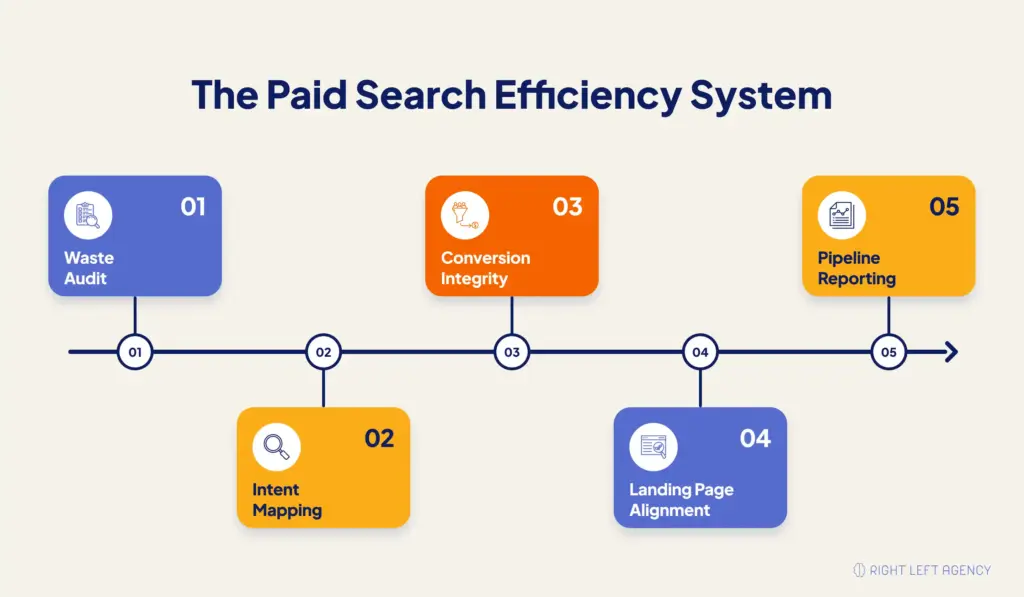
At Right Left Agency, our Paid Search Efficiency System follows five stages:
- Waste Audit: Identify inefficient ad spend.
- Intent Mapping: Align campaigns with buyer intent.
- Conversion Integrity: Verify tracking accuracy.
- Landing Page Alignment: Match landing pages with search intent.
- Pipeline Reporting: Measure qualified leads and opportunities.
A strong agency should demonstrate a similarly structured approach to identifying problems and prioritizing improvements.
Evidence to request: A sample audit showing findings and recommended actions.
Red flag: Recommending higher budgets or major changes without reviewing existing performance.
Learn more in our B2B SaaS Google Ads audit guide.
3. How Will You Align Keywords and Campaigns With Our Ideal Customer Profile?
A strong B2B paid search strategy targets keywords that match your ideal customer profile (ICP) and buying intent, not just high search volume.
Ask agencies how they identify high-intent keywords, segment campaigns, manage negative keywords, and tailor ad messaging to different buyer needs.
Evidence to request: A keyword-to-intent map showing how campaigns target relevant customer segments.
Red flag: Prioritizing search volume without considering buyer relevance or commercial intent.
4. How Do You Approach Bidding, Budget Allocation, and Automation for B2B Campaigns?
B2B bidding and budget decisions should reflect lead quality, conversion data, and business objectives.
Ask agencies how they allocate budgets, use automated bidding, manage campaigns with limited conversion data, and evaluate performance improvements.
A strong agency should explain its decisions using reliable data rather than applying the same strategy to every account.
Evidence to request: An example of a bidding or budget adjustment supported by performance data.
Red flag: Relying entirely on automation without considering lead quality or campaign-specific needs.
5. How Will You Measure Qualified Leads and Connect Google Ads With Our CRM?
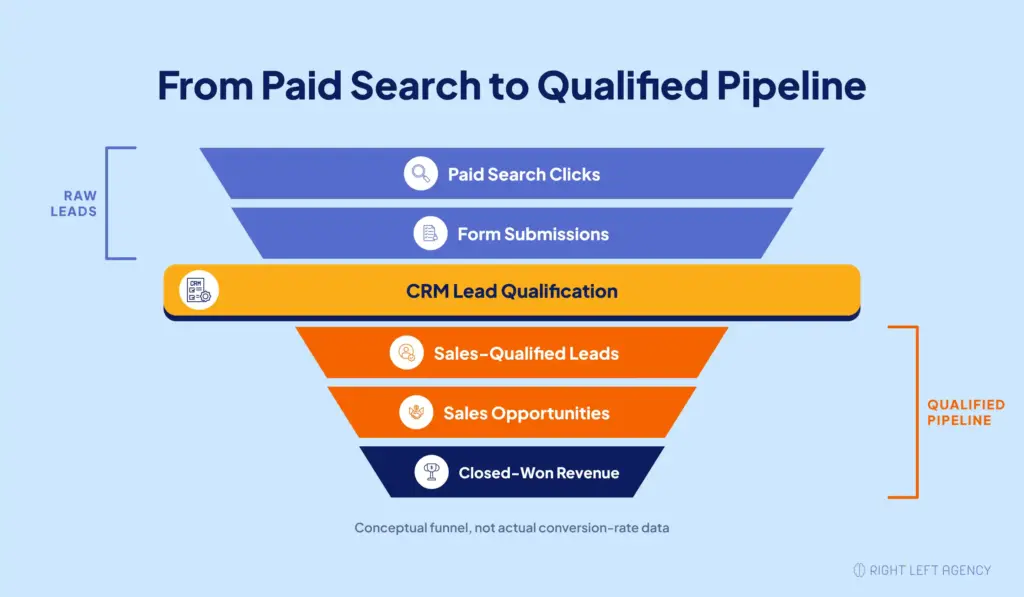
5. How Will You Measure Qualified Leads and Connect Google Ads With Our CRM?
A B2B paid search agency should track qualified leads and sales outcomes, not just form submissions.
Ask how the agency connects Google Ads with your CRM, tracks marketing-qualified leads (MQLs), sales-qualified leads (SQLs), and opportunities, and validates conversion data.
Google Ads supports enhanced conversions for leads, which can help connect offline lead outcomes with advertising interactions using first-party data, subject to privacy requirements.
For example, if 120 form submissions generate only eight qualified leads, the agency should investigate lead quality before recommending increased spending.
Evidence to request: A CRM integration and conversion tracking workflow.
Red flag: Treating all form submissions as equally valuable.
6. How Will You Work With Our Sales Team to Improve Lead Quality?
An effective agency should use sales feedback to improve targeting, messaging, and lead quality.
Ask how the agency reviews disqualified leads, aligns qualification criteria with sales, and adjusts campaigns based on feedback.
RLA Client Example: In its engagement with Billd, RLA optimized paid search and social campaigns, landing pages, and ad messaging. The combined paid media program achieved a 125% increase in qualified leads over six months. This result was not attributable to paid search alone.
Evidence to request: A documented sales-feedback and campaign optimization process.
Red flag: Measuring success solely by submitted leads without considering sales qualification.
7. How Will You Report Paid Search Performance Against Pipeline and Revenue?
B2B paid search reporting should connect advertising performance with qualified opportunities and revenue.
Ask agencies how they track cost per qualified lead, cost per opportunity, attributed pipeline, and closed-won revenue. Reports should explain attribution limitations and provide actionable recommendations.
A strong agency uses these insights to guide campaign improvements and budget allocation.
Evidence to request: A sample performance report connecting advertising data with CRM outcomes.
Red flag: Reporting only clicks, impressions, and raw conversions without evaluating business impact.
Learn more in our B2B paid search reporting guide.
8. How Will You Improve Landing Pages and Conversion Rates?
Landing pages should align with search intent, communicate clear value, and encourage qualified conversions.
Ask agencies how they evaluate landing page messaging, user experience, form friction, and conversion performance. Improvements should consider lead quality, not just conversion rates.
Evidence to request: A landing page testing example showing changes and measurable outcomes.
Red flag: Promising higher conversion rates without considering lead quality.
9. What Does Your First 90-Day Plan Look Like?
A 90-day plan reveals how an agency organizes its work, manages dependencies, and establishes accountability.
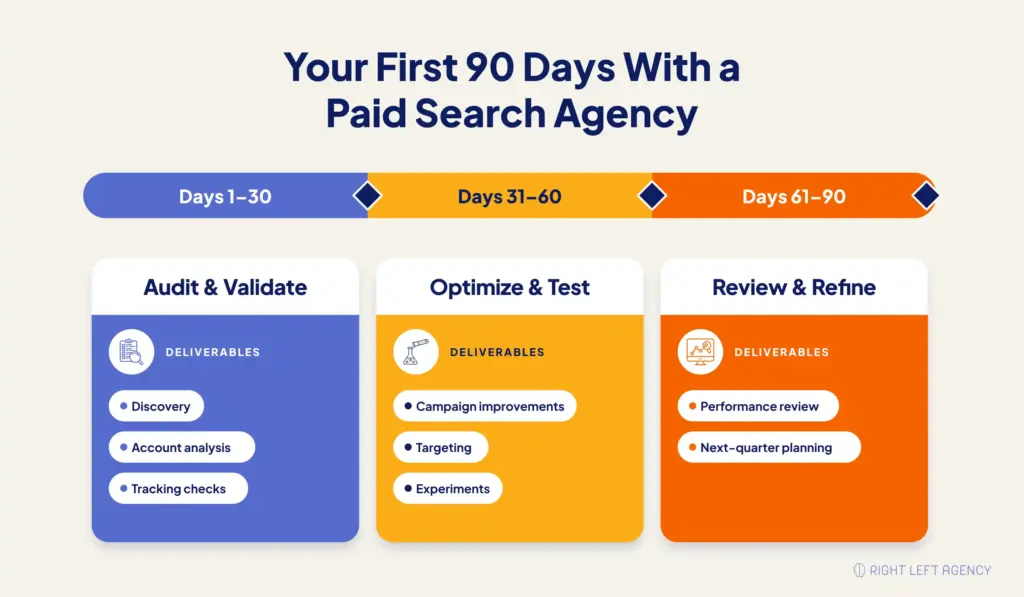
9. What Does Your First 90-Day Plan Look Like?
A strong agency should provide a realistic 90-day plan with clear priorities, deliverables, and responsibilities.
| Timeline | Primary Focus | Expected Output |
|---|---|---|
| Days 1–30 | Audit and tracking validation | Findings and measurement plan |
| Days 31–60 | Campaign improvements and testing | Implemented optimizations |
| Days 61–90 | Performance review and refinement | Results and next-quarter roadmap |
For B2B companies with long sales cycles, agencies should track early performance indicators while pipeline and revenue data develop.
Evidence to request: A 90-day roadmap with milestones and responsibilities.
Red flag: Guaranteeing revenue results without understanding your business or sales cycle.
10. Who Will Manage Our Account, and How Will Communication Work?
Clarify who will manage your campaigns, develop strategies, analyze performance, and communicate results.
Ask about the account manager’s experience, specialist involvement, reporting frequency, and escalation procedures.
Evidence to request: A proposed team structure with defined responsibilities and communication schedules.
Red flag: Unclear accountability or no visibility into who manages your account.
11. How Are Your Fees Structured, and What Is Included in the Engagement?
Paid search agency pricing may include fixed retainers, percentage-of-spend fees, or hybrid models.
Ask agencies to separate advertising spend from management fees and clarify costs for strategy, tracking, reporting, landing pages, and onboarding.
Evidence to request: An itemized proposal outlining fees, deliverables, exclusions, and contract terms.
Red flag: Hidden charges or unclear service inclusions.
Learn more in our paid search agency pricing guide.
12. Who Owns the Advertising Accounts, Data, and Campaign Assets if We End the Contract?
Confirm ownership and access rights for advertising accounts, analytics data, campaign assets, and tracking configurations before signing.
Ask agencies about termination terms, data access, and transition support to avoid disruptions when changing providers.
Evidence to request: Written agreements covering account access, asset ownership, and handover procedures.
Red flag: Restricted account access or unclear ownership and termination policies.
For additional guidance, read our guide to switching SaaS PPC agencies.
B2B Paid Search Agency RFP Template: What to Send Vendors
A B2B paid search agency RFP should clearly communicate your business objectives, advertising requirements, and expectations. Providing consistent information helps agencies submit relevant proposals and makes their responses easier to compare.
Use the following template to structure your RFP.
Copy-Ready B2B Paid Search Agency RFP Template
| RFP Section | Information to Include |
|---|---|
| Company Overview | Company name, business model, target market, and ideal customer profile |
| Business Objectives | Qualified lead targets, pipeline goals, and acquisition priorities |
| Current Advertising | Advertising platforms, monthly budget, existing performance, and challenges |
| Required Services | Campaign strategy, management, conversion tracking, reporting, and landing page optimization |
| Agency Evaluation | Responses to the 12 questions outlined above |
| Supporting Evidence | Relevant case studies, sample reports, team profiles, and a 90-day plan |
| Pricing and Terms | Management fees, included services, additional costs, and account ownership |
| Proposal Deadline | Submission date and preferred document format |
| Selection Timeline | Finalist interviews, expected decision date, and engagement start |
| Primary Contact | Contact name and business email |
What Should Agencies Include in Their Responses?
Ask each agency to answer all 12 questions in the same order and provide supporting evidence wherever possible.
Proposals should clearly explain the recommended strategy, expected deliverables, implementation timeline, assigned team members, pricing, and any assumptions or exclusions.
Agencies should also disclose limitations or requirements that depend on additional tools, access permissions, or third-party services.
How Should You Customize the Template?
Adjust the RFP to reflect your business priorities.
For example, a B2B SaaS company focused on demo requests may prioritize CRM integration, lead qualification, and opportunity tracking. A company entering new markets may emphasize regional targeting, keyword research, and budget allocation.
Keep the core evaluation questions and scoring criteria consistent across agencies to support fair comparisons.
How Should You Score B2B Paid Search Agency RFP Responses?
Evaluate B2B paid search agencies using a weighted scorecard that reflects your business priorities. This helps you compare proposals consistently rather than making decisions based on pricing, presentations, or promises alone.
Start by assigning a weight to each evaluation criterion. For B2B companies, lead quality, measurement, and reporting may deserve greater emphasis because they help connect advertising performance with qualified pipeline.
The following scoring framework is an example you can adapt to your requirements.
How to Calculate an Agency’s Weighted RFP Score
Rate each agency from 1 to 5 based on the quality of its response and supporting evidence:
- 1: Poor or unsupported response.
- 2: Significant gaps or concerns.
- 3: Acceptable, with some limitations.
- 4: Strong response with relevant evidence.
- 5: Excellent response backed by credible evidence.
Calculate each category’s score using this formula:
Weighted Score = (Agency Rating ÷ 5) × Category Weight
For example, an agency receiving 4 out of 5 in a category worth 20% earns 16 points.
Here is how two hypothetical agencies might compare:
| Evaluation Criteria | Weight | Agency A | Agency B |
|---|---|---|---|
| B2B experience and evidence | 15% | 4/5 | 4/5 |
| Strategy and budget approach | 20% | 4/5 | 4/5 |
| Lead quality, measurement, and reporting | 25% | 5/5 | 3/5 |
| Landing page optimization | 15% | 3/5 | 4/5 |
| Team and communication | 10% | 4/5 | 4/5 |
| Pricing and contract terms | 15% | 3/5 | 4/5 |
| Final Weighted Score | 100% | 79/100 | 75/100 |
Agency A scores higher because it demonstrates stronger measurement capabilities, while Agency B performs better in landing page optimization and commercial terms.
However, a higher score does not automatically mean a better fit. Review the evidence behind each rating, confirm the agency’s ability to meet your requirements, and consider the risks of the proposed engagement.
What Should Disqualify an Agency Regardless of Its Score?
Some requirements should be non-negotiable, regardless of an agency’s overall rating.
These may include data security, transparent account ownership, accurate performance claims, and the ability to meet essential contractual obligations.
Before making your final decision, verify references, resolve outstanding concerns, and confirm that the preferred agency meets every mandatory requirement.
The goal is not simply to hire the highest-scoring agency. It is to select a reliable partner whose capabilities, approach, and accountability align with your business objectives.
What Are the Biggest Red Flags When Evaluating a B2B PPC Agency?
The biggest warning signs are unsupported performance promises, weak measurement plans, unclear responsibilities, and contractual arrangements that create unnecessary business risk.
| Warning Sign | Why It Matters |
|---|---|
| Guaranteed revenue outcomes | Ignores uncertainty in market conditions and sales execution |
| No qualified-lead measurement | Makes it difficult to assess commercial value |
| Generic campaign proposals | May indicate limited understanding of your business |
| Unclear contract terms | Creates potential financial and operational risks |
| Limited reporting transparency | Reduces visibility into performance and decisions |
| Restricted account access | Can complicate transitions and reduce operational control |
Not every concern requires immediate rejection.
Some gaps can be addressed through follow-up questions or revised proposals. However, agencies should be willing to explain their recommendations, provide relevant evidence, and document important commitments.
How Do You Choose the Right B2B Paid Search Agency?
Choose a B2B paid search agency by comparing relevant expertise, measurement capabilities, proposed strategy, delivery accountability, and commercial terms.
A structured decision process helps reduce the influence of presentation quality or pricing alone.
Compare Proposals Using the Same Criteria
Use your weighted scorecard to evaluate every agency consistently.
Review missing evidence, unsupported assumptions, and differences in service scope before finalizing scores.
Where reviewers disagree significantly, discuss the evidence behind their ratings rather than simply averaging their opinions.
Validate Experience and Meet the Delivery Team
Request relevant references and discuss the proposed approach with the people who will manage your account.
Focus on how the agency handles business challenges, explains performance issues, and collaborates with internal teams.
Ask finalists to clarify their proposed priorities and the assumptions influencing their recommendations.
Confirm Responsibilities and Contract Terms
Before signing, verify deliverables, fees, reporting expectations, account access, and termination conditions.
The strongest agency is not necessarily the cheapest or the one promising the fastest results. It is the partner that demonstrates relevant capabilities, credible evidence, and a practical understanding of your business objectives.
Choose a B2B Paid Search Partner That Understands Your Revenue Goals
Hiring a B2B paid search agency requires more than comparing advertising fees, campaign experience, or projected lead volume.
The right partner should understand your ideal customers, evaluate qualified pipeline, communicate transparently, and take responsibility for the work it promises to deliver.
Use these 12 RFP questions, the reusable template, and the weighted scorecard to compare agencies with greater confidence.
At Right Left Agency, our paid search approach connects search intent, campaign optimization, landing page performance, and CRM measurement with qualified pipeline.
If you want to identify gaps in your current program before selecting a partner, explore our B2B paid search services and request a Paid Search Opportunity Audit.
Frequently Asked Questions
How Many Agencies Should You Invite to a B2B Paid Search RFP?
A focused shortlist of three to five qualified agencies can provide useful comparisons without creating unnecessary evaluation work.
The appropriate number depends on the project’s complexity, available alternatives, and your team’s procurement requirements. Relevant expertise matters more than the number of invitations.
How Long Does the B2B Paid Search Agency RFP Process Take?
The timeline depends on the complexity of the engagement, the number of agencies involved, and internal approval requirements.
A straightforward selection may take several weeks, while complex engagements involving technical reviews, multiple stakeholders, and contractual negotiations can take longer.
Set clear deadlines for questions, proposals, evaluation, and final selection.
Should You Request a PPC Audit Before Hiring an Agency?
A preliminary PPC audit can help evaluate how an agency identifies problems and prioritizes opportunities.
However, a comprehensive audit may require meaningful access, detailed analysis, and paid discovery work.
Agree on the scope before requesting extensive technical or strategic recommendations.