Key Takeaways
- Google Ads offers broader search reach, making it a practical starting point for capturing high-intent B2B demand.
- Microsoft Advertising provides LinkedIn-based professional targeting, which can help refine B2B audience strategies.
- Lower CPC or CPL does not guarantee better leads. Cost per sales-qualified lead and cost per opportunity provide more meaningful comparisons.
- CRM-connected conversion tracking is essential for evaluating leads that progress into qualified pipeline and revenue.
- Testing both platforms can uncover incremental opportunities, but budget decisions should follow actual business results.
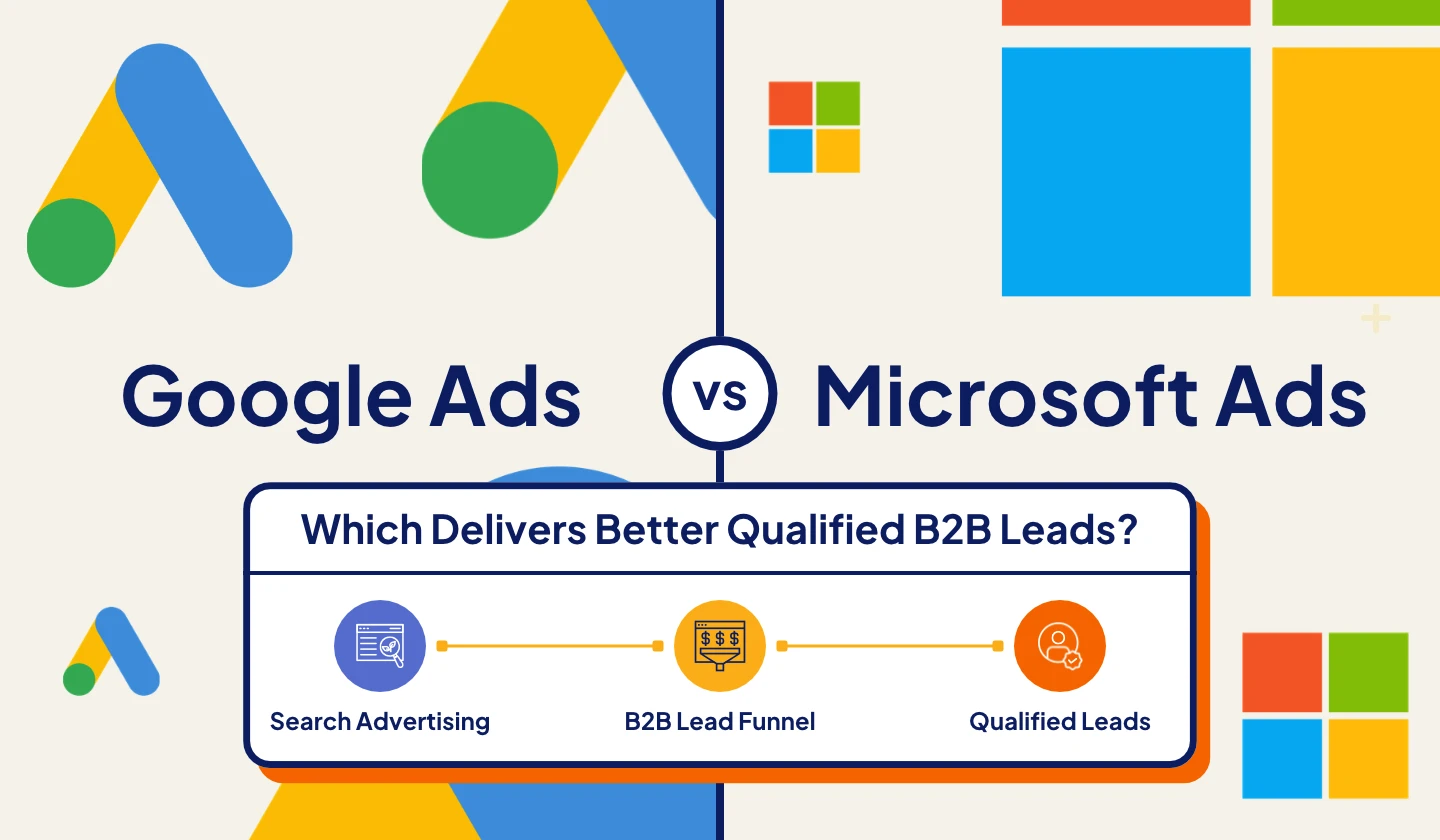
Choosing between Google Ads and Microsoft Ads for B2B lead generation involves more than comparing advertising costs.
Both platforms can reach prospects actively searching for business solutions. However, they differ in search reach, audience targeting, competition, and campaign capabilities.
Google Ads generally offers greater search reach, while Microsoft Advertising provides additional B2B targeting options through LinkedIn profile data. Neither platform consistently generates better qualified leads for every business.
The better choice is the one that produces sales-qualified leads and opportunities at a sustainable cost.
This guide compares both platforms and explains how to evaluate their performance before deciding where to invest your advertising budget.
Google Ads vs. Microsoft Ads for B2B: Quick Comparison
Google Ads and Microsoft Advertising are paid advertising platforms that allow businesses to reach potential customers through search advertising.
Google Ads primarily reaches searchers through Google Search and eligible search partners. Microsoft Advertising reaches users through Bing and participating search partner inventory.
Both platforms help businesses capture existing search demand, but their audience capabilities and available inventory differ.
| Comparison Factor | Google Ads | Microsoft Ads |
|---|---|---|
| Search reach | Larger overall search audience | Smaller audience with additional reach |
| Search targeting | Keywords, search intent, and supported audience segments | Keywords, search intent, and supported audience segments |
| B2B targeting | Customer Match, remarketing, and audience targeting or observation | LinkedIn profile attributes, remarketing, and supported audience targeting |
| Professional attributes | No equivalent native LinkedIn profile targeting | Company, industry, job function, and eligible job seniority targeting |
| Cost per click | Depends on auction competition | May be lower in certain markets |
| Conversion tracking | Google tag, qualified lead goals, and enhanced conversions for leads | UET and offline conversion imports |
| Campaign management | Broad advertising ecosystem | Supports importing eligible Google Ads campaigns |
| Primary advantage | Search scale | Additional professional audience insights |
For B2B advertisers, the comparison comes down to two questions:
- Which platform reaches enough relevant buyers?
- Which platform converts those buyers into qualified sales opportunities efficiently?
Search reach helps determine how much opportunity is available. Lead quality determines whether that opportunity is commercially valuable.
Which Platform Delivers Better Qualified B2B Leads?
The platform generating the most leads is not necessarily the one generating the best leads.
Qualified B2B leads are prospects who meet a company’s agreed qualification criteria and demonstrate a potentially valuable business need.
Depending on the sales process, those criteria may include:
- Company size and industry.
- Geographic market.
- Relevant business requirements.
- Budget or purchasing feasibility.
- Decision-making authority or influence.
- Buying intent and timeline.
These factors should align with the company’s ideal customer profile (ICP).
For example, an enterprise software provider may receive inquiries from students, freelancers, small businesses, and procurement teams at large organizations.
All these inquiries could count as leads in an advertising dashboard, but only a portion may represent genuine enterprise sales opportunities.
Why Lead Volume Can Be Misleading
Consider two hypothetical campaigns.
Campaign A generates 100 demo requests, but sales accepts only 10 as qualified leads.
Campaign B generates 50 demo requests, but sales accepts 20.
Campaign B has a higher lead-to-SQL conversion rate despite generating fewer inquiries.
However, advertising spend and opportunity creation still need to be considered before determining which campaign is more efficient.
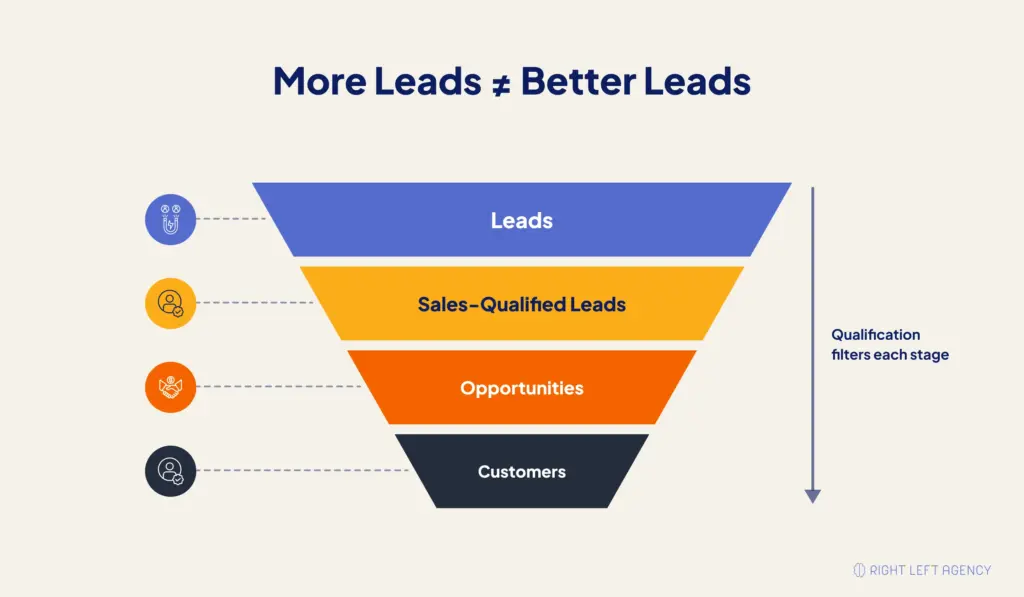
This distinction matters because ad platforms optimize toward the conversion actions advertisers configure.
If every form submission counts equally, the system may prioritize people likely to submit forms instead of prospects likely to become customers.
Our guide to why SaaS paid ads generate low-quality leads explains how conversion signals and CRM feedback affect campaign performance.
The objective is to acquire qualified opportunities at a cost the business can sustain.
Five Key Differences Between Google Ads and Microsoft Ads
1. Search Reach and Buyer Intent
Google Ads offers broader search reach, making it a strong starting point for capturing high-intent B2B demand.
For example, a cybersecurity company targeting searches like “enterprise endpoint protection software” may reach more potential buyers through Google. However, search volume and lead quality vary by industry, location, and keyword.
Microsoft Advertising provides additional reach through Bing and participating search partners, helping businesses connect with prospects beyond Google.
Search intent matters more than search engine popularity. A relevant buyer can demonstrate strong purchasing intent on either platform.
Choose Google Ads: When you need broader reach and sufficient high-intent search demand.
Consider Microsoft Ads: When you want to expand your reach and capture additional qualified search traffic.
2. B2B Audience Targeting
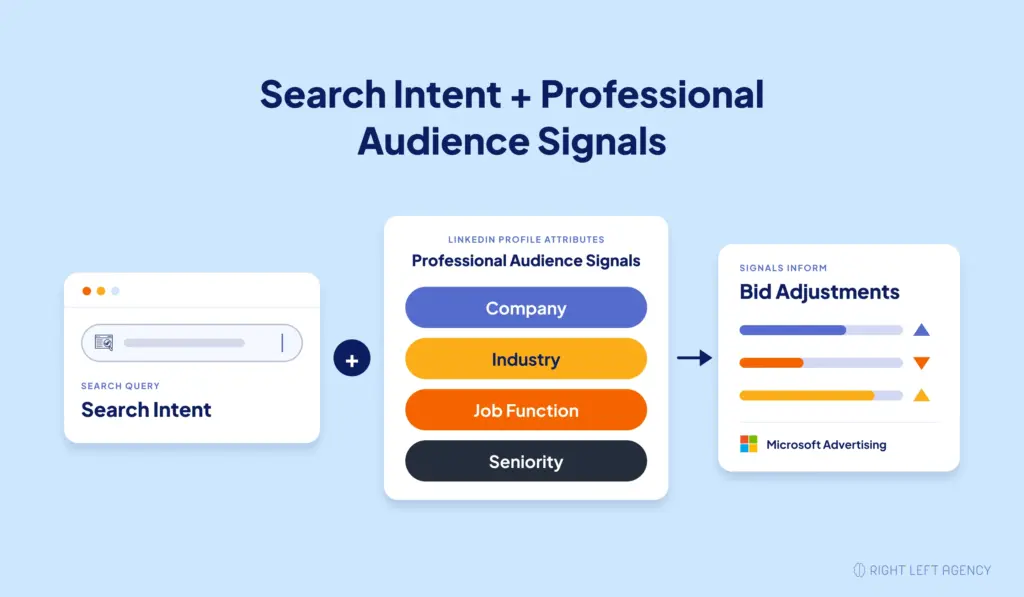
2. B2B Audience Targeting
Microsoft Advertising offers LinkedIn profile targeting, allowing advertisers to use professional attributes such as:
- Company
- Industry
- Job function
- Job seniority
In August 2026, Microsoft announced job seniority targeting for eligible Search and Audience campaigns.
For example, an enterprise software company can combine relevant keywords with finance-related job functions or seniority attributes to help prioritize potential buyers.
However, LinkedIn profile targeting in standard Microsoft Search campaigns uses bid adjustments, not exclusive audience restrictions. It does not guarantee that every click comes from a selected professional audience.
Google Ads takes a different approach, combining search keywords with audience segments, remarketing, and Customer Match where supported.
Choose Google Ads: When search intent is the primary indicator of buying readiness.
Consider Microsoft Ads: When professional audience attributes can strengthen your B2B targeting strategy.
3. Cost Per Click and Lead Acquisition Costs
Microsoft Ads may offer lower cost per click (CPC) in some markets, but advertising costs vary by industry, competition, keywords, and targeting settings.
More importantly, cheaper clicks do not necessarily generate better qualified leads.
B2B advertisers should evaluate three key metrics:
- Cost per lead (CPL): Advertising spend divided by total leads.
- Cost per SQL: Advertising spend divided by sales-qualified leads.
- Cost per opportunity: Advertising spend divided by qualified sales opportunities.
A campaign with a higher CPL may still deliver better results if more leads become qualified opportunities.
For B2B companies, cost per qualified opportunity is often more meaningful than CPC or CPL alone.
4. CRM Integration and Conversion Tracking
Both platforms support conversion tracking, but B2B businesses often need deeper measurement than website conversions.
A form submission may happen today, while sales qualification occurs several days later.
An opportunity might not be created until after discovery calls, product evaluations, or internal purchasing discussions.
If advertising platforms measure only the initial submission, marketers may not know which campaigns produced the most valuable prospects.
Google Ads supports Qualified Lead and Converted Lead conversion goals.
Its enhanced conversions for leads use appropriately processed first-party customer information and offline conversion data to help improve measurement.
Microsoft Advertising supports offline conversion imports, allowing eligible sales outcomes to be associated with earlier advertising interactions.
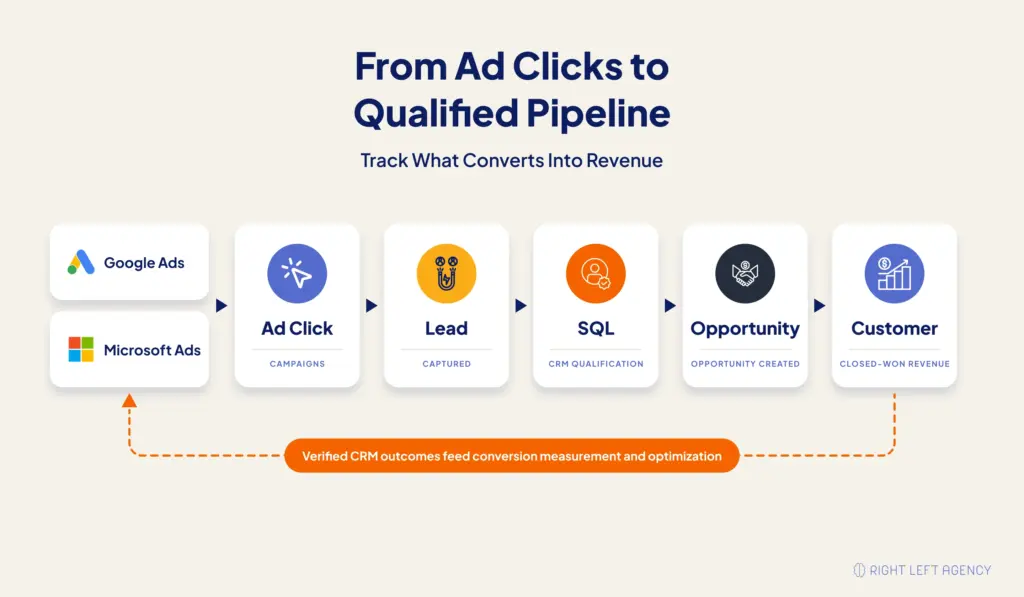
A practical B2B measurement process should connect:
- Advertising source and campaign.
- Lead creation.
- Sales qualification.
- Opportunity creation.
- Closed-won revenue.
For Google Ads, businesses should review enhanced conversions for leads and supported CRM integration methods.
For Microsoft Advertising, businesses should verify appropriate Universal Event Tracking (UET) implementation, Microsoft Click ID (MSCLKID) capture, and offline conversion imports.
According to Microsoft’s offline conversion documentation, the reported conversion event must have occurred within the previous 90 days. It must also occur after the recorded ad click and within the conversion goal’s configured window.
These requirements matter for companies with long sales cycles because later outcomes may fall outside platform attribution windows.
CRM reporting should remain the primary reference for actual sales outcomes, while advertising-platform reporting helps evaluate attributed performance.
The two systems may report different numbers because of attribution rules, conversion windows, and measurement limitations.
For a deeper explanation, see our guide to SaaS marketing attribution.
5. Campaign Scalability and Management
Google Ads generally provides greater opportunities for search expansion because of its larger available search audience.
However, campaign growth is still limited by relevant keyword demand, competition, targeting, and acquisition economics.
Microsoft Advertising can provide incremental reach without requiring marketers to rebuild their entire paid search strategy.
Its campaign import functionality allows advertisers to bring supported Google Ads campaigns into Microsoft Advertising.
This can simplify initial setup.
However, imported campaigns should be reviewed before launch.
Important settings include:
- Keywords and negative keywords.
- Bids and budgets.
- Geographic targeting.
- Search partner settings.
- Audience targeting.
- Conversion tracking.
- Ad copy and landing pages.
A campaign that performs well on Google does not necessarily produce the same results on Microsoft.
Different audiences and auction conditions may require separate optimization.
For companies with established Google Ads performance, Microsoft Advertising is often best approached as an additional channel with its own measurement and optimization plan.
Google Ads vs. Microsoft Ads: Which Generates Qualified Opportunities at a Lower Cost?
The better platform generates qualified sales opportunities at a sustainable cost, not necessarily the lowest cost per lead (CPL).
Consider these hypothetical B2B SaaS campaign results:
| Metric | Google Ads | Microsoft Ads |
|---|---|---|
| Advertising spend | $6,000 | $3,000 |
| Leads generated | 80 | 60 |
| Cost per lead | $75 | $50 |
| Sales-qualified leads | 24 | 9 |
| Lead-to-SQL rate | 30% | 15% |
| Cost per SQL | $250 | $333 |
| Opportunities created | 8 | 3 |
| Cost per opportunity | $750 | $1,000 |
.This illustrates why lead quality and opportunity costs matter more than CPL alone. Actual results will vary by business, audience, and campaign.
Look Beyond Cost Per Opportunity
Not all opportunities have equal business value. A $150,000 potential deal may justify a higher acquisition cost than a $10,000 opportunity.
To assess performance more accurately, consider opportunity value, customer acquisition cost, sales cycle length, closed-won revenue, and customer lifetime value.
Use consistent attribution rules and CRM data to evaluate how each platform contributes to pipeline and revenue.
Which Platform Should Your B2B Business Choose?
The right platform depends on your target audience, budget, search demand, and existing campaign performance.
| Business Situation | Recommended Approach |
|---|---|
| Starting B2B paid search | Evaluate high-intent Google Ads demand first while checking Microsoft opportunities |
| Google Ads already performs well | Test Microsoft Ads for incremental reach |
| Targeting specific professional audiences | Explore Microsoft’s LinkedIn profile targeting |
| Generating leads but few SQLs | Improve tracking, qualification, and campaign relevance first |
| Both platforms produce qualified opportunities | Allocate budget based on acquisition efficiency and available demand |
For B2B SaaS Companies
Google Ads is often a practical starting point for capturing buyers researching software solutions. Microsoft Ads can provide additional search reach and professional audience signals.
Prioritize qualified pipeline over demo-request volume, especially for longer sales cycles.
For Professional Services Companies
Both platforms can reach businesses searching for managed IT, consulting, compliance, and other specialized services.
Focus on high-intent keywords, geographic relevance, and the quality of sales inquiries rather than overall traffic volume.
For Enterprise Technology Businesses
Microsoft’s LinkedIn profile attributes can inform targeting by industry, company, job function, or seniority. Google Ads can capture prospects actively comparing enterprise solutions.
Evaluate both platforms using account fit, opportunity quality, and sales pipeline contribution.
How to Test Google Ads Against Microsoft Ads
A structured comparison helps determine which platform generates more valuable B2B opportunities.
Step 1: Define Lead Qualification Criteria
Align marketing and sales on your ideal customer profile (ICP), sales-qualified lead (SQL) criteria, and opportunity definitions. Apply consistent standards across both platforms.
Step 2: Choose Comparable Campaigns
Test similar high-intent keywords, geographic markets, offers, and landing pages. Separate branded from non-branded traffic and review search partner settings to avoid misleading comparisons.
Step 3: Configure Microsoft Ads Independently
Import eligible Google Ads campaigns if useful, but review keywords, audience settings, bidding, budgets, and conversion tracking before launching.
Step 4: Track Leads Through Your CRM
Connect advertising interactions with lead qualification, opportunity creation, and closed-won revenue. Verify click tracking, offline conversions, and applicable privacy requirements.
Step 5: Compare Leads From the Same Acquisition Period
Evaluate leads from comparable acquisition periods and allow similar time for sales qualification. For example, comparing Google’s 60-day-old leads with Microsoft’s 10-day-old leads may distort results. Measure cost per SQL, cost per opportunity, and pipeline quality after accounting for qualification delays.
For additional guidance, see our B2B SaaS Google Ads audit guide.
Step 6: Reallocate Budget Based on Qualified Pipeline
Compare acquisition efficiency, opportunity value, available demand, and sales capacity before changing budgets.
There is no universal budget split. Some businesses benefit from testing both platforms, while others should optimize one channel first.
Avoid making major budget decisions based on only a few conversions. Treat limited data as directional until enough qualified outcomes are available.
Common Mistakes That Distort Platform Comparisons
Comparing CPC Instead of Qualified Acquisition Costs
Cheaper traffic is not always better traffic.
Compare costs against qualified outcomes rather than relying on clicks and form submissions.
Assuming Microsoft Ads Only Reaches Decision-Makers
LinkedIn profile targeting can provide useful professional audience signals, but it does not guarantee that every search ad impression or click belongs to a selected decision-maker.
Ignoring Search Intent
A relevant professional audience does not automatically demonstrate commercial readiness.
Keyword relevance and buying intent remain important on both platforms.
Using Different Conversion Definitions
If Google Ads counts demo requests while Microsoft Ads counts all contact forms, their reported conversion rates are not directly comparable.
Standardize measurement before evaluating performance.
Overlooking Lead Qualification Delays
B2B leads often require multiple sales interactions before becoming opportunities.
Short reporting windows may understate the value of campaigns whose leads progress more slowly.
Scaling Before Tracking Is Reliable
Increasing advertising investment without trustworthy conversion measurement can amplify inefficient campaigns.
Fix tracking, qualification, and campaign structure before using early performance figures to justify additional spending.
For a broader account review, our SaaS PPC checklist covers measurement, campaign settings, targeting, and landing-page evaluation.
Final Verdict: Google Ads, Microsoft Ads, or Both?
Google Ads generally offers broader search reach, while Microsoft Advertising provides additional B2B targeting opportunities. The better choice depends on which platform generates qualified leads and sales opportunities at a sustainable cost.
Businesses should evaluate lead quality, CRM data, and acquisition costs before deciding whether to invest in one or both platforms.
Build a Paid Search Strategy Around Qualified Leads
Getting leads is not enough. The goal is to turn them into customers.
Right Left Agency’s paid search advertising services help B2B businesses improve targeting, optimize campaigns, and generate more qualified sales opportunities.
Frequently Asked Questions
Is Microsoft Ads Better Than Google Ads for B2B?
Not necessarily. Microsoft Ads offers LinkedIn-based professional targeting and additional search inventory, while Google Ads generally has broader search reach. Compare both platforms using sales-qualified leads, cost per opportunity, and pipeline quality.
Are Microsoft Ads Cheaper Than Google Ads?
Microsoft Ads may have lower CPCs in some markets, but costs vary by keyword, location, competition, and campaign settings. Lower CPC does not guarantee a lower cost per qualified lead or opportunity.
Does Microsoft Advertising Allow LinkedIn Targeting?
Yes. Microsoft Advertising supports LinkedIn profile-based attributes such as company, industry, job function, and eligible job seniority. In standard Search campaigns, these operate through bid adjustments rather than exclusive audience targeting.
Which Platform Is Better for B2B SaaS Lead Generation?
Google Ads is often a practical starting point when relevant search demand exists. Microsoft Advertising can add incremental reach and useful professional signals. B2B SaaS companies should choose based on qualified pipeline, conversion efficiency, and customer acquisition economics.
Should B2B Companies Run Google Ads and Microsoft Ads Together?
Running both can be valuable when each platform generates qualified opportunities at acceptable costs. Businesses with limited budgets or insufficient conversion data may benefit from validating one channel before adding another.