Key Takeaways
- A SaaS SEO consultant is often best for strategic guidance, specialized audits, and companies with existing execution resources.
- A SaaS SEO agency is generally better suited to businesses requiring coordinated technical, content, and analytical execution.
- Growth stage provides useful context, but internal capacity and SEO bottlenecks should drive your hiring decision.
- Compare the total cost of implementation, not just the consultant’s fee or the agency’s monthly retainer.
Choose a partner that can connect SEO priorities with qualified trials, demo requests, and measurable business growth. Your SaaS company is ready to invest in organic growth, but choosing the right SEO partner is not always straightforward. Should you hire an independent consultant or work with an agency?
Both can help improve search visibility, attract qualified buyers, and support customer acquisition. The difference lies in how they deliver expertise, manage implementation, and collaborate with your team.
A SaaS SEO consultant is often the better choice when you need specialized guidance and can execute the strategy internally. An SEO agency may be more suitable when you need multiple specialists coordinating ongoing SEO execution.
However, your growth stage alone should not determine the decision. Your internal capabilities, business priorities, and available budget matter just as much.
This guide explains how to compare both options and choose the right SEO support for your company’s next stage of growth.
What Is the Difference Between a SaaS SEO Consultant and an Agency?
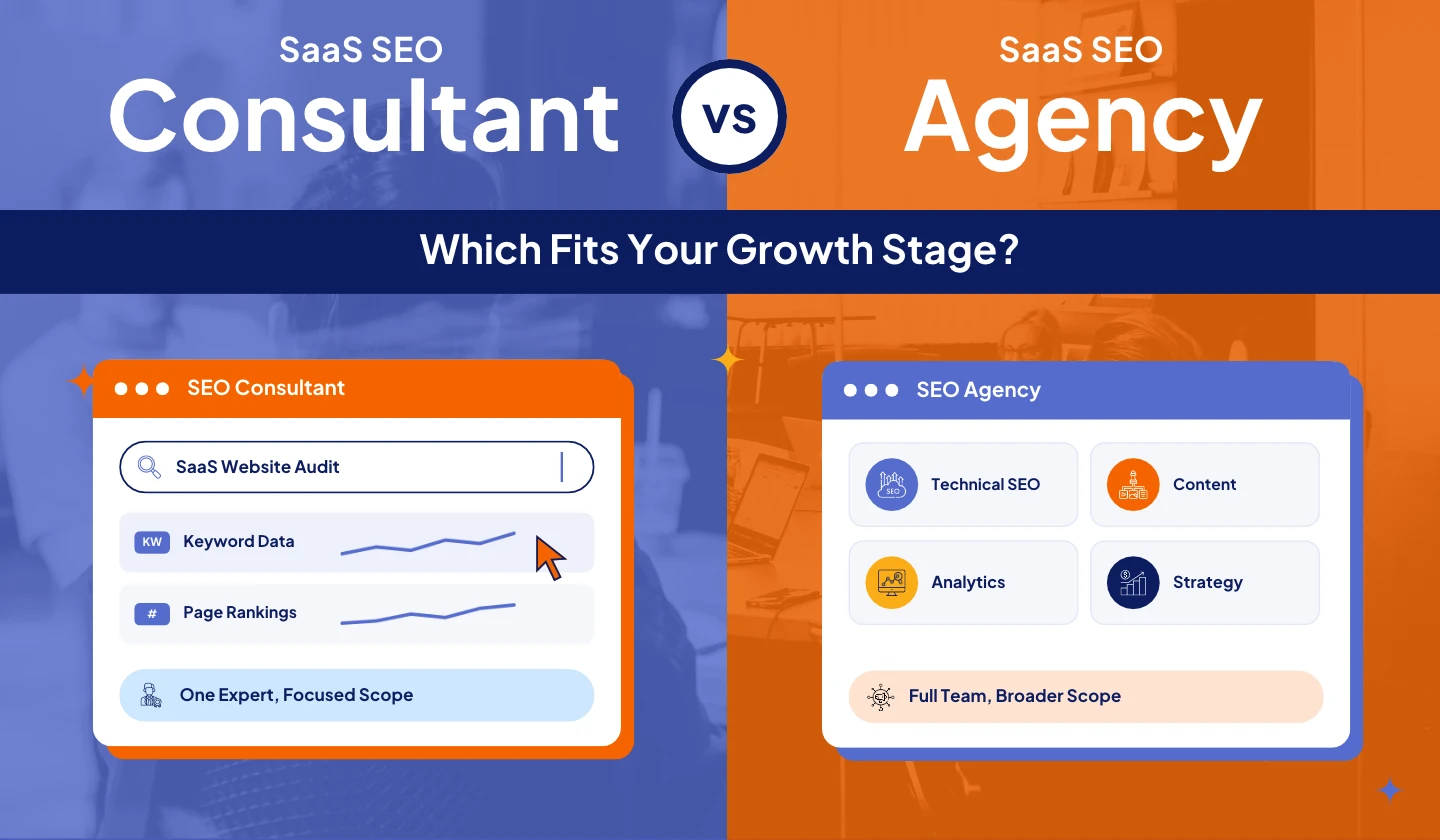
A SaaS SEO consultant is an independent specialist who helps software companies develop and improve their organic search strategies.
Consultants may provide technical audits, keyword research, content planning, website evaluations, and strategic guidance. Some also implement recommendations, depending on their expertise and engagement scope.
A SaaS SEO agency provides SEO services through a coordinated team of specialists. Depending on the agency, these may include SEO strategists, technical specialists, content writers, digital PR professionals, developers, and analysts.
Agencies can support strategy and ongoing implementation within one engagement, although specific capabilities and deliverables vary.
The distinction is primarily about how the work gets delivered, not which model automatically produces better results.
SaaS SEO Consultant vs. Agency: Quick Comparison
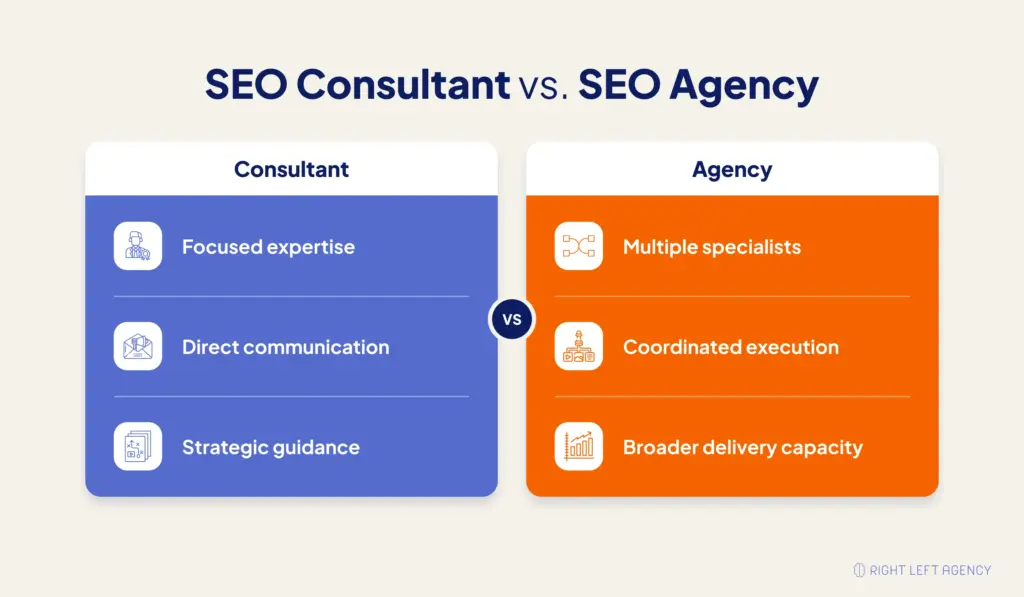
| Factor | SEO Consultant | SEO Agency |
|---|---|---|
| Main advantage | Focused specialist expertise | Coordinated expertise and execution |
| Team structure | Usually one specialist | Multiple specialists or a delivery team |
| Strategy | Often the primary service | Usually combined with execution |
| Implementation | Varies by engagement | May cover several SEO disciplines |
| Communication | Usually direct access to the specialist | Typically through a lead strategist or account team |
| Scalability | Depends on individual availability | Depends on available team capacity |
| Internal involvement | Often higher for advisory engagements | Can be lower, depending on scope |
| Pricing | Hourly, project-based, or retainer | Project-based or recurring retainer |
| Best fit | Focused strategic or technical needs | Sustained, multidisciplinary SEO programs |
These are common characteristics rather than universal rules. An experienced consultant may provide comprehensive implementation, while a small agency may focus on one or two specialties.
The most useful question is not whether a consultant or agency is better. It is which delivery model can solve your company’s current SEO problems.
Which SEO Partner Fits Your SaaS Growth Stage?
As a SaaS company grows, its SEO requirements often become more complex.
An early-stage startup might need help identifying relevant search opportunities. A scaling SaaS company may already know what needs to happen but lack the resources to execute consistently.
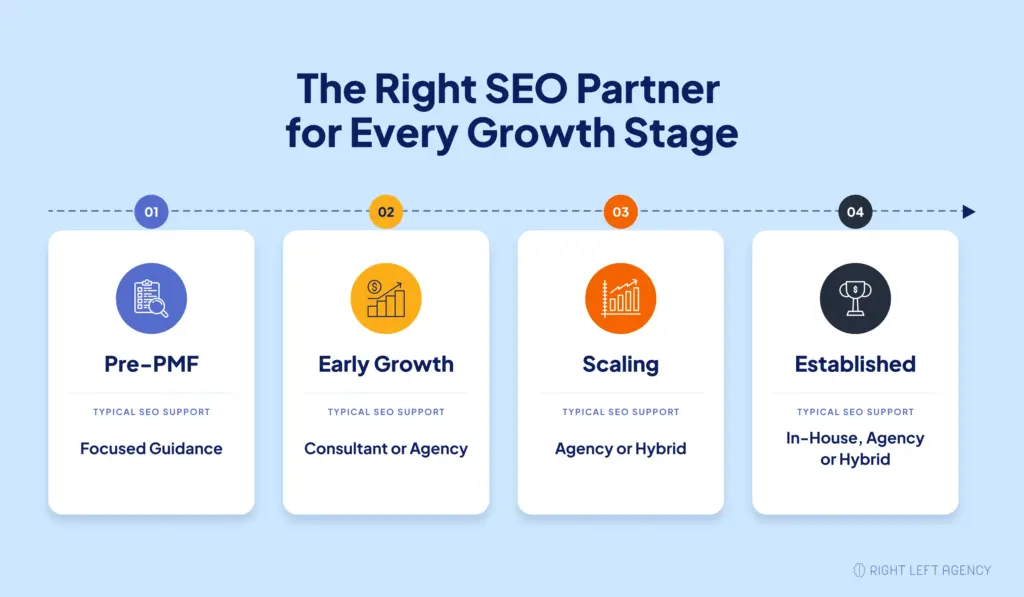
The following framework shows how these needs can influence your decision.
| SaaS growth stage | Common SEO priorities | Recommended approach |
|---|---|---|
| Pre-product-market fit | Validate search demand, positioning, and website fundamentals | Focused consultant or limited specialist support |
| Early growth | Develop commercial pages, build a roadmap, and improve tracking | Consultant or specialist agency |
| Scaling | Execute content, technical SEO, and optimization consistently | Agency or hybrid model |
| Established SaaS | Manage complex websites, multiple products, and advanced measurement | Specialized agency, in-house team, or hybrid |
Pre-Product-Market Fit: Validate Before Scaling
At this stage, your company may still be refining its ideal customer profile, product positioning, and core use cases.
Investing heavily in content production before understanding customer needs can waste resources.
A consultant can help identify relevant search demand, review website architecture, and prioritize foundational improvements.
However, customer interviews, product positioning, and conversion testing may deserve greater attention than a large SEO engagement.
Best approach: Start with focused guidance and invest more heavily only when there is sufficient evidence of relevant demand.
Early Growth: Turn SEO Opportunities Into a Plan
Once your company has clearer product-market fit, SEO can become a more structured acquisition channel.
Your priorities may include:
- Optimizing feature and solution pages
- Creating use-case and integration content
- Targeting relevant commercial keywords
- Fixing technical SEO issues
- Improving demo or trial conversion tracking
If your team has the resources to implement these activities, a consultant may be enough.
If execution is already becoming difficult to manage, an agency with the right capabilities could provide better support.
Best approach: Evaluate how much work your existing team can realistically complete.
Scaling: Increase Execution Capacity
Scaling SaaS companies often face a different problem.
They may already have an SEO roadmap, a content strategy, and clear growth objectives. However, execution cannot keep pace with opportunities.
For example, technical fixes may remain unfinished because developers are focused on product releases. Content production may slow because marketing employees have competing priorities.
A properly staffed agency can help coordinate multiple workstreams without requiring the company to hire an entire internal SEO department.
A hybrid model may work just as well when an internal SEO leader can manage external specialists.
Best approach: Prioritize consistent execution, ownership, and measurable acquisition outcomes.
Established SaaS: Manage Complexity and Efficiency
Established SaaS companies may operate across several markets, products, languages, or customer segments.
SEO often requires coordination between marketing, engineering, analytics, product, and sales teams.
At this stage, a specialized agency or established in-house team can support ongoing execution.
Independent consultants may still provide value through technical audits, migration planning, international SEO advice, or strategic reviews.
Best approach: Choose the structure that provides the required expertise while maintaining clear internal ownership.
When Should Your SEO Delivery Model Change?
Growth stage is a starting point, but operational challenges provide stronger signals.
Consider expanding beyond a consultant-led engagement when:
- Important SEO recommendations repeatedly remain unimplemented.
- Your internal writers or developers cannot support the roadmap.
- Technical, content, and analytics tasks require simultaneous execution.
- Your website is expanding across products, markets, or languages.
- Managing several independent specialists is consuming too much internal time.
These are signals to reassess capacity, not automatic reasons to replace your current provider.
If the existing arrangement continues to deliver the necessary work effectively, switching may create unnecessary disruption.
When Should You Hire a SaaS SEO Consultant?
A consultant is often the stronger option when your organization needs specialized expertise but does not require a full external delivery team.
1. You Have Internal Resources but Need Strategic Direction
Your company may already employ content writers, developers, and marketing specialists.
However, the team might lack an experienced SEO strategist to evaluate opportunities and establish priorities.
A consultant can help develop a roadmap, review implementation quality, and guide internal decisions.
For example, a SaaS company with an experienced content team may need help identifying which product comparison pages and use-case topics are most likely to attract relevant buyers.
Hiring an entire agency for strategy alone may create unnecessary overlap with existing employees.
2. You Need Help With a Specific Technical Problem
Some SEO challenges require concentrated specialist expertise.
Common examples include:
- JavaScript rendering and indexing problems
- Website or domain migrations
- International SEO architecture
- Duplicate content and cannibalization
- Large-scale content audits
- Unexpected organic performance declines
An experienced consultant can investigate the issue, recommend appropriate changes, and support implementation or quality assurance.
Before hiring, confirm whether the consultant will implement fixes or only provide recommendations.
3. You Need an Independent Evaluation
Your SaaS company may already have an SEO program, but leadership is uncertain whether the current strategy is effective.
A consultant can review priorities, technical health, content quality, and performance measurement.
This can help identify whether the main problem is strategy, implementation, market demand, or conversion performance.
Choose a consultant when your biggest constraint is specialized knowledge or strategic clarity, particularly when your team can implement the recommendations.
When Should You Hire a SaaS SEO Agency?
An agency may be more appropriate when your company needs several SEO capabilities working together over an extended period.
1. Your Team Cannot Execute the Full SEO Roadmap
Consider a growth-stage SaaS company with a marketing manager, one content writer, and a developer shared across several departments.
The company wants to improve commercial landing pages, publish new content, resolve technical problems, and measure conversions.
The marketing manager understands these priorities, but there is insufficient capacity to implement them consistently.
An agency that includes the necessary specialists can help manage the workload.
However, the contract should specify which implementation tasks the agency will complete and which depend on internal resources.
2. SEO Requires Multiple Specialties
SaaS SEO often involves more than creating blog content.
A comprehensive program may require:
- Technical SEO and website architecture
- Product, feature, and comparison page optimization
- Search-intent research and content production
- Internal linking and content maintenance
- Digital PR and relevant authority development
- Conversion measurement and performance analysis
These activities involve different skills.
An agency with an appropriate delivery team can coordinate them through a shared roadmap.
The benefit comes from having the right capabilities and processes, not simply having more employees.
3. You Need Consistent Execution Across Growth Initiatives
As your SaaS company expands, SEO may need to support new product launches, integrations, industries, and customer segments.
An agency can help coordinate this work while your internal team focuses on product knowledge, positioning, and commercial decisions.
How Coordinated SEO Execution Works in Practice
Right Left Agency’s work with Privva, a B2B SaaS vendor-risk-management platform, illustrates an integrated delivery model.
The engagement combined website SEO, long-form content, and email marketing. RLA’s published case study reports an 81% increase in organic traffic.
This demonstrates how multiple marketing activities can be coordinated within one engagement. It does not establish that an agency performs better than an independent consultant, nor does it isolate the contribution of each activity.
Choose an agency when you need coordinated expertise, sustained implementation, and sufficient delivery capacity across multiple SEO activities.
When Does a Hybrid SEO Model Make More Sense?
A hybrid arrangement combines internal leadership with external specialists.
For example, your marketing team may understand the product, customers, and sales process but lack the expertise or time to execute every SEO initiative.
You could retain strategic ownership internally while using a consultant for specialized guidance and an agency for agreed implementation tasks.
A typical responsibility structure might look like this:
| Responsibility | Internal Team | External Partner |
|---|---|---|
| Business goals and positioning | Owns | Advises |
| SEO strategy and prioritization | Approves | Develops collaboratively |
| Technical SEO | Provides access and approvals | Audits and implements agreed work |
| Content production | Supplies product expertise | Produces and optimizes content |
| Conversion and CRM reporting | Owns business definitions and data access | Supports setup and analysis |
| Performance reviews | Evaluates commercial impact | Reports progress and recommendations |
The exact division depends on the contract and capabilities.
A hybrid model becomes less effective when several providers make competing recommendations or nobody has authority to prioritize work.
Assign one internal owner to maintain the roadmap, coordinate decisions, and manage accountability.
Practical Example: Consultant vs. Agency for a Growing SaaS Company
Consider a hypothetical B2B SaaS company offering compliance management software.
It has validated its product positioning and wants to attract more qualified demo requests through organic search.
The company has one marketing manager, one content writer, and limited access to a shared developer.
An initial assessment identifies four priorities:
- Improve existing product and solution pages.
- Resolve technical indexing problems.
- Publish high-intent comparison and industry content.
- Connect organic conversions with CRM opportunity data.
The company now needs to decide how to deliver the work.
Option A: Hire an SEO Consultant
The consultant develops the strategy, prioritizes technical fixes, and provides editorial direction.
The internal writer produces content, the developer implements technical changes, and the marketing manager coordinates delivery.
Potential advantage: Direct strategic expertise with strong internal control.
Main risk: Implementation slows when internal employees cannot prioritize SEO work.
Option B: Hire an SEO Agency
The agency develops the strategy and takes responsibility for agreed content, technical, and reporting deliverables.
The internal team provides product expertise, approves content, and supports website access.
Potential advantage: More execution capacity with fewer separate external providers to coordinate.
Main risk: Delivery quality and speed depend on the agency’s actual team, scope, and access to internal stakeholders.
Which Option Makes More Sense?
If the company’s writer and developer have available capacity, a consultant-led arrangement may be efficient.
If important tasks are consistently delayed, an agency with relevant implementation capabilities may be more suitable.
A hybrid arrangement could also work if the company wants to maintain internal strategy ownership while outsourcing selected workstreams.
The deciding factor is not the number of employees or funding stage. It is whether the selected model can complete the required work within the company’s operational constraints.
SaaS SEO Consultant vs. Agency: How Much Does Each Cost?
The cost of SEO support depends on experience, scope, specialization, deliverables, and implementation requirements.
Consultants may charge hourly fees, project fees, or monthly retainers. Agencies commonly offer project-based services or recurring programs.
Neither model is automatically cheaper.
A consultant may have a lower quoted fee while requiring substantial internal labor. An agency may charge more but include services that the company would otherwise need to manage separately.
Compare Total Cost, Not Just Monthly Fees
A useful starting point is:
Total SEO investment = External provider fees + Internal labor costs + Additional implementation expenses
Consider the following illustrative monthly budgets.
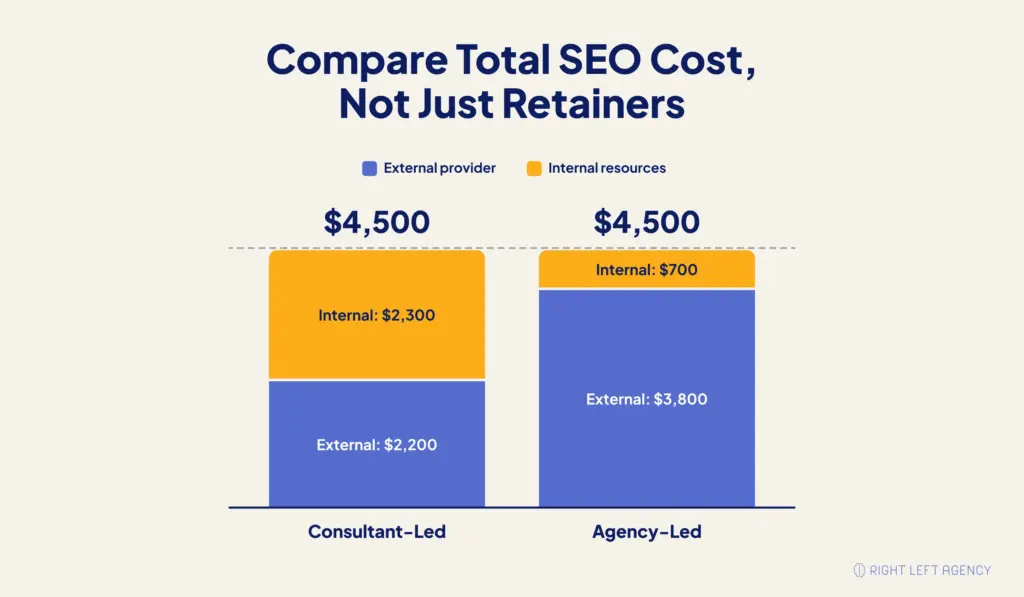
| Cost component | Consultant-led model | Agency-led model |
|---|---|---|
| External SEO provider | $2,200 | $3,800 |
| Internal content and coordination | $1,200 | $300 |
| Developer support | $750 | $300 |
| Additional QA or reporting support | $350 | $100 |
| Total monthly investment | $4,500 | $4,500 |
These figures are hypothetical examples intended to illustrate different cost structures. They are not market averages, actual RLA rates, or verified quotes from providers.
Internal labor expenses depend on the number of hours required, employee costs, and responsibilities assigned to each team.
The two examples also do not assume identical deliverables, work quality, or business outcomes.
Although both scenarios have the same total expenditure, they represent different levels of internal involvement.
A meaningful comparison requires evaluating providers against an equivalent scope of work, expected quality standards, and implementation responsibilities.
What Should You Evaluate Beyond Price?
Consider:
- Which deliverables are included?
- Who implements technical recommendations?
- Who writes, edits, and reviews content?
- How much internal management time is required?
- Are software tools and additional services included?
- What work remains dependent on your internal team?
- How will the engagement adapt if priorities change?
A lower proposal is not necessarily better value if essential tasks remain unfinished.
Likewise, a higher retainer is difficult to justify when the additional services do not address your actual growth constraints.
How to Decide Between a SaaS SEO Consultant and an Agency
Rather than beginning with a list of providers, start by identifying what your company needs help accomplishing.
Step 1: Identify Your Primary Bottleneck
Use this decision framework:
| Your current situation | Potentially better fit | Why |
|---|---|---|
| We have a capable team but need a clearer SEO strategy | Consultant | Focused strategic guidance |
| We need a specialist technical audit | Consultant | Concentrated expertise |
| We know what to do, but implementation keeps getting delayed | Agency | Additional delivery capacity |
| We need content, technical SEO, and reporting support together | Agency | Coordinated capabilities |
| We have an internal SEO lead but lack specialist capacity | Hybrid | Retains internal control |
| We have not validated our customers or positioning | Limited support or defer major investment | Foundational business questions come first |
This framework identifies the type of support to investigate, not an automatic hiring decision.
Step 2: Confirm Who Will Actually Complete the Work
Ask prospective partners to explain:
- What will you deliver during the first month?
- Which tasks will you implement directly?
- What internal resources will you require?
- Who is responsible when work is delayed?
- How will you evaluate commercial performance?
A clear answer should describe responsibilities, dependencies, and limitations.
If an agency seems like the right model, use RLA’s detailed guide on how to choose a B2B SaaS SEO agency for a deeper evaluation framework.
You can also review the 12 questions to ask before hiring a SaaS SEO agency when comparing shortlisted providers.
Step 3: Choose a Measurable Initial Scope
Avoid committing to an undefined SEO engagement.
Instead, agree on the initial priorities, deliverables, implementation responsibilities, and performance indicators.
The goal is to determine whether the provider can help your organization make meaningful progress.
What Should You Expect From a Consultant vs. Agency in the First 30 Days?
The first month can reveal how each provider approaches your business, manages responsibilities, and translates recommendations into action.
Although discovery and planning are important in both models, the expected deliverables may differ.
| First-month expectation | SEO Consultant | SEO Agency |
|---|---|---|
| Discovery | Focused review of business goals and SEO challenges | Business discovery involving relevant delivery specialists |
| Strategy | Specialized recommendations and priority roadmap | Coordinated roadmap across agreed workstreams |
| Execution | Advisory support or scoped implementation | Workstream assignments and agreed implementation activities |
| Main deliverables | Audit findings, specialist recommendations, or completed project | Roadmap, responsibilities, and initial agreed deliverables |
| Internal involvement | Often higher when consulting is advisory | Depends on access, approvals, and contract scope |
| Progress reporting | Findings, decisions, and recommended actions | Completed work, dependencies, and next priorities |
What Matters Most During the First Month?
For a consultant, evaluate whether the recommendations are accurate, actionable, appropriately prioritized, and supported by clear reasoning.
For an agency, evaluate the strategy and the team’s ability to organize work, manage dependencies, and begin delivering the agreed scope.
In either arrangement, you should know:
- What problems have been identified
- Which activities have the highest priority
- Who owns each task
- What has been completed
- What remains blocked
- How future progress will be evaluated
Do not judge the engagement solely by ranking changes during the first month.
Some improvements may produce early technical or visibility signals, while meaningful acquisition and revenue outcomes can take longer.
Instead, assess whether the provider has established a credible plan and demonstrated the ability to deliver it.
When Should You Hire Neither?
Sometimes neither a consultant nor an agency should be the immediate priority.
Consider delaying a substantial SEO investment when:
- Your product positioning and target audience remain unclear.
- You have not validated whether relevant customers search for the problems your product solves.
- Your website has significant conversion problems that need attention first.
- Nobody internally can provide product knowledge, approvals, or basic implementation support.
- Your business requires immediate acquisition results that SEO cannot reasonably promise.
This does not mean ignoring search visibility.
Foundational technical improvements, clear product pages, and basic search performance measurement may still be worthwhile.
However, a comprehensive SEO program should support an established business objective rather than become a substitute for customer research or product-market validation.
Common Mistakes to Avoid When Choosing SEO Support
Hiring Based on Provider Size
A larger agency does not automatically offer better expertise, and an independent consultant is not necessarily less capable.
Evaluate the actual people, skills, and deliverables involved.
Expecting a Consultant to Execute an Entire Roadmap
Some consultants provide hands-on services, but others focus primarily on advisory work.
Make sure the implementation requirements match the agreed scope.
Assuming an Agency Requires No Internal Involvement
Even a full-service agency may need access to developers, product specialists, sales information, and decision-makers.
Plan for those dependencies.
Measuring Success Only Through Rankings and Traffic
Higher rankings can increase visibility, but they do not guarantee qualified buyers or revenue.
Evaluate whether the work supports meaningful business outcomes, including qualified demo requests, relevant trial signups, sales opportunities, and revenue where attribution is sufficiently reliable.
Treating the Hiring Decision as Permanent
A consultant may be the right fit during early growth, while an agency or hybrid arrangement becomes more suitable as execution needs expand.
Review your operating model when priorities, staffing, and workload change.
Final Verdict: Choose the SEO Partner That Fits Your Growth Constraint
A SaaS SEO consultant and an agency can both support organic growth. The right choice depends on the expertise, resources, and execution capabilities your company needs.
Hire a consultant when you need strategic direction or specialized expertise and have the internal capacity to implement recommendations.
Hire an agency when you need coordinated specialists and consistent execution across multiple SEO activities.
Consider a hybrid model when you want to maintain internal strategic ownership while accessing external expertise and implementation capacity.
Most importantly, choose a partner that understands your SaaS business model and can connect SEO priorities with qualified customer acquisition.
At Right Left Agency, we help B2B SaaS companies connect technical SEO, content strategy, and performance measurement with broader growth objectives.
If your company needs help identifying its biggest organic growth constraints or executing a coordinated SEO program, explore our SaaS SEO services to see how we approach sustainable acquisition.
Frequently Asked Questions
Can a SaaS SEO Consultant Handle Everything an Agency Does?
Some consultants provide comprehensive SEO services, including technical implementation, content optimization, and strategic planning. However, an individual may have limited capacity to manage several specialized workstreams simultaneously. Evaluate the provider’s actual capabilities and availability rather than assuming what their title implies.
Is Hiring a SaaS SEO Agency More Expensive Than a Consultant?
An agency may charge a higher external fee, but the total cost depends on the included services and internal resources required. Compare implementation responsibilities, labor costs, deliverables, and quality expectations before deciding which arrangement offers better value.
How Do You Know When to Switch From a Consultant to an Agency?
Consider changing your delivery model when recommendations repeatedly remain unimplemented, your SEO requirements expand across multiple specialties, or your internal team cannot manage the workload. There is no universal revenue threshold or fixed timeline for making the transition.
Who Should Own the SEO Strategy in a Hybrid Model?
Your company should designate one person responsible for business priorities, approvals, and overall accountability. External consultants or agencies can contribute strategy and execution, but clear ownership helps prevent conflicting recommendations, duplicated work, and implementation delays.