Key Takeaways
- Ad platforms optimize for the conversion signal you give them—not necessarily qualified buyers.
- A low CPL can hide poor lead quality when Sales outcomes never reach the ad platform.
- Specific rejection reasons show Marketing exactly where lead quality is breaking.
- Optimize toward the deepest CRM stage with enough timely data to learn from.
- Measure paid media by qualified pipeline and CAC—not CPL alone.
Why do paid ads generate low-quality leads?
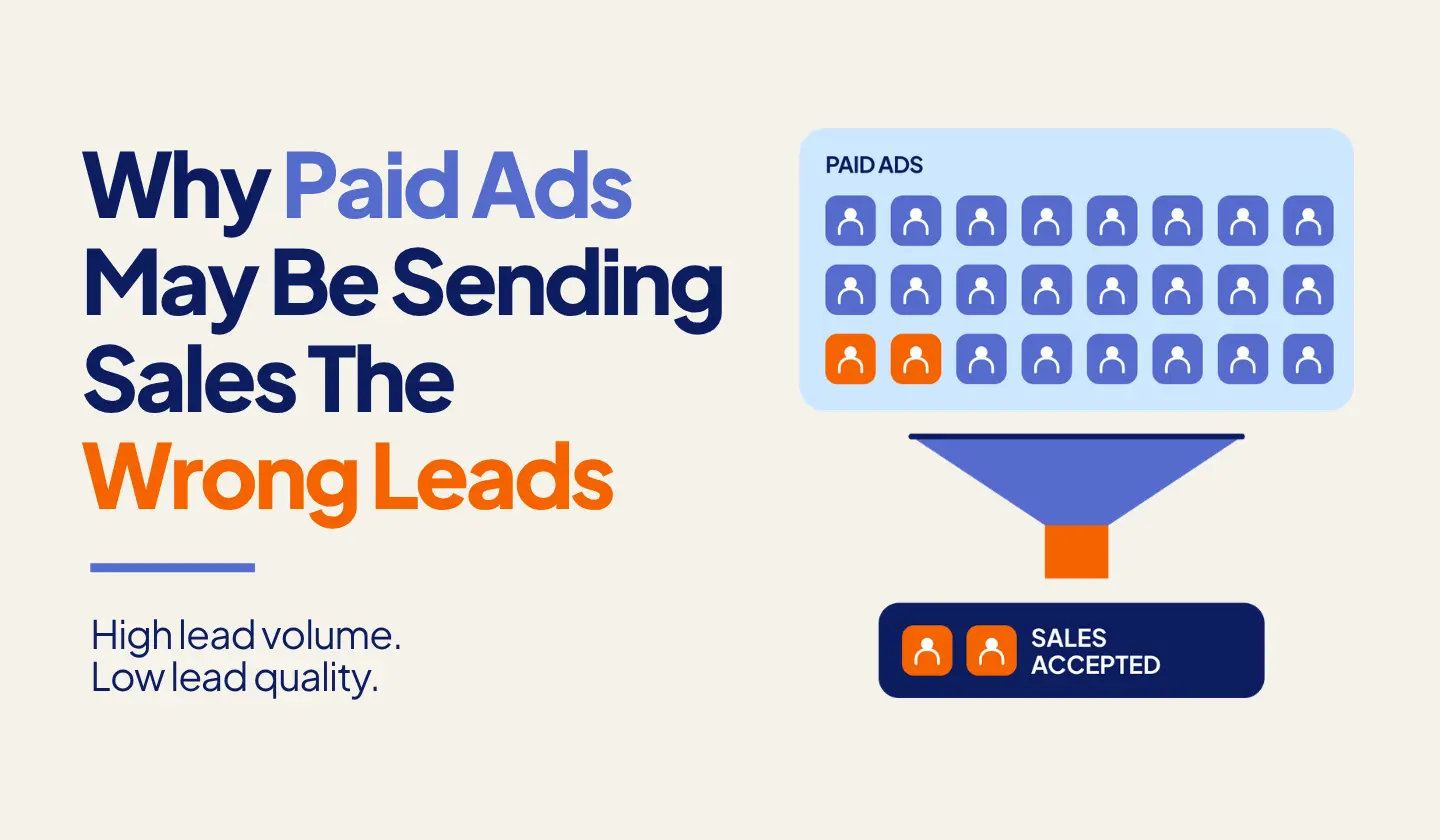
Paid ads generate low-quality leads when the platform optimizes for a different outcome than Sales wants.
If every form submission counts as a conversion, automated bidding learns to find more people likely to submit forms—not necessarily qualified buyers.
A conversion signal is the action you tell the ad platform counts as success. Better B2B SaaS paid search management connects that signal with what happens later in the CRM.
The platform sees a conversion; Sales sees a bad lead
Imagine two people submit the same demo form.
One is an ideal-fit buyer actively evaluating solutions. The other is a student researching your category.
The platform sees two conversions. Sales sees one opportunity and one rejection.
If that Sales outcome stays inside your CRM, the platform never learns the difference.
Cheap leads become the algorithm’s easiest path
Automated bidding tries to deliver the result you ask for efficiently.
If that result is a form submission, you may get:
- Lower CPL
- More leads
- Lower Sales acceptance
- Fewer opportunities
- Flat pipeline
The algorithm may be working exactly as designed. The problem is the definition of success you gave it.
Sales outcomes never make it back
This creates the Wrong Optimization Loop:
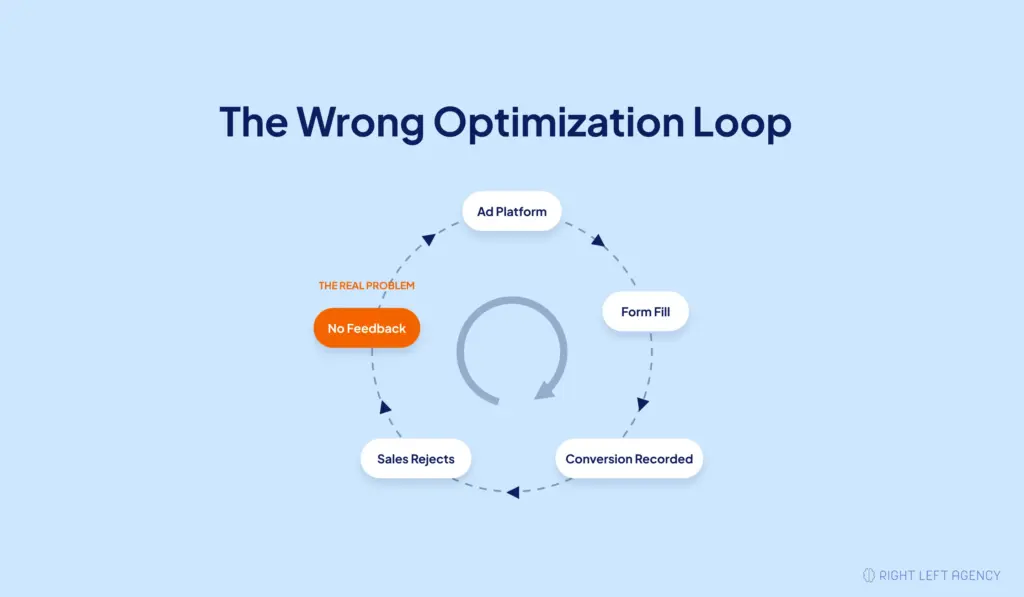
The missing information is the Sales outcome.
When Sales acceptance, qualification, opportunity, or revenue data returns to the platform, bidding gets a much stronger picture of the prospects your company actually wants.
Where is lead quality actually breaking?
Lead quality usually breaks at one of five points:
Traffic → Offer → Form → Data → Reporting
Find the failure point before changing bids, budgets, or targeting.
| Problem | Root cause | Fix | KPI |
|---|---|---|---|
| Irrelevant leads | Traffic | Tighten targeting and exclusions | ICP-fit rate |
| Right companies, weak intent | Offer | Improve offer and messaging | Sales acceptance rate |
| Leads with unknown fit | Form | Add useful qualification | Qualified-lead rate |
| Sales rejects similar leads | Data | Return CRM outcomes | Cost per qualified lead |
| CPL drops, pipeline doesn’t grow | Reporting | Measure downstream results | Cost per opportunity |
Traffic: the wrong people click
Your ideal customer profile needs to translate into campaign targeting.
Review search terms, audiences, locations, industries, job functions, and qualification rates. Use negative keywords and exclusions to remove patterns outside your ICP.
Automated expansion through broad match, Performance Max, or AI Max can also introduce lower-intent traffic. Judge it by accepted leads and opportunities, not lead volume alone.
Offer: low-intent visitors convert
Good targeting can still produce poor leads when the offer attracts weak intent.
A content download, free consultation, and demo request should not automatically carry the same value.
Use messaging and offers that make buyer intent clear before the conversion.
Form: you aren’t qualifying leads
Forms should collect only the information needed to determine fit, such as business email, role, company size, use case, or buying timeline.
More fields do not automatically improve quality. Add a field only when the answer changes qualification, routing, or follow-up.
The same principle applies to your SaaS landing page strategy.
Data: the platform can’t see lead quality
Your CRM may know which leads become qualified, rejected, or opportunities. But if every lead sends the same “form submitted” signal, the ad platform cannot tell the difference.
Return meaningful CRM outcomes and prevent spam, duplicates, and fake submissions from influencing optimization.
Reporting: CPL hides the real result
A lower CPL does not always mean better performance.
If Campaign A produces cheap leads but few opportunities while Campaign B produces fewer, more expensive leads that create pipeline, CPL alone gives you the wrong answer.
Measure qualified leads, opportunities, and pipeline alongside CPL.
“Bad lead” isn’t a diagnosis: turn Sales rejections into data
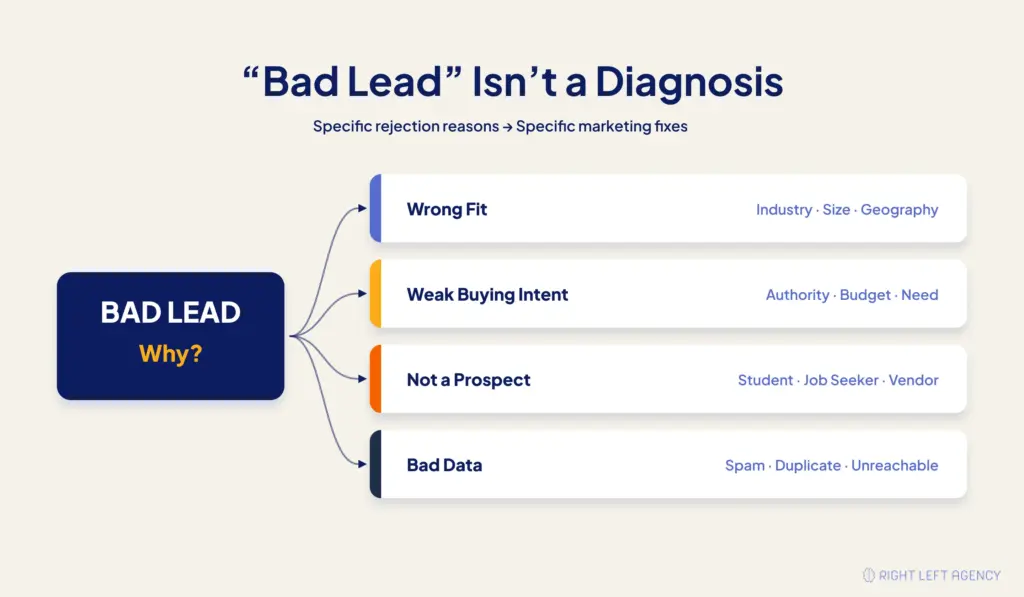
“Bad lead” does not tell Marketing what to fix. Sales needs to record why each lead was rejected so Marketing can act on the pattern.
| Rejection reason | What to check | Possible fix |
|---|---|---|
| Wrong industry, size, or geography | Fit | Targeting and exclusions |
| No authority, budget, or active need | Buying intent | Messaging, offer, qualification |
| Student, job seeker, customer, or vendor | Not a prospect | Negative keywords, exclusions, routing |
| Fake, duplicate, or unreachable | Data quality | Spam prevention, validation, deduplication |
This makes sales and marketing alignment measurable.
Build the taxonomy with Sales
Sales should record a clear rejection reason for every disqualified lead. Marketing can then use those patterns to decide what to change.
For example:
- Wrong company size → review targeting and qualification.
- Student or job seeker → review search terms and exclusions.
- No active need → review intent, messaging, and the offer.
Is it the ads or the sales process?
Not every rejected lead is an advertising problem.
Before changing campaigns, check whether the lead matched the ICP, how quickly Sales responded, whether follow-up happened, and whether Sales and Marketing use the same qualification criteria.
Poor follow-up or inconsistent definitions can make good leads look bad—and help explain why MQLs never become pipeline.
Why “just import your closed-won deals” fails for most SaaS accounts
Closed-won revenue is one of the strongest business outcomes you can send back to an ad platform.
But for many SaaS accounts, it is too infrequent and delayed to work well as the only primary bidding signal. That creates a trade-off.
Deeper funnel stages tell you more about business quality, but they usually produce fewer and later conversions.
| Platform | Documented guidance | What it means for SaaS |
|---|---|---|
| Google Ads | Google recommends choosing an optimization action with at least 15 conversions in the previous 30 days at account level and, ideally, one that occurs within seven days | A sparse opportunity or closed-won event may be too deep |
| LinkedIn recommends sending at least five qualified leads within two weeks. Qualified-lead data must be shared within 30 days. | Qualified-lead optimization needs a steady flow of downstream outcomes, not an occasional import. | |
| Meta | Conversion Leads optimization, which learns from CRM stages sent through the Conversions API, works only with Instant Forms. Meta’s fit guidelines include at least 200 leads per month, a target stage reached within 28 days, and a stage conversion rate between 1% and 40%. | Website-form campaigns can’t use Conversion Leads, and many B2B SaaS accounts won’t reach the volume. |
| Microsoft Advertising | An offline conversion must have occurred within the last 90 days when you upload it. It must also happen after the ad click and inside the conversion goal’s configured window. | Capture the Microsoft Click ID (MSCLKID) at form submission and upload outcomes before they age out. |
According to Google’s guidance for generating high-quality leads, advertisers should choose a conversion goal aligned with the business objective and avoid optimizing toward goals from multiple stages of the lead journey. Google also recommends that the selected action have at least 15 conversions in the previous 30 days at account level and, ideally, occur within seven days.
LinkedIn’s Qualified Leads Optimization guidance recommends sending five or more qualified leads within two weeks to help the system learn. Qualified-lead data must be shared within 30 days.
Now consider an illustrative example.
A SaaS company has a $30,000 ACV but creates only 12 opportunities per month. Opportunity creation is much closer to revenue than a form fill.
But if those 12 opportunities are spread across several campaigns and arrive weeks after the initial click, opportunity creation may be too sparse to serve as the primary optimization signal.
This is why some teams import SQLs or opportunities, see unstable delivery, and retreat to raw form submissions.
The answer is not always to go deeper. It is to find the deepest usable signal.
The Signal Depth Ladder: what your paid ads should optimize for
The Signal Depth Ladder is part of the RLA Paid Search Efficiency System.
It helps SaaS teams choose the deepest funnel stage that represents meaningful buyer quality while still giving the ad platform enough timely data to learn.
Rule: Optimize on the deepest stage that clears the platform’s volume and timing thresholds. Then use lead values to show the platform which of those conversions matter most.
Lead stages compared as bidding signals
| Rung | Event | Business quality | Volume | Delay | When to optimize on it |
|---|---|---|---|---|---|
| 1 | Form submit | Low | High | Immediate | Avoid as the primary goal for sales-led SaaS when a better signal exists |
| 2 | ICP-validated lead | Medium-high | Medium-high | Minutes | Often useful for mid-market SaaS |
| 3 | MQL or SAL | High | Medium | Short | When qualification is consistent, and volume clears platform needs |
| 4 | SQL, held meeting, or opportunity | Very high | Low | Longer | Higher-volume accounts with enough recurring events |
| 5 | Closed-won with value | Highest | Very low | Long | Valuable for reporting and value input; rarely ideal as the only bid target |
An ICP-validated lead is scored at or near submission using form data, firmographic information, role, or enrichment.
A sales-accepted lead (SAL) is a lead Sales agrees is worth actively working.
Both tell the platform more than a raw form submission.
How to choose your rung
Start at the deepest meaningful business event and work upward until you reach a stage with enough volume and acceptable delay.
Do not select opportunity simply because it is closest to revenue. And do not combine every funnel stage into one bidding goal.
Google’s lead-generation guidance recommends choosing a conversion goal that directly aligns with your business objective and avoiding optimization goals from multiple stages of the lead journey.
Also look at how selective your qualification event really is. If 90% of raw leads become “qualified,” qualification tells the platform very little. A useful signal separates stronger prospects from weaker ones.
Add value when the deep stage is too sparse
Value weighting gives you another option when your best downstream event doesn’t happen often enough.
Keep one stage as the bidding goal. Then, instead of telling the platform only that a conversion happened, give each conversion a value that reflects how good the lead is.
For example, if you optimize on ICP-validated leads:
- A lead from a company outside your core segment → lower value
- A lead that matches your ICP on company size and role → higher value
- A lead that matches your ICP and has an active buying timeline → highest value
Base those values on your own history: how often each type of lead has become an opportunity or a customer. In Google Ads, send the value with each conversion and bid with Maximize conversion value, with an optional target ROAS. Bidding then favors the clicks most likely to produce valuable leads, not just more leads.
Don’t recreate the multi-stage problem by making form submits, SALs, and SQLs all primary goals with different values. Google advises against optimizing toward goals from multiple stages of the lead journey. Track deeper stages as secondary conversions for reporting instead.
The rule is simple:
Go as deep as your data allows, but no deeper.
A theoretically perfect conversion event with almost no timely volume can be less useful for bidding than an earlier event that reliably separates good leads from bad ones.
Find Where Your Paid Search Budget Is Being Wasted
If your campaigns are hitting CPL targets but Sales still rejects too many leads, the problem may be hiding between the click and the CRM.
Book a Growth Fit Call to identify where paid search efficiency is breaking.
How to build the feedback loop between Sales, your CRM, and your ad platforms
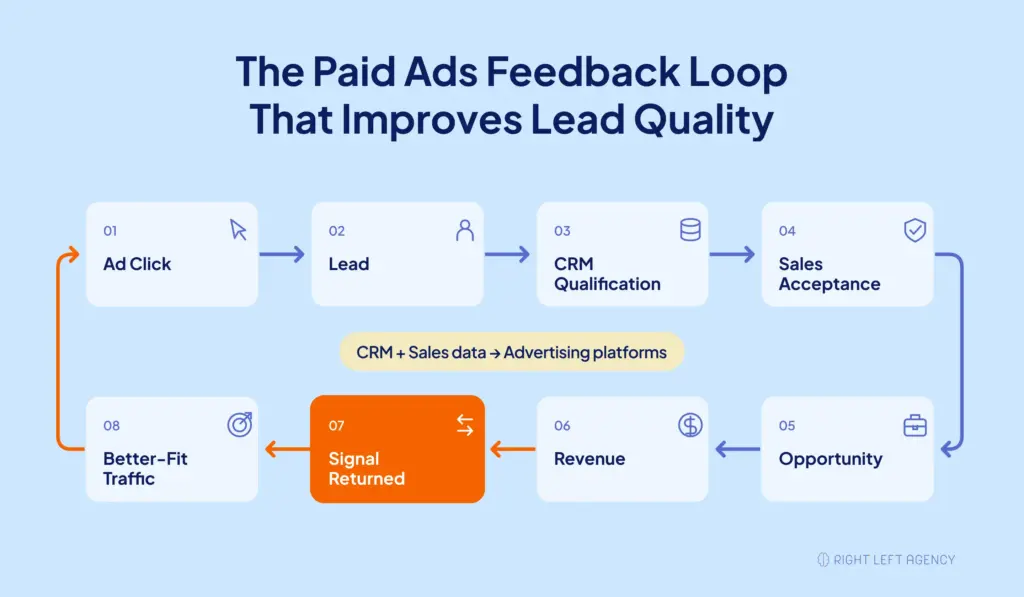
A paid-media feedback loop works when CRM outcomes return to the ad platform quickly enough to improve optimization.
The complete chain is:
Ad click → Lead → CRM qualification → Sales acceptance → Opportunity → Revenue → Signal returned → Better-fit traffic
This also strengthens SaaS marketing attribution, but the main goal is better optimization.
Define a sales-accepted lead
Sales and Marketing need one definition of a sales-accepted lead (SAL) based on factors such as company fit, role, use case, buying intent, geography, and company size.
Without a shared definition, “qualified” can mean different things to different teams.
Standardize CRM stages
Use one lifecycle across Marketing, Sales, and RevOps:
Lead → MQL → SAL → SQL → Opportunity → Closed-Won
Add a clear rejection reason whenever a lead leaves the funnel. This gives your ad platforms cleaner quality signals.
Capture identifiers at form submission
Capture the information needed to connect CRM outcomes with the original ad interaction.
For Google Ads, this can include the GCLID and first-party data used for enhanced conversions for leads.
Send outcomes back quickly
Do not let qualified-lead data sit in your CRM.
Google recommends uploading offline lead data regularly, ideally daily. LinkedIn requires qualified-lead data within 30 days and recommends sending it as soon as possible.
The sooner the platform receives meaningful outcomes, the sooner it can learn from them.
Review what actually creates pipeline
Break results down by:
- Campaign
- Keyword or search term
- Audience
- Offer
- Geography
- Landing page
Look for patterns in qualified leads, opportunities, and Sales rejections. Then fix the specific source of poor lead quality instead of changing the entire account.
How lead-quality problems differ by platform
Google Ads, LinkedIn Ads, Meta Ads, and Microsoft Advertising can all generate weak leads.
But they differ in buyer intent, targeting strength, and how downstream outcomes can be used.
| Platform | Buyer intent | Targeting strength | Main lead-quality risk | Useful downstream signal |
|---|---|---|---|---|
| Google Ads | Often strongest on Search | Search intent | Broad automation plus weak conversion signals | Qualified/converted leads and conversion value |
| LinkedIn Ads | Mixed | Professional and firmographic data | Low-friction Lead Gen Forms | Qualified leads through CRM/CAPI |
| Meta Ads | Usually lower for B2B search-like intent | Audience discovery and scale | Low-intent form volume | CRM-connected lead outcomes where supported |
| Microsoft Advertising | Search intent | Search targeting | Weak offline feedback | Offline and enhanced conversion data |
These differences should shape how you allocate budget and structure your broader paid advertising strategy across platforms.
Google Ads
Google Ads can capture strong search intent, but poor conversion signals can still teach automated bidding to find the wrong leads. Broad match, Performance Max, and AI Max make downstream lead-quality data even more important.
Use enhanced conversions for leads to return qualified offline outcomes. Where volume allows, optimize toward Qualified lead or Converted lead rather than raw form submissions.
If you upload offline conversions through a custom integration, check it now. Since June 15, 2026, offline conversion and enhanced conversions for leads uploads go through Google’s Data Manager API and are blocked in the Google Ads API. Integrations built on the old route need to be migrated.
For a deeper account review, use our B2B SaaS Google Ads audit.
LinkedIn Ads
LinkedIn offers strong professional targeting, but professional fit does not always mean buying intent.
Its Qualified Leads Optimization uses CRM or Conversions API data to help campaigns learn from actual qualified leads. LinkedIn recommends sending at least five qualified leads within two weeks and sharing qualified-lead data within 30 days.
Meta Ads
Meta can generate high lead volume, but low-friction Instant Forms attract genuine buyers and low-intent prospects alike.
Meta’s Conversion Leads optimization can learn from your CRM stages through the Conversions API, but it only works with Instant Forms. Meta’s fit guidelines also call for at least 200 leads a month and a target stage reached within 28 days. Many B2B SaaS accounts won’t meet those requirements.
If Conversion Leads isn’t an option, add qualification questions to the form and exclude audiences outside your ICP. Then judge campaigns by Sales acceptance and opportunities in your CRM, not raw lead volume.
Microsoft Advertising
Microsoft Advertising supports offline conversion imports, so CRM outcomes can be matched to the original ad click.
Two rules apply. The conversion must have happened within the last 90 days when you upload it, or the upload fails. It also has to occur after the click and inside the conversion goal’s window.
Capture the Microsoft Click ID (MSCLKID) at form submission so every outcome can be matched to its click.
What changes when you switch, and how to measure it
When you switch from raw form submissions to a stronger qualified-lead signal, CPL may rise, raw lead volume may fall, and the platform may need time to learn.
That does not automatically mean performance got worse.
The business question is:
Did cost per opportunity improve, and did paid media create more efficient pipeline?
Expect higher CPL, fewer leads, and a learning period
A stricter conversion event removes some of the easy conversions your old setup rewarded. Fewer people may qualify.
That is expected.
LinkedIn notes that Qualified Leads Optimization needs a two-week learning phase and that overall CPL may increase. The number to watch is cost per qualified lead, not CPL.
Explain that trade-off before changing the optimization event—not after leadership sees CPL rise.
This is especially important when your business is already dealing with rising SaaS CAC.
Metrics that matter more than CPL
| Metric | What it tells you |
|---|---|
| ICP-fit rate | How much paid lead volume matches your target customer |
| Sales acceptance rate | Whether Sales agrees the leads are worth working |
| MQL-to-SQL rate | How effectively qualified Marketing leads progress |
| Cost per SQL | What you pay for a sales-qualified prospect |
| Lead-to-opportunity rate | How often paid leads become real pipeline |
| Cost per opportunity | What paid media spends to create an opportunity |
| Pipeline per dollar | Pipeline generated relative to spend |
| CAC | Cost to acquire an actual customer |
| Opportunity-to-close rate | How effectively opportunities become customers |
| Disqualification-reason mix | Why paid leads fail |
Do not replace CPL with another isolated metric. Use these measures together to understand the economics from click to revenue.
The weekly Sales and Marketing lead-quality review
Review one shared scorecard every week:
- Spend
- Raw leads
- Qualified leads
- SALs
- SQLs
- Opportunities
- CPL
- Cost per SAL
- Cost per SQL
- Cost per opportunity
- ICP-fit rate
- Sales acceptance rate
- Lead-to-opportunity rate
- Pipeline generated
Then review the disqualification-reason mix. The purpose is not to argue over whether the leads are “good.”
The purpose is to identify where quality changed and what caused it.
Fixes that can make lead quality worse
Some common lead-quality fixes create new problems:
- Narrowing targeting blindly: You may eliminate legitimate buyers together with irrelevant traffic.
- Adding form fields that change nothing: Extra friction does not create qualification unless the answers affect scoring or routing.
- Pausing higher-CPL campaigns too early: Expensive leads may still create cheaper opportunities.
- Optimizing on an event that is too deep: Sparse data can leave automated bidding without enough signal.
- Mixing several funnel stages: Multiple definitions of success make optimization less clear.
- Marking almost every lead “qualified”: A qualification event that filters almost nothing carries little useful information.
- Scaling before downstream economics are validated: More budget amplifies whatever signal—good or bad—the platform is already learning.
Fix the quality signal before you scale the spend.
Stop teaching your paid campaigns to find the wrong leads
The core problem is simple:
Your ad platform and your Sales team may be using different definitions of success.
A form fill tells the platform that someone converted. Your CRM tells you whether that person was actually worth acquiring. Connect those two systems.
Record why Sales rejects leads. Return qualified outcomes to the ad platforms. Then optimize toward the deepest reliable signal your conversion volume can support.
That is how paid media moves from generating leads to generating pipeline.
Want to find where your paid search budget is being wasted?
Book a Growth Fit Call.
FAQs about low-quality leads from paid ads
Why am I getting low-quality leads from Google Ads?
Google Ads may be optimizing toward a conversion action that does not distinguish strong prospects from weak ones. Check search intent, automated expansion, spam, qualification, and whether CRM outcomes such as qualified or converted leads are being returned to Google Ads.
Should SaaS campaigns optimize for MQLs or SQLs?
Optimize toward the deepest reliable stage that produces enough timely conversion volume. If SQLs are too sparse or delayed, an MQL, SAL, or ICP-validated lead may give the platform a stronger usable signal.
Will cost per lead go up when I optimize for qualified leads?
It can. Removing easy, low-quality conversions may raise CPL while improving Sales acceptance, cost per SQL, or cost per opportunity. LinkedIn specifically notes that overall CPL can increase when campaigns optimize toward qualified leads.
Should I add more fields to my demo form?
Only add fields when the answers change qualification, scoring, routing, or Sales follow-up. More fields create friction; they do not automatically create better leads.
Should opportunity creation be the primary conversion?
Only when opportunity creation happens often and quickly enough to give the platform a usable signal. Lower-volume SaaS accounts usually do better optimizing on an earlier stage. They can then use opportunity and revenue data to measure results and to set the values assigned to earlier-stage leads.
How often should Marketing review rejected leads with Sales?
For active paid programs, review lead quality weekly. Look at rejection reasons, Sales acceptance, SQLs, opportunities, campaign sources, and pipeline together so the discussion results in specific campaign or process changes.