


Key Takeaways
- A longer SaaS sales cycle is not always a performance problem.
- Find the exact stage where buyers are getting stuck.
- Fix targeting, messaging, proof, and buyer education based on evidence.
- Marketing can clarify buyer information, but the responsible teams must resolve budget, product, legal, or security barriers.
- Measure stage progression without sacrificing win rate, deal quality, or retention.
Your team is hitting demo targets and opportunities are entering the pipeline. But close dates keep slipping, deals stay open longer, and expected revenue moves into the next quarter.
A longer SaaS sales cycle can result from larger deals, new customer segments, procurement requirements, or CRM changes. Marketing can also create delays when buyers have poor fit, unclear expectations, weak differentiation, or unanswered implementation and proof questions.
Start by confirming whether the sales cycle has actually changed. Then identify where deals are slowing down, find the buyer question blocking progress, and fix that priority issue before creating more campaigns or content.
Is Your SaaS Sales Cycle Actually Getting Longer?
To understand why your SaaS sales cycle is getting longer, compare consistent start and end points across similar opportunities.
Changes in annual contract value (ACV), customer segment, sales motion, acquisition source, or CRM definitions can make average cycle length move even when sales performance has not deteriorated.
Before trying to shorten the cycle, establish exactly what changed.
Define the Start and End of Your Sales Cycle
For this article, the SaaS sales cycle means the period from qualified opportunity creation to closed-won.
That definition matters because lead-to-opportunity time is a separate period. If marketing generates a lead in January but sales does not create a qualified opportunity until February, that pre-opportunity period should not quietly become part of an opportunity-to-close comparison.
Your organization may use a different convention. What matters is consistency.
Check whether your team recently changed:
- When an opportunity is created
- What qualifies as an opportunity
- CRM stage definitions
- Requirements for moving between stages
- When an opportunity is marked closed-won
A change in CRM practice can create an apparent improvement or decline without buyers behaving differently.
Compare Similar Deals and Check Open Opportunities
Do not compare every opportunity as if it belongs to the same buying process.
Segment deals by relevant characteristics such as:
- Customer segment
- ACV
- Product
- Market
- Acquisition source
- Sales motion
A company moving toward larger enterprise contracts may naturally see longer evaluations because more stakeholders, implementation questions, and approval requirements are involved.
That is different from a pipeline where comparable opportunities suddenly spend weeks waiting in the same stage.
You should also inspect open-opportunity aging, not only closed-won sales cycle length.
Closed-won averages exclude deals that remain unresolved. If slow opportunities are accumulating in the pipeline, looking only at completed deals can hide the problem you are trying to diagnose.
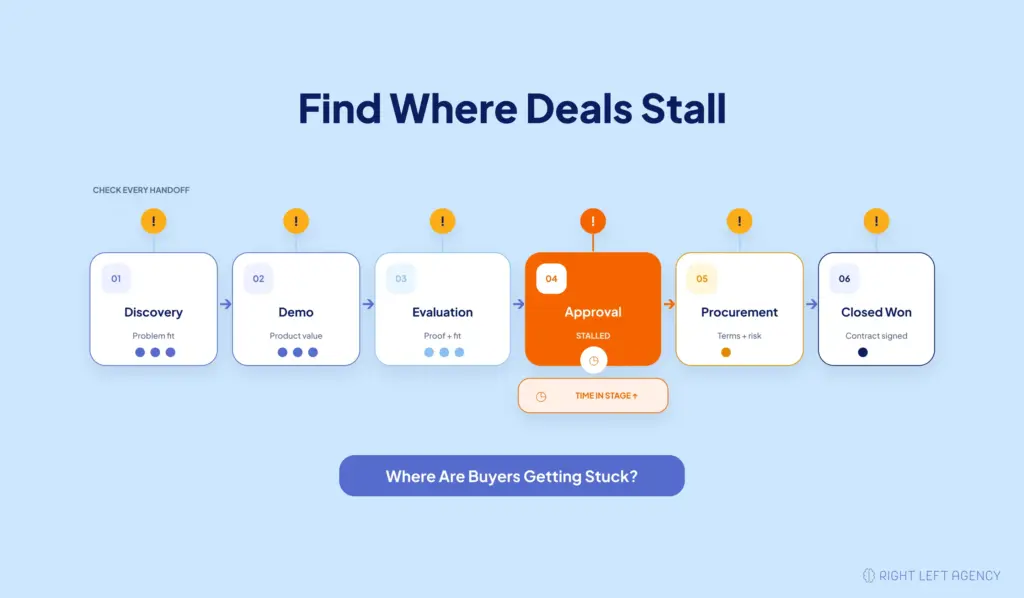
Find Where Buyers Are Getting Stuck
Stage-level evidence tells you where to investigate. It does not automatically tell you why a deal stalled.
Instead of saying, “Our sales cycle is too long,” ask:
Where is the extra time accumulating, and what does the buyer still need to understand, verify, or agree on before moving forward?
Use a diagnostic matrix like this:
| Symptom | Evidence and Possible Cause | Marketing Response and Owner | Metric to Inspect |
|---|---|---|---|
| Poor-fit discovery | Source or segment disqualifications suggest targeting mismatch | Improve qualifying copy; marketing works with sales | Qualification and subsequent progression |
| Basic demo questions | Repeated introductory questions suggest an unclear use case | Create a pre-demo explainer; marketing leads | Question recurrence and stage progression |
| Repeated comparisons | Objections or loss notes suggest weak differentiation | Build evidence-backed comparison content; product marketing works with sales | Evaluation progress and unresolved objections |
| Champion cannot get approval | Missing stakeholders or incomplete justification | Create a shareable business case; sales coordinates | Outstanding approval questions and progression |
| Implementation concern | Technical questions or missing rollout clarity | Provide verified guidance; product or customer success validates | Evaluation aging and unresolved requirements |
| Quiet after demo | Notes reveal an unanswered objection or unclear next step | Send targeted follow-up; sales works with marketing | Next-step completion and stage movement |
| Procurement or security stall | Review status shows missing evidence or an actual requirement | Provide approved documentation; relevant function leads | Review status and unresolved requirements |
This turns a broad pipeline problem into a set of hypotheses you can investigate.
Discovery and Qualification Delays
If opportunities slow down immediately, first determine whether the buyer fits your ideal customer profile (ICP) and arrives with enough context to evaluate the product.
Look for patterns in:
- Disqualification reasons
- Campaign sources
- Customer segments
- Repeated basic discovery questions
- Information transferred from marketing to sales
If certain sources repeatedly create poor-fit demos, investigate targeting and qualification.
If good-fit buyers repeatedly need sales to explain information that could have been clear earlier, investigate messaging instead.
Evaluation and Business Case Delays
When opportunities stall after discovery or demo, the unresolved issue may involve value, differentiation, stakeholder agreement, or adoption. Look at call notes and buyer questions.
- Are buyers repeatedly asking how the product differs from alternatives?
- Does the internal champion like the product but struggle to explain the investment to other stakeholders?
- Are operations or technical evaluators concerned about implementation?
The stage tells you where to investigate. The documented question tells you what marketing may need to address.
Approval and Procurement Delays
Approval-stage delays require a different diagnosis. A buyer may simply need clearer access to existing documentation. Alternatively, a genuine budget, contractual, security, legal, or procurement requirement may remain unresolved.
Marketing can make approved evidence easier to understand and share. Marketing cannot make an unavailable capability appear, approve a contract term, authorize a budget, or resolve a substantive security requirement.
That distinction prevents teams from treating every stalled opportunity as a content problem.
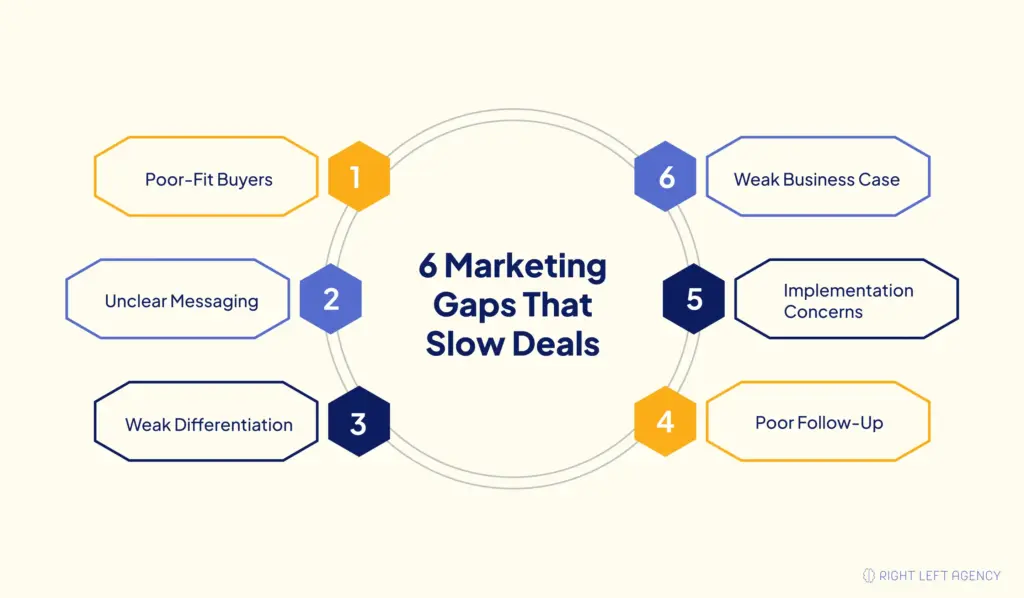
Six Marketing Gaps That Can Extend a SaaS Sales Cycle
Marketing should respond to documented buyer uncertainty rather than create content based on assumptions.
The following six gaps are worth investigating when corresponding evidence appears in your pipeline.
Your Campaigns Attract Buyers Who Do Not Fit
Poor targeting can push an unresolved fit problem deeper into the sales process.
If certain campaigns or sources repeatedly produce opportunities that sales later disqualifies, inspect the expectation being created before the buyer requests a demo.
You may need to clarify:
- Who the product is designed for
- Which use cases it supports
- Which types of teams receive the most relevant value
- What problem the product is intended to solve
- What buyers should expect from the evaluation
Landing-page copy can qualify demand before sales spends time resolving basic fit questions.
This does not mean excluding slow-moving opportunities and declaring the sales cycle fixed. Measure qualification outcomes and subsequent stage progression among comparable sources.
For a broader approach to attracting the right SaaS buyers, see Right Left Agency’s guide to SaaS demand generation.
Your Messaging Leaves Sales Explaining the Basics
If sales repeatedly spends the first part of every demo explaining what the product does, who it is for, or how the workflow works, marketing may not be preparing buyers sufficiently.
Review recurring questions from discovery calls and demos.
Then decide what explanation belongs before the meeting.
Useful assets may include:
- A focused use-case page
- A short product explainer
- A pre-demo guide
- Clear workflow content
The goal is not to replace sales conversations. It is to help suitable buyers arrive with enough context to use the conversation for meaningful evaluation rather than introductory education.
Track whether the same basic questions continue appearing and whether buyers progress through the relevant stage.
Your Differentiation Is Difficult to Defend
Buyers may understand your product and still struggle to identify a defensible reason to choose it.
Look for repeated comparison questions, objections, and competitive loss notes.
Instead of producing generic “we are better” messaging, identify the criteria that matter to the buyer’s actual use case.
Then support your positioning with relevant evidence.
A comparison page might explain differences in:
- Suitable use cases
- Workflow approach
- Implementation expectations
- Relevant capabilities
- Customer evidence
Avoid unsupported superiority claims.
Your differentiation becomes useful when buyers can understand why a specific difference matters to their situation and what evidence supports it.
If unclear differentiation appears repeatedly across opportunities, stronger SaaS product marketing may be needed before adding more acquisition activity.
Your Champion Lacks a Defensible Business Case
An enthusiastic internal champion is not necessarily the person who controls the budget or final approval.
Your champion may understand the product but still need evidence to convince the budget decision-maker, technical evaluator, operations leader, finance stakeholder, or another member of the buying committee.
Marketing can help by giving the champion evidence that can travel through the organization without requiring your salesperson to explain every point again.
What the Business Case Should Contain
A useful business case should help stakeholders understand:
- The operational problem — What problem is the organization trying to address?
- Affected roles — Who experiences the problem or will be affected by the change?
- The baseline — What is happening today?
- Expected benefit and assumptions — What may improve, and what assumptions support that expectation?
- Implementation and adoption requirements — What effort or organizational change may be required?
- Evidence — What credible information supports the proposed decision?
- The next decision — What should stakeholders evaluate or approve next?
If verified financial figures are unavailable, do not invent them. Qualitative assumptions are better than unsupported ROI claims.
What Each Stakeholder Needs to Evaluate
Different stakeholders can examine the same purchase from different angles.
| Stakeholder | Primary Evaluation Need |
|---|---|
| Internal champion | Can I explain why this product addresses our problem? |
| Economic buyer | Is the investment justified for the organization? |
| Technical evaluator | Will the product fit our technical and operational environment? |
| End user | Will this work in the workflow I actually use? |
A content view or email click does not prove that these concerns have been resolved.
Record the outstanding approval questions and watch whether the opportunity progresses after the relevant evidence is provided.
Your Content Leaves Implementation Questions Unanswered
A buyer can believe in the product’s value and still hesitate because implementation feels unclear.
Common evaluation concerns may involve:
- Migration
- Integrations
- Rollout
- Internal responsibilities
- Workflow changes
- User adoption
Marketing should not invent answers to these questions.
Work with product and customer success teams to create verified guidance that accurately explains how implementation works and who is responsible for what.
Depending on the product, that might include:
- A rollout guide
- An implementation-responsibility overview
- A workflow demonstration
- Relevant customer proof
Measure unresolved implementation questions and subsequent stage progression rather than promising that a particular asset will remove a specific number of days from the cycle.
Your Follow-Up Misses the Actual Objection
A quiet buyer does not automatically need another “just checking in” email. Start with what happened in the previous conversation.
Review:
- Call notes
- Questions
- Objections
- Promised materials
- Stakeholders still involved
- Agreed next steps
Then match the next communication or asset to the unresolved question.
- If the operations team needs rollout information, send rollout information.
- If the economic buyer needs justification, support the business case.
- If the technical evaluator needs existing security documentation, route that requirement appropriately.
The objective is to help the buyer make the next decision, not simply increase contact frequency.
Active-opportunity follow-up is also different from broader pre-opportunity nurturing. For that wider topic, see these SaaS lead nurturing strategies.
What Marketing Can Fix and Where Other Teams Must Lead
Marketing can lead communication and evidence improvements, but budget, product, legal, or security barriers must remain with the function that owns them.
| Ownership Type | Examples | Marketing’s Role |
|---|---|---|
| Marketing-led | Positioning, use-case clarity, qualification copy, comparison content, buyer education | Create and improve the communication |
| Marketing-supported | Business cases, implementation information, approved security or procurement documentation | Make verified information clear and usable |
| Other-function led | Missing product capabilities, budget, payment terms, contractual decisions, security requirements, implementation capacity | Support communication while the responsible team resolves the issue |
For example, marketing can package an approved security document clearly. It cannot determine whether a security requirement is acceptable.
Sales, marketing, product, RevOps, customer success, finance, legal, security, and procurement may all own different parts of the buying process.
Clear sales and marketing alignment helps ensure a documented buyer problem reaches the team capable of resolving it.
How to Choose Your First Marketing Fix
Do not respond to a longer sales cycle by creating every possible sales-enablement asset.
Choose the first fix using four criteria:
- Repeated evidence: Does the same issue appear across comparable opportunities?
- Progression impact: Is the issue associated with the stage where deals are accumulating?
- Feasibility: Can the team create a truthful, testable response using verified information?
- Ownership: Is someone clearly responsible for producing, validating, delivering, and reviewing the response?
A frequently repeated buyer question with clear ownership is usually a better starting point than an asset idea with no supporting evidence.
Example of a Construction SaaS Adoption Concern
Consider this hypothetical construction SaaS situation.
An office buyer sees value in stronger reporting and visibility. The initial conversation goes well.
But operations leaders hesitate because they are unsure whether field teams will actually adopt the software.
A generic product brochure may repeat features and benefits without addressing the real concern.
A better response would focus specifically on adoption evidence. It might include:
- A clear rollout guide
- A field-workflow demonstration
- Named implementation responsibilities
- Relevant customer proof, when verified evidence is available
The question is no longer simply, “Does the product look valuable?”
It becomes, “Can our organization introduce this product into the field workflow successfully?”
Marketing can help the buying group evaluate that question by presenting accurate implementation and adoption information. Product and customer success should validate what the content says.
The team can then observe whether adoption questions are resolved and whether opportunities begin moving forward. It should not claim a cycle reduction before comparable results exist.
A 30-Day Plan to Address the Biggest Delay
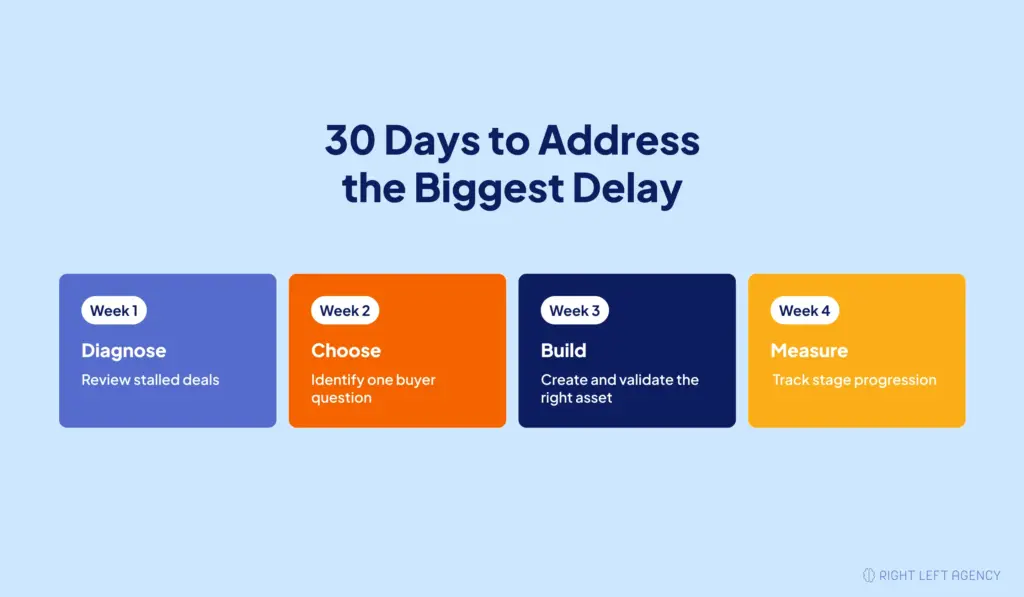
Use this 30-day plan to investigate one recurring delay, develop a focused response, and begin collecting early feedback.
| Week | Action | Owner | Output |
|---|---|---|---|
| Week 1 | Review stage aging, call notes, objections, losses, no-decisions, and open opportunities | Marketing + sales | Evidence summary, baseline stage metrics, and priority buyer question. |
| Week 2 | Choose and specify one response to the recurring issue | Marketing owner + relevant contributor | Asset brief and success criteria |
| Week 3 | Create, validate, and deploy the asset | Marketing + product/CS/sales reviewer | Approved live asset and delivery process |
| Week 4 | Collect sales feedback and inspect early progression signals | Marketing + sales/RevOps | Initial observations and next iteration |
Keep the work narrow.
The purpose of the 30-day window is to build a better response to one demonstrated source of uncertainty and establish a baseline for evaluating it.
How to Measure Progress Without Sacrificing Deal Quality
Measure the stage your intervention is intended to improve, then assess downstream commercial quality when comparable opportunities have had enough time to mature.
Do not treat content engagement as proof of causation.
A business case view shows that someone involved in the deal viewed the content, but it does not prove the content caused the purchase
Your measurement framework should include three layers:
Outcome metrics
- Closed-won sales cycle length
- Win rate
- Deal value
- No-decision outcomes
Leading indicators
- Time in the affected stage
- Stage progression
- Open-opportunity aging
- Outstanding buyer questions
Commercial guardrails
- Discounting
- Customer fit
- Deal quality
- Downstream retention
For a broader framework, see how to measure marketing’s revenue impact.
Track the Stage the Change Is Intended to Improve
Match the metric to the problem you attempted to address.
If you created pre-demo education, look at recurring basic questions and progression through discovery.
If you improved a business case, inspect outstanding approval questions and movement through the relevant approval stage.
If you clarified implementation, watch evaluation aging and unresolved implementation requirements.
Include:
- Open opportunities
- Closed-won opportunities
- Lost opportunities
- No-decision outcomes
A no-decision outcome is different from losing to a competitor. The buyer may defer or abandon the purchase without selecting an alternative.
That distinction can reveal whether opportunities are failing because another vendor wins or because the organization never becomes confident enough to act.
Compare Fairly and Keep Commercial Guardrails
Use a comparable cohort: a defined group of opportunities from a similar segment and period with relevant characteristics in common.
Record:
- Sample size
- Customer segment
- ACV
- Sales motion
- Observation period
- CRM definition changes
- Concurrent marketing or sales changes
Make sure enough time has passed for the opportunities being studied to mature.
Also investigate apparent improvements carefully.
- Did the team disqualify more slow opportunities?
- Did opportunity creation move later?
- Did heavier discounting accelerate approvals?
- Did the mix of contract values change?
If several things changed at once, describe the result as observational rather than claiming the marketing asset caused it.
Where feasible, a controlled rollout can improve confidence. But even without one, disciplined cohort comparisons are more useful than an unsupported before-and-after claim.
Final Thoughts
A longer SaaS sales cycle becomes easier to address when you stop treating it as one problem. Inspect the stage where time is accumulating, identify the buyer question that remains unanswered, choose the most appropriate response, assign the right owner, and evaluate progression alongside commercial quality.
If recurring positioning, differentiation, buyer-evidence, or product-marketing gaps are making that diagnosis difficult, Right Left Agency’s Product Marketing Growth Audit can help you identify where your product story and decision-support content need stronger alignment with the buying process.
Frequently Asked Questions
What Is a Good SaaS Sales Cycle Length?
There is no single SaaS sales cycle length that is appropriate for every company.
Evaluate your performance against comparable internal cohorts while considering annual contract value, sales motion, customer segment, and evaluation complexity.
A larger enterprise contract can reasonably take longer than a simpler deal. The important question is whether similar opportunities are taking longer without a clear explanation.
Should Evaluation Content Be Ungated?
Evaluation content should be easy for the buying group to access when unnecessary access friction makes the next decision harder. That does not mean every asset must always be ungated or that sensitive information should be publicly available.
Start with the buyer’s missing evidence. If stakeholders need approved, shareable information to evaluate the purchase, make sure they can access it through an appropriate process without unnecessary barriers.
Does Trial Activity Prove a Buyer Is Ready to Purchase?
No. Trial activity can provide useful context, but product usage alone does not prove purchase readiness.
An active user may still lack budget authority. An internal champion may still need economic-buyer approval. Security, technical, legal, or procurement requirements may still be unresolved.
Treat trial activity as one evaluation signal rather than a substitute for understanding the buying committee and remaining purchase requirements.