


Key Takeaways
- Positioning defines how a SaaS product competes, while messaging communicates that position to buyers.
- Strong positioning starts with customer research, buying context, and real competitive alternatives.
- Clear differentiation connects specific product capabilities to meaningful customer priorities.
- A practical messaging hierarchy keeps Marketing, Sales, Product, and Customer Success aligned.
- Positioning should be tested with customer feedback, commercial data, and lifecycle signals before major changes.
What Are SaaS Positioning and Messaging?
SaaS positioning defines how a product competes. SaaS messaging turns that strategy into language buyers can quickly understand and trust.
Positioning should come first. Strong copy cannot fix an unclear audience, weak differentiation, or a confusing market position.
SaaS Positioning Defines How the Product Competes
SaaS positioning answers five core questions:
- What is the product?
- Who is it for?
- Which category or use case gives it context?
- What alternatives do customers use?
- Why should they choose this product?
Strong positioning requires focus. Trying to appeal to everyone usually makes the product sound generic.
Product positioning explains how the product competes. Brand positioning shapes how the wider company is perceived. They should support each other, but they are not the same.
SaaS Messaging Communicates the Positioning
SaaS messaging is how you communicate your positioning through website copy, campaigns, sales materials, product updates, onboarding, and Customer Success. The core message should stay consistent, but the wording can change by audience, channel, and buying stage. Strong positioning can still fail if the message is unclear, while polished copy cannot fix a weak strategy.
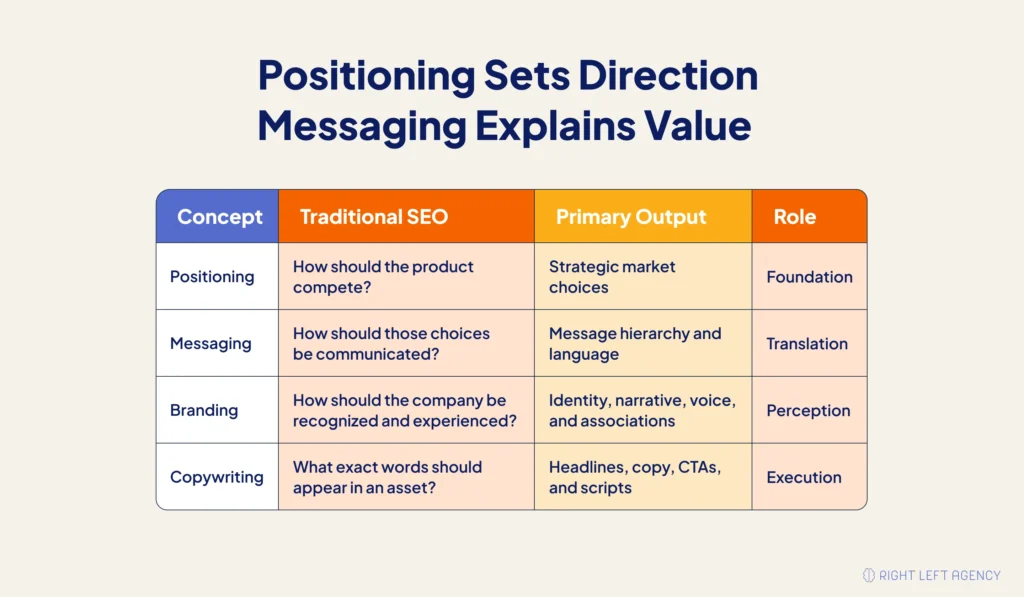
Positioning vs. Messaging vs. Branding and Copywriting
| Concept | Main Question | Primary Output | Role |
|---|---|---|---|
| Positioning | How should the product compete? | Strategic market choices | Foundation |
| Messaging | How should those choices be communicated? | Message hierarchy and language | Translation |
| Branding | How should the company be recognized and experienced? | Identity, narrative, voice, and associations | Perception |
| Copywriting | What exact words should appear in an asset? | Headlines, copy, CTAs, and scripts | Execution |
A value proposition sits between positioning and messaging. It explains the result a specific audience can expect and why the product is a credible way to achieve it.
Why Positioning and Messaging Matter for SaaS Growth
Clear positioning helps the right buyers quickly see why a product matters to them. Strong messaging then makes the value easier to understand, compare, and trust.
Positioning Improves Relevance and Acquisition Efficiency
Focused B2B SaaS positioning improves targeting across content, paid media, demand generation, and sales outreach. It attracts better-fit prospects, helps poor-fit leads self-qualify, and supports stronger conversion and lead quality.
Messaging Aligns Revenue Teams
Marketing, Sales, Product, Customer Success, and leadership should communicate the same core message: who the product serves, what problem it solves, what value it creates, and why it is different.
The wording may change by channel, but the promise should remain consistent.
Do You Have a Positioning Problem or a Messaging Problem?
A positioning problem means the audience, category, value, competitive frame, or differentiation is unclear. A messaging problem means the strategic choices are sound, but the company is not communicating them well.
| Positioning Problem | Messaging Problem |
|---|---|
| The priority audience is unclear. | The right audience is not clearly addressed. |
| The category or use case is confusing. | The category is buried under vague wording. |
| The differentiation is generic. | The differentiation exists but is poorly explained. |
| Teams disagree about how the product competes. | Teams agree on the strategy but use inconsistent language. |
Signs of Weak SaaS Positioning
You may have a positioning problem when:
- The company targets several unrelated audiences.
- Buyers do not see the problem as urgent.
- Sales repeatedly has to explain what the product is.
- Competitors can make the same claims.
- Traffic is growing, but lead quality remains weak.
- Different teams describe the product differently.
Signs of Weak SaaS Messaging
You may have a messaging problem when:
- The copy focuses on features without explaining their relevance.
- Headlines rely on vague promises such as “drive growth.”
- Internal terminology replaces customer language.
- The value proposition changes from one channel to another.
- Important claims lack proof.
- The message sounds clever but is difficult to understand.
Use the Messaging Strategy Matrix
The Messaging Strategy Matrix looks at two factors: market alignment and a distinctive point of view.
| Quadrant | Market Alignment | Point of View | Result |
|---|---|---|---|
| Wandering in the desert | Low | Weak | The message lacks relevance and distinction. |
| Vision without an audience | Low | Strong | The idea is original but disconnected from customer priorities. |
| The commodity trap | Strong | Weak | The message is relevant but sounds interchangeable. |
| The sweet spot | Strong | Strong | The message is relevant, differentiated, and credible. |
How to Build a SaaS Positioning Strategy
A strong SaaS positioning strategy starts with customer evidence. From there, the company can define the best-fit segment, choose a clear market context, understand alternatives, establish differentiated value, and document the strategy.
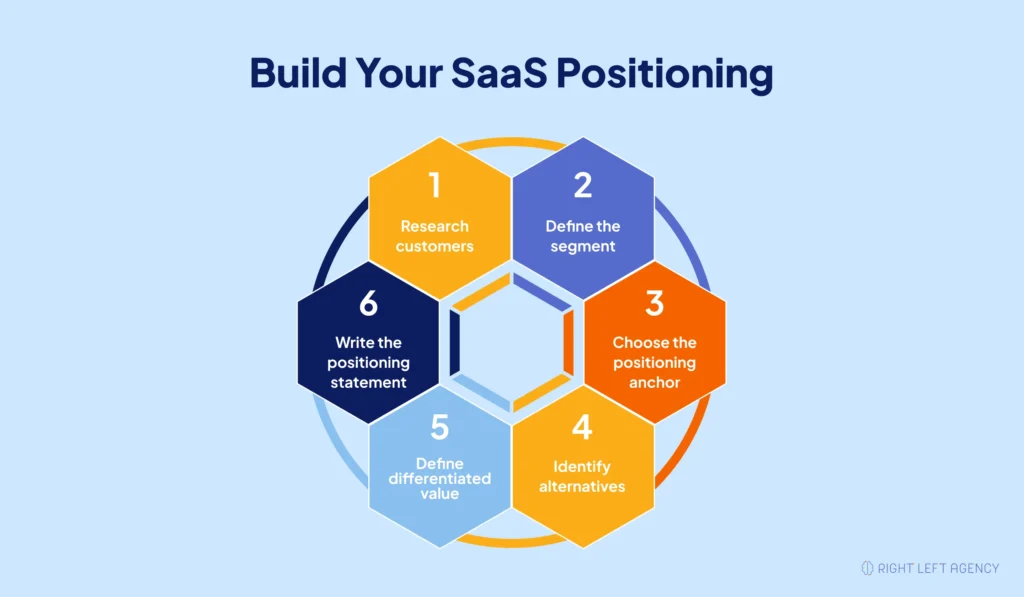
Step 1: Research the Customer’s Buying Context
Start with the customer’s real situation, not your product features.
Use customer interviews, sales calls, win/loss reviews, Customer Success feedback, support tickets, product reviews, and usage data to understand:
- What the customer is trying to do.
- What is getting in the way.
- What creates urgency.
- What they use today.
- What result they want.
- What concerns affect the decision.
- How they describe the problem in their own words.
Voice of Customer research reveals the language buyers use. Jobs to Be Done helps explain the progress they are trying to make.
Focus on repeated patterns, not isolated comments.
Step 2: Define the Best-Fit Customer Segment
Industry, company size, and revenue can help identify prospects, but they do not always explain why someone buys.
A stronger segment shares a similar:
- Workflow.
- Problem.
- Buying trigger.
- Current alternative.
- Desired outcome.
- Evaluation process.
The segment should also be large enough to support growth and reachable through practical marketing and sales channels.
Finally, identify the end user, internal champion, and economic buyer, as each may care about different parts of the value proposition.
| Role | Main Priority |
|---|---|
| End user | Workflow, usability, and daily experience |
| Internal champion | Problem resolution, adoption, and internal support |
| Economic buyer | Cost, risk, efficiency, and strategic value |
The homepage should usually speak to the internal champion first because that person often recognizes the problem and builds the business case.
Step 3: Choose a Category or Use-Case Positioning Anchor
A positioning anchor gives the buyer a familiar way to understand the product.
| Approach | Main Question | Best Used When |
|---|---|---|
| Use-case positioning | What can the customer accomplish? | The activity is clearer than the product category. |
| Category positioning | What type of product is this? | Buyers already understand the category. |
Use-Case or Jobs-to-be-Done Positioning
Use-case positioning connects the product to a recognizable customer activity. Calendly, for example, is easy to use for scheduling meetings without repeated email exchanges.
When a product supports multiple use cases, prioritize the one connected to the strongest buying trigger, clearest value, and most commercially important segment.
Market-Category Positioning
Category positioning places the product within a market buyers already understand. CRM for logistics companies” gives buyers more context than “an all-in-one growth platform.
The category explains what the product is. The differentiation explains why the buyer should choose it. Creating a completely new category can require significant education. Companies should not invent one when an existing category or clear use case already works.
Step 4: Identify the Real Competitive Alternatives
Your competitors are not limited to similar SaaS products. Customers may also rely on spreadsheets, manual processes, internal tools, consultants, legacy systems, disconnected software, or simply do nothing.
Ask what customers used before your product and what they would use without it. Their answers reveal the alternatives, trade-offs, and capabilities that matter most.
Step 5: Define Differentiated Value and a Market Point of View
Strong differentiation connects a specific capability to something customers genuinely value. Generic claims such as “innovative,” “all-in-one,” and “customer-focused” are easy to copy.
Differentiation may come from industry expertise, workflow fit, integrations, implementation, pricing, compatibility, or faster time to value.
The Black Tiger example shows that a narrower solution can stand out through simplicity, predictable licensing, and compatibility with existing systems. A product does not need more features than every competitor. It needs to fit the right customer better.
A clear market point of view also explains what current approaches get wrong and why a different approach works better.
Step 6: Write the SaaS Positioning Statement
A SaaS positioning statement brings the main strategic choices together. It is an internal reference, not finished homepage copy.
For [best-fit customer] experiencing [problem or trigger], [product] is a [category or use-case solution] that provides [unique value]. Unlike [alternative], it uses [differentiated approach], supported by [proof].
Review each part of the statement.
Is the audience specific? Is the problem important? Is the category clear? Is the value relevant? Can competitors make the same claim? Is there credible proof?
How to Turn Positioning into a SaaS Messaging Framework
A SaaS messaging framework translates the strategy into a clear system that teams can use across channels.
The framework should help buyers recognize their situation, understand the product, see why it differs, and trust its claims.
Define the Customer Problem Before the Solution
Start with the customer’s workflow, friction, consequence, or risk.
Weak:
Customers need automated workflow orchestration.
Stronger:
Operations teams lose hours moving information between disconnected systems.
The second version describes a recognizable situation. It also keeps the customer at the center of the story.
Build the Messaging Hierarchy
A practical messaging hierarchy should include:
- Target audience.
- Core customer problem.
- Core value proposition.
- Market category or recognizable use case.
- Primary differentiator.
- Messaging pillars.
- Supporting benefits.
- Feature-to-value connections.
- Proof points.
- Objection responses.
- Approved customer language.
- Claims to avoid.
A messaging pillar supports one important part of the value proposition. Each pillar should connect to relevant capabilities, benefits, and proof.
Keep the document short enough for teams to use in everyday work.
Connect Features, Activities, Benefits, and Outcomes
SaaS buyers care about both product capabilities and business outcomes.
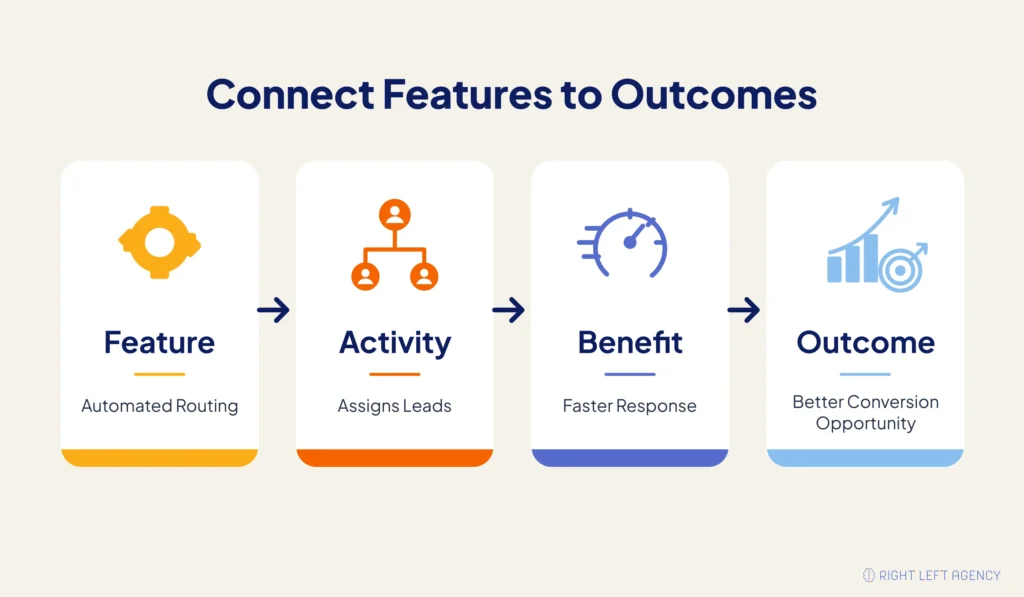
This approach explains the connection without making unsupported performance claims.
Use Customer Language and Prioritize Clarity
Use language from interviews, sales calls, reviews, support conversations, and search behavior.
Avoid buzzwords, vague abstractions, internal terminology, and exaggerated claims.
Use the networking-event test. Could a relevant buyer explain what the product does, who it helps, and why it matters after hearing the message once?
Support Major Claims with Proof
Proof reduces perceived risk and makes the value proposition more credible.
Useful proof may include:
- Case studies.
- Specific testimonials.
- Product screenshots.
- Integrations.
- Implementation details.
- Security and compliance information.
- Comparison pages.
- Workflow demonstrations.
- Verified customer outcomes.
- Clear pricing or licensing information.
Place the proof close to the claim it supports.
How to Apply SaaS Messaging Across the Customer Journey
The messaging framework should guide the website, campaigns, sales process, product experience, onboarding, and Customer Success communication.
The core position should stay consistent even when the emphasis changes.
Make the Homepage the Public Source of Positioning Truth
Above the fold, the homepage should explain:
- What the product is or what activity it supports.
- Who the product serves.
- What problem it solves.
- Why its approach is different.
- What valuable outcome it enables.
- What action the visitor should take.
- Why the visitor should trust the claim.
Explain the product before leading with a broad outcome.
Address the internal champion first. Then provide enough information about ROI, implementation, integrations, risk, and proof to help that person build an internal case.
Adapt the Core Message by Audience and Buying Stage
Different buyers care about different parts of the value.
End users care about workflow and usability. Internal champions care about adoption and problem resolution. Economic buyers care about cost, risk, efficiency, and strategic value.
The core audience, problem, value, and differentiation should stay consistent. Supporting messages can change by persona, industry, use case, and funnel stage.
Adapt Messaging Across Marketing, Sales, Product, and Customer Success
Use the same core message across SEO, paid campaigns, landing pages, emails, sales materials, demos, onboarding, product updates, Customer Success, and partner content.
Product-led messaging should focus on quick value and ease of use. Sales-led messaging should address implementation, ROI, risk, and buyer concerns.
The details may change by channel, but the core promise should stay consistent.
How to Test, Measure, and Maintain SaaS Positioning and Messaging
SaaS positioning and messaging should be tested with customer feedback, performance data, and input from Sales and Customer Success. Internal agreement is not enough. Buyers must understand the message, see its relevance, and believe the claims.
Test Clarity, Relevance, Differentiation, and Credibility
Start with simple qualitative tests before relying on conversion data.
- Run a five-second test.
- Check whether buyers understand the product.
- Ask whether the problem feels relevant.
- Compare the message with realistic alternatives.
- Test whether the claims feel credible.
- Validate recurring themes through interviews.
- Use controlled A/B tests to compare different executions.
Qualitative feedback helps explain why a message works or fails. Conversion data then shows how different versions perform.
Measure Commercial and Customer Signals
Track patterns across the customer journey, including:
- Homepage, demo, and trial conversion.
- Lead quality and qualified pipeline.
- Win rate and sales-cycle length.
- Customer acquisition cost.
- Activation and product adoption.
- Retention, churn, and expansion.
- Customer lifetime value.
- Message recall and branded search.
Do not assume positioning alone caused a metric change. Use the data to identify patterns.
For example, poor lead quality may point to an audience mismatch. High churn may show that the value promised before the sale does not match the value customers experience.
Create a Sales and Customer Success Feedback Loop
Review Sales and Customer Success feedback every month.
- Collect buying triggers, objections, outcomes, and churn reasons.
- Group repeated themes.
- Compare pre-sale expectations with post-sale results.
- Identify gaps between the promise and the customer experience.
- Update supporting messages, proof, targeting, or sales enablement.
Sales explains why customers start looking and why they buy. Customer Success explains why they adopt, renew, expand, or leave.
Establish Clear Ownership
Assign one person to manage the positioning and messaging system. Other teams should contribute evidence and apply the framework consistently.
Maintain a concise messaging playbook containing:
- Target audience and core problem.
- Positioning statement and value proposition.
- Differentiators and messaging pillars.
- Supporting proof.
- Approved customer language.
- Objection responses.
- Channel examples.
- Messages to avoid.
- Owner and review date.
Use version control, approvals, training, and periodic reviews to prevent message drift.
Know When to Refresh or Reposition
Refresh the messaging when the strategy is still valid, but the wording, emphasis, proof, or channel execution needs improvement.
Reposition when the market strategy has materially changed, such as:
- Entering a new market or vertical.
- Moving upmarket.
- Launching a product suite.
- Changing the go-to-market motion.
- Expanding into a platform.
- Completing a merger or acquisition.
- Attracting the wrong customers.
- Responding to a major market shift.
Keep the core position stable unless strong evidence supports a strategic change.
Common SaaS Positioning and Messaging Mistakes
Most SaaS positioning and messaging failures come from weak focus, limited customer evidence, generic differentiation, or poor internal adoption.
| Mistake | Strategic Correction |
|---|---|
| Targeting everyone | Prioritize a viable segment with a shared problem. |
| Relying only on firmographics | Segment by workflow, trigger, alternative, and outcome. |
| Starting with features | Define the customer problem first. |
| Leading with broad outcomes | Explain what the product does and how it creates value. |
| Using an unclear category | Use a recognizable category or use case. |
| Comparing only direct competitors | Include manual work, the status quo, and doing nothing. |
| Using generic differentiation | Connect a capability to a customer priority. |
| Prioritizing cleverness | Make the message clear to the intended buyer. |
| Publishing claims without proof | Support major claims with reasons to believe. |
| Using different narratives by department | Use one hierarchy with flexible execution. |
| Changing the message constantly | Allow enough time for adoption and evidence. |
| Expecting AI to replace strategy | Establish customer evidence and strategic inputs first. |
Final Thoughts
Strong SaaS positioning and messaging do more than improve website copy. They help the right buyers understand the product, recognize its value, and see why it is a better fit than the alternatives.
The process starts with customer evidence, not internal assumptions. SaaS teams must define the audience, buying context, category or use case, competitive alternatives, differentiated value, and proof before turning those decisions into headlines, campaigns, sales conversations, and product communication.
The strongest strategy is also consistent. Marketing, Sales, Product, Customer Success, and leadership should work from the same message hierarchy while adapting it to different audiences and stages of the customer journey. When the market or company strategy changes, the positioning should evolve. Until then, teams should focus on improving clarity, proof, and execution rather than constantly rewriting the message.
Need a Clearer SaaS Positioning and Messaging Strategy?
Clarify your value, sharpen your differentiation, align your teams, and build a messaging system that supports consistent growth.
Book a SaaS Positioning and Messaging Strategy Consultation
Frequently Asked Questions About SaaS Positioning and Messaging
How Narrow Should SaaS Positioning Be?
SaaS positioning should be narrow enough that buyers share a recognizable problem, workflow, buying trigger, alternative, and desired outcome. The segment must also be large enough, reachable, and commercially viable.
How Long Should SaaS Messaging Run Before It Is Changed?
Keep the messaging stable long enough for teams to adopt it and for the company to collect meaningful evidence. Around six months can be a useful review point, but companies may need longer when the market and strategy have not changed.
Who Should Own SaaS Positioning and Messaging?
A founder, Product Marketing leader, or senior marketing leader should own the system. Marketing, Sales, Product, Customer Success, leadership, and RevOps should contribute evidence and use the framework consistently.
Can AI Create a SaaS Positioning and Messaging Strategy?
AI can support research analysis, drafting, channel adaptation, and message iteration once the audience, problem, alternatives, differentiation, customer language, and proof are clear. It cannot replace customer research or human strategic judgment.