Key Takeaways
- Choose a SaaS creative partner based on the specific marketing problem you need to solve.
- Performance creative agencies are generally suited to ongoing advertising experiments and creative optimization.
- Brand studios help SaaS companies strengthen positioning, differentiation, and brand consistency.
- In-house teams offer greater product familiarity and direct control but require sufficient expertise and resources.
- Evaluate creative partners through their capabilities, testing processes, total costs, and alignment with business objectives.
Choosing the right creative partner for SaaS paid media depends on your company’s marketing challenges, internal capabilities, and growth objectives. A performance creative agency is generally suited to ongoing advertising experimentation, a brand studio focuses on positioning and identity, and an in-house team provides direct control and deeper product knowledge.
For B2B SaaS companies, the decision goes beyond producing attractive advertisements. Complex buying journeys, multiple decision-makers, and delayed conversions make it important to develop creative that communicates relevant value and supports qualified acquisition.
More creative assets do not automatically produce better results. Likewise, stronger branding alone may not resolve ineffective targeting or insufficient campaign testing.
This guide compares the three creative models and introduces a five-step framework to help SaaS marketing leaders evaluate their options.
What Does a Creative Partner for SaaS Paid Media Actually Do?
A SaaS paid media creative partner develops advertising concepts, messages, and assets designed to communicate a software product’s value to relevant audiences.
Depending on the arrangement, the partner may provide creative strategy, audience research, copywriting, design, video production, and performance analysis.
For B2B SaaS companies, creative development should consider the ideal customer profile (ICP), buying committee, product positioning, and objectives of individual campaigns.
Typical responsibilities include:
- Audience research: Identifying relevant buyer roles, pain points, and purchasing motivations.
- Creative strategy: Developing concepts and messages based on customer needs and product differentiation.
- Asset production: Producing static graphics, videos, motion assets, and platform-specific variations.
- Campaign messaging: Aligning creative with awareness, consideration, and conversion objectives.
- Creative testing: Evaluating alternative messages, formats, offers, or visual concepts.
- Performance analysis: Using campaign evidence to guide subsequent creative decisions.
However, creative production and performance creative strategy are not interchangeable.
A production-focused team may create multiple versions of an advertisement highlighting the same product features.
A performance-focused team may develop distinct messages around cost savings, operational efficiency, or implementation simplicity, then evaluate how those concepts perform with relevant audiences.
Both capabilities matter. Strong creative execution makes a message understandable and engaging, while a structured strategy helps determine what the message should communicate and how its effectiveness will be assessed.
Performance Creative Agency vs. Brand Studio vs. In-House Team
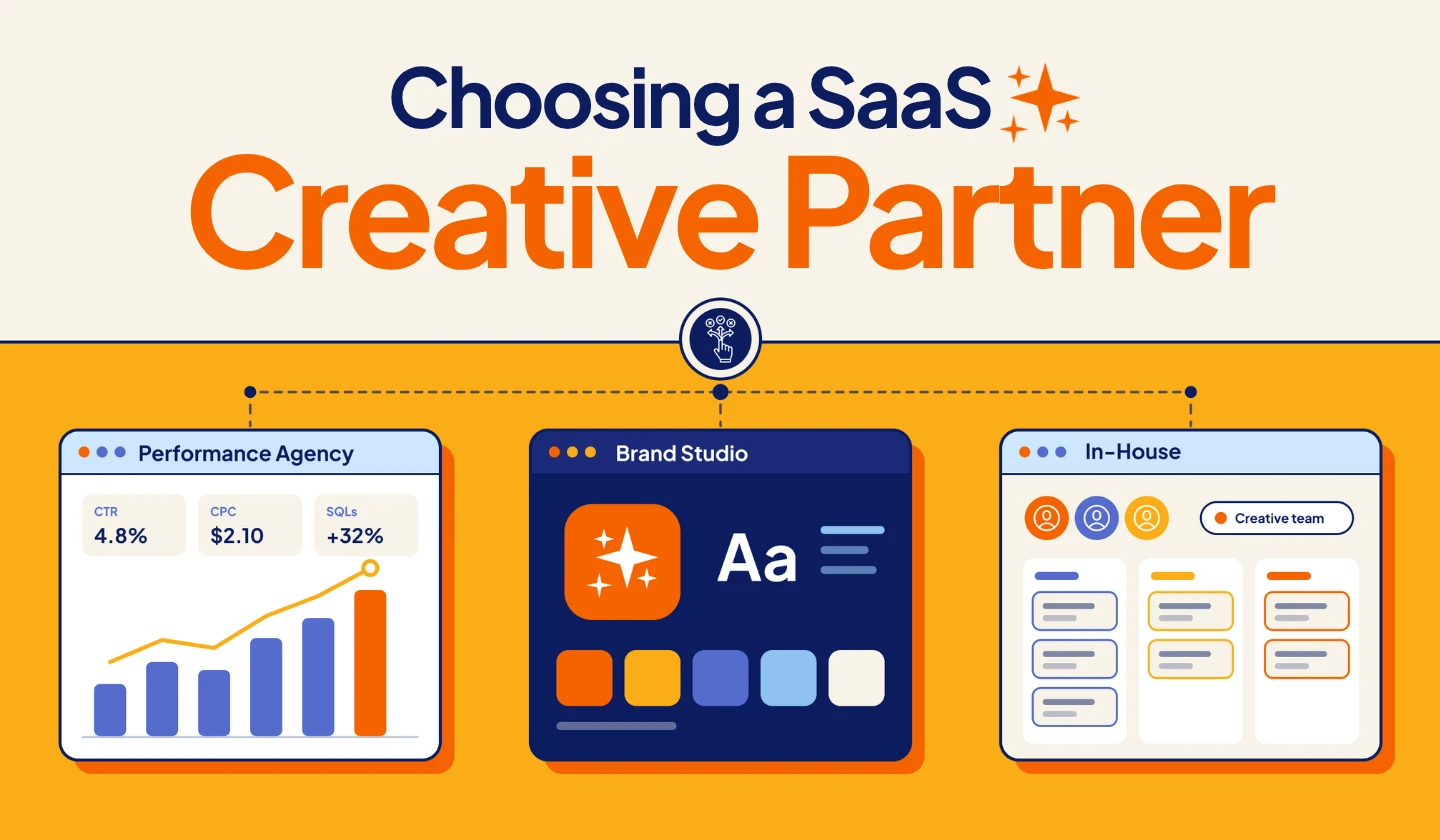
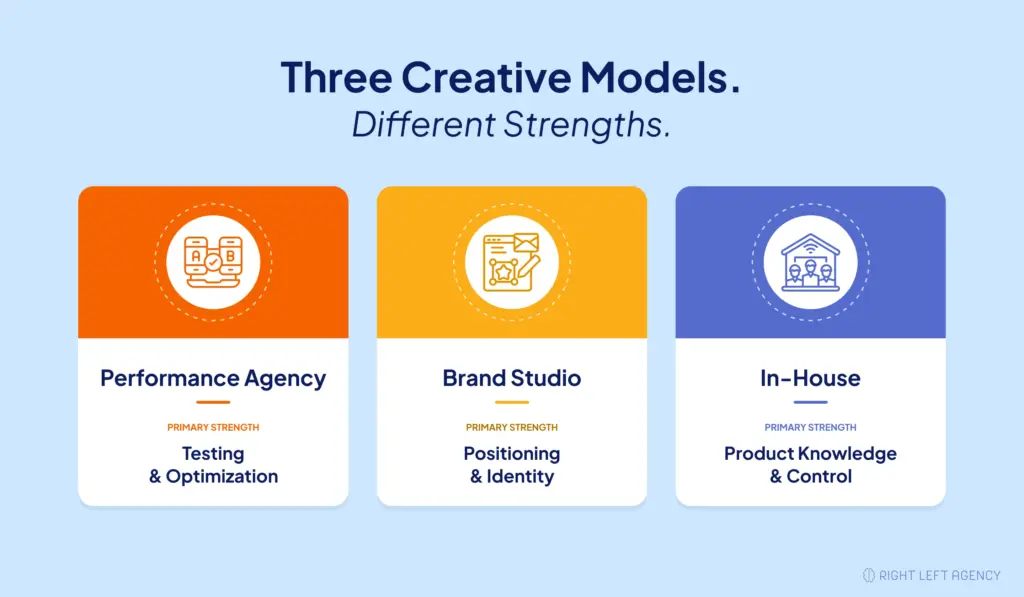
A performance creative agency is typically suited to ongoing paid media experimentation, a brand studio is suited to positioning and identity development, and an in-house team is suited to sustained creative work requiring close product collaboration. The best option depends on the work required and the capabilities available.
Performance Creative Agency
A performance creative agency develops advertising concepts and assets with an emphasis on campaign objectives, experimentation, and continuous improvement.
Its services may include audience research, advertising copy, visual production, creative testing, and collaboration with paid media specialists.
For example, a B2B SaaS company running LinkedIn Ads may want to compare messages tailored to operations managers, finance leaders, and technical decision-makers.
A performance creative partner can help develop those concepts, coordinate suitable testing, and translate credible results into future creative decisions.
Best suited for: SaaS companies with active acquisition campaigns that need specialized creative strategy, consistent production, and structured experimentation.
Potential limitation: External partners require onboarding, coordination, and access to relevant campaign and customer information. Service scope and expertise also vary.
Brand Studio
A brand studio specializes in how a company positions itself, communicates its identity, and differentiates from competitors.
Its capabilities often include brand strategy, visual identity, messaging systems, storytelling, and campaign creative direction.
Consider a cybersecurity SaaS company whose advertising emphasizes generic benefits such as security and reliability.
If prospective customers struggle to distinguish the product from alternatives, creating more advertising variations may not address the underlying positioning problem.
A brand studio could help clarify the company’s differentiation and develop consistent communication across channels.
Best suited for: SaaS companies launching products, repositioning their brands, entering new markets, or addressing inconsistent messaging.
Potential limitation: Some studios do not specialize in continuous paid media experimentation, although others offer both brand and performance capabilities.
In-House Creative Team
An in-house creative team works directly within the SaaS business and develops familiarity with its products, customers, and internal priorities.
Internal designers, copywriters, and creative strategists can collaborate closely with product, sales, and marketing teams.
This is particularly useful when creative production requires frequent product updates, technical accuracy, or ongoing stakeholder involvement.
However, maintaining a complete internal team requires appropriate specialist coverage, management, software, and production capacity.
Best suited for: SaaS businesses with consistent creative demand and sufficient resources to support an internal function.
Potential limitation: Recruitment, specialist availability, and competing internal priorities can affect output.
SaaS Creative Partner Comparison
| Factor | Performance creative agency | Brand studio | In-house team |
|---|---|---|---|
| Primary focus | Campaign creative and experimentation | Brand positioning and identity | Ongoing internal creative needs |
| Creative strategy | Campaign-oriented | Brand-oriented | Depends on expertise |
| Paid media knowledge | Usually emphasized | Varies | Depends on team |
| Product familiarity | Requires onboarding | Requires discovery | Usually deeper |
| Testing capabilities | Commonly integrated | Varies | Depends on resources |
| Main cost structure | Retainer or project fees | Project or retainer fees | Salaries and operating costs |
| Main limitation | External coordination | Potential performance specialization gap | Capacity and specialist coverage |
These are general operating-model differences rather than fixed rules. The capabilities of individual providers should be evaluated separately.
Which Creative Model Fits Your SaaS Business?
The appropriate creative model depends more on a company’s immediate needs than its size or revenue alone.
When Brand Positioning Is Still Developing
SaaS companies with unclear differentiation or evolving value propositions may benefit from brand strategy expertise before increasing advertising production.
For example, an early-stage workflow automation company may need to determine whether its strongest message concerns productivity, accuracy, or ease of implementation.
A brand studio or experienced strategist can help clarify positioning, while selective paid media experiments may provide additional evidence about audience responses.
When Paid Acquisition Requires More Creative Testing
Companies with established positioning and active paid campaigns may need stronger creative experimentation capabilities.
A performance creative agency can be useful when the internal team lacks the expertise or capacity to develop, test, and refine different advertising concepts.
However, campaign volume, conversion tracking, and available data should support the proposed approach.
When Creative Demand Becomes Continuous
A SaaS business managing multiple products, markets, or campaigns may benefit from an internal creative team.
Internal ownership can support regular production, brand consistency, and frequent product collaboration.
An external partner may still provide specialist expertise or additional capacity.
The decision should reflect workload, management capabilities, and business priorities rather than a universal growth-stage rule.
How to Choose a SaaS Paid Media Creative Partner
Selecting a SaaS creative partner requires evaluating the capabilities needed to address your current marketing challenges.
The following RLA SaaS Creative Partner Evaluation Framework provides a practical five-step process for making that decision.
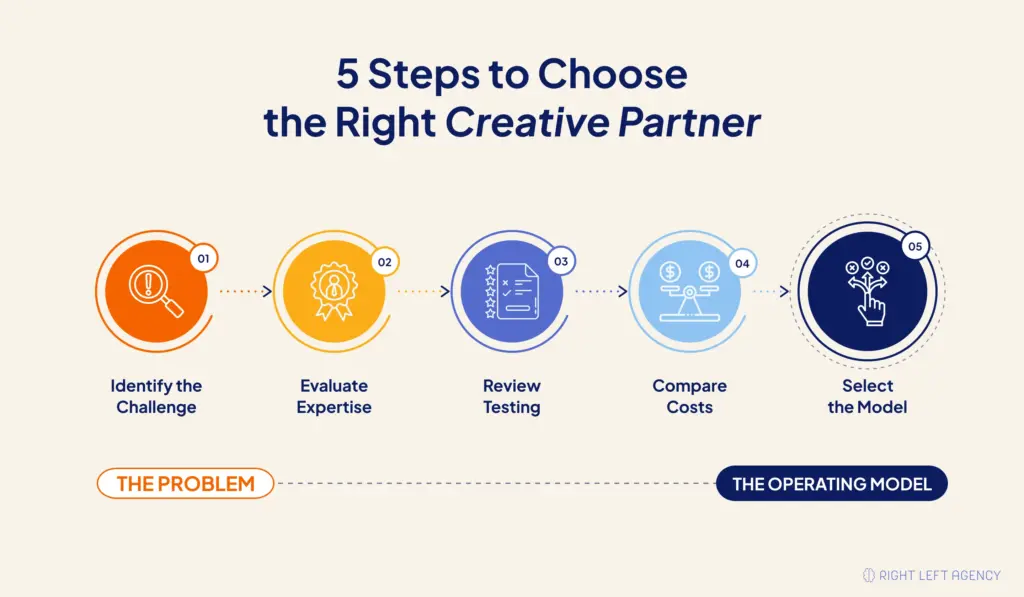
Step 1 — Identify Your Biggest Creative and Paid Media Challenge
Before evaluating potential partners, determine what is limiting your current marketing performance.
Common issues include:
- Unclear product positioning or differentiation.
- Inconsistent messaging across campaigns.
- Limited creative production capacity.
- Insufficient creative testing.
- Weak performance reporting.
- Gaps in specialist creative skills.
The objective is to distinguish creative problems from broader acquisition challenges.
For example, a SaaS campaign may generate relevant clicks but few qualified demo requests. The underlying issue could involve the offer, landing page, audience targeting, or message alignment.
Producing additional advertisements without diagnosing those factors may not resolve the problem.
Review campaign results, customer feedback, lead quality, and existing workflows to establish where support is required.
Decision output: A clearly defined problem that the creative partner must help solve.
Step 2 — Evaluate SaaS and Paid Media Expertise
A potential partner should understand how SaaS buyers evaluate software products.
B2B campaigns may need to communicate differently with technical evaluators, department leaders, and economic decision-makers.
For example, an IT leader evaluating workflow software may prioritize integrations and security, while an operations executive may focus on efficiency and process reliability.
A qualified partner should explain how these differences influence advertising messages and creative formats.
Evaluate:
- Experience with relevant SaaS audiences.
- Understanding of complex B2B buying journeys.
- Creative strategy and copywriting capabilities.
- Familiarity with Google Ads, LinkedIn Ads, or other relevant channels.
- Ability to collaborate with demand generation and sales teams.
Request examples that demonstrate the partner’s approach to research, strategy, production, and learning.
A visually impressive portfolio is useful, but it does not independently establish paid media expertise.
Decision output: Evidence that the partner understands the target audience and possesses the required capabilities.
Step 3 — Review Creative Testing and Measurement Capabilities
A performance-focused creative partner should have a structured method for developing hypotheses, evaluating results, and identifying future improvements.
A useful process includes:
- Define the audience and creative hypothesis.
- Select a relevant performance metric.
- Establish suitable testing conditions.
- Evaluate results and uncertainty.
- Document findings and determine the next action.
For example, a SaaS team might test whether a productivity-focused message generates more relevant interest than one emphasizing cost reduction.
Google Ads provides platform-supported experiment capabilities, including ad variations and experiment types for eligible campaigns. The appropriate method depends on the campaign format and available features.
Testing also requires careful interpretation.
A creative with higher CTR does not necessarily produce more qualified leads. Likewise, a small difference in conversions may be too uncertain to support a definitive conclusion.
A credible partner should explain how it handles insufficient data instead of presenting every observed difference as a proven improvement.
Decision output: A documented testing and reporting process appropriate to the company’s campaign conditions.
Step 4 — Compare Total Costs and Operational Requirements
Agency fees and internal salaries represent different cost structures, so comparing them directly may overlook important expenses.
Evaluate the full investment required to deliver the same capabilities.
For an agency, this may include retainers, production allowances, revisions, and work outside the agreed scope.
A brand studio may charge for discovery, positioning, identity development, and additional campaign assets.
An internal team requires salaries, benefits, recruitment, software, management, and specialist support.
A practical comparison is:
Total creative investment = Direct service or employment costs + production expenses + tools + management and coordination costs.
Also assess turnaround times, approval requirements, flexibility, and ownership of final deliverables.
The lowest-cost arrangement is not necessarily the most suitable if it lacks essential capabilities.
Decision output: A comparable cost and resource estimate for each realistic operating model.
Step 5 — Select the Model That Supports Your Marketing Objectives
Use the findings from the previous steps to make a decision.
| Primary requirement | Model to evaluate first |
|---|---|
| Continuous creative testing and campaign iteration | Performance creative agency |
| Positioning, differentiation, and identity | Brand studio |
| Predictable ongoing creative work | In-house team |
| Internal product expertise plus external specialization | Hybrid model |
| Unclear acquisition problem | Further diagnosis before selecting a partner |
These recommendations identify suitable starting points, not guaranteed solutions.
Before committing, document:
- The responsibilities of each team.
- Required deliverables and production timelines.
- Reporting and measurement expectations.
- Budget and contract terms.
- Approval and communication processes.
- Criteria for evaluating the partnership.
Decision output: A selected operating model with clear ownership, expectations, and evaluation criteria.
How to Evaluate a SaaS Creative Partner’s Performance Capabilities
When reviewing a performance creative agency, focus on how it develops and evaluates advertising decisions rather than the number of assets it promises.
Three capabilities deserve particular attention.
Audience-Specific Creative Strategy
The partner should translate customer needs into messages relevant to different buying roles and stages.
For example, an awareness campaign may emphasize a familiar operational problem, while a consideration-stage campaign may highlight product capabilities, differentiation, or supporting proof.
Ask how audience research and product information influence creative decisions.
Structured Experimentation
Creative tests should begin with meaningful hypotheses and appropriate comparison conditions.
Google recommends defining clear experiment objectives and using suitable testing methods to evaluate campaign changes.
For SaaS campaigns with limited qualified conversions, the partner should also acknowledge statistical uncertainty and avoid drawing unsupported conclusions.
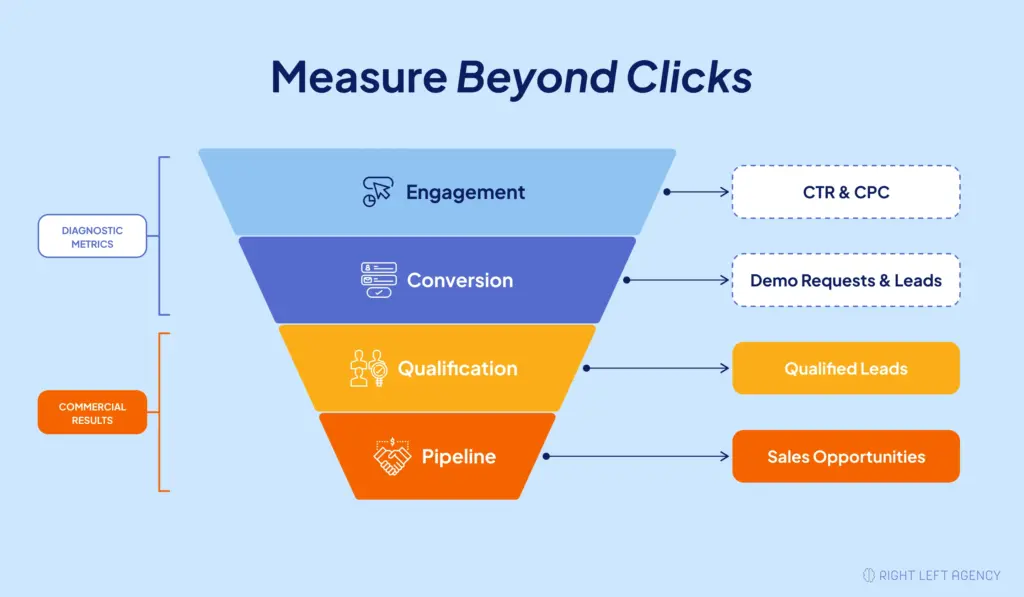
Measurement Beyond Engagement
Campaign engagement provides useful diagnostic information, but it does not establish customer acquisition quality.
| Metric | Main purpose | Limitation |
|---|---|---|
| CTR | Evaluate click engagement | Does not establish lead quality |
| CPC | Measure click acquisition cost | Lower cost does not guarantee relevant prospects |
| Landing-page conversion rate | Evaluate post-click actions | Influenced by audience, offer, and page experience |
| Qualified leads | Evaluate prospect suitability | Often limited or delayed |
| Cost per opportunity | Assess opportunity acquisition efficiency | Sensitive to small sample sizes |
| Attributed pipeline value | Evaluate associated commercial potential | Does not independently prove incremental impact |
Where reliable CRM data is available, creative reviews should consider qualified leads and opportunities alongside engagement metrics.
A partner should also explain what remains uncertain and which results may reflect targeting, landing pages, bidding, or other campaign factors.
How Much Does a Performance Creative Agency Cost Compared With In-House?
There is no universal cost advantage to hiring a performance creative agency, working with a brand studio, or building an in-house team.
Costs depend on required expertise, production volume, contract scope, and operating arrangements.
| Cost factor | Performance agency | Brand studio | In-house team |
|---|---|---|---|
| Primary expense | Retainer or project fee | Project or retainer fee | Salaries and benefits |
| Specialist access | Depends on agreement | Depends on project | Depends on hiring |
| Production scalability | Contract-dependent | Capacity-dependent | Staffing-dependent |
| Management | Vendor coordination | Project coordination | Internal team management |
| Additional expenses | Extra revisions or deliverables | Scope expansions | Tools, recruitment, contractors |
Consider a SaaS business requiring occasional video production, regular advertising concepts, and ongoing creative experiments.
An agency may provide several specialist capabilities without requiring equivalent full-time hires.
However, a company with substantial and predictable weekly production requirements may find an established internal team more suitable.
Compare equivalent capabilities and total costs rather than assuming one arrangement always provides better financial value.
For a broader marketing staffing and cost comparison, read our SaaS Growth Marketing Agency vs. In-House Team guide.
When Should SaaS Companies Use a Hybrid Creative Model?
A hybrid model combines internal marketing ownership with external creative specialization.
It may be appropriate when a SaaS company has strong product knowledge and internal leadership but needs additional production or testing capabilities.
For example, an internal growth manager might own audience priorities, product messaging, and campaign budgets.
An external performance creative partner could support creative concepts, advertising production, and experimentation.
A practical responsibility structure could include:
| Responsibility | Internal team | External partner |
|---|---|---|
| Business objectives | Owns | Advises |
| Product and customer knowledge | Provides | Applies |
| Brand direction | Owns | Follows and contributes |
| Creative concepts | Collaborates | Leads or supports |
| Production | Reviews or contributes | Delivers agreed assets |
| Testing | Collaborates | Plans or supports |
| Performance reporting | Owns or shares | Provides agreed analysis |
The main benefit is access to complementary capabilities.
However, hybrid arrangements require clear accountability, shared workflows, and consistent communication. Without those foundations, coordination costs can offset potential advantages.
Questions to Ask Before Hiring a SaaS Creative Partner
Before selecting a partner, ask questions that reveal its actual process and capabilities.
- What experience do you have with similar SaaS audiences? Look for relevant business and buyer understanding.
- How do you research our ICP? Ask how customer insights influence messaging and concepts.
- How do you develop creative strategy? Determine whether concepts are based on specific problems and hypotheses.
- What is your testing process? Review methods, metrics, and approaches to inconclusive results.
- How do you evaluate lead quality? Understand whether reporting extends beyond engagement.
- How will you collaborate with our internal team? Clarify responsibilities and approvals.
- What deliverables are included? Confirm formats, turnaround times, and revisions.
- Can you provide relevant examples? Request case studies, anonymized reports, or documented approaches.
- Who owns the creative assets? Review intellectual property, licensing, and source-file access.
- What happens during the first 30–60 days? Look for a realistic onboarding and execution plan.
Strong answers should include specific methods, practical examples, transparent limitations, and clearly defined responsibilities.
Common Mistakes When Choosing a SaaS Creative Partner
Avoid these selection mistakes when comparing creative agencies, studios, and internal teams.
1. Choosing Based Only on Portfolio Quality
A polished portfolio demonstrates creative execution but does not necessarily establish strategic or testing expertise.
Ask how previous creative decisions were developed and evaluated.
2. Prioritizing Creative Volume Over Strategy
Producing more advertisements may increase testing opportunities, but variations without meaningful hypotheses can generate limited insight.
Focus on relevant messages and clearly defined creative objectives.
3. Hiring for the Wrong Marketing Problem
A brand studio may not resolve a campaign experimentation gap, while a performance agency may not be the right first choice for fundamental positioning work.
Diagnose the problem before choosing the provider.
4. Overlooking Collaboration and Ownership
Unclear responsibilities can create delays, inconsistent messaging, and fragmented reporting.
Define how internal and external teams will work together before starting.
5. Measuring Success Only Through Engagement
Higher CTR or lower CPC does not automatically indicate improved customer acquisition.
Evaluate qualified outcomes where the data supports them.
6. Ignoring Total Costs and Contract Terms
Retainers, salaries, additional production, asset ownership, and management requirements all influence the long-term value of a partnership.
Compare full operating arrangements rather than headline prices.
SaaS Creative Partner Selection Example
Consider a hypothetical B2B SaaS company selling workflow management software to mid-market businesses.
The company advertises through LinkedIn Ads and Google Ads. It has an internal marketing manager and designer, established positioning, and a reasonably clear ICP.
However, its team struggles to develop distinct advertising messages, maintain a consistent testing schedule, and interpret creative findings.
The company considers three options.
| Option | Potential advantage | Main limitation |
|---|---|---|
| Performance creative agency | Specialized creative development and experimentation | Requires external coordination |
| Brand studio | Stronger brand direction | May not address the immediate testing problem |
| In-house expansion | Greater direct control | Requires hiring and additional management |
Applying the five-step evaluation framework:
Step 1 — Identify the challenge: The main problem is inconsistent creative experimentation rather than weak brand positioning.
Step 2 — Evaluate expertise: The company needs specialists familiar with SaaS messaging and paid advertising.
Step 3 — Review testing: The selected partner must demonstrate an appropriate testing and reporting process.
Step 4 — Compare resources: Leadership evaluates whether external support or additional internal hiring provides the required capabilities within its operating constraints.
Step 5 — Select the model: A performance creative agency or hybrid arrangement becomes a reasonable option to evaluate first.
The conclusion changes if the company’s positioning is unclear.
In that situation, brand strategy may need attention before expanding campaign experiments.
The example demonstrates why the appropriate creative partner depends on the underlying business problem.
Choose a Creative Partner That Supports Your SaaS Growth Goals
The right creative partner for SaaS paid media depends on your positioning, campaign requirements, internal expertise, and resources.
Performance creative agencies can support ongoing experimentation, brand studios can strengthen differentiation, and in-house teams can provide consistent creative ownership.
The most useful approach is to identify the actual problem, evaluate the capabilities required, and select a model with clear responsibilities and measurable objectives.
At Right Left Agency, our paid advertising services bring together audience research, creative development, campaign strategy, testing, and performance reporting to support SaaS and B2B acquisition goals.
If your creative production and paid media strategy are not working together effectively, we can help you evaluate your current approach and identify the next priorities.
Explore Our Paid Advertising Services
Frequently Asked Questions
What is the difference between a performance creative agency and a brand studio?
A performance creative agency typically focuses on advertising concepts, campaign experimentation, and performance-related objectives. A brand studio specializes in positioning, identity, messaging, and creative consistency. Some providers offer both capabilities, so their actual services should be evaluated individually.
Should a SaaS company hire a creative agency or build an in-house team?
A SaaS company should evaluate its creative workload, specialist requirements, internal expertise, and budget. An agency can provide external capabilities, while an in-house team offers direct ownership and product familiarity. A hybrid model may be useful when both are needed.
Can a brand studio manage performance advertising?
Yes, some brand studios provide paid advertising creative and performance services. However, capabilities vary. Before hiring, assess the studio’s experience with relevant platforms, creative testing, campaign reporting, and collaboration with media buyers.
How do you measure the success of a SaaS creative partner?
Evaluate agreed deliverables, creative strategy, testing quality, and relevant campaign outcomes. Engagement metrics help diagnose advertising performance, while qualified leads and opportunities provide additional commercial context. Results should be interpreted with appropriate attribution and data limitations.
Is a hybrid creative model suitable for B2B SaaS companies?
A hybrid model can work when internal teams provide product knowledge, marketing leadership, and strategic ownership while external specialists support creative development or experimentation. Effective collaboration requires clear responsibilities, workflows, and measurement expectations.