Key Takeaways
- Shortlists often form before sales contact, so healthy traffic can coexist with a weak pipeline.
- Buyers are more likely to consider vendors they can understand and validate quickly.
- Search, AI answers, reviews, comparison content, and peer recommendations can all influence vendor research.
- Strong decision-stage visibility requires proof around integrations, security, implementation, pricing, support, and product fit.
- More content alone will not close the gap. You need content that answers real buying questions.
- Win/loss data, sales conversations, CRM data, and AI prompt testing can show where competitors have the advantage.
Your rankings are steady. Traffic looks healthy. But prospects are reaching sales already familiar with your competitors. They know their integrations. They understand their pricing. They may already prefer one.
That is the decision-stage visibility gap.
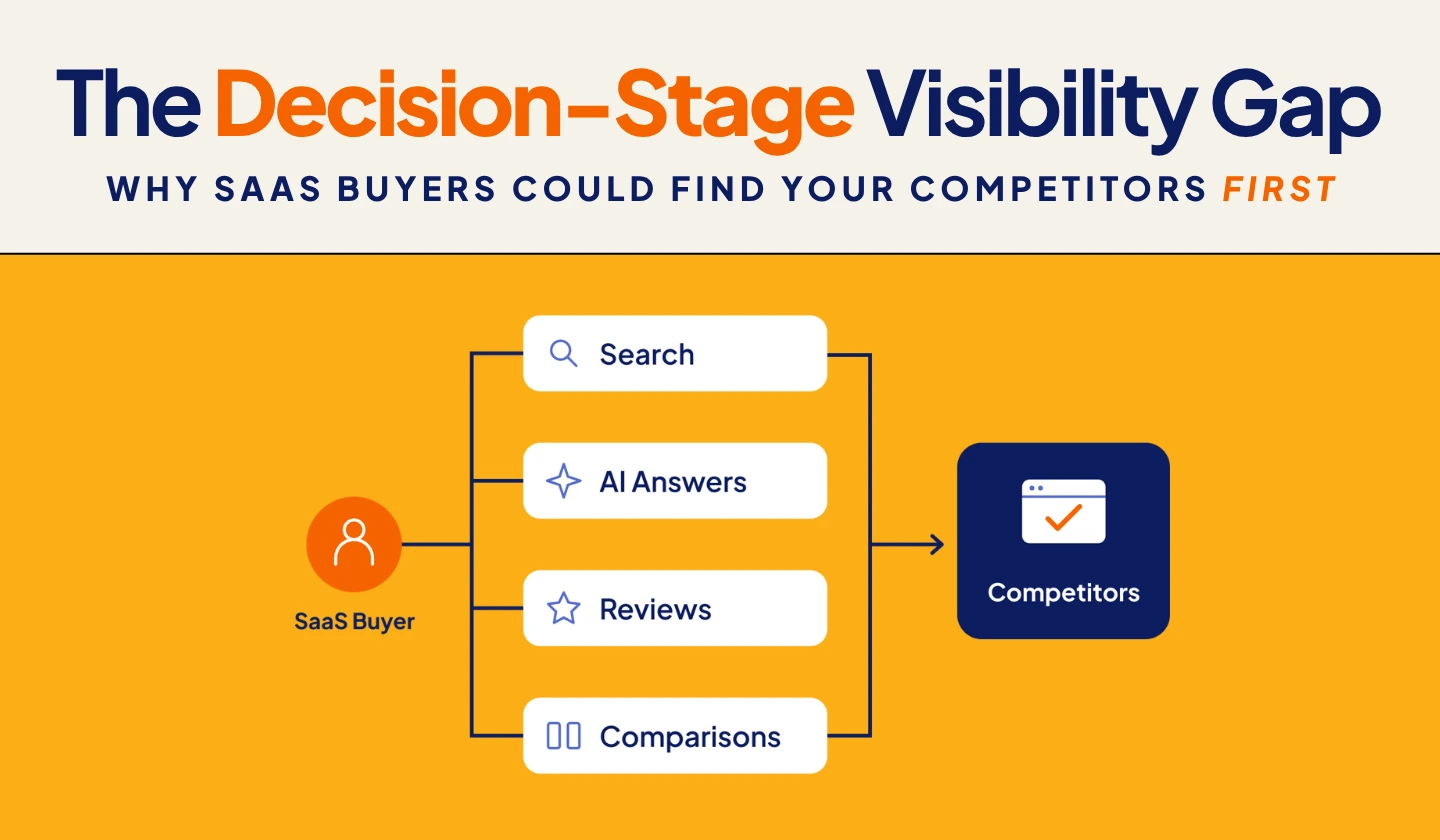
It happens when competitors become easier to discover, understand, trust, and validate while buyers are building their shortlist.
For SaaS companies, that discovery happens across search results, AI answers, software review platforms, comparison content, industry experts, and peer conversations—often before the buyer reaches your website. And that creates a bigger problem than lost traffic.
It means your competitor may be shaping the buying decision before your sales team gets a chance.
The Decision-Stage Visibility Gap: What Changed in SaaS Buying?
The decision-stage visibility gap is the distance between where buyers research and form preferences and where your marketing becomes visible.
Modern B2B buying does not follow a clean, website-first funnel.
Buyers can research independently, compare options, build a shortlist, and develop vendor preferences before talking to sales.
Research supports that shift.
6sense’s 2025 B2B Buyer Experience Report, based on nearly 4,000 B2B buyers, found that buyers evaluated an average of 5.1 vendors and already had 3.6 on their shortlist on day one. The eventual purchase came from that day-one shortlist 95% of the time.
The same study found that 94% of buyers ranked their shortlist before engaging with sellers.
Forrester’s Buyers’ Journey Survey, 2024 points in the same direction. According to Forrester, 41% of B2B buyers reported having a single vendor in mind when they began the purchase process, while 92% already had a shortlist.
These studies cover B2B buying broadly rather than SaaS alone. But the implication for SaaS marketing is important:
By the time a buyer requests a demo, meaningful vendor preferences may already exist.
That explains a problem many SaaS teams miss.
You can rank well for the keywords you track while a competitor appears more consistently during the research that actually shapes the shortlist.
The question is no longer simply:
Do we rank?
It is:
Do buyers find enough evidence to include and trust us when they compare options?
Where SaaS Buyers Build Their Shortlist
A SaaS shortlist can take shape across several research environments.
Search and Commercial-Investigation Queries
Queries containing terms such as:
- best
- alternatives
- vs
- pricing
- integrations
- reviews
- implementation
- security
signal that the buyer is moving beyond basic awareness.
These are high-value decision-stage searches.
If a competitor has useful pages answering these questions and you do not, buyers have more opportunities to encounter and understand that competitor during evaluation.
This is why a modern SaaS SEO strategy cannot focus only on informational keywords and traffic. It also needs to capture the searches buyers use when comparing solutions and preparing to buy.
AI Answer Engines and Conversational Research
ChatGPT, Gemini, Perplexity, Google AI experiences, and other AI tools have added another research layer.
Buyers can ask:
- What are the best platforms for this use case?
- What are the alternatives to Product X?
- Product A vs. Product B—which fits our workflow?
- Does Product X integrate with our stack?
- What are the limitations of Product Y?
AI should not be treated as the entire buyer journey. It sits alongside search, review platforms, vendor websites, industry experts, and peers.
6sense’s 2025 research found widespread LLM usage among its surveyed B2B buyers while also reporting continued reliance on vendor content and third-party experts.
So the goal is not to optimize only for AI. It is to make your company easier to understand, verify, and cite across the places buyers research.
That is where AI search optimization becomes part of the wider SaaS visibility strategy.
Review Sites and Peer Recommendations
Software buyers also look beyond vendor-controlled messaging.
Capterra’s software-buying research shows that review and comparison platforms play a meaningful role in software evaluation. Its 2026 Software Buying Trends research reports that 45% of successful software adopters consulted software review and comparison sites, while 51% consulted industry experts.
That makes platforms such as G2 and Capterra important validation surfaces.
Buyers can use reviews to investigate questions your marketing may not answer directly:
- Is implementation difficult?
- How responsive is support?
- What limitations appear after adoption?
- Does the product work for companies like ours?
- Are customers consistently reporting the same problem?
Peer conversations in private communities, Slack groups, forums, professional networks, and direct messages add another layer that traditional attribution may never fully capture.
Comparison Pages and Third-Party Sources
Buyers also encounter vendors through comparison pages, directories, analyst content, industry publications, and “best software” lists.
These sources give buyers outside context.
If your competitors consistently appear while your product is absent, they simply have more opportunities to enter the shortlist.
7 Reasons SaaS Buyers Find and Trust a Competitor First
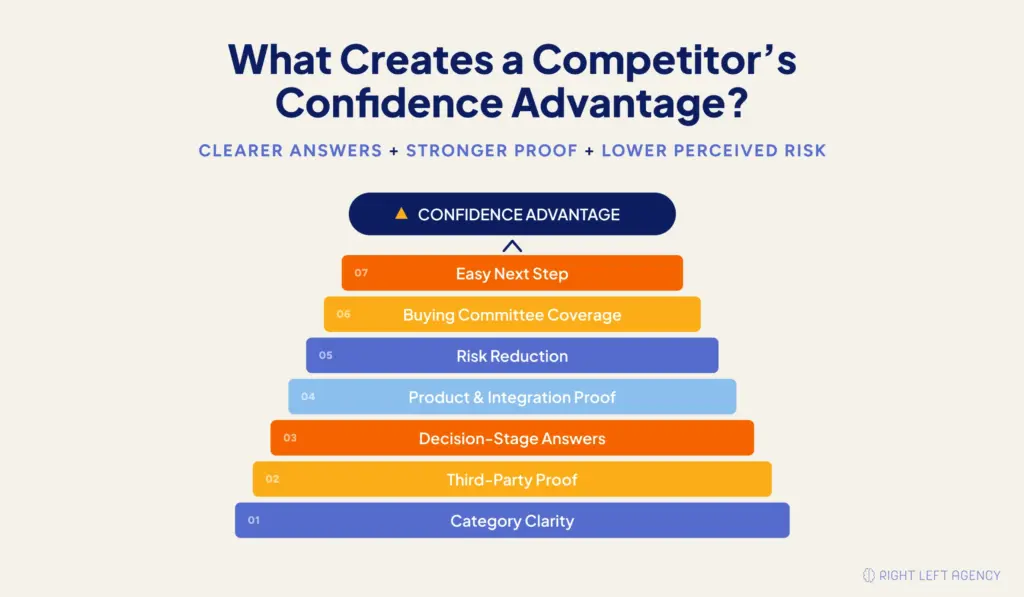
SaaS buyers often lean toward the vendor that gives them more confidence during evaluation. That confidence comes from answering important questions clearly and reducing uncertainty.
Here are seven places to investigate.
1. The Competitor Is Easier to Understand
Buyers need to understand quickly:
What does this product do, who is it for, and why is it different?
Generic positioning makes that harder. Specific positioning makes comparison easier.
Self-check: Ask someone unfamiliar with your company to look at your homepage for ten seconds.
Can they explain what you sell and who should buy it?
If not, positioning may be part of the problem.
2. The Competitor Has Stronger Third-Party Proof
Your case studies matter.
But buyers also look for independent evidence from reviews, experts, customers, and peers.
Capterra recommends evaluating multiple information sources and looking closely at recent, detailed reviews from organizations with similar use cases.
Self-check: Compare your presence with your three closest competitors across relevant software review platforms.
Look at:
- review volume
- review recency
- level of detail
- recurring strengths
- recurring complaints
- similarity of reviewers to your ICP
Do not compare star ratings alone.
3. The Competitor Answers Decision-Stage Questions More Directly
Imagine a buyer searches:
“Your product vs. Competitor X.”
Your competitor has a detailed comparison page. You have nothing. They now control more of the comparison.
The same problem appears around pricing, integrations, implementation, security, migration, and alternatives.
This is why effective SaaS content marketing needs bottom-of-funnel assets, not just educational blog posts.
Self-check: List the ten questions most frequently raised by lost prospects.
Search each one from a buyer’s perspective. Which vendor gives the clearest answer?
4. The Competitor Has More Specific Product and Integration Evidence
“Integrates with your stack” is a claim.
Buyers need evidence.
A stronger integration page explains:
- which systems connect
- what data moves
- what workflows are supported
- what setup involves
- where limitations exist
Self-check: Review every important integration you advertise.
Can a technical buyer understand what it actually does without booking a demo?
5. The Competitor Reduces Security, Implementation, and Switching Risk
Choosing SaaS creates operational risk.
Buyers may need answers about:
- security
- compliance
- migration
- implementation
- training
- data handling
- downtime
- internal adoption
A vendor that makes these answers easier to find gives the buying team more evidence to work with.
Self-check: Can an IT, security, or procurement stakeholder find what they need without contacting sales?
6. The Competitor Speaks to the Whole Buying Committee
A SaaS purchase rarely belongs to one person.
The champion, users, IT, security, finance, procurement, and leadership can all need different proof.
That means your content cannot speak only to the person booking the demo.
Self-check: Map every important buying role to the content or proof you provide.
Empty rows reveal potential gaps.
7. The Competitor Makes the Next Step Easier
Decision-stage buyers should not have to hunt for basic information.
Clear pricing signals, straightforward demo paths, accessible product information, useful documentation, and sensible trial options reduce friction.
Self-check: Give a first-time visitor one task:
Work out whether this product could be right for your company and what you should do next.
See how long it takes.
What Buyers Validate Once They Reach Your Website
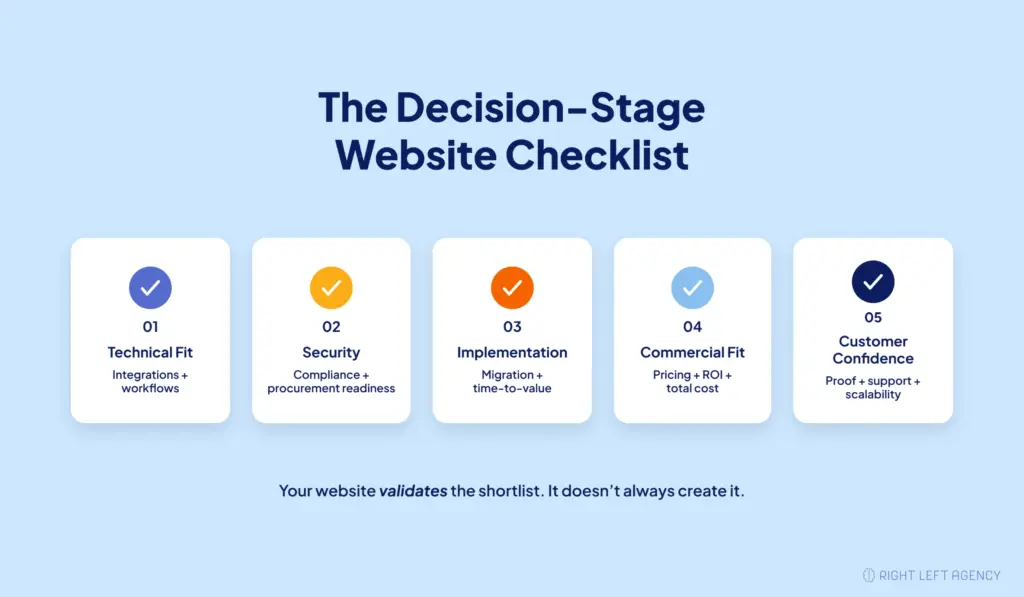
Your website still matters. But for many decision-stage buyers, its job is no longer just discovery.
It is validation. They want to know whether you deserve to remain on the shortlist.
Integrations and Technical Fit
Does the product work with the tools they already use?
Show named integrations, supported workflows, data movement, setup requirements, and relevant limitations.
Security, Compliance, and Procurement Readiness
Security and procurement teams may need certifications, policies, data-handling information, subprocessors, or other documentation.
Make appropriate trust information easy to locate.
Implementation, Migration, and Time-to-Value
- How long does implementation typically take?
- Who needs to be involved?
- What needs to be migrated?
- What support will they receive?
Specific expectations are more useful than vague promises such as “get started in minutes.”
Pricing, ROI, and Total Cost
You do not necessarily need to publish a complete price list.
But buyers should understand what affects cost.
Explain relevant factors such as:
- users
- usage
- features
- implementation
- support
- contracts
- add-ons
Then help buyers understand how customers evaluate the return.
Customer Proof, Support, and Scalability
Show evidence from customers similar to the buyers you want.
Help prospects understand:
- who uses the product
- what they use it for
- what results they achieved
- what support looks like
- how the product handles growth
Specific evidence is easier to evaluate than broad claims.
The Decision-Stage Content Assets You Need
Do not build content because it appears on a calendar. Build it because buyers have questions.
A strong SaaS content strategy maps content to search intent, buyer pain points, funnel stage, and conversion goals.
| Buyer question | Search or AI query | Content or page needed | Proof needed |
|---|---|---|---|
| How do you compare to X? | “[you] vs [competitor]” | Comparison page | Side-by-side criteria and fit guidance |
| Who else could I use? | “[competitor] alternatives” | Alternatives page | Use-case differences |
| Does it work with our stack? | “[product] + [tool] integration” | Integration page | Workflows, documentation, screenshots |
| Is it secure? | “[product] security / SOC 2” | Security or trust page | Certifications, policies, documentation |
| How hard is setup? | “[product] implementation time” | Implementation guide | Timelines and checklists |
| What will it cost? | “[product] pricing” | Pricing and ROI page | Pricing structure and cost drivers |
| Has it worked for companies like us? | “[product] case study [industry]” | Case study | Relevant customer evidence and verified metrics |
| Who supports us afterward? | “[product] support” | Support and onboarding page | Support model, SLAs, contacts, resources |
The goal is not more pages.
It is fewer unanswered buying questions.
How SEO and AI Visibility Work Together at the Decision Stage
SEO and AI visibility should not operate as separate strategies.
Both benefit from clear, accessible, well-structured information about your company, product, category, integrations, customers, and use cases.
Focus on five fundamentals.
Keep Your Positioning Consistent
Use clear product and category language across your website and important third-party profiles.
Build Credible Third-Party Presence
Reviews, relevant mentions, expert coverage, customer evidence, and industry sources give buyers additional ways to validate your claims.
Keep Decision-Stage Pages Discoverable
Important comparison, integration, security, pricing, implementation, and support content should be crawlable and easy to navigate.
Cover the Questions Behind the Question
A buyer asking about alternatives may next ask about pricing, integrations, migration, security, or suitability for a specific use case.
Give Every Page a Clear Purpose
Do not force one page to answer every possible buyer question. No company can guarantee inclusion in an AI-generated answer.
What you can control is the clarity, usefulness, consistency, accessibility, and authority of the information available about your product.
A modern SEO and AI visibility strategy should improve both discovery and the path from search to qualified pipeline.
How to Diagnose Why a Specific Competitor Keeps Winning
Do not start by publishing another 20 blog posts.
Start with evidence.
1. Run Win/Loss Interviews
Ask won and lost buyers:
- Which vendors did you consider?
- Which vendor did you prefer initially?
- Where did you first encounter each option?
- What information influenced the shortlist?
- What made one vendor feel safer?
- What nearly stopped the purchase?
Look for patterns, not individual comments.
2. Mine Sales Calls
Review call recordings and tag:
- competitor mentions
- pricing questions
- integration questions
- security objections
- implementation concerns
- missing features
- switching concerns
Repeated questions reveal information buyers could not confidently answer during independent research.
3. Use Self-Reported Attribution
Add a simple question to your demo or contact process:
How did you first hear about us?
Analytics alone cannot explain every discovery path.
4. Clean Up CRM Loss Reasons
Avoid a catch-all reason such as:
Competitor.
Record which competitor won and, where known, why.
Then review the patterns monthly.
For longer SaaS buying journeys, a stronger marketing attribution system can help connect multiple marketing touchpoints to pipeline and revenue.
5. Test AI Prompts
Create a fixed prompt set around:
- your category
- best solutions
- alternatives
- comparisons
- integrations
- use cases
- pricing
- implementation
Run the same prompts periodically across relevant AI platforms.
Record which vendors appear, what claims are made, and which sources are referenced.
Treat this as directional visibility research—not precise market-share measurement.
Build a Simple Competitor Scorecard
Score yourself and a named competitor from 0 to 2 across each area.
The example below is illustrative, not benchmark data.
| Dimension | Vendor A | Vendor B |
|---|---|---|
| AI answer presence | 0: rarely/not observed | 2: frequently observed |
| Review depth | 1: limited or dated | 2: substantial and recent |
| Comparison content | 0: absent | 2: detailed and criteria-led |
| Security information | 1: difficult to find | 2: dedicated and current |
| Demo friction | 1: longer path | 2: straightforward path |
| Buying-committee coverage | 0: one role | 1–2: multiple roles |
The score is not the goal.
The gaps are.
What to Measure Beyond Rankings and Traffic
Rankings and sessions tell you whether people can find your website. They do not tell you whether buyers trust you enough to put you on the shortlist.
Start with metrics closest to revenue:
- qualified demo requests
- demo-to-opportunity rate
- win rate against named competitors
- assisted pipeline
- competitor-related loss reasons
Then use supporting visibility indicators:
- branded search demand
- competitor mentions in sales calls
- comparison-page engagement
- integration and security-page engagement
- review volume and recency
- AI mention rate across a fixed prompt set
This is the difference between measuring SEO as traffic and measuring it as a growth channel.
For SaaS companies, the objective should be a path from visibility → shortlist → qualified demo → opportunity → revenue.
A 90-Day Decision-Stage Visibility Plan
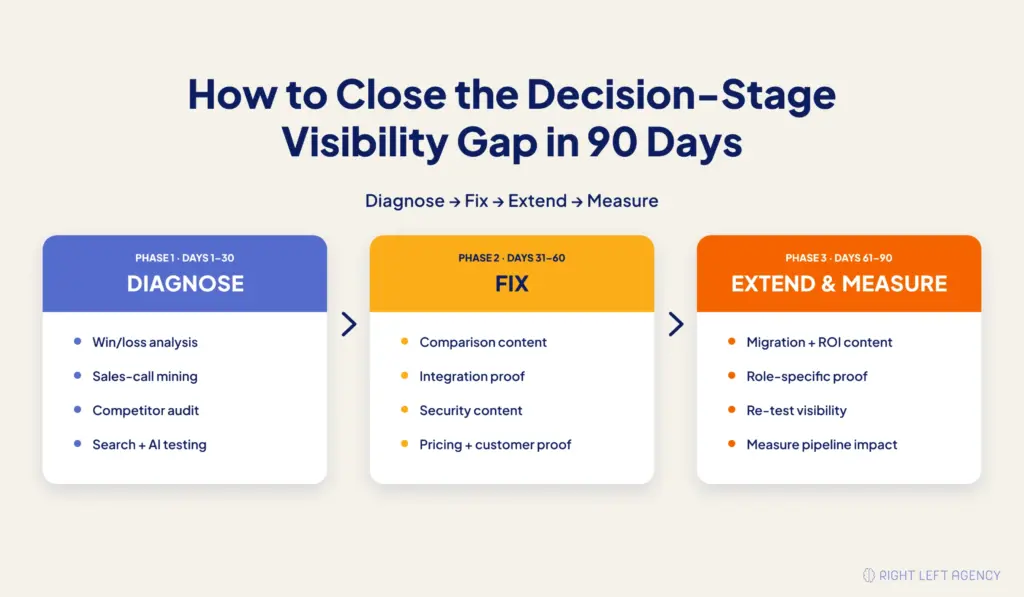
You do not need to rebuild your entire marketing strategy. Start with the gaps closest to revenue.
Days 1–30: Diagnose
- Run win/loss interviews.
- Mine sales calls.
- Review CRM loss reasons.
- Audit competitor review profiles.
- Test decision-stage search queries.
- Run your initial AI prompt set.
Then compare yourself with your top two competitors.
The goal is simple:
Find where buyers are getting stronger answers from someone else.
Days 31–60: Fix
Prioritize the biggest gaps.
Depending on the audit, that may mean improving:
- competitor comparison pages
- integration pages
- security and trust content
- implementation information
- pricing explanations
- customer proof
Update important software-review profiles and establish a consistent process for requesting genuine customer reviews.
Do not build everything.
Fix the questions most closely connected to lost opportunities first.
Days 61–90: Extend and Measure
Expand into the next layer of decision-stage content:
- migration guides
- role-specific content
- industry-specific proof
- ROI content
- support documentation
- alternatives pages
- additional integration content
Then repeat your original tests.
Compare:
- qualified demos
- competitor mentions
- loss reasons
- comparison-page engagement
- AI visibility
- win rates against named competitors
The objective is not more content.
It is stronger visibility and greater buyer confidence before the sales conversation begins.
Final Thoughts
They need to answer the buyer’s questions earlier—and with stronger proof. That is why traffic alone is an incomplete measure of SaaS visibility.
You need to know whether buyers can discover you while comparing options, validate your claims, and whether every important stakeholder can find the evidence they need.
Start with the questions buyers ask before a demo.
Find where competitors answer them better.
Then close those gaps with clearer positioning, stronger proof, decision-stage content, SEO, and AI visibility.
Not sure where competitors are gaining the visibility advantage?
Find out where your decision-stage visibility is breaking down—and what to fix first.
Request an SEO and AI Visibility Audit
Frequently Asked Questions
How do I know if I’m losing decision-stage deals to a competitor?
Look for the same competitor appearing in lost-deal notes, prospects citing details they learned elsewhere, and healthy traffic paired with weak demo-to-close rates. Win/loss interviews confirm it.
Do “vs” and alternatives pages actually help SaaS companies convert more demos?
They can help when they answer the buyer’s real criteria honestly and point to clear use-case fit. Thin or one-sided pages lose trust. Measure them by engagement and assisted pipeline, not traffic alone.
How has AI search changed how SaaS buyers compare products?
Buyers can ask for a category summary or vendor comparison in seconds, which speeds up shortlisting. It makes clear positioning and consistent third-party signals more important, not less.
Is this a content problem, a positioning problem, or an SEO problem?
Often it’s all three, but diagnose in order: positioning first, proof second, discoverability third. Publishing more content on unclear positioning rarely closes the gap.
How long does it take to start showing up in competitor comparisons?
There is no reliable fixed timeline. Pages you control can be updated and re-crawled sooner, while review volume and third-party mentions depend on other people and take longer. Measure progress against your day-one baseline.