

Key Takeaways
- Fintech agency retainers are only part of the real marketing cost.
- Compliance maturity directly affects marketing efficiency.
- Fintech marketing costs vary significantly by sub-vertical.
- Compare fully loaded marketing costs—not just agency retainers.
- A fintech specialist premium is only worthwhile when fintech-specific complexity is the real constraint.
Published pricing from fintech marketing agencies can tell you what an agency charges. It usually does not tell you what marketing will actually cost your company.
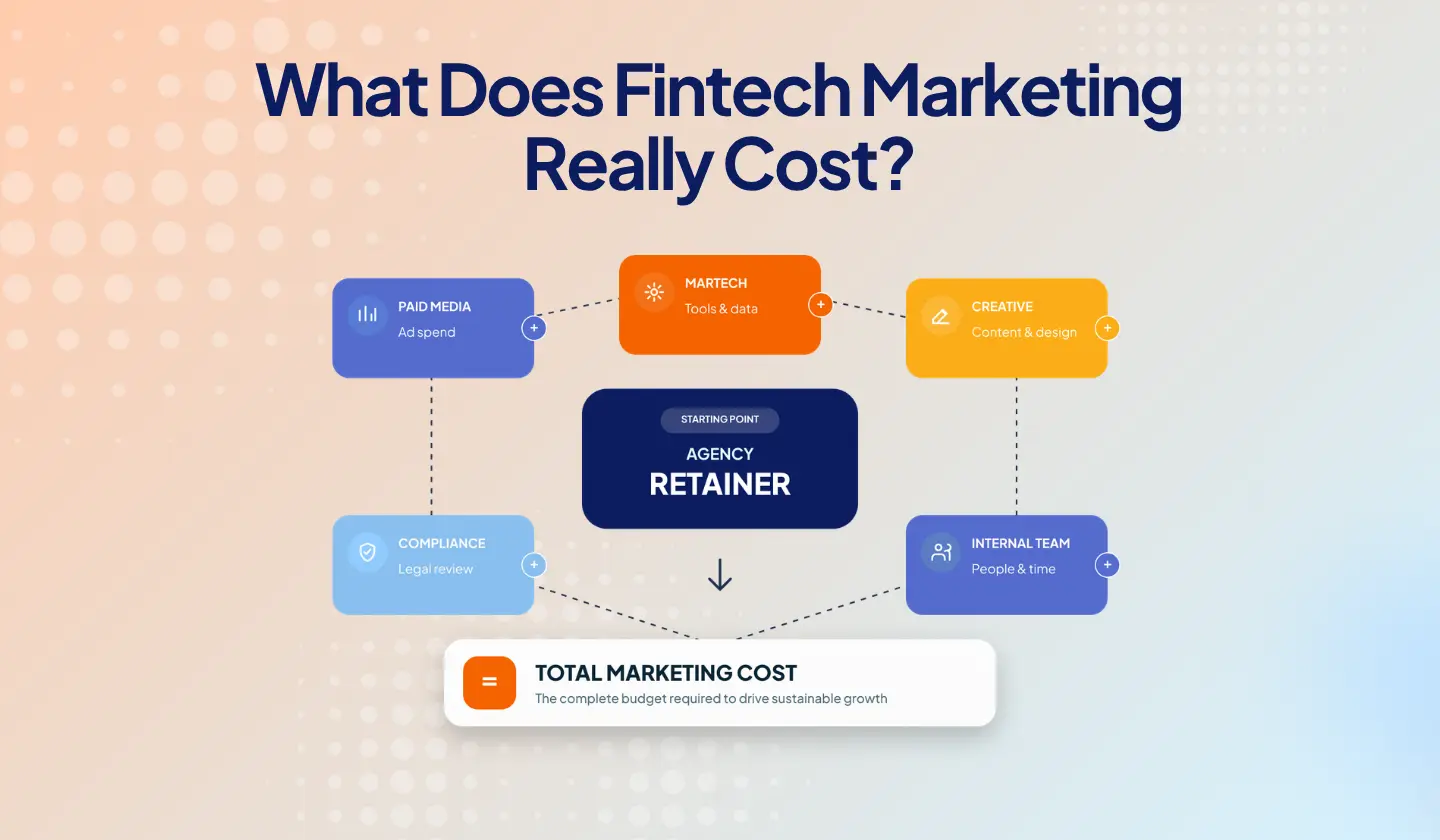
The agency fee may exclude paid media, software, creative production, website work, legal review, compliance coordination, and hours from your internal team. In fintech, those costs can materially change the final budget.
This guide takes a different approach. You will get attributable market pricing first, then a framework for calculating the fully loaded cost of fintech marketing and deciding whether an agency proposal accounts honestly for the work required to get campaigns approved and into market.
What Does a Fintech Marketing Agency Cost?
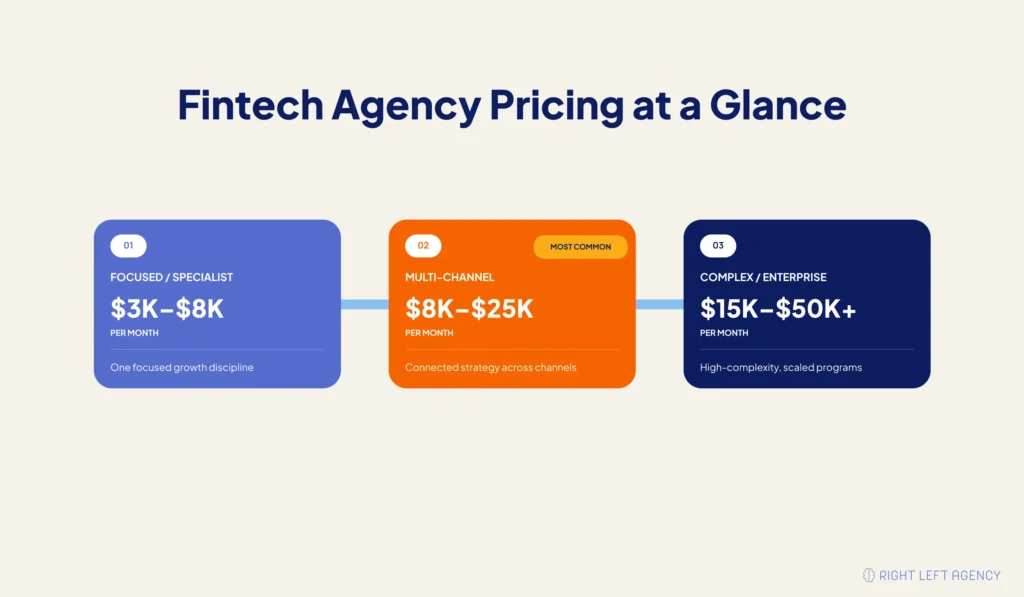
Published fintech agency pricing varies significantly by provider and scope. Bill Rice Strategy Group lists 4,000–8,000 per month for a standalone service and 8,000–15,000 for bundled work, while CSG reports 3,000–7,000 for smaller engagements, 10,000–25,000 for mid-sized agencies, and 30,000–50,000+ for enterprise engagements. These are agency fees, not total marketing budgets.
Bill Rice Strategy Group’s published pricing was checked on August 21, 2026. Its pricing page also lists 15,000–35,000 per month for PE portfolio engagements. CSG’s published fintech marketing cost guide provides broader market ranges based on agency size and scope. These sources are shown separately because combining them into one “average fintech agency price” would imply a level of market precision the underlying data does not support.
Fintech Marketing Agency Pricing at a Glance
| Engagement type | Published monthly pricing | What it may cover | Common exclusions | Potential fit |
|---|---|---|---|---|
| Focused / specialist | Bill Rice: 4K–8K; CSG smaller providers: 3K–7K | One focused service, project-based support, SEO, content, pipeline work, or limited PR | Media, major production, legal counsel, software, internal time | A fintech company with one clearly defined capability gap |
| Multi-channel | Bill Rice bundled engagement: 8K–15K; CSG mid-sized agencies: 10K–25K | Coordinated strategy and execution across several activities | Often media, external counsel, specialist production, major development | Growth-stage teams that need coordinated execution |
| Complex / enterprise | Bill Rice PE portfolio: 15K–35K; CSG enterprise/specialist firms: 30K–50K+ | Larger teams, multiple markets, deeper strategy, reporting, PR, or portfolio support | Large media budgets, events, external legal work, extensive development | Enterprise, multi-market, or operationally complex programs |
If you are evaluating a wider growth program, review fintech marketing services alongside the cost model.
How Compliance Overhead Increases Fintech Marketing Costs
Compliance increases fintech marketing costs because it affects the time, people, revisions, documentation, and approvals required across multiple marketing activities rather than sitting neatly inside one budget line.
A campaign may move through a workflow such as:
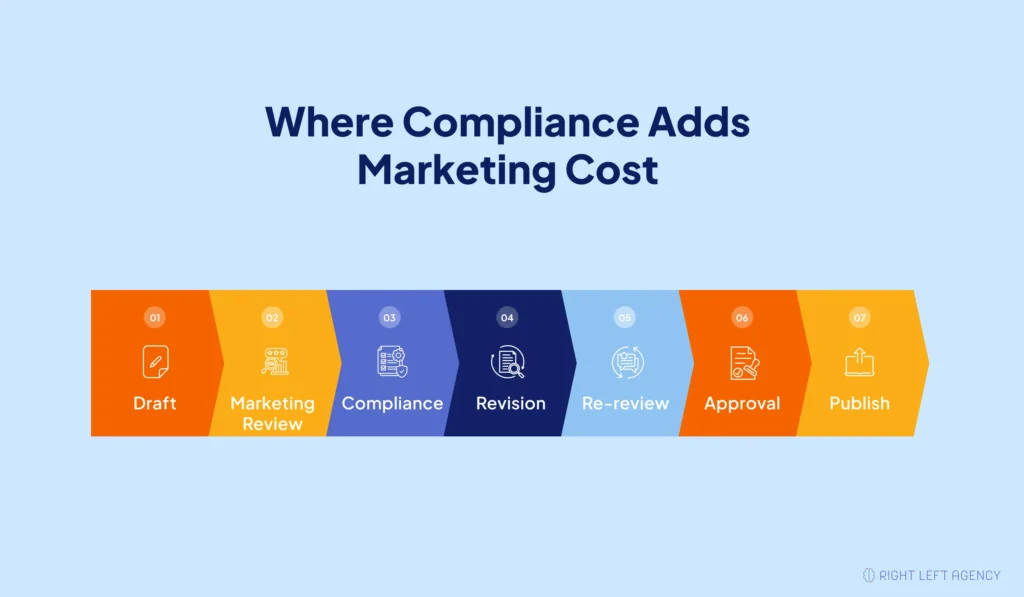
Every additional loop can consume strategy capacity, copywriting time, design hours, internal reviewer time, and calendar time. The agency retainer may remain unchanged while fewer assets reach the market.
Legal and Compliance Review Cycles
Legal and compliance review can increase effective marketing cost even when the review itself is handled internally. An asset may stop moving while feedback is collected, interpreted, revised, and resubmitted. Without defined reviewers and turnaround expectations, more of the monthly marketing capacity can be consumed by coordination instead of new campaign work.
Claim Substantiation and Disclosure Requirements
Financial-services marketing may require more supporting information behind product claims and more care around disclosures. Google, for example, requires specific disclosures for financial products and services, including a physical business address and associated fees where applicable.
For marketing teams, that can mean additional research, source collection, landing-page changes, and review before an asset is ready to launch.
Additional Revision Rounds
Compliance feedback can affect more than one sentence. A changed claim may require updates to the headline, supporting copy, ad variants, creative, disclosure, and landing page.
The cost consequence is cumulative. If a proposal assumes a standard revision process but your internal approvals regularly reopen messaging decisions, the effective cost per approved asset rises.
Senior Strategist Involvement
Regulated or high-scrutiny messaging may require senior marketing judgment earlier in the process.
The strategist may need to identify high-risk claims, simplify technical product language, organize supporting evidence, and align stakeholders before an asset reaches formal review. That does not make the agency a compliance adviser. It means more senior marketing capacity may be needed to reduce avoidable rework.
Ad Platform Financial-Services Verification
Financial-services advertisers may also face platform-specific verification requirements.
Google states that some target locations require additional financial-services verification and that separate verification may be needed for each targeted location. The process can involve information about services, licensing, registration, and other location-specific requirements.
Meta’s current advertising standards similarly state that advertisers promoting financial products and services may be required to verify their business or individual identity and demonstrate authorization.
For fintech paid search, verification should therefore be treated as part of launch planning rather than discovered after campaigns are built.
Multi-Jurisdiction Complexity
Entering more markets can add marketing work even when the underlying product stays the same.
Platform requirements, disclosures, approval processes, available claims, and product positioning can differ by location. That can require separate documentation, campaign structures, landing-page variants, and approval paths.
The cost comes from added execution and coordination—not simply from buying more media.
Compliance Maturity: The Variable That Changes Your Actual Cost
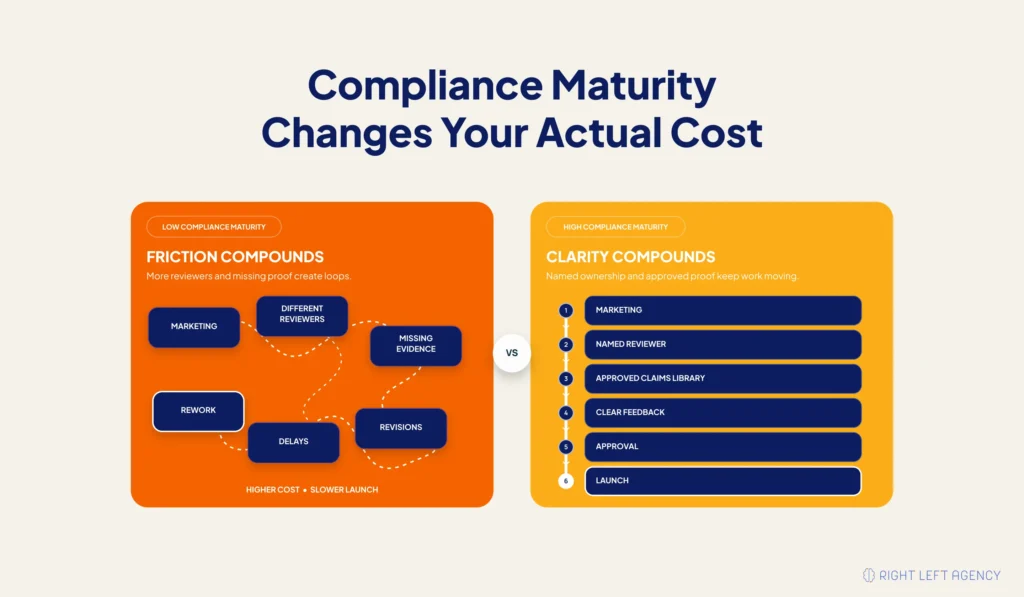
Two fintech companies buying the same agency scope can experience materially different effective costs because their internal approval infrastructure determines how much paid marketing capacity becomes approved work.
Consider a company with low compliance-process maturity.
There is no documented marketing approval workflow. Compliance becomes involved near the end. Reviewers vary by asset. Supporting evidence sits across email, Slack, and shared drives. Previously approved claims are difficult to find.
Marketing creates an asset, feedback arrives late, strategy decisions reopen, and multiple teams repeat work.
Now compare that with an established approval environment.
A named reviewer owns feedback. Review expectations are defined. Common disclosures are accessible. Supporting material for frequently used claims is organized. Marketing knows which messages require early escalation.
Compliance still happens, but less paid capacity disappears into preventable rework.
This is why company stage alone is a weak predictor of fintech marketing cost. A larger fintech with a disciplined review process can sometimes move assets faster than a smaller company with fewer people but no clear approval infrastructure.
The actionable takeaway is simple:
Improving your approval workflow may be one of the lowest-cost ways to improve marketing efficiency.
Before negotiating an agency retainer downward, examine how much of the current marketing budget is being consumed by avoidable internal revisions, unclear ownership, and approval delays.
What Fintech Sub-Vertical You’re In Changes the Number
Your fintech sub-vertical can change marketing cost because product complexity, buyer risk, advertising restrictions, messaging sensitivity, and review requirements vary significantly across fintech categories.
The distinctions below are directional marketing observations, not legal guidance.
| Fintech category | Directional marketing-cost pressure |
|---|---|
| Lending | Greater sensitivity around product terms, claims, disclosures, targeting, and acquisition messaging |
| Wealth and investing | Higher scrutiny around financial claims, performance-related messaging, product explanation, and trust |
| Banking-as-a-Service | Complex B2B messaging, partner dependencies, multiple stakeholders, and potential multi-market coordination |
| Insurtech | Highly dependent on whether the business provides software infrastructure, distribution, or directly promotes financial products |
| Payments | Often technically complex; marketing burden varies significantly between infrastructure products and consumer-facing financial services |
| RegTech | Often driven more by sophisticated B2B messaging, credibility, and technical proof than consumer acquisition requirements |
A B2B payments infrastructure company and a consumer lender can both be called fintech, but their marketing processes may look completely different.
Do not use the fintech label alone to set a budget. Map the actual product, claims, acquisition channels, buyer, target locations, and approval requirements first.
What a Fintech Agency Retainer Usually Does Not Include
A fintech agency retainer may exclude paid media, martech, specialist production, external legal or compliance counsel, significant website development, events, and your internal team’s time.
Those exclusions are important because the agency fee can look comparable to a general B2B engagement while the total program costs much more.
Common additional budget categories include:
- Paid media spend: Money paid directly to advertising platforms.
- Martech and analytics: CRM, automation, attribution, SEO, reporting, experimentation, and analytics software.
- Creative production: Video, motion design, specialist creative, photography, animation, or high-volume campaign production outside normal scope.
- External legal or compliance counsel: Formal regulatory or legal interpretation should not be assumed to sit inside a marketing agency retainer.
- Website development: Landing-page systems, integrations, calculators, tracking implementation, or substantial website changes.
- Events and sponsorships: Sponsorship fees, travel, booths, production, and event creative.
- Internal team time: Product experts, executives, sales, finance, marketing, legal, and compliance may all contribute to campaign execution.
These exclusions are not distributed evenly across every industry.
In fintech, legal coordination, internal review, documentation, and trust-focused production may consume more of the overall investment than they would in a less regulated B2B category. That is why comparing retainers alone can give you the wrong picture.
The Fully Loaded Cost of Fintech Marketing
The fully loaded cost of fintech marketing includes every external and internal resource required to produce, approve, distribute, measure, and improve marketing—not just the agency invoice.
The RLA Total Investment Equation for fintech is:
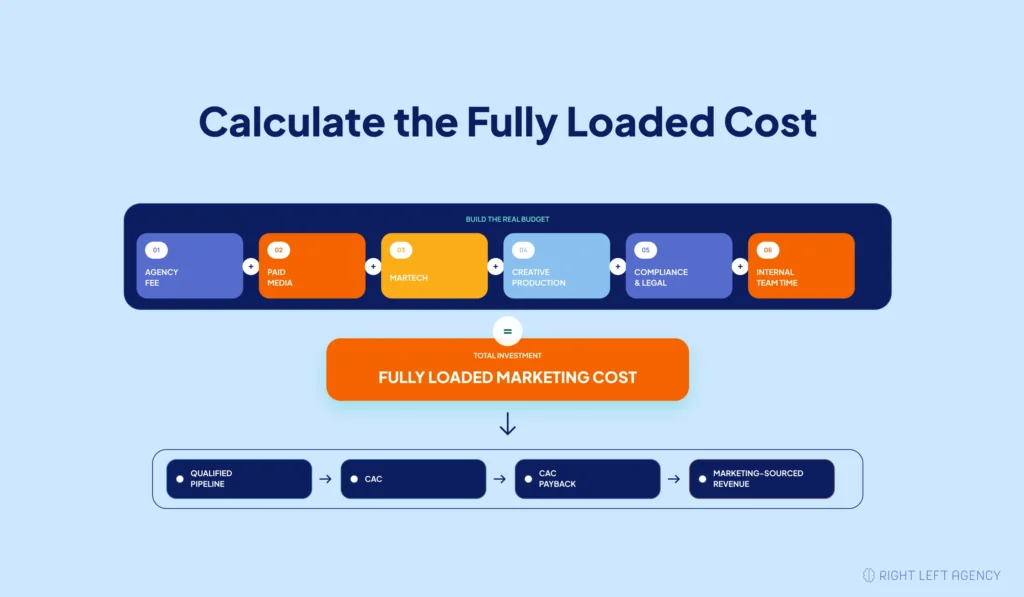
That equation gives you a better basis for evaluating a proposal because it forces excluded costs into the budget discussion.
You should then connect the combined investment to business outcomes through metrics such as qualified pipeline, CAC, CAC payback, cost per qualified opportunity, and marketing-sourced revenue rather than judging the agency fee in isolation.
This is also where connecting marketing spend to pipeline becomes critical.
Three Structural Fintech Budget Models
Because there is no verified RLA fintech budget dataset to support precise dollar allocations, these scenarios show relative weighting rather than invented budget figures.
| Cost category | Lean specialist | Growth-stage multi-channel | Enterprise compliance-heavy |
|---|---|---|---|
| Agency fee | Primary external cost | Significant | Significant |
| Paid media | Low or variable | Moderate to high | High / multi-market |
| Martech | Focused stack | Growing stack | Broad integrated stack |
| Creative production | Limited | Recurring | High-volume / multi-format |
| Compliance and legal | Variable | Material | Major operating consideration |
| Internal team time | High relative to scope | Shared across functions | Distributed across many stakeholders |
| Development | Selective | Recurring | Often substantial |
| Approval complexity | Low to moderate | Moderate | High |
A lean external engagement can still carry a high effective cost if your internal team performs most implementation and coordination.
Likewise, a larger agency retainer may be economically sensible if it replaces fragmented vendors or removes execution gaps.
Compare the entire operating model, not only the invoice.
How to Tell Whether a Fintech Agency Proposal Is Priced Honestly
A fintech agency proposal is priced honestly when it makes approval ownership, compliance-related revisions, exclusions, responsibilities, and timeline dependencies clear before the engagement begins.
The most important hidden variable is often who absorbs compliance friction.
Apply the RLA Proposal Normalization Score by forcing five questions into the open:
- Who manages approvals? Does the agency coordinate directly with reviewers, or does your internal marketing team manage every handoff?
- How are revision rounds treated? Are compliance-driven revisions included, capped, or charged separately?
- Does review coordination consume scoped capacity? Determine whether meetings, documentation, resubmission, and stakeholder management reduce the hours available for execution.
- Who owns claim substantiation? Clarify who supplies evidence and who is responsible for formal legal or compliance decisions.
- What happens when approval blocks a campaign? Does the agency shift to other work, move the timeline, or leave planned capacity unused?
Once those variables are visible, comparing fintech marketing agencies becomes more useful because you are comparing operating models rather than headline retainers.
When the Fintech Specialist Premium Is Worth Paying — and When It Isn’t
A fintech specialist premium is worth paying when fintech-specific execution friction is already creating meaningful rework or slowing growth; it may not be worth paying when regulation is not your primary marketing constraint.
Specialist experience may justify the additional cost when:
- campaigns repeatedly return from internal review with major changes;
- important messaging is being rejected or rewritten late;
- you are entering a new jurisdiction;
- nobody internally has managed regulated acquisition before; or
- product complexity makes clear, defensible messaging difficult.
In those situations, a team familiar with regulated marketing workflows may reduce avoidable iteration.
But “fintech specialist” should not automatically mean “better economic choice.”
A strong generalist B2B growth team may be the better fit when your approval workflow is mature, restrictions are relatively light, and your real constraint is conversion, attribution, channel strategy, or measurement.
If buyers simply do not understand why your product matters, for example, stronger positioning and messaging for regulated products may be more valuable than paying a premium for a fintech label.
Pay for the constraint you actually need solved.
Build the Budget Around the Work That Actually Has to Happen
The right fintech marketing budget accounts for the complete path from strategy to approved execution—not simply the agency retainer.
A lower proposal is not automatically a lower-cost operating model if media, production, review management, technical implementation, and internal time sit outside the fee.
If you are sizing a fintech marketing budget or comparing proposals, Book a Growth Fit Call to get a clearer view of what your scope should realistically require and where your approval workflow may be creating avoidable cost.
FAQ
Fintech agency pricing becomes easier to evaluate when you separate the agency fee from the operating costs and approval requirements surrounding it.
How Much Does a Fintech Marketing Agency Cost Per Month?
There is no single defensible market average. Published benchmarks currently include 4,000–8,000 for Bill Rice Strategy Group’s standalone services and 8,000–15,000 for bundled engagements. CSG reports 3,000–7,000 for smaller providers, 10,000–25,000 for mid-sized agencies, and 30,000–50,000+ for enterprise engagements.
Why Are Fintech Marketing Agencies More Expensive Than General B2B Agencies?
They can be more expensive when the engagement requires additional review coordination, documentation, claim substantiation, senior strategy involvement, platform-policy work, and revision capacity. A premium is not automatically justified, though. Your product, channels, jurisdictions, and internal approval maturity determine how much fintech-specific complexity actually exists.
How Much Does Compliance Add to Fintech Marketing Costs?
There is no reliable universal percentage. Measure the impact through internal reviewer time, external counsel where needed, additional revision rounds, documentation requirements, delayed throughput, senior strategy time, and duplicated work across markets.
Is Ad Spend Included in a Fintech Agency Retainer?
Do not assume it is. Treat media spend as a separate line until the proposal explicitly states otherwise. Also confirm whether creative production, landing pages, analytics implementation, testing, and software are included or billed separately.
What Additional Costs Should a Fintech Company Budget for Beyond the Agency Fee?
Typical additional categories include advertising spend, martech, analytics, specialist creative production, development, external legal or compliance counsel, events, and internal employee time. Which categories matter most depends on your channels, product, approval process, and growth model.
How Long Does Compliance Review Typically Add to a Campaign Timeline?
There is no universal benchmark that applies across fintech. Review time depends on the product, claim, jurisdiction, reviewer availability, documentation quality, and number of revision rounds. Track your own approval cycle by asset type and use that data to establish a realistic internal planning benchmark.
Should an Early-Stage Fintech Hire an Agency or Build In-House?
Choose based on the capabilities and workload you need. An agency can make sense when several specialist skills are needed before there is enough stable work to hire each role internally. For the broader comparison, see agency vs. in-house economics.