

Key Takeaways
- A typical SaaS agency retainer costs $3,000–$15,000 per month.
- The retainer is only one part of your total marketing investment.
- Scope, company stage, sales cycle, channels, and internal resources influence pricing.
- A full-service agency may be a poor investment before product-market fit.
- Agency performance should be judged by qualified pipeline and acquisition economics—not traffic alone.
How Much Does a SaaS Marketing Agency Cost?
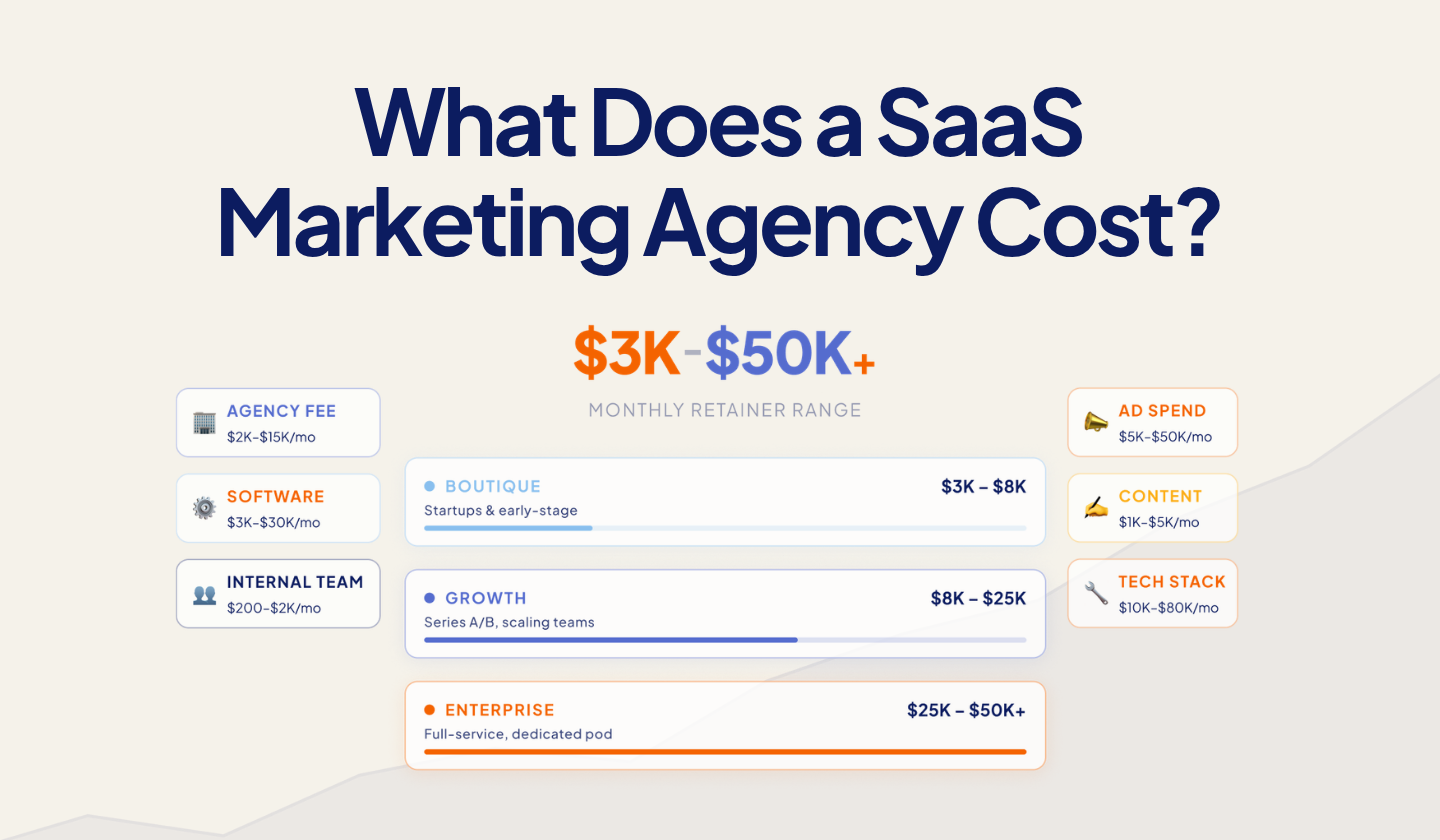
A SaaS marketing agency usually costs $3,000–$15,000 per month, for a flat retainer. Entry-level support may cost $1,250–$5,000, mid-market execution $8,000–$15,000, and enterprise scopes $20,000–$50,000 or more.
A monthly retainer is a fixed recurring fee for an agreed scope. Quotes vary by stage, channels, strategy, seniority, and implementation.
Agency fees do not normally represent the complete marketing budget.
SaaS Marketing Agency Pricing at a Glance
| Engagement level | Indicative monthly cost | Likely buyer | Realistic scope |
|---|---|---|---|
| Entry-level or boutique | $1,250–$5,000 | Early-stage SaaS with a focused need | One specialist channel, advisory support, or limited recurring production. |
| Mid-market or multi-channel | $8,000–$15,000 | Growing SaaS company | Coordinated strategy and execution across several functions |
| Enterprise or complex | $20,000–$50,000+ | Enterprise or multi-market SaaS | Multiple products, markets, teams, channels, and reporting requirements |
These bands overlap because pricing depends on scope, specialist seniority, production volume, and internal support. They are planning ranges rather than rigid agency tiers.
Entry-Level or Boutique Support
A lower-cost engagement usually addresses one defined need, such as SEO planning, paid search management, content strategy, an audit, or advisory support. Your internal team will probably still handle design, writing, development, approvals, implementation, and sales coordination.
Mid-Market Multi-Channel Support
A budget of $8,000–$15,000 per month can support coordinated work across SEO, content, paid media, email, conversion rate optimization, creative, and reporting. Ad spend, software, and major development projects may still sit outside the retainer.
Enterprise and Complex Engagements
Enterprise programs may require coordination across regions, products, customer segments, sales teams, and executive stakeholders. Senior strategists, attribution specialists, dedicated account management, governance, and customized reporting can push the cost above $20,000–$50,000 per month.
What Can a $20,000 Marketing Budget Buy?
A $20,000 marketing budget can mean three very different things. Before judging whether it is enough, clarify whether the number is a one-time amount, an annual budget, or a monthly investment.
| Budget definition | Realistic use |
|---|---|
| $20,000 total | Research, positioning, an audit, setup, or one focused project |
| $20,000 annually | Freelancer support or a tightly limited channel |
| $20,000 monthly | A broader agency team and coordinated multi-channel execution |
$20,000 Total Budget
Best used for research, positioning, analytics setup, an audit, campaign planning, or one focused implementation project—not a sustained multi-channel program.
$20,000 Annual Budget
At roughly $1,667 per month, this can support a freelancer, advisor, limited content production, or one narrow service with strong internal ownership.
$20,000 Monthly Budget
This can support coordinated strategy and execution across several disciplines, although media spend, software, and major development may remain separate.
What Is the Total Cost of Hiring a SaaS Marketing Agency?
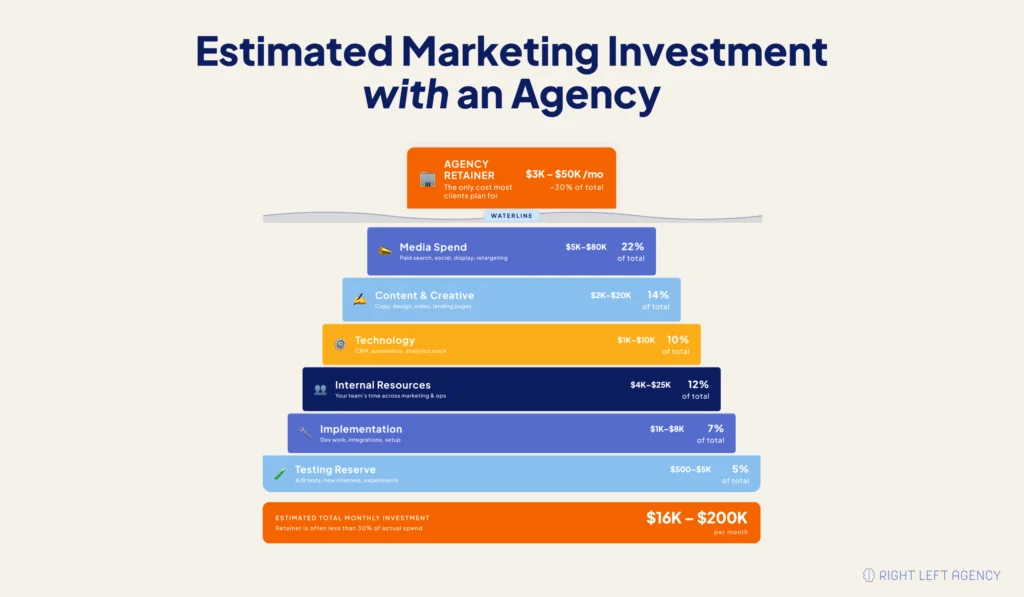
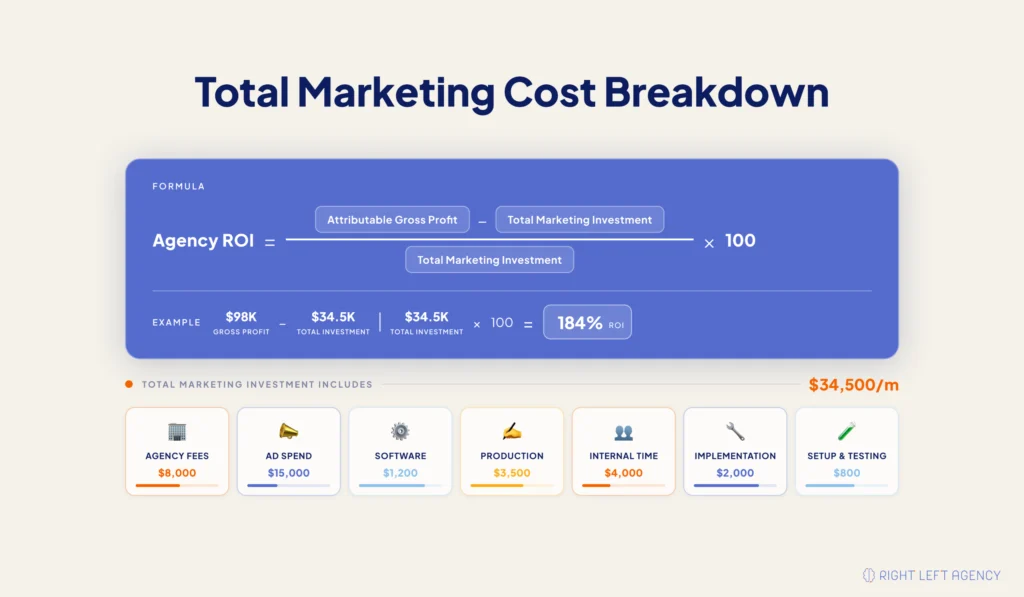
The real cost of an agency engagement includes every resource needed to plan, launch, manage, and improve the program.
Total marketing investment = agency fees + media spend + technology + production + internal resources + implementation + testing reserve
A low monthly retainer can still become expensive when your team must purchase extra software, hire separate creatives, or complete all technical implementation independently.
Agency Fees Versus Working Media
Working media is the money paid directly to platforms such as Google Ads or LinkedIn Campaign Manager. It is separate from the agency’s management fee.
Some paid-media agencies charge a flat retainer, while others calculate their management fee as a percentage of ad spend. An indicative range is 10%–20%, depending on campaign size, channel complexity, and service scope.
For example, a $20,000 monthly media budget could create a separate management fee of $2,000–$4,000. Ask whether the fee automatically increases with ad spend and how the agency protects acquisition efficiency as budgets rise.
Technology, Production, and Internal Costs
Your total budget may also need to cover:
- A customer relationship management system such as HubSpot or Salesforce
- Marketing automation software
- SEO and analytics platforms
- Content writing and editing
- Design and creative production
- Landing-page or website development
- Conversion tracking
- Reporting dashboards
- Internal reviews and approvals
- Sales-team coordination
- Campaign testing
Internal time is easy to overlook. Someone still needs to provide product knowledge, approve campaigns, answer agency questions, coordinate with sales, and make sure recommendations are implemented.
When approvals take weeks or tracking remains incomplete, the business loses money even if the monthly retainer does not change.
Setup, Onboarding, and Project Costs
Some costs appear before the monthly work begins.
Indicative pricing ranges used for budget planning include:
| Project | Indicative cost |
|---|---|
| Website audit | $1,500–$5,000 |
| Marketing automation implementation | $7,500–$30,000 |
| Brand repositioning | $10,000–$50,000 |
Before signing, ask the agency to separate onboarding, strategy, tracking, integrations, and implementation in its quote.
What Pricing Models Do SaaS Marketing Agencies Use?
SaaS agencies use several pricing models, including monthly retainers, fixed projects, channel-specific fees, hourly consulting, fractional leadership, percentage-of-spend pricing, performance arrangements, and hybrid agreements.
| Pricing model | Best fit | Main advantage | Main risk |
|---|---|---|---|
| Monthly retainer | Ongoing execution | Predictable monthly cost | Scope limitations |
| Fixed project | Defined initiative | Clear outcome and timeline | No ongoing optimization |
| Channel-specific retainer | One specialist discipline | Focused expertise | Limited cross-channel coordination |
| Percentage of ad spend | Paid-media management | Fee scales with campaign size | Incentive to increase spend |
| Hourly or fractional | Strategic guidance | Flexible access to senior expertise | Limited execution |
| Performance-based or hybrid | Measurable commercial outcomes | Partial incentive alignment | Attribution disputes |
Flat Monthly Retainer
A monthly retainer fits continuous execution and optimization. The agreement should define deliverables, responsibilities, deadlines, exclusions, reporting, and approval requirements. It should also explain how scope changes are handled. A change order is a formal adjustment to the agreed work, timeline, or price.
Project-Based or Fixed-Fee Pricing
Fixed-fee pricing fits work with a clear beginning, output, and completion point, such as research, positioning, a marketing audit, website development, analytics setup, automation implementation, or go-to-market planning. The proposal should define completion criteria, revisions, implementation ownership, and post-project support.
Channel-Specific Retainers and Percentage of Ad Spend
A channel-specific engagement may focus on SEO, content, Google Ads, LinkedIn, or conversion optimization. Paid-media agencies may charge a flat fee or a percentage of media spend. When fees rise with the budget, ask how the agency will control customer acquisition cost and prevent unnecessary spending.
Hourly, Advisory, and Fractional Pricing
Hourly consultants and fractional leaders are useful when the company needs senior strategic direction rather than a full execution team. A fractional chief marketing officer may support positioning, planning, budgeting, team structure, and channel selection, but the company may still need specialists to implement the recommendations.
Performance-Based, Revenue-Share, and Hybrid Pricing
Performance pricing links part of the agency’s compensation to an agreed outcome. The contract should define what counts as a qualified result, the attribution method, data ownership, the sales team’s role, the credit period, and how compensation works when marketing creates a pipeline that sales does not close.
What Factors Affect SaaS Marketing Agency Pricing?
Agency quotes are shaped by your company stage, annual recurring revenue, funding, runway, annual contract value, sales cycle, target market, channel count, existing assets, internal resources, and required level of senior support.
SaaS Stage, ARR, Funding, and Runway
Annual recurring revenue (ARR) is the normalized yearly value of recurring subscription revenue. A company validating its product may need positioning and channel testing, while a growth-stage company may need multi-channel demand generation, lifecycle marketing, conversion optimization, and attribution. Runway determines how long the company can support the program before judging results.
ACV, Sales Cycle, and Go-to-Market Motion
Annual contract value (ACV) is the average annual revenue generated by a customer contract. Higher ACV can justify a larger acquisition budget, but enterprise deals often take longer and involve more decision-makers. Product-led and sales-led companies also require different channels, conversion points, and measurement systems.
Number of Channels and Service Complexity
A single-channel engagement usually costs less than a coordinated program involving SEO, content, paid media, LinkedIn, email, CRO, design, automation, and analytics. Costs rise further when campaigns require new messaging, landing pages, tracking, CRM integration, and sales-process changes.
Existing Team, Assets, and Implementation Capacity
A capable internal team and strong existing infrastructure can reduce agency workload. Useful assets include customer research, clear positioning, existing content, design support, reliable tracking, a configured CRM, development capacity, and an efficient approval process. Weak infrastructure, delayed decisions, or limited implementation capacity increase the work required and slow results.
Agency Team Seniority and Contract Structure
Two agencies may propose similar deliverables but assign very different teams. Compare who will perform the work, how often senior staff will participate, the contract length, cancellation terms, and the process for changing scope.
What Should a SaaS Marketing Agency Retainer Include?
A strong retainer clearly defines strategy, execution, deliverables, team access, reporting, ownership, communication, exclusions, and success metrics.
Strategy and Research
The strategic work may include:
- Customer interviews
- Competitor research
- Ideal customer profile development
- Buyer personas
- Positioning and messaging
- Go-to-market planning
- Channel strategy
- Content planning
- Measurement design
Ask whether this work is included in the monthly retainer, completed during onboarding, or sold as a separate project.
Channel Execution and Production
Execution may include SEO, content, paid search, LinkedIn advertising, email, lead nurturing, CRO, creative, landing pages, and automation. Ask for specific production volumes and confirm who publishes the work, handles technical changes, and approves deliverables.
Analytics, Attribution, and Reporting
The scope may cover:
– Google Analytics 4 and Google Search Console
– CRM integration and conversion tracking
– Reporting dashboards
– Pipeline attribution and revenue reporting
Your company should retain access to its accounts, historical data, and reporting infrastructure.
Team Structure, Deliverables, and Governance
A complete proposal should identify the lead strategist, account manager, channel specialists, deliverable volume, approval responsibilities, meeting frequency, reporting cadence, and escalation process. Confirm whether the senior team involved in the sales process will remain active after the contract begins.
Costs and Responsibilities Commonly Excluded
Common exclusions include:
- Advertising spend
- Premium software
- Large website-development projects
- Additional creative production
- Third-party vendors
- Travel and workshops
- Work outside the agreed scope
- Urgent requests
These exclusions should be visible before signing.
How Do SaaS Marketing Costs Vary by Service?
Different marketing services require different skills, tools, production resources, and implementation support. That is why a SaaS SEO engagement cannot be priced in the same way as a brand repositioning project or a paid-media program.
SaaS SEO and Content Marketing
SaaS SEO may include technical work, keyword strategy, content, internal linking, landing-page optimization, and reporting.
There is no single standard price or cost-per-lead benchmark for SaaS SEO. Both depend on technical complexity, content investment, market competition, implementation scope, lead quality, and the attribution period used.
SaaS SEO cost per lead = total SEO investment ÷ leads attributed to organic search
Also track cost per qualified lead, opportunity, and closed customer.
Paid Search, LinkedIn, and Paid Social
Separate campaign-management fees from media spend, creative, landing pages, tracking, and testing. Costs rise with channel complexity, campaign volume, reporting needs, and production requirements.
Demand Generation, Email, and Marketing Automation
Demand generation may combine demand capture, nurturing, sales enablement, automation, and pipeline reporting.
To estimate the annual cost, use:
Annual program cost = 12 months of agency fees + media + technology + production + implementation + internal resources
Marketing automation implementation may cost $7,500–$30,000, depending on system complexity and integrations.
CRO, Landing Pages, and Website Development
CRO may include journey analysis, testing plans, analytics, landing pages, and website changes. A $1,500–$5,000 website audit may identify problems, but implementation usually requires a separate budget.
Positioning, Product Marketing, and Brand Strategy
Positioning may include customer research, competitive analysis, messaging, differentiation, and sales enablement. Brand repositioning may cost $10,000–$50,000 and is often most valuable before scaling acquisition.
Analytics, Attribution, and Reporting
Measurement work may require CRM integration, conversion tracking, attribution rules, dashboards, and pipeline analysis. Confirm who builds the system, pays for tools, and owns the data.
How Much Should SaaS Companies Budget by Growth Stage?
Early-stage SaaS companies may invest approximately 12%–25% or more of ARR, growth-stage companies may invest 10%–20%, and mature companies may invest 5%–15%.
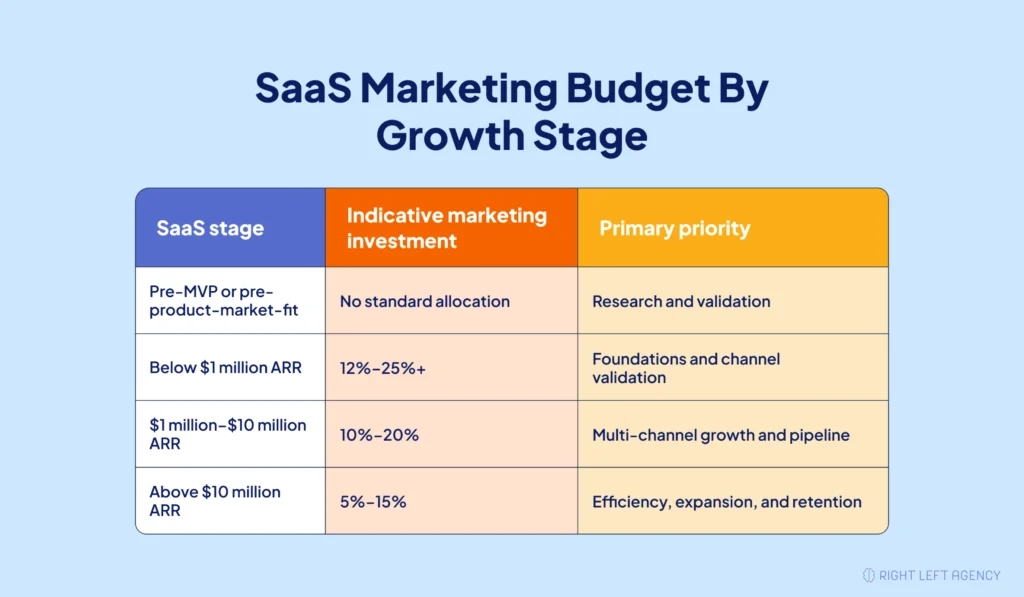
These ranges refer to total marketing investment—not agency fees alone.
| SaaS stage | Indicative marketing investment | Primary priority |
|---|---|---|
| Pre-MVP or pre-product-market-fit | No standard allocation | Research and validation |
| Below $1 million ARR | 12%–25%+ | Foundations and channel validation |
| $1 million–$10 million ARR | 10%–20% | Multi-channel growth and pipeline |
| Above $10 million ARR | 5%–15% | Efficiency, expansion, and retention |
Pre-MVP and Pre-Product-Market-Fit SaaS
Prioritize customer, problem, product, positioning, and sales validation. A focused project, advisor, or fractional leader may be more appropriate than a full-service agency.
Early-Stage SaaS Below $1 Million ARR
Concentrate resources on positioning, analytics foundations, demand capture, and one or two promising acquisition channels.
Growth-Stage SaaS at $1 Million–$10 Million ARR
Broader demand generation, CRO, lifecycle marketing, and attribution may be appropriate. Reporting should connect activity to pipeline, revenue, CAC, and payback.
Mature or Enterprise SaaS Above $10 Million ARR
Budgets often shift toward efficiency, retention, expansion, market leadership, and multi-market execution.
Illustrative Channel Allocation
These ranges overlap. They are planning guides, not a universal formula that automatically totals 100%.
| Channel | Illustrative allocation |
|---|---|
| Paid acquisition | 20%–35% |
| SEO and content | 15%–35% |
| Account-based marketing | 15%–25% |
| Email and lifecycle | 10%–20% |
| MarTech and AI tools | 5%–10% |
Paid acquisition supports demand capture and testing. SEO and content build long-term visibility. Account-based marketing targets high-value accounts. Email and lifecycle support nurturing, retention, and expansion. Technology supports CRM, automation, analytics, attribution, and reporting.
Is Your SaaS Company Ready to Hire a Marketing Agency?
A SaaS company is more likely to benefit from an agency when it has product-market fit, a clear ideal customer profile, stable positioning, customer evidence, sales capacity, reliable analytics, implementation resources, and an internal owner.
Agency-Readiness Checklist
Your company should be able to answer yes to most of these questions:
Has the product shown evidence of product-market fit?
Can you describe your best-fit customer clearly?
Is your positioning stable enough to guide campaigns?
Do existing customers provide evidence of value?
Has someone successfully sold the product?
Can sales process and close more opportunities?
Is conversion tracking in place?
Is there budget beyond the agency fee?
Can someone manage approvals and decisions?
Can the business implement recommendations?
Does the runway support the expected channel timeline?
When You Should Not Hire a Full-Service Agency Yet
Do not hire a full-service agency when:
The product is still pre-MVP.
The target customer remains unclear.
Positioning changes every few weeks.
No one has sold the product successfully.
Sales cannot follow up with new demand.
The retainer would consume the complete budget.
There is no internal owner.
The company cannot implement the work.
An agency can improve and scale a working business model. It cannot invent one on the founder’s behalf.
What to Prepare Before Requesting Proposals
Prepare the following information before approaching agencies:
Current ARR and growth stage
Revenue or pipeline objective
ACV and sales cycle
Ideal customer profile
Target markets
Current marketing performance
Existing content, creative, and website assets
CRM and analytics setup
Internal responsibilities
Available agency budget
Available media and implementation budget
Expected timeline
Agency vs. Freelancer vs. Fractional Leader vs. In-House Team
Agencies, freelancers, fractional leaders, and in-house teams solve different problems. Choose based on the type of help you need—not on which option appears cheapest at first glance.
| Model | Best fit | Main advantage | Main risk |
|---|---|---|---|
| Fractional leader | Strategic direction | Senior guidance without full-time hire | Limited execution capacity |
| Freelancer | Narrow specialist need | Focused expertise and lower overhead | More internal coordination |
| SaaS agency | Broader execution | Access to several specialists | Higher cost |
| In-house team | Long-term ownership | Deep product and customer knowledge | Recruitment time and skill gaps |
Advisor or Fractional Marketing Leader
Choose this model when your company needs clearer decisions, stronger planning, or help building an internal marketing function.
Marketing Freelancer
A freelancer works well when the need is focused, such as content writing, design, PPC management, or technical SEO.
SaaS Marketing Agency
An agency fits a company with defined goals that needs coordinated execution across several marketing disciplines.
In-House Marketing Team
An in-house team makes sense when the company needs long-term ownership, deep product knowledge, and enough ongoing work to justify permanent specialists.
When an Agency Is Financially Better
An agency may be more cost-effective when:
- You need several specialist skills.
- Recruiting a full team would take too long.
- Managing several freelancers would create too much complexity.
- Your strategy is clear, but execution capacity is limited.
- The likely pipeline value can justify the complete investment.
How Should SaaS Companies Calculate Agency ROI?
Agency return on investment should be measured against total marketing investment and the gross profit, pipeline, or revenue connected to the program.
Traffic and clicks can help diagnose performance, but they are not the final return.
Backsolve the Budget From Pipeline Targets
Define the ARR or Revenue Goal
Start with the financial result the marketing program needs to support.
Separate new-customer revenue, expansion revenue, and retention goals when they require different activities.
Calculate Required Closed Customers
Divide the revenue target by the average contract value.
For example, an illustrative $1 million ARR target with a $25,000 ACV requires 40 new customers.
Calculate Required Opportunities
Apply the expected win rate.
At a 20% opportunity-to-customer win rate, 40 customers would require about 200 qualified opportunities.
Estimate the Required Marketing Investment
Work backward from the number of opportunities and customers required.
Compare the expected acquisition cost with your gross margin, available runway, customer lifetime value, and acceptable payback period.
Use SaaS Financial and Pipeline Metrics
LTV-to-CAC Ratio
A 3:1 LTV-to-CAC ratio is commonly used as a planning benchmark, although the appropriate target depends on gross margin, retention, and growth stage.
CAC Payback Period
Customer acquisition cost payback measures how long it takes gross profit to recover the cost of acquiring a customer.
A reasonable planning guideline suggests less than 12 months, with some venture-backed companies targeting approximately 8–10 months.
Cost per Lead, Qualified Lead, and Opportunity
Cost per lead can look efficient even when the leads are unlikely to buy.
Cost per qualified lead and cost per opportunity provide better commercial context.
Marketing-Sourced Pipeline and Revenue
Track:
- Qualified opportunities
- Pipeline value
- Marketing-sourced revenue
- Win rate
- Pipeline velocity
- Gross margin
- Break-even point
- Customer acquisition cost
- CAC payback
Set Realistic Timelines by Channel
Paid Search and Paid Social
Paid channels may provide useful conversion data within one to three months.
The quality of that data depends on tracking, budget, targeting, creative, offer strength, landing pages, and sales follow-up.
SEO and Content
SEO and content may need six to twelve months to build meaningful ranking and pipeline momentum.
Organic performance often compounds, which makes it difficult to judge using short reporting periods.
CRO, Lifecycle, and Strategic Foundations
Conversion work, positioning, analytics, and lifecycle marketing may improve future performance without creating immediate last-click revenue.
Address Attribution Challenges
Attribution is the method used to assign credit for a conversion or revenue outcome.
SaaS buying journeys are rarely simple. A prospect may read several articles, see an ad, attend a webinar, speak with sales, and return through a branded search before buying.
Use CRM data, campaign tracking, multi-touch reporting, and self-reported attribution where appropriate.
How Agency Performance Should Be Measured
Review performance in this order:
- Tracking and implementation milestones
- Leading channel indicators
- Qualified leads and opportunities
- Marketing-sourced pipeline
- Marketing-sourced revenue
- Customer acquisition cost
- CAC payback
- LTV-to-CAC ratio
- Retention and expansion metrics
How to Compare SaaS Marketing Agency Proposals
Compare proposals using the complete investment, service scope, team seniority, implementation responsibilities, measurement system, ownership terms, and contract risk.
The lowest monthly fee is not always the lowest-cost option.
Normalize the Total Cost
For every proposal, document:
- Monthly or project fee
- Setup and onboarding
- Media-management fees
- Required advertising spend
- Technology costs
- Production costs
- Implementation
- Internal resources
- Minimum contract term
- Change-order rules
Calculate the full 12-month investment when comparing ongoing engagements.
Compare Scope and Team Seniority
Look at:
- Access to strategy
- Named specialist roles
- Senior involvement
- Channel coverage
- Deliverable volume
- Reporting
- Account management
- Implementation ownership
A more expensive proposal may create less operational risk when it includes the right specialists and implementation support.
Review Contract, Ownership, and Data Terms
Check:
- Cancellation terms
- Notice periods
- Advertising account ownership
- Analytics access
- CRM and data ownership
- Intellectual-property rights
- Exclusivity
- Service expectations
Your company should retain access to its accounts, content, creative assets, reporting history, and customer data.
Look for Evidence Relevant to SaaS
Relevant proof may include:
- SaaS experience
- Similar ACV or sales cycles
- Comparable go-to-market models
- Client references
- Pipeline or revenue outcomes
- Transparent reporting
- Familiarity with product-led or sales-led growth
Traffic growth alone does not prove that the agency can generate commercially useful demand.
Warning Signs of an Unsuitable Agency
Be cautious when an agency:
- Promises traffic without discussing pipeline
- Ignores your ideal customer profile
- Does not ask about positioning
- Hides deliverables behind vague language
- Uses senior people to sell and junior people to deliver
- Limits access to performance data
- Owns your advertising accounts
- Guarantees ROI without an attribution agreement
- Pushes higher media spend without CAC safeguards
Proposal summary: Compare what the agency will own, what your team must provide, and the total program cost. A cheap quote can become expensive when critical work is excluded.
How to Choose the Right Budget and Engagement Model
Choose your budget and engagement model by confirming readiness, defining the commercial goal, assigning responsibilities, calculating the complete investment, and comparing each proposal against pipeline and payback potential.
Step 1 — Confirm Company Readiness
Validate product-market fit, your ideal customer profile, positioning, customer evidence, sales capacity, tracking, budget, and internal ownership.
Step 2 — Define the Required Business Outcome
Choose the primary objective:
- Build strategic foundations
- Create demand
- Capture existing demand
- Generate qualified pipeline
- Scale an established channel
- Improve retention or expansion
Step 3 — Select Required Services and Internal Owners
Decide what the agency will manage and what remains with founders, sales, product, development, and internal marketing.
Do not buy every channel when one bottleneck is holding back growth.
Step 4 — Calculate Total Marketing Investment
Add agency fees, media, technology, production, internal time, implementation, and testing.
Make sure enough money remains to execute the strategy after paying the retainer.
Step 5 — Compare Proposals Against ROI Potential
Evaluate complete cost, scope, team, relevant evidence, ownership, contract terms, pipeline potential, customer acquisition cost, and payback.
Choose a Budget That Can Support the Work
The right SaaS marketing budget should fund more than the agency retainer. It should also cover the media, tools, production, implementation, and testing needed to turn strategy into results.
Before committing, compare the complete investment with your growth stage, ACV, pipeline target, customer acquisition cost, runway, sales capacity, and acceptable payback period.
Request a SaaS Marketing Budget Assessment
Review your company stage, growth model, internal team, priority channels, approximate budget, and current pipeline challenge before selecting an agency.
Frequently Asked Questions About SaaS Marketing Agency Costs
What Is the Average Cost of a SaaS Marketing Agency?
An indicative SaaS marketing agency retainer is $3,000–$15,000 per month.
Boutique engagements may start around $1,250 per month, while enterprise programs may exceed $20,000–$50,000 per month. The total marketing investment is usually higher than the retainer.
What Is the Average Marketing Budget for a SaaS Company?
For budget-planning purposes, SaaS companies may use the following indicative ranges: approximately 12%–25% or more of ARR for early-stage companies, 10%–20% for growth-stage companies, and 5%–15% for mature SaaS businesses.
These percentages apply to total marketing investment.
Does a SaaS Marketing Agency Retainer Include Ad Spend?
Ad spend is commonly separate from the agency fee.
Also check whether the proposal excludes software, content production, design, landing pages, analytics, and testing.
How Much Does a SaaS PPC Agency Cost?
A SaaS PPC agency may charge a flat retainer, a channel-specific fee, or approximately 10%–20% of media spend.
Advertising spend and creative production may be additional.
How Much Does a SaaS SEO Agency Cost?
There is no single standard price for SaaS SEO. Costs vary based on website complexity, content requirements, implementation needs, reporting scope, and the level of specialist support required.
The cost depends on technical complexity, content volume, implementation, reporting, website size, and required tools.
How Long Does It Take to See ROI?
Paid channels may produce actionable data within one to three months.
SEO and content may require six to twelve months to build meaningful momentum. Neither timeline guarantees a positive return.
Should an Early-Stage SaaS Company Hire an Agency?
Readiness matters more than company age.
A full-service agency may be premature when the company lacks product-market fit, a defined customer, stable positioning, sales capacity, implementation resources, or enough runway.