

Key Takeaways
- SaaS SEO needs to deliver more than rankings — think traffic, signups, demos, and sales.
- Product, feature, use-case, and comparison pages are your highest-intent growth pages.
- Technical SEO is what lets search engines crawl and index your pages in the first place.
- Topic clusters build authority around product problems and buyer pain points.
- SEO reporting should tie organic traffic back to pipeline and sales, not just visibility.
Who This Checklist Is For
This checklist is for teams that want organic growth tied to revenue, not just to rankings. It’s built for SaaS founders, CMOs, growth marketers, and SEO teams who need more qualified traffic, signups, demos, or trials — not just clicks.
It works whether you’re product-led or sales-led, and it adapts across stages: early-stage teams can use it to fix technical and content foundations, growth-stage teams can use it to scale product, feature, and comparison pages, and mature teams can use it to sharpen attribution, authority, and revenue reporting.
The goal never changes: turn search visibility into growth you can actually measure.
Why Does SaaS Need a Different Checklist?
SaaS buyers don’t convert on the first visit. They dig in, comparing tools, checking integrations, pulling in a manager or a procurement team before anyone signs anything. That’s the real reason SaaS SEO can’t run on the same playbook as a typical content site.
Traditional SEO is mostly built for visibility and early-stage leads: rank, get clicks, capture an email. SaaS SEO has to carry buyers through education and evaluation and still get credit for the revenue at the end of that chain.
In practice, that means a SaaS SEO strategy is doing two jobs at once — creating demand among people who haven’t started searching yet and winning the buyers who are already mid-comparison.
| Page Type | Funnel Stage | Why It Matters |
|---|---|---|
| Blog content | TOFU | Builds authority on buyer pain points and creates problem awareness |
| Use-case pages | MOFU | Align to pain-point searches from real teams and workflows |
| Feature pages | MOFU/BOFU | Capture searches from buyers who already know what they’re looking for |
| Integration pages | MOFU/BOFU | Pull in demand from connected software ecosystems |
| Comparison pages | BOFU | Help buyers compare SaaS tools before purchasing |
| Alternative pages | BOFU | Bring in buyers actively considering switching products |
| Signup paths | BOFU | Convert qualified visitors into trials and demos |
How to Use This SaaS SEO Checklist
Don’t just work down this list top to bottom. Rank tasks by impact, difficulty, and where your business actually is right now. If you’re early-stage, fix technical and conversion issues before anything else. Past that stage, the bigger lever is usually expanding BOFU pages and topic clusters.
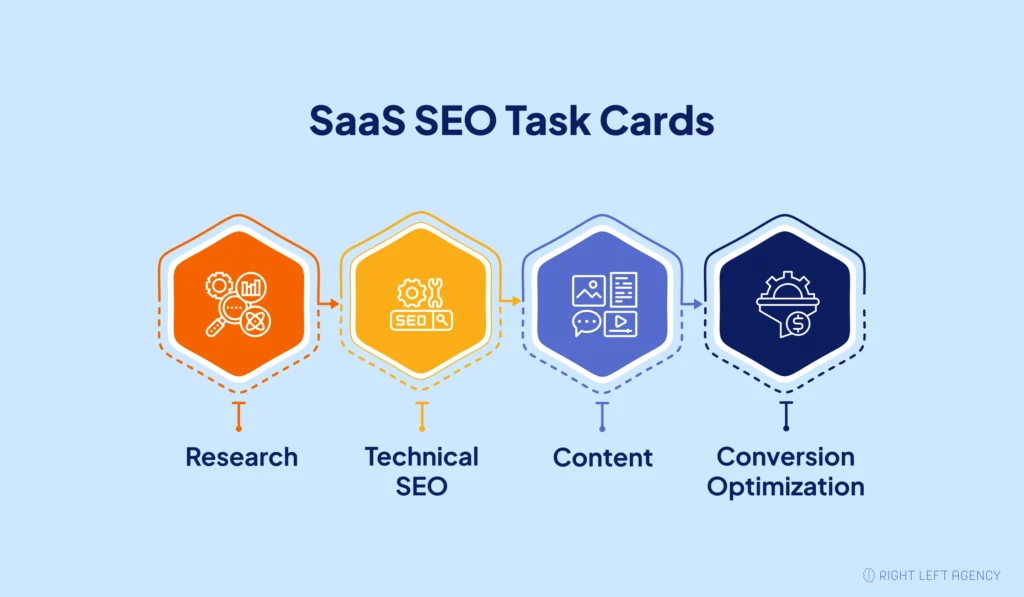
Once a team is more mature, the priorities shift again toward attribution, authority, and original research. Treat this less like a checklist you finish once and more like a plan you keep coming back to.
| Priority Type | Meaning | Best For |
|---|---|---|
| Quick Win | Fast fix, instant effect | Initial SEO improvements |
| High Impact | Strong effect on signups or rankings | Priority execution |
| Growth Catalyst | Enables long-term organic growth | Scaling SaaS SEO |
| Advanced | Needs more time or expertise | Established SaaS teams |
Use it for audits, for planning, for execution — whatever stage you’re in. Just revisit it monthly, because your product, your competitors, and the market underneath you won’t sit still.
SaaS SEO Strategy Checklist
Strategy comes before keywords, content, or backlinks — not after. Without clear business goals, a real sense of who the buyer is, and defined conversion targets, you’re optimizing in a vacuum.
Get the strategy right, and SEO starts pulling its weight on acquisition, not just awareness. It also permits you to ignore rankings that look good on a report but never actually touch the funnel.
- Set a primary SEO goal tied to signups or revenue, not just rankings.
- Profile your ideal buyer before you start chasing keyword opportunities.
- Tie SEO goals to pipeline, ARR, MRR, CAC, and LTV.
- Separate top-of-funnel (TOFU), middle-of-funnel (MOFU), and bottom-of-funnel (BOFU) opportunities before building pages.
- Audit what’s already ranking — traffic, conversions, revenue, all of it.
- Build a roadmap and score it by impact and difficulty.
Every keyword and content decision should trace back to your ICP. A CRM tool and a cybersecurity platform are chasing completely different intent: one’s after sales-pipeline searches while the other’s after compliance and risk terms. Treat them the same, and you’ll waste a lot of content.
Do this well, and SEO stops being a side project; it becomes something an executive can actually tie to revenue.
SaaS Keyword Research Checklist
SaaS keyword research falls apart fast if it stays stuck on informational blog topics. Buyers search by problem, by feature, by workflow, by competitor name, and by tool. A solid B2B keyword checklist needs to cover all of those angles, not just the ones with the highest search volume.
- Research problem-aware terms that expose real, urgent buyer pain.
- Identify product-aware phrases that signal someone’s actively shopping.
- Map feature-based keywords to specific product capabilities.
- Build keyword lists around target industries, teams, workflows, and roles.
- Build alternative and comparison keyword lists for purchase-intent searches.
- Find integration and template keywords tied to your SaaS ecosystem.
- Map every keyword to its funnel stage and the page type it belongs to.
Think about what that actually looks like. A project management tool might chase “agency project management software” or “alternatives to Asana.” A marketing automation platform might go after “email automation tools” or “HubSpot Mailchimp integration.” An accounting SaaS is probably better served by invoice, payroll, and reporting keywords — unglamorous searches, but ones that usually mean someone’s close to buying.
Volume is the wrong thing to optimize for here. A low-volume BOFU keyword will often out-convert a high-volume TOFU term many times over.
Technical SEO Checklist for SaaS Websites
Technical SEO‘s job is simple to describe and annoying to execute: make sure search engines can actually crawl, render, and index your important pages. No amount of good writing fixes a page that Google can’t see properly.
And SaaS sites get complicated fast — feature pages, templates, filters, integration pages, documentation. Each of those needs its own technical attention; none of them behave like a normal blog post.
- Confirm crawlability and run a monthly indexation check in Search Console.
- Fix broken internal links that are quietly wasting crawl budget and authority.
- Improve Core Web Vitals on product and landing pages specifically.
- Make sure JavaScript-rendered content is actually visible to search engines.
- Clean up duplicate title tags and meta descriptions across similar pages.
- Review canonical tags wherever pages are duplicate or near-duplicate.
- Submit a clean XML sitemap through Search Console.
- Fix the pages closest to signups or demos first, not the easiest ones.
That means product, feature, comparison, alternative, and pricing pages go to the front of the line. A fast, crawlable page is good for rankings and good for the person trying to evaluate your product. There’s no tradeoff here.
SaaS Website Architecture Checklist
Good architecture does double duty: it helps users understand what your product actually does, and it helps search engines understand the same thing. Internal linking, topical authority, and conversion paths all get easier with a clean structure underneath.
The simplest way to think about it is a framework built around buyer intent, where problems, features, use cases, and solutions link into each other instead of sitting in isolation.
- Organize pages around product, feature, use case, industry, and intent.
- Use a URL structure that tells you what the page is about before you click it.
- Build topic clusters around your highest-value SaaS problems.
- Link supporting content into the relevant product and feature pages.
- Keep priority pages within three clicks of the homepage.
| Page Type | Example URL |
|---|---|
| Features hub | /features/ |
| Feature page | /features/automation/ |
| Use-case hub | /use-cases/ |
| Use-case page | /use-cases/agencies/ |
| Comparisons hub | /comparisons/ |
| Alternatives hub | /alternatives/ |
| Integrations hub | /integrations/ |
| Templates hub | /templates/ |
The payoff is twofold: buyers find what they need faster, and Google understands how your pages relate to each other. A blog post should link into the feature page it supports. That feature page should lead somewhere: a use case, an integration, a signup.
On-Page SEO Checklist
On-page SEO has to satisfy two very different readers at once — the algorithm and the actual human deciding whether to sign up. Every page needs to match intent, make the value obvious, and point toward a next step.
None of this should read like it was written for keywords first and people second. What actually works on a SaaS page is clarity, proof, a clear sense of value, and a CTA that isn’t buried.
- Write natural, keyword-aligned title tags, and use H1/H2 consistently across pages.
- Open with an introduction that matches what the searcher actually came for.
- Add internal links to related product and resource pages.
- Write real, descriptive alt text — not just the keyword stuffed in.
- Use schema markup where it genuinely improves clarity, not everywhere.
- Add CTAs to high-intent pages instead of leaving visitors to figure out next steps themselves.
What that looks like in practice: a feature page explains what the feature does and what it actually changes for the business. A comparison page names real, specific differences instead of vague positioning. A use-case page walks through the problem, the workflow, and the fix so the reader understands the value before pricing even comes up.
SaaS Content Strategy Checklist
A real content strategy covers the whole buyer journey. Education, comparison, validation, and the final push to act.
Generic blog content rarely converts on its own. If there’s no clear line back to the product, it’s just traffic. The connection between the buyer’s problem and your solution needs to be built into the content, not tacked on at the end.
- Create TOFU content that actually educates problem-aware buyers, not just SEO bait.
- Develop MOFU material for buyers who already know they need a solution and are comparing approaches.
- Build BOFU comparison and alternative pages for people in active buying mode.
- Create industry and use-case pages for the specific segments you’re targeting.
- Build integration and template pages to capture ecosystem-based demand.
- Refresh stale content on a schedule, before a competitor quietly takes your spot.
An HR platform probably builds around onboarding and retention. A finance tool leans into reporting and reconciliation. A cybersecurity company builds authority on compliance and risk. The common thread: whatever you’re educating people on should circle back to why your product matters.
Content also decays quietly if you ignore it. Screenshots go stale, data ages out, internal links rot; keeping that refreshed protects rankings you’d otherwise lose without noticing.
Product-Led SEO Checklist
Product-led SEO connects organic search directly to product discovery and activation. It’s not about blog traffic, rankings, or generic lead capture — it’s about getting the right user into the product fast enough that they feel the value themselves, before a sales conversation ever happens.
- Build SEO pages around real product use cases and workflows.
- Create feature pages that explain outcomes, not just capabilities.
- Add templates, calculators, or tools that genuinely support product usage.
- Connect educational content to relevant in-product actions or signup paths.
- Use product screenshots to show how users solve specific problems.
- Add free trial CTAs on pages with clear product-led intent.
- Create integration pages for tools your ICP already uses.
- Build template pages for repeatable tasks the product helps complete.
- Use onboarding content to support new organic signups.
- Track how organic users behave once they’re inside the product.
A page shouldn’t stop at explaining the problem. It should preview the solution clearly enough that the reader can picture using the product before they’ve even signed up. That’s the difference between product-led SEO and SEO that just happens to serve a product company.
AI Search Optimization Checklist
AI search has changed how SaaS buyers discover, compare, and evaluate solutions. Your content now has to hold up in front of search engines, AI summaries, AND answer engines, which means your important pages need sharper context, structure, and proof than most SaaS sites currently have.
- Answer core buyer questions clearly near the top of each page.
- Add short definitions for complex SaaS terms and product categories.
- Use direct headings that match the questions real customers actually ask.
- Build comparison content with clear differences, use cases, and limitations.
- Add FAQs to product, feature, comparison, and use-case pages.
- Mention who the product serves, what it solves, and when to use it.
- Include first-party insights, examples, screenshots, and product data.
- Use schema markup for FAQs, software apps, reviews, and articles.
- Keep author details and proof points visible, not buried in a footer.
- Refresh outdated claims, screenshots, pricing references, and competitor mentions.
- Make answers concise enough for AI tools to summarize accurately.
- Back every major claim with specific proof or customer outcomes.
None of this replaces core SEO — it just raises the bar on clarity and trust across the buyer journey, whether it’s a human or an AI summary making the recommendation.
Conversion SEO Checklist for Signups
At the end of the day, SaaS SEO has to produce something measurable. Traffic that never becomes a signup, trial, demo, or lead isn’t worth much, no matter how good it looks in a dashboard.
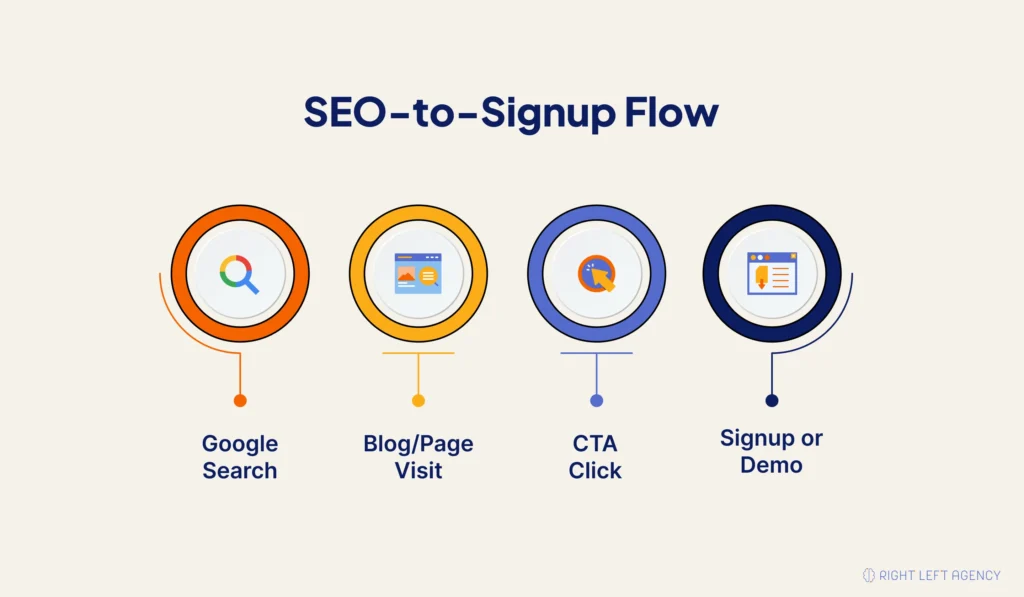
Conversion SEO is the piece that maps search intent to the right step in the signup flow — Google Search → Page Visit → CTA Click → Signup or Demo — and not every page deserves the same CTA. It depends entirely on how ready that visitor already is.
- Match every CTA to where the visitor actually is in their search intent.
- Add free trial CTAs to product-aware and feature-focused pages.
- Use demo CTAs on enterprise and high-ticket pages, where a self-serve signup won’t cut it.
- Place signup CTAs above the fold on high-intent landing pages.
- Add secondary CTAs for visitors who aren’t ready to commit yet.
- Reduce form fields across signup, trial, and demo flows.
- Make the signup value clear before asking anyone to commit to anything.
- Place social proof right where buyers tend to hesitate: near pricing, forms, and signup.
- Add product screenshots beside CTAs to cut down on uncertainty.
- Review drop-off points across the full signup journey, not just the landing page.
Product-led companies usually get the most out of free trial CTAs. Sales-led companies tend to do better with demo CTAs, since the buying process carries more weight anyway. Either way, measure this by qualified signups, demos, trials, and pipeline. Traffic is a vanity metric until it moves through the rest of the flow.
SaaS Link Building and Authority Checklist
Competitive SaaS keywords don’t move on content alone. They need authority behind them. The right backlinks make the difference for product pages, clusters, and comparisons trying to compete.
- Skip low-quality links that don’t actually build topical or brand authority.
- Earn links from relevant SaaS, industry, and partner sites.
- Build authority through partner, marketplace, and integration listings.
- Publish original data or research that’s genuinely worth citing.
A payroll platform might publish a wage benchmark report. A marketing SaaS might pull conversion data out of its own campaigns and publish that. Either way, original research gives journalists and partners something to actually quote, and that builds trust with both search engines and the buyers evaluating you.
SaaS SEO Tracking and Reporting Checklist
Reporting on SaaS SEO can’t stop at rankings and traffic. At some point, someone’s going to ask how this connects to acquisition and revenue, and you need an answer ready.
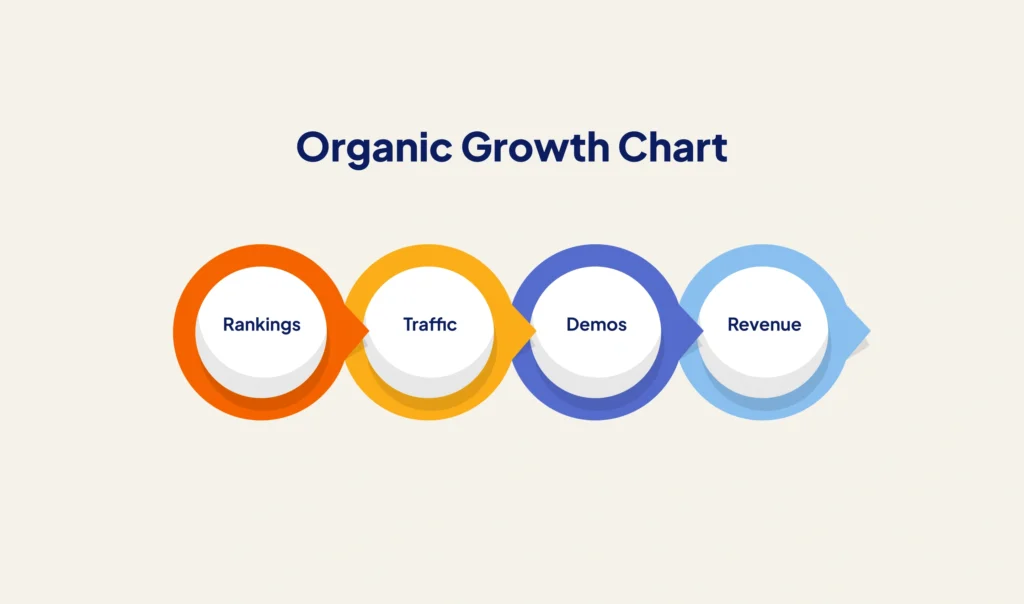
A ranking improvement isn’t an outcome by itself. It only counts once it shows up somewhere downstream in demos, trial activation, product usage, or revenue.
- Track rankings and traffic, but always alongside conversions and assisted pipeline.
- Connect signups, demos, trials, and revenue back to SEO performance.
- Track trial-to-active-user rate to see if organic signups actually use the product.
- Measure signup-to-demo rate for sales-led SaaS journeys.
- Track free trial activation rate for product-led growth.
- Measure product-qualified leads coming from organic search.
- Track feature usage from organic signups, not just signup volume.
- Measure trial-to-paid conversion rate by organic cohort.
- Report organic-assisted revenue across both sales and product funnels.
- Report SEO’s impact on CAC and acquisition efficiency to leadership regularly, not just at renewal time.
| Metric | Why It Matters |
|---|---|
| Keyword rankings | Show search visibility across important topics |
| Organic traffic | Demonstrates growth in visibility from search channels |
| Signup conversion rate | Shows the connection between visitor quality and page intent |
| Demo requests | Indicates organic visitors’ buying intent |
| Trial-to-active-user rate | Shows whether organic signups actually activate in the product |
| Signup-to-demo rate | Tracks how organic signups move through sales-led journeys |
| Free trial activation rate | Shows how many product-led signups reach real usage |
| Product-qualified leads | Flags organic users showing buying intent inside the product |
| Feature usage from organic signups | Shows whether organic users engage with core value |
| Trial-to-paid conversion rate | Connects organic trials to paying customers |
| Organic-assisted revenue | Ties SEO to recurring revenue, not just traffic |
| Assisted pipeline | Connects SEO influence to sales opportunities |
| CAC | Shows acquisition efficiency across channels |
| ARR/MRR influence | Connects SEO performance to recurring revenue |
Google Analytics and Search Console cover the core tracking. HubSpot or Salesforce is where you connect leads to actual pipeline and revenue outcomes.
Get this right, and SEO stops being the line item that’s hardest to defend at budget time.
SaaS SEO Priority Matrix
Use this matrix to decide what to tackle first. Indexation issues and high-intent conversion pages should usually be at the top, regardless of what else is competing for attention.
| SEO Task | Impact | Difficulty | Priority |
|---|---|---|---|
| Fix indexation issues | High | Medium | High |
| Optimize product pages | High | Medium | High |
| Build comparison pages | High | Medium | High |
| Improve Core Web Vitals | Medium | Medium | Medium |
| Refresh old blog content | Medium | Low | Quick Win |
| Create integration pages | Medium | Medium | Growth Lever |
| Publish original data | High | High | Advanced |
If you’re early-stage, clear the technical debt before you scale content; content built on a broken foundation won’t perform.
Growth-stage teams get more out of product pages, comparisons, and topic clusters. And once you’re mature, the leverage moves to attribution, links, and original research. It’s less a checklist and more a progression.
Common SaaS SEO Mistakes
Most SaaS teams underperform at SEO for one simple reason: they treat it as a publishing habit instead of a strategy. Volume of content was never the bottleneck. Intent mapping and conversion planning are.
- Focusing mainly on high-volume keywords
Teams often chase search volume without checking buyer intent.
It impacts the site, attracting traffic that rarely converts into signups.
Solution: Target TOFU, MOFU, and BOFU keywords across the funnel. - Ignoring BOFU pages
Teams focus heavily on blogs and educational content.
The impact is that the website misses buyers who are ready to compare solutions.
Solution: Build feature, comparison, alternative, pricing, and use-case pages. - Publishing disconnected blog content
Why it occurs: Writers create articles without a product-led content strategy.
The impact is that blog readers leave without understanding how the product helps.
Solution: Link blog content directly to product, feature, and use-case pages. - Missing internal links
Teams publish pages without planning the content architecture.
The impact is that search engines and users struggle to find important SaaS pages.
Solution: Connect blogs, guides, product pages, and BOFU pages strategically. - Measuring traffic only
Teams depend on basic SEO reports and ranking dashboards.
The impact is that leadership cannot see how SEO supports real business growth.
Solution: Track signups, demos, pipeline, assisted conversions, and revenue. - Excluding technical SEO
Teams prioritize content while ignoring crawl and index issues.
The impact is that search engines may miss, duplicate, or slowly load important pages.
Solution: Protect crawlability, indexing, page speed, canonicals, and redirects. - Writing weak comparison content
Teams avoid clear differences because comparisons feel sensitive.
The impact is that buyers cannot understand why they should choose your product.
Solution: Present honest, specific, and useful differences between available options. - Forgetting content refreshes
Teams keep publishing new content and ignore older pages.
The impact is that rankings decline when content becomes outdated, thin, or less useful.
Solution: Update old content before rankings, traffic, and conversions decline.
The fix for most of this is the same: build around buyer intent, and make sure every important page eventually points back to product value and conversion.
How Often Should You Update This Checklist?
Review this checklist monthly. SaaS products, competitors, search results, and buyer behavior move fast enough that a checklist that worked six months ago can quietly miss the opportunities sitting in front of you today.
Use a monthly cadence for technical issues, rankings, and conversion performance. Save the quarterly review for content refreshes, keyword gaps, and page priorities. Update it right away after product launches, pricing changes, rebrands, or whenever a competitor publishes a stronger comparison page than yours.
Make AI search visibility part of every major content refresh, and pay extra attention to BOFU pages, signup flows, and reporting metrics since those sit closest to trials, demos, pipeline, and revenue.
Treat this as a living system you keep sharpening, not a list you check off once.
Conclusion
If there’s one thing to take from this checklist, it’s that SaaS SEO stops being useful the moment it’s treated as a list of one-off fixes. It’s a framework — one that founders, marketers, and SEOs can actually build on.
Rankings were never really the point. The point is qualified leads and signups, and the only way to get there consistently is by combining technical health, content, architecture, and authority, then tying all of it back to demos, pipeline, CAC, and revenue.
Start with whatever’s costing you the most right now. Build from there. Make execution repeatable across the whole customer journey, and the rankings — along with the signups and the revenue — tend to follow.
Get a prioritized execution strategy with a SaaS SEO assessment.
FAQ
What is a SaaS SEO checklist?
It’s a structured list of optimization tasks aimed at improving rankings, traffic quality, signups, demos, and revenue, covering everything from strategy and keyword research to technical SEO, content, and reporting. The goal throughout is tying SEO execution to buyer intent and actual conversion paths, not just visibility.
Why is SEO important for SaaS companies?
Because it lets you attract qualified buyers without leaning entirely on paid ads. SaaS buying journeys are long; education, comparison, evaluation, and SEO can support all of that while lowering CAC and building a more sustainable acquisition channel over time.
How is SaaS SEO different from traditional SEO?
Traditional SEO is largely built around traffic and basic lead capture. SaaS SEO has more riding on it — product pages, features, use cases, comparisons, plus the entire signup and demo flow behind them. Rankings have to connect to pipeline and customer acquisition, not just visibility.
What should a SaaS SEO audit checklist include?
A solid SaaS SEO audit covers both technical issues and content gaps — indexation, Core Web Vitals, title tags, canonical tags, along with a look at keyword intent, internal linking, and conversion paths. The point is finding exactly what’s standing between your pages and signups.
How long does SaaS SEO take to show results?
It depends heavily on competition, existing authority, and how consistently you execute. Technical fixes can move the needle fairly quickly; new content clusters usually take longer and need sustained publishing and links behind them. Either way, track rankings, signups, demos, pipeline, and revenue together rather than watching any one metric in isolation.
Which SaaS pages should you optimize first?
Start with whatever sits closest to product evaluation and revenue — product, feature, use case, comparison, and alternative pages. From there, move to high-performing blog posts that are already pulling in relevant traffic. This order gets you rankings and signups without wasting effort on pages that were never going to convert anyway.
How do you measure SaaS SEO success?
Rankings, organic traffic, and signups or demos are the core metrics, but assisted pipeline, CAC, and ARR/MRR impact matter just as much. Traffic alone tells you almost nothing about whether SEO is actually working for a SaaS business — the real signal is whether organic search is showing up in revenue.