Key Takeaways
- This is a sequencing question, not “which is better.”
- Test three things first: demand, conversion, economics.
- Sometimes neither channel is the answer — fix conversion or positioning first.
- Compare incremental CAC, not blended averages.
- Revisit the decision — it’s not permanent.
For most growth-stage SaaS companies, fund paid search first when the immediate need is qualified pipeline and the company still needs to validate demand, messaging, or acquisition economics. Paid search can produce demand-side learning faster than SEO, making it useful as a research instrument before committing heavily to a longer-term organic programme.
That recommendation reverses when paid CAC is already above your payback tolerance, non-branded search demand is verified, positioning is settled, and the business has enough runway to absorb SEO’s slower ramp. A third option matters just as much: if qualified traffic already reaches your site but does not convert, neither SEO nor paid ads is the first investment. Fix the conversion constraint first.
Why “SEO vs Paid Ads” Is Usually the Wrong Question
SEO vs paid ads for SaaS is usually a sequencing problem, not a superiority contest. The useful question is not which channel is universally better; it is which investment solves the company’s current constraint with the available runway and economics.
A SaaS company choosing between SEO and PPC is often choosing under pressure. The budget may support one channel properly, but not both. The decision therefore needs to account for demand, conversion readiness, customer economics, sales-cycle length, and the information the business still needs.
That changes the answer from “SEO is better because it compounds” or “PPC is better because it is faster” to a more useful question: what does the next dollar need to accomplish?
If the company needs to learn which searches produce qualified opportunities, paid search can provide that information quickly. If the company already knows its ICP, positioning, search demand, and economics, SEO can turn investment into an asset that continues generating organic visibility.
There is also a third possibility: the channel is not the constraint.
If qualified visitors already arrive but the website converts poorly, additional traffic simply creates more expensive leakage. In that situation, conversion rate optimization may be the better first investment — more on how to test for this below.
What Paid Ads and SEO Actually Buy a SaaS Company
Paid ads and SEO can both generate demand, but they create value in fundamentally different ways. Paid search primarily buys speed, control, and information. SEO primarily buys compounding visibility, ownership, and long-term search presence.
What paid search buys
Paid search buys demand-side data faster than SEO. A well-measured Google Ads programme can show which queries attract buyers, which messages generate engagement, which landing pages convert, and which leads progress toward qualified opportunities.
That makes paid search more than a traffic source. It can function as a research instrument.
For a SaaS company with uncertain positioning, paid search can test whether buyers respond to a particular problem statement before the company invests heavily in content around that topic. Search-term data can also reveal how prospects describe the problem in their own language.
Paid search also provides controllable volume. A company can increase or reduce media spend without waiting for rankings to change.
The trade-off is straightforward: paid traffic is rented acquisition. When media spend stops, the traffic generated directly by that spend stops as well.
The relevant metrics therefore go beyond CPC or CPL. A SaaS team should eventually connect spend to cost per qualified opportunity, sales-accepted leads, pipeline, CAC, and contribution margin.
What SEO buys
SEO buys an organic acquisition asset that can continue producing after the initial investment. Once relevant pages establish visibility, additional visits do not require a new payment for every click.
SEO can also build category credibility. Consistent visibility across informational, commercial, and problem-oriented searches can make a SaaS company easier to discover before a buyer enters a sales conversation.
But SEO is not free traffic.
SEO requires content capacity, technical work, subject-matter expertise, internal coordination, and time. Its ceiling is also constrained by search demand. If buyers do not search for the problem a SaaS company solves, ranking more pages cannot manufacture substantial non-branded demand.
Modern SEO also extends beyond traditional blue-link rankings. Organic visibility increasingly includes AI answer surfaces and search experiences such as Google AI Overviews, Google AI Mode, Bing/Copilot, ChatGPT, and Perplexity — which is why AI search optimization for SaaS is now part of the broader organic visibility question, not a separate one.
Side-by-side: how the two channels behave
| Factor | Paid search | SEO |
|---|---|---|
| What it buys | Speed, demand capture, and data | Compounding organic visibility |
| Time to meaningful signal | Typically faster | Typically slower |
| Cost behaviour | Spend scales with traffic | Investment shifts toward production and capacity |
| When spending stops | Direct paid traffic stops | Existing rankings can continue |
| Primary risk | CAC becomes uneconomic | Investment produces insufficient demand |
| Best-fit constraint | Need for signal and demand capture | Existing demand and long-term acquisition |
| Core performance lens | Qualified pipeline per marginal dollar | Qualified pipeline from organic investment |
For SaaS companies evaluating paid search execution, paid search management for B2B and SaaS should be judged against qualified pipeline rather than clicks alone. SEO should likewise be evaluated against business outcomes rather than rankings alone through SaaS SEO and AI visibility services.
Three Tests to Run Before You Fund Either Channel
Before choosing SEO or paid ads, test whether the business is actually ready to benefit from either channel. The three gates are search demand, conversion readiness, and paid unit economics.
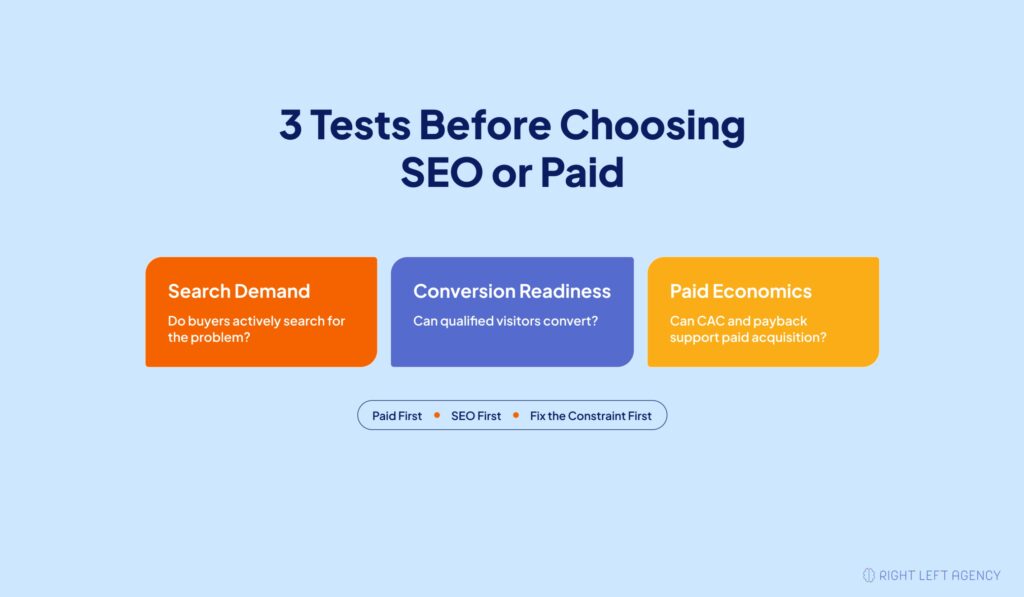
Test 1: Does the search demand actually exist?
SEO is viable only when enough relevant search demand exists to support the acquisition goal. The critical question is whether buyers search for the problem, category, or use case the SaaS product addresses — not merely whether they search for the company’s brand.
Start with non-branded demand.
Look for searches associated with the problem being solved, commercial use cases, category terms, alternatives, and high-intent comparison queries. Then examine whether competitors receive visibility for those searches and whether the search language resembles the language used by actual buyers.
Google Search Console can show existing search behaviour for a site. Broader keyword research can help estimate the addressable search universe.
The distinction matters for category-creating SaaS. A company may have an excellent product but very little established search demand because the market does not yet have a common vocabulary for the problem.
In that case, SEO becomes partly a demand-creation investment rather than pure demand capture. Paid search may still be useful, but the company should not expect SEO alone to solve a market-awareness problem quickly.
A simple pass/fail test is:
- Pass: Buyers use established, non-branded search language for the problem.
- Pass: Competitors receive organic visibility for relevant commercial queries.
- Pass: The search demand aligns with the company’s ICP and offer.
- Fail: Most relevant searches are branded or extremely limited.
- Fail: Buyers do not describe the problem in searchable language.
If the demand test fails, SEO may still have strategic value, but the company should recognise that it is funding market creation and category education rather than simply capturing existing demand.
Test 2: Is the website the constraint?
If qualified visitors already reach the website but fail to convert, conversion rate optimization should come before buying significantly more traffic.
The easiest way to diagnose this is to look downstream from acquisition.
Review commercial-page engagement, demo-request behaviour, form starts and completions, landing-page conversion, and the quality of leads entering the sales process. Compare existing organic and paid traffic where the data allows.
If both channels bring relevant visitors but neither produces enough qualified action, changing channels may simply move the same problem around.
Consider a SaaS company receiving relevant traffic from Google but generating few demo requests. Buying more clicks may increase sessions without improving pipeline. Publishing more content may create the same outcome at a different stage of the funnel.
That makes CRO a third funding option.
The signal is not simply a low website conversion rate in isolation. The stronger signal is qualified traffic combined with weak progression toward a commercially meaningful action.
If the website is the constraint, address:
- Landing-page relevance
- Value proposition clarity
- CTA alignment
- Form friction
- Proof and trust signals
- Message consistency between search intent and page content
- Follow-up after conversion
If the answer is no, start with a SaaS website conversion audit before increasing acquisition spend.
Test 3: Do the unit economics support paid at all?
Paid search is viable only when ACV, gross margin, conversion rates, and acceptable CAC payback leave enough room for acquisition costs.
A high ACV does not automatically make PPC profitable, and a low ACV does not automatically make it impossible. The relationship between revenue, margin, conversion rates, CPC, sales-cycle length, and close rate determines the answer.
Start with the economics the business can tolerate.
Calculate:
- Target ACV
- Gross margin
- Contribution margin
- Acceptable CAC
- Tolerable CAC payback period
- Estimated CPC
- Landing-page conversion rate
- Lead-to-opportunity rate
- Opportunity-to-customer close rate
The result is an economic ceiling for acquisition.
For example, a low-ACV SaaS product competing for expensive commercial keywords may struggle to absorb high CPCs unless conversion rates and sales efficiency are exceptionally strong. An enterprise SaaS product with a substantially larger contract value may have more room for paid acquisition, even when the sales cycle is long.
Sales cycle length also changes measurement. A channel that produces a qualified opportunity today may not produce closed revenue for months. That does not mean the channel failed; it means the measurement model needs to reflect the buying process.
The three tests can therefore be reduced to one decision checklist:
Search demand: Is there enough relevant non-branded demand?
Conversion readiness: Can existing qualified traffic convert efficiently?
Paid economics: Can the business support the expected CAC and payback?
If SEO passes the demand test, the website passes the conversion test, and paid fails the economics test, SEO becomes the more defensible investment.
If paid economics pass but search demand is weak, paid can lead while the company validates demand and builds the longer-term organic opportunity.
When to Fund Paid Ads First
Fund paid ads first when the business needs acquisition data quickly, and its economics can support controlled experimentation.
Paid search is usually the stronger first investment when:
- ICP or positioning still needs validation.
- The company needs qualified pipeline signal within the current planning horizon.
- Search demand for the category is not yet proven.
- Sales needs additional opportunities to validate its process.
- The product has enough ACV and margin to support paid acquisition.
- The business needs to test messaging before committing to large-scale content production.
- A board or funding milestone requires measurable acquisition evidence.
The important distinction is to fund paid as research, not as an unlimited growth line.
A research-oriented paid programme should have a defined learning objective. The team might need to identify which search themes generate qualified opportunities, determine which messaging attracts the right ICP, or establish an initial cost-per-qualified-opportunity range.
The budget should therefore have a learning deadline and explicit decision criteria.
A useful question is not “How much should we spend on Google Ads?” It is “What do we need to learn, and what evidence would justify increasing or reducing the investment?” Auditing an existing paid search programme before increasing spend can help determine whether it’s producing useful information or simply buying more traffic.
When to Fund SEO First
Fund SEO first when non-branded search demand is established, paid acquisition is becoming uneconomic, and the business can support a longer investment horizon.
SEO becomes the stronger first investment when:
- Paid CAC is above the company’s acceptable payback tolerance.
- Paid acquisition costs continue rising without proportional pipeline improvement.
- Non-branded search demand is already verified.
- The ICP and positioning are settled.
- Competitors receive meaningful visibility from relevant commercial searches.
- Content and subject-matter expertise can be produced consistently.
- The business has sufficient runway to tolerate a slower organic ramp.
- The SaaS model requires efficient acquisition at scale, and CPC economics are difficult to sustain.
The runway condition matters. A business with only a few months of operating runway cannot treat a long-term SEO programme as its only near-term pipeline solution simply because SEO has attractive long-term economics.
For companies dependent almost entirely on paid acquisition, SEO can also become the route toward a healthier channel mix. But the transition should be phased rather than abrupt.
Do not cut paid acquisition simply because SEO starts generating traffic. Reduce paid dependency when organic begins producing consistent qualified pipeline and the business has enough evidence to replace the lost contribution safely.
The goal is not to replace one channel with another overnight. It is to move from rented acquisition toward a more diversified acquisition system.
When Neither Channel Is Your Constraint
Neither SEO nor paid ads should be funded first when the primary constraint sits downstream of acquisition.
Three situations commonly justify delaying the channel decision:
- Conversion is the bottleneck. Qualified visitors arrive but fail to become opportunities. Fix the website, landing pages, or conversion path first.
- Positioning is unclear. The company cannot clearly communicate who the product is for, what problem it solves, or why the buyer should care. More traffic will not solve unclear value.
- Sales follow-up is weak. Marketing creates leads or opportunities, but the sales process fails to accept, follow up with, or progress them. Improve sales handoff before increasing acquisition volume.
The identifying signal is simple: the business already has enough relevant demand entering the funnel to expose a downstream problem.
In these cases, buying more traffic can make the reported acquisition numbers look busier while leaving qualified pipeline unchanged.
How to Compare the Next Dollar: A Simple Funding Model
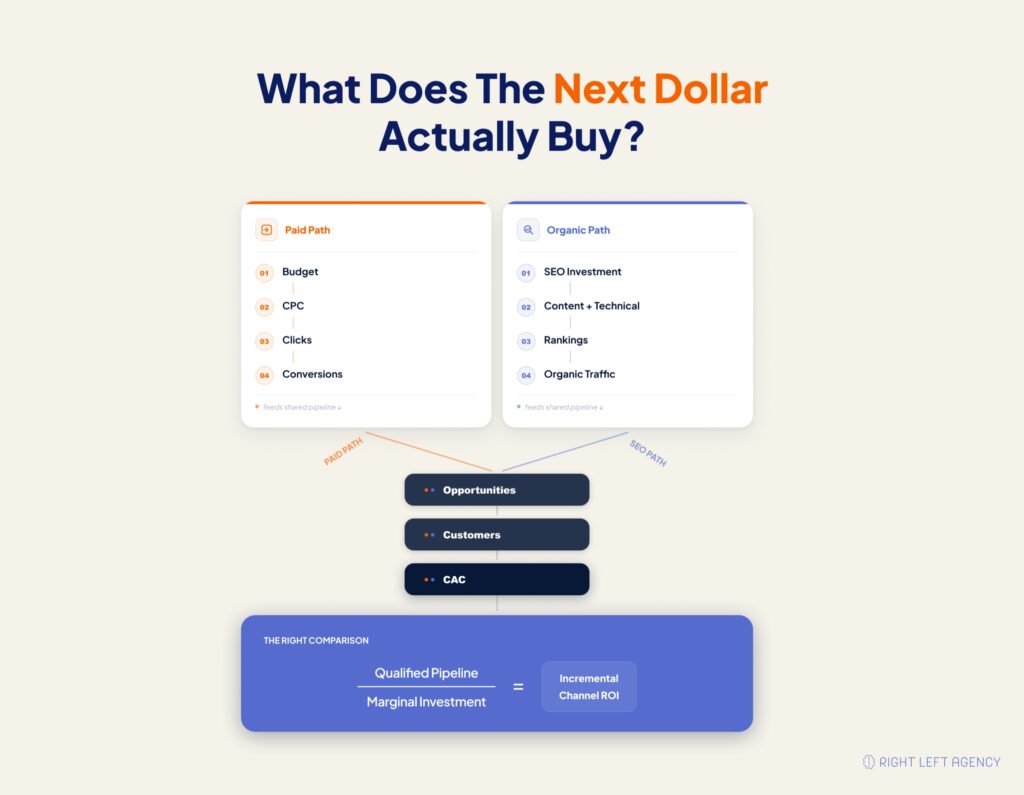
The next-dollar test compares what the marginal investment in each channel is expected to produce over the planning horizon the business can actually afford.
Model the paid scenario
A paid acquisition model should start with economics rather than a media budget.
Use these inputs:
- Target ACV
- Gross margin
- Estimated CPC
- Landing-page conversion rate
- Lead-to-opportunity rate
- Opportunity-to-customer close rate
- Target CAC
- Acceptable payback period
The calculation moves through the funnel:
CPC → traffic → conversion → qualified lead → opportunity → customer → CAC
The objective is to estimate cost per qualified opportunity and implied customer acquisition cost.
Do not use an invented benchmark to make the model look precise. Substitute your actual CPC, conversion, qualification, and close-rate assumptions.
The model should also distinguish between an initial learning period and a mature acquisition programme. Early paid data may be noisy while the team is learning which queries and messages produce qualified opportunities.
Model the SEO scenario
An SEO model should treat organic acquisition as a fully-loaded investment rather than free traffic.
Include:
- SEO strategy or retainer cost
- Content production
- Subject-matter expert time
- Technical implementation
- SEO tooling
- Internal management time
- Content refresh and maintenance
- Measurement and reporting
Then estimate the addressable organic ceiling using actual search-demand data.
The key difference is that SEO does not have a simple CPC attached to every visit. Investment occurs before the traffic arrives, and the resulting organic visibility can continue producing after individual production costs have been incurred.
That creates a different time profile.
Paid search can generate information and traffic quickly. SEO can take longer to establish visibility but may become more efficient as the asset base grows.
Comparing both on the same basis
Compare SEO and paid search using incremental CAC and qualified pipeline per marginal dollar, not blended channel averages.
Blended CAC tells you what the existing acquisition system costs on average. Incremental CAC asks a more useful question: what does the next dollar buy?
The planning horizon also changes the answer.
Over a short horizon, paid search may have an advantage because it can generate measurable demand and learning sooner. Over a longer horizon, SEO may become more attractive because organic visibility can continue producing without paying for every additional click.
Neither statement is a universal rule. The business must choose a horizon that matches its runway and commercial requirements.
The funding decision can therefore be expressed as:
Next-dollar value = qualified pipeline generated by the marginal investment ÷ marginal investment required
The calculation should use the same commercial definitions for both channels. If the goal is qualified pipeline, do not compare paid CPL with SEO traffic. If the goal is customers, compare customer acquisition economics. If the goal is contribution margin, include margin in both models.
If you already have a defined marketing budget and need to decide how to divide it across channels, that’s an allocation question rather than a sequencing question, and it deserves its own analysis.
Sequencing by Company Stage
Company stage influences channel sequencing, but stage alone should never determine the decision.
| Stage | Typical constraint | Usual first funding | What would change it |
|---|---|---|---|
| Pre-PMF or early validation | Demand and positioning uncertainty | Paid research | Strong existing search demand |
| Early growth with traction | Acquisition signal | Paid search | Paid economics fail |
| Growth-stage predictable pipeline | Efficient scalable acquisition | SEO plus paid coordination | Weak organic demand |
| Established SaaS reducing paid dependency | Channel concentration | SEO | Organic demand remains weak |
A seed-stage SaaS with an established category and strong search demand may have a better SEO opportunity than a larger company creating an entirely new category.
Likewise, two companies at the same ARR can require completely different channel strategies. ACV, gross margin, sales cycle, product-led versus sales-led motion, category maturity, and search behaviour can change the economics.
Stage is a context variable, not a funding rule. Do not assign a fixed budget percentage to each stage. The correct allocation depends on the underlying constraints and belongs in a separate budget-allocation model.
From “First” to “Both”: Running SEO and Paid Together
Once the first channel reaches a useful level of maturity, the goal should often shift from choosing one channel to coordinating both.
The crossover point
Start funding the second channel when the first channel reaches a measurable limit in learning, efficiency, or addressable growth.
For paid search, the signal may be that additional spend produces less new information or increasingly expensive qualified opportunities.
For SEO, the signal may be consistent qualified organic sessions and opportunities from commercial search themes.
There is no universal month when the crossover should happen. The correct trigger is observable performance.
A company should also consider its exposure to channel concentration. If nearly all pipeline depends on paid acquisition, developing an organic channel may be strategically valuable even before paid performance deteriorates.
Don’t pay for traffic you already own
Branded search deserves an incrementality test because paid clicks can overlap with organic demand the company already captures.
A company ranking strongly for its own brand terms may still spend on branded Google Ads. Sometimes that spend is justified by competitor conquesting, SERP control, or message control.
But the key question is whether the paid activity creates incremental outcomes.
An incrementality test can compare outcomes with and without branded paid coverage while controlling for the conditions that matter. The objective is to determine whether paid branded spend adds customers or merely captures clicks that would have arrived organically. That distinction matters because branded paid spend can make channel-level performance look strong while consuming working spend that could have produced incremental demand elsewhere.
One keyword map, one source of pipeline truth
SEO and paid search should share one query strategy and one definition of qualified pipeline.
The operational foundation should include:
- A shared keyword and query map
- Clear ownership of paid versus organic opportunities
- A stated reason for overlapping coverage
- Shared conversion definitions
- CRM pipeline reconciliation
- Consistent opportunity-stage definitions
- Reporting that connects acquisition to revenue
The systems may include GA4, Google Search Console, Google Ads, HubSpot, Salesforce, and Looker Studio, but tools do not solve a fragmented measurement model.
The bigger failure occurs when two teams or vendors optimise independently. One reports CPC and conversions while another reports rankings and organic sessions, and neither can reconcile activity to qualified pipeline or closed revenue. A shared measurement model prevents SEO and paid from competing for credit instead of improving total acquisition efficiency.
How to Tell Whether You Chose Correctly
The funding model predicts performance; the measurement model determines whether the decision was actually correct.
Review performance across different horizons rather than expecting revenue evidence immediately.
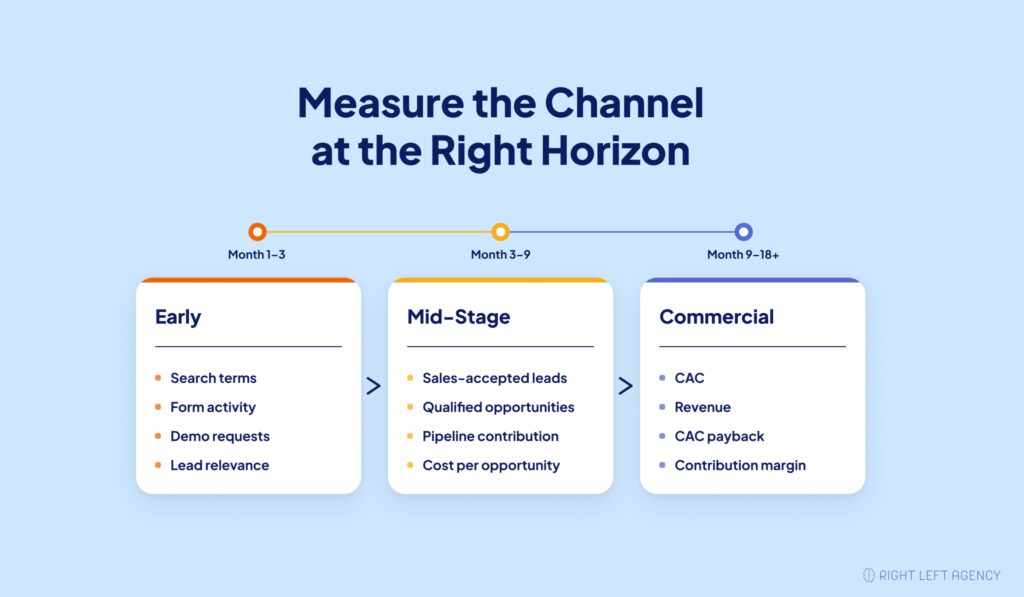
At 30 days, focus on leading indicators:
- Search terms producing relevant leads
- Form starts and completions
- Demo requests
- Landing-page behaviour
- Early qualification signals
At 90 days, focus more heavily on pipeline indicators:
- Sales-accepted leads
- Qualified opportunities
- Cost per qualified opportunity
- Pipeline contribution
- Quality by query or content cluster
At 180 days and beyond, evaluate commercial outcomes:
- CAC
- Pipeline-to-revenue progression
- Customer acquisition
- Contribution margin
- CAC payback
- Incremental channel value
Long B2B sales cycles make attribution especially important. A Q1 acquisition investment may generate opportunities in Q1 while closed revenue appears much later. That means judging a SaaS channel solely on last-touch revenue inside a short window can produce a false negative.
The reversal trigger should be defined before the programme starts: what evidence would make us increase, reduce, or redirect funding? That turns the channel decision into a reviewable investment rather than a permanent commitment.
Mistakes That Make This Decision Worse
- Funding both channels at half strength: Neither channel receives enough investment to produce a useful signal.
- Judging SEO on traffic alone: More organic sessions do not necessarily mean more qualified pipeline.
- Judging paid on CPL alone: A cheap lead is irrelevant if the lead cannot become a qualified opportunity.
- Cutting paid as soon as SEO works: Organic traction does not automatically replace paid pipeline.
- Letting separate vendors optimise against each other: Independent reporting can create channel-level wins without improving total acquisition.
- Treating the decision as permanent: Channel sequencing should be reviewed as demand, economics, conversion, and business stage change.
Where Right Left Agency Fits
Right Left Agency approaches SaaS growth as a constraint-diagnosis problem rather than a channel-shopping exercise.
The starting point is not “Should we buy SEO or PPC?” It is identifying what currently limits qualified pipeline. That may be search demand, conversion, paid economics, positioning, sales follow-up, attribution, or channel concentration.
From there, the appropriate mix can include SEO, paid search, CRO, content, and marketing attribution working as one system.
Right Left Agency is best suited to SaaS, B2B, and ConTech companies that have product-market fit, a defined buyer, and the capacity to support a multi-month growth programme. That also means knowing when not to recommend an engagement.
RLA is not the right fit for a company that needs meaningful acquisition results inside two weeks, has not validated its offer, lacks a sales follow-up process, or expects marketing to compensate for unresolved product-market fit.
The goal is qualified pipeline, not channel activity. For SaaS companies looking for a broader growth programme, explore SaaS growth marketing.
Frequently Asked Questions
Is SEO better than paid ads for SaaS?
SEO is better when established search demand, strong positioning, and a longer investment horizon support compounding organic acquisition. Paid ads are better when a SaaS company needs faster demand-side data, immediate demand capture, or messaging validation. The correct choice depends on the company’s current constraint and economics.
Do paid search ads last longer than SEO?
No. Paid search traffic normally depends on continued media spend, while SEO visibility can continue after the original investment. Paid search offers faster control and learning; SEO can create a longer-lived acquisition asset once relevant rankings are established.
How long does SEO take to generate pipeline for a SaaS company?
SEO typically takes longer than paid search to generate reliable pipeline, but the timeline varies significantly by domain authority, search demand, competition, content capacity, and technical condition. A “6–12 month” timeframe is a common industry pattern rather than a rule, so SaaS companies should use observable milestones instead of a fixed deadline.
Can a SaaS company run SEO and paid search at the same time on a limited budget?
Yes, if both channels have clearly defined jobs and neither is funded so thinly that it cannot produce a meaningful signal. Paid can capture demand and generate learning while SEO builds longer-term visibility. The key is coordinating queries, measurement, and pipeline attribution.
What budget does paid search need to produce useful data?
There is no universal paid-search budget that guarantees useful data. The required investment depends on CPC, conversion rates, sales-cycle length, qualification rates, and the amount of learning required. Set the budget around a defined research question and decision threshold rather than an arbitrary spending benchmark.
Which channel produces higher-quality leads for B2B SaaS?
Neither channel inherently produces higher-quality leads; lead quality depends on intent, targeting, offer, conversion path, and qualification. Paid search can capture high-intent searches quickly, while SEO can attract prospects across the research and commercial journey. Judge quality by qualified opportunities and pipeline, not lead volume.
Should we stop paid ads once SEO starts working?
No, not automatically. Reduce paid dependency only when organic produces consistent qualified pipeline and the business has enough evidence to replace the contribution being removed. Paid may continue to serve demand capture, competitive coverage, or incremental acquisition even after SEO becomes productive.
What is an example of SaaS marketing?
SaaS marketing is the process of attracting, converting, and retaining customers for a software subscription business. Examples include SEO for non-branded search, Google Ads for demand capture, LinkedIn Ads for B2B targeting, lifecycle email, content marketing, CRO, and product-led acquisition.