Key Takeaways
- Hybrid SaaS pricing combines predictable subscriptions with usage-based and AI charges.
- SaaS customer retention depends on proven value, strong product adoption, and early detection of renewal risk.
- Expansion revenue fuels sustainable growth only when it doesn’t mask churn or weak acquisition.
- AI-assisted software discovery rewards SaaS brands that publish trustworthy information and clearly demonstrate value.
- For 2027, SaaS companies should prioritize pricing efficiency, retention quality, and revenue-focused acquisition over chasing every trend.Hybrid SaaS pricing combines predictable subscriptions with usage-based and AI charges.
- SaaS customer retention depends on proven value, strong product adoption, and early detection of renewal risk.
- Expansion revenue fuels sustainable growth only when it doesn’t mask churn or weak acquisition.
- AI-assisted software discovery rewards SaaS brands that publish trustworthy information and clearly demonstrate value.
- For 2027, SaaS companies should prioritize pricing efficiency, retention quality, and revenue-focused acquisition over chasing every trend.
The SaaS subscription model isn’t going away. It’s changing. As AI changes how software delivers value and buyers scrutinize subscription spend, B2B SaaS companies are rethinking how they price AI features, retain customers, and build lasting recurring revenue.
The data shows the pressure. Benchmarkit’s 2026 SaaS analysis found gross revenue retention is falling, and Revenera’s October 2026 monetization study found that software producers now care more about predictable pricing than about maximizing short-term revenue. Growth that depends only on winning new customers is getting harder to sustain.
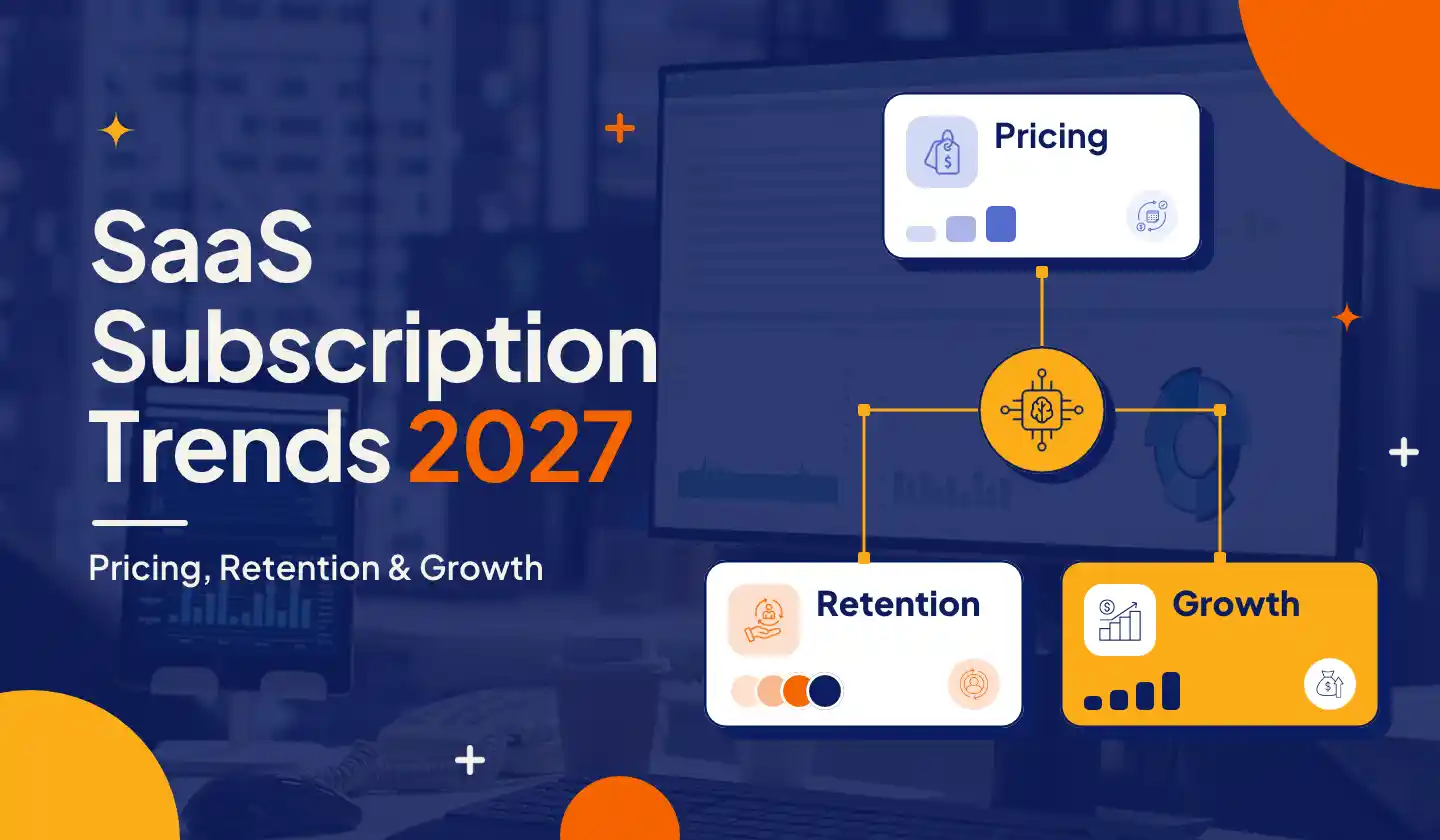
For 2027, the biggest opportunity isn’t chasing every new trend. It’s understanding how pricing, retention, and acquisition affect each other. This guide covers the evidence behind these shifts, what to expect in 2027, and how B2B SaaS leaders can prepare.
What Are the Biggest SaaS Subscription Business Trends for 2027?
The biggest SaaS subscription trends for 2027 include hybrid pricing, AI monetization, customer retention, expansion revenue, efficient acquisition, and AI-assisted software discovery. These changes reflect a growing focus on customer value and sustainable recurring revenue.
| SaaS Trend | What’s Changing | Business Impact |
|---|---|---|
| Hybrid pricing | Combining subscriptions with usage-based charges | Flexible monetization |
| AI monetization | New pricing models for AI features | Better cost and margin management |
| Pricing transparency | Clearer billing and usage limits | Greater buyer confidence |
| Customer retention | Focus on measurable customer outcomes | Stronger renewal potential |
| Expansion revenue | More growth from existing customers | Increased recurring revenue |
| Efficient acquisition | Prioritizing qualified leads over volume | Improved acquisition efficiency |
| AI-assisted discovery | AI influences software research | Greater need for credible product information |
For 2027, SaaS companies should prioritize the trends that best align with their customers, pricing model, and growth objectives rather than adopting every industry change.
Why Is the SaaS Subscription Business Model Changing?
SaaS subscription models are evolving as AI reshapes software value, customers demand predictable pricing, and businesses prioritize sustainable revenue growth. These changes are influencing how SaaS companies price, sell, and retain customers.
AI Is Changing How Software Delivers Value
AI is challenging traditional per-seat pricing. For example, when AI resolves customer support tickets, the value delivered may no longer depend entirely on the number of human users.
Revenera’s 2026 research found that 45% of surveyed technology-company leaders reported AI-related pricing pressure, while only 7% reported direct customer seat loss. This suggests that pricing models are facing pressure even as seat-based subscriptions remain relevant.
Pricing Predictability Is Becoming More Important
Usage-based pricing offers flexibility but can create unpredictable costs.
Revenera found that 47% of surveyed software producers prioritized predictable pricing, compared with 16% prioritizing near-term revenue maximization. These findings reflect provider priorities, not direct buyer survey results.
For 2027, SaaS companies should balance flexible pricing with transparent costs and spending controls.
SaaS Growth Requires Better Revenue Efficiency
SaaS Capital’s 2026 research reported median annual growth of 22% among surveyed private B2B SaaS companies, compared with 25% in its previous benchmark.
The research also found a positive relationship between net revenue retention (NRR) and growth.
For SaaS companies, sustainable growth requires balancing new customer acquisition with retention, expansion revenue, and pricing efficiency.
SaaS Pricing Trends for 2027: Hybrid Models, AI Monetization, and Transparency
SaaS pricing in 2027 is expected to shift toward more flexible models that balance customer value, predictable billing, and profitability. Hybrid subscriptions and AI-specific pricing are gaining attention, but traditional models remain relevant.
Hybrid Pricing Is Becoming a More Relevant Option
Hybrid pricing combines a fixed subscription with usage-based charges. For example, an automation platform might include a monthly workflow allowance and charge for additional usage.
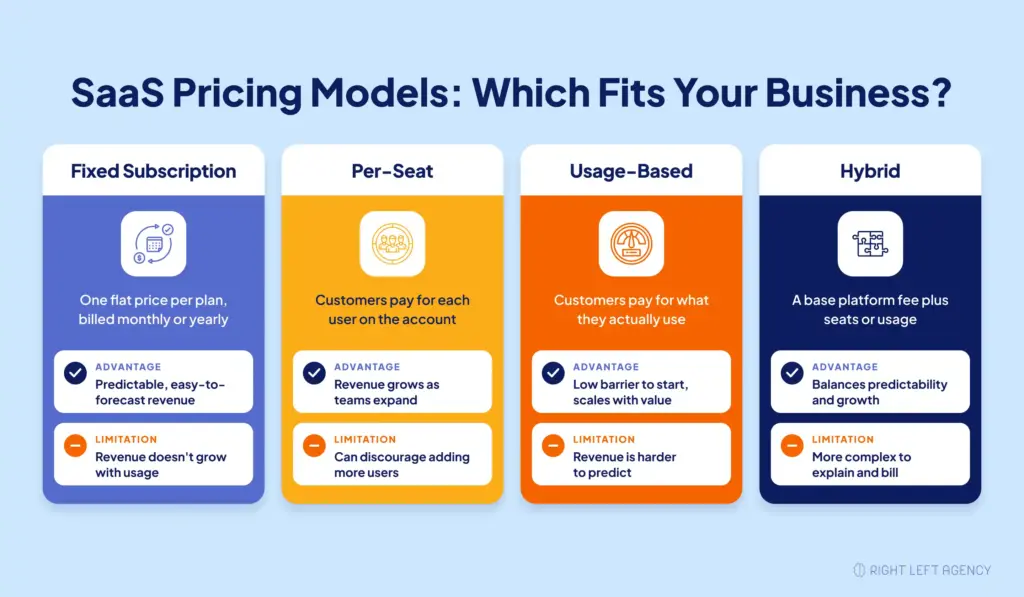
Different models suit different products:
| Pricing Model | Main Advantage | Main Risk |
|---|---|---|
| Fixed subscription | Predictable costs | Limited usage flexibility |
| Per-seat | Simple user-based scaling | Seats may not reflect value |
| Usage-based | Aligns charges with consumption | Unpredictable bills |
| Outcome-based | Links payment to results | Difficult to measure outcomes |
| Hybrid | Balances predictability and usage | More complex billing |
Benchmarkit’s 2026 research reported 108% net revenue retention (NRR) for usage-based pricing cohorts versus 98% for seat-based cohorts. These observational differences do not prove that pricing models cause higher retention.
The right pricing model depends on customer needs, usage patterns, and business economics. Learn more in our SaaS pricing strategy guide.
AI Monetization Requires Demonstrating Customer Value
AI features do not automatically justify higher subscription prices. SaaS companies must balance customer value with delivery costs.
Revenera’s 2026 research found that 40% of surveyed software producers offered AI in premium tiers, 39% included it without additional charges, and 37% used hybrid pricing approaches. These categories overlap.
Additionally, 41% reported that AI delivery costs were squeezing margins.
Before monetizing AI, companies should evaluate usage costs, customer willingness to pay, and expected gross margins.
Transparent Pricing Can Reduce Purchase Friction
Clear pricing helps buyers understand costs and evaluate subscriptions confidently.
Usage-based products should provide defined allowances, spending alerts, transparent overage charges, and accessible usage information.
For example, an automation platform showing monthly consumption and additional charges may be easier to budget for than one with unpredictable billing.
When Should SaaS Companies Avoid Changing Their Pricing Models?
Not every SaaS business needs hybrid or usage-based pricing. Existing models may remain effective when customers prefer predictable costs and pricing already reflects product value.
Changing pricing without reliable usage data or demonstrated customer demand can create unnecessary complexity and retention risks.
For 2027, the priority is choosing a pricing model that supports customer value, sustainable margins, and long-term growth, rather than following industry trends.
SaaS Retention Trends for 2027: Customer Outcomes, Churn Signals, and Revenue Quality
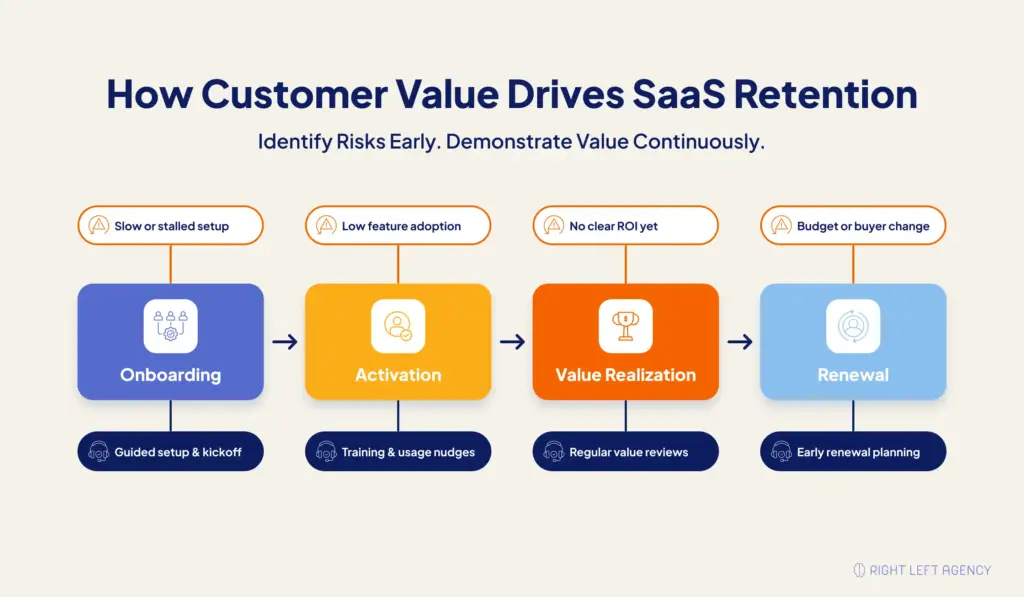
SaaS retention strategies for 2027 should focus on demonstrating customer outcomes, identifying account risks early, and maintaining subscription value as customer requirements change.
Better retention is not simply about persuading customers to renew. It is about making continued use of the product commercially worthwhile.
Why Is Customer Success Shifting From Activity to Outcomes?
Product usage doesn’t prove customer value. A customer can log in weekly and still fail to produce the reports management needs. Another can log in rarely and still hit its business goals every time.
Retention strategy should track outcomes, such as less manual work, faster reporting, lower operating costs, or more reliable processes. Customer success teams should agree on expected outcomes during onboarding and measure progress before renewal. That gives the team concrete proof of the subscription’s value.
Can AI Predict SaaS Churn?
AI can flag churn risk, but a person still needs to interpret the signal. Common warning signs include:
- Falling use of key features
- Support tickets that stay open
- Missed implementation milestones
- Less engagement from decision-makers
A risk flag doesn’t mean the customer plans to cancel. Usage can drop because of seasonality, a finished project, or a restructuring, as well as dissatisfaction. Let predictive analytics decide which accounts get attention first. Then have a customer success manager find out what changed before anyone acts.
Do Flexible Subscriptions Reduce Churn?
They can, if they keep real value in place. When a customer’s needs shrink, offering fewer seats, lower usage limits, or a different package can save the relationship, even though near-term revenue drops. Before you offer one, weigh the account’s profitability, its expansion potential and its cost to serve. A downgrade that doesn’t fix the underlying dissatisfaction only delays the cancellation.
Why Should SaaS Leaders Track GRR Alongside NRR?
Strong NRR can hide churn. According to Benchmarkit’s 2026 B2B SaaS benchmarks (342 companies, full-year 2025 data), median gross revenue retention fell from 88% to 84%. That shows retention pressure across the sample, but it doesn’t mean every company declined.
- Gross revenue retention (GRR) measures the revenue kept from existing customers, excluding expansion.
- Net revenue retention (NRR) adds expansion revenue on top.
A few large enterprise upgrades can push NRR up while smaller accounts churn. That pattern can point to product-market fit, onboarding, pricing, or experience problems in one segment. Review GRR, NRR, customer churn, and cohort trends together.
For additional strategies, see our SaaS customer retention guide.
SaaS Growth Trends for 2027: Expansion, Acquisition Efficiency, and AI-Assisted Discovery
SaaS growth in 2027 will increasingly depend on expansion revenue, efficient customer acquisition, and adapting to AI-assisted buying. The priority is attracting valuable customers and building sustainable recurring revenue.
Expansion Revenue Matters, but It Can Hide Acquisition Problems
Expansion revenue comes from existing customers purchasing additional users, features, or services.
Benchmarkit’s 2026 research found that expansion contributed 40% of net new ARR at the median. However, strong expansion can also mask weak new-customer acquisition.
SaaS companies should evaluate expansion alongside new-customer ARR, churn, customer concentration, and acquisition efficiency.
Why Efficient Acquisition Beats Lead Volume
SaaS marketing should prioritize customer quality over lead volume.
| Metric | Campaign A | Campaign B |
|---|---|---|
| Marketing spend | $20,000 | $15,000 |
| Leads | 200 | 100 |
| Cost per lead | $100 | $150 |
| New customers | 5 | 10 |
| Marketing spend per customer | $4,000 | $1,500 |
Although Campaign A generates cheaper leads, Campaign B acquires more customers at a lower marketing cost per customer.
SaaS companies should also consider customer lifetime value, retention, profitability, and expansion potential when evaluating acquisition channels.
Explore our SaaS marketing strategy guide for a broader growth framework.
How AI-Assisted Buying Is Changing SaaS Discovery
AI tools are increasingly influencing how B2B buyers research and compare software.
Forrester’s October 2026 forecast predicts that AI agents will influence 75% of B2B purchasing decisions in 2027. This is a forecast, not a measured outcome.
To support both traditional and AI-assisted discovery, SaaS companies should provide:
- Clear product positioning and use cases
- Accurate pricing and feature information
- Verifiable customer reviews and case studies
- Helpful comparisons and accessible documentation
Original, trustworthy content helps buyers evaluate products across search engines, AI tools, and other discovery channels.
Learn more about SEO versus AI search optimization for SaaS.
How Retention-Led Marketing Drives Customer Growth
Retention-led marketing helps existing customers discover valuable features, adopt new capabilities, and identify relevant upgrade opportunities.
Through customer education, targeted lifecycle campaigns, and collaboration with customer success teams, SaaS businesses can support retention and expansion without relying solely on new customer acquisition.
How Do Pricing, Retention, and Growth Work Together?
Pricing, retention, and acquisition influence the same recurring revenue system.
A pricing increase may improve revenue per customer but weaken conversion or retention. Better onboarding can help customers achieve value sooner, supporting renewals and future expansion. More effective acquisition can produce customers whose needs align more closely with the product.
This relationship becomes clearer when the different revenue levers are compared directly.
The SaaS Revenue Growth Equation
A simplified annual recurring revenue model is:
Ending ARR = Beginning ARR + New Customer ARR + Expansion ARR − Churn and Contraction
This model assumes a consistent ARR definition and measurement period.
Variable usage revenue should be reported carefully rather than automatically treating uncertain future consumption as contracted recurring revenue.
A Practical SaaS Revenue Scenario
Consider a hypothetical B2B SaaS business with $1 million in beginning ARR.
During the year, the business generates $400,000 in new customer ARR and $150,000 from expansion.
It also loses $120,000 through customer churn and contraction.
| ARR Component | Annual Value |
|---|---|
| Beginning ARR | $1,000,000 |
| New Customer ARR | +$400,000 |
| Expansion ARR | +$150,000 |
| Churn and Contraction | −$120,000 |
| Ending ARR | $1,430,000 |
The business achieves 43% annual ARR growth.
Its net revenue retention is 103%.
NRR = ($1,000,000 + $150,000 − $120,000) ÷ $1,000,000 × 100 = 103%
This calculation assumes expansion and losses apply to the opening customer cohort. New customer ARR is excluded from NRR.
Now suppose the company wants to add another $40,000 in ending ARR.
It has three potential options.
Which Revenue Improvement Creates the Most Value?
| Hypothetical Scenario | Ending ARR | Key Consideration |
|---|---|---|
| Current baseline | $1,430,000 | Existing performance |
| Reduce churn and contraction by $40,000 | $1,470,000 | Cost and feasibility of retention improvements |
| Increase existing-customer expansion by $40,000 | $1,470,000 | Customer value and upgrade opportunities |
| Acquire an additional $40,000 in new ARR | $1,470,000 | Acquisition costs and customer fit |
These scenarios are illustrative and assume all other ARR components remain unchanged.
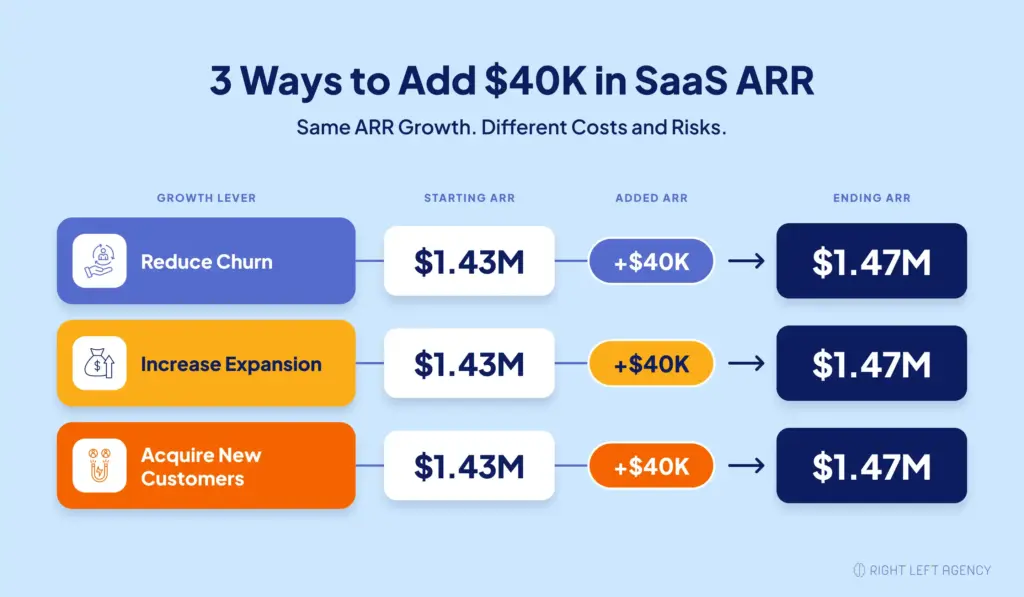
All three improvements produce the same ending ARR.
However, their economic implications differ.
Reducing churn improves retention and NRR but may require additional investment. Expansion increases revenue from existing customers, while acquisition creates new growth opportunities at potentially higher costs.
In this scenario, improved retention or expansion raises NRR from 103% to 107%, while new customer ARR leaves it unchanged.
SaaS leaders should evaluate growth opportunities based on costs, margins, retention risks, and long-term revenue potential, not ARR alone.
The strategic lesson: Equal ARR growth does not necessarily create equal business value.
That is why pricing, retention, and acquisition decisions should be evaluated through a shared financial and customer-performance framework.
What Should SaaS Companies Avoid Changing in 2027?
Not every industry trend deserves immediate adoption.
SaaS leaders should avoid making changes that increase complexity without improving customer value or business economics.
Don’t Replace Per-Seat Pricing Simply Because AI Is Growing
Per-seat pricing remains suitable for products where users, access, or collaboration closely reflect delivered value.
A new pricing model should solve a demonstrated problem.
Don’t Charge Separately for AI Without Demonstrating Value
AI features may increase costs or improve efficiency, but customers need a clear reason to pay more.
Charging separately for functionality that provides little incremental value can weaken product positioning.
Don’t Use Expansion Revenue to Ignore Gross Churn
Strong expansion may compensate for recurring revenue losses temporarily.
It does not eliminate the underlying problems causing customers to cancel or downgrade.
Don’t Prioritize AI Search Visibility Over Product Credibility
Appearing in AI-generated recommendations is not a substitute for having accurate product information, reliable customer evidence, and a compelling value proposition.
Don’t Chase Growth Metrics Without Understanding Profitability
Higher ARR, more customers, or greater product usage can be positive outcomes.
Their contribution to long-term business performance depends on acquisition costs, delivery costs, customer retention, and margin.
For 2027, successful adaptation may involve preserving strategies that already work while selectively improving those that no longer reflect customer needs.
Which SaaS Trends Matter Most at Different Growth Stages?
SaaS companies should prioritize 2027 trends based on their growth stage, customer needs, and revenue challenges. What works for an early-stage startup may not be suitable for an established enterprise SaaS business.
| Business Stage | Primary Challenge | Recommended 2027 Focus |
|---|---|---|
| Early-stage SaaS | Establishing product value | Simple pricing, onboarding, customer feedback |
| Growth-stage SaaS | Scaling efficiently | Customer acquisition, retention, pricing optimization |
| Established SaaS | Improving recurring revenue | Expansion revenue, customer segmentation |
| Enterprise SaaS | Managing complex accounts | Renewals, customer ROI, pricing governance |
How Should SaaS Companies Prioritize Growth Opportunities?
The most effective strategy starts with identifying the biggest revenue constraint.
| Business Challenge | Recommended Action |
|---|---|
| Declining qualified leads | Improve targeting, positioning, and acquisition channels |
| Low trial conversions | Optimize onboarding, pricing, and product experience |
| High customer churn | Improve activation, customer value, and retention |
| Strong NRR but weak GRR | Investigate churn hidden by expansion revenue |
| Growing usage but declining margins | Review pricing and delivery costs |
| Strong retention but slow growth | Explore new customer acquisition and expansion |
These are starting points, not guaranteed solutions. SaaS leaders should use customer feedback, product analytics, and financial performance to identify the underlying causes before investing in new initiatives.
The priority for 2027 is to address the growth constraints that matter most, rather than adopting every emerging SaaS trend.
How Should SaaS Companies Prepare for 2027?
SaaS businesses can prepare for 2027 through a focused 90-day process that connects performance assessment, controlled experiments, and investment decisions.
The objective is not to implement every emerging pricing or growth model. It is to identify the changes most likely to improve business performance.
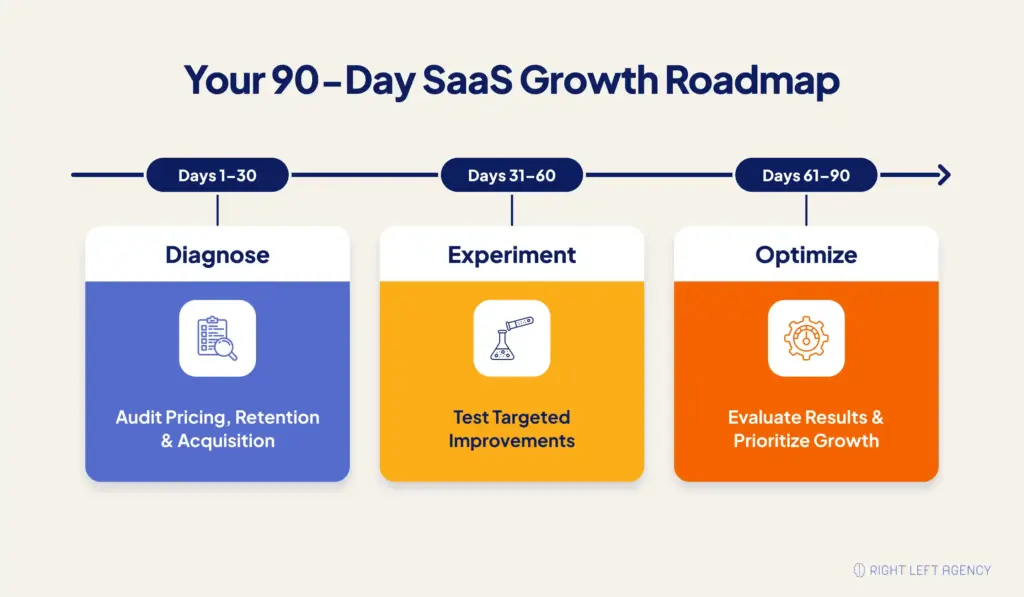
First 30 Days: Identify Revenue Constraints
Review pricing, customer acquisition, product adoption, churn, GRR, NRR, and gross margins to identify the biggest growth challenges.
Expected outcome: A performance scorecard highlighting pricing, retention, and acquisition gaps.
Days 31–60: Test Targeted Improvements
Run focused experiments to improve pricing clarity, customer onboarding, billing transparency, and high-intent conversion. Set measurable goals for each test.
Expected outcome: Initial results showing which improvements have the most potential.
Days 61–90: Evaluate and Prioritize
Assess acquisition efficiency, customer feedback, revenue impact, and early retention signals. Prioritize successful initiatives and establish longer-term tracking.
Expected outcome: A data-driven SaaS growth roadmap for 2027.
| Timeline | Primary Focus | Deliverable |
|---|---|---|
| Days 1–30 | Analyze performance | Revenue performance scorecard |
| Days 31–60 | Test improvements | Experiment results |
| Days 61–90 | Prioritize growth | 2027 growth roadmap |
The goal is to invest in improvements with the greatest potential business impact, rather than pursuing too many initiatives at once.
Which SaaS Metrics Should Business Leaders Track in 2027?
SaaS leaders should evaluate a balanced set of growth, retention, and profitability metrics rather than relying on ARR growth alone.
| Metric | What It Measures | Business Importance |
|---|---|---|
| Annual Recurring Revenue (ARR) | Annualized recurring revenue | Recurring revenue scale |
| Net Revenue Retention (NRR) | Existing-customer revenue after expansion and losses | Revenue retention and account growth |
| Gross Revenue Retention (GRR) | Existing-customer revenue retained before expansion | Underlying revenue loss |
| Expansion ARR | Additional recurring revenue from current customers | Account growth contribution |
| Customer Acquisition Cost (CAC) | Fully loaded cost of acquiring customers | Acquisition efficiency |
| CAC Payback Period | Time required to recover acquisition cost through gross-margin-adjusted revenue contribution | Capital efficiency |
| Time to Value (TTV) | Time until customers achieve meaningful outcomes | Early adoption and retention signals |
| AI Feature Gross Margin | Revenue remaining after direct AI feature delivery costs | AI monetization profitability |
| Qualified Pipeline and Closed-Won ARR | Sales opportunities and recurring revenue under defined attribution rules | Acquisition contribution to growth |
Why Should These Metrics Be Evaluated Together?
A company with strong ARR growth may still have weak retention. Another company may retain customers effectively but struggle to attract enough new accounts.
Similarly, high NRR can conceal poor GRR, while attractive acquisition costs may mean little if customers cancel before their acquisition investment is recovered.
The metrics are most useful when interpreted together and segmented by customer type, contract value, pricing model, and acquisition channel.
For more background, see our guide to SaaS business models, metrics, and growth strategies.
Final Thoughts
The future of SaaS subscriptions in 2027 depends on aligning pricing, customer retention, and acquisition with measurable business value. SaaS leaders should prioritize sustainable growth, improve customer outcomes, and make data-driven decisions.
At Right Left Agency, we help B2B SaaS companies attract qualified buyers and improve conversions through strategic SEO and AI search optimization.
Explore our SaaS SEO and AI visibility services to support long-term growth.
Frequently Asked Questions
What Are the Biggest SaaS Subscription Trends for 2027?
Key trends include hybrid pricing, AI monetization, customer retention, expansion revenue, and efficient acquisition. AI-assisted buying is also expected to influence SaaS discovery and growth.
Will Usage-Based Pricing Replace Traditional SaaS Subscriptions?
No. Fixed and per-seat subscriptions remain relevant. Hybrid pricing offers flexibility for usage-driven products but can increase billing complexity.
How Will AI Affect SaaS Subscription Pricing in 2027?
AI is driving new pricing approaches, including premium features, usage credits, and consumption-based charges. The best model depends on customer value, usage costs, and profitability.
Why Is Net Revenue Retention Important for SaaS Growth?
Net revenue retention (NRR) measures recurring revenue retained and expanded from existing customers. NRR above 100% indicates expansion exceeds churn and contraction.
How Can SaaS Companies Grow Without Increasing Acquisition Spending?
SaaS companies can improve conversions, reduce churn, strengthen onboarding, and expand existing accounts to generate more revenue without increasing acquisition budgets.