Key Takeaways
- Low conversion volume makes statistically conclusive creative testing difficult for many B2B SaaS companies.
- Inconclusive results do not prove that competing ad creatives perform equally.
- Engagement metrics provide early feedback but cannot independently establish qualified pipeline impact.
- Testing feasibility depends on conversion volume, meaningful performance differences, budget, and statistical power.
- Structured experiments and risk-aware decisions help SaaS marketers improve advertising without overstating the evidence.
Your B2B SaaS campaigns generate only a handful of qualified leads each month. You compare two ad creatives, and one appears to perform better, but neither produces enough conversions to establish a statistically significant difference.
Should you keep testing, choose the apparent winner, or change your approach?
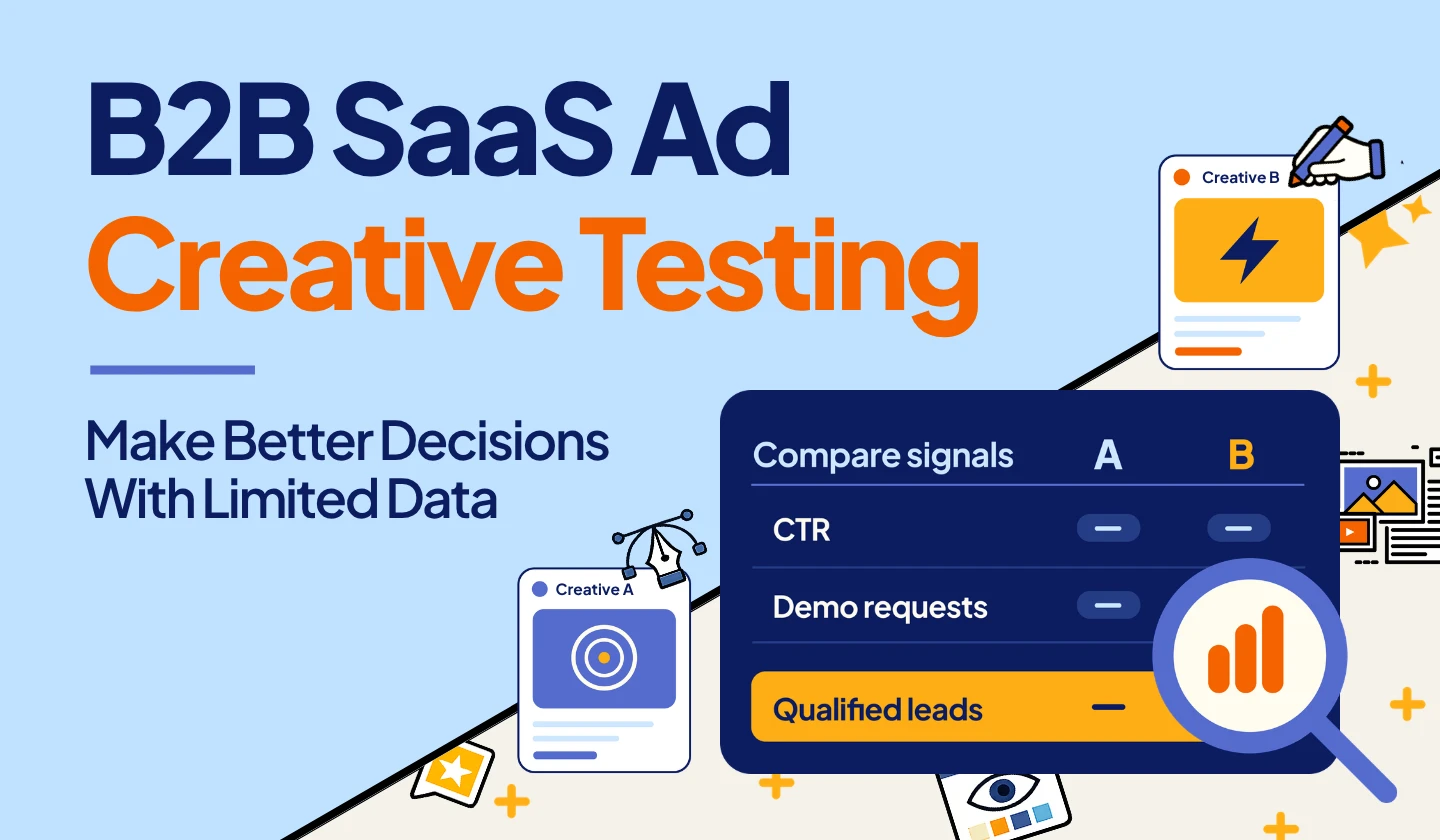
You can make useful B2B SaaS ad creative decisions without reaching statistical significance, but an inconclusive test cannot prove which creative performs better.
The key is to test clear hypotheses, maintain comparable testing conditions, evaluate early performance signals, and connect advertising results with qualified pipeline outcomes.
For SaaS companies with narrow audiences and limited budgets, successful creative testing is about gathering useful evidence, understanding uncertainty, and making better decisions without unnecessary spending.
Why Is Statistical Significance Difficult in B2B SaaS Ad Testing?
B2B SaaS campaigns often target narrow audiences and generate limited qualified conversions, making statistically significant creative testing difficult. Small sample sizes increase uncertainty and make performance differences harder to evaluate reliably.
Key challenges include:
- Narrow audiences: Specific ideal customer profiles (ICPs) limit available traffic.
- High acquisition costs: Expensive clicks and conversions increase testing budgets.
- Long sales cycles: Prospects may take weeks or months to qualify.
- Small performance differences: Minor improvements are difficult to distinguish from random variation.
- Conversion delays: Lead qualification often happens long after the initial conversion.
These limitations make realistic testing expectations essential.
How Sample Size and Conversion Volume Affect Test Results
Statistical significance helps evaluate whether an observed difference is unlikely under a no-effect hypothesis. However, significance does not guarantee business value, and non-significant results do not prove equal performance.
Four factors influence sample-size requirements:
- Baseline conversion rate: How frequently visitors convert.
- Minimum detectable effect: The improvement the test aims to identify.
- Statistical power: The likelihood of detecting a specified effect when it exists.
- Significance threshold: The standard used to evaluate statistical evidence.
For example, increasing a SaaS conversion rate from 5% to 6% represents a 20% relative improvement but may require thousands of visitors per variation to detect reliably.
Google Ads provides estimated lift, p-values, and confidence intervals for supported experiments to help advertisers interpret results.
The key challenge is determining whether collecting enough reliable data is financially practical.
Can You Test B2B SaaS Ad Creative Without Statistical Significance?
Yes. B2B SaaS marketers can evaluate ad creative without statistically significant results by using controlled comparisons, directional performance signals, and downstream business metrics.
However, they must distinguish between observations suggesting improvement and evidence sufficient to establish a reliable performance difference.
| Test outcome | What it means | Recommended response |
|---|---|---|
| Statistically supported improvement | Evidence indicates a performance difference under the experiment’s assumptions | Consider adopting the variation and monitor performance |
| Directional improvement | One variation appears stronger, but substantial uncertainty remains | Investigate, gather more evidence, or make a provisional change |
| Inconclusive result | The experiment cannot establish a reliable difference | Review uncertainty, testing costs, and next steps |
Suppose Creative A generates eight qualified leads while Creative B generates six.
Although Creative A has the higher observed count, the difference does not prove it has a higher underlying conversion rate without considering exposure, experiment design, and uncertainty.
A marketing team might temporarily choose Creative A if the potential downside is small and the decision can be reversed. That is a provisional business decision, not a statistically proven result.
The purpose of creative testing is to improve decision quality, not create false confidence.
A Practical Framework for Testing B2B SaaS Ads With Limited Data
Effective creative testing starts with a clear hypothesis, realistic testing conditions, and measurable outcomes. This five-step framework helps B2B SaaS marketers make informed decisions with limited conversion data.
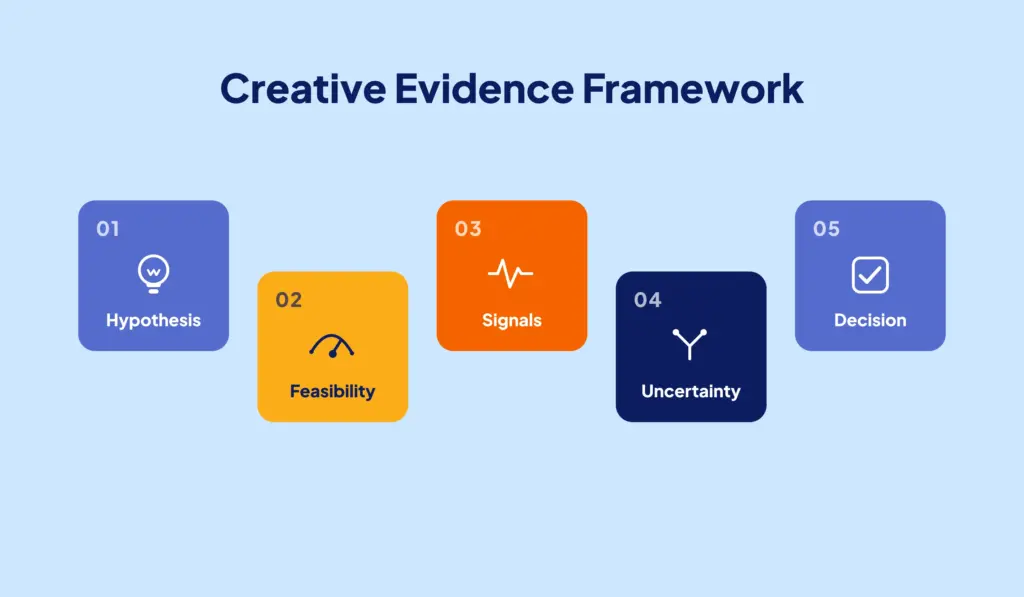
Step 1: Define One Creative Hypothesis
Test one meaningful messaging difference while keeping other conditions consistent.
For example:
- Creative A — Pain-Point: “Reduce Manual Reporting and Repetitive Work”
- Creative B — Outcome-Focused: “Improve Team Productivity With Automated Workflows”
Hypothesis: Pain-point messaging will generate a higher qualified-demo conversion rate.
Step 2: Check Testing Feasibility
Estimate the traffic, conversions, and budget needed to detect a meaningful improvement.
| Test Assumption | Value |
|---|---|
| Baseline conversion rate | 5% |
| Target conversion rate | 6% |
| Relative improvement | 20% |
| Statistical power | 80% |
| Significance level | 5% |
| Approximate visitors per variation | 8,150 |
At $10 per visitor, the estimated testing cost is $163,000.
This hypothetical estimate assumes equal allocation, independent observations, and a conventional two-sided test.
If testing is unaffordable, prioritize meaningful creative differences or higher-volume diagnostic metrics.
A B2B SaaS Google Ads audit can help identify tracking and targeting problems before testing.
Step 3: Maintain Comparable Testing Conditions
Keep audiences, offers, landing pages, conversion definitions, and testing periods consistent.
Use randomized experiments when available. Google recommends at least four weeks for supported standard A/B experiments, while LinkedIn recommends a minimum of two weeks. Neither duration guarantees conclusive results.
Step 4: Evaluate Performance Signals
Use CTR, CPC, and landing-page engagement for early feedback. Track demo requests, qualified leads, and sales opportunities for business relevance.
Higher CTR does not automatically mean better lead quality.
Step 5: Document Results and Decide
Record the hypothesis, test conditions, results, and uncertainty.
Choose whether to continue testing, revise creative, provisionally adopt a variation, or stop based on the evidence and business risk.
Key point: Inconclusive tests can provide useful insights without proving which creative performs best.
What If You Cannot Afford a Statistically Powered Creative Test?
When traditional A/B testing exceeds your budget, focus on experiments that provide useful insights and support low-risk decisions.
Test Meaningfully Different Messages
Compare distinct value propositions, such as cost savings versus compliance benefits, instead of minor visual or headline changes. This can produce more actionable insights.
Use Higher-Volume Metrics
Use CTR and landing-page engagement to evaluate early performance when qualified conversions are limited. These metrics provide directional feedback but do not prove revenue impact.
Make Smaller, Reversible Decisions
When results are inconclusive, make limited changes rather than shifting the entire budget. Monitor lead quality and acquisition costs before expanding.
Prioritize High-Impact Experiments
Focus on creative hypotheses with meaningful business potential, considering available evidence, testing costs, and expected outcomes.
The goal is to maximize useful learning without unnecessary testing expenses.
Which Metrics Matter When Conversion Volume Is Low?
When B2B SaaS conversions are limited, evaluate early engagement metrics alongside qualified pipeline outcomes to understand creative performance.
| Metric | What it evaluates | Limitation |
|---|---|---|
| CTR | Click engagement | Doesn’t establish buying intent |
| CPC | Cost per click | Cheap clicks may not convert |
| Landing-page conversion rate | Visitor actions | Affected by audience and page experience |
| Demo requests | Initial interest | Doesn’t confirm lead quality |
| Qualified-lead rate | Prospect suitability | Qualification may be delayed |
| Cost per opportunity | Pipeline acquisition efficiency | Sensitive to small samples |
| Pipeline value | Commercial potential | Doesn’t prove incremental revenue |
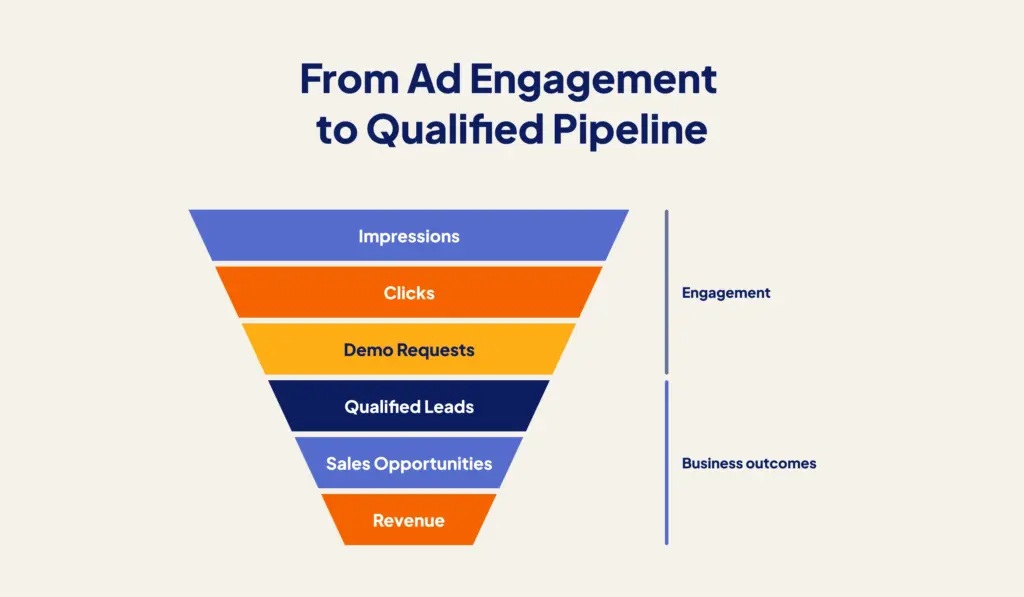
Use Engagement Metrics to Diagnose Creative Performance
CTR and CPC provide early feedback on message engagement and traffic costs. However, higher engagement doesn’t necessarily mean better lead quality.
Use these metrics for initial insights, not as proof of customer acquisition success.
Use CRM Data to Evaluate Acquisition Quality
Track qualified leads, sales opportunities, and pipeline value to assess whether creatives attract relevant prospects.
Account for conversion delays and compare leads using consistent qualification criteria. Remember that attributed pipeline does not automatically prove incremental revenue.
If your campaigns attract unqualified prospects, explore why SaaS paid ads generate low-quality leads before changing your creative strategy.
What Should You Do When Creative Test Results Are Inconclusive?
When results are inconclusive, decide whether to continue, revise, provisionally adopt, or stop testing based on available evidence, business impact, and testing costs.
Continue Testing When More Evidence Is Worth the Cost
Extend the test if a meaningful improvement remains possible and additional data is affordable. Longer testing does not guarantee statistical significance.
Revise Creative When Messaging Problems Appear
If an ad attracts clicks but few qualified leads, review its messaging, audience relevance, and landing-page alignment. Treat substantially revised creative as a new variation.
Make a Provisional Decision When Risk Is Manageable
Consider a limited rollout when directional results are promising. Monitor performance and define when to reverse the decision without claiming a proven winner.
Stop Testing When Further Evidence Has Limited Value
Stop when additional testing costs outweigh potential benefits or when insufficient traffic or unreliable tracking prevents meaningful conclusions.
Creative Testing Decision Matrix
| Situation | Recommended Action |
|---|---|
| Meaningful improvement is possible, and more data is affordable | Continue testing |
| Messaging or lead-quality problems emerge | Revise creative |
| Directional evidence is promising with limited risk | Make a provisional change |
| Further testing is not cost-effective | Stop testing |
| Tracking or testing conditions are unreliable | Redesign the test |
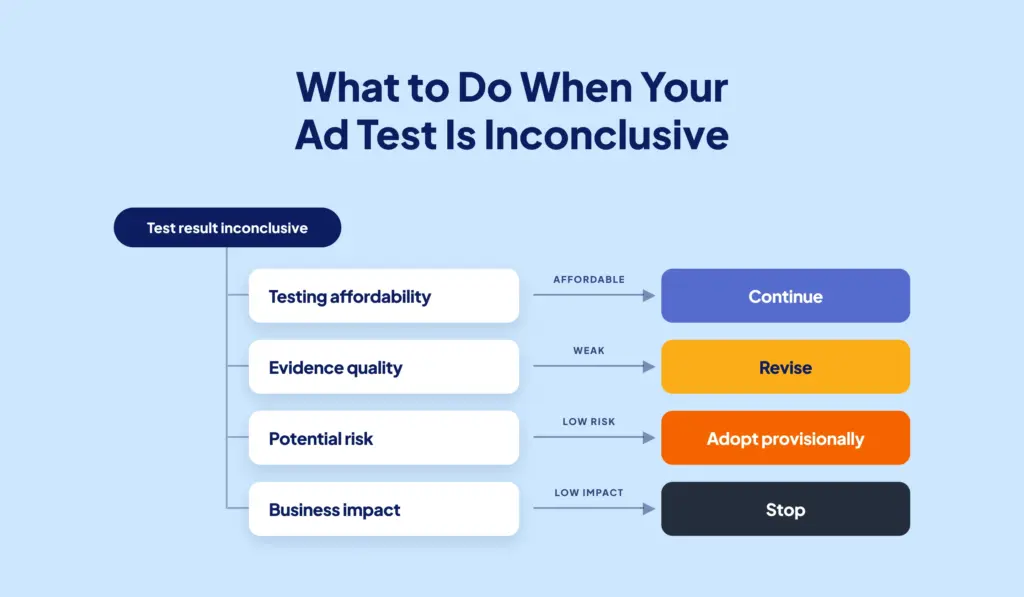
The goal is to make better business decisions without treating inconclusive results as proof of performance.
Can Bayesian Testing Help With Small B2B SaaS Audiences?
Bayesian testing helps marketers evaluate uncertain creative results by combining observed data with prior assumptions. It can estimate the probability that one creative outperforms another.
However, Bayesian testing cannot overcome insufficient data, and results may depend heavily on prior assumptions.
Sequential testing can also support planned interim analysis, but repeatedly checking conventional p-values can increase false-positive risk.
For small SaaS teams, a structured testing plan with clear metrics and decision criteria may be more practical.
B2B SaaS Ad Creative Testing Example With Limited Conversions
Consider a hypothetical B2B SaaS company comparing two LinkedIn ad creatives:
- Creative A: Reduce Manual Reporting
- Creative B: Improve Team Productivity
| Metric | Creative A | Creative B |
|---|---|---|
| Impressions | 10,000 | 10,000 |
| Clicks | 120 | 150 |
| CTR | 1.2% | 1.5% |
| Demo requests | 6 | 5 |
| Qualified leads | 3 | 2 |
All figures are hypothetical and do not represent RLA client results.
What Can the Marketing Team Learn?
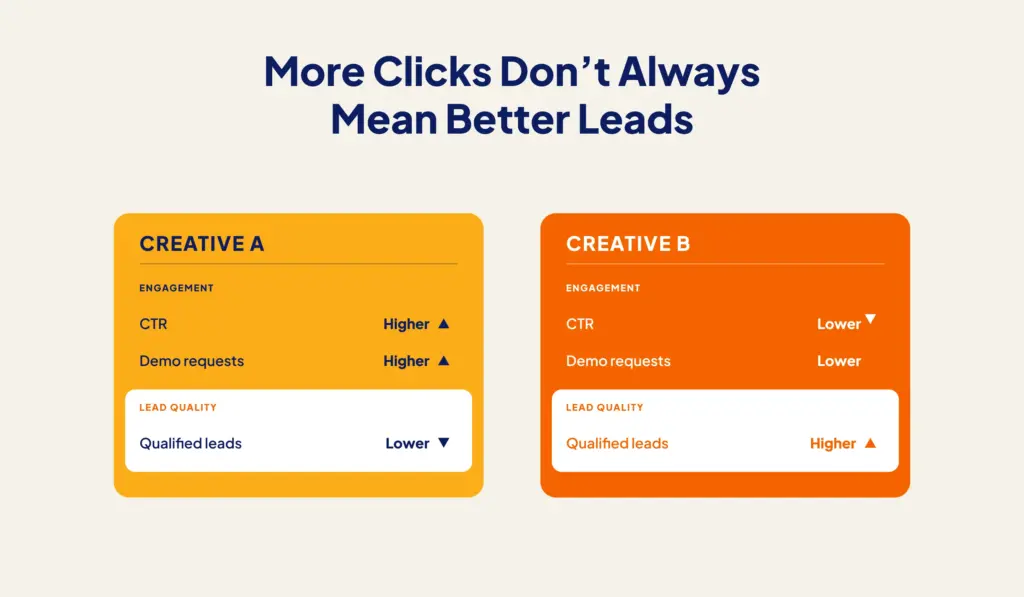
Creative B generates 25% more clicks, while Creative A produces slightly more demo requests and qualified leads.
However, the small conversion counts cannot establish a reliable winner, and equal impressions do not guarantee a controlled comparison.
What Should the Marketing Team Do Next?
Since qualified demos are the primary goal, the team maintains its existing creative allocation, reviews lead quality, and develops a follow-up hypothesis.
The key takeaway is that higher engagement does not necessarily mean better-qualified acquisition.
Common Mistakes in Low-Volume SaaS Creative Testing
Avoid these six mistakes when testing ad creatives with limited conversion data.
- Declaring a winner too early: Small conversion differences may reflect random variation, so review effect size and uncertainty before concluding.
- Testing too many variables: Changing several elements simultaneously makes it difficult to identify what influenced performance.
- Comparing different delivery conditions: Audience and delivery differences can introduce bias into creative comparisons.
- Prioritizing CTR over qualified leads: Higher engagement does not automatically indicate better customer acquisition.
- Ignoring conversion delays: Recently acquired prospects may not have had enough time to become qualified opportunities.
- Extending tests without a decision plan: Additional data is not always worth the time and cost required to collect it.
For each experiment, define the question, comparison conditions, metrics, and decision criteria before launch.
How to Build a Repeatable B2B SaaS Creative Testing Process
A useful creative testing program should accumulate evidence across experiments, even when individual tests remain inconclusive.
Maintain a prioritized backlog of hypotheses covering buyer pain points, objections, value propositions, and messaging relevance.
For every experiment, document:
- Hypothesis: What creative difference was tested?
- Primary metric: Which outcome was the experiment intended to evaluate?
- Test conditions: How were audiences, delivery, and conversion definitions controlled?
- Observed results: What performance differences appeared?
- Uncertainty: What can and cannot be concluded?
- Next action: What decision was made, and why?
Review CRM outcomes as new information becomes available and use those findings to prioritize future tests.
Avoid combining results from different audiences or campaign conditions as though they originated from one randomized experiment.
Creative learning should also support a broader B2B SaaS lead generation strategy that addresses targeting, qualification, and pipeline performance.
Over time, consistent documentation helps marketers identify which messages deserve further exploration and where testing resources can create the most value.
Make Better B2B SaaS Creative Decisions With Limited Data
Low conversion volume does not mean B2B SaaS companies should abandon creative testing. It means experiments must reflect realistic data constraints, and decisions must match the strength of the available evidence.
Clear hypotheses, comparable testing conditions, meaningful performance metrics, and CRM feedback help marketers distinguish useful observations from unsupported conclusions.
When conclusive testing is not financially practical, prioritize commercially important questions, make risk-aware decisions, and preserve what each experiment teaches you.
At Right Left Agency, our paid search advertising services focus on connecting campaign strategy, creative messaging, conversion measurement, and performance optimization with business objectives.
Explore Our Paid Advertising Services
Frequently Asked Questions
How Many Conversions Do You Need for a Statistically Significant Ad Test?
There is no universal minimum. Sample-size requirements depend on baseline conversion rate, expected effect size, statistical power, significance threshold, and experiment design. Smaller differences generally require larger samples. Calculate requirements for your specific hypothesis rather than relying on a fixed conversion threshold.
How Long Should B2B SaaS Ad Creative Tests Run?
Duration depends on audience size, traffic volume, conversion delays, and experiment design. Google recommends at least four weeks for supported standard A/B experiments, while LinkedIn recommends a minimum two-week period for its supported A/B tests. Neither duration guarantees statistically conclusive results.
Can You Choose a Winning Ad Without Statistical Significance?
You can provisionally select a creative using directional evidence and business considerations, but it should not be described as a statistically proven winner. Document the uncertainty, manage downside risk, and monitor performance. A practical business decision is not the same as a statistical conclusion.
Is CTR Enough to Determine the Best-Performing SaaS Ad?
No. CTR measures the percentage of impressions generating clicks, not whether those clicks become qualified prospects or customers. It can be a primary metric for engagement-focused tests, but acquisition-focused decisions should also consider relevant conversion and pipeline outcomes.