Key Takeaways
- SEO and AI search work together through strong SEO fundamentals.
- AI platforms discover and display content differently.
- AI search is changing how SaaS buyers research solutions.
- Commercial pages help attract qualified buyers and drive demos.
- SaaS SEO success should be measured by pipeline and revenue, not just traffic.
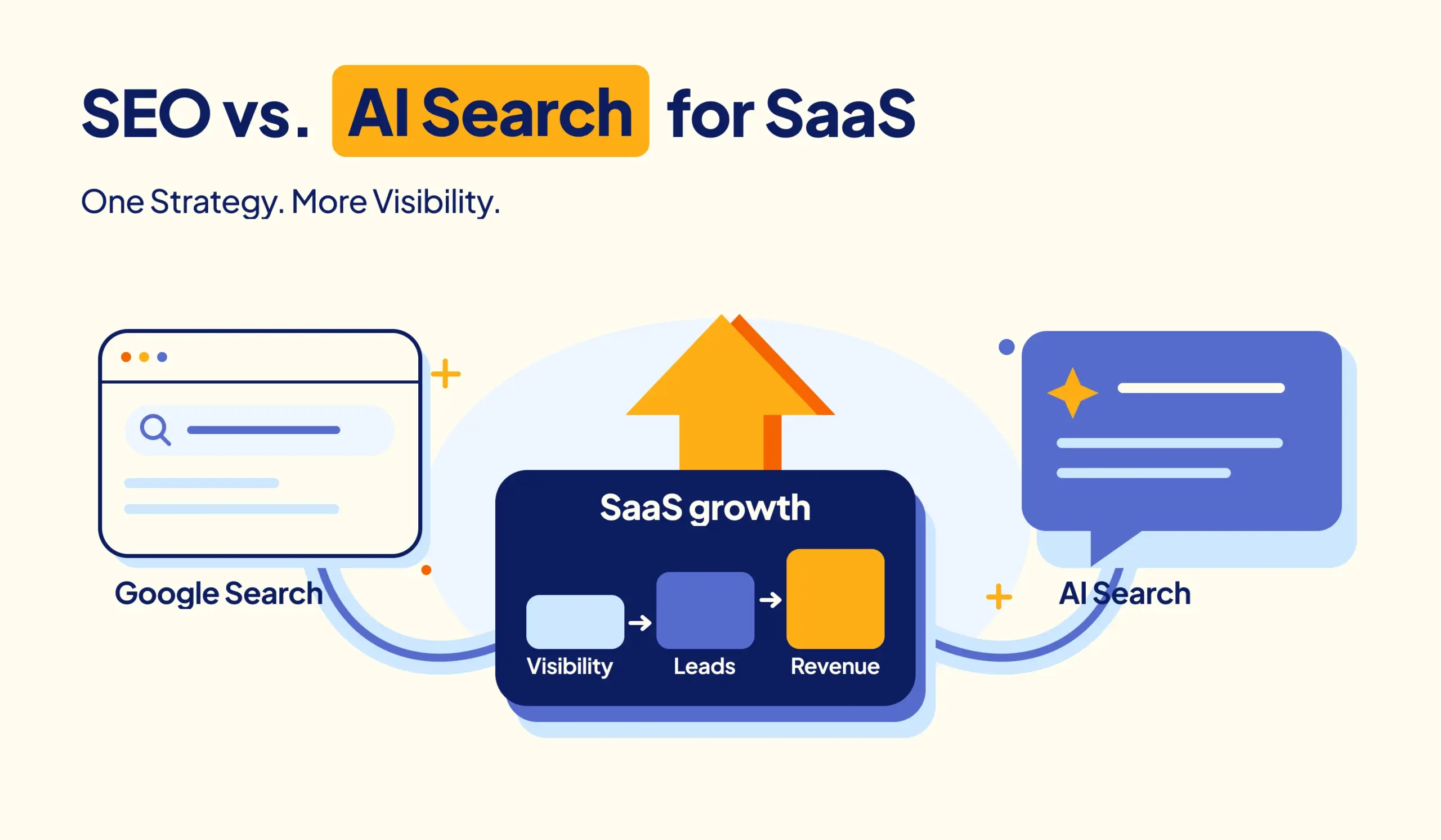
For SaaS companies, SEO vs. AI search is becoming the wrong question. Your buyers aren’t choosing between Google and AI assistants. They’re using both.
A prospect might discover a problem through Google, ask ChatGPT to compare solutions, check product reviews, and visit your website before requesting a demo.
If your marketing strategy measures only rankings and traffic, you may miss important parts of that journey. But that doesn’t mean you need to replace SEO with an entirely separate AI optimization program.
Google confirms that its AI Overviews and AI Mode follow established SEO fundamentals. Standalone assistants introduce additional discovery and measurement considerations, but the underlying objective remains the same: help the right buyers find credible, useful information about your product.
The bigger challenge for SaaS teams isn’t choosing between SEO and AI search. It’s connecting both to qualified pipeline.
What the SEO vs. AI search debate gets wrong
SEO and AI search are often treated as competing strategies, leading SaaS teams to invest in separate tools and content programs instead of fixing existing growth gaps.
In reality, they work together:
- SEO: Helps your content appear in search results.
- AEO: Makes information clear and easy to answer.
- GEO: Improves content visibility across AI-generated answers.
Google’s official guidance confirms that AI Overviews and AI Mode follow existing SEO best practices without requiring special optimization.
For example, a SaaS comparison page needs strong search visibility, clear product information, and credible evidence to support buyer decisions across search experiences.
At Right Left Agency, we connect SEO, AEO, and GEO to qualified pipeline, not just visibility.
Instead of creating more content, we prioritize improving commercial pages, product messaging, and conversion paths that turn interested buyers into demo requests.
What actually changed, and what didn’t
SEO fundamentals remain the same, but AI search is changing how buyers find and consume information.
Unlike traditional search, AI-powered search can summarize answers and compare products without users visiting multiple websites.
A 2025 Pew Research Center study found that users clicked traditional search results in 8% of visits with AI summaries, compared with 15% without them.
Similarly, a 2026 Ahrefs study found that AI Overviews correlated with a 58% lower click-through rate for top-ranking informational results compared with estimated performance without AI Overviews.
These findings don’t mean every SaaS website will lose traffic, but they show why rankings and clicks alone no longer tell the full story.
Consider two hypothetical SaaS websites:
- Website A: 15,000 monthly organic visits generating 20 qualified demos.
- Website B: 8,000 monthly organic visits generating 45 qualified demos.
Website B attracts less traffic but generates more qualified opportunities.
At Right Left Agency, we focus on what matters beyond visibility: attracting the right buyers and turning organic traffic into qualified pipeline.
One index, three answer surfaces: the model that replaces the binary
A useful way to organize SaaS search strategy is to examine three connected discovery surfaces. They share many optimization fundamentals, but they do not rely on one universal index.
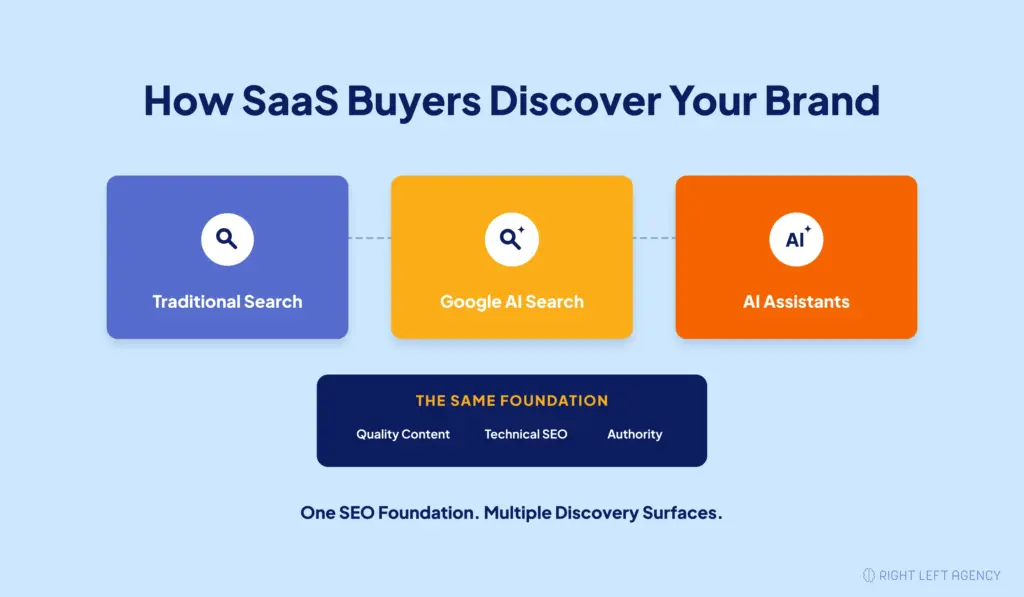
1. Traditional organic search
Traditional search remains an important source of website traffic and buyer discovery. Search engines crawl and index eligible content, then rank pages according to their search systems.
Technical SEO, search intent, content quality, internal linking, and website experience remain important.
For SaaS companies, this includes ensuring that product, solution, integration, comparison, and pricing pages are accessible and aligned with relevant buyer questions.
2. Google’s AI Overviews and AI Mode
Google’s AI features operate within Google Search.
Google explains that AI Overviews and AI Mode may use query fan-out, exploring multiple related searches to develop an answer.
For example, a buyer searching for enterprise project management software may also need information about:
- Security and compliance.
- Pricing and contract requirements.
- Integrations with existing systems.
- Implementation timelines.
- Alternatives and product limitations.
These subjects often influence the same purchasing decision.
A SaaS website that answers these connected questions with useful, accurate information can support different stages of buyer research.
3. Standalone AI assistants
ChatGPT, Copilot, Perplexity, and Gemini provide additional environments where buyers research products.
Depending on the assistant, its configuration, and the question being asked, information may come from web search, platform-specific retrieval systems, or other sources.
Visibility in Google does not automatically guarantee that a page will be retrieved or cited by another assistant.
That’s why cross-platform checks matter.
| Factor | Google AI Overviews / AI Mode | ChatGPT & Copilot | Perplexity |
|---|---|---|---|
| Discovery | Google Search infrastructure | Platform-specific search and retrieval | Web search and retrieval systems |
| Technical foundation | Google indexation and snippet eligibility | Accessible content and supported retrieval paths | Accessible, retrievable content |
| Content priorities | Helpful answers, relevance, accuracy | Clear explanations and trustworthy information | Relevant, reliable information |
| Measurement | Search Console reporting | Citation checks and referral analytics | Citation checks and referral analytics |
| SaaS opportunity | Capture connected buyer questions | Support product research and comparisons | Provide useful information for vendor evaluation |
The practical lesson is that SaaS companies should maintain one consistent product-information foundation while monitoring how their brand appears across different discovery experiences.
Why assistants reward authority, not just rankings
SaaS buyers discover products through search engines, AI assistants, reviews, comparison sites, and industry publications. This makes credible brand information important beyond Google rankings.
AI assistants use different retrieval systems, and no single ranking formula determines which brands they cite. The best approach is to publish accurate, useful information across relevant sources.
For example, a financial reporting SaaS should clearly explain its integrations, security, implementation process, features, and competitive differences. Without these details, buyers may struggle to evaluate the product.
Right Left Agency’s approach: Audit the evidence behind the visibility.
We recommend evaluating four areas:
- Search coverage: Does your brand appear for relevant buyer searches?
- Answer quality: Do your pages clearly explain your product and its value?
- Brand visibility: Is your SaaS mentioned across relevant AI assistants and industry sources?
- Conversion readiness: Can interested buyers easily request a demo or start a trial?
The goal is to identify what’s limiting qualified leads, not simply increase content volume.
Your SaaS may not need fifty new articles. It may need five stronger commercial pages that help buyers make confident decisions.
What to keep doing for SaaS SEO
Most established SaaS SEO practices remain relevant in an AI-powered search environment.
Google continues to emphasize technical accessibility, helpful content, accurate information, and a positive website experience.
Keep prioritizing:
- Technical accessibility: Ensure important pages can be crawled, rendered, and indexed.
- Search intent: Align content with the problems and questions your ideal customers are trying to solve.
- Original expertise: Include genuine product knowledge, useful examples, research, and accurate supporting evidence.
- Internal linking: Connect informational resources with relevant product, solution, comparison, and conversion pages.
- Structured data: Use appropriate supported markup that accurately reflects visible page content.
- Website experience: Make pages accessible, mobile-friendly, and easy to navigate.
- Content maintenance: Update important product facts, integrations, pricing information, and outdated explanations.
Google does not require special AI schema or an llms.txt file for eligibility in AI Overviews and AI Mode.
For SaaS teams, the most valuable opportunities frequently sit within existing content. An outdated integration page may create uncertainty for a technical buyer.
A vague product comparison may fail to explain what makes one solution more suitable than another. A high-traffic article may answer an informational question but provide no relevant next step.
These are problems that SEO, content strategy, product marketing, and conversion optimization can address together.
Our enterprise SaaS SEO strategies guide explores how search architecture, commercial content, and technical improvements can support larger SaaS growth programs.
What to actually change for SaaS
You don’t need a separate AI SEO strategy. Focus on improving search visibility, buyer experience, and conversions.
1. Lead with the answer
Make important information easy to find. Use clear headings, direct answers, and supporting evidence.
For product and comparison pages, explain what your software does, who it’s for, and why it matters. Help buyers evaluate your solution quickly.
2. Build earned authority off-site
Strengthen your brand through industry publications, expert contributions, customer reviews, and independent product coverage.
Prioritize relevant, credible mentions over volume. Genuine customer experiences build more trust than generic promotions.
3. Prioritize queries where being the answer pays
Not every keyword drives business value. At Right Left Agency, we recommend prioritizing SaaS pages using four factors:
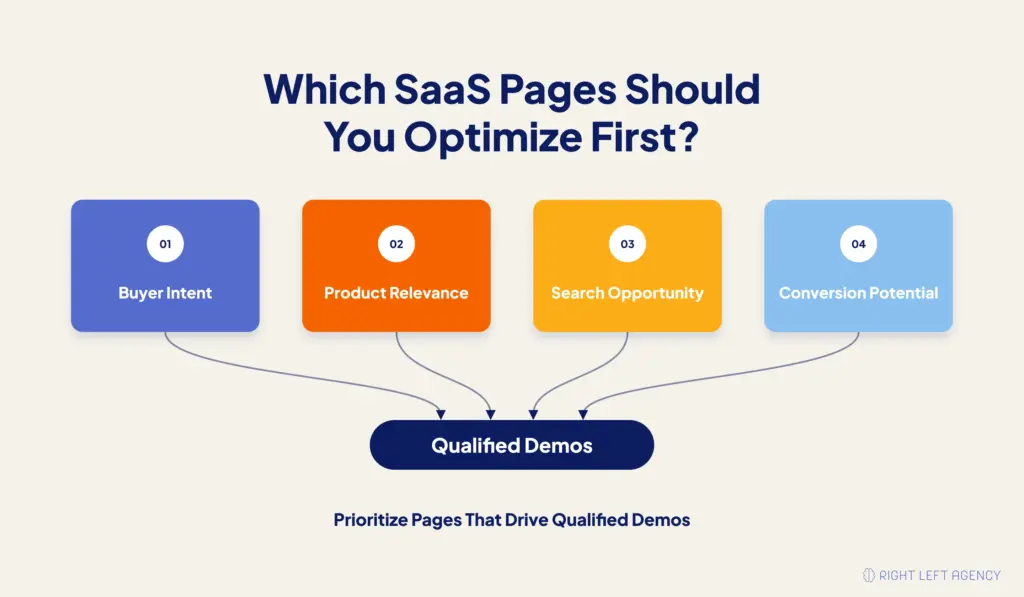
| Priority factor | What to evaluate |
|---|---|
| Buyer intent | Is the visitor ready to evaluate or buy? |
| Product relevance | Does the page address a problem your product solves? |
| Search opportunity | Is there relevant demand or a content gap? |
| Conversion potential | Can the page generate qualified demos or trials? |
For example, “best compliance management software for healthcare” may attract buyers closer to a decision than “what is compliance management?”
Prioritize pages in this order when supported by demand and conversion data:
- Product and solution pages.
- Comparison and alternative pages.
- Integration and industry-specific pages.
- Pricing and implementation resources.
- Supporting informational content.
Focus on pages that attract qualified buyers and move them toward a purchase decision.
4. Cover your category across engines
Use Google Search Console and Bing Webmaster Tools to check indexing, crawlability, and search performance.
Test relevant buyer questions across AI assistants to identify missing brand mentions, inaccurate information, and content gaps.
Focus on improving useful information rather than chasing guaranteed AI citations.
Paid acquisition can support organic growth by capturing existing demand while SEO visibility develops.
The goal is simple: reach qualified buyers, communicate value, and generate more sales opportunities.
How to measure SaaS AI search visibility
Rankings and organic traffic still matter. But neither metric tells you whether search visibility is helping your SaaS business grow.
A website can gain traffic without attracting qualified buyers. It can also lose informational clicks while maintaining strong commercial demand. That’s why search performance should connect visibility, buyer engagement, and revenue.
At Right Left Agency, we organize this thinking around three connected measurement layers.
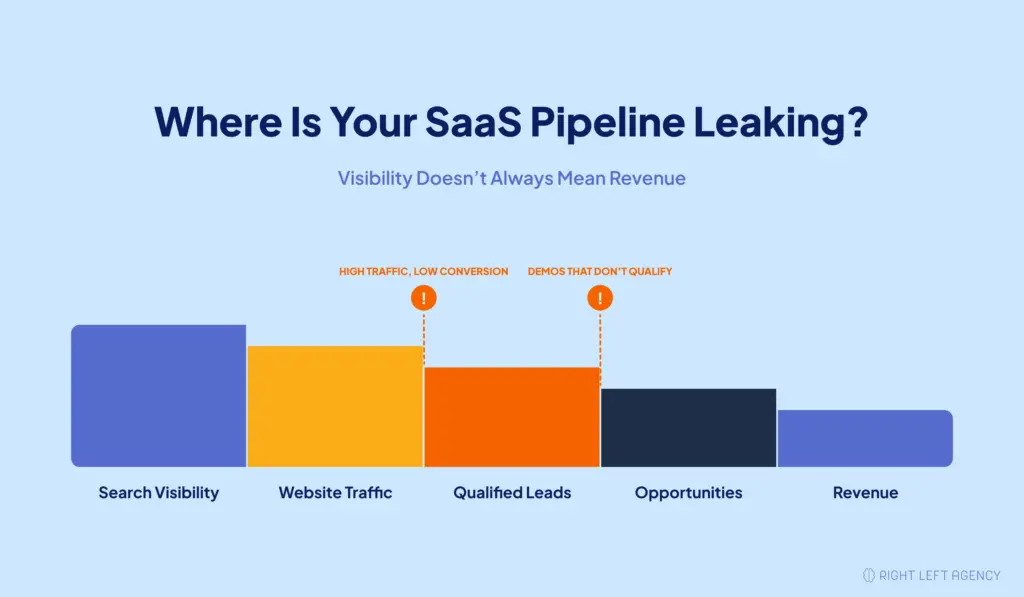
1. Search and AI visibility
Use Google Search Console and Bing Webmaster Tools to monitor traditional search performance and available AI visibility data.
Google introduced generative AI performance reporting in 2026, while Bing added AI citation insights. Since their metrics differ, evaluate each separately.
For SaaS, track:
- Visibility for high-intent commercial queries.
- Performance of product and comparison pages.
- Branded and non-branded search demand.
- AI citations and content discovery issues.
2. Brand mentions and citations
Monitor how your SaaS brand appears across ChatGPT, Perplexity, Copilot, and other relevant AI assistants.
Test consistent buyer questions about software recommendations, integrations, pricing, and competitors.
Track brand mentions, cited sources, and accuracy. Use these findings to identify visibility and content gaps, recognizing that AI responses can vary.
3. Qualified leads and pipeline
Connect GA4 and CRM data to measure how search visibility contributes to business growth.
Focus on:
- Qualified demos and trial signups.
- Sales-accepted leads.
- Demo-to-opportunity conversion.
- Opportunities, pipeline, and revenue.
AI referral traffic doesn’t capture every AI-influenced journey, so avoid attributing conversions without supporting evidence.
A practical search-to-pipeline diagnostic
| Observation | Possible problem | Next investigation |
|---|---|---|
| Organic traffic grows, demos stay flat | Content attracts the wrong intent | Review commercial query coverage and visitor journeys |
| Product pages receive traffic but few demos | Messaging or conversion friction | Audit positioning, proof, UX, and CTAs |
| Strong Google rankings but limited AI mentions | Discovery or answer-coverage gap | Review retrieval accessibility and cited sources |
| Demo requests grow, but Sales rejects more leads | Poor qualification | Compare lead sources with ICP and CRM rejection reasons |
| Branded searches rise while referrals stay low | Possible untracked brand discovery | Examine attribution and buyer research feedback |
Use these signals to investigate problems before investing in more content.
Connect SEO reporting with how Sales evaluates lead quality.
The goal is to measure how search visibility contributes to qualified leads, pipeline, and revenue—not traffic alone.
Where this leaves your SaaS growth strategy
SEO remains essential, but rankings and traffic alone no longer define SaaS growth. The focus should be on connecting SEO, AI search visibility, and conversion optimization to qualified pipeline.
Start by auditing your five most important commercial pages:
- Do they address real buyer problems?
- Is your product value clear?
- Do they answer key purchasing questions?
- Do they provide credible proof?
- Is there a clear path to conversion?
Improving these pages may deliver more value than publishing additional low-intent content.
At Right Left Agency, we connect search visibility with the SaaS buying journey, helping brands attract qualified buyers, improve conversions, and generate measurable pipeline.
The goal is not simply to become more visible in Google or AI search. It’s to make your SaaS product easier to discover, easier to evaluate, and easier to choose.
Final Thoughts
Your SaaS website might rank for relevant keywords and still miss qualified buyers researching solutions through Google and AI assistants. Or your content might attract traffic without giving visitors a clear reason to request a demo.
Right Left Agency helps SaaS companies identify where search visibility, buyer intent, product messaging, and conversion performance are disconnected.
Our SaaS SEO services combine technical SEO, commercial content strategy, AEO/GEO readiness, and conversion optimization with a focus on qualified pipeline.
Find out where your SaaS brand is losing search visibility and which improvements could create more qualified demo opportunities.
Get My SEO & AI Visibility Review
Frequently Asked Questions
Is AI search optimization different from SEO for SaaS?
AI search optimization overlaps significantly with traditional SEO. Google’s AI Overviews and AI Mode follow established SEO best practices without requiring separate AI-specific optimizations. Standalone AI assistants use different retrieval systems, so SaaS companies should also monitor citation visibility, product information accuracy, and brand discovery across relevant platforms.
Do I need a separate GEO or AEO strategy?
Most SaaS companies benefit from integrating GEO and AEO activities into their existing SEO strategy rather than creating independent programs. Start with technical accessibility, clear answers, accurate product information, credible sources, and AI visibility measurement. Prioritize commercial pages where stronger visibility can support qualified demos and sales opportunities.
Will AI Overviews kill my SaaS organic traffic?
AI Overviews can reduce clicks on affected searches, but the impact varies by query and audience. Pew Research found traditional-result clicks in 8% of visits with an AI summary compared with 15% without one. SaaS companies should evaluate their own search performance, commercial traffic, demo conversions, and pipeline before changing their strategy.
How do I know if AI engines cite my SaaS site?
Review available Google Search Console and Bing Webmaster Tools reporting, then test a consistent set of relevant buyer questions across AI assistants. Record brand mentions, cited sources, and competitor visibility. Connect measurable AI referrals with GA4 and CRM conversion data to understand how AI-assisted discovery contributes to business outcomes.
Should I still invest in SaaS SEO in 2026?
Yes. SEO remains an important foundation for organic discovery and Google’s AI search features. For SaaS companies, the strongest opportunities often involve improving technical accessibility, buyer-intent content, product and comparison pages, and conversion paths. AI visibility monitoring should extend this work rather than replace it.