Key Takeaways
- GTM breaks when ACV and buyer complexity outgrow your marketing.
- Rising CAC can signal misalignment, not bad leads.
- Moving upmarket means marketing must support more stakeholders.
- More traffic won’t fix a broken buying journey.
- Align positioning, content, channels, conversion, and attribution with your GTM.
Your lead volume looks healthy, but close rates are slipping, and customer acquisition cost keeps creeping up on the same traffic. When a SaaS GTM motion stops working, the cause is rarely the metric you’re staring at — it’s that your average contract value and your buyers have changed faster than the marketing system built to reach them. This post shows you how to spot that drift, name where you actually sit today, and realign before it quietly taxes every deal you try to close.
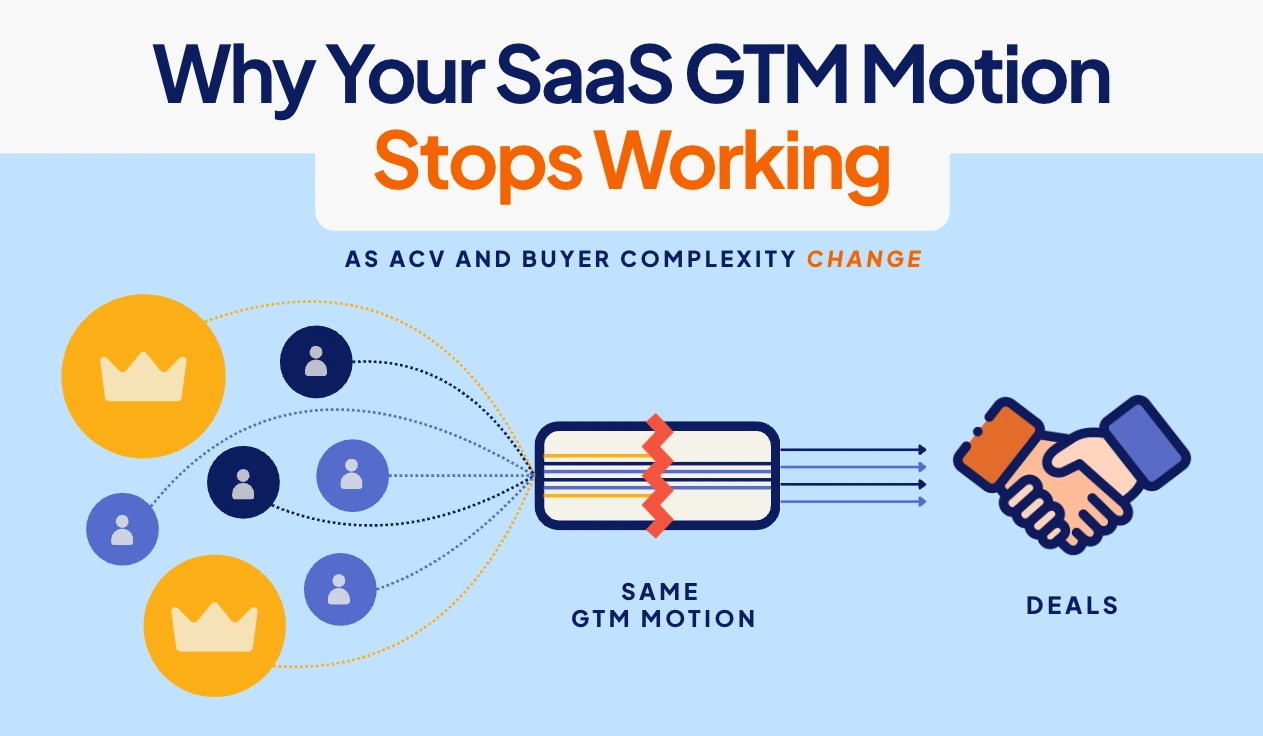
A go-to-market (GTM) motion is simply the repeatable way you turn interest into revenue: product-led self-serve, inbound, sales-led, or account-based. You picked yours early, when it fit your price point and your buyer. The problem is that the motion stays fixed while the business moves underneath it.
As your SaaS business grows, that motion needs to evolve with your ACV, buyer complexity, and sales process. That alignment is a core part of effective SaaS growth marketing.
The symptoms founders misread
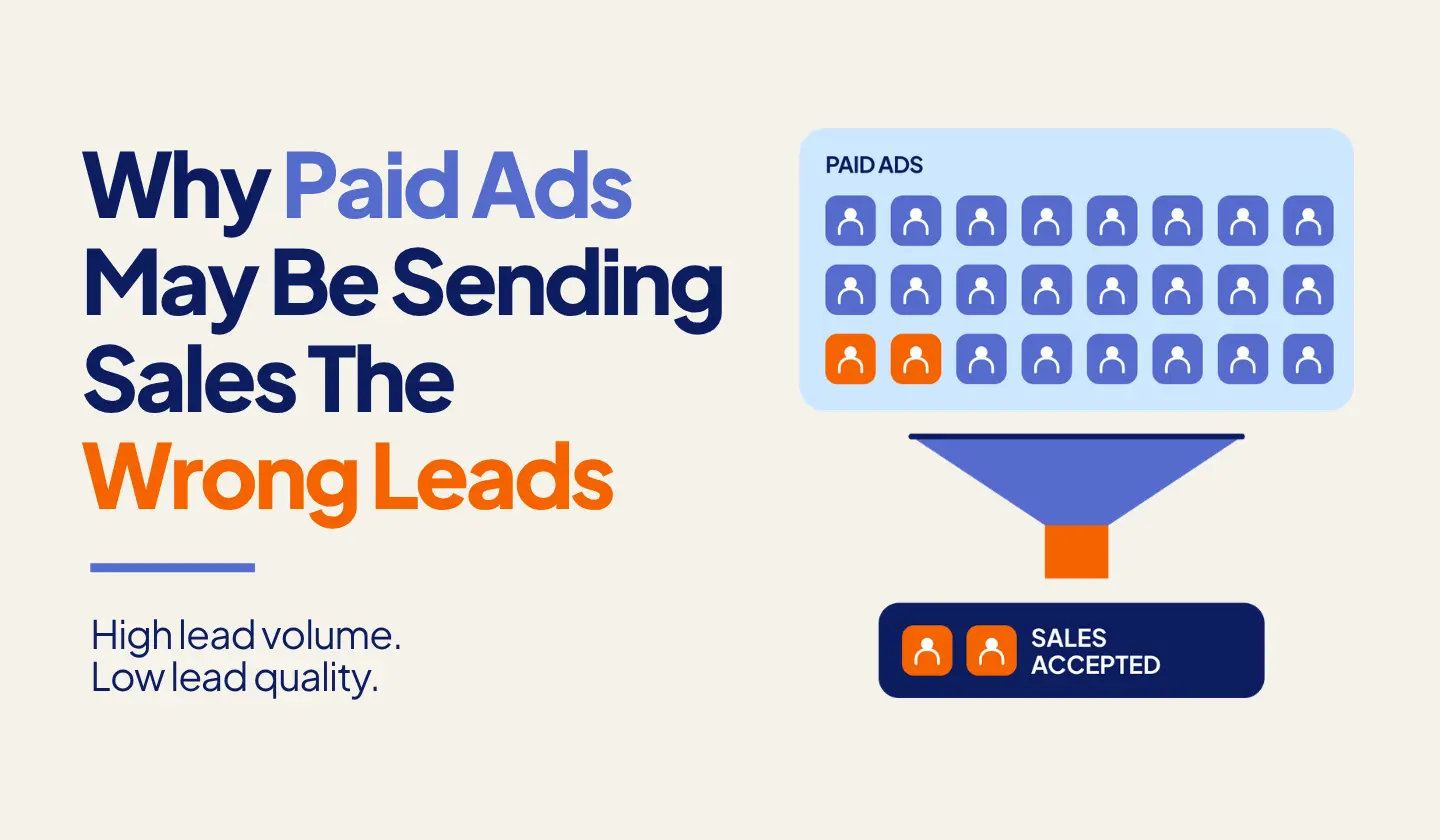
The first warning signs usually appear in your marketing metrics. CAC starts rising, good-fit leads stall after demos, and sales cycles get longer. These often look like traffic or lead-quality problems, but the real issue may be that your GTM motion no longer matches how customers buy.
The pattern is easy to miss. Demo volume stays steady, but fewer opportunities turn into customers. Sales starts questioning lead quality, while marketing responds by generating more top-of-funnel demand.
That can make the problem worse.
If the buying process has changed, more traffic only sends more prospects into the same misaligned funnel. The metrics are not the root cause. They are signals that your marketing system may have fallen behind your buyer.
Why “lead quality” is usually the wrong diagnosis
When sales says the leads are bad, the instinct is to tighten targeting or buy more pipeline. That rarely helps, because the leak is downstream of the click. The people filling out your form may be a genuinely strong fit — they’re just evaluating you in a way your marketing no longer accounts for.
A single buyer who could trial your product and decide alone has been replaced by a group that needs business cases, security review, and internal consensus. If your site still speaks to one person making a fast decision, your “qualified” leads will keep stalling in a buying process your content never addresses. The fix isn’t better filtering. It’s meeting the buyer who actually shows up now.
A SaaS website conversion audit can help identify whether the breakdown happens at traffic intent, messaging, conversion, tracking, or sales handoff.
What Actually Changes as SaaS Companies Move Upmarket
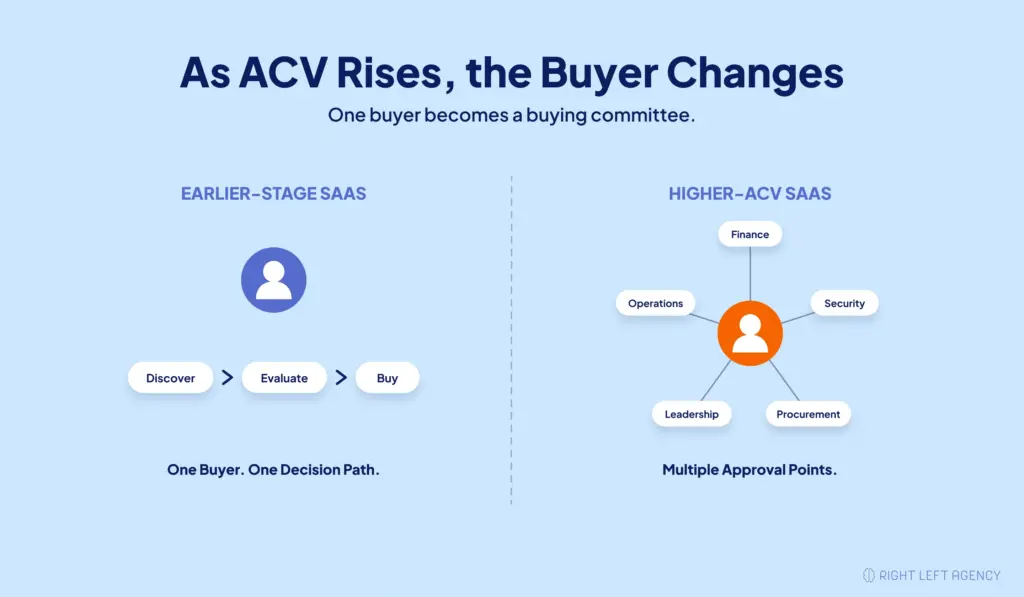
Two variables become especially important as a SaaS company evolves:
Average contract value
and
Buyer complexity.
They do not move in perfect lockstep. But as commercial stakes increase, buying processes often become more rigorous. A relatively simple purchase may involve one primary user and a manager.
A larger purchase may involve:
- A product champion
- Department leadership
- An economic buyer
- IT or security
- Procurement
- Finance
- Legal
- Executive leadership
Different stakeholders also ask different questions.
The user asks:
Will this solve my problem?
The manager asks:
Will this improve the team’s performance?
Finance asks:
Is the return worth the cost?
Security asks:
Can we safely approve this?
Leadership asks:
Why should we prioritize this now?
Marketing therefore has a bigger job than attracting the original champion. It has to help the buying group build enough confidence to move forward.
Gartner describes complex B2B purchasing as a nonlinear process involving multiple buying tasks, including problem identification, solution exploration, requirements building, supplier selection, validation, and consensus creation.
That has major implications for SaaS marketing.
Your website, content, positioning, conversion paths, sales enablement, and measurement system all need to evolve with the buyer.
The RLA GTM Motion–Marketing Fit Model
One way to diagnose this problem is to look at two variables together:
Deal value and buyer complexity.
Plot them against each other, and four broad GTM environments emerge.
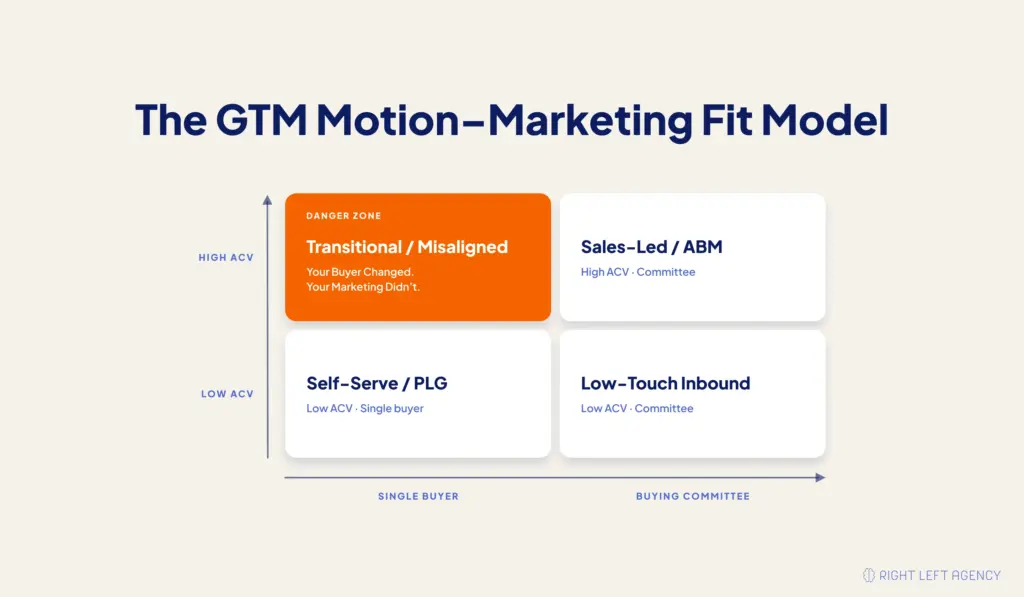
Self-serve / PLG (low ACV, single buyer). Product-led growth, where the product itself drives signups and conversion. Marketing’s job is activation, product-led content, and self-serve conversion. Success is signups and activation rate, not sales-qualified leads.
Low-touch inbound (low ACV, small committee). Volume demand capture with fast qualification and light sales assist. Speed-to-lead matters more than deep nurture.
Sales-led / ABM (high ACV, committee). Account-based marketing (ABM) targets specific accounts rather than casting wide. Here marketing owns positioning, bottom-of-funnel and comparison content, intent plus account targeting, committee-ready conversion paths, and multi-touch attribution across a long cycle.
Unstable/transitional (high ACV, single buyer). This is the danger zone, and it’s where most drift lives. You’ve moved upmarket, and your deals have grown, but your marketing still treats each one like a single, fast buyer. CAC rises on the same traffic, and your best-fit leads stall. If any section of this post feels uncomfortably familiar, you’re probably sitting here.
Spend your attention on that transitional quadrant. It’s the most common place for a growing SaaS company to get stuck, and it’s the gap between the motion you designed and the revenue you’re now chasing.
The three dangerous transitions
Drift tends to hit at three predictable handoffs, each triggered when your deals get bigger, or your buyers get more numerous. Knowing which one you’re in tells you what to fix first.
PLG → sales-assisted
What breaks: your self-serve machine starts attracting accounts too big to buy through a credit card. These prospects want a conversation, a custom scope, and answers for stakeholders the product tour never anticipated. The marketing symptom is a growing share of “contact sales” requests that your activation-focused site handles badly — strong interest that leaks because there’s no committee-ready path behind it.
Inbound SMB → mid-market demand gen
What breaks: volume MQLs that used to close now stall, because committee buying has quietly begun. The person who fills out the form is no longer the person who decides. The symptom shows up as falling MQL-to-opportunity rates and sales complaining about “unqualified” leads that are, in fact, just early-stage committee members with no material to take back to their team.
Mid-market → enterprise / ABM
What breaks: demand capture stops being enough. At enterprise ACV, many of your best accounts aren’t searching for you yet, so pure inbound can’t reach them. You need demand creation and account targeting, not just more keywords. The symptom is a stalled logo count at the top end and a sense that your biggest opportunities never enter the funnel at all.
How to Identify Your Actual GTM Motion
Ignore the motion you designed and look at the revenue you’re actually closing. The motion that matters is the one your won deals follow, not the one on your strategy deck. Run through these quickly:
- What’s your real ACV today, versus two years ago?
- How many people typically touch a closed deal — one, or five-plus?
- Does procurement, security, or legal now enter most deals?
- How much of your revenue closes self-serve versus sales-closed?
- Has your sales cycle lengthened by weeks or months?
- Are “good-fit” leads stalling after the first conversation?
- Is CAC rising while traffic and lead volume hold flat?
If your deals are bigger and your buyers are more numerous, but your marketing still looks like the version that got you here, you’ve found your drift.
How to Realign Marketing With Your GTM Motion
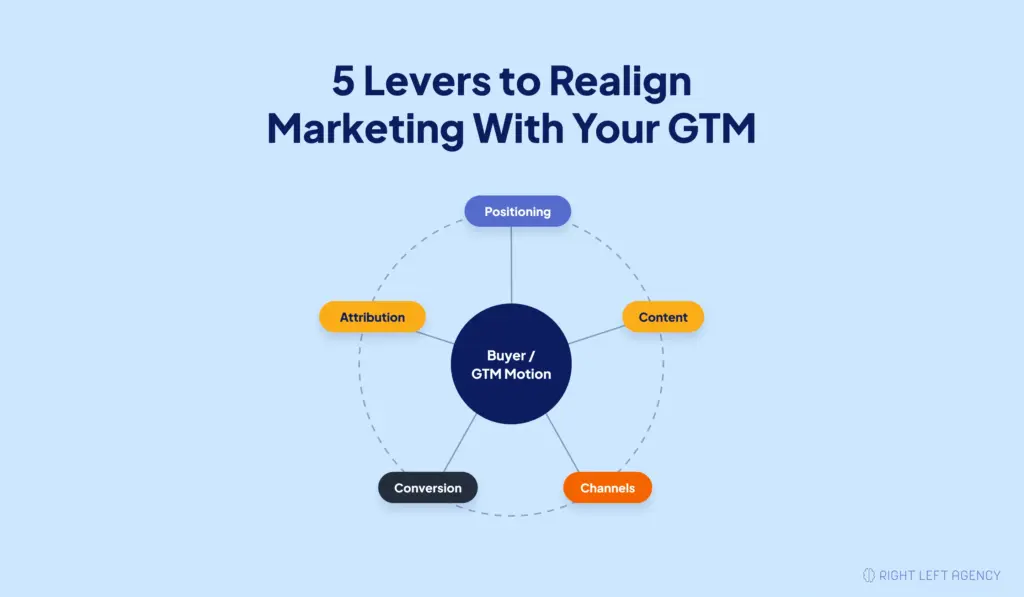
Realignment isn’t a rebrand or a bigger budget — it’s adjusting five levers until they match the buyer you now sell to. Pull them in order.
Positioning and messaging
When the committee grows, positioning breaks first. Your message has to arm a champion to sell internally and answer the economic buyer’s “why this, why now.” This is usually where SaaS positioning and branding work earns its keep.
Content type
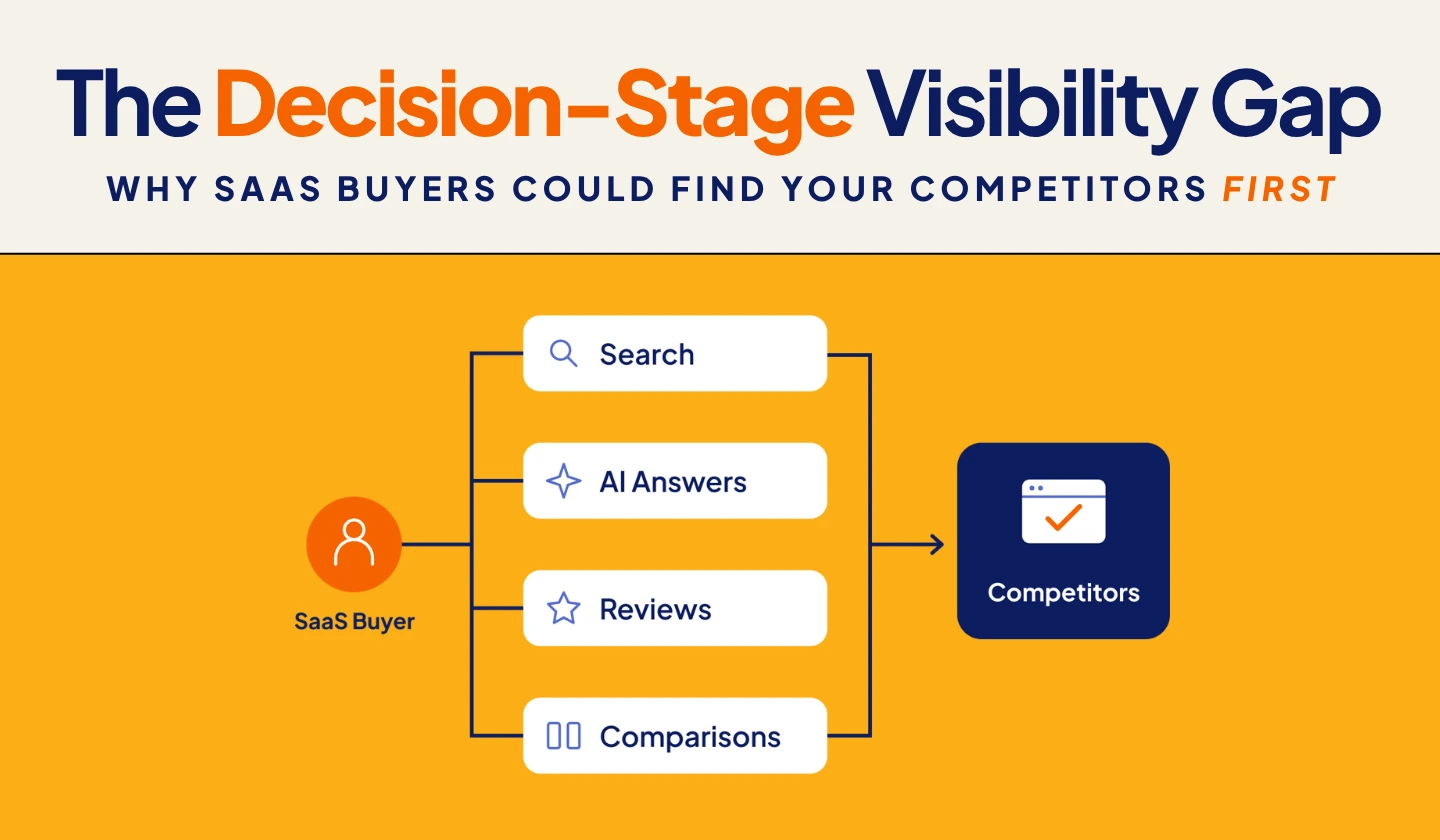
Shift the mix from top-of-funnel education toward decision-stage and comparison content that a committee actually uses — ROI cases, security and implementation detail, “us vs. the alternative” clarity.
Channel mix
Move from pure demand capture toward demand creation and account targeting as ACV rises. At enterprise scale, waiting for buyers to search for you leaves your best accounts untouched.
Conversion design
A lone demo form is built for a single buyer. Committee-ready conversion means multiple entry points, resources for different stakeholders, and paths that don’t force everyone through the same CTA. This is core conversion rate optimization territory.
Attribution window
A long, multi-stakeholder cycle makes last-touch attribution lie to you. Move to SaaS marketing attribution that credits the full path, or you’ll keep cutting the channels that actually create pipeline. Reallocating spend sensibly starts with honest SaaS marketing budget allocation.
Each lever maps to a discipline, but they move together. Fix positioning without fixing conversion, and you’ll attract the right committee only to lose them at a single-buyer form.
What GTM Realignment Looks Like in Practice
Consider a growth-stage SaaS company that originally built momentum through inbound marketing and a relatively simple sales process.
As the company moves upmarket:
- Average contract value increases
- Security reviews become common
- Procurement gets involved
- Sales cycles become longer
- More stakeholders join demonstrations
- Lead volume remains healthy
- Close rates begin falling
The obvious reaction might be to generate more leads. But if the underlying issue is GTM misalignment, more lead volume does not address it.
Instead, the company could realign the system.
Positioning
Shift from feature-heavy messaging to clearer business outcomes and organizational value.
Content
Add implementation, comparison, ROI, security, and customer-proof content.
Website
Create conversion paths for different levels of intent and different stakeholders.
Sales Enablement
Give champions material they can share internally.
Channel Strategy
Expand beyond pure demand capture into demand creation and account targeting.
Measurement
Connect marketing activity with opportunity, pipeline, and revenue data. None of these changes alone fixes the GTM system.
Together, they make the marketing experience better match the way customers actually buy.
Realign Before GTM Drift Compounds
A SaaS GTM motion doesn’t fail loudly. It drifts, quietly taxing every deal while your dashboard tells you the inputs are fine. The companies that scale cleanly notice the gap between the revenue they’re closing and the marketing system still built for an earlier buyer—and close it on purpose.
If your CAC is climbing and your best leads are stalling, the next step isn’t more traffic.
Book a Growth Fit Call and we’ll pressure-test whether your marketing system still matches the motion you’ve grown into — and show you exactly which lever to pull first.
Frequently Asked Questions
Why is my SaaS CAC rising even though traffic is stable?
Stable traffic with rising CAC can indicate a conversion, targeting, sales-process, pricing, or buyer-complexity problem. If your ACV has increased and more stakeholders are involved in purchase decisions, check whether your marketing and conversion system still supports the buying process before simply increasing acquisition spend.
How do I know if my SaaS GTM motion has stopped working?
Look for several signals occurring together: rising CAC, longer sales cycles, good-fit leads stalling, weaker demo-to-opportunity conversion, and more stakeholders joining deals. One signal alone does not prove GTM misalignment, but several appearing as your company moves upmarket deserve investigation.
Does my GTM motion need to change as ACV increases?
Not automatically, but higher-value purchases often require more evaluation, stakeholder involvement, and sales support. Many SaaS companies therefore add sales-assisted or sales-led paths while keeping self-service motions for lower-value customers.
PLG vs. sales-led: Which GTM motion is better?
Neither is universally better. PLG works well when customers can understand, adopt, and gain value from the product with minimal human assistance. Sales-led motions become more useful when contracts are larger, implementation is complex, or several stakeholders must approve the purchase.
Why did our SaaS funnel stop converting after we moved upmarket?
Your existing funnel may have been designed for a simpler buyer. Moving upmarket can introduce security, procurement, finance, executive approval, and longer evaluation cycles. If your website and content do not support those needs, strong prospects can stall even when they fit your ICP.
How does buyer complexity change SaaS marketing?
Buyer complexity expands marketing’s role. Instead of persuading one person, marketing must help several stakeholders understand the problem, evaluate the solution, assess risk, justify the investment, and reach consensus. That affects positioning, content, website conversion, channel strategy, sales enablement, and attribution.
Should we generate more leads when SaaS pipeline slows?
Not necessarily. First, determine where the pipeline is breaking. If qualified traffic is declining, acquisition may be the priority. If leads are arriving but failing to progress, the bigger opportunity may be messaging, conversion, sales handoff, buyer enablement, or GTM alignment.
What should a SaaS company measure instead of lead volume?
Track metrics closer to revenue, including qualified opportunities, MQL-to-SQL rate, opportunity conversion, pipeline generated, sales-cycle length, CAC, win rate, and closed-won revenue. Lead volume is useful, but it should not be the primary measure of growth efficiency.