

Key Takeaways
- Choose SaaS expertise over generic SEO experience.
- Measure SEO by pipeline, not just traffic and rankings.
- Ask how content and technical SEO are actually handled.
- Demand transparent reporting and realistic accountability.
- Review contract and ownership terms before signing.
Most SaaS founders and CMOs don’t get burned by a bad SEO agency in month one. They get burned in month four, after signing a 6-12 month retainer based on a polished pitch deck, when it becomes clear the agency doesn’t know what a trial funnel is, has never touched a docs site, and reports nothing more sophisticated than a traffic chart.
This is for anyone currently evaluating two or more agencies and trying to figure out which one actually understands SaaS versus which one just added the word to their homepage.
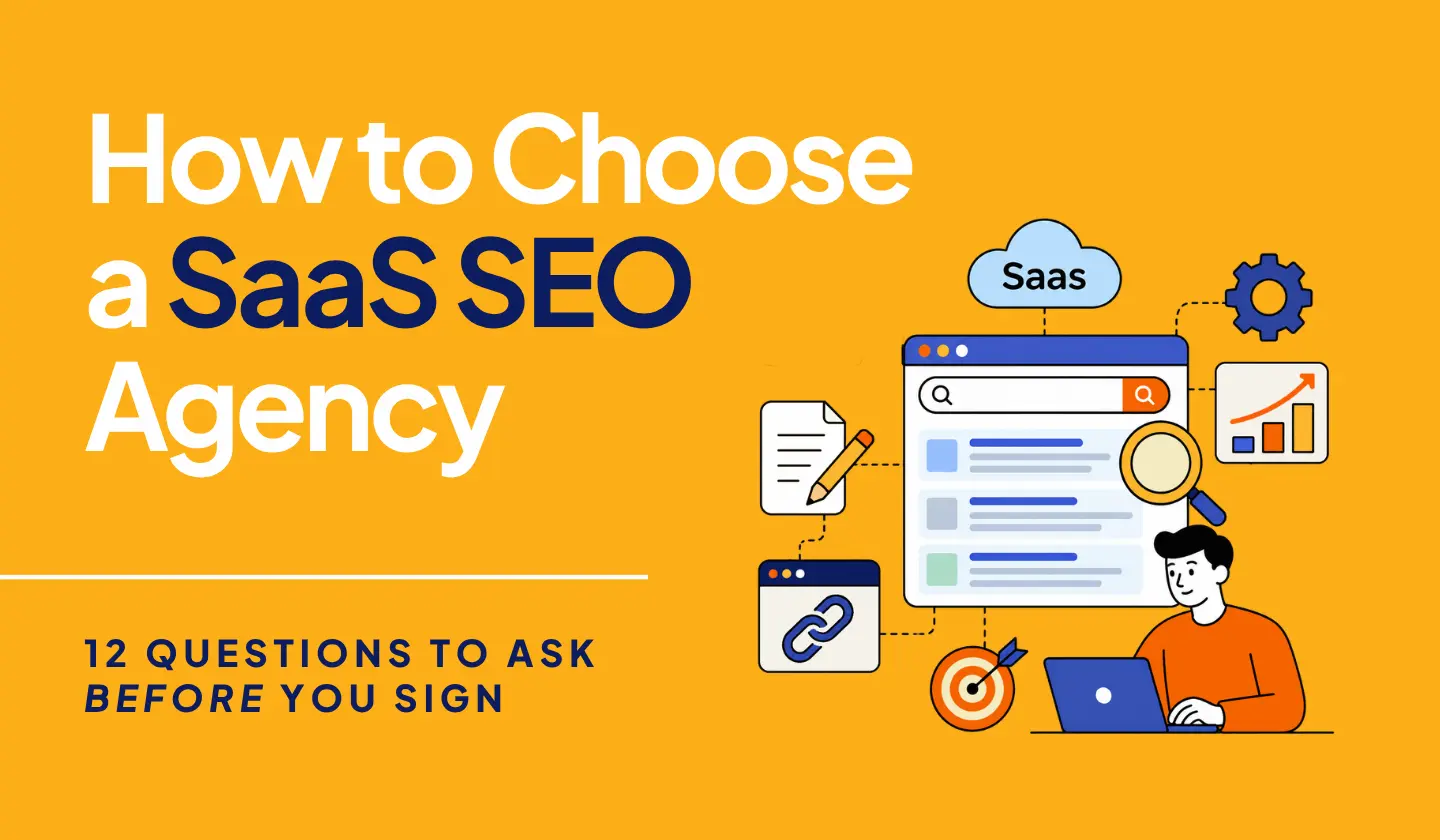
Below are 12 questions across 4 categories — specialization, methodology, reporting, and contract terms — that you can ask directly in a vendor call. A SaaS SEO agency should be vetted on SaaS-specific experience, a methodology tied to pipeline rather than rankings alone, transparent reporting, and fair contract terms — not on price or promised rankings.
Why Generalist SEO Agencies Often Fail SaaS Companies
SEO for a SaaS company isn’t the same discipline as SEO for a services business or an ecommerce store, and the gap shows up in specific places: trial and product pages that need to convert self-serve visitors, comparison and alternative pages that go up against named competitors, docs and help-center content that has its own indexation and structure problems, and the technical split between an app subdomain and the marketing site.
A generalist agency that’s mostly worked with local businesses or ecommerce brands can produce competent blog content and still have no idea how to structure a /product/vs/competitor page, or why your docs subdomain is quietly cannibalizing your marketing site in search results. This isn’t a knock on generalists — it’s just a different skill set, and most agencies that claim “SaaS experience” haven’t actually built for a product-led funnel.
That’s the pattern worth testing for before you sign anything. For a broader look at what SaaS-specific SEO actually covers, see our SEO services page.
12 Questions to Ask Before You Sign
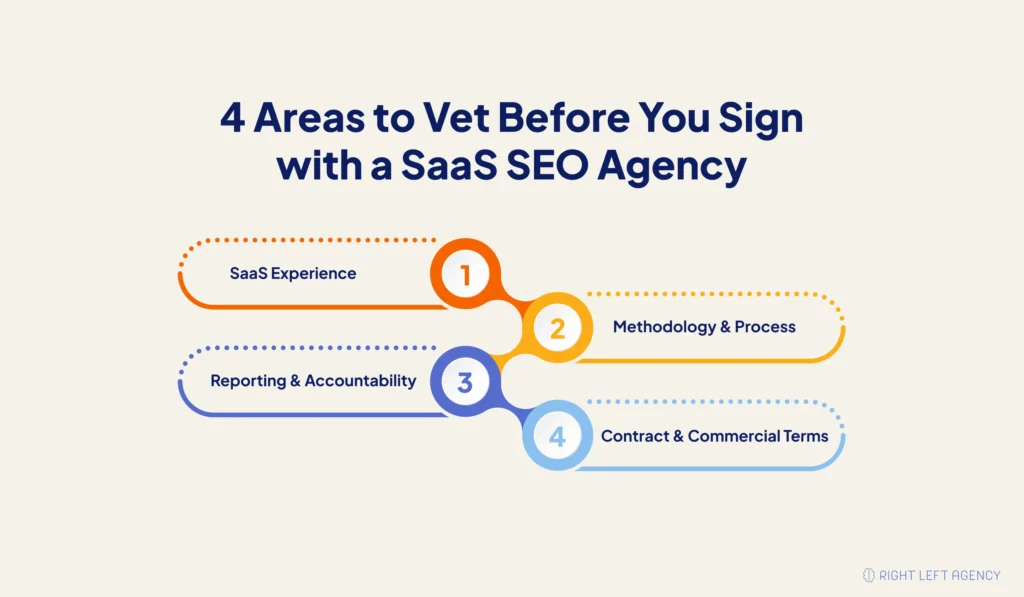
These are organized into four categories: specialization and experience, methodology and process, reporting and accountability, and commercial and contract terms. Ask all 12 in a single call if you can — the pattern across answers tells you more than any single response.
Specialization & Experience
1. How many SaaS clients have you worked with, and at what stage — early-stage, growth-stage, enterprise?
Stage matters because the problems are different. An agency that’s only worked with early-stage, pre-revenue SaaS companies may not know how to operate inside an established content library or a mature technical setup. Red flag: a vague “we’ve worked with a lot of SaaS clients” with no stage breakdown. Strong answer: specific client stages named, with an explanation of how the approach changed between them.
2. Can you show a case study with a specific, verifiable outcome — not just a traffic screenshot?
Traffic is the easiest metric to inflate and the least connected to revenue. Red flag: a case study that stops at “traffic increased X%” with no mention of what that traffic did — trials, demos, pipeline. Strong answer: a named result tied to a business outcome, with the agency able to walk through how they got there.
3. Do you understand product-led growth SEO, or only traditional B2B content SEO?
PLG SEO means writing for self-serve trial and freemium funnels, not just top-of-funnel education for a sales-assisted buyer. Red flag: the agency can’t articulate a difference between the two motions, or answers with generic content-marketing language. Strong answer: they ask what your activation and conversion events are before answering.
Methodology & Process
4. How do you connect keyword and content work to pipeline, not just rankings?
This is the single most revealing question on the list. Red flag: the answer stops at “we track rankings and traffic in [tool].” Strong answer: they describe a specific way of tying content to trial signups, demo requests, or sales-qualified leads — even an imperfect one, as long as it’s a real attempt.
5. How do you handle SaaS-specific technical SEO — subdomains, app/marketing-site separation, JS rendering, staging vs. production indexation?
These are the technical issues that generalist agencies routinely miss because they don’t come up outside of software products. Red flag: a blank stare or a pivot back to generic technical SEO talking points (site speed, meta tags). Strong answer: they’ve clearly hit at least one of these problems before and can describe how they diagnosed it.
6. What’s your content production process — who writes, who reviews for accuracy?
SaaS content lives or dies on accuracy about the product itself. Red flag: content is produced by generalist freelancers with no subject-matter review step. Strong answer: a defined review process, ideally involving someone who understands the product or industry, not just an editor checking grammar.
7. How do you approach AI-search visibility — AI Overviews, AI Mode, LLM citation — alongside traditional SEO?
This is now a standard part of the conversation, not a niche add-on. Red flag: a claim that they “guarantee” AI citations, or an inability to name which platforms they actually monitor. Strong answer: a grounded explanation of how they structure content for citability, without overselling certainty in a space that’s still evolving.
Reporting & Accountability
8. What do you report on monthly — traffic and rankings only, or qualified leads and pipeline too?
If the answer is traffic and rankings only, that’s a structural limitation, not a reporting preference. Red flag: dashboards full of vanity metrics with no attempt at connecting to revenue. Strong answer: reporting that includes some version of qualified traffic, conversions, or pipeline influence, even if attribution isn’t perfect.
9. How do you attribute organic-sourced pipeline, and what are the limits of that attribution?
No agency has perfect attribution, and the ones that claim to are the ones to worry about. Red flag: confident claims of precise revenue attribution with no acknowledgment of multi-touch complexity. Strong answer: an honest description of their attribution model and where it breaks down.
10. What happens if targets aren’t hit in 90 or 180 days?
This tells you whether the agency has thought about accountability at all. Red flag: no defined process, or a shrug. Strong answer: a described process for diagnosing what’s not working and adjusting the approach — not a guarantee of results, since no legitimate agency can guarantee those.
Commercial & Contract Terms
11. What’s the minimum engagement length, and what are the actual termination and notice terms?
Get this in writing, not just verbally described. Red flag: vague answers about “flexibility” that don’t hold up when you ask for the actual contract language. Strong answer: clear minimum terms and a defined notice period, stated plainly.
12. Who owns the content, data, and tooling if you leave — is offboarding clean?
This is the question agencies most want to gloss over. Red flag: any hesitation about handing over full ownership of content, analytics access, or keyword research. Strong answer: a clean, stated offboarding process where you retain everything you paid for.
The 12-Question Vetting Scorecard
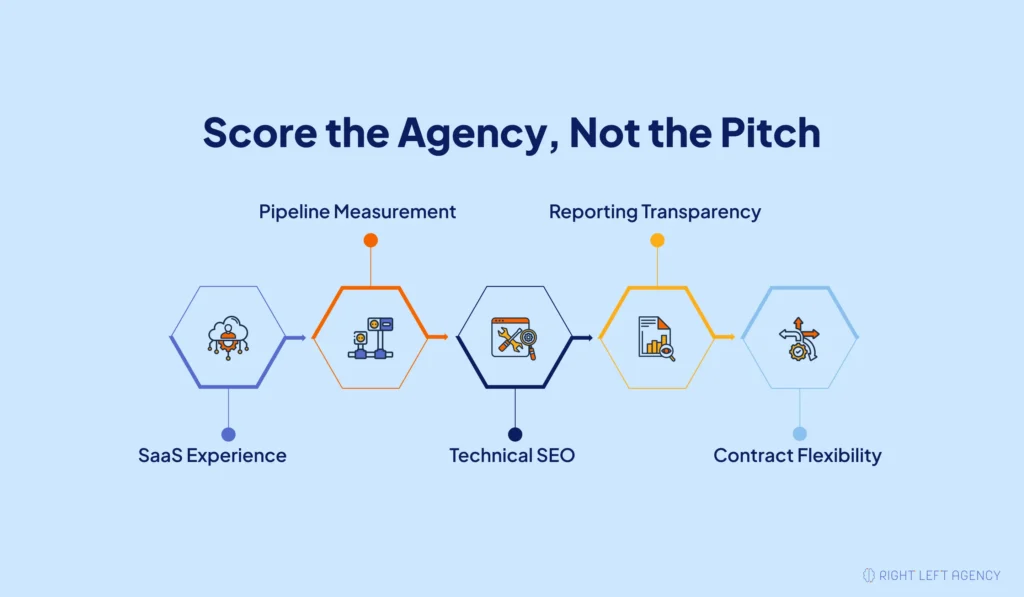
| Question | Why It Matters | Red Flag Answer | Strong Answer |
|---|---|---|---|
| SaaS client count & stage | Different stages need different approaches | Vague, no stage breakdown | Specific stages, approach explained |
| Verifiable case study | Traffic alone isn’t a business outcome | Traffic screenshot only | Named result tied to pipeline/revenue |
| PLG vs. traditional SEO | PLG needs a different content approach | Can’t distinguish the two | Asks about your activation events first |
| Content tied to pipeline | The single biggest differentiator | Stops at rankings/traffic | Specific pipeline-tracking method |
| SaaS technical SEO | Subdomains and JS rendering are common blind spots | Pivots to generic technical SEO | Concrete prior experience described |
| Content production & review | Accuracy matters more in SaaS | No subject-matter review step | Defined review process |
| AI-search approach | Now table stakes, not a niche add-on | Guarantees citations | Grounded, platform-specific answer |
| Reporting depth | Determines what you can actually manage | Traffic/rankings only | Includes qualified leads or pipeline |
| Attribution model | No agency has perfect attribution | Claims precise revenue attribution | Honest about the model’s limits |
| 90/180-day accountability | Shows if they’ve thought about it at all | No process, or a shrug | Defined diagnosis-and-adjust process |
| Contract & termination terms | Verbal flexibility isn’t contract language | Vague on actual terms | Clear minimum term, stated notice period |
| Content/data/tooling ownership | Agencies often gloss over this | Hesitation on full ownership | Clean, stated offboarding process |
Red Flags That Apply Regardless of the Answer
Some responses are disqualifying no matter how the rest of the call goes:
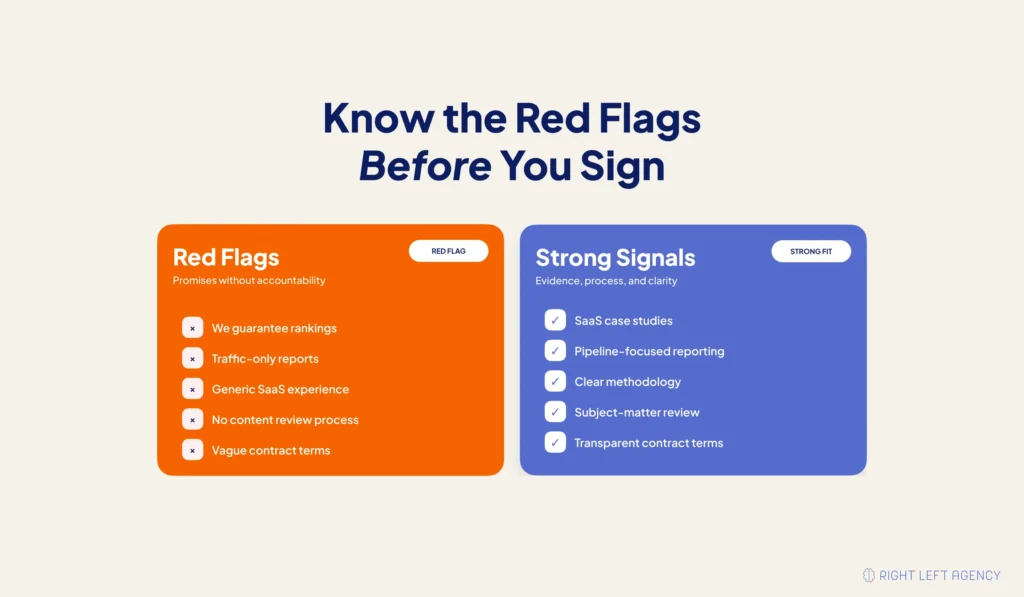
- Guarantees specific rankings or traffic numbers
- Can’t name a single SaaS client or case study
- Reporting is traffic and rankings only, with no path to pipeline
- Vague or evasive answer on contract termination terms
- Refuses to explain their content review and accuracy process
Is Right Left Agency the Right Fit?
We’re not the right fit for everyone, and we’d rather say that upfront than waste your time on a call.
Best fit: growth-stage B2B SaaS companies with existing product-market fit, who want SEO connected to pipeline and CAC rather than rankings for their own sake, and who are comfortable with a multi-month engagement.
Not the best fit: pre-PMF companies that need fast iteration more than a sustained SEO investment, or companies that want SEO handled fully separate from broader growth, CRO, and paid strategy.
One example of what that looks like in practice: we grew Privva’s organic traffic by 81% through consistent long-form content, on-page SEO, and a monthly newsletter — work that led Privva to expand our role into a fractional CMO engagement. See our full SaaS industry page for more on how we work with SaaS clients specifically.
If you want the complete evaluation framework — including a readiness checklist and weighted scorecard for comparing agencies side by side — that lives in our full guide to choosing a B2B SaaS SEO agency.
Conclusion
The goal of this framework isn’t to find the cheapest agency or the one with the smoothest pitch — it’s to build a defensible evaluation process you can actually stand behind. Keep the scorecard above open on your next vendor call, or send it as-is with an RFP.
Not Sure If an Agency Is Actually SaaS-Specialized?
Get a free SEO and AI Visibility Audit and see how your current setup — or a prospective agency’s plan — stacks up. From there, a Growth Fit Call is the natural next step if the audit turns up gaps worth solving together.
FAQ
What’s the difference between a general SEO agency and a SaaS SEO agency?
A SaaS SEO agency understands product-led funnels, trial and comparison pages, and the technical quirks of app-plus-marketing-site setups. A general agency applies the same playbook regardless of business model.
How long should a SaaS SEO agency contract be before you see results?
Most agencies structure initial terms around 90-180 days to allow for research and early implementation, though meaningful pipeline results typically take longer. Get the specific minimum term in writing rather than relying on a verbal estimate.
Should I ask for client references, and what should I ask them?
Yes. Ask references about responsiveness, whether the team that pitched is the team that delivered, and how the agency handled a period when results were slower than expected.
Is it a red flag if an agency guarantees rankings or traffic numbers?
Yes. No legitimate agency can guarantee search rankings, since they don’t control the algorithm or your competitors’ actions.
What’s a reasonable minimum monthly investment for SaaS SEO?
This varies widely by scope and market. For a full breakdown, see How Much Does a SaaS Marketing Agency Cost — we won’t repeat those numbers here.