

Key Takeaways
- AI search shifts SaaS SEO from ranking pages to earning mentions and citations.
- SaaS brands need clear content, robust technical SEO, and reliable third-party validation.
- Buyer prompts are as important as traditional keywords today.
- AI visibility is important for the comparison, alternative, use-case, and pricing pages.
- Measure AI search success by mentions, citations, demos, trials, and pipeline impact.
What Is AI Search Optimization for SaaS?
AI Search Optimization for SaaS is the process of making your SaaS company easier for AI search engines to understand, verify, cite, and recommend. It helps AI systems identify what your product does, who it helps, which problems it solves, and when it should appear in buyer recommendations.
This does not replace SEO. It builds on it.
Traditional SaaS SEO helps your pages rank in Google. AI search optimization helps your brand appear inside AI-generated answers, vendor shortlists, comparison summaries, and recommendation-style responses.
For SaaS companies, this matters because buyers rarely search with one simple keyword. They search by problem, use case, category, competitor, integration, pricing, and company size.
For example, a buyer may ask:
- “Best CRM for remote sales teams”
- “HubSpot alternatives for startups”
- “Best onboarding software for product-led SaaS”
- “Intercom vs Zendesk for B2B SaaS support”
- “Project management software for agencies”
- “Best analytics tool for SaaS activation tracking”
These are not just search queries. They are buying conversations.
AI Search Optimization vs. AEO vs. GEO
You may see terms like AEO and GEO when people discuss AI search.
AEO, or Answer Engine Optimization, focuses on making content easier for answer engines to extract. GEO, or Generative Engine Optimization, focuses on helping brands appear in generative AI results. AI Search Optimization combines both with technical SEO, structured content, entity consistency, third-party authority, and SaaS growth strategy.
| Term | What It Means | How It Helps SaaS Companies |
|---|---|---|
| AEO | Answer Engine Optimization | Helps content answer buyer questions clearly |
| GEO | Generative Engine Optimization | Helps brands appear in AI-generated results |
| AI Search Optimization | A broader strategy across SEO, AI visibility, authority, and measurement | Helps SaaS brands get cited, mentioned, and recommended |
In simple terms, AI Search Optimization helps AI systems connect your SaaS product with the right category, problem, buyer, use case, and competitor comparison.
Why SaaS Companies Should Care About AI Search Now
SaaS companies should care about AI search now because buyers are using AI tools earlier in the research journey. AI answers can shape vendor shortlists before buyers visit websites, talk to sales, or submit a demo form.
This creates a type of influence many teams miss.
A buyer may discover your brand in ChatGPT, compare you in Perplexity, check your reviews on G2, and then visit your website directly a few days later. In analytics, that visit may show up as direct traffic or branded search. But the first touchpoint may have happened inside an AI answer.
That is why SaaS teams need to look beyond clicks. They need to track mentions, citations, recommendations, and buyer recall.
There is also a timing advantage. If competitors already appear in review platforms, comparison pages, partner directories, and “best tools” lists, AI systems may trust them faster. Waiting too long can make it harder to catch up because your competitors may already own the prompts that matter most.
Why Traditional SaaS SEO Is No Longer Enough
Traditional SaaS SEO helps your website rank, attract traffic, and capture demand. AI search changes how buyers consume information. A buyer can now receive a complete answer, vendor shortlist, feature comparison, and recommendation without clicking through several websites.
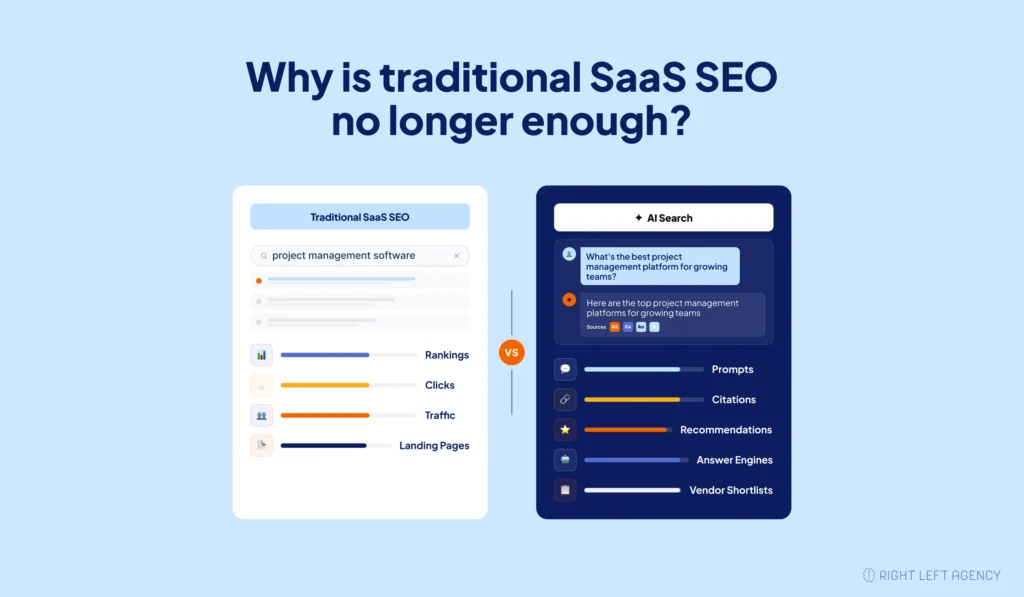
That means SaaS brands need to optimize for visibility inside the answer, not only traffic from the search result.
| Area | Traditional SaaS SEO | AI Search Optimization for SaaS |
|---|---|---|
| Main goal | Rank pages in Google | Get cited, mentioned, and recommended in AI answers |
| Main assets | Blogs and landing pages | Product pages, comparison pages, docs, reviews, FAQs, third-party mentions |
| Buyer behavior | Search keyword, click result | Ask detailed questions and receive summarized answers |
| Success metrics | Rankings, traffic, leads | AI mentions, citations, share of voice, demos, pipeline |
| Content style | Long-form SEO content | Clear, structured, answer-ready content |
A SaaS page can rank well and still miss AI visibility. This often happens when the content is vague, too generic, outdated, or weakly supported by trusted third-party sources.
AI systems need enough confidence to recommend a brand. They need to understand what your product does, who it helps, how it compares, and whether other trusted sources support your claims.
Traditional SEO helps your content get discovered. AI search optimization helps your brand become recommendable.
How AI Search Changes SaaS Buyer Behavior
AI search makes SaaS research faster, more specific, and more conversational. Instead of typing one broad keyword, buyers ask detailed questions based on their role, company size, budget, workflow, tech stack, and business goal.
A Head of Growth may ask: “What are the best tools to improve activation for a product-led SaaS company?”
A founder may ask: “What are the best affordable CRM tools for a small SaaS startup?”
A support leader may ask: “Should a B2B SaaS company choose Intercom or Zendesk?”
These prompts show strong intent. The buyer already understands the problem and wants clear direction.
AI Tools Help Buyers Build Shortlists
AI tools can narrow the market quickly. They summarize options, compare features, explain pros and cons, pull in review signals, and recommend tools for specific use cases.
That means your brand needs visibility before the buyer lands on your website. If AI tools keep recommending your competitors, those competitors earn trust earlier in the journey.
AI Search Traffic May Be Smaller but More Qualified
AI search may not always send large traffic numbers. Some buyers may see your brand in an AI answer, remember it, and later visit through direct traffic or branded search.
That makes attribution harder. But those visitors may also be more educated. They may already understand the category, know the main options, and feel closer to booking a demo or starting a trial.
| Buyer Stage | AI Prompt Example | Content You Need |
|---|---|---|
| Problem aware | “How do I reduce churn in SaaS onboarding?” | Educational guide or problem page |
| Solution aware | “Best onboarding software for SaaS startups” | Use-case page or category page |
| Evaluation | “Userpilot vs Appcues” | Comparison page |
| Decision | “Is Userpilot good for B2B SaaS onboarding?” | Case studies, reviews, pricing, and FAQs |
How AI Search Engines Decide Which SaaS Brands to Mention
AI search engines mention SaaS brands when they can clearly understand the product, verify the brand through trusted sources, and match the company to the user’s prompt. They rely on content clarity, topical authority, structured data, freshness, third-party validation, and consistent entity information across the web.
In sum, AI systems have to be confident enough to suggest your SaaS brand. They need to know what your product does, who it helps, what problem it addresses, and why it deserves to be on the buyer’s shortlist.
Clear Product Positioning
Your website should describe your goods clearly and accurately. AI systems need to swiftly figure out what your SaaS product is, who it serves, what problem it addresses, and how it is different from competitors.
A generic sentence like “We help teams work better” doesn’t give enough context. A stronger version: “Our onboarding software helps B2B SaaS teams increase activation through product tours, in-app checklists, and no-code user guidance.”
Clear positioning helps AI search engines match your product to the correct category, consumer problem, and use case.
Topical Depth and Content Coverage
AI search algorithms are looking for depth, not just surface-level content. A SaaS brand with only broad coverage may not appear in specific AI responses.
Your content needs to span the buyer path for better visibility. Category pages, use case pages, comparative pages, alternative pages, integration pages, pricing inquiries, buyer objections, and implementation guides are included.
For example, an onboarding software provider should not just post content about “user onboarding.” It should also include activation data, product tours, onboarding checklists, Appcues alternatives, onboarding software comparisons, and onboarding tools for product-led SaaS teams.
This depth helps AI systems understand your authority in the category.
Structured and Extractable Information
AI likes content that is easy to read, extract, and summarize. They find it more difficult to detect key data in long, ambiguous paragraphs.
Use headlines in the form of questions, short answer paragraphs, bullet points, comparison tables, FAQ sections, schema markup, pricing tables, feature matrices, and direct definitions.
Structured content allows AI algorithms to read your pages faster. It also helps buyers to skim the page, evaluate options, and understand your offer without friction.
Third-Party Verification
AI search engines do not simply take your word for what you say about your own products. They also consider what other reliable sources say about your brand.
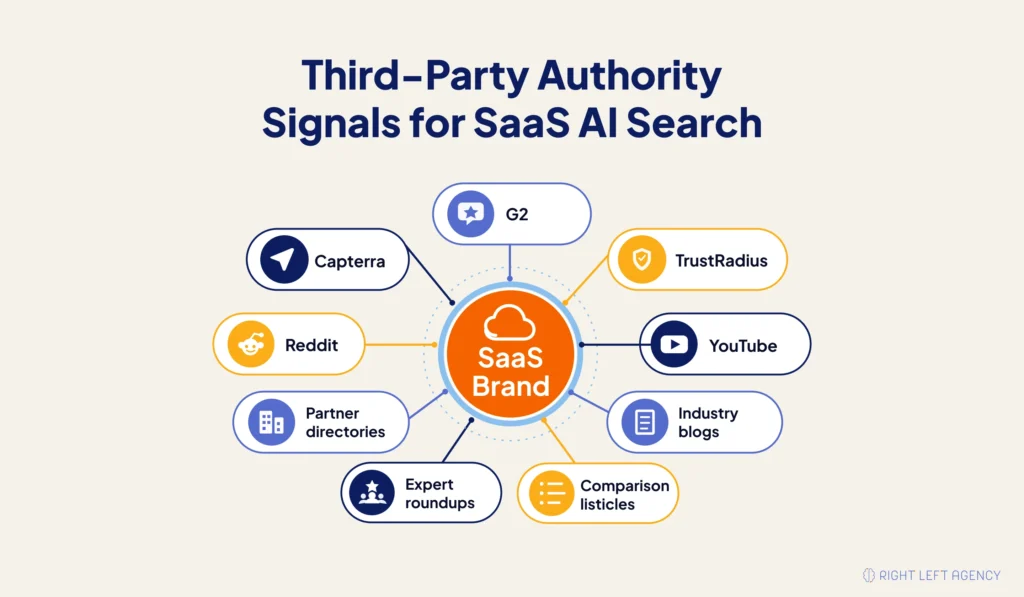
Your company’s mentions on review platforms, industry blogs, comparative listicles, Reddit debates, YouTube reviews, expert roundups, partner sites, and directories might be impacted by AI algorithms.
Build your credibility with sources like G2, Capterra, TrustRadius, Reddit, YouTube, industry blogs, and partner marketplaces. When sources speak well of your goods, AI tools have more evidence to quote or recommend your brand.
Freshness and Consistency
Information that is outdated or inconsistent can hurt AI visibility. If your price page says one thing, your G2 profile says something else, and an old article talks about features you no longer offer, AI algorithms may struggle to know which information is correct.
Ensure your product descriptions, pricing information, feature names, integration details, documentation, review profiles, and partner pages are current. AI search engines build trust in your brand by seeing consistent information across the web.
AI Search Mention Checklist
AI systems are more likely to suggest a SaaS brand when it has:
Well-defined category positioning
Crawlable pages for products
Structured feature and price information
Other pages and comparison
Reviews and citations from third parties
Uniform company facts across the web
New content, improved documentation
The louder these signals, the easier it is for AI search engines to understand, trust, and suggest your SaaS brand.
The SaaS AI Visibility Framework
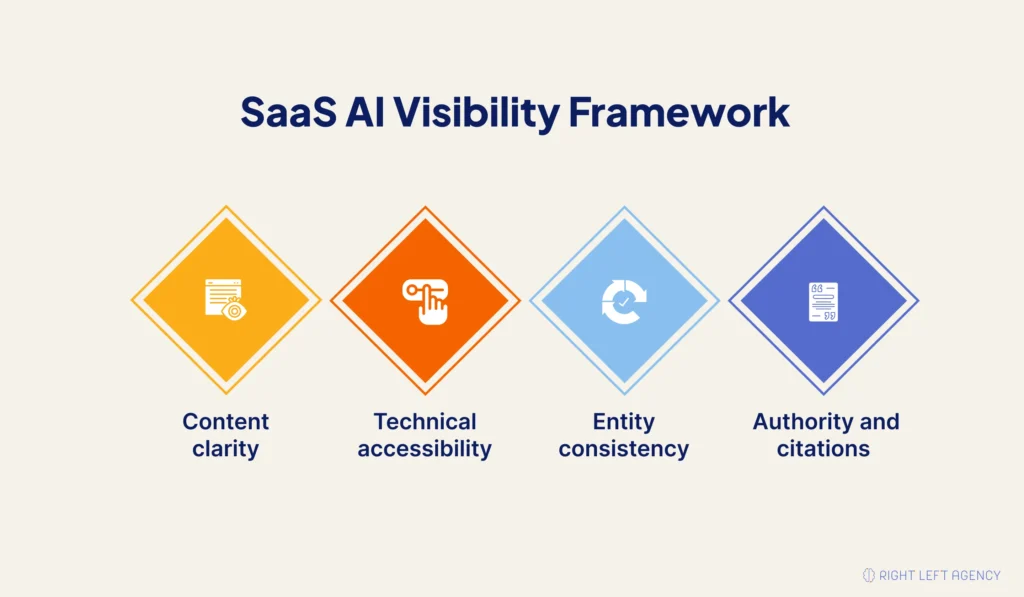
A strong AI search strategy has four layers: content clarity, technical accessibility, entity consistency, and authority. These layers help AI systems find your brand, understand your product, verify your claims, and recommend you for the right buyer prompts.
| Pillar | Goal | SaaS Example |
|---|---|---|
| Content clarity | Help AI extract useful answers | A page for “best CRM for early-stage SaaS sales teams” |
| Technical accessibility | Help crawlers access and understand pages | Clean HTML, FAQ schema, product schema |
| Entity consistency | Help AI connect your brand to the right category | Same product description across website, G2, and Crunchbase |
| Authority | Help AI trust your brand | Reviews, listicles, expert quotes, case studies |
Content Clarity
Your content should answer buyer questions directly. Each important page should include definitions, use cases, feature explanations, FAQs, comparison blocks, and buyer-focused summaries.
For example, a feature page should not only say “automated reporting.” It should explain what the feature does, who uses it, which workflow it improves, and what business outcome it supports.
Technical Accessibility
AI crawlers and search engines need clean, crawlable pages. Your website should use clear HTML, strong internal linking, structured data, fast loading times, and accessible content.
Do not hide important text inside scripts, images, broken tabs, or gated assets. If AI crawlers cannot access the content, they cannot use it.
Entity Consistency
Your brand should look consistent across the web. Your company name, product category, description, features, pricing, integrations, competitors, and use cases should align across your website, review platforms, social profiles, and partner pages.
Inconsistent information creates confusion. Consistent information builds trust.
Authority and Citations
AI systems are more likely to recommend brands that trusted sources mention. Reviews, backlinks, expert quotes, customer stories, industry publications, and third-party listicles all help build that trust.
Authority turns your brand from “another option” into a credible recommendation.
Chunk-Wise Optimization
Structure every section in small, easy-to-read content blocks so both readers and AI search engines can understand the information quickly.
Each major section should begin with a short direct answer that explains the main idea in 2–3 sentences. After that, add supporting details, SaaS-specific examples, bullet points, tables, or short explanations where needed.
A strong content chunk should include:
- A clear answer to the heading
- A short explanation of why it matters
- Practical SaaS examples
- Bullet points or tables for easy scanning
- A simple takeaway or action step
This format helps readers find answers faster. It also makes the content easier for AI tools like ChatGPT, Perplexity, Gemini, Claude, and Google AI Overviews to extract, summarize, cite, and recommend.
10 AI Search Optimization Strategies for SaaS Companies
SaaS companies can improve AI search visibility by creating answer-ready content, improving technical crawlability, strengthening product pages, building third-party authority, and tracking AI mentions and citations.
The best approach does not treat AI search as a separate trick. It connects AI visibility to demos, trials, pipeline, CAC, and revenue.
1. Audit Your Current AI Search Visibility
Start by checking whether AI platforms already mention your brand.
Test prompts across ChatGPT, Perplexity, Gemini, Claude, Bing Copilot, and Google AI Overviews. Use the same types of questions your buyers ask.
Examples include:
- “Best [category] software for [use case]”
- “Top [category] tools for [company size]”
- “[Your brand] vs [competitor]”
- “Best alternatives to [competitor]”
- “What is the best software for [job to be done]?”
Track where your brand appears, which competitors appear more often, and which sources AI platforms cite.
Do not only track by platform. Track by prompt cluster. For example, a SaaS onboarding platform may track separate prompt clusters for “best onboarding software,” “Appcues alternatives,” “product tour tools,” “activation software,” and “onboarding tools for PLG teams.”
This shows where your AI visibility is strong and where competitors control the conversation.
2. Map Buyer Prompts Across the SaaS Funnel
AI search starts with buyer prompts, not only keywords.
Map what your buyers ask at each stage of awareness. This helps your content match problem-aware, solution-aware, comparison, and decision-stage intent.
| Funnel Stage | Prompt Type | Example |
|---|---|---|
| Problem aware | Pain or problem | “How do SaaS teams reduce onboarding drop-off?” |
| Solution aware | Category or use case | “Best onboarding tools for B2B SaaS” |
| Evaluation | Comparison | “Appcues vs. Userpilot” |
| Decision | Validation | “Is Appcues worth it for startups?” |
This process helps you build content that supports the entire buyer journey.
3. Build Answer-Ready SaaS Content
Answer-ready content gives AI systems clear, factual, easy-to-use information.
Each important page should include:
- Short definitions
- Question-based headings
- Direct answer paragraphs
- Bullets
- Tables
- FAQs
- Real SaaS examples
- Clear next steps
Avoid long intros that take too long to reach the point. Buyers and AI systems both need clarity quickly.
4. Create Use-Case and Industry Pages
Use-case pages help AI tools understand when your product is a good fit.
Instead of only explaining features, show who the product helps, what workflow it improves, and what outcome it supports.
Examples include:
- “CRM for remote sales teams”
- “Project management software for agencies”
- “Customer support software for B2B SaaS”
- “Analytics platform for product-led growth teams”
- “Onboarding software for SaaS startups”
These pages help you appear for specific, high-intent prompts.
5. Create Comparison and Alternative Pages
Comparison and alternative pages help your brand appear when buyers ask AI tools to compare vendors.
These pages should be honest and useful. They should not attack competitors or read like one-sided sales copy.
Include:
- Feature comparison tables
- Pricing differences
- Integration differences
- Best-fit scenarios
- Use-case recommendations
- Pros and cons
- Clear CTAs
Comparison pages are no longer optional for SaaS AI visibility. Buyers ask AI tools about competitors, replacements, and alternatives. If you do not create useful content for those prompts, AI systems may rely on competitor pages, review sites, or third-party listicles instead.
6. Optimize Product, Feature, and Pricing Pages for AI Extraction
AI tools need clear product information to recommend your SaaS company.
Your product, feature, and pricing pages should clearly explain:
- What the product does
- Who it helps
- Which problems it solves
- Which features matter most
- How plans compare
- Which integrations are supported
- What security or compliance details matter
- What buyers should do next
Pricing pages are especially important. If your pricing is unclear, outdated, or hard to understand, both buyers and AI tools may struggle to evaluate your product.
7. Add Structured Data and Schema Markup
Structured data helps search engines understand your content more clearly.
Useful schema types for SaaS companies include:
- Article schema
- FAQPage schema
- HowTo schema
- Organization schema
- BreadcrumbList schema
- Product schema where relevant
Use the same links to connect trusted profiles such as LinkedIn, G2, Crunchbase, YouTube, Wikipedia, and partner directories when available.
Schema will not magically make your SaaS brand appear in every AI answer, but it gives search engines and AI systems cleaner signals about your content, company, product, and relationships.
8. Improve Crawlability for AI and Search Bots
AI visibility depends on whether crawlers can access and understand your content.
Review:
- Robots.txt
- XML sitemap
- Indexability
- Internal linking
- Page speed
- Server-side rendering
- Clean HTML
- JavaScript-heavy content
- Important text hidden in images
Also review how your website handles AI crawlers such as GPTBot, OAI-SearchBot, and PerplexityBot. Blocking everything without a clear strategy may limit your visibility.
9. Build Third-Party Authority and Brand Mentions
AI search engines look beyond your website. They also consider what trusted external sources say about your brand.
Focus on building and improving:
- G2 reviews
- Capterra profiles
- TrustRadius listings
- Reddit discussions
- YouTube reviews
- Industry listicles
- Partner marketplaces
- Integration directories
- Expert roundups
- Digital PR mentions
AI search favors brands with consistent public proof. Your website can explain your product, but external sources help confirm your credibility.
10. Track AI Visibility, Mentions, Citations, and Pipeline Impact
Do not measure AI search only by traffic.
Track visibility and business impact together.
| Metric | What It Shows |
|---|---|
| AI mention rate | How often AI tools mention your brand |
| Citation rate | How often AI tools cite your pages or third-party mentions |
| AI share of voice | How visible your brand is compared with competitors |
| Prompt cluster visibility | Which buyer prompt groups you own or miss |
| AI-referred traffic | Visits from AI platforms |
| Direct traffic lift | Possible brand recall after AI-assisted research |
| Demo self-attribution | Leads saying they found you through AI tools |
| Assisted pipeline | Revenue influenced by AI search visibility |
Want to know which AI prompts already mention your SaaS brand?
Get a SaaS AI Search Visibility Audit from Right Left Agency and see which competitors are being recommended instead, which sources AI tools trust, and which content, technical, or authority gaps may be costing you qualified demos.
What SaaS Pages Should You Optimize for AI Search?
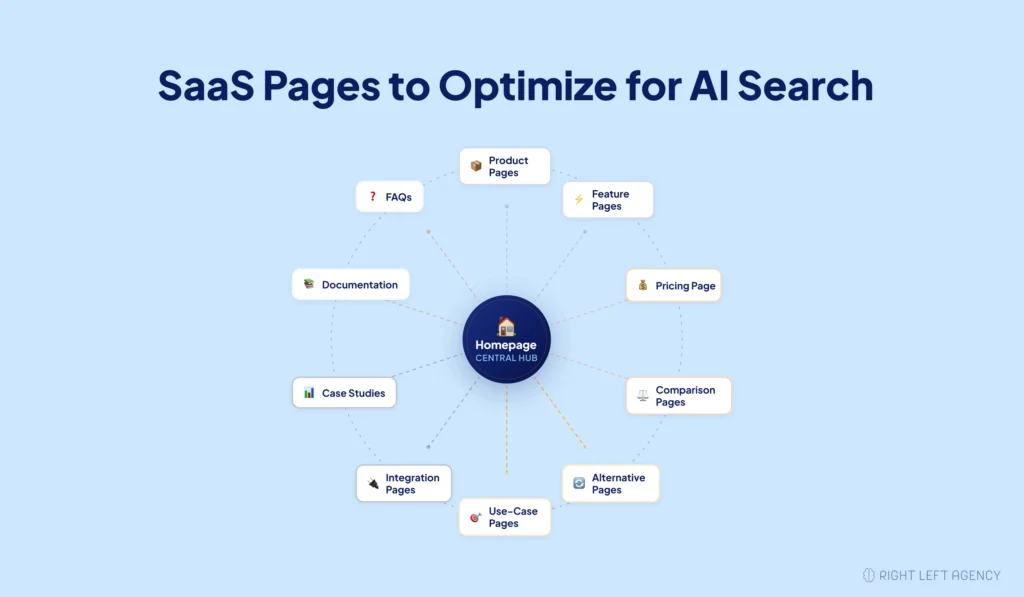
The best pages to optimize are the pages that help AI systems understand, compare, and recommend your product.
For SaaS companies, these pages usually include the homepage, product pages, feature pages, pricing page, comparison pages, alternative pages, integration pages, use-case pages, documentation, case studies, and FAQs.
| Page Type | AI Search Purpose |
|---|---|
| Homepage | Defines your company, product, category, and positioning |
| Product pages | Explains what the software does |
| Feature pages | Connects capabilities to buyer problems |
| Pricing page | Gives clear plan and cost information |
| Comparison pages | Supports vendor evaluation prompts |
| Alternative pages | Captures competitor replacement prompts |
| Integration pages | Matches tech-stack-specific prompts |
| Use-case pages | Matches role, workflow, and industry prompts |
| Case studies | Proves outcomes and credibility |
| Documentation | Gives technical clarity and implementation details |
| FAQ pages | Provides direct answers to buyer questions |
Each page should include a clear opening explanation, structured sections, practical examples, FAQs, and internal links to related pages.
How to Structure SaaS Content so AI Tools Can Use It
AI tools prefer SaaS content that is clear, factual, structured, and easy to extract.
Writers should use direct answers, question-based headings, tables, FAQs, definitions, and short summaries. Avoid vague claims, long introductions, and important information locked inside images.
Use Question-Based Headings
Question-based headings match how buyers use AI tools.
Examples include:
- “What is AI search optimization for SaaS?”
- “How does AI search affect SaaS buyer behavior?”
- “How do SaaS companies appear in ChatGPT answers?”
- “What pages should SaaS companies optimize for AI search?”
These headings make the content easier for readers and answer engines.
Add Direct Answers Below Headings
Every major section should answer the heading right away. Do not make readers wait. Start with the answer, then explain the details.
Use Tables for Important Comparisons
Tables help buyers scan information. They also help AI systems understand relationships between ideas.
Use tables for comparisons, metrics, roadmaps, feature breakdowns, prompt maps, and agency evaluation criteria.
Use FAQs for Long-Tail Prompts
FAQs help you answer specific buyer questions. They also support FAQPage schema when implemented correctly.
Keep each answer clear, direct, and useful.
Avoid Generic AI Content
Generic content is easy to summarize but hard to cite.
Your content should include original examples, real SaaS use cases, practical frameworks, and clear opinions. That is what makes it more useful to buyers and more valuable for AI search.
How to Build Topical Authority for SaaS AI Search
Topical authority helps AI systems understand that your SaaS company is a credible source in its category.
You build topical authority by covering the full buyer journey: problems, categories, use cases, comparisons, alternatives, integrations, pricing questions, and implementation questions.
A strong SaaS content cluster may include:
- AI search optimization for SaaS
- SaaS SEO strategy
- B2B SaaS content strategy
- SaaS demand generation
- Product-led SEO
- SaaS comparison page strategy
- SaaS alternative page strategy
- SaaS technical SEO
- AI visibility tracking for SaaS
- Generative Engine Optimization for SaaS
Build Clusters Around Buyer Problems
Start with the problems your buyers care about.
For example, if your SaaS product helps with customer onboarding, your content cluster may cover activation metrics, onboarding tools, product tours, churn reduction, onboarding emails, and comparisons of onboarding software.
This helps AI systems connect your brand to more buyer prompts.
Connect Content to Product Use Cases
SaaS content should educate, but it should also connect naturally to the product.
For example, an article about activation metrics should explain what activation means, how to measure it, and how your product helps teams improve it.
Keep Content Fresh
Update old product details, pricing language, comparison pages, screenshots, feature names, and statistics.
Fresh content gives buyers better information and gives AI systems cleaner signals.
How Third-Party Mentions Influence SaaS AI Search Visibility
Third-party mentions matter because AI systems often verify brand claims through external sources.
If review sites, listicles, partner pages, forums, and industry publications describe your product clearly and positively, AI tools have stronger evidence to recommend it.
Review Platforms
G2, Capterra, and TrustRadius can influence both buyers and AI systems.
Keep your profiles complete and updated. Add accurate descriptions, product screenshots, categories, integrations, and customer reviews.
Community and Forum Mentions
Reddit, niche SaaS communities, founder groups, and industry forums can shape brand perception.
Monitor what people say. Use those insights to improve messaging, documentation, support content, and objection handling.
Industry Listicles and Partner Pages
AI answers often pull from third-party “best tools” articles, partner directories, integration marketplaces, and expert roundups.
Find the sources that AI tools already cite for your target prompts. Then work on getting mentioned, improving your profile, or building partnerships with those sources.
Expert Quotes and Digital PR
Expert-led mentions help build trust.
Founder interviews, guest articles, podcast appearances, customer stories, and industry commentary can all strengthen your brand entity.
Action for SaaS teams: Search your top buyer prompts in ChatGPT, Perplexity, Gemini, Claude, and Google AI Overviews, and record which sources appear. Then prioritize outreach, profile updates, and content partnerships around those sources.
How to Measure AI Search Optimization for SaaS
SaaS companies should measure AI search with visibility, engagement, conversion, and revenue metrics.
Traditional SEO metrics still matter, but they do not show the full impact of AI-generated answers. A buyer may discover your brand through AI search, then visit later through direct traffic or branded search.
| Measurement Category | Metrics to Track | What It Shows |
| AI Visibility Metrics | Mention rate, citation rate, share of voice, prompt coverage, prompt cluster visibility, competitor visibility, platform-by-platform visibility | Shows whether your brand appears when buyers ask AI tools for recommendations. |
| Website and Analytics Metrics | AI referral traffic, direct traffic, branded search growth, organic assisted conversions, engaged sessions, demo page visits, trial signup rate | Shows how AI discovery affects website visits, user behavior, and conversion paths. |
| Revenue and Pipeline Metrics | Demo requests, trial signups, MQLs, SQLs, pipeline value, closed-won influence, self-reported attribution, CAC impact | Shows whether AI visibility is turning into qualified growth, pipeline, and revenue. |
| Attribution Signals | Direct traffic, branded search, demo self-attribution, assisted conversions, assisted pipeline | Shows the indirect impact of AI search when buyers discover your brand through AI but return later through another channel. |
| SEO Performance Metrics | Rankings, impressions, organic clicks, content engagement | Shows how traditional SEO performance supports AI search visibility and overall organic growth. |
Common AI Search Optimization Challenges for SaaS Companies
SaaS companies often struggle with AI search because their content is too generic, product information is inconsistent, key pages are hard to crawl, or third-party validation is weak.
These gaps make it harder for AI systems to understand and trust the brand.
Generic Content That Does Not Stand Out
AI tools can summarize generic content, but they need specific, useful, original information to cite. Use real examples, clear frameworks, SaaS-specific use cases, and strong product context.
Weak Comparison and Alternative Coverage
Many SaaS companies avoid competitor content, but buyers ask comparison questions, and AI tools answer them. Without comparison and alternative pages, you may lose visibility for some of the highest-intent prompts in your market.
Inconsistent Brand Information Across the Web
Different product descriptions, outdated pricing, old feature names, and incomplete review profiles create confusion. Keep your brand information consistent across your website and third-party sources.
Poor Technical Crawlability
Blocked crawlers, missing schema, weak internal links, slow pages, and JavaScript-heavy content can reduce visibility. Strong technical SEO makes your content easier to find, read, and trust.
Measurement Gaps
Many teams still track only traffic and rankings. AI search requires prompt-level tracking, citation monitoring, competitor share of voice, and pipeline impact reporting.
90-Day AI Search Optimization Roadmap for SaaS Companies
A 90-day roadmap helps SaaS teams move from research to execution.
The goal is to find where your brand is missing, fix content and technical gaps, strengthen authority, and start measuring AI visibility against business outcomes.
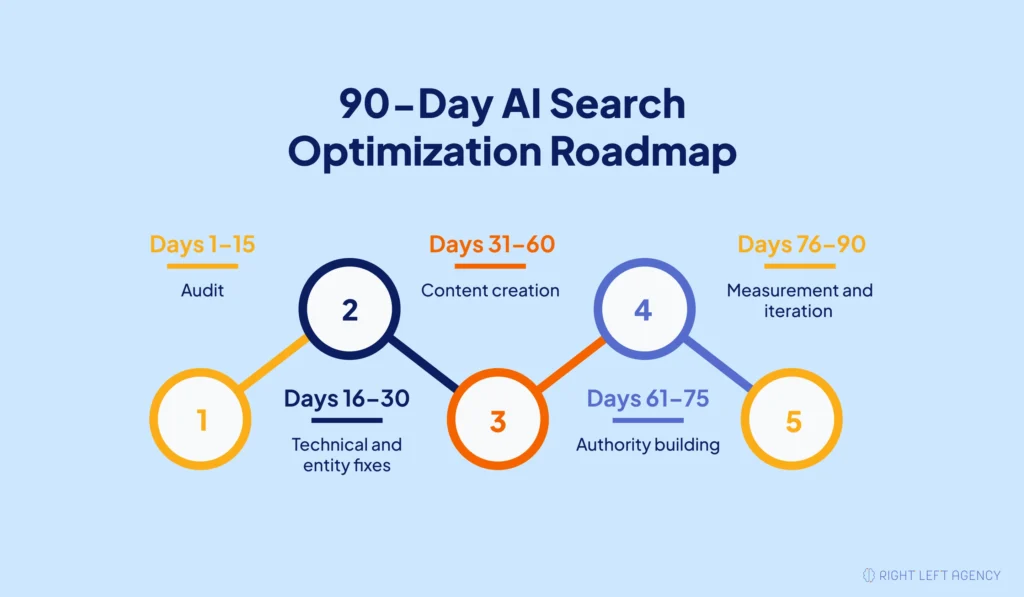
Days 1–15: AI Visibility and Prompt Audit
Test your target prompts across ChatGPT, Perplexity, Gemini, Claude, Bing Copilot, and Google AI Overviews.
Record:
- Where your brand appears
- Where competitors appear
- Which sources AI tools cite
- Which page types you are missing
- Which prompts show high buying intent
This gives you a clear starting point.
Days 16–30: Technical and Entity Issues
Review your technical foundation.
Focus on:
- Robots.txt
- Crawlability
- XML sitemap
- Schema markup
- Internal links
- Organization details
- Product descriptions
- Third-party profile consistency
This helps AI systems access your content and understand your brand correctly.
Days 31–60: Content Creation and Optimization
Build or improve high-intent pages.
Prioritize:
- Use-case pages
- Comparison pages
- Alternative pages
- Integration pages
- FAQ sections
- Product pages
- Feature pages
- Bottom-funnel guides
Each page should answer buyer questions clearly and connect naturally to your product.
Days 61–75: Authority and Citation Building
Strengthen your external trust signals.
Update:
- G2
- Capterra
- TrustRadius
- Crunchbase
- Partner profiles
- Integration directories
Then identify third-party sources that AI tools already cite and build outreach around them.
Days 76–90: Measurement and Iteration
Retest your prompts and compare results with your baseline.
Track:
- Mention rate
- Citation rate
- Share of voice
- AI referral traffic
- Direct traffic
- Branded search
- Demo requests
- Trial signups
- Pipeline influence
Use the data to decide what to fix next.
Need help finding your AI search gaps?
Right Left Agency can audit where your SaaS brand appears, where competitors are winning, and what to fix first to improve AI visibility and qualified pipeline.
What Should You Look for in an AI Search Optimization Agency for SaaS?
A SaaS AI search optimization agency should understand both AI visibility and SaaS growth.
The right agency should help you map buyer prompts, optimize content, fix technical crawlability, improve third-party authority, track AI mentions, and connect visibility gains to demos, trials, and pipeline.
| Requirement | Why It Matters |
|---|---|
| SaaS specialization | SaaS buyers search by use case, category, and competitor |
| AI visibility auditing | Shows where your brand appears or is missing |
| Technical SEO knowledge | Ensures AI crawlers can access content |
| Content strategy | Builds answer-ready SaaS assets |
| Authority building | Improves trust signals across the web |
| Revenue reporting | Connects AI visibility to demos and pipeline |
A good agency should not only publish content. It should show which prompts matter, which competitors are winning, which sources AI tools cite, and how each recommendation supports qualified growth.
When Should a SaaS Company Invest in AI Search Optimization?
A SaaS company should invest in AI search optimization when buyers already research its category, compare competitors, or ask AI tools for software recommendations.
The strategy is especially useful for B2B SaaS companies with existing SEO activity, clear positioning, and a need to improve qualified demos, trials, and pipeline.
| SaaS Stage | Main Priority |
|---|---|
| Pre-seed or seed | Clear positioning, homepage, product pages |
| Early growth | Use-case pages, FAQs, technical SEO |
| Growth-stage | Comparison pages, alternatives, review profiles |
| Scale-up | AI visibility tracking, authority building, share of voice |
| Enterprise SaaS | Category ownership, documentation, third-party citations |
Early-stage companies should focus on clarity. Growth-stage companies should focus on use cases, comparisons, authority, and measurement. Mature SaaS companies should monitor category ownership and competitive visibility inside AI-generated answers.
Final Takeaway: SaaS Companies Need to Optimize for Recommendations, Not Just Rankings
AI search is changing the game of SaaS SEO.
It’s not enough to rank for keywords and wait for buyers to click. SaaS firms must now become the go-to option in AI-generated recommendations, comparisons, and vendor shortlists.
ChatGPT, Perplexity, Gemini, Claude, Bing Copilot, and Google AI Overviews are already affecting the way customers research software. They impact which brands buyers find, trust, compare, and engage with.
Traditional SEO still matters, but SaaS companies now need a stronger strategy that includes answer-ready content, clear product pages, technical accessibility, entity consistency, third-party authority, and AI visibility measurement.
The brands that win will make it easy for both buyers and AI systems to understand why they matter.
Get Your SaaS AI Search Visibility Audit
Find out where your SaaS company appears in AI-generated answers, which competitors are being recommended instead, and what content, technical, and authority gaps may be costing you qualified demos, trials, and pipeline.
FAQs About AI Search Optimization for SaaS
How do you implement AI search optimization for SaaS?
If you want to nail AI search optimization for SaaS, then you need to assess your AI visibility, map buyer prompts, organize content with direct replies, construct comparison and use-case pages, add schema markup, increase crawlability, establish third-party mentions, and track AI citations, mentions, and pipeline impact. The idea is to get AI systems to comprehend, trust, and sell your goods.
At what stage should a SaaS company invest in AI search strategy?
A SaaS company should start investing in AI search while buyers are in the process of looking for their category, comparing alternatives, or asking AI tools for software recommendations. Clear positioning and crawlable product pages are a must-have for early-stage companies. Growth-stage teams should focus on use-case material, comparison sites, authority building, and visibility measurement.
What should I look for in an AI search agency?
Look for an agency with SaaS SEO experience, AI visibility auditing, prompt research, technical SEO knowledge, content strategy, structured data expertise, and revenue-focused reporting. The agency should show where your brand appears in AI answers, where competitors win, and which content or authority gaps affect demos, trials, and pipeline.
How do we optimize our website for AI search and ChatGPT answers?
To optimize your website for AI search and ChatGPT answers, make your product information easy to understand and verify. Clearly explain what your SaaS does, who it helps, and when it is the best fit. Add direct answers, FAQs, comparison tables, schema markup, clean HTML, and updated documentation. Also build consistent brand mentions across trusted third-party sources.
What are the most important AI search metrics for SaaS?
The most important AI search metrics for SaaS are AI mention rate, citation rate, share of voice, prompt coverage, AI-referred traffic, branded search growth, direct traffic changes, demo self-attribution, assisted conversions, and pipeline influence. These metrics show whether AI visibility is turning into business impact.
Is AI search optimization replacing traditional SEO?
AI search optimization isn’t killing traditional SEO. It adds answer-ready content, entity consistency, structured data, third-party validation, and AI visibility tracking to SEO. But SaaS companies still need technical SEO, excellent content, backlinks, and topical authority. They also need to optimize for AI-generated answers and recommendations.